


Report Overview
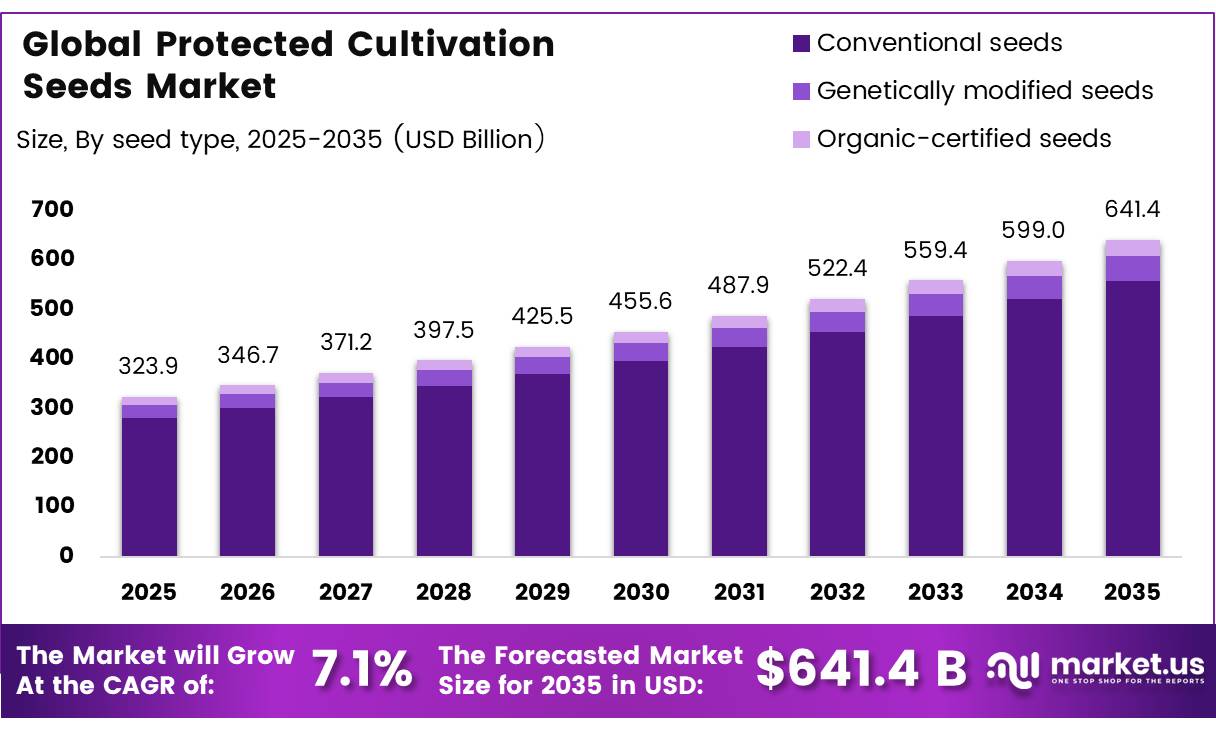
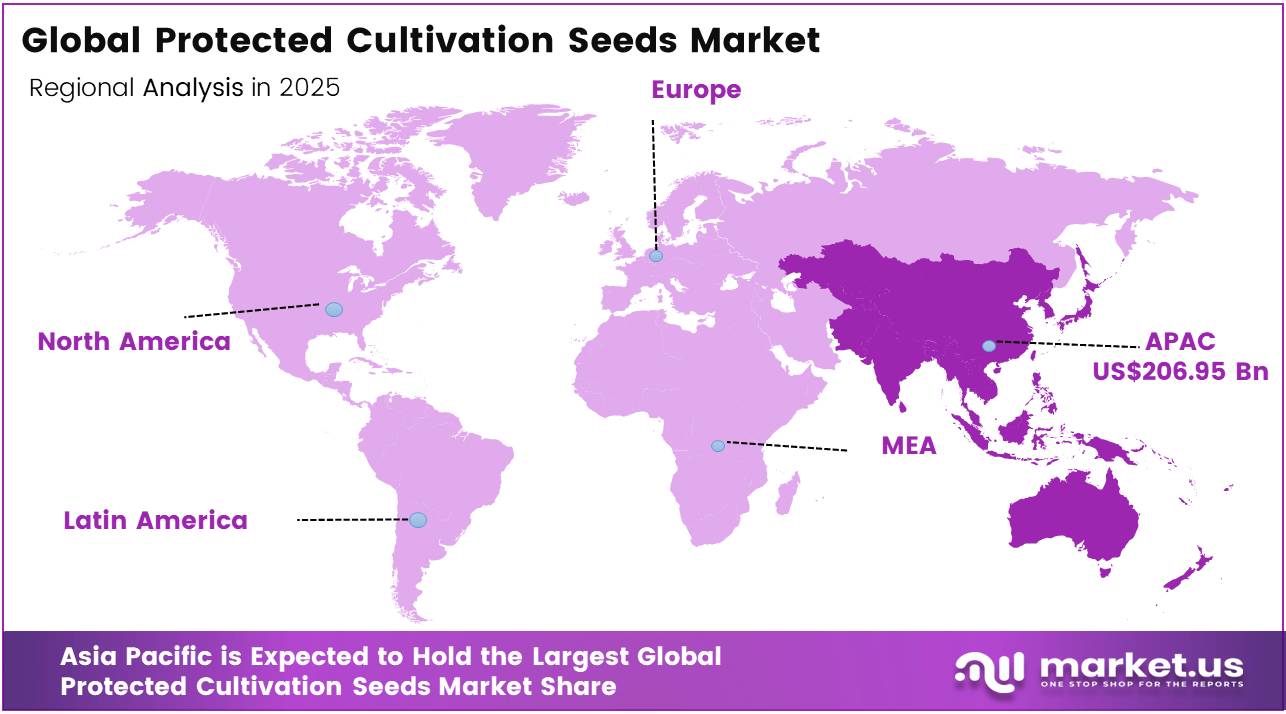
In 2025, the Global Protected Cultivation Seeds Market was valued at USD 323.9 billion, and between 2026 and 2035, this market is estimated to register a CAGR of 7.1%, reaching about USD 641.4 billion by 2035. In 2025, North America held a dominant market position, capturing more than a 63.90% share, holding USD 206.95 Billion revenue.
Protected cultivation seeds are specialized hybrids and varieties developed for greenhouses, polyhouses, tunnels, hydroponic units and other controlled production systems. Their commercial value depends on traits such as indeterminate growth, compact plant structure, uniform fruit size, extended harvesting, resistance to soil-borne and foliar diseases, and tolerance to heat, humidity or low-light conditions.
- In Canada, greenhouse vegetable and fruit sales reached CAD 3.1 billion in 2025, increasing 10.0% from the previous year. However, total greenhouse operating expenses rose 4.3% to CAD 4.2 billion, while plant-material costs increased 16.3% to CAD 759.5 million and electricity expenditure climbed 21.2% to CAD 181.9 million. These figures indicate strong crop demand but also show why growers require high-germination seeds, predictable yields and varieties capable of reducing crop losses.
Key Takeaways
- The global Protected Cultivation Seeds market was valued at USD 323.9 billion in 2025.
- The global Protected Cultivation Seeds market is projected to grow at a CAGR of 7.1% and is estimated to reach USD 641.4 billion by 2035.
- On the basis of crop family, Solanaceae Protected Cultivation Seeds dominated the market, constituting 78.3% of the total market share.
- Based on the seed type, the Conventional seeds dominated the Protected Cultivation Seeds market, with a substantial market share of around 55.4%.
- Based on the breeding technology, Hybrid seeds led the market, comprising 72.7% of the total market.
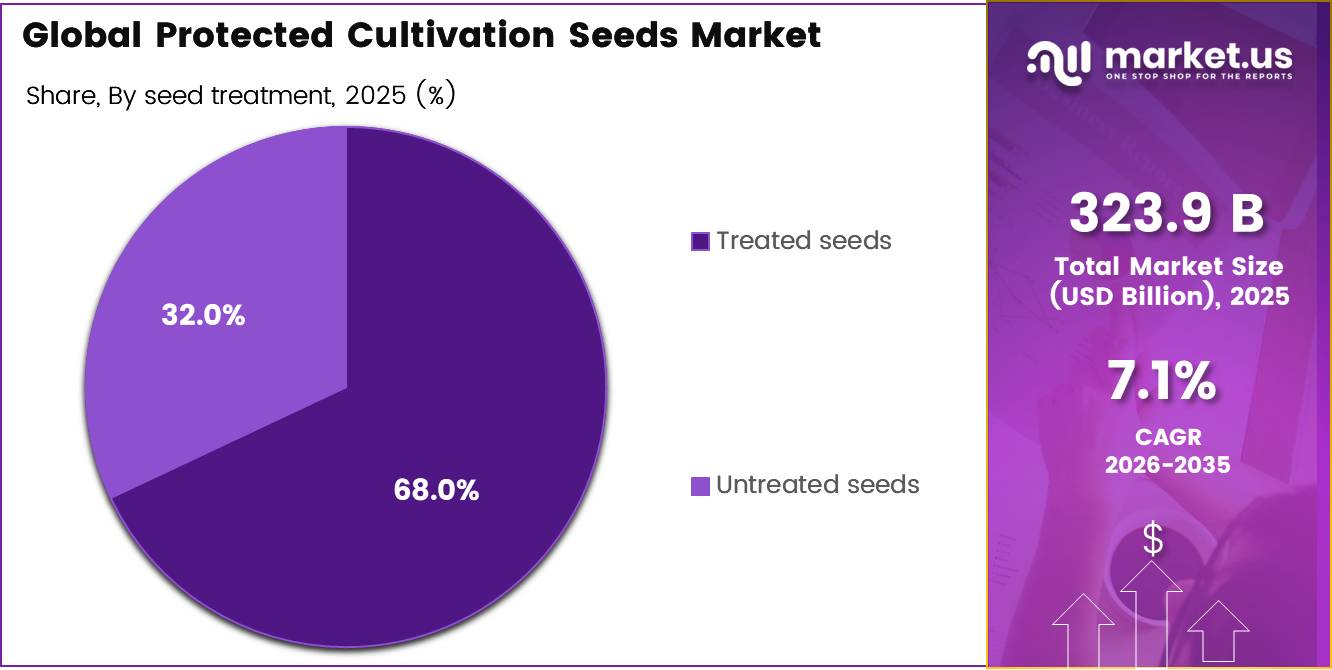
- Among the seed treatment, Treated seeds held a major share in the Protected Cultivation Seeds market, 60.8% of the market share.
- In 2025, the Asia Pacific was the most dominant region in the Protected Cultivation Seeds market, accounting for 63.9% of the total global consumption.
The European Union harvested 62.2 million tonnes of fresh vegetables in 2024, up 6% year over year, including 16.8 million tonnes of tomatoes, which increased 5%. Spain, Italy and France together represented 55% of EU fresh-vegetable production. This scale supports continued demand for greenhouse-adapted tomato, pepper, cucumber, lettuce and melon genetics. The breeding environment is also becoming more structured: UPOV reports 562,370 plant-variety applications, with 95% of applications covered by 341 test guidelines across 80 members representing 99 states.
- Government support is widening future opportunities. In January 2025, the USDA announced USD 14.4 million for urban agriculture and innovative production, including USD 2.5 million in competitive grants and USD 11.9 million for technical assistance across 27 priority cities. The programme explicitly supports controlled-environment agriculture. Future development is expected in disease-resistant rootstocks, heat-tolerant hybrids, seed priming, biological coatings, digital phenotyping and varieties requiring less energy, water and crop protection.
The protected cultivation seeds industry is expanding alongside greenhouse, tunnel and soilless vegetable production. In February 2026, the USDA reported USD 18.3 billion in total U.S. horticultural sales during 2024. Food crops grown under protection generated USD 1.01 billion, representing a 44% increase from 2019. This progress supports demand for uniform, disease-resistant and high-germination hybrids suited to controlled environments.
Resource efficiency remains a major growth driver for specialized protected-cultivation seeds. The EU CAP Network highlighted a nine-hectare hydroponic tomato greenhouse using automated monitoring and recycled water. The facility produced around 2,000 tonnes of tomatoes in 2024 while using approximately 70% less water than conventional greenhouse cultivation. Such systems require seeds developed for dense planting, stable fruit quality, nutrient control and continuous harvesting.
Future opportunities will strengthen around heat-tolerant, parthenocarpic, low-light and pathogen-resistant vegetable hybrids. In October 2025, FAO estimated that 1.4 million to 2 million hectares were already under greenhouse cultivation worldwide. Improved ventilation and insect netting raised greenhouse cucumber yields by 232% in Uzbekistan and increased farmers’ incomes fourfold. These results encourage investment in seed breeding for smart greenhouses, hydroponics, vertical farms and climate-resilient food production.
Crop family Analysis
Solanaceae represents dominant Segment in the Market.
Solanaceae leads with 40.60% due to strong demand for greenhouse tomatoes, peppers and eggplants. In 2025, Solanaceae held the leading market position, capturing more than a 40.60% share. These crops remain suitable for protected cultivation because breeders can develop hybrids with better fruit uniformity, heat tolerance, disease resistance and extended harvesting periods. USDA data released in February 2026 showed that protected tomato cultivation covered 50.997 million square feet, produced 2.642 million hundredweight and generated USD 382.988 million in 2024. These figures support continued demand for high-yielding Solanaceae seeds designed for hydroponic and climate-controlled systems.
Cucurbits are emerging as the growing segment as greenhouse growers seek faster crop cycles and consistent output. Cucumbers are widely planted in tunnels and hydroponic facilities because they respond well to vertical training and controlled fertigation. In 2024, USDA recorded 1,439 protected cucumber operations, covering 6.459 million square feet and producing 293,130 hundredweight. This production base encourages demand for parthenocarpic, disease-resistant and high-vigour cucumber hybrids.
Seed type Analysis
Conventional seeds a significant type.
Conventional seeds lead with 87.00% due to their broad availability and dependable crop performance. They remain widely used in protected vegetable cultivation because growers can select from established tomato, pepper, cucumber and leafy vegetable varieties with predictable germination and yield. European Commission data show that EU fruit and vegetable production generated EUR 72.2 billion in 2024. Vegetable output, including pulses, reached 63.8 million tonnes, while fruit and nut production totalled 40.8 million tonnes. This large production base supports steady seed replacement and repeated greenhouse planting. European Commission source
Organic-certified seeds are emerging as the growing segment as growers respond to sustainable farming targets and stronger organic demand. Eurostat reported that organic farming covered an estimated 10.9% of EU agricultural land in 2024, up 2.4% points from 2019, with a 25% target set for 2030. USDA also recorded U.S. organic food imports of USD 5.7 billion in 2024. These trends encourage demand for certified, untreated seeds with clear traceability.
Breeding technology Analysis
Polyethylene (PE) Separators Are the Most Widely Used Separators.
Hybrid seeds lead with 72.70% due to their uniform growth and reliable greenhouse performance. Protected-cultivation growers prefer these seeds for consistent plant height, fruit quality, maturity and disease resistance. Agriculture and Agri-Food Canada reported 974 commercial greenhouse vegetable operations in 2024, producing 866,484 metric tons, up 5% from 2023. Greenhouse fruit and vegetable sales also increased 8%, reaching CAD 2.7 billion. This expanding production base supports repeated demand for high-performing hybrid varieties.
Open-pollinated varieties are emerging as the growing segment due to their seed-saving potential and wider genetic diversity. In February 2026, USDA reported that its National Plant Germplasm System maintained over 500,000 seed accessions covering 10,000 species. Seeds are stored at -18°C, while cryogenic preservation can reach -196°C, helping protect diverse varieties for future breeding
Seed treatment Analysis
Treated seeds Held a Major Share of the Protected Cultivation Seeds Market.
Treated seeds lead with 68.00% because they offer stronger protection during germination and early plant growth. Protected-cultivation growers favour coated seeds because losses during establishment can disrupt carefully scheduled greenhouse cycles. A 2025 USDA study evaluated 2 bacterial strains used as seed coatings. Their volatile compounds reduced fungal growth by 17% to 76%, while treated seeds lowered young-plant leaf damage by 38% to 84%. These results support wider interest in biological and lower-chemical seed treatments.
Untreated seeds are emerging as the growing segment as organic and low-input growers seek cleaner planting materials. USDA’s Organic Survey reflects increasing engagement from producers interested in organic practices, while regulatory guidance encourages growers to prioritize organic seed sourcing and maintain clear documentation when alternatives are used. These frameworks reinforce the importance of transparency and traceability, supporting the rising preference for untreated seed varieties suited to organic protected cultivation.
Key Market Segments
By Crop Family
- Solanaceae
- Tomato
- Pepper
- Eggplant
- Cucurbits
- Leafy vegetables
- Lettuce
- Cabbage
By seed type
- Conventional seeds
- Genetically modified seeds
- Organic-certified seeds
By Breeding technology
- Hybrid seeds
- Open-pollinated varieties
By seed treatment
- Treated seeds
- Untreated seeds
Driver Analysis
Greenhouse acreage expansion in high-value vegetables
Protected-cultivation seed demand is structurally leveraged to the expansion of greenhouse and broader controlled-environment horticulture, because every incremental hectare in tomatoes, cucumbers, peppers, lettuce, and similar high-value crops requires more frequent varietal selection, tighter crop scheduling, and higher-performing hybrid seed than open-field systems. The greenhouse horticulture market moved from roughly USD 42.36 billion in 2025 to about USD 46.21 billion in 2026 in one source, while another 2025 benchmark placed the market at about USD 36.0 billion with growth toward 2034; although those figures are not seed-market numbers, they confirm that the production system consuming these seeds is expanding at a high-single-digit pace.
In the United States, controlled-environment agriculture operations increased from 1,476 in 2009 to 2,994 in 2019, while production volumes rose 56 percent to 7.86 million hundredweight, and 60 to 70 percent of CEA output was concentrated in tomatoes, lettuce, and cucumbers, which directly maps to the crop groups with the highest protected-seed intensity. This expands the addressable seed pool not only through more acreage, but through denser crop rotation, multi-cycle planting, and a shift toward premium indeterminate, disease-resistant, and climate-tuned hybrids, which is why greenhouse footprint growth adds the single largest incremental push to the 2026 CAGR outlook.
Drivers Impact Analysis
| Driver | (~) % Impact on CAGR Forecast | Geographic Relevance | Impact Timeline |
|---|---|---|---|
| Greenhouse acreage expansion in high-value vegetables | +2.1% | APAC core, North America core, Mediterranean EU | Medium term (2-4 years) |
| Yield and income uplift from protected systems raising seed replacement value | +1.6% | India, Southeast Asia, Latin America, MENA | Short term (≤ 2 years) |
| Pesticide-reduction compliance shifting demand to resistant hybrids | +1.3% | EU core, UK aligned markets, premium export corridors in APAC | Medium term (2-4 years) |
| Subsidies and agri-infra finance lowering adoption barriers for polyhouse projects | +1.1% | India core, selected APAC, MENA spill-over | Short term (≤ 2 years) |
| Energy-efficient year-round production improving crop planning and premium seed ROI | +0.9% | Netherlands, Northern Europe, North America, Japan | Short term (≤ 2 years) |
| Genome-editing and trait acceleration improving protected-crop seed innovation cycles | +0.8% | US, Japan, India, innovation-led APAC corridors | Long term (≥ 4 years) |
Restraint Analysis
High capex for protected structures and irrigation
The biggest brake on protected cultivation seed adoption is the capital intensity of greenhouses, polyhouses, fertigation, and climate-control infrastructure, which raises minimum efficient scale thresholds and delays project decisions even when agronomic benefits are well understood, with typical commercial polyhouse builds requiring upfront outlays that many smallholders cannot amortize without subsidy or blended finance, leading to multi-year lags between proposal and commissioning.
While Indian schemes under the National Horticulture Mission and allied programs can cover up to about half of eligible project costs for structures, actual cash deployment often remains constrained by bank collateral requirements, interest rates in the high-single to low-double digit range, and cost overruns on irrigation and plastic components, meaning many projects effectively run 15 to 30 percent above initial budgets and take 2 to 3 additional seasons before achieving positive cash flow, which depresses seed demand from new entrants and limits crop rotation frequency.
In emerging-market APAC, MENA, and Latin American corridors, construction inflation on steel, poly films, and pumps combined with currency volatility against major input currencies can push real capex burden up by a further 10 to 15 percent versus pre-2020 baselines, prompting growers to under-specify structures, reduce protected acreage, or delay high-value greenhouse vegetable adoption, resulting in slower ramp-up of seed volumes in protected segments relative to open-field vegetable seeds despite strong economic case studies.
Restraint Impact Analysis
| Restraint | (~) % Impact on CAGR Forecast | Geographic Relevance | Impact Timeline |
|---|---|---|---|
| High capex for protected structures and irrigation | -2.0% | APAC corridors, MENA, Latin America | Medium term (2-4 years) |
| Fragmented and weak seed traceability in greenhouse channels | -1.7% | India core, Southeast Asia, Africa | Short term (≤ 2 years) |
| Complex seed regulatory and IP frameworks slowing variety deployment | -1.5% | India, EU, selected African economies | Long term (≥ 4 years) |
| Technical skills gap in protected agronomy and crop management | -1.3% | APAC corridors, MENA, Latin America | Medium term (2-4 years) |
| Energy and input-cost volatility compressing greenhouse margins | -1.2% | EU core, UK, North America | Short term (≤ 2 years) |
| Logistics and lead-time risks in specialized seed supply chains | -1.0% | Global, with APAC and EU hubs | Short term (≤ 2 years) |
Opportunity Analysis
SaaS-linked greenhouse seed advisory platforms
Controlled-environment agriculture research highlights the role of AI, IoT, and sensor networks in optimizing microclimates, while broader agtech trend tracking suggests AI adoption in agriculture is moving toward the 60 percent mark for large operations by the mid-2020s, yet most seed firms still sell product without bundling real-time advisory.
A realistic upside scenario assumes that by 2030–2032, 15 to 25 percent of protected-cultivation seed customers in key emerging corridors are attached to seed-branded advisory platforms priced at perhaps 2 to 4 percent of annual crop revenue, with gross margins of 60 to 70 percent versus 35 to 45 percent for seeds alone, which could lift overall seed-company EBITDA margins by 300 to 500 basis points and add 2-plus percentage points to CAGR if solution bundles help reduce crop failure rates by 10 to 15 percent and improve average yields by 8 to 12 percent.
Opportunity Impact Analysis
| Opportunity | (~) % Potential CAGR Upside | Geographic Relevance | Execution Window |
|---|---|---|---|
| SaaS-linked greenhouse seed advisory platforms | +2.2% | APAC emerging, Latin America, Africa | Short term (≤ 2 years) |
| High-margin niche varieties for vertical and urban farms | +1.9% | North America core, EU core, Japan | Medium term (2-4 years) |
| Trait-stacked CRISPR and molecular-breeding bundles | +1.7% | US, Japan, India, APAC innovation hubs | Long term (≥ 4 years) |
| Carbon-credit and ESG-linked protected seed portfolios | +1.4% | EU core, UK, North America, OECD Asia | Medium term (2-4 years) |
| White-label and M&A roll-up of fragmented regional seed brands | +1.3% | APAC corridors, MENA, Latin America | Medium term (2-4 years) |
| Data-driven, outcome-based seed pricing models | +1.1% | Global, with early uptake in EU and North America | Long term (≥ 4 years) |
Challenges Analysis
Climate volatility and input stress
Climate volatility and input stress form a systemic challenge rather than a discrete restraint because protected structures buffer crops from extreme events but remain embedded in broader hydrological and ecological systems, forcing seed companies and growers to manage increased variability in water availability, ambient temperatures, and baseline pest pressure even when greenhouses are operational, with India’s own protected-cultivation narratives citing erratic weather patterns, water scarcity, pest attacks, and soil degradation as persistent realities that enclosed systems only partially mitigate.
At an operational level, this translates into rising irrigation-energy costs, more frequent reliance on borewells or micro-irrigation systems, and higher nutrient and biocontrol usage, with many regions seeing 10 to 25 percent increases in per-unit water and nutrient costs over early-2020 baselines and a widening standard deviation of yields often 15 to 20 percent between seasons for the same hybrid due to climate-linked stressors outside the greenhouse envelope.
Seed firms must therefore invest steadily in stress-tolerance traits, localized varietal portfolios, and advisory services that help growers adjust planting windows and fertigation schedules, which increases R&D and service opex by several percentage points and holds back top-line acceleration; modeled conservatively, the inability to fully neutralize climate volatility trims the market’s maximum attainable CAGR by around 1.5 to 2.0 percentage points because a portion of potential acreage and intensity gains are reallocated to risk management, and climate adaptation will remain a long-term, multi-decade mitigation effort rather than a quick fix.
Challenges Impact Analysis
| Challenge | (~) % CAGR Friction Drag | Geographic Relevance | Mitigation Horizon |
|---|---|---|---|
| Climate volatility and input stress | -1.6% | APAC weather belts, MENA, Sub-Saharan Africa | Long term (≥ 4 years) |
| Seed supply-chain visibility gaps | -1.4% | India core, APAC logistics corridors, Africa | Medium term (2-4 years) |
| Persistent protected-agronomy skill deficit | -1.3% | APAC emerging, MENA, Latin America | Long term (≥ 4 years) |
| Slow digitization of greenhouse operations | -1.1% | Global, stronger in APAC and Africa | Medium term (2-4 years) |
| Standardization and quality-variance in protected seeds | -1.0% | APAC, Africa, fragmented local markets | Medium term (2-4 years) |
| Policy and funding cyclicality for protected projects | -0.9% | India, emerging APAC, MENA | Long term (≥ 4 years) |
Geopolitical Impact Analysis
Trade Nationalism and Import Dependence Reshaping Protected Cultivation Seed Supply
Geopolitical efforts to strengthen domestic agriculture are changing how premium vegetable seeds move across borders. For 2025/26, USDA forecasts China’s vegetable-seed imports at 7,200 metric tons, around 10% lower than the previous year. However, vegetable seeds still represented 58% of total seed-import value, showing continued dependence on advanced genetics. Thailand, Denmark and Indonesia supplied 75% of imported vegetable-seed volume, exposing greenhouse growers to policy changes, shipping disruption and phytosanitary restrictions affecting a small group of trade partners.
Seed companies are therefore diversifying production, storage and distribution locations. USDA recorded U.S. planting-seed exports worth USD 1.6 billion and totalling 607,428 metric tons in 2025. Meanwhile, UK government data showed that plant and planting-material import value reached GBP 1.576 billion in 2024, rising 55.7% from 2020. These movements encourage regional breeding, larger safety stocks and multi-country sourcing for protected cultivation
Regional Analysis
Asia Pacific Held the Largest Share of the Global Protected Cultivation Seeds Market.
Asia Pacific leads with 63.90% owing to its large vegetable production base and rising need for climate-controlled farming. Protected cultivation is gaining importance as growers seek stable output despite weather disruption. China’s National Bureau of Statistics reported that natural disasters affected 6.07 million hectares of crops in 2025, including 0.69 million hectares of complete crop failure. Floods, waterlogging and geological events caused losses of CNY 166.6 billion, strengthening demand for resilient greenhouse seeds.
Europe is emerging as the growing region as growers expand protected vegetable areas and adopt high-performance varieties. UK government data showed that protected cultivation area increased 4.7% to 866 hectares in 2025. Protected tomato production rose 4.1% to 79,000 tonnes, while its planted area expanded 7.2% to 226 hectares. This growth supports demand for seeds offering stable fruit setting, resistance and reliable performance under heated greenhouses.
Key Regions and Countries Covered
- North America
- The US
- Canada
- Europe
- Germany
- France
- The UK
- Spain
- Italy
- Russia & CIS
- Rest of Europe
- APAC
- China
- Japan
- South Korea
- India
- ASEAN
- Rest of APAC
- Latin America
- Brazil
- Mexico
- Rest of Latin America
- Middle East & Africa
- GCC
- South Africa
- Rest of MEA
Key Players Analysis
Protected cultivation seed manufacturers focus on strengthening varietal differentiation, breeding efficiency, and distribution reliability to remain competitive. A key priority is continuous genetic improvement, including the development of heat-tolerant, disease-resistant, parthenocarpic, and high-yielding varieties that perform consistently under greenhouse, tunnel, and hydroponic conditions.
Companies further invest in advanced breeding programs, molecular selection, and controlled-environment trials, as these methods help shorten development cycles and improve seed performance across different climatic zones. Integration with nurseries, greenhouse operators, and input suppliers helps secure market access, improve technical support, and strengthen demand forecasting.
Strategic expansion across Asia Pacific, Europe, and North America allows suppliers to remain close to major protected vegetable production clusters. Manufacturers also emphasize seed purity, germination consistency, traceability, and treatment quality to maintain dependable crop establishment. At the same time, long-term partnerships with growers, distributors, and research institutions support faster variety adoption, strengthen customer loyalty, and improve positioning in premium tomato, cucumber, pepper, and leafy vegetable segments.
The Major Players In The Industry
- Bayer AG
- BASF SE
- Syngenta Group
- Rijk Zwaan Zaadteelt en Zaadhandel B.V.
- Enza Zaden Beheer B.V.
- Groupe Limagrain
- Sakata Seed Corporation
- Takii & Co., Ltd.
- Bejo Zaden B.V.
- East-West Seed International Ltd.
- KWS SAAT SE & Co. KGaA
- Vilmorin-Mikado
- Chia Tai Co., Ltd.
- Southern Seed S.p.A.
- NongWoo Bio Co., Ltd.
Key Development
- In September 2025, Syngenta Group partnered with Heritable Agriculture to use artificial intelligence for selecting and positioning vegetable varieties, helping growers identify stronger options across different production environments.
- In June 2025, Enza Zaden Beheer B.V. opened a 2-hectare research expansion featuring a high-tech greenhouse for cucumber breeding, a sustainable energy centre and added capacity supporting protected-cultivation seed development.
Report Scope
| Report Features | Description |
|---|---|
| Market Value (2025) | USD 323.9 Bn |
| Forecast Revenue (2035) | USD 641.4 Bn |
| CAGR (2026-2035) | 7.1% |
| Base Year for Estimation | 2025 |
| Historic Period | 2020-2024 |
| Forecast Period | 2026-2035 |
| Report Coverage | Revenue Forecast, Market Dynamics, Competitive Landscape, Recent Developments |
| Segments Covered | By crop family (Solanaceae, Cucurbits and Leafy vegetables), By seed type (Conventional seeds, Genetically modified seeds and Organic-certified seeds), By breeding technology (Hybrid seeds and Open-pollinated varieties), By seed treatment (Treated seeds and Untreated seeds) |
| Regional Analysis | North America – The US & Canada; Europe – Germany, France, The UK, Spain, Italy, Russia & CIS, Rest of Europe; APAC– China, Japan, South Korea, India, ASEAN & Rest of APAC; Latin America– Brazil, Mexico & Rest of Latin America; Middle East & Africa– GCC, South Africa, & Rest of MEA |
| Competitive Landscape | Bayer AG — Seminis and De Ruiter, BASF SE — Nunhems, Syngenta Group, Rijk Zwaan Zaadteelt en Zaadhandel B.V., Enza Zaden Beheer B.V., Groupe Limagrain — HM.CLAUSE and Hazera, Sakata Seed Corporation, Takii & Co., Ltd., Bejo Zaden B.V., East-West Seed International Ltd., KWS SAAT SE & Co. KGaA, Vilmorin-Mikado, Chia Tai Co., Ltd., Southern Seed S.p.A., NongWoo Bio Co., Ltd. |
| Customization Scope | Customization for segments, region/country-level will be provided. Moreover, additional customization can be done based on the requirements. |
| Purchase Options | We have three licenses to opt for: Single User License, Multi-User License (Up to 5 Users), Corporate Use License (Unlimited Users and Printable PDF) |





































