


Report Overview
The Global Juice Testing Market size is expected to be worth around USD 23.3 Billion by 2035, from USD 11.1 Billion in 2025, growing at a CAGR of 7.8% during the forecast period from 2026 to 2035. In 2025, Europe held a dominant market position, capturing more than a 39.2% share, holding USD 4.0 Billion revenue.
Juice testing is becoming more important as fruit juice makers face stricter checks on safety, purity, sugar claims, and label accuracy. The industry covers microbiology testing, pesticide residue testing, heavy metal analysis, Brix/sugar testing, authenticity testing, and shelf-life checks. In 2023, global fruit and vegetable production reached 2.1 billion tonnes, giving juice processors a large raw material base that needs regular quality control.
Key Takeaways
- Juice Testing Market size is expected to be worth around USD 23.3 Billion by 2035, from USD 11.1 Billion in 2025, growing at a CAGR of 7.8%.
- Fruit Juices held a dominant market position, capturing more than a 45.80% share.
- Microbiological Testing held a dominant market position, capturing more than a 35.90% share.
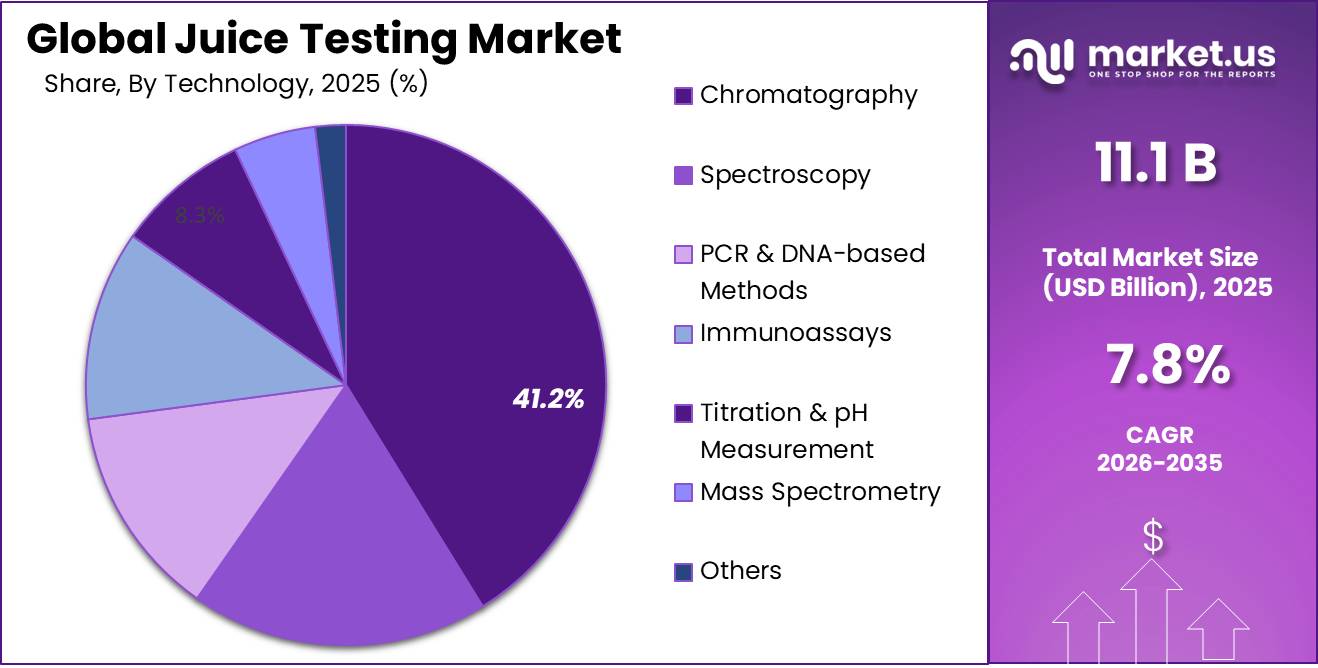
- Chromatography held a dominant market position, capturing more than a 41.20% share.
- Juice Manufacturers & Bottlers held a dominant market position, capturing more than a 48.20% share.
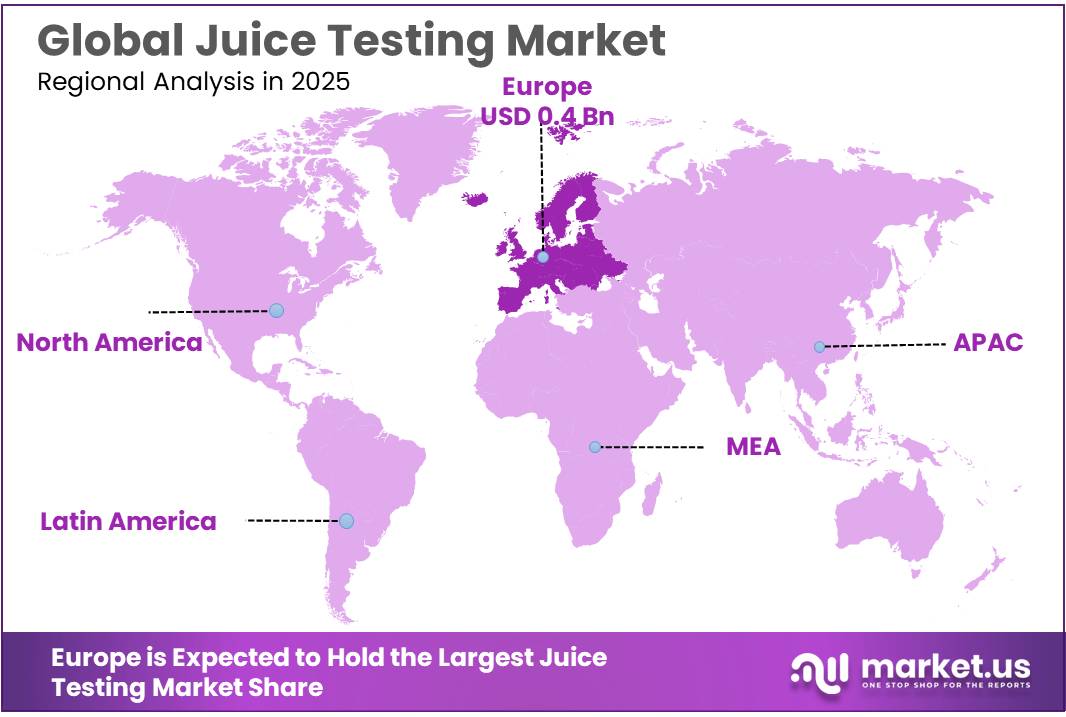
- Europe held a dominant position in the global Juice Testing Market, capturing 39.20% of the total market share and accounting for nearly USD 0.4 Billion.
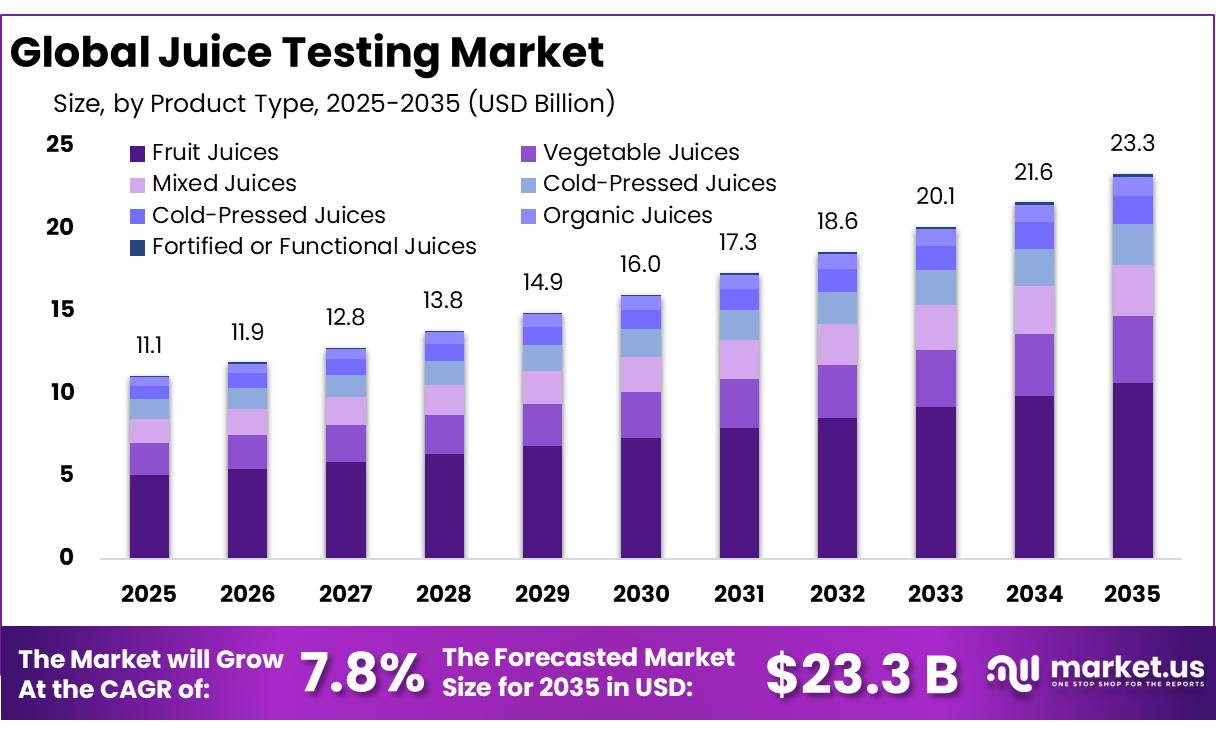
The industrial scenario is being shaped by stricter food safety laws and rising demand for clean-label beverages. In the U.S., FDA’s 21 CFR Part 120 requires juice processors to follow HACCP systems, while juice controls must achieve a 5-log pathogen reduction. This creates steady demand for microbiology, E. coli, Salmonella, yeast, mold, patulin, pesticide, and nutritional testing. In Europe, Directive (EU) 2024/1438 updated fruit juice rules under the “Breakfast Directives,” supporting clearer labelling and healthier product choices.
Demand is also supported by public health concerns. CDC estimates that foodborne diseases cause around 48 million illnesses, 128,000 hospitalizations, and 3,000 deaths each year in the U.S. alone. This makes juice safety testing important because unpasteurized or poorly processed juice can carry harmful microorganisms. USDA data also shows that orange juice remained a major juice category in the U.S., with 16.6 pounds, or 1.9 gallons, available per person, showing that juice still holds a meaningful role in beverage consumption.
Eurofins Scientific is a major player in this space, supported by its global laboratory network and strong food testing capabilities. In 2025, Eurofins reported revenue of €7,296 million, up 5.0% as reported, while Q1 2025 revenue reached €1,767 million, rising 6.9% year-on-year. The company’s food and beverage testing services support contaminant testing, authenticity checks, nutritional analysis, and regulatory compliance for juice producers.
By Product Type Analysis
Fruit Juices dominates with 45.80% share driven by strong consumer demand and broad product availability
In 2025, Fruit Juices held a dominant market position, capturing more than a 45.80% share in the global Juice Testing Market. This leading position was supported by the high production and consumption of packaged and processed fruit-based beverages across developed and emerging economies. Fruit juices continue to remain one of the most widely tested beverage categories because manufacturers are under constant pressure to maintain product quality, nutritional accuracy, shelf-life stability, and compliance with food safety standards.
By Test Type Analysis
Microbiological Testing dominates with 35.90% share as food safety standards continue to strengthen across juice production
In 2025, Microbiological Testing held a dominant market position, capturing more than a 35.90% share in the global Juice Testing Market. The segment maintained its leading position due to increasing attention on product safety, contamination prevention, and regulatory compliance across juice manufacturing operations. Juice producers continued to prioritize microbiological analysis to detect harmful microorganisms and maintain product consistency before products reached retail channels.
By Technology Analysis
Chromatography dominates with 41.20% share due to its high accuracy in juice quality and composition analysis
In 2025, Chromatography held a dominant market position, capturing more than a 41.20% share in the global Juice Testing Market. The segment achieved strong market presence because of its ability to deliver accurate separation and identification of compounds found in juice products. Juice manufacturers increasingly relied on chromatography-based testing to evaluate product composition, detect impurities, verify ingredient authenticity, and maintain consistent quality standards across production batches.
By End-User Analysis
Juice Manufacturers & Bottlers dominates with 48.20% share driven by increasing focus on product quality and compliance
In 2025, Juice Manufacturers & Bottlers held a dominant market position, capturing more than a 48.20% share in the global Juice Testing Market. This leading position was supported by the growing responsibility of manufacturers and bottling companies to maintain product quality, safety, and consistency throughout production and packaging operations. As consumer expectations for safe and high-quality beverages continued to rise, companies increased testing activities across raw material inspection, process control, and final product validation.
Key Market Segments
By Product Type
- Fruit Juices
- Vegetable Juices
- Mixed Juices
- Cold-Pressed Juices
- Concentrates & Purees
- Organic Juices
- Fortified or Functional Juices
By Test Type
- Microbiological Testing
- Chemical Testing
- Nutritional Analysis
- Allergen Testing
- Adulteration & Authenticity Testing
- Preservative Detection
- Shelf-Life Testing
- Regulatory Compliance Testing
By Technology
- Chromatography
- Spectroscopy
- PCR & DNA-based Methods
- Immunoassays
- Titration & pH Measurement
- Mass Spectrometry
- Others
By End-User
- Juice Manufacturers & Bottlers
- Food Testing Laboratories
- Regulatory Bodies
- Exporters & Importers
- Research Institutions
- Retail Chains & Private Labels
Market Dynamics
Driver Analysis - Stricter Food Safety Standards Increase Demand For Juice Testing
One of the major driving factors for the Juice Testing Market is the growing focus on food safety compliance and product authenticity across the global beverage industry. Consumers today expect juice products to be safe, clean, accurately labeled, and consistent in quality. This shift has pushed manufacturers to increase testing activities across every stage of production, from raw fruit inspection to final packaged beverages.
Government regulations and international food standards continue to strengthen this trend. The FAO and WHO under the Codex Alimentarius General Standard for Fruit Juices and Nectars emphasize verification of composition, quality, authenticity, and analytical testing methods for fruit juice products. These standards support routine testing to confirm product integrity and maintain food safety across international trade.
The need for stronger testing has also increased due to contamination monitoring and quality control requirements. According to Food Standards Australia New Zealand (FSANZ), a 2025 analytical survey of apple juice and apple-based products found that 82% of tested samples showed no detectable metal contamination levels, while all tested products remained below national and international regulatory limits. Such monitoring programs demonstrate how laboratory testing has become an important industry practice to maintain consumer trust and compliance with food safety frameworks.
Restraint Analysis - High Compliance and Multi-Stage Testing Costs Limit Adoption
One of the major restraining factors in the Juice Testing market is the rising cost and complexity of meeting food safety, contamination, and quality testing requirements across global supply chains. Juice manufacturers today are expected to conduct multiple layers of testing including microbiological screening, pesticide residue checks, heavy metal analysis, authenticity verification, and shelf-life validation before products reach consumers. While these measures improve safety, they also increase operational expenses, especially for small and medium-sized juice processors.
Government food safety programs and international standards continue to push stricter testing practices. The U.S. Food and Drug Administration (FDA) introduced Juice HACCP requirements to strengthen preventive controls in juice processing after multiple food safety concerns linked to juice products. These regulations require producers to identify hazards and maintain documented testing and control systems throughout production.
At the international level, the Codex Alimentarius Commission, supported by FAO and WHO, now includes 188 member countries working under science-based food safety standards that influence global food trade and product acceptance. Meeting these standards often requires laboratories, certified testing methods, trained staff, and continuous monitoring systems, which raises compliance costs for producers operating across several markets.
Recent market incidents also show how expensive testing failures can become. In 2024, routine testing identified elevated inorganic arsenic levels in nearly 9,535 cases of apple juice, leading to a product recall across multiple markets. Separately, more than 170,000 bottles of apple juice were recalled in 2025 after testing found possible patulin contamination linked to mold exposure. Such events increase pressure on manufacturers to expand testing frequency and quality assurance budgets.
Opportunity Analysis - Expansion of Juice Authenticity Testing Creates New Opportunities
One of the strongest growth opportunities in the juice testing industry is the rising demand for juice authenticity verification and anti-adulteration testing. Consumers today expect juices to contain exactly what labels claim, while governments and food regulators are tightening quality standards. This shift is creating long-term demand for advanced juice testing services across production, export, and retail channels.
Global consumption trends are creating additional room for testing expansion. By 2023, worldwide fruit juice consumption was estimated at 36,809.8 million liters, showing the large scale at which manufacturers must maintain product quality and regulatory compliance. Higher production volumes directly increase the need for routine testing and verification across supply chains.
Government and international food initiatives are also supporting this opportunity. The Codex Alimentarius Commission provides internationally recognized definitions and standards for fruit juice quality and composition. In Europe, the European Fruit Juice Association applies detailed guidance covering authenticity, identity, and quality parameters that are widely used by food inspections and juice processors globally. Regulatory frameworks in regions such as the EU and North America increasingly emphasize product traceability and label accuracy.
Emerging Trend Analysis - Rapid Safety Testing Becomes Key Juice Industry Trend
One major emerging trend in the juice testing market is the fast shift toward rapid safety testing and stronger traceability. Juice companies are under more pressure to test products quickly for pathogens, pesticide residues, heavy metals, preservatives, sugar levels, and adulteration. This is important because juice is often consumed directly, and even a small safety issue can affect large batches. The FDA Juice HACCP rule requires juice processors to achieve a 5-log pathogen reduction, equal to a 100,000-fold reduction in harmful microorganisms. This makes microbiological testing a core part of juice production, not just a final quality check.
Food safety alerts are also pushing companies to test more often. The European Commission reported 9,460 RASFF notifications in 2024, an 8% increase from the previous year. These alerts cover food safety risks across the supply chain and show why juice brands are investing in faster lab methods, digital records, and supplier-level testing.
Another reason behind this trend is changing consumption and supply patterns. USDA data shows fruit juice availability is tracked by type, including fresh, canned, juice, and dried fruit, while its 2024 outlook noted that apple juice availability reached 1.98 gallons per person in 2021/22 in the U.S. This steady demand means testing labs must support both large processors and private-label juice brands with faster turnaround times.
Government traceability rules are adding more momentum. FDA’s Food Traceability Rule has a compliance date of January 20, 2026, requiring stronger records for faster identification and removal of unsafe foods from the market. For juice testing providers, this creates demand for connected lab reports, batch tracking, and real-time quality documentation.
Regional Insights
Europe Dominated the Juice Testing Market with 39.20% Share
In 2025, Europe held a dominant position in the global Juice Testing Market, capturing 39.20% of the total market share and accounting for nearly USD 0.4 Billion in market value. The region maintained leadership due to its highly regulated food and beverage industry, strong consumer focus on product quality, and strict food safety standards across juice manufacturing and distribution channels.
One of the major factors supporting regional dominance is the strong consumption and production base for fruit juices across European countries. According to European consumption statistics, average juice and nectar consumption reached around 14.9 liters per person in the European Union in 2024, reflecting steady demand for quality-controlled juice products. This sustained consumption directly supports the need for regular testing throughout production and supply chains.
Key Regions and Countries Insights
- North America
- US
- Canada
- Europe
- Germany
- France
- The UK
- Spain
- Italy
- Rest of Europe
- Asia Pacific
- China
- Japan
- South Korea
- India
- Australia
- Rest of APAC
- Latin America
- Brazil
- Mexico
- Rest of Latin America
- Middle East & Africa
- GCC
- South Africa
- Rest of MEA
Key Players Analysis
Eurofins Scientific remains one of the strongest companies in the Juice Testing Market through its broad food testing and laboratory network. The company operates more than 940 laboratories across 62 countries and supports juice manufacturers with microbiology, pesticide residue, authenticity, sugar profiling, and contaminant testing services. In FY 2025, the company reported EUR 7.30 billion revenue, increasing 5.0% year over year, supported by growth in food and environmental testing.
SGS maintains a strong position in juice testing through food safety verification, ingredient authentication, and contamination analysis services. The company operates a global network of over 2,500 laboratories and business facilities and employs around 99,500 professionals worldwide. SGS supports beverage manufacturers with testing aligned to international food regulations and certification standards. The company’s food division continues expanding digital inspection and traceability capabilities, helping juice processors improve compliance, product consistency, and export readiness.
ALS Limited is expanding its presence in food and beverage testing through analytical services focused on quality assurance and contaminant detection. The company operates more than 350 laboratory locations across over 65 countries. In FY 2025, ALS generated approximately AUD 2.9 billion in revenue, supported by testing growth across food, life sciences, and environmental segments. Its laboratory infrastructure allows juice manufacturers to perform routine testing with faster turnaround times and stronger supply chain control.
Top Key Players Outlook
- Eurofins Scientific
- SGS
- ALS Limited
- Intertek Group
- Bureau Veritas
- Q Laboratories
- Merieux NutriSciences
- FoodChain ID
Recent Developments
In 2025, Bureau Veritas had a changing role in the Juice Testing sector because it moved away from direct food laboratory testing under its LEAP | 28 strategy. The company agreed to sell its global food testing business to Mérieux NutriSciences for an enterprise value of EUR 360 million, with the food testing unit generating EUR 133 million revenue in 2023.
In 2025, Intertek reported group revenue of GBP 3,432 million, up 4.3% at constant currency, with like-for-like growth of 3.9% and an operating margin of 18.1%. Its Health and Safety division, which supports food and related testing activities, grew 2.4% in 2025.
Report Scope
| Report Features | Description |
|---|---|
| Market Value (2025) | USD 11.1 Bn |
| Forecast Revenue (2035) | USD 23.3 Bn |
| CAGR (2026-2035) | 7.8% |
| Base Year for Estimation | 2025 |
| Historic Period | 2020-2024 |
| Forecast Period | 2026-2035 |
| Report Coverage | Revenue Forecast, Market Dynamics, Competitive Landscape, Recent Developments |
| Segments Covered | By Product Type (Fruit Juices, Vegetable Juices, Mixed Juices, Cold-Pressed Juices, Concentrates And Purees, Organic Juices, Fortified or Functional Juices), By Test Type (Microbiological Testing, Chemical Testing, Nutritional Analysis, Allergen Testing, Adulteration And Authenticity Testing, Preservative Detection, Shelf-Life Testing, Regulatory Compliance Testing), By Technology (Chromatography, Spectroscopy, PCR And DNA-based Methods, Immunoassays, Titration And pH Measurement, Mass Spectrometry, Others), By End-User (Juice Manufacturers And Bottlers, Food Testing Laboratories, Regulatory Bodies, Exporters And Importers, Research Institutions, Retail Chains And Private Labels) |
| Regional Analysis | North America – US, Canada; Europe – Germany, France, The UK, Spain, Italy, Rest of Europe; Asia Pacific – China, Japan, South Korea, India, Australia, Singapore, Rest of APAC; Latin America – Brazil, Mexico, Rest of Latin America; Middle East & Africa – GCC, South Africa, Rest of MEA |
| Competitive Landscape | Eurofins Scientific, SGS, ALS Limited, Intertek Group, Bureau Veritas, Q Laboratories, Merieux NutriSciences, FoodChain ID |
| Customization Scope | Customization for segments, region/country-level will be provided. Moreover, additional customization can be done based on the requirements. |
| Purchase Options | We have three licenses to opt for: Single User License, Multi-User License (Up to 5 Users), Corporate Use License (Unlimited User and Printable PDF) |





































