


Report Overview
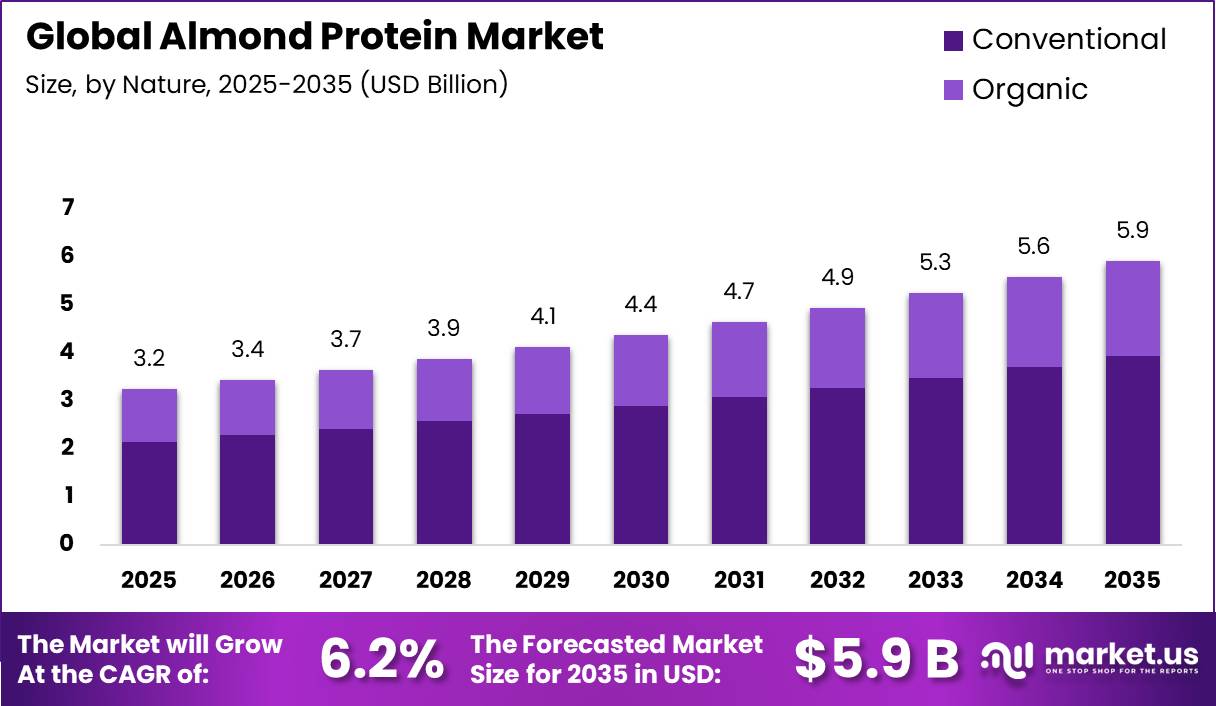
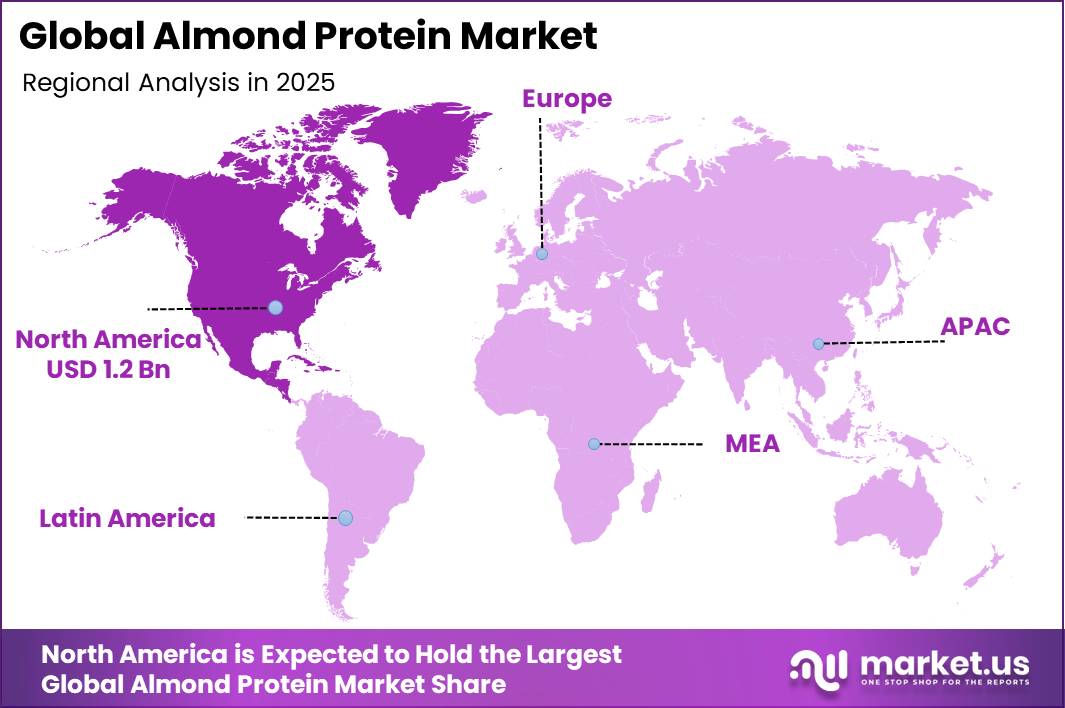
In 2025, the Global Almond Protein Market was valued at USD 3.2 billion, and between 2026 and 2035, this market is estimated to register a CAGR of 6.2%, reaching about USD 5.9 billion by 2035. In 2025, North America led the market, achieving over 37.5% share with a revenue of USD 1.2 billion.
Almond protein is emerging as a value-added plant ingredient derived from whole almonds, defatted almond meal, almond flour, and protein-rich fractions obtained through mechanical pressing, separation, extraction, and drying. The ingredient is increasingly used in nutrition bars, bakery products, cereals, dairy-free beverages, desserts, spreads, and meal-replacement formulations.
Its mild taste and compatibility with clean-label product development allow manufacturers to combine nutritional value with texture, moisture retention, and flavor performance. The industry remains closely linked to almond-processing capacity because protein ingredients are commonly developed alongside almond oil, flour, butter, and beverage production.
- As of July 18, 2026, the USDA National Agricultural Statistics Service reported approximately 1.39 million harvested almond acres in California and an average yield of 1,940 pounds per acre.
- In July 2026, the USDA National Agricultural Statistics Service reported that California’s 2025 utilized shelled almond production reached 2.715 billion pounds, with the value of production recorded at USD 6.8744 billion.
Key Takeaways
- The Global Almond Protein Market was valued at USD 3.2 billion in 2025.
- The market is projected to grow at a CAGR of 6.2% and is estimated to reach USD 5.9 billion by 2035.
- On the basis of nature, Conventional dominated the market, constituting 66.3% of the total market share.
- Based on the form, Powder dominated the market, with a substantial market share of around 50.1%.
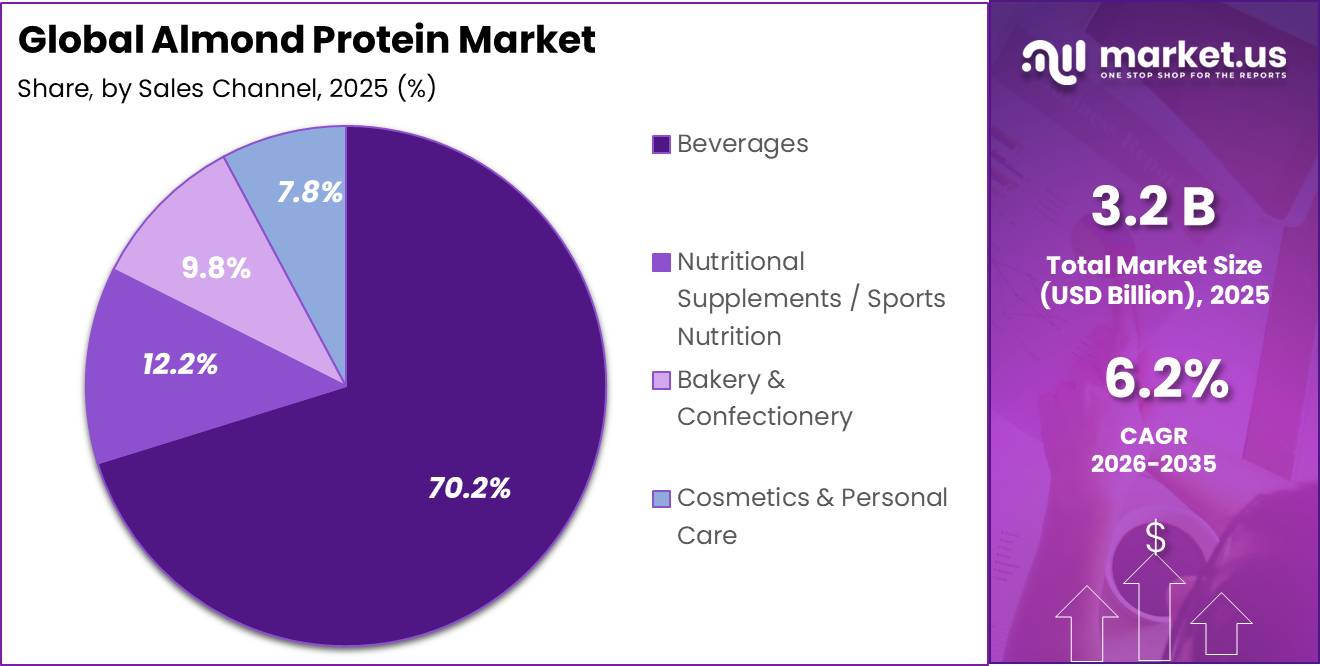
- Based on the application, Beverages led the market, comprising 70.2% of the total market.
- On the basis of sales channel, Online Retail dominated the market, constituting 40.2% of the total market share.
- In 2025, North America was the most dominant region in the market, accounting for 37.5% of the total global consumption.
This large output provides an established raw-material base for almond flour, oil, meal, and protein-rich ingredient processing. This large agricultural base provides processors with substantial raw material availability and supports commercial investment in milling, defatting, filtration, spray drying, allergen control, and ingredient standardization. Greater utilization of almond press cake and lower-oil meal can also improve processing economics by converting secondary material streams into higher-value protein ingredients.
- On July 24, 2025, the USDA Economic Research Service reported that almond exports reached 1.727 billion pounds during August 2024 to May 2025. This volume was 1.6% higher than the corresponding period of the previous marketing year and 2.7% above the five-year average.
Strong international movement encourages processors to improve shelf stability, traceability, microbiological control, packaging, and specification consistency. It also supports the development of protein concentrates and specialized almond ingredients that can be shipped efficiently to food manufacturers serving bakery, snack, beverage, and sports-nutrition applications.
On April 28, 2025, the revised U.S. Food and Drug Administration definition for the voluntary “healthy” nutrient-content claim became effective. Under the updated criteria, qualifying nuts and seeds can carry the claim because of their nutrient profile. This regulatory development creates stronger positioning opportunities for almond-based protein foods, particularly products formulated with controlled levels of saturated fat, sodium, and added sugars. It may also encourage manufacturers to develop simpler formulations that highlight recognizable ingredients and nutrient density.
- On April 13, 2026, USDA announced USD 100.9 million in specialty-crop grant funding, including USD 86.6 million through the Specialty Crop Block Grant Program and USD 14.3 million through the Specialty Crop Multi-State Program.
These funds can support research, food safety, marketing, crop competitiveness, and processing innovation for tree nuts. Future almond protein opportunities are expected in sports nutrition, fortified bakery, dairy alternatives, elderly nutrition, and blended plant-protein systems. However, manufacturers must maintain strict allergen labeling, sanitation, and cross-contact controls because almonds remain a major tree-nut allergen under FDA requirements.
Nature Analysis
Conventional Almond Protein leads with a 66.3% share due to its broad availability and dependable supply.
In 2025, Conventional held a dominant market position, capturing more than a 66.3% share of the Almond Protein Market. The segment benefits from established almond farming, large processing volumes, easier raw-material sourcing, and competitive production costs. As of July 18, 2026, USDA data showed that California had 1.39 million bearing almond acres, while the utilized yield stood at 1,940 pounds per acre. This large supply base supports continuous protein extraction and high-volume production for food, beverage, bakery, and nutritional applications.
Organic Almond Protein is the fastest-growing segment of the market. Its growth is supported by rising interest in certified ingredients, sustainable farming practices, traceable sourcing, and minimally processed plant-based nutrition. In December 2025, USDA launched its 2025 Organic Survey to gather updated information on organic acreage, production, sales, income, and farming practices. During 2026, survey forms were distributed to approximately 26,000 organic and transitioning producers across the United States. The expanding certified supply network is expected to improve the availability of organic almonds for protein powders, nutrition bars, beverages, and premium functional foods.
Form Analysis
Powder dominates the almond protein market with a 50.1% share due to its easy storage and broad formulation use.
In 2025, Powder held a dominant market position, capturing more than a 50.1% share. Powdered almond protein is widely preferred because it is easy to measure, package, transport, and mix into protein shakes, bakery products, nutrition bars, cereals, and dairy-free foods. Its lower moisture content also makes it more practical for manufacturers handling large production volumes.
- In May 2025, the U.S. Department of Agriculture forecast U.S. almond production at 2.80 billion pounds on a shelled basis, representing an increase of 3% from the previous year. This large raw-material supply supports the production of almond flour, protein concentrates, and other powdered almond ingredients.
Liquid is the fastest growing segment in the almond protein market. In 2025, its growth was supported by increasing use in ready-to-drink protein beverages, dairy-free nutrition drinks, smoothies, and meal-replacement products. Liquid almond protein allows beverage manufacturers to reduce mixing and preparation stages while maintaining a smooth and consistent product texture. Its convenient format also suits consumers seeking portable and easy-to-consume plant-based nutrition products.
Application Analysis
Beverages lead the almond protein market with more than a 70.2% share, supported by strong use in plant-based drinks.
In 2025, Beverages held a dominant market position, capturing more than a 70.2% share. The segment benefits from the growing use of almond protein in plant-based milk, smoothies, ready-to-drink nutrition products, breakfast beverages, and dairy-free formulations. Beverage producers prefer almond protein because it supports clean-label positioning and helps improve the protein content of products designed for vegan and health-conscious consumers.
- In 2026, Harris Woolf strengthened its beverage ingredient portfolio through Almond Milk 2.0, which provides 3 grams of protein per serving. The company sources almonds from a network of more than 200 California farms and supplies almond protein powder, almond paste and almond-milk bases for plant-based milk, protein drinks, coffee beverages and ready-to-drink formulations.
Nutritional Supplements / Sports Nutrition is the fastest-growing segment in the almond protein market. Growth is being supported by rising interest in plant-based protein powders, recovery drinks, meal-replacement products, and everyday wellness supplements. Sports nutrition manufacturers are using almond protein to develop products for consumers who prefer alternatives to dairy and soy ingredients. Its mild taste also makes it suitable for flavored powders and blended protein formulations. Continued product development in vegan nutrition, active-lifestyle products, and convenient protein supplements is expected to strengthen the segment’s market position.
Sales Channel Analysis
Online Retail leads the Almond Protein Market with more than a 40.2% share, supported by convenience and wider product access.
In 2025, Online Retail held a dominant market position, capturing more than a 40.2% share. The channel benefited from the growing availability of almond protein powders, nutrition blends, snack bars, and beverage mixes across brand websites and large e-commerce platforms. Consumers increasingly preferred online stores because they could compare ingredients, read product reviews, access specialised plant-based products, and receive regular orders at home.
- Supporting the broader online sales environment, the U.S. Census Bureau reported in March 2026 that total U.S. retail e-commerce sales reached USD 1,233.7 billion in 2025, increasing by 5.4% and accounting for 16.4% of total retail sales.
Supermarkets / Hypermarkets is the fastest growing segment. In 2025, the channel gained momentum as retailers expanded their plant-based nutrition, sports food, organic product, and functional beverage sections. Physical stores allow shoppers to examine nutrition labels, compare prices, check flavours, and purchase almond protein products alongside their regular groceries. Large retailers also support growth through promotional displays, private-label launches, and broader distribution across urban and suburban locations.
Key Market Segments
By Nature
- Conventional
- Organic
By Form
- Powder
- Liquid
By Application
- Beverages
- Nutritional Supplements / Sports Nutrition
- Bakery & Confectionery
- Cosmetics & Personal Care
By Sales Channel
- Online Retail
- Supermarkets / Hypermarkets
- Specialty Stores
- Indirect Sales
- Direct Sales
Driver Analysis
Higher California almond crop and ingredient availability
The most immediate 2026 market driver is simple physical availability: USDA’s 2025 California Almond Objective Measurement Report forecast output at 3.00 billion meat pounds, up 10% from the prior crop’s 2.73 billion pounds, with 1.39 million bearing acres and a 7% rise in average nut set per tree to 4,364, giving processors a materially larger raw-material pool for protein extraction, flour co-products, and beverage base manufacturing.
In practical terms, when upstream availability rises by roughly 270 million pounds year over year, the almond protein value chain gains room to move from niche batch production toward more continuous supply contracts with beverage, sports nutrition, and clean-label bakery customers, which is why this driver merits an estimated +1.9 percentage-point lift to forecast CAGR in the near term.
Drivers Impact Analysis
| Driver | (~) % Impact on CAGR Forecast | Geographic Relevance | Impact Timeline |
|---|---|---|---|
| Higher California almond crop and ingredient availability | +1.9% | North America core, EU importers, APAC corridors | Short term (≤ 2 years) |
| Plant-based labeling formalization improving product clarity | +1.3% | North America core, EU, developed APAC | Short term (≤ 2 years) |
| Global plant protein substitution into beverages, powders, and bakery mixes | +2.1% | North America core, EU, APAC urban markets | Medium term (2-4 years) |
| Price support and risk management improving processor planning | +1.0% | North America core, export-linked markets | Short term (≤ 2 years) |
| Allergen transparency strengthening premium positioning and formulation discipline | +0.8% | EU core, North America core, APAC regulated markets | Medium term (2-4 years) |
| Export-market crop concentration and trade reach sustaining ingredient scale-up | +1.5% | North America supply base, EU, India, East Asia | Medium term (2-4 years) |
Restraint Analysis
Almond input cost volatility
USDA’s 2025 California almond forecast of 2.80 billion pounds, versus 2.73 billion pounds in the prior year, points to adequate but not abundant raw-material growth, which means almond protein producers still operate in a feedstock environment where small crop misses, export swings, or inventory tightening can quickly reprice kernels and almond meal used for protein extraction.
In practical unit-economics terms, almond protein typically carries a materially lower protein yield per ton of incoming nuts than soy or pea isolates, so a modeled 8% to 15% increase in almond input cost can translate into roughly 180 to 320 basis points of gross-margin compression for processors unless they push through price increases of about 6% to 10%, a difficult move in private-label beverage, nutrition, and bakery channels where formulation switching remains feasible; the strategic effect is slower contract conversion, lower promotional intensity, and delayed geographic expansion, justifying an estimated 2.4 percentage-point drag on baseline CAGR in 2026–2028.
Restraint Impact Analysis
| Restraint | (~) % Impact on CAGR Forecast | Geographic Relevance | Impact Timeline |
|---|---|---|---|
| Almond input cost volatility | -2.4% | North America core, EU importers, APAC buyers | Short term (≤ 2 years) |
| Water stress and orchard risk | -1.9% | California-linked global supply chain, North America core | Medium term (2-4 years) |
| Allergen labeling friction | -1.4% | North America core, EU, APAC modern retail | Short term (≤ 2 years) |
| Pollination dependency | -1.2% | California origin supply base, global downstream markets | Medium term (2-4 years) |
| Trade-policy and tariff exposure | -1.0% | India, APAC corridors, EU import channels | Medium term (2-4 years) |
| Processing yield and CapEx burden | -1.6% | North America, EU, APAC manufacturing hubs | Long term (≥ 4 years) |
Opportunity Analysis
Fortified medical & senior nutrition
Fortified medical and senior nutrition formulations represent a high-value white space for almond protein because clinical nutrition and geriatric food categories are still dominated by dairy and soy, despite rapid aging demographics and rising chronic disease prevalence in OECD and East Asian markets.
Between 2026 and 2035, the share of plant-based protein in European diets is targeted to reach 60% by 2030 under emerging policy frameworks, yet penetration into medical nutrition channels remains below 10–15% by value, leaving an estimated USD 2–3 billion of uncaptured TAM specifically for hypoallergenic, low-FODMAP, nut-based proteins that can support immune and cardiometabolic health claims.
Positioning almond protein into oral nutritional supplements, renal-friendly beverages, and texture-modified foods for dysphagia patients where price points of USD 6–10 per liter-equivalent and gross margins above 40% are common could lift segment-level revenue intensity by 20–25% versus current mainstream RTD plant milks, while reducing customer acquisition risk through hospital, long-term care, and insurance-channel contracts with renewal rates above 80% and churn under 5% annually.
Because the baseline almond protein market forecast today largely assumes foodservice and retail beverage use, shifting 8–12% of 2030 almond protein volume into clinical and senior nutrition SKUs could add roughly 3.5 percentage points to overall CAGR by 2035, driven by higher ARPU, more stable demand profiles, and reimbursement-linked pricing structures, making this clearly a future, underpenetrated strategic pivot rather than a current driver.
Opportunity Impact Analysis
| Opportunity | (~) % Potential CAGR Upside | Geographic Relevance | Execution Window |
|---|---|---|---|
| Fortified medical & senior nutrition | +3.5% | North America, EU, Japan | Medium term (2–4 years) |
| Clean-label sports & performance blends | +2.8% | North America core, EU, urban APAC | Short term (≤ 2 years) |
| Almond protein-based hybrid dairy | +2.3% | EU, North America, selected APAC | Medium term (2–4 years) |
| Government-backed plant protein programs | +4.0% | EU, India, China, ASEAN | Long term (≥ 4 years) |
| Circular by-product valorization platforms | +1.9% | US, EU, Australia | Medium term (2–4 years) |
| B2B ingredient digital marketplaces | +1.7% | Global, with NA/EU lead | Short term (≤ 2 years) |
Challenges Analysis
Climate‑linked yield volatility
FAO and related datasets show that global almond output peaked around 4.17 million tonnes in 2020 and fell to roughly 3.63 million tonnes in 2022, a drop of nearly 9.9%, illustrating a structural volatility band that directly feeds into protein feedstock cost and availability.
USDA-linked position data indicate carry-in stocks in the United States exceeding 480 million kernel pounds in some crop years, with year-on-year shifts of 3–5%, which forces processors to manage inventory buffers of 10–20% of annual throughput to avoid stockouts; this ties up working capital and adds an estimated 20–40 basis points to cost of goods sold for almond protein manufacturers.
In importing markets such as India, where government-linked sources report domestic production around 4,100 metric tonnes versus projected imports of 180,000–190,000 tonnes, demand-side growth in almond ingredients is structurally dependent on volatile overseas yields, magnifying the impact of each climate shock on local protein processors’ raw material acquisition costs.
The operational friction emerges through price corridors where kernel input prices can swing by 15–25% within a 12–18 month window, forcing formulators and brand owners to either accept margin erosion of 150–250 basis points or reformulate SKUs, both of which cumulatively drag the market’s potential CAGR by nearly 0.9 percentage points in a steady-state scenario.
Challenges Impact Analysis
| Challenge | (~) % CAGR Friction Drag | Geographic Relevance | Mitigation Horizon |
|---|---|---|---|
| Climate-linked yield volatility | -0.9% | US West, Mediterranean, India | Long term (≥ 4 years) |
| Water and energy cost pressure | -0.7% | California, Spain, MENA | Medium term (2-4 years) |
| Import dependency exposure | -0.6% | India, East Asia, MENA | Medium term (2-4 years) |
| Processing capacity bottlenecks | -0.5% | North America, EU hubs | Medium term (2-4 years) |
| Food safety and allergen risk | -0.5% | Global urban markets | Long term (≥ 4 years) |
| Talent and tech adoption gap | -0.4% | Emerging APAC, LATAM | Long term (≥ 4 years) |
Geopolitical Impact Analysis
Red Sea Conflict and Its Ripple Effect on the Almond Protein Trade
Ongoing hostilities in the Red Sea corridor continue to shape trade flows relevant to the global almond protein market, even though direct attacks have eased since their 2024 peak. Vessels carrying almond-derived ingredients still avoid the Suez Canal in favour of the longer Cape of Good Hope route, adding ten to fourteen days to transit times and tightening global container capacity. Trade tensions have compounded this pressure.
According to the USDA Foreign Agricultural Service, U.S. almonds exported to China faced a 25 percent tariff from February 2020, rising to 35 percent from March 2025, before an additional escalation pushed the rate as high as 125 percent over the following two months. A bilateral agreement in mid-May 2025 later reduced tariffs for a 90-day period.
Manufacturers sourcing almond protein for beverages, supplements, and bakery applications have responded by diversifying both shipping routes and export markets, shifting volumes toward the European Union, India, and the UAE. For instance, several ingredient suppliers have redirected China-bound shipments to buffer against tariff volatility. While the market has not lost momentum, freight delays and tariff swings have added real cost and planning friction that buyers continue to navigate through 2026.
Regional Analysis
North America Dominates the Almond Protein Market.
North America is established as the dominant region in the global almond protein market, accounting for approximately 37.5% of total market share in 2025, with regional revenue reaching close to US$1.2 billion. This leadership position is supported by high consumer awareness around plant-based protein alternatives, a well-developed sports nutrition and functional beverage industry, and strong retail penetration across the United States and Canada. Almond protein is widely incorporated into protein powders, ready-to-drink beverages, and bakery formulations across the region, aided by the presence of established almond cultivation and processing infrastructure in California, which supplies a significant share of the region’s raw material needs.
Asia Pacific is recognized as the fastest-growing region in the market, driven by rising disposable incomes, expanding urban populations, and a rapid shift toward Western dietary patterns favoring plant-based nutrition. Countries such as China, India, and Japan are witnessing increased adoption of almond-based protein ingredients in functional foods, beverages, and nutraceutical products, supported by growing health consciousness and rising incidence of lactose intolerance across the region. This combination of demand-side momentum and supply-side investment positions Asia Pacific as the region likely to register the sharpest growth trajectory over the forecast period, gradually narrowing the gap with more mature markets such as North America and Europe.
Key Regions and Countries Covered
- North America
- The US
- Canada
- Europe
- Germany
- France
- The UK
- Spain
- Italy
- Russia and CIS
- Rest of Europe
- APAC
- China
- Japan
- South Korea
- India
- ASEAN
- Rest of APAC
- Latin America
- Brazil
- Mexico
- Rest of Latin America
- Middle East and Africa
- GCC
- South Africa
- Rest of MEA
Key Players Analysis
Harris Woolf is the only company in this list with a directly verified almond protein offering. It introduced almond protein powder and almond oil in 2020 and sources almonds through more than 200 California farms. Its powder is produced by pressing almond paste, separating oil, and milling the remaining material into protein powder with 40%+ protein content, compared with 21–29% for traditional almond flour. The company offers natural, blanched, and organic formats, packed in 40-pound sacks, with a stated shelf life of 12–18 months, supporting food, beverage, nutrition-bar, and sports-nutrition manufacturers at scale.
Maxicrop USA, Inc. operates mainly in seaweed-based agricultural inputs rather than verified almond protein manufacturing. Its raw material is sourced from seaweed harvested along Norway’s 12,500-mile coastline. The company markets formulations with numerical nutrient profiles, including Liquid Seaweed Plus Iron at 0-0-1 and Liquid Fish at 3-1-1. Its relevance to almond protein is therefore indirect, mainly through crop nutrition and sustainable input support for agricultural supply chains and orchards worldwide.
Celtic Sea Minerals is better positioned as a complementary nutrition-ingredient supplier than as a confirmed almond protein producer. The company focuses on seaweed-derived minerals for animal nutrition and supports its portfolio with more than 160 research papers, including 60 peer-reviewed publications. Its Celtimin product delivers 74 bioavailable minerals. These capabilities may support fortified protein formulations, but public company information does not verify a dedicated almond protein product commercially today.
The Major Players in The Industry
- Blue Diamond Growers
- Olam Group
- Harris Woolf
- InovoBiologic Inc.
- Celtic Sea Minerals
- Marigot Ltd.
- Maxicrop USA, Inc.
- BioFlora, LLC
- Alesco
- Sabinsa Corporation
- Noosh Brands
- BASF SE
- Sar Agrochemicals & Fertilizers Pvt. Ltd.
- All Organic Treasures GmbH
- Treehouse California Almonds
- Other Key Players
Key Development
- In August 2025, Olam Group operates in the almond protein sector through ofi, under partnership and financing agreements, ofi secured a US$2.10 billion multi-tranche facility supported by 18 banks, providing funds for refinancing and general business needs.
- In August 2025, Blue Diamond Growers expanded its role as the Official Snack of the Big Ten Conference, covering 18 member The partnership promoted almonds containing 6 grams of protein, 3 grams of fiber, 75 milligrams of magnesium, and 7.4 milligrams of vitamin E per 28-gram serving.
Report Scope
| Report Features | Description |
|---|---|
| Market Value (2025) | USD 3.2 Bn |
| Forecast Revenue (2035) | USD 5.9 Bn |
| CAGR (2026-2035) | 6.2% |
| Base Year for Estimation | 2025 |
| Historic Period | 2020-2024 |
| Forecast Period | 2026-2035 |
| Report Coverage | Revenue Forecast, Market Dynamics, Competitive Landscape, Recent Developments |
| Segments Covered | By Nature (Conventional and Organic), By Form (Powder and Liquid), By Application (Beverages, Nutritional Supplements/Sports Nutrition, Bakery & Confectionery, and Cosmetics & Personal Care), By Sales Channel (Online Retail, Supermarkets/Hypermarkets, Specialty Stores, Indirect Sales, and Direct Sales) |
| Regional Analysis | North America – The US and Canada; Europe – Germany, France, The UK, Spain, Italy, Russia and CIS, Rest of Europe; APAC– China, Japan, South Korea, India, ASEAN and Rest of APAC; Latin America– Brazil, Mexico and Rest of Latin America; Middle East and Africa– GCC, South Africa, and Rest of MEA |
| Competitive Landscape | Blue Diamond Growers, Olam Group, Harris Woolf, InovoBiologic Inc., Celtic Sea Minerals, Marigot Ltd., Maxicrop USA, Inc., BioFlora, LLC, Alesco, Sabinsa Corporation, Noosh Brands, BASF SE, Sar Agrochemicals & Fertilizers Pvt. Ltd., All Organic Treasures GmbH, Treehouse California Almonds, and Other Key Players |
| Customization Scope | Customization for segments, region/country-level will be provided. Moreover, additional customization can be done based on the requirements. |
| Purchase Options | We have three licenses to opt for: Single User License, Multi-User License (Up to 5 Users), Corporate Use License (Unlimited Users and Printable PDF) |





































