


Report Overview
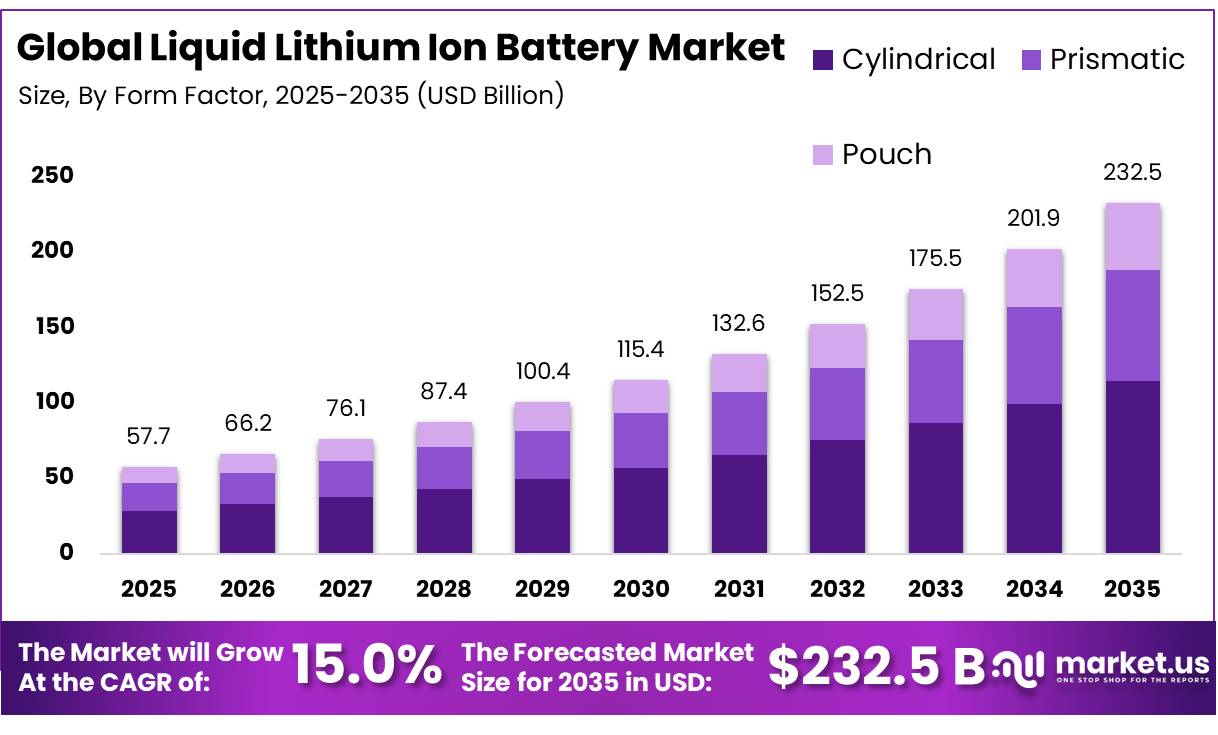
In 2025, the Global Liquid Lithium Ion Battery Market was valued at USD 57.7 billion, and between 2026 and 2035, this market is estimated to register a CAGR of 15.0%, reaching about USD 232.5 billion by 2035. In 2025, Asia Pacific led the market, achieving over 67.3% share with a revenue of USD 38.8 Billion.
Liquid lithium-ion batteries use a flammable organic liquid electrolyte to transport lithium ions between the cathode and anode. This technology remains widely used in electric vehicles, consumer electronics, power tools and stationary storage systems. Its commercial strength comes from established manufacturing processes, high energy density, long operating life and compatibility with several cathode chemistries, including lithium iron phosphate and nickel-manganese-cobalt.
- According to the International Energy Agency’s Global EV Outlook 2026, electric-vehicle battery deployment reached 1.2 TWh in 2025, rising by almost 30% from 2024. The level was also more than 7 times that recorded in 2020. Light-duty vehicles represented over 85% of total EV battery deployment during the year, confirming passenger cars and vans as the main users of liquid lithium-ion cells.
Key Takeaways
- The Global Liquid Lithium Ion Battery Market was valued at USD 57.7 billion in 2025.
- The market is projected to grow at a CAGR of 15.0% and is estimated to reach USD 232.5 billion by 2035.
- Based on the battery chemistry, Lithium Iron Phosphate (LFP) dominated the market, with a substantial market share of around 44.1%.
- Based on the form factor, Cylindrical led the market, comprising 49.3% of the total market.
- On the basis of capacity, Less than 3,000 mAh dominated the market, constituting 38.7% of the total market share.
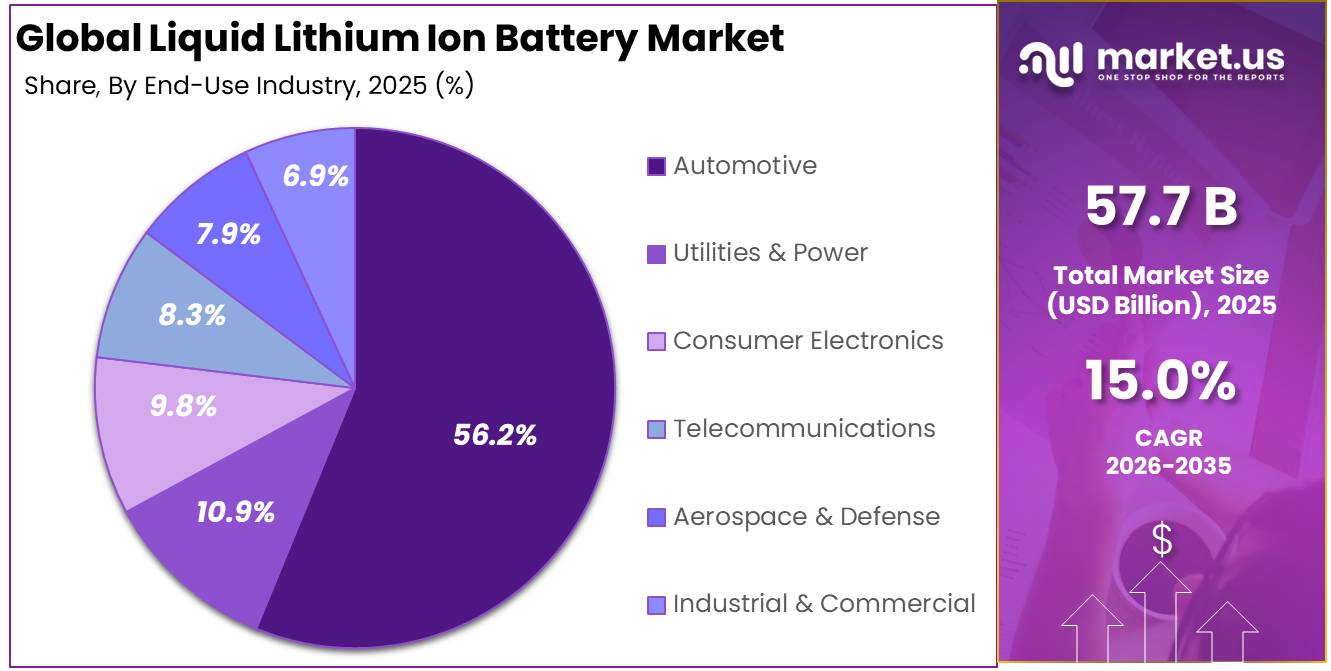
- Based on the end-use industry, Automotive dominated the market, with a substantial market share of around 56.2%.
- In 2025, Asia Pacific was the most dominant region in the market, accounting for 67.3% of the total global consumption.
Lower battery costs are supporting wider commercial adoption. The IEA reported in 2026 that lithium iron phosphate battery packs were more than 40% cheaper per kilowatt-hour than nickel-manganese-cobalt packs in 2025. Battery pack prices in China were also 30% lower than in North America and 35% lower than in Europe during 2025. These cost differences reflect manufacturing scale, integrated material supply, production efficiency and strong competition among cell producers.
- In 2024, total battery demand across electric vehicles and energy-storage applications reached 1 TWh, according to the IEA’s Global EV Outlook 2025. EV battery demand exceeded 950 GWh, increasing by 25% compared with 2023. Electric cars generated more than 85% of EV battery demand, while battery demand from electric trucks increased by over 75% during the same year.
Stationary energy storage offers another major growth opportunity. In its 2024 battery transition assessment, the IEA estimated that worldwide energy-storage capacity must expand sixfold to approximately 1,500 GW by 2030. Battery storage is expected to provide 90% of the required increase and reach around 1,200 GW by 2030. Annual battery-storage deployment would therefore need to increase by an average of 25% through the end of the decade.
- Government support is strengthening regional production and recycling capacity. In September 2024, the U.S. Department of Energy selected 25 projects across 14 states for more than USD 3 billion in funding. The projects are expected to support over 8,000 construction jobs and more than 4,000 operating jobs across battery materials, components, manufacturing and recycling facilities.
Future opportunities will emerge from safer liquid electrolytes, fast-charging additives, silicon-enhanced anodes, advanced separators and closed-loop recycling. European Union rules introduced in 2025 require lithium-based batteries to achieve 65% recycling efficiency by December 2025, increasing to 70% by 2030. Lithium recovery requirements will rise from 50% in 2027 to 80% in 2031, encouraging investment in material recovery, battery traceability and secondary raw-material supply.
Battery Chemistry Analysis
Lithium Iron Phosphate Leads with a 44.1% Share as Cost Advantages Strengthen Adoption
In 2025, Lithium Iron Phosphate held a dominant market position, capturing more than a 44.1% share of the Liquid Lithium Ion Battery Market. LFP batteries gained strong acceptance because they offer better thermal stability, longer cycle life and lower material costs than several competing chemistries. According to the International Energy Agency’s Global EV Outlook 2026, LFP batteries represented more than 55% of global electric vehicle batteries deployed in 2025, rising from nearly 50% in 2024. LFP battery packs were also over 40% cheaper per kilowatt-hour than NMC alternatives during 2025. These cost and safety advantages supported wider use across electric vehicles, energy storage systems, electric buses and commercial battery applications.
Lithium Nickel Manganese Cobalt Oxide is the fastest-growing segment in the Liquid Lithium Ion Battery Market. NMC chemistry provides higher energy density, making it suitable for premium electric vehicles, long-range mobility and compact battery systems where weight and available installation space are important. Battery producers continue to improve nickel-rich cathodes to increase driving range while reducing cobalt requirements. NMC batteries also support strong power delivery and cold-weather performance.
Form Factor Analysis
Cylindrical Cells Dominate with a 49.3% Share Due to Proven Reliability and Scalable Production.
In 2025, Cylindrical held a dominant market position, capturing more than a 49.3% share of the Liquid Lithium Ion Battery Market by form factor. The segment benefited from its strong mechanical structure, standardized design and efficient automated production process. Cylindrical cells are widely preferred in electric vehicles, power tools, consumer electronics and specialized energy systems because their metal casing provides consistent protection against vibration and physical stress. Their mature manufacturing ecosystem also supports uniform cell quality, effective thermal management and easier replacement. These practical advantages continued to strengthen the cylindrical segment’s position, particularly in applications requiring high power output, operational reliability and large-volume battery production.
Prismatic is the fastest-growing segment in the Liquid Lithium Ion Battery Market by form factor. In 2025, its adoption increased as battery manufacturers focused on reducing unused space inside electric vehicle and stationary storage battery packs. The rigid rectangular structure allows cells to be arranged closely, helping manufacturers simplify pack designs and accommodate larger individual cell capacities. Prismatic cells also support cell-to-pack and cell-to-chassis configurations, which reduce the need for intermediate modules and improve overall packaging efficiency.
Capacity Analysis
Less than 3,000 mAh batteries dominate with a 38.7% share due to their strong use in compact electronics.
In 2025, Less than 3,000 mAh held a dominant market position, capturing more than a 38.7% share. The segment remained widely used in mobile phones, wireless headphones, smartwatches, cameras, medical devices, and other compact electronic products that require lightweight and cost-effective power sources. According to the International Telecommunication Union, global mobile-cellular subscriptions reached 9.2 billion in 2025, equal to 112 subscriptions per 100 people. Active mobile-broadband subscriptions also reached 99 per 100 people, while mobile broadband represented 89% of total mobile subscriptions. This large connected-device base supported demand for the Less than 3,000 mAh segment, which is widely used in smaller portable electronics requiring compact size, low weight, and reliable power performance
The 3,000–10,000 mAh segment is the fastest-growing segment in the liquid lithium-ion battery market. Its growth is supported by rising demand for batteries that provide longer usage periods while remaining suitable for portable and medium-sized devices. This capacity range is increasingly used in premium smartphones, tablets, handheld gaming systems, power banks, portable medical equipment, industrial scanners, and wireless tools. Manufacturers are adopting these batteries to support larger displays, faster processors, continuous connectivity, and high-power applications without significantly increasing device size. Improved charging systems and better cell-management technology are also making this capacity range more practical and reliable.
End-Use Industry Analysis
Automotive dominates the Liquid Lithium-Ion Battery Market with a 56.2% share.
In 2025, Automotive held a dominant market position, capturing more than a 56.2% share of the Liquid Lithium-Ion Battery Market. The segment benefited from the rising production of battery-electric and plug-in hybrid vehicles, as liquid-electrolyte lithium-ion batteries continued to offer dependable energy density, established manufacturing capacity, and competitive costs. Automakers also increased battery use across passenger cars, commercial vehicles, buses, and electric trucks. According to the International Energy Agency, global electric-car sales reached 20 million units in 2025, increasing by more than 20% from the previous year. Electric models represented one in every four cars sold worldwide, supporting substantial battery demand from the automotive industry.
Utilities & Power is the fastest growing segment in the Liquid Lithium-Ion Battery Market. Growth is supported by the increasing installation of battery energy-storage systems for renewable-energy integration, grid balancing, peak-load management, backup power, and frequency control. Liquid lithium-ion batteries remain widely used in stationary storage because their supply chain is mature and the technology provides fast charging, high efficiency, modular deployment, and rapid response to electricity fluctuations. Utility operators are also combining large battery installations with solar and wind projects to store surplus electricity and release it during periods of higher demand.
Key Market Segments
By Battery Chemistry
- Lithium Iron Phosphate (LFP)
- Lithium Nickel Manganese Cobalt Oxide (NMC)
- Lithium Nickel Cobalt Aluminum Oxide (NCA)
- Lithium Cobalt Oxide (LCO)
- Others
By Form Factor
- Cylindrical
- Prismatic
- Pouch
By Capacity
- Less than 3,000 mAh
- 3,000–10,000 mAh
- 10,000–60,000 mAh
- 60,000 mAh and above
By End-Use Industry
- Automotive
- Utilities & Power
- Consumer Electronics
- Telecommunications
- Aerospace & Defense
- Industrial & Commercial
Driver Analysis
EV pack demand scaling from 1.2 TWh battery deployment in 2025
The strongest 2026 demand driver for liquid lithium-ion batteries remains electric mobility volume expansion, because liquid-electrolyte lithium-ion chemistries still dominate mass-market EV packs and therefore capture most cell demand created by rising vehicle sales. The IEA reports EV battery deployment reached 1.2 TWh in 2025, up almost 30% year over year and more than seven times the 2020 level, while its 2025 outlook had already placed battery demand at about 1 TWh in 2024 and above 3 TWh by 2030 under stated policies, indicating a still-steep scale curve entering 2026.
Strategically, this expands addressable revenue not only at the cell level but across cathode/anode coatings, electrolyte filling, separator converting, formation cycling, and pack integration, which improves fixed-cost absorption across giga-scale lines and pushes buyers toward multi-year offtake contracts rather than spot procurement. For suppliers, the business-model shift is from opportunistic component sales to qualification-led platform supply, because each additional 10–20 GWh contract tranche can justify upstream localization of precursor processing, module tooling, and recycling tie-ins, especially in China, Europe, and the United States where automotive OEMs want lower logistics risk and better policy compliance visibility.
Driver Impact Analysis
| Driver | (~) % Impact on CAGR Forecast | Geographic Relevance | Impact Timeline |
|---|---|---|---|
| EV pack demand scaling from 1.2 TWh battery deployment in 2025 | +2.8% | APAC core, EU, North America core | Short term (≤ 2 years) |
| Grid storage acceleration tied to utility-scale battery additions | +1.9% | North America core, China, EU, Australia | Short term (≤ 2 years) |
| Manufacturing localization via public funding and capacity build-out | +1.6% | North America core, EU, selected APAC corridors | Medium term (2-4 years) |
| EU lifecycle compliance and recycling mandates raising formal-market pull | +1.1% | EU core, UK adjacency, export-oriented APAC suppliers | Medium term (2-4 years) |
| Lithium and critical-mineral supply security investment | +1.4% | North America, Latin America linkage, Australia, APAC refining hubs | Medium term (2-4 years) |
| Transport safety and logistics standardization favoring large qualified suppliers | +0.7% | Global airfreight lanes, North America, EU, APAC export hubs | Short term (≤ 2 years) |
Restraint Analysis
Regulatory compliance load
The second restraint is regulatory friction from Europe’s battery rulebook, which has moved from principle to operational burden: the European Commission states that carbon-footprint declaration requirements, performance classes, due-diligence obligations, and recycling and recovery rules are being phased in from 2025 onward, with carbon intensity performance class labeling from 1 January 2026 and tighter compliance thresholds following from 1 July 2027.
For liquid lithium-ion battery suppliers serving the EU, this creates a multilayer cost stack spanning product-level carbon accounting, supplier traceability for lithium, nickel, cobalt, and graphite, documentation systems, and audit-readiness across mining, refining, precursor, cell, and pack stages; in operating terms, that can add roughly 1% to 3% to SG&A for mid-sized exporters, require six- to twelve-month ERP and product-passport adaptation cycles, and extend customer qualification windows by 60 to 180 days for suppliers lacking mature chain-of-custody data.
Restraint Impact Analysis
| Restraint | (~) % Impact on CAGR Forecast | Geographic Relevance | Impact Timeline |
|---|---|---|---|
| Import tariff escalation | -2.1% | North America core, China-linked imports | Short term (≤ 2 years) |
| Regulatory compliance load | -1.6% | EU, UK-adjacent supply chains, export hubs in APAC | Medium term (2-4 years) |
| Raw material price whiplash | -1.8% | China, EU, U.S., Korea, Japan | Short term (≤ 2 years) |
| High import dependence | -1.4% | U.S. core, EU converters, APAC importers | Medium term (2-4 years) |
| Project delay and permitting risk | -1.3% | Americas lithium triangle, North America, EU | Long term (≥ 4 years) |
| Recycling scale-up gap | -1.1% | U.S., EU, developed APAC corridors | Medium term (2-4 years) |
Opportunity Analysis
Grid-storage pack pivot
This is an opportunity rather than a baseline driver because the current liquid lithium-ion market is still primarily indexed to EV demand, while the underpenetrated upside lies in repackaging cell supply, thermal architecture, and software into utility-scale and behind-the-meter storage products aimed at grids that must absorb a rapid renewable buildout; the IEA indicates global energy storage capacity must rise to 1,500 GW by 2030 in the NZE pathway, with batteries delivering 90% of the increase and battery storage alone rising 14-fold to 1,200 GW by 2030, creating a large adjacent TAM not yet fully monetized by EV-centered cell suppliers.
For liquid lithium-ion manufacturers, this pivot can add roughly 8% to 12% incremental addressable volume utilization on top of baseline automotive allocations, lift plant utilization by 5 to 9 percentage points through demand smoothing, and improve gross margin by an estimated 150 to 300 basis points when containerized systems, controls, service contracts, and augmentation cycles are bundled instead of selling cells only; the opportunity is strongest in North America and Europe because DOE and EU industrial policies are already funding manufacturing, strategic technologies, and storage-linked resilience programs that de-risk commercialization timing.
Opportunity Impact Analysis
| Opportunity | (~) % Potential CAGR Upside | Geographic Relevance | Execution Window |
|---|---|---|---|
| Grid-storage pack pivot | +2.8% | North America core, EU, APAC | Short term (≤ 2 years) |
| Second-life BESS platforms | +1.9% | North America core, EU | Medium term (2-4 years) |
| Battery passport premiumization | +1.4% | EU core, North America export corridors | Short term (≤ 2 years) |
| LFP localization roll-up | +2.2% | U.S., EU, India, Southeast Asia | Medium term (2-4 years) |
| Heavy-duty fleet battery stacks | +1.7% | China, EU, North America | Medium term (2-4 years) |
| Recycling-linked closed-loop offtake | +2.1% | U.S., EU, Canada, Australia | Long term (≥ 4 years) |
Challenges Analysis
Battery-grade mineral volatility
The market’s most persistent operating challenge is not absolute raw-material scarcity but the instability between upstream mineral availability and downstream battery-grade chemical conversion, because lithium-ion production still depends on lithium, nickel, cobalt, manganese, and graphite streams whose pricing and qualification cycles do not move in sync; the IEA notes that critical mineral prices rebounded in 2025 and early 2026 under tighter supply conditions, while battery supply chains remain heavily dependent on a narrow set of refined-material nodes, creating a recurring 6- to 12-month planning mismatch between cathode procurement, contract resets, and customer pricing pass-through.
In practical terms, that mismatch can push cathode-active-material input costs up by roughly 8% to 15% inside a single annual contracting window, widen quarterly gross-margin variance by 180 to 260 basis points for mid-scale cell producers, and force safety-stock buffers 20 to 35 days above lean targets, which is why a synthesized CAGR drag of about -1.4 percentage points is reasonable in 2026 even though demand continues expanding.
Challenges Impact Analysis
| Challenge | (~) % CAGR Friction Drag | Geographic Relevance | Mitigation Horizon |
|---|---|---|---|
| Battery-grade mineral volatility | -1.4% | APAC refining hubs, North America cell plants, EU import chains | Medium term (2-4 years) |
| Cell manufacturing yield instability | -1.1% | China core, U.S. gigafactories, EU scale-up sites | Medium term (2-4 years) |
| Skilled process labor gap | -0.9% | North America core, EU industrial belts, APAC expansion zones | Medium term (2-4 years) |
| Traceability compliance overload | -0.8% | EU regulatory hubs, exporters into EU, global industrial battery suppliers | Short term (≤ 2 years) |
| Recycling economics mismatch | -0.7% | EU circularity markets, U.S. recycling corridors, East Asia recovery clusters | Long term (≥ 4 years) |
| Logistics and inventory latency | -0.6% | APAC logistics corridors, trans-Atlantic routes, inland North America | Short term (≤ 2 years) |
Geopolitical Impact Analysis
War-Driven Supply Risks Reshape the Liquid Lithium-Ion Battery Market
Ongoing wars in Ukraine and the Middle East are increasing uncertainty across the liquid lithium-ion battery market by disrupting shipping routes, energy supplies, mineral processing, and trade. Battery producers remain exposed because electrolytes, cathode materials, graphite anodes, lithium chemicals, nickel, and cobalt move through concentrated supply chains. Longer transit times and higher insurance, freight, and energy costs can raise cell-production expenses and delay deliveries to electric vehicle, electronics, and energy-storage manufacturers.
- The International Energy Agency reported in 2026 that China produced over 80% of global battery cells in 2025, around 85% of cathode active material, and more than 90% of anode active material. This concentration means conflict-related trade restrictions or transport interruptions can quickly affect prices and availability. The IEA also stated that Middle East disruptions affected sulphur and sulphuric-acid supply, increasing costs for processing copper, nickel, cobalt, rare earths, and battery chemicals.
Governments are supporting domestic refining, recycling, strategic stockpiles, and regional battery plants to reduce dependence on vulnerable routes. These measures create opportunities for local electrolyte production, safer sourcing, recycling technologies, and supplier agreements. However, continued geopolitical tension may keep procurement costs volatile and encourage manufacturers to hold inventories.
Regional Analysis
Asia-Pacific Dominates the Liquid Lithium Ion Battery Market
In 2025, Asia-Pacific held a dominant market position, capturing more than a 67.3% share and generating approximately USD 38.8 billion. The region benefits from China, Japan, and South Korea’s established battery ecosystems, large electronics industries, and extensive electric-vehicle production.
- According to the International Energy Agency, China represented 60% of global electric-vehicle battery deployment in 2025. More than 13 million electric cars were sold in China, accounting for six out of every ten electric cars sold worldwide. China also produced nearly 75% of global electric cars, reinforcing regional demand for liquid-electrolyte lithium-ion cells across vehicles, energy storage, and portable devices.
Europe is expected to be the fastest-growing region, driven by stricter vehicle-emission standards, expanding electric-car adoption, and efforts to reduce dependence on imported battery cells. The International Energy Agency reported that European electric-car sales increased by 30% to more than 4 million units in 2025. The European Union also represented almost 15% of global electric-vehicle battery deployment during the year.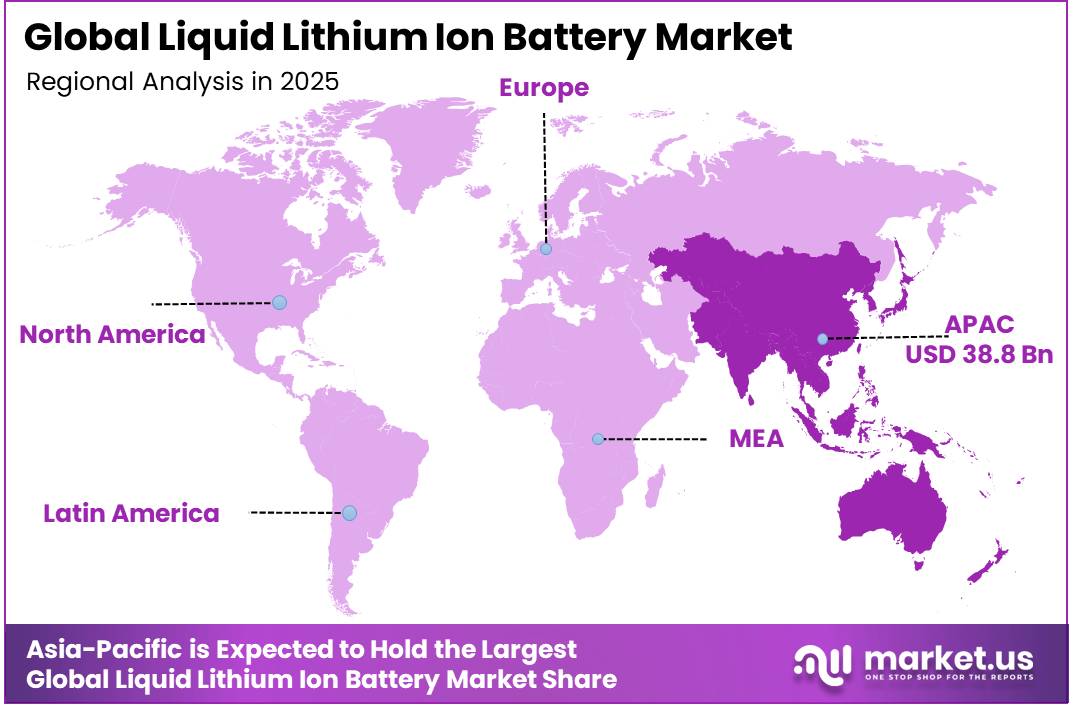
Key Regions and Countries Covered
- North America
- The US
- Canada
- Europe
- Germany
- France
- The UK
- Spain
- Italy
- Russia & CIS
- Rest of Europe
- APAC
- China
- Japan
- South Korea
- India
- ASEAN
- Rest of APAC
- Latin America
- Brazil
- Mexico
- Rest of Latin America
- Middle East & Africa
- GCC
- South Africa
- Rest of MEA
Key Players Analysis
Panasonic Holdings Corporation maintains a strong liquid lithium-ion battery position through Panasonic Energy, which supplies cylindrical cells for electric vehicles, industrial equipment, and consumer applications. In fiscal 2026, the company continued expanding its battery operations and developing higher-capacity cells, including the 2170 and 4680 formats. Panasonic Energy’s large manufacturing presence in Japan and North America supports reliable supply to automotive customers. Its competitiveness is strengthened by more than 30 years of lithium-ion battery production experience and continued investment in energy density, safety, and manufacturing productivity.
SVOLT Energy Technology has strengthened its liquid lithium-ion battery business through rapid capacity development, short-blade cells, fast-charging technologies, and international manufacturing. During January–October 2025, its global EV battery installations reached 23.7 GWh, increasing 86.6% year over year, while its worldwide market share rose from 1.8% to 2.5%. The company operates 14 production sites and 3 technology research centers and recorded more than 11,000 patent applications. It also invested RMB 5.2 billion in research and development between 2019 and 2025.
Shenzhen Capchem Technology plays an important role in the liquid lithium-ion battery value chain by producing electrolytes, lithium salts, solvents, and performance additives. In April 2025, its Chongqing facility began operating the first phase of a project designed to manufacture 100,000 tons of lithium-ion battery electrolyte annually. Its Polish facility had already established 40,000 tons of electrolyte capacity. Capchem also signed a supply arrangement with a German customer expected to generate more than EUR 1.1 billion in cumulative revenue between 2025 and 2034, strengthening its international customer base.
GS Yuasa International Ltd. supplies liquid lithium-ion batteries for hybrid, plug-in hybrid, electric, aerospace, marine, and specialized applications. In the fiscal year ending March 2026, its automotive lithium-ion battery segment generated JPY 89.93 billion in sales and JPY 4.93 billion in operating profit. The company increased Blue Energy’s production capacity to approximately 70 million cells annually to meet hybrid-vehicle demand. GS Yuasa has supplied automotive lithium-ion batteries for more than 15 years and continues developing competitive cells for future battery-electric vehicles through its joint venture with Honda.
The Major Players in The Industry
- CATL (Contemporary Amperex Technology)
- BYD Company Ltd.
- LG Energy Solution
- CALB (China Aviation Lithium Battery)
- Gotion High-Tech Co., Ltd.
- SK On Co., Ltd.
- Panasonic Holdings Corporation
- EVE Energy Co., Ltd.
- Samsung SDI Co., Ltd.
- SVOLT Energy Technology
- Tinci Materials Technology
- Shenzhen Capchem Technology
- Mitsubishi Chemical Group
- LG Chem Ltd.
- GS Yuasa International Ltd.
Key Development
- In March 2026, BYD Company introduced its second-generation Blade Battery with 1,500 kW FLASH charging, enabling charging from 10% to 70% in 5 minutes and reaching 97% in 9 minutes.
- In April 2025, CATL signed a framework agreement with Sinopec to establish at least 500 battery-swapping stations during the year, with a long-term target of 10,000 stations, supporting wider use of standardized lithium-ion battery packs.
Report Scope
| Report Features | Description |
|---|---|
| Market Value (2025) | USD 57.7 Bn |
| Forecast Revenue (2035) | USD 232.5 Bn |
| CAGR (2026-2035) | 15.0% |
| Base Year for Estimation | 2025 |
| Historic Period | 2020-2024 |
| Forecast Period | 2026-2035 |
| Report Coverage | Revenue Forecast, Market Dynamics, Competitive Landscape, Recent Developments |
| Segments Covered | By battery chemistry (Lithium Iron Phosphate (LFP), Lithium Nickel Manganese Cobalt Oxide (NMC), Lithium Nickel Cobalt Aluminum Oxide (NCA), Lithium Cobalt Oxide (LCO), Others), By form factor (Cylindrical, Prismatic, Pouch), By capacity (Less than 3,000 mAh, 3,000–10,000 mAh, 10,000–60,000 mAh, 60,000 mAh and above), and By end-use industry (Automotive, Utilities & Power, Consumer Electronics, Telecommunications, Aerospace & Defense, Industrial & Commercial) |
| Regional Analysis | North America – The US & Canada; Europe – Germany, France, The UK, Spain, Italy, Russia & CIS, Rest of Europe; APAC– China, Japan, South Korea, India, ASEAN & Rest of APAC; Latin America– Brazil, Mexico & Rest of Latin America; Middle East & Africa– GCC, South Africa, & Rest of MEA |
| Competitive Landscape | CATL (Contemporary Amperex Technology), BYD Company Ltd., LG Energy Solution, CALB (China Aviation Lithium Battery), Gotion High-Tech Co., Ltd., SK On Co., Ltd., Panasonic Holdings Corporation, EVE Energy Co., Ltd., Samsung SDI Co., Ltd., SVOLT Energy Technology, Tinci Materials Technology, Shenzhen Capchem Technology, Mitsubishi Chemical Group, LG Chem Ltd., GS Yuasa International Ltd. |
| Customization Scope | Customization for segments, region/country-level will be provided. Moreover, additional customization can be done based on the requirements. |
| Purchase Options | We have three licenses to opt for: Single User License, Multi-User License (Up to 5 Users), Corporate Use License (Unlimited Users and Printable PDF) |





































