


Report Overview
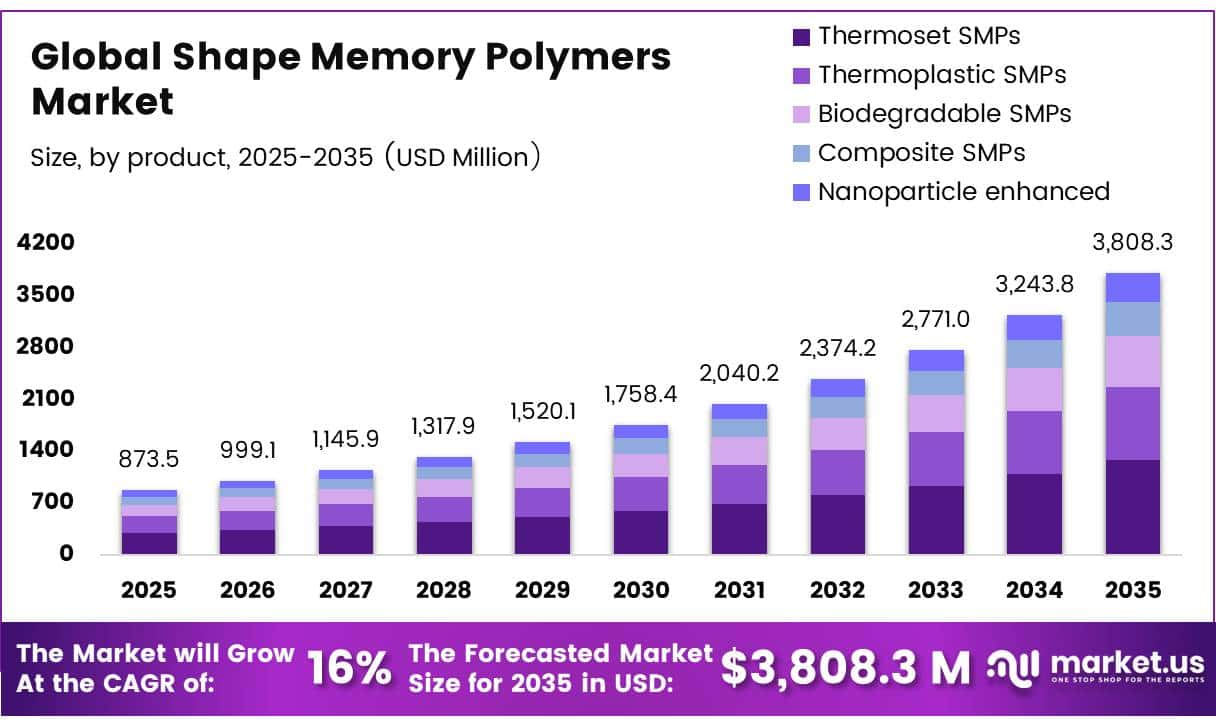
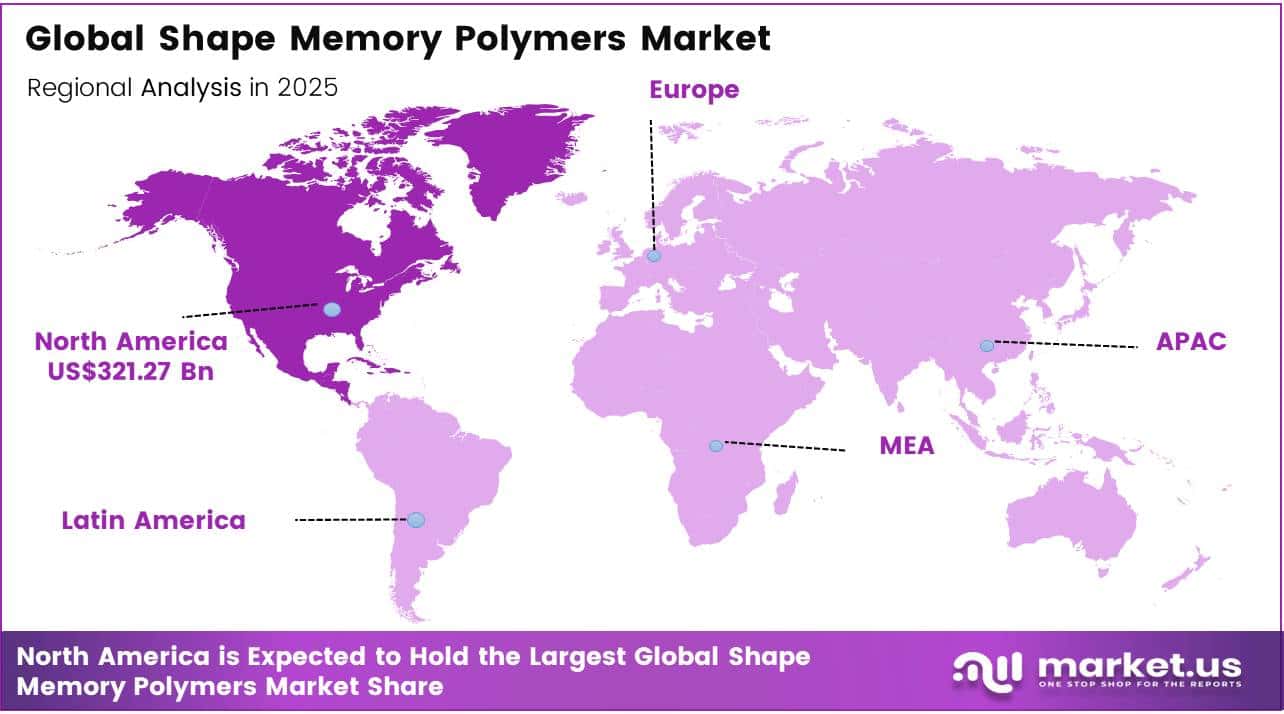
In 2025, the Global Shape Memory Polymers Market was valued at USD 873.5 million, and between 2026 and 2035, this market is estimated to register a CAGR of 16.0%, reaching about USD 3,808.3 million by 2035. In 2025, North America held a dominant market position, capturing more than a 36.78% share, holding USD 321.27 million revenue.
Shape memory polymers are becoming smart materials globally because they can recover a programmed form after exposure to heat, light, electricity, moisture or magnetic fields. Their low density, deformation and transition temperature support aerospace structures, composite tooling, electronics, soft robotics and medical devices.
- NASA’s 2025 microgravity campaign folded five samples and one sample under hypergravity. A NASA dust-tolerant reversible-joint programme demonstrated operation over hundreds of cycles and targets Technology Readiness Level 5, indicating progress toward deployable spacecraft hardware.
Healthcare offers an industrial pathway. The European Union’s SMARTSHAPE initiative has a total budget of €3.218 million and is developing a temperature-responsive polymer sensor for continuous blood-pressure monitoring. The programme addresses a condition associated with more than 9 million premature deaths annually.
- In 2025, researchers produced multimaterial shape-memory polymer fibres with 10-micrometre resolution and aspect ratios above 100,000. These fibres supported controlled drug release for up to 6 months and self-tightened within 40 seconds, strengthening opportunities in sutures, implants, catheters and localized drug delivery.
Future growth will be driven by 4D printing, lighter aerospace mechanisms, minimally invasive healthcare, adaptive electromagnetic shielding and reusable composite tools. The EU-funded Sim3D-DynaShield project received €216,240 for work on 3D-printed dynamic shielding through April 2027. Its funding classification assigns 100% relevance to digital technologies, 100% to artificial intelligence and 40% to climate action.
Wider adoption will depend on faster recovery, improved fatigue life, repeatable cycling, biocompatibility, recyclability and scalable production. Manufacturers combining programmable polymers with additive manufacturing, sensors and conductive fillers are likely to unlock higher-value applications.
Key Takeaways
- The global Shape Memory Polymers market was valued at USD 873.5 million in 2025.
- The global market is projected to grow at a CAGR of 16.0% and is estimated to reach USD 3,808.3 million by 2035.
- On the basis of Product, the Thermoset SMPs dominated the market, constituting 33.78% of the total market share.
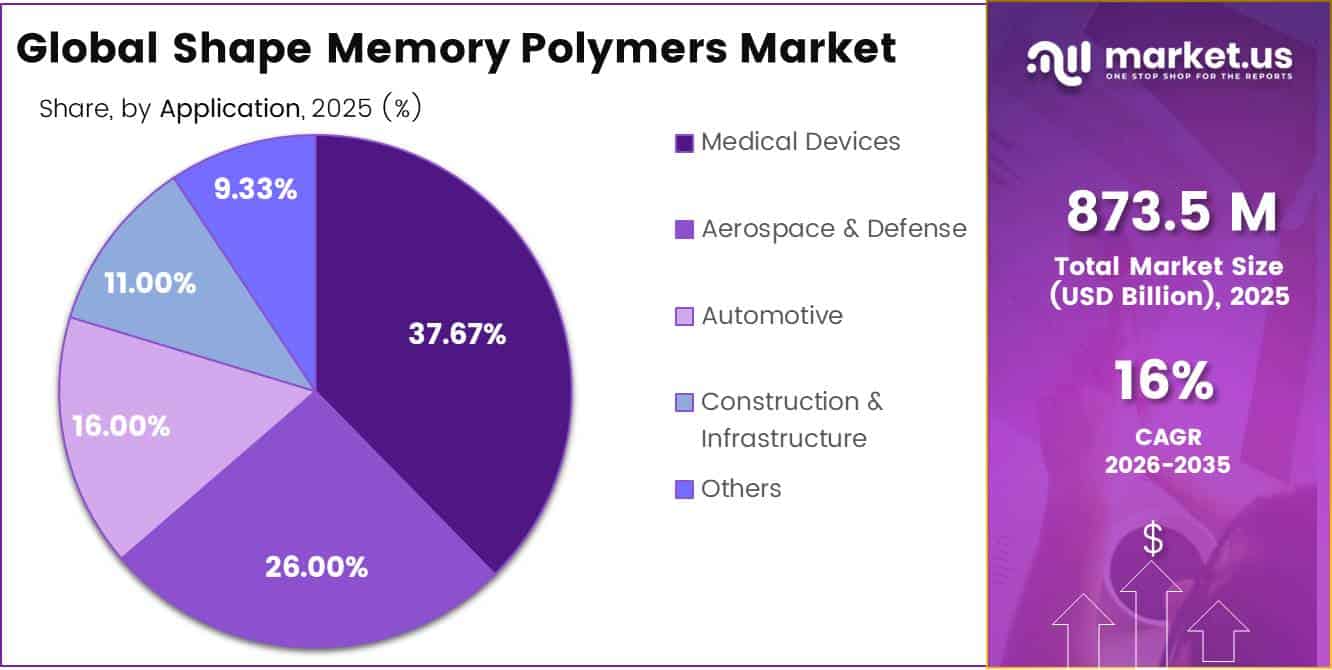
- Based on the Application, the Medical Devices dominated the Shape Memory Polymers market, with a substantial market share of around 37.67%.
- In 2025, the North America was the most dominant region in the Shape Memory Polymers market, accounting for 36.78% of the total global consumption.
Product Analysis
Thermoset SMPs represents dominant Segment in the Market.
Thermoset shape memory polymers held the largest market share at 33.78%. Their permanently cross-linked structure offers reliable shape retention, thermal resistance and dimensional stability, making them suitable for aerospace structures, composite tooling and deployable components. NASA-developed thermoset SMP composite trusses demonstrated repeatable self-deployment after linear compaction exceeding an 11:1 ratio. This high packaging efficiency supports their use in systems where lightweight construction and compact storage are essential.
Biodegradable SMPs are gaining momentum in healthcare applications. Demand is increasing for temporary implants, regenerative scaffolds and minimally invasive devices that can recover their programmed shape before gradually degrading. A 2025 study hosted by the U.S. National Library of Medicine evaluated biodegradable SMP scaffolds within 4 mm × 8 mm bone defects. The materials showed strong biocompatibility, limited inflammatory response and successful bone ingrowth, supporting future opportunities in tissue regeneration and patient-specific implants.
Application Analysis
Medical devices a significant Application.
Medical devices held the leading position in the shape memory polymers market with a 37.67% share. Demand is supported by minimally invasive instruments that can change stiffness, navigate narrow pathways and recover a programmed form inside the body. A 2024 study hosted by the U.S. National Library of Medicine reported a nontoxic SMP catheter delivering a 66-fold stiffness change and a transition speed 26 times faster than its non-cooled design. The catheter also achieved bending of up to 127° in air, highlighting the material’s potential for cardiac and vascular procedures.
Aerospace and defense is emerging as the growing application as agencies seek lightweight, compact and self-deploying structures. NASA’s Flight Opportunities programme tested more than 30 technologies between February and November 2024. During the campaign, shape memory polymer samples completed their first recorded self-folding demonstration in microgravity under infrared light, strengthening prospects for deployable space hardware and adaptive components.
Key Market Segments
By Product
- Thermoplastic SMPs
- Polyurethane-based systems
- Polyester-based systems
- Polycaprolactone systems
- Thermoset SMPs
- Epoxy-based systems
- Cyanate ester systems
- Polyimide systems
- Biodegradable SMPs
- Poly(ε-caprolactone) based
- PLGA-based systems
- PHA-based systems
- Composite SMPs
- Carbon fiber reinforced
- Glass fiber reinforced
- Nanoparticle enhanced
By Application
- Medical Devices
- Aerospace & Defense
- Automotive
- Construction & Infrastructure
- Others
Driver Analysis
Minimally Invasive Devices & Implants
The U.S. FDA received 21,780 medical-device submissions and authorized 124 novel devices in FY2025; its 510(k) performance target is a decision within 90 FDA days, while the FY2026 standard 510(k) fee is $26,067 and annual establishment-registration fee is $11,423 economics that favour established material suppliers able to provide biocompatibility data packages, batch traceability, extractables/leachables evidence, and validated sterilization compatibility rather than merely selling resin.
In Europe, MDR transition deadlines of 31 December 2027 for Class III and most Class IIb implantables and 31 December 2028 for other specified device classes create a near-term redesign and recertification cycle; SMP producers that co-develop catheter, embolic, orthodontic, scaffold, and implant components can capture qualification-led, multi-year revenues, although clinical evidence and post-market surveillance increase time-to-revenue.
Drivers Impact Analysis
| Driver | (~) % Impact on CAGR | Geographic Relevance | Impact Timeline |
|---|---|---|---|
| Minimally invasive devices & implants | +2.4 pp | North America core, EU, Japan, China | Medium term (2–4 years) |
| 4D printing and customized components | +1.9 pp | North America, EU, China, Japan, South Korea | Short term (≤ 2 years) |
| EV battery thermal-safety systems | +1.5 pp | China core, EU, U.S., South Korea, Japan | Medium term (2–4 years) |
| Aerospace deployables & morphing structures | +1.2 pp | U.S., EU, Japan, India, China | Long term (≥ 4 years) |
| Soft robotics, wearables & smart textiles | +1.1 pp | APAC, North America, EU | Medium term (2–4 years) |
| Circular, recyclable SMP chemistries | +0.8 pp | EU core, North America, Japan, South Korea | Long term (≥ 4 years) |
Restraint Analysis
Specialty Feedstock Cost
In a 2026 base-case production model, a formulated SMP compound can carry a 20–45% raw-material premium over a conventional engineering thermoplastic, while conductive fillers, bio-based feedstocks, radiation-stable additives, and medical-grade traceability can add a further 10–25% to delivered material cost; this weakens adoption in high-volume automotive trim, consumer goods, and low-cost industrial components where the functional benefit does not offset the conversion-cost penalty.
The commercial consequence is margin compression for compounders that cannot pass through specialty-input inflation, while OEMs defer qualification and tooling investment until annual demand is sufficient to support dedicated production runs, dual sourcing, and lower scrap rates; additive manufacturing can reduce assembly count, but it does not eliminate the high per-kilogram cost of qualified SMP feedstock.
Restraint Impact Analysis
| Restraint | (~) % Impact on CAGR | Geographic Relevance | Impact Timeline |
|---|---|---|---|
| Specialty feedstock cost | -2.1 pp | Global; APAC import markets | Short term (≤ 2 years) |
| Low load-bearing strength | -1.8 pp | North America, EU, Japan | Medium term (2–4 years) |
| Moisture and thermal instability | -1.5 pp | Global; medical and electronics | Medium term (2–4 years) |
| Medical qualification burden | -1.4 pp | North America core, EU, Japan | Medium term (2–4 years) |
| Scale-up and lot variability | -1.2 pp | Global; China, India, Southeast Asia | Short term (≤ 2 years) |
| Chemical and circularity compliance | -0.9 pp | EU core, UK, North America | Long term (≥ 4 years) |
Opportunity Analysis
Device-Platform Licensing
This is an opportunity rather than a present driver because most SMP revenue remains tied to one-time material supply and project-specific development, whereas a platform model allows one qualified material architecture to be deployed across several device variantssuch as self-expanding occlusion devices, catheter tips, wound-closure products, orthodontic components, and soft-actuation modules.
An analyst 2026 commercial model indicates that converting 20–30% of specialty-material revenue into design-license, validation, and recurring technical-support revenue could improve gross margin by 8–15 percentage points, reduce customer qualification cycles by 4–9 months, and lower customer acquisition cost by 15–25% where a pre-tested biocompatibility and manufacturing dossier is reused. The opportunity is credible because SMPs already demonstrate utility across sensors, smart textiles, aerospace, robotics, biomedicine, and tissue-engineering applications, but these applications remain commercially fragmented rather than packaged as repeatable design platforms.
Opportunity Impact Analysis
| Opportunity | (~) % Potential CAGR Upside | Geographic Relevance | Execution Window |
|---|---|---|---|
| Device-platform licensing | +2.2 pp | North America, EU, Japan | Short term (≤ 2 years) |
| Resorbable implant platforms | +2.0 pp | U.S., EU, China, Japan | Medium term (2–4 years) |
| Distributed 4D-printing hubs | +1.7 pp | China, India, ASEAN, Brazil | Medium term (2–4 years) |
| Satellite deployable systems | +1.5 pp | U.S., EU, India, Japan | Long term (≥ 4 years) |
| Circular vitrimer SMPs | +1.3 pp | EU core, North America, Korea | Medium term (2–4 years) |
| Microfluidic diagnostics modules | +1.1 pp | North America, EU, China | Medium term (2–4 years) |
Challenges Analysis
Activation Uniformity Control
SMP manufacturers must continuously manage the gap between laboratory-scale activation and repeatable field performance because recovery response depends simultaneously on transition temperature, heating rate, part thickness, filler dispersion, electrical resistance, moisture exposure, thermal history, and local stress concentration; this is an operational challenge rather than a current sales restraint because products can still be sold, but the variability increases warranty risk, scrap, validation cost, and customer engineering time.
Recent research identifies non-uniform activation and the trade-off between mechanical strength and recovery performance as central SMP development challenges, while electrothermal composite testing has demonstrated 90% recovery and 7.38 N maximum recovery force under controlled conditions performance that can deteriorate materially when heating uniformity, part geometry, or conductive-network distribution changes in scaled production.
In an analyst manufacturing scenario, a ±3–5°C shift in switching temperature across lots can create 5–12% additional rejection in precision applications, while adding embedded sensors, conductive pathways, infrared heating validation, or closed-loop thermal controls can raise conversion cost by 8–18%; companies therefore need digital thermal mapping, process-capability targets above 1.33 Cpk, and application-specific activation protocols rather than relying on generic material datasheets.
Challenges Impact Analysis
| Challenge | (~) % CAGR Friction | Geographic Relevance | Mitigation Horizon |
|---|---|---|---|
| Activation uniformity control | -1.6 pp | North America, EU, Japan, China | Medium term (2–4 years) |
| Standards and test gaps | -1.4 pp | EU regulatory hubs, U.S., Japan | Medium term (2–4 years) |
| Cross-disciplinary talent scarcity | -1.2 pp | North America, EU, APAC innovation hubs | Long term (≥ 4 years) |
| Multi-tier feedstock traceability | -1.1 pp | APAC corridors, EU, North America | Medium term (2–4 years) |
| Long-cycle durability proof | -1.0 pp | Global; aerospace, medical, automotive | Long term (≥ 4 years) |
| Application data fragmentation | -0.8 pp | Global; emerging APAC, Latin America | Short term (≤ 2 years) |
Geopolitical Impact Analysis
Critical-Material Nationalism and Supply Chain Localization Reshaping Shape Memory Polymer Manufacturing.
Geopolitical tensions are reshaping shape memory polymer supply chains because advanced formulations can use graphite, rare-earth additives, metallic particles and specialty chemicals. The U.S. Geological Survey reported that China produced 82% of global natural graphite, 71% of mined rare earths and 99% of primary gallium in 2024. In 2025, the United States still relied on China as a major source for 14 of the 33 critical minerals where import dependence was highest. Export controls or shipping disruption can therefore raise material qualification, inventory and logistics costs for aerospace, defense, medical and electronically activated SMP products.
Governments are responding through domestic production and advanced-manufacturing investment. The U.S. Department of Defense awarded $192.5 million across 7 projects to establish capacity for 22 critical chemicals by the end of 2027; total Defense Production Act awards since fiscal 2024 reached $289 million across 10 projects.
In January 2025, the Department of Commerce allocated $210 million to technology hubs, including about $48 million for aerospace-material manufacturing and $29 million for critical-mineral processing. These programmes encourage SMP manufacturers to qualify regional suppliers, localize compounding, expand recycling and maintain multiple sourcing routes. Although localization may initially increase compliance and testing expenses, it can reduce exposure to trade restrictions and improve long-term supply reliability
Regional Analysis
Asia Pacific Held the Largest Share of the Global Shape Memory Polymers Market.
North America held the leading position in the shape memory polymers market, capturing a 36.78% share in 2025. Regional leadership is supported by strong medical-device manufacturing, aerospace research and early adoption of programmable materials in minimally invasive products. The U.S. Food and Drug Administration regulated 264,670 medical devices and supervised 25,530 registered device manufacturing firms during 2025. It also authorized 124 novel medical devices, reflecting an active innovation environment where shape memory polymers can gain wider use in catheters, implants, surgical tools and wearable systems.
Asia-Pacific is the fastest-growing region as advanced manufacturing, additive production and aerospace activity expand. China’s National Bureau of Statistics reported that high-technology manufacturing output increased by 9.4% in 2025. Production of 3D-printing equipment rose by 52.5%, while aircraft manufacturing grew by 24.8%. These developments create practical opportunities for 4D-printed structures, adaptive automotive parts and lightweight deployable aerospace systems using shape memory polymers.
Key Regions and Countries Covered
- North America
- The US
- Canada
- Europe
- Germany
- France
- The UK
- Spain
- Italy
- Russia & CIS
- Rest of Europe
- APAC
- China
- Japan
- South Korea
- India
- ASEAN
- Rest of APAC
- Latin America
- Brazil
- Mexico
- Rest of Latin America
- Middle East & Africa
- GCC
- South Africa
- Rest of MEA
Key Players Analysis
Shape memory polymer manufacturers focus on strengthening material performance, application-specific design and production consistency to maintain competitiveness. A major priority is continuous polymer innovation, including the development of thermoset, thermoplastic, biodegradable and nanoparticle-enhanced formulations that offer improved recovery speed, mechanical strength, thermal responsiveness and fatigue resistance.
Closer integration with specialty chemical suppliers, research institutes and end-use manufacturers helps secure high-quality raw materials and shorten product-development cycles. Strategic production expansion near aerospace, healthcare and advanced-manufacturing clusters allows suppliers to respond more quickly to specialized demand. Manufacturers further emphasize patent protection, automated quality control and standardized testing to ensure reliable shape recovery across repeated cycles.
The Major Players In The Industry
- DOW Corning
- BASF SE
- Evonik Industries AG
- DSM N.V.
- Syngenta AG
- 3M Company
- Ashland Global Holdings Inc.
- Coating Place Inc.
- Capsugel (Lonza Group)
- Balchem Corporation
- Aveka Inc.
- Other Key Players
Key Development
- In March 2025, BASF SE expanded its Ultramid Advanced T1000 portfolio with hydrolysis-resistant grades tested at 130°C for up to 3,000 hours, strengthening high-performance polymer options relevant to demanding automotive and smart-material applications.
- In November 2025, Evonik Industries AG reported successful trial operation of a second polyamide reactor in Shanghai, increasing its long-chain polyamide production capacity in Asia by 100% (doubling output) and significantly strengthening regional supply capability for automotive, energy storage, additive manufacturing, and advanced polymer applications.
Report Scope
| Report Features | Description |
|---|---|
| Market Value (2025) | USD 873.5 Mn |
| Forecast Revenue (2035) | USD 3,808.3 Mn |
| CAGR (2026-2035) | 16% |
| Base Year for Estimation | 2025 |
| Historic Period | 2020-2024 |
| Forecast Period | 2026-2035 |
| Report Coverage | Revenue Forecast, Market Dynamics, Competitive Landscape, Recent Developments |
| Segments Covered | By Product (Thermoset SMPs, Thermoplastic SMPs, Biodegradable SMPs, Composite SMPs and Nanoparticle enhanced), By Application (Medical Devices, Aerospace & Defense, Automotive, Construction & Infrastructure and Others) |
| Regional Analysis | North America – The US & Canada; Europe – Germany, France, The UK, Spain, Italy, Russia & CIS, Rest of Europe; APAC– China, Japan, South Korea, India, ASEAN & Rest of APAC; Latin America– Brazil, Mexico & Rest of Latin America; Middle East & Africa– GCC, South Africa, & Rest of MEA |
| Competitive Landscape | DOW Corning, BASF SE, Evonik Industries AG, DSM N.V., Syngenta AG, 3M Company, Ashland Global Holdings Inc., Coating Place Inc., Capsugel (Lonza Group), Balchem Corporation, Aveka Inc., Other Key Players. |
| Customization Scope | Customization for segments, region/country-level will be provided. Moreover, additional customization can be done based on the requirements. |
| Purchase Options | We have three licenses to opt for: Single User License, Multi-User License (Up to 5 Users), Corporate Use License (Unlimited Users and Printable PDF) |





































