


Report Overview
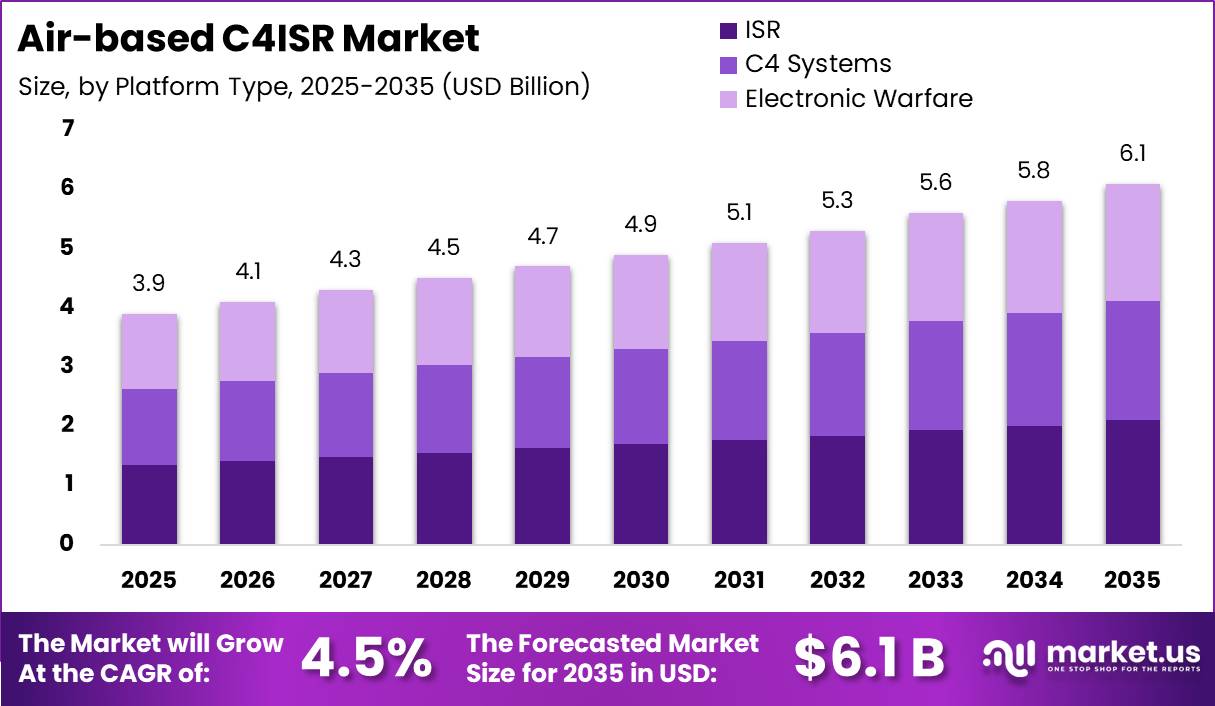
In 2025, the Global Air-based C4ISR Market was valued at USD 3.9 billion. The market is projected to grow at a CAGR of 4.5% during 2026–2035, reaching approximately USD 6.1 billion by 2035. North America dominated the global market in 2025, accounting for more than 38.2% of the total market share and generating approximately USD 1.4 billion in revenue.
According to SIPRI, worldwide military expenditure reached a record USD 2,887 billion in 2025, marking the 11th consecutive year of growth. The global military burden increased to 2.5% of world GDP, its highest level since 2009. NATO members collectively allocated 2.77% of GDP to defence in 2025, while European and Canadian allies increased expenditure by 19.6% year-on-year.
NATO members have also committed to raising annual defence-related spending to 5% of GDP by 2035. In Asia, military expenditure grew by 8.1% to USD 681 billion, the fastest increase since 2009. China raised spending by 7.4% to USD 336 billion, continuing its 31-year military modernisation trend. India’s expenditure increased by 8.9% to USD 92.1 billion.
The United States Department of Defense submitted a USD 961 billion budget request for 2026, while congressional plans exceed USD 1 trillion for 2026 and propose USD 1.5 trillion by 2027. Ukraine’s military spending also increased by 20% in 2025, reaching 40% of GDP. These investments are strengthening demand for airborne surveillance aircraft, reconnaissance drones, early-warning systems, and secure communication platforms.
Key Takeaway
- The Air-based C4ISR Market was valued at USD 3.9 billion in 2025 and is projected to reach USD 6.1 billion by 2035, growing at a CAGR of 4.5%.
- The ISR segment is dominated by Platform Type with a 34.6% share in 2025, supported by continued investment in airborne surveillance fleets.
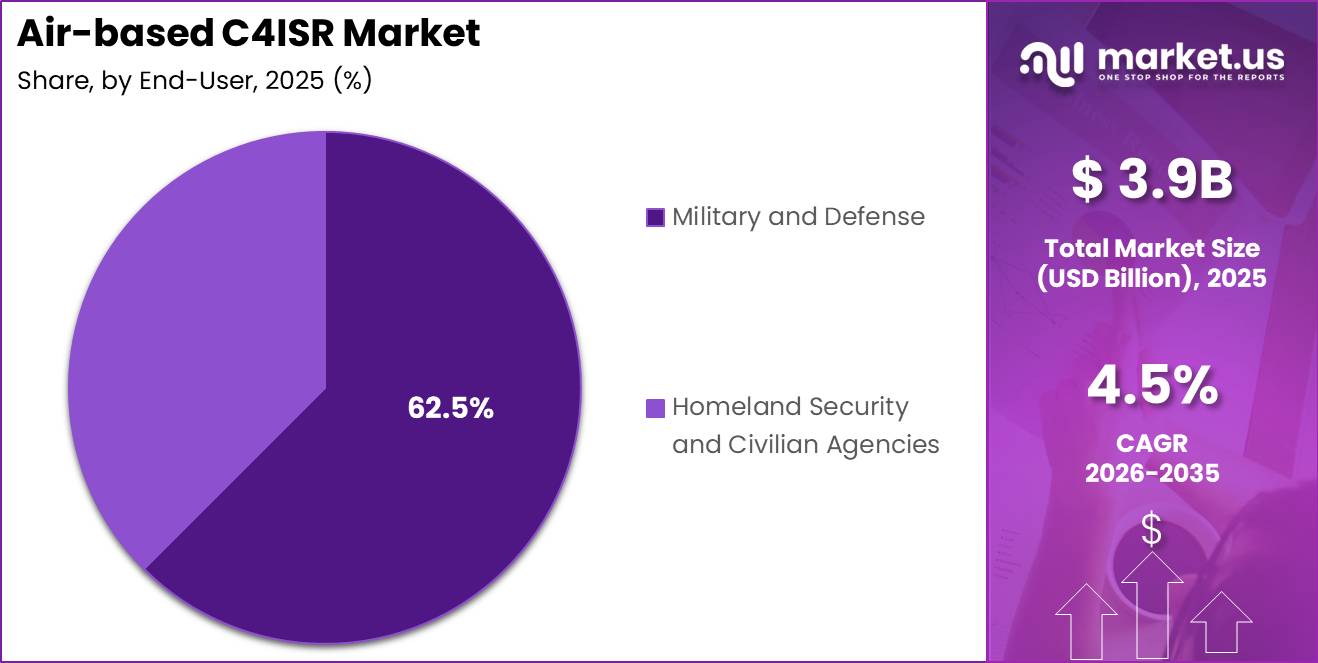
- The Military and Defense segment led the End-User category with a 62.5% share in 2025.
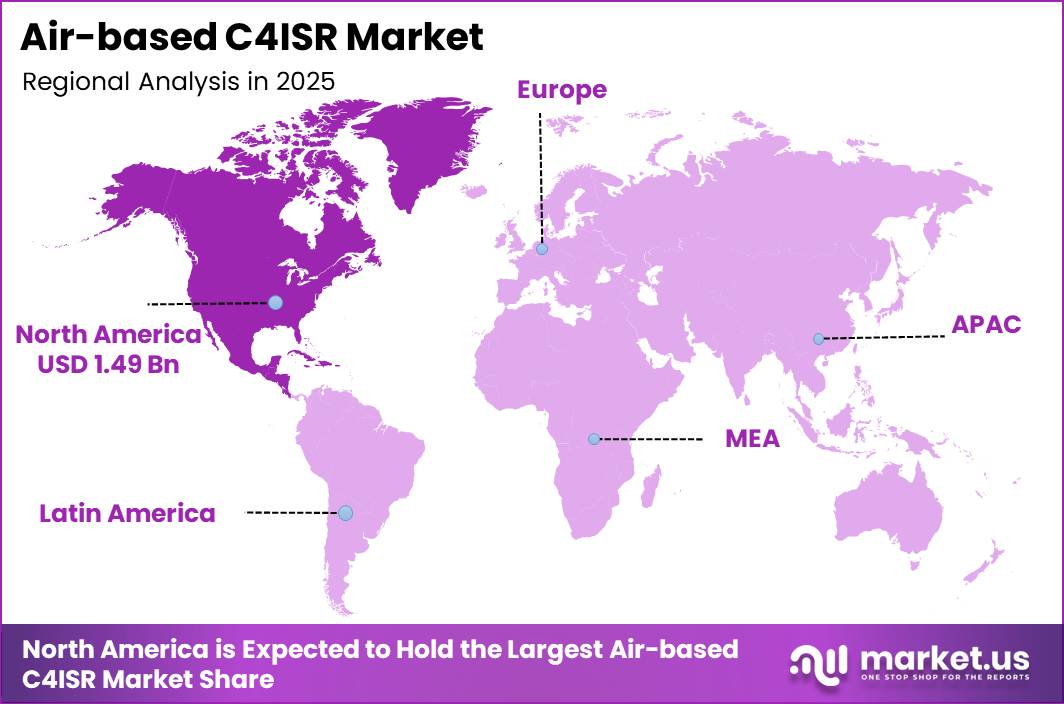
- North America led the global market in 2025 with a 38.2% share, generating approximately USD 1.4 billion in revenue.
Market Statistics and Data Insights
- NATO currently operates 14 Boeing E-3A AWACS aircraft, while the United Kingdom is preparing to operate 3 E-7 Wedgetail aircraft. NATO has also announced plans involving up to 10 Saab GlobalEye aircraft to replace part of its ageing E-3A fleet. The E-3A life-extension programme is designed to keep the existing fleet operational until 2035.
- A single NATO E-3A operating at approximately 30,000 feet can monitor more than 312,000 square kilometres. It can detect low-altitude targets within 400 kilometres and medium-altitude targets within 520 kilometres. Three aircraft flying coordinated orbits can provide continuous radar coverage across Central Europe.
- In December 2025, the US Space Development Agency awarded approximately USD 3.5 billion across 4 agreements for 72 Tracking Layer satellites. Lockheed Martin, Rocket Lab, Northrop Grumman and L3Harris were each selected to deliver 18 satellites for missile warning, tracking and defence missions, with launches planned for fiscal year 2029.
- During NATO’s Formidable Shield 2025 exercise, AWACS aircraft supported 16 ships, more than 25 aircraft and approximately 3,000 personnel. The aircraft supplied real-time air and maritime surveillance while coordinating fighter operations against subsonic, supersonic and ballistic targets.
- In July 2026, the US Government Accountability Office reported that the average delivery period for major US defence acquisition programmes had increased to more than 12 years. The Department of Defense planned to invest more than USD 2.4 trillion in its costliest weapon programmes, while programme delays and immature technologies continued to restrict timely delivery.
- In 2025, the GAO found that expected initial-capability delivery for major defence programmes had increased by 18 months to almost 12 years from programme start. The combined estimated cost of 30 major programmes increased by USD 49.3 billion, partly because of development delays, inflation and immature technologies.
- DARPA’s 100G programme developed airborne links targeting a transmission capacity of 100 gigabits per second. Its technical targets included air-to-air connectivity over 200 kilometres and air-to-ground connectivity over 100 kilometres from aircraft operating at approximately 60,000 feet.
- In December 2025, US Navy and Marine Corps tactical unmanned aircraft passed 1 million ISR flight hours. The programme had completed more than 50 ship installations and operated from over 50 land-based locations worldwide.
- In October 2025, South Korea selected a Global 6500-based airborne early-warning and control programme valued at more than USD 2.26 billion. The aircraft will integrate airborne radar, command-and-control and threat-tracking systems.
- During NATO’s Falcon Strike 2025 exercise, more than 50 aircraft completed approximately 460 sorties and logged over 1,000 flight hours between 3 and 14 November 2025. More than 1,000 personnel participated in the integrated air operations.
By Platform Type
In 2025, the ISR, or Intelligence, Surveillance and Reconnaissance, segment held a dominant position in the Air-Based C4ISR market, accounting for a 34.6% share. This leadership is supported by continued investment in airborne surveillance fleets and intelligence-gathering platforms. According to the 2025 USAF Almanac, the United States Air Force operated 340 dedicated ISR, battle-management, and command, control, and communications aircraft.
This fleet included 27 U-2S high-altitude reconnaissance aircraft, 22 RC-135 Rivet Joint signals-intelligence aircraft, and 9 RQ-4B Global Hawk unmanned aircraft. NATO also operated 14 E-3A Airborne Warning and Control System aircraft through its multinational Airborne Early Warning and Control Force. These platforms support continuous airspace monitoring, early threat identification, and coordinated military operations.
Airborne ISR systems remain important because they provide mobile, wide-area, and line-of-sight surveillance across remote, difficult, or contested locations. Unlike fixed ground-based radar, these platforms can be repositioned quickly to support changing mission requirements. Demand is also being supported by the replacement of older aircraft, including the E-3 fleet, with modern systems such as the E-7 Wedgetail.
By End-User
In 2025, the Military and Defense segment held a dominant position in the Air-Based C4ISR market, accounting for a 62.5% end-user share. This leadership is mainly linked to the direct ownership and operation of airborne command, surveillance, and intelligence systems by national defence organisations.
The US Department of Defense requested USD 142 billion for research, development, testing and evaluation in FY2026. The amount increased to USD 179.1 billion when reconciliation funding was included. A significant part of this funding supports the modernisation of command-and-control systems, sensor networks, secure communications and intelligence platforms. These technologies are required to coordinate approximately 1.2 million active-duty personnel across five military branches.
International defence procurement also supports segment growth. According to the SIPRI Arms Transfers Database, global transfers of major weapons increased by 9.2% during 2021–2025 compared with the previous five-year period. This represented the strongest increase since 2011–2015.
Key Market Segments
By Platform Type
- ISR
- C4 Systems
- Electronic Warfare
By End-User
- Military and Defense
- Homeland Security and Civilian Agencies
Geopolitical Impact Analysis
Geopolitical tensions are creating serious supply-chain risks for the Air-Based C4ISR market, particularly through restrictions on rare earth materials. Following China’s export controls introduced in April 2025, Chinese customs data indicated that exports of heavy rare earths, including dysprosium and terbium, declined by roughly 50% year-on-year.
Supply pressure increased further in June 2026, when China expanded export restrictions to 10 additional US defence-linked companies, including Pentagon-supported MP Materials. These measures may limit access to dual-use materials and components required for airborne surveillance, intelligence and secure communication systems.
Trade barriers are also affecting the wider manufacturing environment. According to the World Trade Organization, tariff measures introduced through February 2026 affected approximately 72% of global trade conducted under most-favoured-nation terms. Global merchandise trade growth is expected to slow from 4.6% in 2025 to 1.9% in 2026 because of tariff uncertainty and energy-market instability in the Middle East.
AI-related goods, including chips, semiconductors and data-transmission equipment, remain largely protected from new tariffs, helping reduce pressure on C4ISR electronics. However, continued increases in crude oil and LNG prices could lower global trade growth further to 1.4% in 2026. Higher freight, energy and material costs are therefore encouraging manufacturers to diversify rare earth sourcing beyond China and strengthen regional supply networks.
Regional Analysis
In 2025, North America held a dominant position in the Air-Based C4ISR market, accounting for a 38.2% share valued at approximately USD 1.4 billion. The region’s leadership is supported by large US defence budgets, advanced aerospace manufacturing, and continued investment in airborne intelligence and communication systems.
The Department of the Air Force submitted a USD 338.8 billion budget request for FY2026, representing an increase of USD 92.5 billion year-on-year. This included USD 7.4 billion for 38 F-35 aircraft, USD 3.9 billion for 15 KC-46A tankers and USD 7 billion for the B-21 bomber programme. These aircraft use integrated surveillance, communication, navigation and battle-management technologies. The wider Pentagon procurement request of USD 205 billion for FY2026 further supports North America’s strong market position.
Asia Pacific is expected to be the fastest-growing region as Japan, China and India increase defence modernisation spending. Japan approved a record JPY 9.0 trillion, or USD 57.9 billion, defence budget for FY2026, marking its 12th consecutive record year. Around JPY 100.1 billion was allocated for thousands of surveillance drones under the SHIELD coastal defence programme.
China’s defence spending reached USD 336 billion in 2025 after increasing by 7.4%, continuing a 31-year modernisation trend. India’s spending also rose by 8.9% to USD 92.1 billion. Rising regional tensions and coastal surveillance requirements are supporting strong demand for airborne early-warning, reconnaissance and secure communication systems.
Key Regions and Countries
- North America
- US
- Canada
- Europe
- Germany
- France
- The UK
- Spain
- Italy
- Rest of Europe
- Asia Pacific
- China
- Japan
- South Korea
- India
- Australia
- Rest of APAC
- Latin America
- Brazil
- Mexico
- Rest of Latin America
- Middle East & Africa
- GCC
- South Africa
- Rest of MEA
Market Dynamics
Drivers
| Driver | (~) % CAGR | Geographic Relevance | Impact Timeline |
|---|---|---|---|
| Rising defense budget allocations to airborne surveillance | +1.4% | North America, Europe | Short term (2 years or less) |
| Networked battle-management modernization programs | +1.0% | North America, NATO members | Short term (2 years or less) |
| Territorial tension-driven aerial reconnaissance procurement | +0.8% | Asia Pacific | Medium term (2 to 4 years) |
| Legacy AWACS and ISR fleet replacement cycles | +0.6% | North America, Europe | Medium term (2 to 4 years) |
| Increased unmanned airborne sensor integration in active fleets | +0.5% | Global | Short term (2 years or less) |
Defense Budget Reallocation Toward Airborne Surveillance
The strongest market driver is the shift in national defence budgets toward airborne command, surveillance and sensing systems rather than personnel expansion or traditional ground-force equipment. In several countries, air force procurement accounts increased by more than 25% year-on-year, supported by the redirection of legacy aircraft maintenance budgets toward networked C4ISR technologies.
This budget shift is also shortening the sales cycle for major defence contractors, moving from long multi-year approval processes toward near-annual contract awards. Companies with pre-qualified radar, sensor and battle-management integration capabilities may benefit from programme margin improvements of around 150 to 200 basis points. Faster contract activity and stronger margins are expected to contribute an additional 1.4% to the market’s baseline 4.5% CAGR.
Restraints
| Restraint | (~) % CAGR | Geographic Relevance | Impact Timeline |
|---|---|---|---|
| Export control restrictions on critical sensor-grade rare earth inputs | -1.1% | Global | Short term (2 years or less) |
| High interest rate environment delaying capital-intensive fleet orders | -0.6% | Europe, emerging Asia Pacific | Short term (2 years or less) |
| Classified procurement bans on foreign-sourced avionics components | -0.5% | North America | Medium term (2 to 4 years) |
| Budget sequestration risk in constrained fiscal-deficit economies | -0.4% | Europe | Short term (2 years or less) |
Rare Earth and Sensor-Component Export Restrictions
The main market restraint is the slowdown in production caused by export licensing controls on rare earth elements and dual-use magnetic materials used in radar and electro-optical sensors. This pressure increased through 2025 and 2026, as heavy rare earth shipment volumes declined by approximately 40% to 50% year-on-year. Limited material availability has extended lead times for radar transmit-receive modules by an estimated 60 to 90 days compared with pre-restriction levels.
These supply constraints are increasing costs for manufacturers working under fixed-price airborne sensor contracts. Gross margins on these programmes could decline by around 200 to 300 basis points, while major systems integrators may need to redirect several hundred million dollars toward testing and qualifying alternative materials.
Challenges
| Challenge | (~) % CAGR | Geographic Relevance | Mitigation Horizon |
|---|---|---|---|
| Skilled avionics engineering talent shortage | -0.5% | North America, Europe | Long term (4 years or more) |
| Legacy system interoperability integration friction | -0.4% | NATO members | Medium term (2 to 4 years) |
| Cybersecurity hardening of airborne data links | -0.3% | Global | Medium term (2 to 4 years) |
| Multi-tier subcontractor quality assurance delays | -0.3% | Asia Pacific | Medium term (2 to 4 years) |
| Prolonged aircraft certification and airworthiness reviews | -0.2% | North America, Europe | Long term (4 years or more) |
Skilled Avionics and Systems Engineering Talent Deficit
The most important ongoing challenge is the shortage of security-cleared engineers specialising in avionics, radar and software-defined systems. This workforce gap widened during 2025, with an estimated 15,000 to 20,000 cleared engineering positions remaining unfilled across the airborne systems industry.
The limited availability of skilled workers is extending programme engineering schedules by approximately 4 to 6 months for each major system-integration milestone. To manage this issue, defence companies are increasing investment in apprenticeship programmes, workforce training and automated system-testing tools.
Internal training capital expenditure is reported to be rising by around 10% to 15% annually as companies work to build long-term technical capacity. This shortage is expected to limit project delivery speed rather than reduce overall demand, creating an estimated -0.5% friction against the market’s baseline 4.5% CAGR.
Opportunities
| Opportunity | (~) % CAGR | Geographic Relevance | Execution Window |
|---|---|---|---|
| AI-enabled sensor fusion retrofit for legacy airborne fleets | +1.2% | North America, Europe | Medium term (2 to 4 years) |
| Allied co-development and technology-sharing joint ventures | +0.9% | Asia Pacific, Europe | Medium term (2 to 4 years) |
| Commercial-to-military dual-use airborne sensing adaptation | +0.6% | Global | Long term (4 years or more) |
| Emerging market fleet modernization roll-up acquisitions | +0.5% | Middle East, Southeast Asia | Long term (4 years or more) |
AI-Enabled Sensor Fusion Retrofit of Legacy Airborne Fleets
The most significant untapped opportunity lies in retrofitting existing airborne surveillance and early-warning aircraft with AI-enabled sensor-fusion software instead of focusing only on new-build platforms. This opportunity is supported by the large number of legacy aircraft still awaiting digital upgrades, with average airframe ages exceeding 25 years across several allied air forces.
The economic benefits are also attractive. Retrofit software and processing-unit packages are estimated to deliver gross margins of 55% to 65%, compared with 30% to 35% for new-aircraft integration. Per-unit retrofit costs may also decline by around 8% to 10% with each successive fleet batch as production experience improves. Capturing this opportunity within the planned execution period could add approximately 1.2% to the market’s baseline 4.5% CAGR.
Key Players Analysis
The Air-Based C4ISR market has a concentrated competitive structure led by Tier-1 companies such as Lockheed Martin, Northrop Grumman, and L3Harris Technologies. These companies maintain their leadership through broad airborne platform portfolios, advanced system-integration capabilities, and large long-term order backlogs.
Lockheed Martin reported USD 75.0 billion in net sales in 2025, representing 6% year-on-year growth. Its Aeronautics business generated USD 30.3 billion, while the company ended the year with a record backlog of USD 194 billion. This backlog represents more than 2.5 years of future sales and provides strong visibility for aircraft, sensor and mission-system programmes.
Northrop Grumman recorded USD 42 billion in 2025 sales and closed the year with a USD 95.7 billion backlog. Its Mission Systems division, which supplies airborne radar, electro-optical systems and sensor payloads, increased sales by 10% to USD 12.5 billion. Growth was supported by higher production levels across restricted airborne radar programmes.
L3Harris Technologies invested USD 536 million in company-funded research and development during 2025, equal to 2% of total revenue, to strengthen its sensing, secure communication and multi-domain technology portfolio.
Tier-2 companies, including Kratos Defense and Security Solutions, Elbit Systems and General Dynamics, mainly compete in specialised unmanned and mission-support areas. Kratos ended 2025 with a USD 1.5 billion backlog, including a USD 1.4 billion hypersonic testbed award. Overall, Tier-1 firms lead large, multi-year programmes, while Tier-2 players compete through specialised technology and focused R&D.
Top Key Players in the Market
- Lockheed Martin Corporation
- Elbit Systems Ltd.
- Maxar Technologies Ltd.
- General Dynamics Corporation
- BAE Systems plc
- CACI International Inc.
- Northrop Grumman Corporation
- Kratos Defense and Security Solutions Inc.
- The Boeing Company
- L3Harris Technologies Inc.
- Defence Research and Development Organisation
- Hanwha Systems Co. Ltd.
Recent Developments
- In March 2026, the US Air Force awarded Boeing contract modifications worth USD 2.4 billion for the E-7A Wedgetail programme. The investment supports the planned procurement of 7 aircraft fitted with Northrop Grumman’s MESA surveillance radar.
- In July 2026, the Missile Defense Agency awarded L3Harris a potential 10-year contract valued at approximately USD 499.6 million. The agreement covers the operation, maintenance, and modernisation of the HALO airborne sensor fleet. HALO aircraft support missile testing by collecting tracking and performance data during flight.
- In August 2025, Elbit Systems secured a USD 1.6 billion contract for a period of 5 years from a European country. The agreement includes unmanned reconnaissance platforms, ISTAR systems, SIGINT, COMINT, and electronic-warfare technologies. These systems improve battlefield awareness, intelligence collection, and secure military communication.
Report Scope
| Report Features | Description |
|---|---|
| Market Value (2025) | USD 3.9 Billion |
| Forecast Revenue (2035) | USD 6.1 Billion |
| CAGR (2026-2035) | 4.5% |
| Base Year for Estimation | 2025 |
| Historic Period | 2020-2024 |
| Forecast Period | 2026-2035 |
| Report Coverage | Revenue Forecast, Market Dynamics, Competitive Landscape, Recent Developments |
| Segments Covered | By Platform Type (ISR, C4 Systems, Electronic Warfare); By End-User (Military and Defense, Homeland Security and Civilian Agencies) |
| Regional Analysis | North America – US, Canada; Europe – Germany, France, The UK, Spain, Italy, Rest of Europe; Asia Pacific – China, Japan, South Korea, India, Australia, Singapore, Rest of APAC; Latin America – Brazil, Mexico, Rest of Latin America; Middle East & Africa – GCC, South Africa, Rest of MEA |
| Competitive Landscape | Lockheed Martin Corporation, Elbit Systems Ltd., Maxar Technologies Ltd., General Dynamics Corporation, BAE Systems plc, CACI International Inc., Northrop Grumman Corporation, Kratos Defense and Security Solutions Inc., The Boeing Company, L3Harris Technologies Inc., Defence Research and Development Organisation, Hanwha Systems Co. Ltd. |
| Customization Scope | Customization for segments, region/country-level will be provided. Moreover, additional customization can be done based on the requirements. |
| Purchase Options | We have three licenses to opt for: Single User License, Multi-User License (Up to 5 Users), Corporate Use License (Unlimited Users and Printable PDF) |





































