


Report Overview
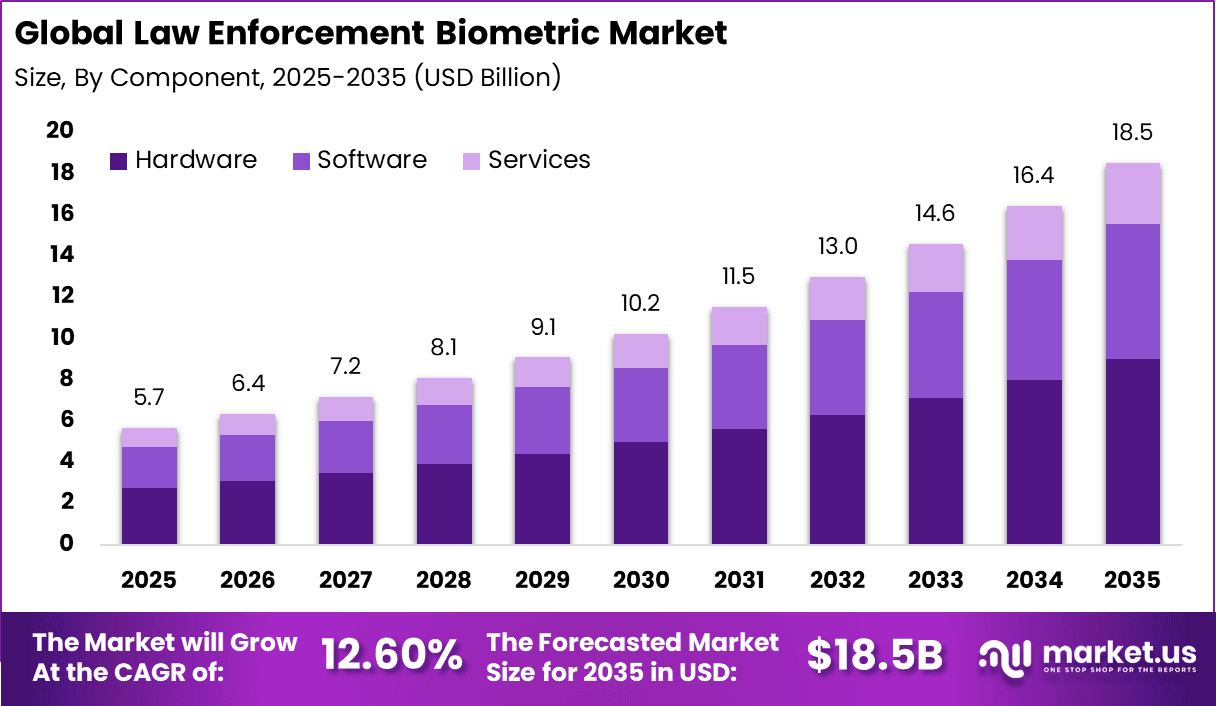
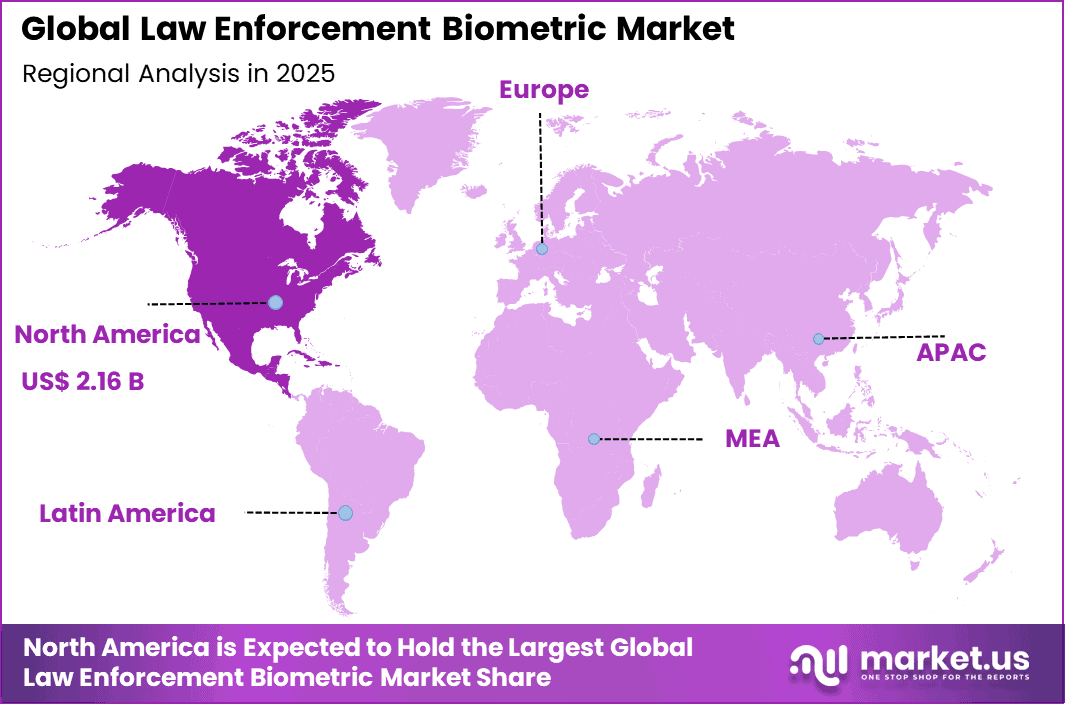
The Global Law Enforcement Biometric Market generated USD 5.7 billion in 2025 and is predicted to register growth from USD 6.4 billion in 2026 to about USD 18.5 billion by 2035, recording a CAGR of 12.6% throughout the forecast span. In 2025, North America held a dominant market position, capturing more than a 38.3% share, with USD 2.16 billion in revenue.
The law enforcement biometric market refers to technologies and systems used by police and public safety agencies to identify individuals based on unique physical or behavioural traits. These systems include fingerprint scanners, facial recognition cameras, iris and palm print readers, voice recognition tools, and gait analysis software.
Biometric data is compared with existing databases to confirm identity during criminal investigations, border control, suspect tracking, and access to secure facilities. Law enforcement agencies use these tools to support investigations, improve suspect identification accuracy, and enhance public safety.
Biometric systems provide faster and more reliable verification that can support investigations and operational decisions. Growth in digital records and national biometric databases also supports integration of biometric tools in routine law enforcement activities. Advances in sensor quality and pattern matching technologies have made biometric identification more accurate under real-world conditions.
Top Market Takeaways
- By technology type, biometric identification systems led the law enforcement biometric market with a 45.6% share, enabling rapid suspect matching via fingerprints, faces, and irises.
- By component, hardware captured 48.7%, providing scanners, mobile kits, and live scan devices for field and station use.
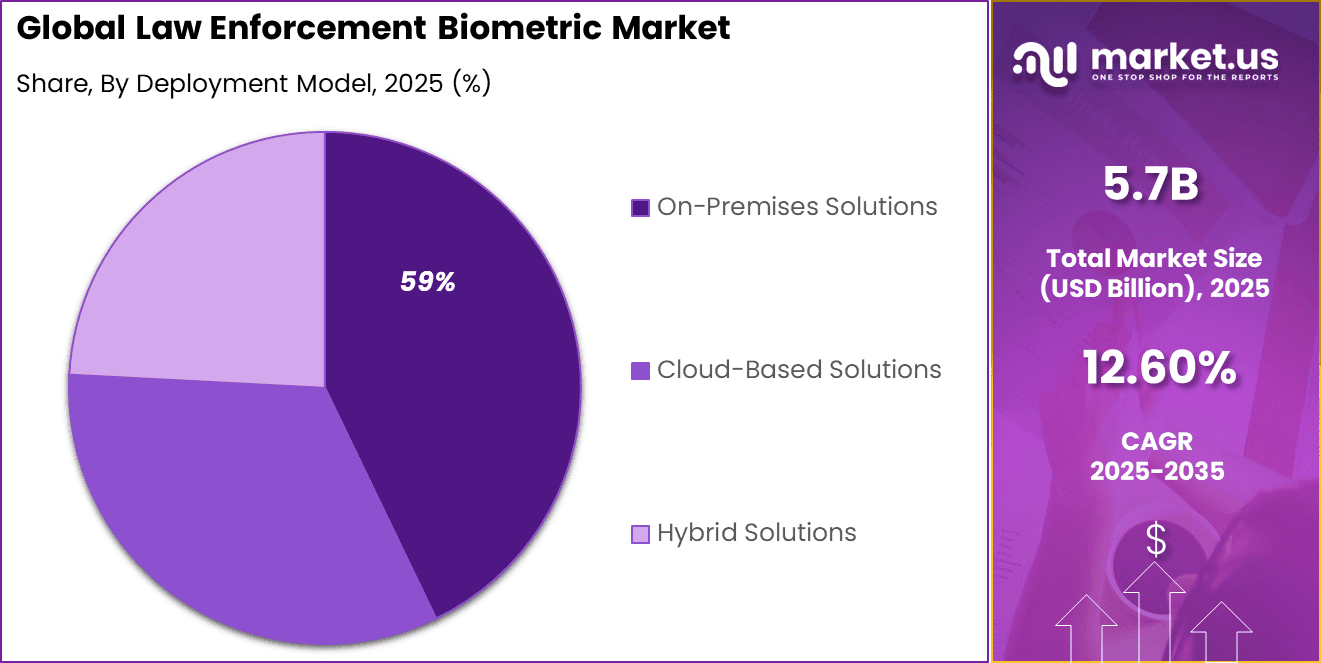
- By deployment model, on-premises solutions dominated at 58.5%, ensuring data sovereignty and integration with legacy justice systems.
- By end-user, law enforcement agencies held 40.7%, using biometrics for bookings, watchlists, and border control.
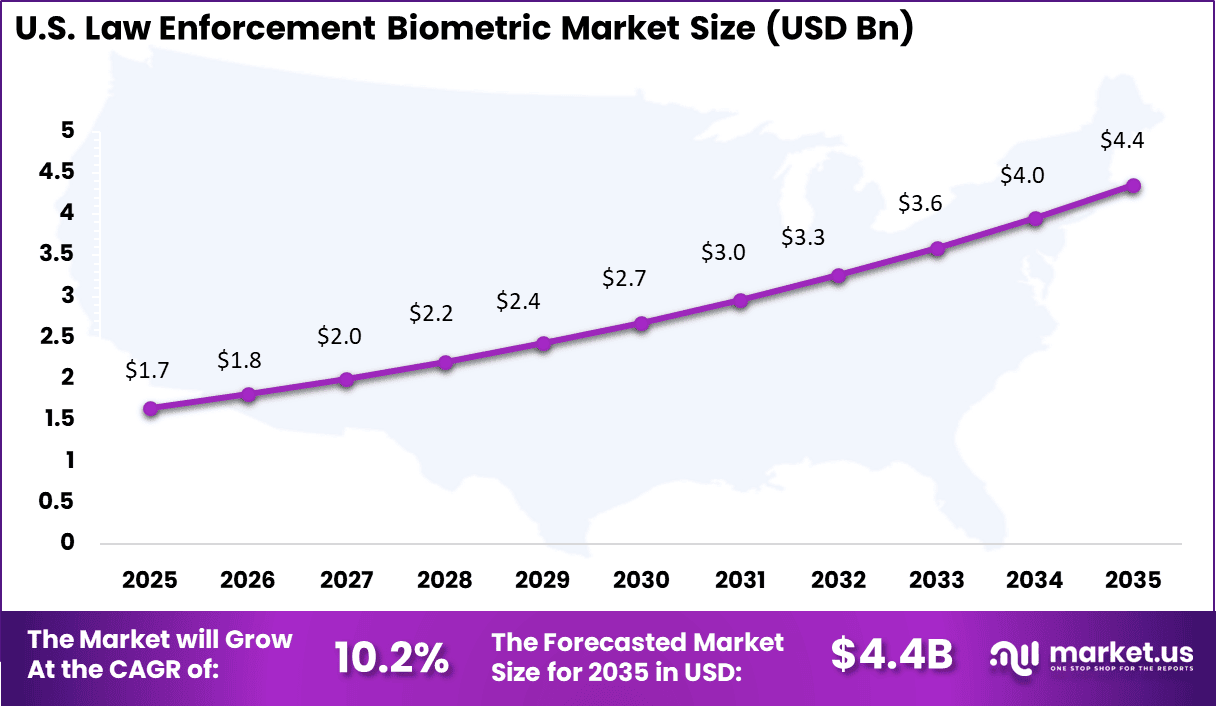
- North America accounted for 38.3% of the global market, with the U.S. valued at USD 1.65 billion and growing at a CAGR of 10.2%.
Technology Type Analysis
Biometric identification systems account for 45.6% of the Law Enforcement Biometric market, showing that identity matching and recognition are the core focus of biometric adoption in policing. These systems use fingerprints, facial recognition, iris scans, and other biometric traits to identify individuals from large databases.
From an operational standpoint, biometric identification systems help agencies manage large volumes of biometric data efficiently. They support rapid searches across databases and improve coordination between departments. The strong share of this segment reflects growing demand for reliable and scalable identification tools to enhance law enforcement effectiveness.
Component Analysis
Hardware accounts for 48.7% of the market, indicating that physical biometric devices are essential to law enforcement operations. This includes fingerprint scanners, facial recognition cameras, mobile biometric devices, and secure processing units. Agencies invest in durable hardware that can operate in field conditions and deliver accurate data capture. Reliable hardware is critical for ensuring system accuracy and minimizing data errors.
From a deployment perspective, hardware-based systems support both fixed installations and mobile use cases. Portable biometric devices enable officers to identify individuals in real time. The strong share of this segment reflects continued reliance on robust and high-quality hardware to support biometric identification in law enforcement.
Deployment Model Analysis
On-premises solutions hold 58.5% of the Law Enforcement Biometric market, showing preference for local control over sensitive data. Law enforcement agencies handle confidential information that must be protected under strict data governance policies. On-premises deployment allows agencies to maintain full ownership and control of biometric databases and system access.
This deployment model also supports customization based on agency-specific workflows and legal requirements. Integration with existing systems is easier in controlled environments. The strong presence of on-premises solutions reflects security concerns and regulatory requirements that favor local deployment in law enforcement contexts.
Key Market Segments
By Technology Type
- Biometric Identification Systems
- Biometric Verification Systems
- Multimodal Biometric Systems
- Mobile Biometric Solutions
- Others
By Component
- Hardware
- Scanners
- Readers
- Integrated Devices
- Others
- Software
- Services
By Deployment Model
- On-Premises Solutions
- Cloud-Based Solutions
- Hybrid Solutions
By End User
- Law Enforcement Agencies
- Bioscanning Service Providers
- Government Organizations
- Private Security Firms
Regional Analysis
North America accounted for a 38.3% share, supported by widespread adoption of biometric technologies across federal, state, and local law enforcement agencies. Biometric systems have been used for suspect identification, criminal record management, border control, and surveillance applications.
Demand has been driven by the need to improve identification accuracy, speed up investigations, and enhance public safety. The region’s strong investment in digital policing tools and integrated criminal justice systems has reinforced steady adoption.
The U.S. market reached USD 1.65 Bn and is projected to grow at a 10.2% CAGR, reflecting consistent investment in public safety and security technologies. Adoption has been driven by the need to enhance identity verification, reduce processing time, and improve investigative outcomes. Biometric systems such as fingerprint, facial recognition, and iris scanning have supported faster suspect identification and improved case resolution.
Key Regions and Countries
- North America
- US
- Canada
- Europe
- Germany
- France
- The UK
- Spain
- Italy
- Russia
- Netherlands
- Rest of Europe
- Asia Pacific
- China
- Japan
- South Korea
- India
- Australia
- Singapore
- Thailand
- Vietnam
- Rest of APAC
- Latin America
- Brazil
- Mexico
- Rest of Latin America
- Middle East & Africa
- South Africa
- Saudi Arabia
- UAE
- Rest of MEA
Key Reasons for Adoption
- Crime investigation is becoming more complex and data-intensive
- Law enforcement agencies require accurate and reliable identification tools
- Manual identification methods are time-consuming and prone to error
- Public safety operations need faster suspect verification
- Cross-agency data sharing is increasing for coordinated policing efforts
Benefits
- Identification accuracy is improved through biometric verification
- Investigation timelines are reduced with faster identity matching
- Operational efficiency is increased across policing activities
- Human error is reduced in suspect identification processes
- Public trust is strengthened through transparent and reliable identification
Usage
- Used in criminal identification and background verification
- Applied in forensic investigations to match biometric evidence
- Deployed in border and immigration control operations
- Utilized in surveillance and suspect tracking systems
- Integrated into law enforcement databases for identity management
Emerging Trends
| Key Trend | Description |
|---|---|
| Multimodal biometric systems | Combined use of fingerprint, face, iris, and voice improves identification accuracy and system resilience. |
| Mobile and handheld biometrics | Portable devices enable on-the-spot identity checks in the field for patrol and border units. |
| Cloud-based AFIS/ABIS platforms | Centralized, scalable systems support real-time searches across large biometric databases. |
| AI-enhanced facial recognition | Deep-learning algorithms improve matching accuracy in low light, crowded scenes, and partial occlusions. |
| Integration with body-worn and CCTV video | Automated matching against watchlists from live and recorded video streams enhances situational awareness. |
Growth Factors
| Key Factor | Description |
|---|---|
| Rising crime and terrorism threats | Agencies require faster and more reliable tools for suspect identification and prevention. |
| Government investments in public safety | National and regional programs fund large-scale biometric infrastructure deployments. |
| Expansion of national ID and biometric databases | Larger repositories increase the utility and accuracy of law-enforcement biometric systems. |
| Cross-border migration and border security needs | Biometrics support tighter border control and secure international data sharing. |
| Demand for operational efficiency and accuracy | Automated identification reduces manual workload and minimizes errors in investigations. |
Market Dynamics
Driver Analysis - Government Focus on Security and Public Safety
A strong driver of the law enforcement biometric market is rising government investment in advanced identification technologies to enhance public safety and security. Law enforcement agencies around the world are adopting biometric tools such as facial recognition, fingerprint systems, and multimodal identity solutions to improve suspect identification, reduce crime, and support investigations. These technologies help police and security forces respond more effectively by linking real-time biometric data to records, which supports quicker and more accurate decisions in high-pressure situations.
This trend is backed by increasing public expectations for safer communities and stronger security infrastructure. Agencies see value in integrating biometric solutions into daily operations because they provide reliable identity verification at checkpoints, border crossings, and crime scenes. With advancements in algorithm accuracy and portable biometric hardware, these systems are now more practical for field deployment and mass identification, encouraging wider adoption among law enforcement bodies.
Restraint Analysis - Privacy Concerns and Regulatory Scrutiny
One restraint on the law enforcement biometric market is growing privacy concerns and legal scrutiny over the use of biometric data. Biometrics involve capturing sensitive personal traits such as fingerprints and facial patterns, and this can raise legal and ethical questions when used without clear consent or robust protections. Civil rights groups in some regions have challenged law enforcement use of facial recognition, citing risks including misidentification and potential misuse of personal data, which impacts public trust and slows deployment.
Regulatory frameworks for biometric surveillance are uneven across jurisdictions, which creates uncertainty for agencies investing in these systems. In some countries, regulators have called for stricter rules or independent oversight to ensure that biometric technologies are used responsibly and within legal boundaries. This uncertainty can delay procurement decisions and limit the scale at which agencies deploy advanced biometric tools.
Opportunity Analysis - Integration with AI and Mobile Biometric Platforms
An important opportunity in the law enforcement biometric market is the integration of biometric systems with artificial intelligence and mobile platforms. AI-enhanced solutions can improve accuracy in identification and reduce false matches by analysing patterns and contextual data in real time. Mobile biometric tools allow officers in the field to capture and verify identities directly at the point of contact, which improves efficiency and supports rapid decision-making during investigations.
This opportunity is also shaped by trends in smart city and public safety programmes, where biometric data can be combined with sensors and surveillance networks to provide a more complete situational awareness. Agencies that adopt AI-driven biometric platforms gain the ability to manage large datasets more effectively and enhance response strategies. These integrated systems present scope for growth as law enforcement bodies look to modernise their technology stacks.
Challenge Analysis - Accuracy and Bias in Real-World Conditions
A central challenge for the law enforcement biometric market is ensuring high accuracy and fairness across diverse populations and real-world environments. Biometric systems can perform differently based on lighting, angle, and the quality of captured images, which affects reliability in practical use. In addition, some biometric algorithms have shown bias against certain demographic groups, leading to higher rates of false positives or false negatives, which can undermine the credibility of law enforcement outcomes and raise ethical concerns.
Addressing these challenges requires continuous refinement of algorithms, expanded training datasets that represent diverse communities, and regular performance testing under varied conditions. Law enforcement agencies and technology providers must work together to validate systems, reduce bias, and balance operational effectiveness with fairness and public confidence. This ongoing effort demands investment in research, evaluation, and transparency to maintain both accuracy and trust.
Competitive Analysis
The competitive landscape of the law enforcement biometric market is shaped by a mix of established biometric technology providers and specialized identification solution companies serving public safety agencies. Crossmatch, 3M Cogent, NEC, Safran, Aware, Cognitec Systems, and Suprema hold strong positions due to their broad biometric portfolios covering fingerprint, facial, iris, and multimodal identification systems.
These vendors benefit from long-term government contracts, proven accuracy, and compliance with strict law enforcement and forensic standards, which supports deployment across criminal identification, border control, and surveillance use cases.
Focused biometric specialists such as 4Gid, M2SYS Technology, Ayonix, BI2 Technologies, BioEnable, BioLink Solutions, FaceFirst, Fulcrum Biometrics, Iris ID, IriTech, Nuance, SpeechPro, and Tenbio increase competition by offering niche capabilities in mobile biometrics, facial recognition, iris scanning, and voice identification.
Top Key Players in the Market
- CrossmatcH
- 4Gid
- 3M Cogent
- M2SYS Technology
- NEc
- Safran
- Aware
- Ayonix
- BI2 Technologies
- BioEnable
- BioLink Solutions
- Cognitec Systems
- FaceFirst
- FulcruMBiometrics
- Iris ID
- IRITECH
- Nuance
- SpeechPro
- Suprema
- Tenbio
- Others
Future Outlook
Growth in the Law Enforcement Biometric market is expected to remain strong as agencies use technology to improve identification and public safety. Biometric systems such as fingerprint, facial, and iris recognition are helping speed up investigations and reduce errors.
Rising focus on crime prevention, border security, and digital record management is supporting adoption. Over time, better accuracy, faster processing, and clearer legal frameworks are likely to improve trust and operational efficiency.
Recent Developments
- In July 2025, BioEnable announced that its MOSIP‑compliant Biometric Registration Kit—featuring 4‑4‑2 fingerprint, dual‑iris, face, and document capture—is certified for use in national‑ID and voter‑registration programs, with applicability to law‑enforcement and border‑control identity verification.
- In February 2025, U.S. Immigration and Customs Enforcement (ICE) announced plans to acquire advanced iris‑biometric systems from BI2 Technologies via a sole‑source contract, expanding iris‑based biometric surveillance in enforcement operations.
Report Scope
| Report Features | Description |
|---|---|
| Market Value (2025) | USD 5.7 Billion |
| Forecast Revenue (2035) | USD 18.5 Billion |
| CAGR(2025-2035) | 12.6% |
| Base Year for Estimation | 2024 |
| Historic Period | 2020-2024 |
| Forecast Period | 2025-2035 |
| Report Coverage | Revenue forecast, AI impact on Market trends, Share Insights, Company ranking, competitive landscape, Recent Developments, Market Dynamics and Emerging Trends |
| Segments Covered | By Technology Type (Biometric Identification Systems, Biometric Verification Systems, Others), By Component (Hardware, Software, Services), By Deployment Model (On‑Premises Solutions, Cloud‑Based Solutions, Hybrid Solutions), By End User (Law Enforcement Agencies, Bioscanning Service Providers) |
| Regional Analysis | North America – US, Canada; Europe – Germany, France, The UK, Spain, Italy, Russia, Netherlands, Rest of Europe; Asia Pacific – China, Japan, South Korea, India, New Zealand, Singapore, Thailand, Vietnam, Rest of Latin America; Latin America – Brazil, Mexico, Rest of Latin America; Middle East & Africa – South Africa, Saudi Arabia, UAE, Rest of MEA |
| Competitive Landscape | CrossmatcH, 4Gid, 3M Cogent, M2SYS Technology, NEC, Safran, Aware, Ayonix, BI2 Technologies, BioEnable, BioLink Solutions, Cognitec Systems, FaceFirst, FulcruMBiometrics, Iris ID, IRITECH, Nuance, SpeechPro, Suprema, Tenbio, Others |
| Customization Scope | Customization for segments, region/country-level will be provided. Moreover, additional customization can be done based on the requirements. |
| Purchase Options | We have three licenses to opt for: Single User License, Multi-User License (Up to 5 Users), Corporate Use License (Unlimited Users and Printable PDF) |





























