Report Overview
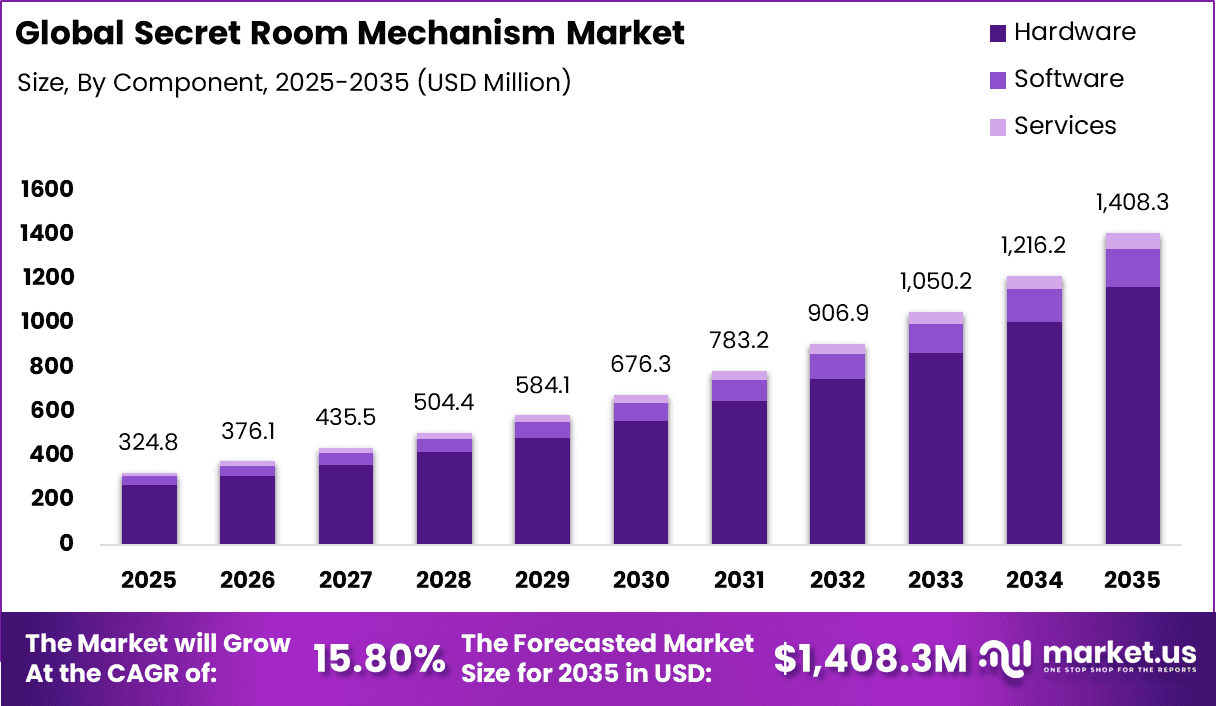
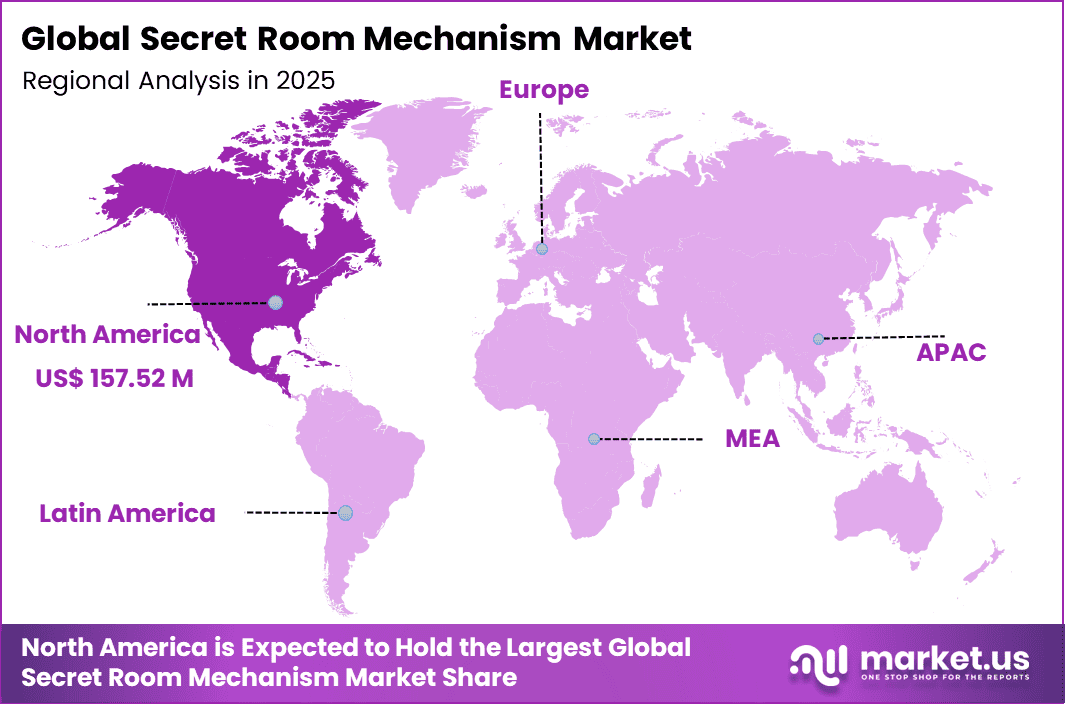
The Global Secret Room Mechanism Market generated USD 324.8 million in 2025 and is predicted to register growth from USD 376.1 million in 2026 to about USD 1,408.3 million by 2035, recording a CAGR of 15.8% throughout the forecast span. In 2025, North America held a dominant market position, capturing more than a 48.5% share, with USD 157.52 million in revenue.
Secret Room Mechanism market refers to concealed access systems used to create hidden rooms, secure storage spaces, and discreet entry points within residential and selected commercial properties. These mechanisms include hidden hinges, concealed tracks, custom locking systems, and automated opening components that allow walls, shelves, mirrors, or furniture panels to function as secret doors.
One of the main factors driving this market is the growing demand for private and secure spaces inside homes and high-value properties. Homeowners are showing greater interest in hidden storage, panic room access, and custom architectural features that improve both safety and design appeal.
Demand for secret room mechanisms is increasing mainly in high-end residential construction, home remodeling, and custom interior design projects. Buyers in this market usually want made-to-order systems that provide privacy without changing the visible design of the space.
Top Market Takeaways
- By Component, hardware leads with an 82.7% share, delivering actuators, sensors, and reinforced framing for seamless concealment and structural integrity.
- By Mechanism Type, sliding wall/panel systems capture 48.3%, enabling space-efficient hidden access through motorized tracks and synchronized panel alignment.
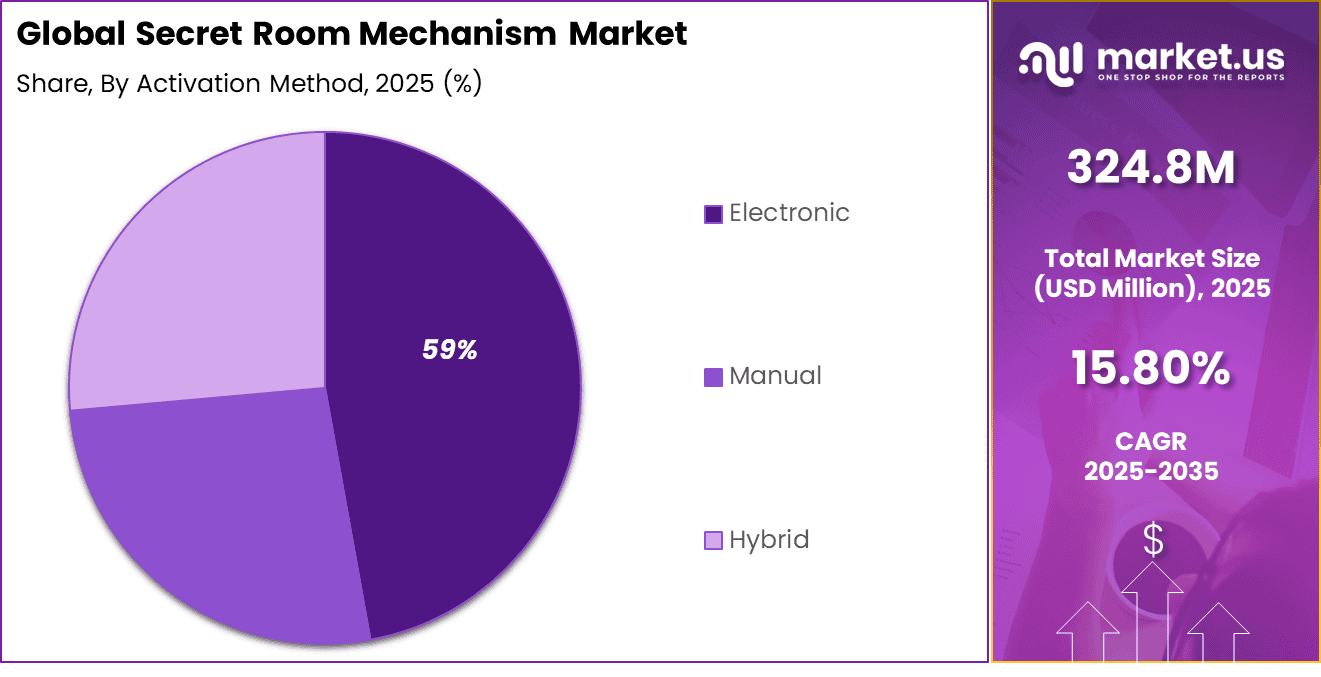
- By Activation Method, electronic controls claim 58.9%, featuring smartphone apps, biometric scanners, and voice activation with fail-safe manual overrides.
- By Application, residential holds 71.5%, powering panic rooms, home vaults, and media concealment in high-end custom builds.
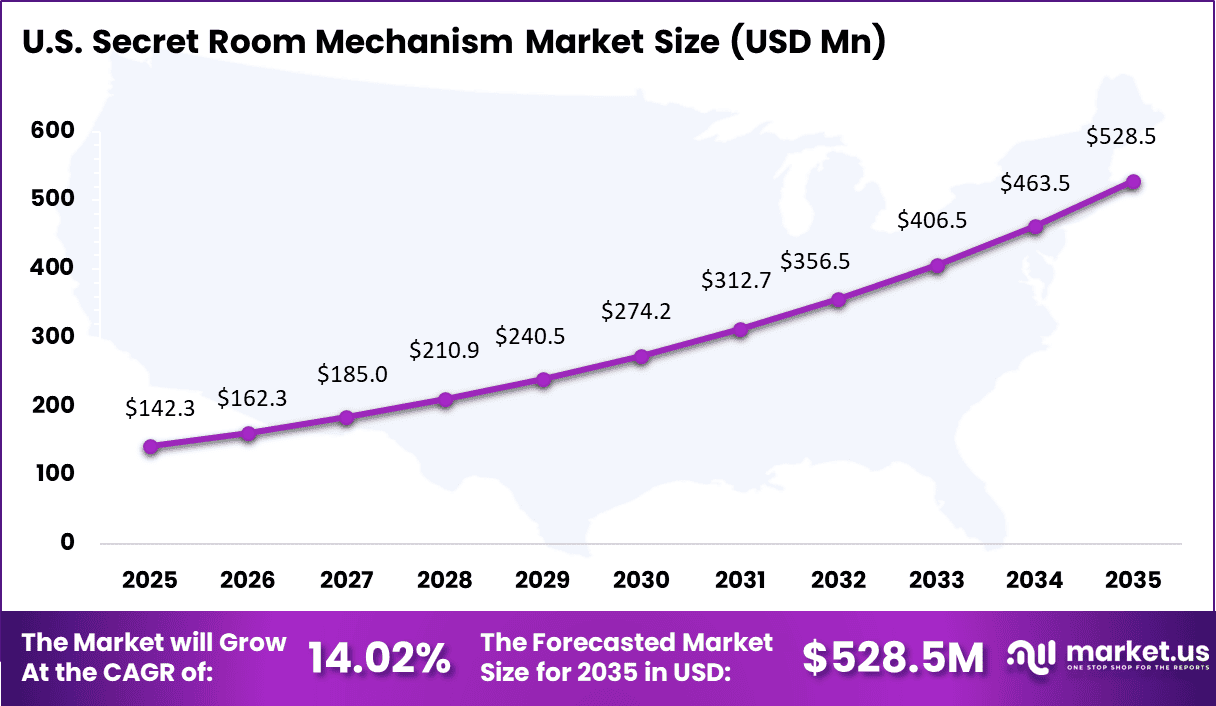
- North America accounts for 48.5% global share, with the U.S. market valued at USD 142.3 million and a CAGR of 14.02%, driven by affluent homeowner demand and smart home integration.
By Component Analysis
Hardware accounted for 82.7% of the Secret Room Mechanism Market. This segment leads because physical components such as concealed doors, locking systems, structural frames, and motion mechanisms form the foundation of hidden room installations. These elements are essential for ensuring durability, safety, and seamless concealment within walls or furniture.
The segment is also driven by increasing demand for robust and reliable construction in custom home designs. Consumers and builders prioritize high-quality hardware that can support repeated use while maintaining discreet functionality, which continues to strengthen the dominance of this segment.
By Mechanism Type Analysis
Sliding wall or panel systems represented 48.3% of the market. This segment dominates because sliding mechanisms provide smooth operation and effective concealment without requiring additional space for door movement. These systems are widely used in residential and luxury property designs to create hidden entry points.
The segment is supported by growing interest in space-efficient and visually seamless solutions. Sliding panels allow integration into walls, bookshelves, or decorative structures, which enhances both functionality and aesthetic appeal in modern interior design.
By Activation Method Analysis
Electronic activation held 59% of the market. This segment leads because electronic systems offer advanced access control through keypads, remote devices, biometric inputs, or mobile applications. These features improve both convenience and security for users.
The segment is also growing due to the increasing integration of smart home technologies. Electronic activation allows hidden rooms to be connected with home automation systems, enabling controlled access, monitoring, and enhanced user experience in secure environments.
By Application Analysis
Residential accounted for 71.5% of the Secret Room Mechanism Market. This segment dominates because homeowners are increasingly investing in hidden rooms for security, privacy, and personal storage. These installations are commonly used for safes, panic rooms, or concealed spaces within homes.
The segment is also driven by rising interest in customized living spaces and home security upgrades. As consumers look for unique and functional design features, hidden room mechanisms are becoming more popular in residential construction and renovation projects.
Key Market Segments
By Component
- Hardware
- Software
- Services
By Mechanism Type
- Sliding Wall/Panel Systems
- Rotating Bookcase/Door Mechanisms
- Elevator/Staircase Displacement
- Concealed Door & Passage Systems
By Activation Method
- Manual
- Electronic
- Hybrid
By Application
- Residential
- Commercial
- Institutional
Regional Analysis
North America accounted for 48.5% of the Secret Room Mechanism Market, reflecting strong demand for concealed security and privacy solutions across residential and commercial properties. Homeowners, luxury real estate developers, and businesses increasingly adopt hidden room mechanisms for safeguarding valuables, personal safety, and discreet storage.
The growing interest in customized interior design combined with enhanced security features has supported the adoption of advanced concealed door systems, automated panels, and hidden access solutions across the region.
The U.S. generated about USD 142.3 Mn within the regional market and is projected to expand at a CAGR of 14.02%. Property owners across the country continue to invest in secret room mechanisms for both security and aesthetic purposes, particularly in high-end residences and private offices.
These systems offer concealed entry, controlled access, and integration with smart home technologies. As awareness of personal security and privacy increases, demand for innovative hidden space solutions continues to grow steadily across the US market.
Key Regions and Countries
- North America
- US
- Canada
- Europe
- Germany
- France
- The UK
- Spain
- Italy
- Russia
- Netherlands
- Rest of Europe
- Asia Pacific
- China
- Japan
- South Korea
- India
- Australia
- Singapore
- Thailand
- Vietnam
- Rest of APAC
- Latin America
- Brazil
- Mexico
- Rest of Latin America
- Middle East & Africa
- South Africa
- Saudi Arabia
- UAE
- Rest of MEA
Drivers Impact Analysis
| Key Driver | Impact on CAGR Forecast (~%) | Geographic Relevance | Impact Timeline | Strategic Effect |
|---|---|---|---|---|
| Rising demand for luxury and customized home interiors | +2.9% | North America, Europe | Short to Mid Term (2025–2031) | Increases adoption in premium housing |
| Growing interest in hidden storage and space optimization | +2.6% | Global | Mid Term (2026–2032) | Enhances functional interior design |
| Increasing focus on personal safety and private secure spaces | +2.4% | US, Europe | Mid Term (2026–2032) | Drives demand for concealed safe rooms |
| Expansion of smart home and automated interior solutions | +2.2% | North America, Asia Pacific | Mid to Long Term (2026–2035) | Integrates hidden mechanisms with smart systems |
| Rising renovation and remodeling activities | +2.0% | North America, Europe | Mid Term (2026–2032) | Supports installation in existing homes |
Restraints Impact Analysis
| Key Restraint | Impact on CAGR Forecast (~%) | Geographic Relevance | Impact Timeline | Strategic Effect |
|---|---|---|---|---|
| High installation and customization costs | -2.3% | Global | Mid Term (2026–2032) | Limits adoption in mass market |
| Limited awareness among general consumers | -2.0% | Asia Pacific, Latin America | Short to Mid Term (2025–2030) | Reduces market penetration |
| Complexity in integrating mechanisms with existing structures | -1.8% | North America, Europe | Mid Term (2026–2032) | Increases project time and cost |
| Dependence on skilled craftsmanship and design expertise | -1.7% | Global | Mid to Long Term (2026–2035) | Restricts scalability |
| Regulatory and building code constraints | -1.5% | Europe, North America | Mid to Long Term (2026–2035) | Limits installation flexibility |
Investor Type Impact Analysis
| Investor Type | Growth Sensitivity | Risk Exposure | Geographic Focus | Investment Outlook |
|---|---|---|---|---|
| Venture Capital Firms | Medium | Medium | US, Europe | Niche luxury innovation |
| Private Equity Firms | High | Medium | North America, Europe | Expansion in premium housing solutions |
| Strategic Interior Design Investors | Medium to High | Medium | US, Europe, Middle East | Growth in customized interior systems |
| Corporate Venture Arms | Medium | Medium | Global | Partnerships with home automation brands |
| Real Estate and Infrastructure Funds | Medium | Low to Medium | North America, Europe, Middle East | Integration in luxury real estate projects |
Technology Enablement Analysis
| Technology Enabler | Impact on CAGR Forecast (~%) | Geographic Relevance | Impact Timeline | Implementation Significance |
|---|---|---|---|---|
| Automated sliding and concealed door mechanisms | +2.8% | Global | Short to Mid Term (2025–2031) | Enables smooth hidden access |
| Smart home integration for remote activation | +2.5% | North America, Europe, Asia Pacific | Mid Term (2026–2032) | Enhances control and convenience |
| Electronic and biometric access systems | +2.3% | US, Europe | Mid to Long Term (2026–2035) | Improves security levels |
| Advanced materials for lightweight and durable structures | +2.1% | Global | Mid Term (2026–2032) | Improves mechanism reliability |
| Custom design software for architectural planning | +1.9% | North America, Europe | Mid to Long Term (2026–2035) | Simplifies design and installation |
Key Challenges
- High installation cost is a major challenge because secret room mechanisms often need custom hardware, precise engineering, and professional fitting to work properly.
- Design and integration can be difficult because the mechanism must fit smoothly into walls, bookcases, panels, or other hidden structures without affecting normal room use.
- Reliability is a key concern because moving parts such as motors, tracks, hinges, and hidden switches must open and close correctly every time.
- Maintenance can become costly because concealed systems are harder to inspect and repair when there is a fault in the track, frame, or opening mechanism.
- Safety and security remain important challenges because hidden room systems must stay discreet while also allowing safe access during emergencies or technical failure.
Emerging Trends
A notable trend in the Secret Room Mechanism market is the growing demand for discreet architectural solutions that blend seamlessly into modern interiors. Hidden doors, sliding panels, and concealed access systems are being designed to match walls, furniture, and flooring, making them almost invisible.
These mechanisms are increasingly integrated with electronic controls such as remote activation and biometric access, which adds both convenience and security. This trend reflects a shift toward combining aesthetics with functionality, where privacy features are built into living and working spaces without affecting design appeal.
Growth Factors
The increasing focus on privacy, security, and personalized spaces is supporting the growth of secret room mechanisms. Homeowners and commercial property developers are looking for ways to create secure storage areas, private offices, and safe rooms within existing layouts.
These systems offer controlled access while maintaining a clean and modern appearance. At the same time, rising interest in luxury interiors and customized design solutions encourages the adoption of hidden mechanisms that enhance both safety and exclusivity in residential and commercial environments.
Competitive Analysis
The competitive landscape of the Secret Room Mechanism market includes specialized hidden door manufacturers and custom architectural solution providers. Creative Home Engineering, Doors of the Mind, Inc., JBH Hidden Doors, The Hidden Door Store, LLC, Murphy Door, and S & B Hidden Doors, LLC compete by offering concealed entry systems, bookcase doors, pivot walls, and custom hidden access solutions for residential and commercial spaces.
These companies focus on design quality, smooth operation, and the ability to blend security with interior style. Other players such as Haas Doors, Inc., Assa Abloy AB, Milestone Architectural, Inc., Duvinage Corporation, Stairways, Inc., and Slide Aside, Inc. strengthen the market through door hardware, access systems, and customized structural mechanisms.
Competition in this market is shaped by craftsmanship, installation quality, security features, and customization options. Overall, the market remains competitive as customers look for hidden access solutions that combine privacy, function, and aesthetic appeal.
Top Key Players in the Market
- Creative Home Engineering
- Doors of the Mind, Inc.
- JBH Hidden Doors
- The Hidden Door Store, LLC
- Murphy Door
- S & B Hidden Doors, LLC
- Haas Doors, Inc.
- Assa Abloy AB
- Milestone Architectural, Inc.
- Duvinage Corporation
- Stairways, Inc.
- Slide Aside, Inc.
- Others
Future Outlook
The future outlook for the Secret Room Mechanism Market appears positive as demand grows for hidden doors, concealed storage, and customized interior features in residential and commercial spaces. Interest in minimalist design, renovation activity, and premium hardware solutions is expected to support adoption of these mechanisms in the coming years. Better design integration, smoother operation, and rising focus on privacy, security, and space optimization are also likely to strengthen market growth.
Recent Developments
- In January 2026, CHE debuted MirrorVault systems featuring one-way mirrored panels concealing 8×10 panic rooms with independent HVAC, EMP shielding, and 4K interior monitoring maintaining perfect room aesthetics. Custom installations completed for 50+ celebrity estates averaging $250K per deployment.
- In February 2026, Hidden Door Store launched Echelon Pocket Doors featuring flush-fit millwork panels disappearing completely into walls with 500lb capacity and smart glass reveal for media room transformation serving 300+ urban luxury condos. Wireless charging pads embedded in thresholds power devices during activation.
Report Scope
| Report Features | Description |
|---|---|
| Market Value (2025) | USD 324.8 Million |
| Forecast Revenue (2035) | USD 1,408.3 Million |
| CAGR(2025-2035) | 15.8% |
| Base Year for Estimation | 2024 |
| Historic Period | 2020-2024 |
| Forecast Period | 2025-2035 |
| Report Coverage | Revenue forecast, AI impact on Market trends, Share Insights, Company ranking, competitive landscape, Recent Developments, Market Dynamics and Emerging Trends |
| Segments Covered | By Component (Hardware, Software, Services), By Mechanism Type (Sliding Wall/Panel Systems, Rotating Bookcase/Door Mechanisms, Elevator/Staircase Displacement, Concealed Door & Passage Systems), By Activation Method (Manual, Electronic, Hybrid), By Application (Residential, Commercial, Institutional) |
| Regional Analysis | North America – US, Canada; Europe – Germany, France, The UK, Spain, Italy, Russia, Netherlands, Rest of Europe; Asia Pacific – China, Japan, South Korea, India, New Zealand, Singapore, Thailand, Vietnam, Rest of Latin America; Latin America – Brazil, Mexico, Rest of Latin America; Middle East & Africa – South Africa, Saudi Arabia, UAE, Rest of MEA |
| Competitive Landscape | Creative Home Engineering, Doors of the Mind, Inc., JBH Hidden Doors, The Hidden Door Store, LLC, Murphy Door, S & B Hidden Doors, LLC, Haas Doors, Inc., Assa Abloy AB, Milestone Architectural, Inc., Duvinage Corporation, Stairways, Inc., Slide Aside, Inc., Others |
| Customization Scope | Customization for segments, region/country-level will be provided. Moreover, additional customization can be done based on the requirements. |
| Purchase Options | We have three licenses to opt for: Single User License, Multi-User License (Up to 5 Users), Corporate Use License (Unlimited Users and Printable PDF) |