Report Overview
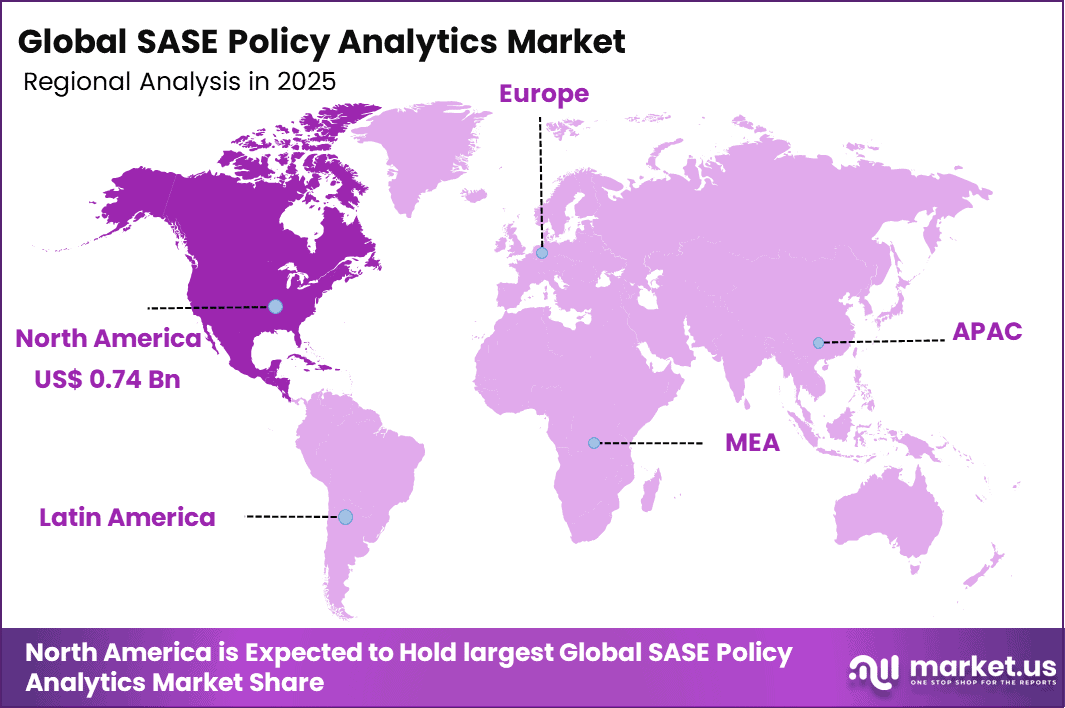
The Global SASE Policy Analytics Market generated USD 2.1 billion in 2025 and is predicted to register growth from USD 2.6 billion in 2026 to about USD 17.5 billion by 2035, recording a CAGR of 23.5% throughout the forecast span. In 2025, North America held a dominant market position, capturing more than a 35.2% share, with USD 0.74 billion in revenue.
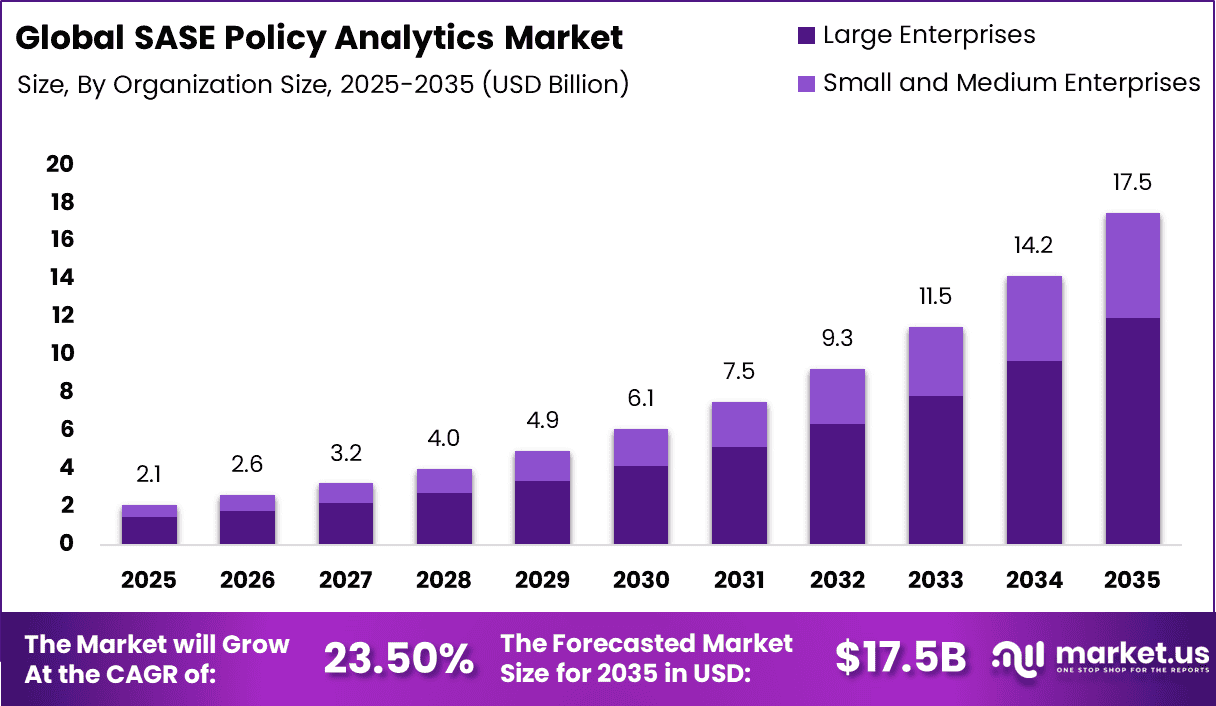
SASE Policy Analytics market refers to tools and platforms that help organizations analyze, manage, and improve security and access policies across secure access service edge environments. These solutions give security teams better visibility into how policies are applied across users, devices, applications, and network traffic.
One of the main factors driving this market is the growing complexity of managing security policies in cloud-based and hybrid work environments. As organizations expand remote access, zero trust practices, and multi-location operations, they need analytics tools that can identify misconfigurations, reduce policy conflicts, and improve security decisions. The increasing need for unified policy control across networking and security functions is also supporting market growth.
Top Market Takeaways
- By Deployment Mode, on-premises captures 72.6%, ensuring sovereign visibility, air-gapped compliance reporting, and integration with legacy firewall rulebases during SASE migration.
- By Organization Size, large enterprises hold 68.4%, orchestrating multi-cloud policy fabrics with automated drift detection and risk-prioritized remediation recommendations.
- By Application, network security leads at 39.2%, powering CASB discovery, SWG optimization, and FWaaS rule rationalization through behavioral traffic analytics.
- By End-User, BFSI commands 37.4%, addressing PCI-DSS convergence, regulatory audit trails, and zero-trust policy enforcement across global branch networks.
- North America accounts for 35.2% global share, with the U.S. market valued at USD 0.63 billion and a CAGR of 19.6%, driven by federal CISA directives and financial sector SASE adoption mandates.
By Component Analysis
Hardware accounted for 56.9% of the SASE Policy Analytics Market. This segment leads because organizations deploy dedicated network appliances and edge devices to monitor traffic, enforce policies, and support secure access environments. Hardware infrastructure forms a critical layer for handling large data flows and maintaining consistent network performance.
The segment is also supported by the need for reliable and high-capacity processing in complex enterprise networks. Many organizations prefer physical systems that can handle security analytics locally, which strengthens control over data flow and supports stable policy enforcement across distributed environments.
By Deployment Mode Analysis
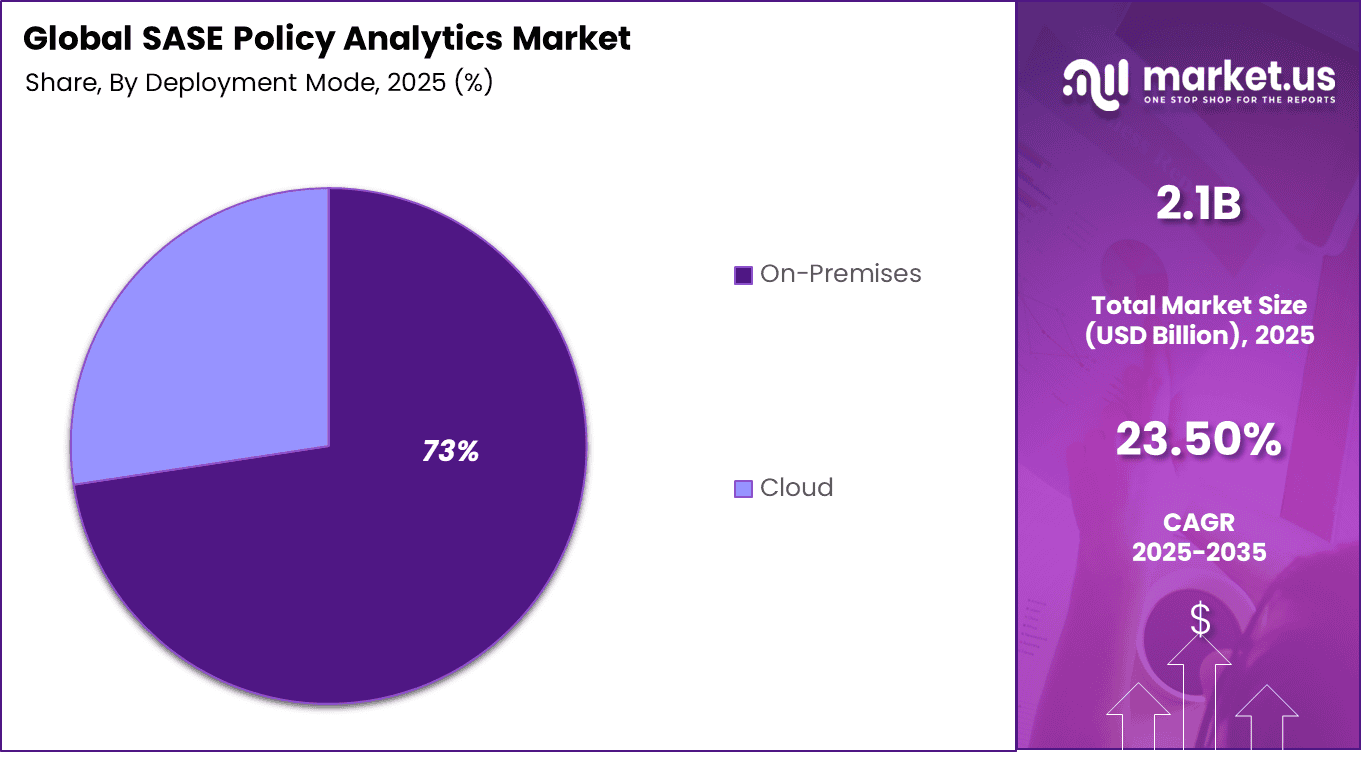
On-premises deployment held 73% of the market. This segment dominates because enterprises prefer to keep sensitive network data and security analytics within their own infrastructure. Maintaining internal control helps organizations meet compliance requirements and manage policy enforcement with greater oversight.
The segment is also driven by the need for consistent performance and reduced dependency on external environments. Organizations handling critical operations often rely on on-premises systems to ensure secure and uninterrupted network monitoring and policy management.
By Organization Size Analysis
Large enterprises accounted for 68.4% of the SASE Policy Analytics Market. This segment leads because large organizations operate complex networks with multiple users, devices, and access points. Managing these environments requires advanced analytics tools to monitor policies and ensure secure connectivity.
The segment is supported by higher investment capacity and the need for centralized control across global operations. Large enterprises focus on strengthening network security frameworks, which drives strong adoption of policy analytics solutions.
By Application Analysis
Network security represented 39.2% of the market. This segment dominates because policy analytics plays a key role in identifying risks, enforcing access controls, and maintaining secure data flow across enterprise networks. Organizations use these tools to monitor traffic patterns and detect unusual activity.
The segment continues to grow as cyber threats become more sophisticated. Businesses increasingly rely on analytics-driven security systems to improve visibility and strengthen protection across network environments.
By End User Analysis
BFSI captured 37.4% of the market. This segment leads because financial institutions require strong network security and strict policy enforcement to protect sensitive customer data and transaction systems. SASE policy analytics helps these organizations monitor access, detect anomalies, and reduce security risks.
The segment is also driven by regulatory pressure and the need to maintain secure digital services. BFSI organizations invest heavily in advanced security frameworks, which supports steady adoption of policy analytics solutions within this sector.
Key Market Segments
By Component
- Software
- Hardware
- Services
By Deployment Mode
- Cloud
- On-Premises
By Organization Size
- Large Enterprises
- Small and Medium Enterprises
By Application
- Network Security
- Compliance Management
- Threat Detection and Response
- Access Control
- Others
By End-User
- BFSI
- Healthcare
- IT and Telecommunications
- Retail
- Government
- Others
Regional Analysis
North America accounted for 35.2% of the SASE Policy Analytics Market, reflecting strong adoption of cloud-based security frameworks across enterprises. Organizations across the region increasingly implement secure access service edge models to manage distributed networks, remote users, and cloud applications.
Policy analytics tools help security teams monitor, evaluate, and optimize access policies in real time, improving visibility and control across complex IT environments. As businesses shift toward cloud-first strategies, the need for advanced policy analysis and enforcement continues to grow across North America.
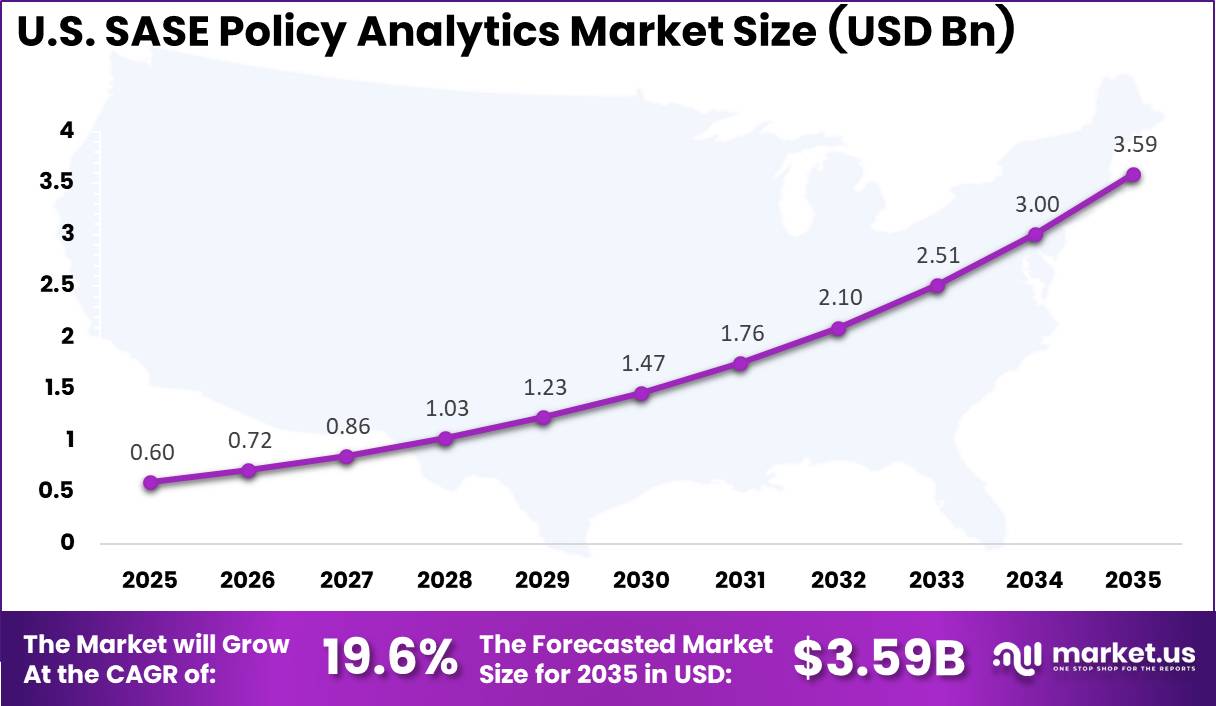
The U.S. generated about USD 0.6 Bn within the regional market and is projected to expand at a CAGR of 19.6%. Enterprises across the country continue to invest in solutions that provide deeper insights into network access behavior and security policy effectiveness.
SASE policy analytics platforms help identify risks, ensure compliance, and support faster decision-making across hybrid and remote work environments. As organizations manage increasing volumes of network traffic and user access points, demand for intelligent policy analytics solutions continues to rise rapidly across the US market.
Key Regions and Countries
- North America
- US
- Canada
- Europe
- Germany
- France
- The UK
- Spain
- Italy
- Russia
- Netherlands
- Rest of Europe
- Asia Pacific
- China
- Japan
- South Korea
- India
- Australia
- Singapore
- Thailand
- Vietnam
- Rest of APAC
- Latin America
- Brazil
- Mexico
- Rest of Latin America
- Middle East & Africa
- South Africa
- Saudi Arabia
- UAE
- Rest of MEA
Drivers Impact Analysis
| Key Driver | Impact on CAGR Forecast (~%) | Geographic Relevance | Impact Timeline | Strategic Effect |
|---|---|---|---|---|
| Rising adoption of secure access service edge architectures | +4.0% | North America, Europe, Asia Pacific | Short to Mid Term (2025–2031) | Improves unified security management |
| Increasing complexity of enterprise network policies | +3.7% | Global | Mid Term (2026–2032) | Drives need for policy visibility |
| Growth of remote work and distributed workforce models | +3.4% | Global | Short to Mid Term (2025–2030) | Expands demand for cloud-based security analytics |
| Rising cyber threats and need for real-time policy monitoring | +3.1% | US, Europe, Japan | Mid to Long Term (2026–2035) | Enhances threat detection capabilities |
| Integration of network and security analytics platforms | +2.8% | Global | Mid to Long Term (2026–2035) | Improves decision-making efficiency |
Restraints Impact Analysis
| Key Restraint | Impact on CAGR Forecast (~%) | Geographic Relevance | Impact Timeline | Strategic Effect |
|---|---|---|---|---|
| Complexity in integrating multi-vendor SASE environments | -2.6% | North America, Europe | Mid Term (2026–2032) | Slows implementation |
| High cost of advanced analytics platforms | -2.3% | Global | Mid Term (2026–2032) | Limits adoption among SMEs |
| Shortage of skilled cybersecurity professionals | -2.1% | Global | Mid Term (2026–2032) | Delays deployment and optimization |
| Data privacy and compliance challenges | -2.0% | Europe, North America | Mid to Long Term (2026–2035) | Restricts data usage |
| Lack of standardization across SASE frameworks | -1.8% | Global | Mid to Long Term (2026–2035) | Creates interoperability issues |
Investor Type Impact Analysis
| Investor Type | Growth Sensitivity | Risk Exposure | Geographic Focus | Investment Outlook |
|---|---|---|---|---|
| Venture Capital Firms | Very High | High | US, Europe, Israel | Strong cybersecurity analytics opportunity |
| Private Equity Firms | High | Medium | North America, Europe | Consolidation in security platforms |
| Strategic Technology Investors | Very High | Medium | US, Japan, South Korea | Expands network security ecosystem |
| Corporate Venture Arms | High | Medium | Global | Supports cloud security integration |
| Government and Cybersecurity Funds | Medium | Low to Medium | North America, Europe, Asia Pacific | Supports national cybersecurity initiatives |
Technology Enablement Analysis
| Technology Enabler | Impact on CAGR Forecast (~%) | Geographic Relevance | Impact Timeline | Implementation Significance |
|---|---|---|---|---|
| AI-driven policy analytics and anomaly detection | +4.1% | Global | Short to Mid Term (2025–2031) | Improves policy insights |
| Cloud native SASE architecture platforms | +3.8% | Global | Short to Mid Term (2025–2030) | Enables scalable deployment |
| Real-time network traffic monitoring tools | +3.5% | North America, Europe, Asia Pacific | Mid Term (2026–2032) | Enhances threat visibility |
| Integration with zero trust security frameworks | +3.2% | Global | Mid to Long Term (2026–2035) | Strengthens access control |
| API based integration with enterprise systems | +2.9% | Global | Mid Term (2026–2032) | Improves interoperability |
Key Challenges
- Managing policies across users, devices, cloud apps, and network locations is difficult because SASE combines many security and networking functions in one framework.
- Integration is a major challenge because many organizations still use older security tools and network systems that do not connect smoothly with newer SASE platforms.
- Policy errors can create serious problems because weak or poorly configured rules may allow too much access or block normal business activity.
- Compliance and data handling are difficult because traffic, identities, and security events often move across cloud environments and different regions.
- Skill gaps and internal coordination remain a challenge because network teams and security teams often need to work together more closely during SASE policy planning and management.
Emerging Trends
A key trend in the SASE Policy Analytics market is the growing use of unified visibility tools that help organizations understand how security and access policies perform across distributed networks. As users connect from different locations and devices, companies need clearer insight into policy enforcement and user behavior.
Analytics platforms are evolving to provide detailed views of access patterns, policy conflicts, and potential risks in real time. This trend reflects a shift toward smarter policy management where decisions are guided by continuous monitoring and deeper understanding of network activity.
Growth Factors
The expansion of remote work and cloud-based applications is supporting the growth of SASE policy analytics solutions. Organizations manage access across multiple environments, which makes it difficult to maintain consistent security policies without advanced analysis tools. Policy analytics helps teams evaluate how rules are applied, identify gaps, and improve overall security posture. At the same time, increasing focus on data protection and controlled access encourages enterprises to adopt solutions that provide better visibility and help maintain secure and efficient network operations.
Competitive Analysis
The competitive landscape of the SASE Policy Analytics market includes major network security and cloud security providers that offer strong policy control, traffic visibility, and risk monitoring tools. Cisco Systems Inc., Palo Alto Networks, Zscaler Inc., Fortinet Inc., VMware Inc., Akamai Technologies, Cloudflare Inc., and Check Point Software Technologies hold a strong position because they combine secure network access with real-time policy analysis across distributed users, devices, and applications.
Other companies such as Forcepoint LLC, McAfee Corp., Broadcom Inc. (Symantec Enterprise Division), Cato Networks, Netskope Inc., and Aryaka Networks add strong competition through cloud-based security platforms, policy enforcement tools, and analytics-driven access control. Competition in this market is shaped by ease of deployment, policy accuracy, threat visibility, and the ability to support remote work and multi-cloud environments.
Top Key Players in the Market
- Cisco Systems Inc.
- Palo Alto Networks
- Zscaler Inc.
- Fortinet Inc.
- VMware Inc.
- Akamai Technologies
- Cloudflare Inc.
- Check Point Software Technologies
- Forcepoint LLC
- McAfee Corp.
- Broadcom Inc.(Symantec Enterprise Division)
- Cato Networks
- Netskope Inc.
- Aryaka Networks
- Versa Networks
- Barracuda Networks
- Juniper Networks
- Open Systems AG
- Perimeter 81
- SonicWall Inc.
- Others
Future Outlook
The future outlook for the SASE Policy Analytics Market looks strong as more organizations move to cloud-based security models that combine networking and protection in one platform. SASE is designed to bring together services such as secure web gateways, CASB, firewall as a service, and zero trust access, and newer platforms increasingly emphasize centralized policy management and single-pane visibility across branches, users, and cloud environments.
As companies handle more remote work, distributed apps, and stricter access controls, demand is expected to grow for analytics tools that can monitor policies, reduce misconfigurations, and improve security decisions.
Recent Developments
- In February 2026, Cisco Secure Access Policy Analytics launched AI-powered policy drift detection across Umbrella/SecureX, identifying 10K+ redundant rules daily across 50K+ enterprise deployments with automated remediation workflows reducing attack surface by 73%. Native integration with ThousandEyes provides path-based policy recommendations optimizing global SD-WAN performance.
- In January 2026, Zscaler Policy Intelligence launched Risk360 scoring engine analyzing 500B+ daily transactions, identifying over-permissive internet rules blocking 98% zero-day threats at edge. Digital Experience Monitoring correlates policy changes with user productivity metrics.
Report Scope
| Report Features | Description |
|---|---|
| Market Value (2025) | USD 2.1 Billion |
| Forecast Revenue (2035) | USD 17.5 Billion |
| CAGR(2025-2035) | 23.5% |
| Base Year for Estimation | 2024 |
| Historic Period | 2020-2024 |
| Forecast Period | 2025-2035 |
| Report Coverage | Revenue forecast, AI impact on Market trends, Share Insights, Company ranking, competitive landscape, Recent Developments, Market Dynamics and Emerging Trends |
| Segments Covered | By Component (Software, Hardware, Services), By Deployment Mode (Cloud, On-Premises), By Organization Size (Large Enterprises, Small and Medium Enterprises), By Application (Network Security, Compliance Management, Threat Detection and Response, Access Control, Others), By End-User (BFSI, Healthcare, IT and Telecommunications, Retail, Government, Others) |
| Regional Analysis | North America – US, Canada; Europe – Germany, France, The UK, Spain, Italy, Russia, Netherlands, Rest of Europe; Asia Pacific – China, Japan, South Korea, India, New Zealand, Singapore, Thailand, Vietnam, Rest of Latin America; Latin America – Brazil, Mexico, Rest of Latin America; Middle East & Africa – South Africa, Saudi Arabia, UAE, Rest of MEA |
| Competitive Landscape | Cisco Systems Inc., Palo Alto Networks, Zscaler Inc., Fortinet Inc., VMware Inc., Akamai Technologies, Cloudflare Inc., Check Point Software Technologies, Forcepoint LLC, McAfee Corp., Broadcom Inc. (Symantec Enterprise Division), Cato Networks, Netskope Inc., Aryaka Networks, Versa Networks, Barracuda Networks, Juniper Networks, Open Systems AG, Perimeter 81, SonicWall Inc., Others |
| Customization Scope | Customization for segments, region/country-level will be provided. Moreover, additional customization can be done based on the requirements. |
| Purchase Options | We have three licenses to opt for: Single User License, Multi-User License (Up to 5 Users), Corporate Use License (Unlimited Users and Printable PDF) |