


Report Overview
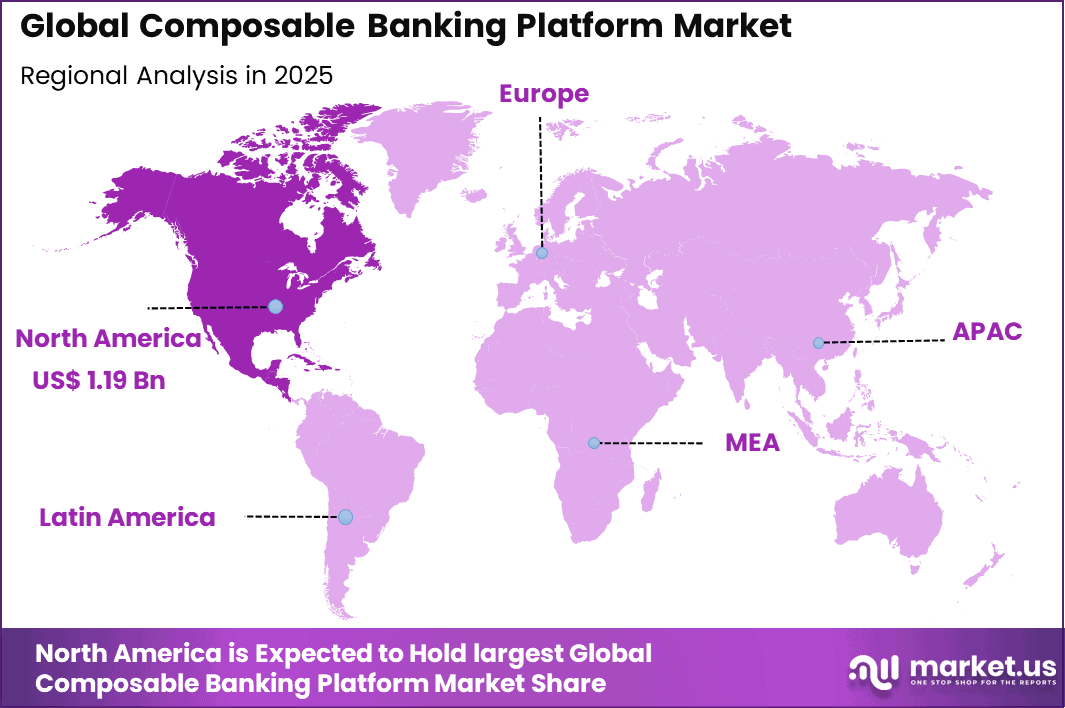
The Global Composable Banking Platform Market generated USD 3.3 billion in 2025 and is predicted to register growth from USD 4.0 billion in 2026 to about USD 27.4 billion by 2035, recording a CAGR of 23.7% throughout the forecast span. In 2025, North America held a dominant market position, capturing more than a 36.5% share, with USD 1.19 billion in revenue.
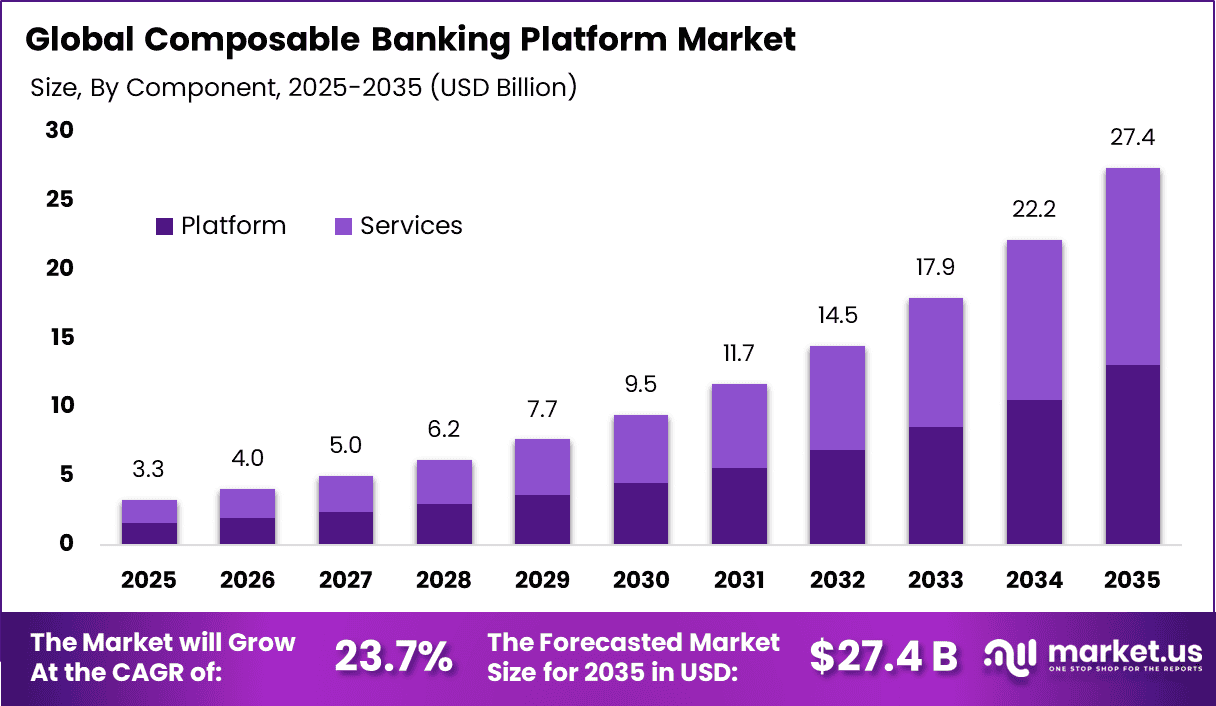
The composable banking platform market focuses on modular banking architectures that allow financial institutions to assemble services and capabilities as independent building blocks. Instead of relying on a single, tightly integrated core system, banks can combine specialized components for payments, lending, onboarding, and analytics. This approach increases flexibility and enables faster adaptation to changing customer needs.
The market is shaped by institutions seeking greater control over technology evolution without full system replacement. Composable models allow banks to upgrade or replace specific modules without disrupting other functions. In addition, competitive pressure from digital-first institutions is encouraging banks to adopt more agile and interoperable technology frameworks.
Growth in the composable banking platform market is supported by the broader shift toward open architectures and application programming interface-driven integration. Financial institutions are prioritizing ecosystems where internal systems can connect easily with external partners and fintech services. Improved governance models and standardized integration practices are also reducing operational risk.
Top Market Takeaways
- By component, platforms account for 47.6% of the market, enabling modular assembly of microservices for core banking, lending, and customer engagement.
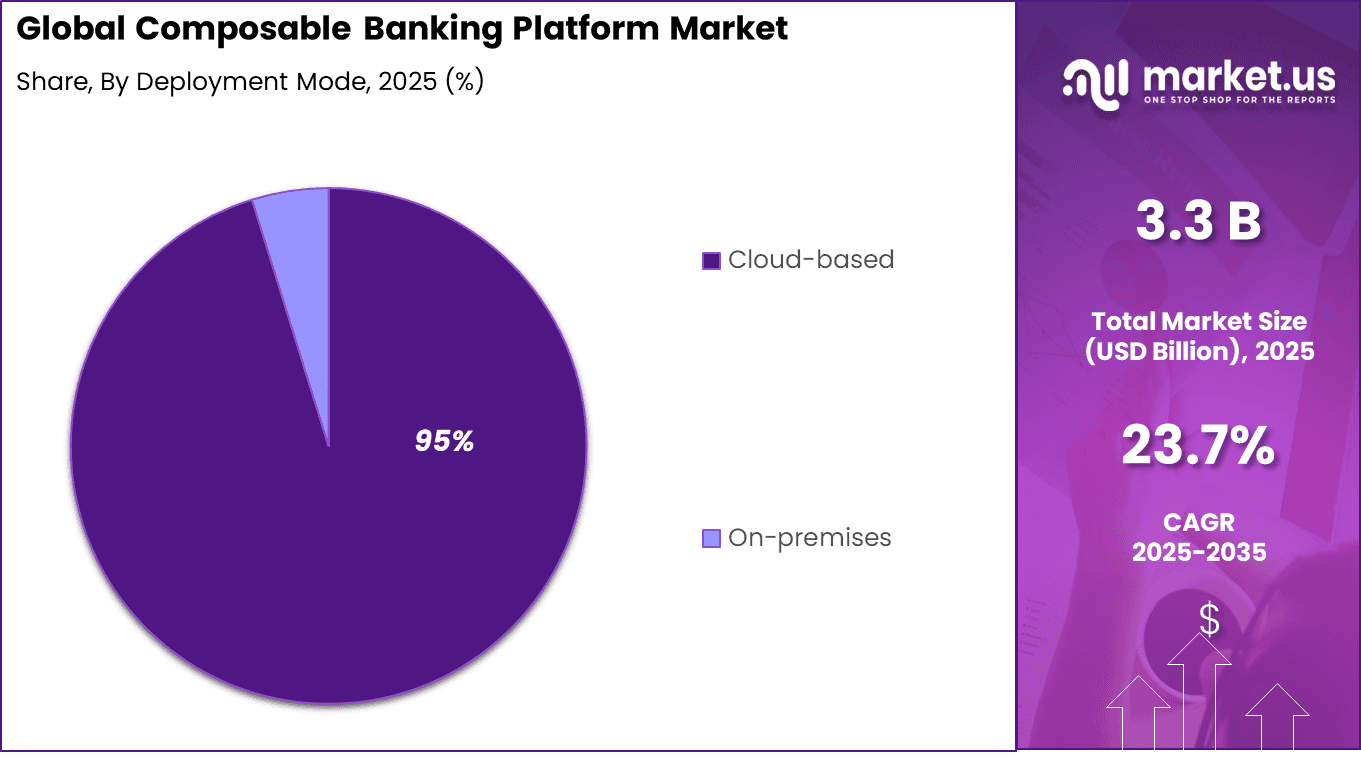
- By deployment mode, cloud-based solutions represent 95.2%, prized for agility, low-code customization, and rapid feature deployment in competitive landscapes.
- By application, payments & transactions capture 33.5%, powering real-time rails, cross-border transfers, and embedded finance integrations.
- By end-user, banks hold 52.8% share, modernizing legacy cores via composable architectures to match FinTech speed and innovation.
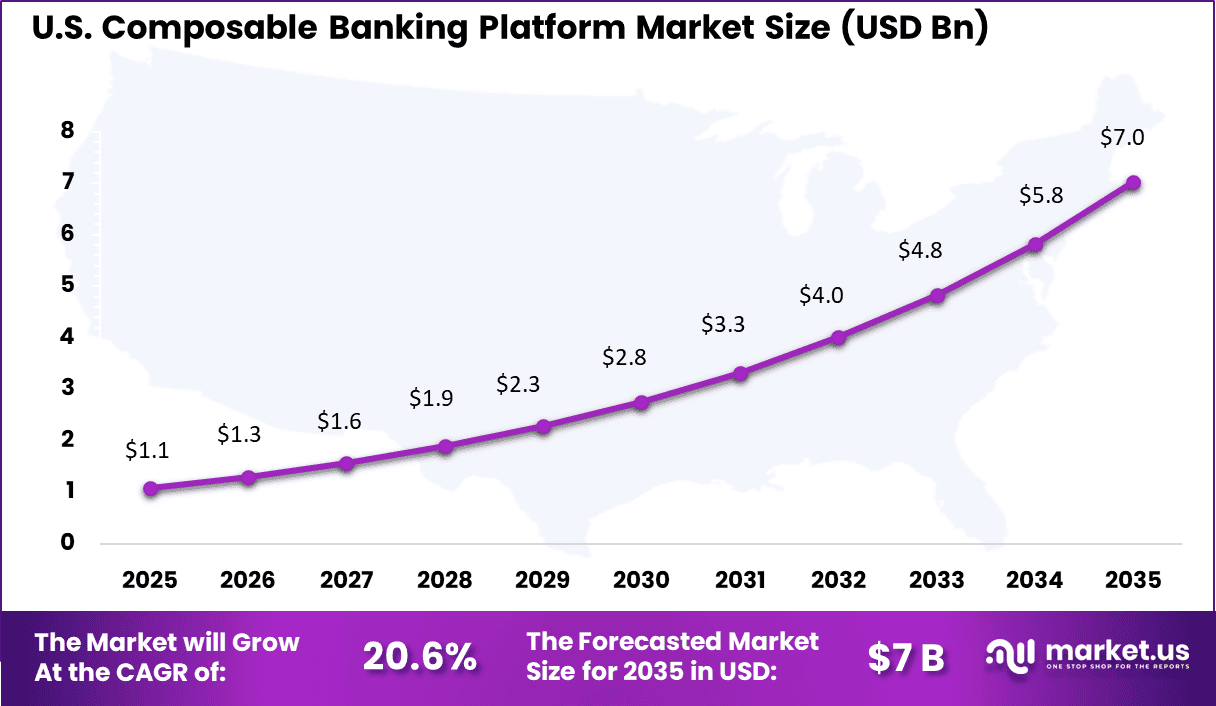
- By region, North America leads with 36.5% of the global market, where the U.S. is valued at USD 1.08 billion with a projected CAGR of 20.6%, boosted by open banking APIs and challenger competition.
By Component
Platform-based offerings account for 47.6% of adoption within the composable banking platform market, as financial institutions increasingly adopt modular software frameworks. These platforms enable banks to assemble core banking capabilities from reusable components. This approach supports flexibility in responding to changing business needs and customer expectations.
Institutions benefit from modular design by reducing dependency on monolithic systems. Each composable building block can be upgraded independently. This operational advantage continues to support steady adoption of platform-centric solutions.
By Deployment Mode
Cloud-based deployment holds 95%, reflecting strong preference for scalable infrastructure. Cloud environments support rapid provisioning of new services without heavy upfront hardware investment. This model also enhances system resilience and data accessibility across teams.
Cloud adoption is particularly strong because it supports iterative innovation. Banks can test and launch new capabilities faster. Ease of integration with external data sources and services further reinforces high cloud adoption.
By Application
Payments and transactions represent 33.5% of application focus, as these functions are central to everyday banking operations. Composable systems support real-time payment processing, reconciliation, and routing across digital channels. This improves customer experience and operational throughput.
The growing volume of digital payments has made flexible payment modules essential. Institutions use composable architectures to tailor payment services to specific customer segments. This supports consistent attention on payments as a core use case.
By End User
Banks account for 52.8% of end user adoption, driven by the need to modernize legacy core systems and enhance product agility. Composable platforms help banks deconstruct complex systems into manageable modules. This supports faster response to market shifts and regulatory changes. Banks also prioritize customer-centricity. Modular components allow personalized service experiences and quicker product launches. This alignment sustains strong adoption among traditional banking institutions.
Key Market Segments
By Component
- Platform
- API Management & Orchestration Layer
- Developer Portal & Marketplace
- Cloud Infrastructure & DevOps Tools
- Others
- Services
- Strategic Consulting & Blueprinting
- Implementation & Systems Integration
- Managed Services & BPO
By Deployment Mode
- On-Premises
- Cloud-based
By Application
- Payments & Transactions
- Lending & Credit
- Deposit & Account Management
- Cards & Wallets
- Others
By End-User
- Banks
- Fintech Companies
- Credit Unions
- Others
Driver Impact Analysis
| Key Driver | Impact on CAGR Forecast (~%) | Geographic Relevance | Impact Timeline |
|---|---|---|---|
| Increasing need to replace monolithic legacy core systems | +6.4% | North America, Europe | Short to medium term |
| Rising adoption of API-first and microservices architecture | +5.3% | Global | Medium term |
| Expansion of digital-only banks and fintech ecosystems | +4.8% | Europe, Asia Pacific | Medium term |
| Demand for faster product innovation and customization | +3.9% | Global | Medium term |
| Growth of Banking-as-a-Service and embedded finance models | +3.3% | North America, Asia Pacific | Medium to long term |
Restraints Impact Analysis
| Key Restraint | Impact on CAGR Forecast (~%) | Geographic Relevance | Impact Timeline |
|---|---|---|---|
| High transformation and migration costs | −4.5% | Global | Short to medium term |
| Complexity of integrating modular components across vendors | −3.9% | Global | Medium term |
| Shortage of skilled cloud-native and API development talent | −3.2% | Asia Pacific, Latin America | Medium term |
| Data security and regulatory compliance risks during transition | −2.8% | North America, Europe | Medium term |
| Organizational resistance to architectural change | −2.4% | Global | Medium to long term |
Investor Type Impact Matrix
| Investor Type | Growth Sensitivity | Risk Exposure | Geographic Focus | Investment Outlook |
|---|---|---|---|---|
| Cloud-native core banking and platform providers | Very High | Medium | North America, Europe | Strong SaaS-driven scalability |
| Banks and financial institutions | High | Medium | Global | Strategic digital transformation investment |
| Fintech infrastructure providers | High | Medium to High | North America, Asia Pacific | Ecosystem expansion opportunity |
| Private equity firms | Medium | Medium | North America, Europe | Consolidation of modular banking vendors |
| Venture capital investors | High | High | North America | Innovation in API-first banking stacks |
Technology Enablement Analysis
| Technology Enabler | Impact on CAGR Forecast (~%) | Primary Function | Geographic Relevance | Adoption Timeline |
|---|---|---|---|---|
| Microservices-based core banking architecture | +6.1% | Modular deployment and scalability | Global | Short to medium term |
| API gateways and open banking integration frameworks | +5.2% | Ecosystem connectivity | Europe, North America | Medium term |
| Cloud-native infrastructure and containerization | +4.7% | Elastic scalability and cost efficiency | Global | Medium term |
| Event-driven processing and real-time data streaming | +3.8% | Instant transaction handling | Global | Medium to long term |
| AI-driven product configuration and workflow automation | +3.1% | Operational efficiency | North America, Europe | Long term |
Key Challenges
- Complexity in integrating multiple modular components into one stable system
- Dependence on strong API management and interoperability standards
- Higher coordination effort across different technology vendors
- Risk of system disruption during replacement of legacy core functions
- Shortage of skilled professionals with experience in microservices and cloud architecture
Emerging Trends
In the Composable Banking Platform market, a strong trend is the adoption of modular, plug-and-play components that allow banks to assemble and reassemble services rapidly. Traditional core systems are being replaced or supplemented by discrete building blocks such as payment engines, customer data hubs, and risk engines that can be combined through standard interfaces.
This shift enables financial institutions to introduce new services, modify pricing, or adjust compliance logic without disruptive, monolithic upgrades. Another emerging pattern is the focus on interoperability with external ecosystems, so banks can connect to fintech partners, payment networks, and data providers more fluidly, fostering innovation while maintaining control over key operational elements.
Growth Factors
A main growth driver in this market is the imperative for agility in responding to evolving customer expectations. Customers now expect personalised experiences, rapid onboarding, and seamless service continuity across channels, which demands infrastructure that can change at the pace of demand. Composable platforms help institutions shift from rigid development cycles to more responsive service delivery, improving both speed and relevance.
Another key driver is the pressure to reduce technical debt associated with legacy systems that are costly to maintain and slow to adapt. By breaking down functionality into reusable modules, organisations can focus investment on strategic capabilities while retiring or replacing outdated components in a controlled manner, strengthening both operational resilience and future-readiness.
Regional Analysis
North America holds a 36.5% share of the composable banking platform market, supported by strong digital banking maturity and early adoption of modular technology architectures. Financial institutions in the region are moving away from monolithic core systems toward flexible, API-driven components that can be integrated and scaled independently. Demand is driven by the need to accelerate product innovation, improve customer experience, and reduce long-term dependency on rigid legacy infrastructure.
The United States market is valued at USD 1.08 Bn and is expanding at a CAGR of 20.6%, reflecting aggressive investment in next-generation banking platforms. Adoption is influenced by competitive pressure from digital-first banks, open banking initiatives, and rising expectations for real-time services. Growth is further supported by increasing focus on cloud-native deployment, faster system integration, and the ability to launch new financial products with greater speed and operational efficiency.
Key Regions and Countries
- North America
- US
- Canada
- Europe
- Germany
- France
- The UK
- Spain
- Italy
- Russia
- Netherlands
- Rest of Europe
- Asia Pacific
- China
- Japan
- South Korea
- India
- Australia
- Singapore
- Thailand
- Vietnam
- Rest of APAC
- Latin America
- Brazil
- Mexico
- Rest of Latin America
- Middle East & Africa
- South Africa
- Saudi Arabia
- UAE
- Rest of MEA
Competitive Analysis
The Composable Banking Platform market includes global core and digital banking providers such as Temenos, Finastra, FIS, Oracle Financial Services, SAP Fioneer, Infosys Finacle, Tata Consultancy Services BaNCS, Jack Henry, Avaloq, and Sopra Banking Software.
These companies compete on broad banking functionality, regulatory alignment, and the ability to integrate modular components into existing core systems. Their strength is typically seen in large banks that require stable vendor ecosystems and end-to-end transformation support.
Digital-first and cloud-focused players such as Mambu, Backbase, nCino, Thought Machine, Q2 Holdings, and Intellect Design Arena compete through API driven architecture and flexible product assembly. Competition in this segment is driven by faster product launches, independent module selection, and improved customer experience layers.
Top Key Players in the Market
- Mambu
- Temenos
- Backbase
- nCino
- Finastra
- Thought Machine
- FIS (Fidelity National Information Services)
- Oracle Financial Services
- SAP Fioneer
- Infosys Finacle
- Tata Consultancy Services (TCS) BaNCS
- Q2 Holdings
- Intellect Design Arena
- Jack Henry & Associates
- Avaloq
- Sopra Banking Software
- Others
Future Outlook
The future outlook for the Composable Banking Platform Market is positive as banks and financial institutions seek more flexible ways to build and update their digital services. Demand for composable banking platforms is expected to rise because these solutions allow institutions to mix and match modular components to quickly launch new products.
Adoption of API-based architecture, cloud infrastructure, and low-code tools will support faster innovation and reduced development costs. Growth can be attributed to the need for personalized customer experiences, competitive pressure, and operational efficiency. Overall, the market is expected to expand as organizations prioritize adaptable and scalable banking technology.
Recent Developments
- In October 2025, Mambu Launched composable banking for U.S. credit unions to replace legacy cores. Supports speedboat dual-core and staged migrations with best-fit integrations. Extends with Mambu Payments post-Numeral acquisition.
- In August 2025, Thought Machine powered Shawbrook’s digital shift with Vault Core on Google Cloud. Replaced legacy for lending deposits agility. Enables personalized services at scale.
Report Scope
| Report Features | Description |
|---|---|
| Market Value (2025) | USD 3.3 Billion |
| Forecast Revenue (2035) | USD 27.4 Billion |
| CAGR(2025-2035) | 23.7% |
| Base Year for Estimation | 2024 |
| Historic Period | 2020-2024 |
| Forecast Period | 2025-2035 |
| Report Coverage | Revenue forecast, AI impact on Market trends, Share Insights, Company ranking, competitive landscape, Recent Developments, Market Dynamics and Emerging Trends |
| Segments Covered | By Component (Platform, Services), By Deployment Mode (On-Premises, Cloud-based), By Application (Payments & Transactions, Lending & Credit, Deposit & Account Management, Cards & Wallets, Others), By End-User (Banks, Fintech Companies, Credit Unions, Others) |
| Regional Analysis | North America – US, Canada; Europe – Germany, France, The UK, Spain, Italy, Russia, Netherlands, Rest of Europe; Asia Pacific – China, Japan, South Korea, India, New Zealand, Singapore, Thailand, Vietnam, Rest of Latin America; Latin America – Brazil, Mexico, Rest of Latin America; Middle East & Africa – South Africa, Saudi Arabia, UAE, Rest of MEA |
| Competitive Landscape | Mambu, Temenos, Backbase, nCino, Finastra, Thought Machine, FIS (Fidelity National Information Services), Oracle Financial Services, SAP Fioneer, Infosys Finacle, Tata Consultancy Services (TCS) BaNCS, Q2 Holdings, Intellect Design Arena, Jack Henry & Associates, Avaloq, Sopra Banking Software, Others |
| Customization Scope | Customization for segments, region/country-level will be provided. Moreover, additional customization can be done based on the requirements. |
| Purchase Options | We have three licenses to opt for: Single User License, Multi-User License (Up to 5 Users), Corporate Use License (Unlimited Users and Printable PDF) |





































