Report Overview
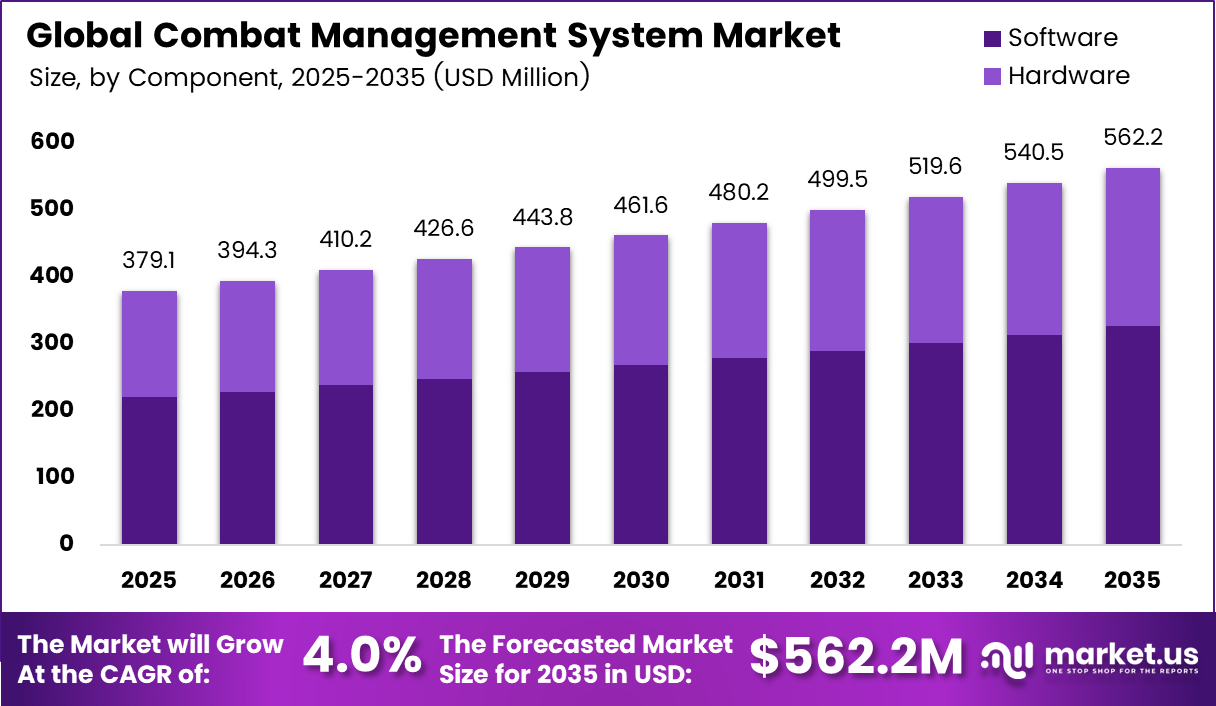
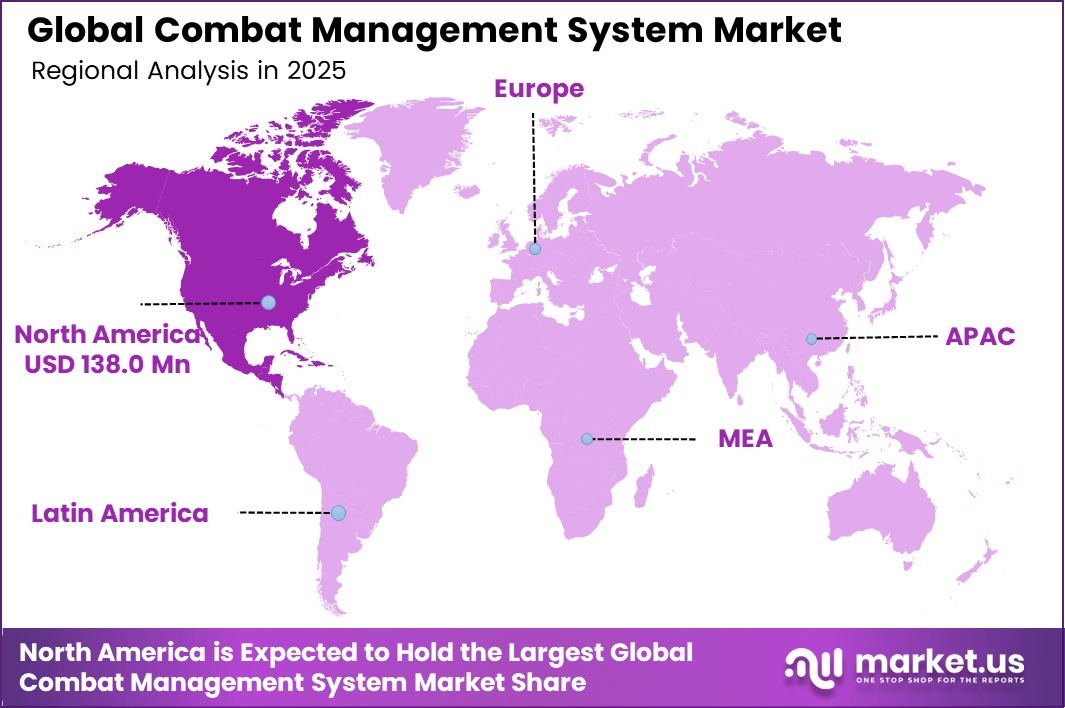
The Global Combat Management System Market size is expected to reach around USD 562.2 million by 2035, up from USD 379.1 million in 2025, growing at a CAGR of 4.0% during the forecast period from 2025 to 2035. North America held a dominant market position, capturing more than 36.4% share and generating USD 138.0 million in revenue.
According to SIPRI (Stockholm International Peace Research Institute), global military expenditure reached USD 2.9 trillion in 2025, a record high and the tenth consecutive year of growth. In 2024 alone, spending jumped more than 9% year-over-year, the steepest single-year increase since the Cold War. This macro-level spending surge directly funds the procurement of advanced shipboard systems, and CMS, the digital brain that integrates weapons, sensors, and command decisions on a warship, is one of the first systems navies invest in when modernizing their fleets.
North America’s Combat Management System market leadership is supported by sustained U.S. defense and naval modernization spending. The U.S. Department of Defense requested USD 961.6 billion for FY2026, including USD 292.2 billion for the Department of the Navy and USD 47.4 billion for procuring 19 battle-force ships. The proposed FY2027 naval shipbuilding budget of USD 65.8 billion further indicates a strong multi-year pipeline for integrated CMS deployment across new and upgraded naval platforms.
Beyond the U.S., the global CMS demand pool is widening significantly. At the 2025 NATO Summit in The Hague, all member states formally committed to raising defense spending to 5% of GDP by 2035. In 2025 alone, European NATO allies and Canada increased defense spending by 20% year-over-year, the first time in recorded NATO history that all allies exceeded the 2% GDP threshold.
Key Takeaway
- The Global Combat Management System Market is projected to reach USD 562.2 million by 2035, growing from USD 379.1 million in 2025 at a 4.0% CAGR.
- Software accounted for 57.4% of the market, driven by its central role in integrating weapons, sensors, surveillance, and command functions.
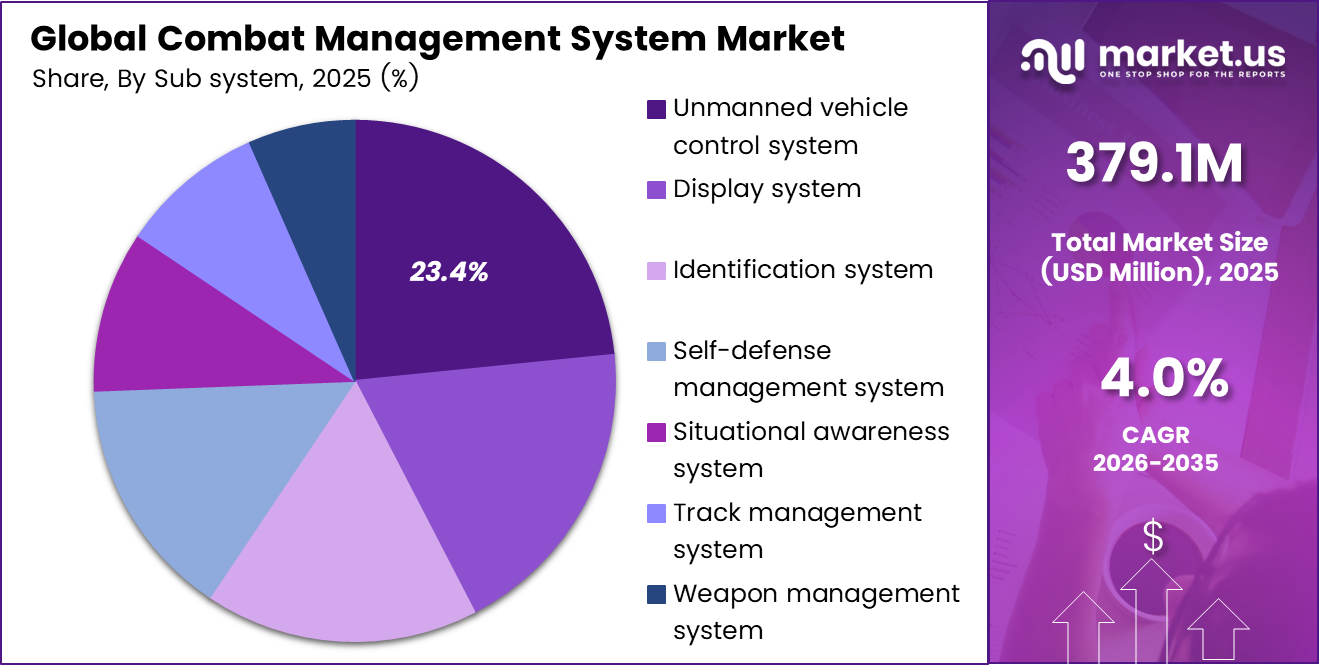
- Unmanned vehicle control systems held 23.4% share, reflecting rising deployment of autonomous naval platforms and unmanned maritime systems.
- Amphibious ships captured 25.6% share, supported by increasing multi-mission fleet deployments and expeditionary naval operations.
- North America led the market with a 36.4% share, generating approximately USD 138.0 million in revenue.
Component Analysis
Software dominates with 57.4% due to widespread adoption across naval combat systems.
The software segment’s commanding 57.4% share of the Combat Management System (CMS) market is structurally anchored in codified U.S. federal law and unprecedented government R&D commitments. Under Title 10 U.S.C. § 4401, enacted in 2019, all Major Defense Acquisition Programs (MDAPs) receiving Milestone A or B approval are legally mandated to adopt a Modular Open Systems Approach (MOSA) — a software-first architecture that decouples capability upgrades from physical platform replacement.
Operationally, a CMS software layer must simultaneously execute sensor fusion, track management, threat correlation, weapon assignment, and C2 communications in real-time tasks that are computationally intensive yet platform-agnostic, making software the scalable, updatable cost center. The U.S. DoD’s FY2026 budget requests USD 142 billion in RDT&E from its base budget, augmented by USD 37 billion through the One Big Beautiful Bill Act to a combined total of USD 179 billion, with the Department of the Navy alone allocated approximately USD 25.7 billion in R&D funding.
Every new naval hull mandated under the FY2026 USD 47.4 billion shipbuilding request requires a software-defined CMS capable of integrating unmanned vehicle control, EW situational awareness, and multi-domain sensor feeds — each function delivered exclusively through software. This convergence of legal mandate, budget posture, and operational necessity confirms the software segment’s structural dominance as durable and accelerating.
Sub system Analysis
Unmanned vehicle control system dominates with 23.4% due to rising integration of autonomous naval platforms.
Unmanned vehicle control sub-systems are emerging as the structural center of gravity within modern combat management systems (CMS), capturing the largest and fastest‑expanding share of CMS sub‑system spend as navies and joint forces pivot to mixed manned–unmanned fleets. NATO’s Maritime Unmanned Systems initiatives explicitly frame future task groups as “fleets of autonomous systems supporting and working together with manned assets,” making CMS‑embedded unmanned control the mandatory orchestration layer rather than an optional add‑on.
Economically, this shift is underwritten by surging defense expenditure: global military spending reached about USD 2.9 trillion in 2025, with the United States alone investing roughly USD 954 billion, a material share of which is directed to autonomous and remotely operated capabilities. Operationally, every additional unmanned aerial, surface, or underwater platform multiplies the number of tracks, sensor feeds, and engagement options that must be ingested, deconflicted, and tasked at machine speed, making scalable unmanned control logic the primary performance bottleneck inside CMS architectures.
Platforms Analysis
Amphibious ships dominate with 25.6% due to rising multi-mission amphibious fleet deployments.
Amphibious ships currently command the largest installed base of combat management systems (CMS) because they are the structural backbone of expeditionary, joint-force and crisis‑response naval operations, and therefore must embed the most complex C2, sensor‑fusion and landing‑force coordination logic onboard.
Statutorily, the U.S. Navy is required to sustain not less than 31 large amphibious ships, including at least 10 big‑deck LHA/LHDs, ensuring that amphibious platforms represent a durable, high‑volume CMS install base across one of the world’s most technologically advanced navies. As global amphibious forces are increasingly tasked with power projection, territorial defense, humanitarian assistance and stabilization operations, their multi‑mission profile drives continuous CMS upgrades for multi‑domain situational awareness and joint fires coordination, reinforcing amphibious ships’ leading share of platform‑level CMS deployments.
Key Market Segments
Component Analysis
- Hardware
- Combat data centre
- Control consoles
- Data network switchers
- Software
Sub system Analysis
- Unmanned vehicle control system
- Display system
- Identification system
- Self-defense management system
- Situational awareness system
- Track management system
- Weapon management system
Platforms Analysis
- Amphibious ships
- Corvettes
- Aircraft carriers
- Destroyers
- Fast Attack Craft (FAC)
- Frigates
- Submarines
- Others
Geopolitical Impact Analysis
Geopolitical risk is now structurally embedded in the combat management system (CMS) supply chain, with trade, logistics, and energy shocks directly translating into higher manufacturing costs, longer lead times, and pricing volatility for defense integrators. Elevated tariff regimes have increased the average effective U.S. tariff rate to around 18–19% in 2025, the highest since the 1930s, with specific rates on strategic suppliers such as China exceeding 50% on many categories of imports.
At the logistics level, UNCTAD reports that container ship transits in the Red Sea corridor dropped 67% year‑on‑year in early 2024, with Shanghai–Europe spot freight rates more than tripling and U.S. West Coast routes also more than doubling despite bypassing Suez. For CMS integrators relying on multi‑modal routes from Asian PCB, FPGA, and radar sub‑system suppliers into European and Indian assembly lines, these diversions typically add 10–15 transit days and can push inbound freight budgets up by 70–100% on affected lanes, compressing margins on fixed‑price naval and air defense contracts.
Energy dynamics further amplify total landed cost volatility across CMS programs. Brent crude averaged about 80 USD per barrel in 2024 and is forecast to soften toward 75–76 USD in 2025–2026, but the International Energy Agency expects demand growth to remain subdued at roughly 680,000 barrels per day in 2025 and 700,000 barrels per day in 2026, reflecting persistent uncertainty and episodic price spikes around regional conflicts.
Regional Analysis
North America leads with a 36.4% share and a USD 138.0 million market value.
The global combat management system (CMS) market is characterized by strong regional disparities, with North America currently holding a dominating position and Asia-Pacific emerging as the fastest‑growing region over the forecast horizon. North America accounts for an estimated 36.4% share of the global CMS market, translating to around USD 138.0 million in revenues, supported primarily by the United States’ high defense spending and sustained naval modernization programs.
The region’s leadership is reinforced by large-scale fleet upgrade initiatives, integration of advanced command-and-control architectures on destroyers, frigates, and submarines, and a strong base of prime contractors such as Lockheed Martin, Northrop Grumman, and Raytheon Technologies that drive continuous innovation in software, hardware, and unmanned vehicle control sub-systems.
In contrast, Asia-Pacific is identified as the fastest-growing CMS market, underpinned by rising maritime security challenges, expanding shipbuilding activity, and accelerating deliveries of combat vessels across China, India, Japan, South Korea, and Australia. Regional defense forces are investing heavily in open-architecture, modular combat management suites to enhance situational awareness, multi‑platform interoperability, and real‑time threat evaluation across both blue‑water and littoral environments.
Key Regions and Countries
North America
- US
- Canada
Europe
- Germany
- France
- The UK
- Spain
- Italy
- Rest of Europe
Asia Pacific
- China
- Japan
- South Korea
- India
- Australia
- Rest of APAC
Latin America
- Brazil
- Mexico
- Rest of Latin America
Middle East & Africa
- GCC
- South Africa
- Rest of MEA
Market Dynamics
Challenge
Legacy-digital integration remains a major bottleneck in modern CMS upgrades because integrating open-architecture systems into legacy naval platforms often leads to 15-25% cost overruns and 12-24 months of schedule delays. These delays are driven by bespoke middleware development, electromagnetic compatibility requalification, and extensive rewiring of aging hulls.
Many mixed fleets still operate with CMS baselines that are more than 10 years old, and upgrading them requires interfacing with 50-150 heterogeneous subsystems per ship, each with different data formats and latency characteristics. As a result, integration testing cycles expand from 6-9 months for new builds to 18-30 months for legacy upgrades.
This complexity reduces modernization throughput by 20-30%, creating an estimated 1.4 percentage point drag on CMS market CAGR versus new-build-only scenarios. While modular open systems architectures (MOSA) and standardized middleware aim to reduce friction, fleet-wide adoption is constrained by multi-year refit schedules, extensive re-qualification requirements, and coordination across 5-10 contractors per platform, extending the normalization horizon beyond 4 years.
| Challenge | (~) % CAGR | Geographic Relevance | Mitigation Horizon |
|---|---|---|---|
| Legacy–digital integration drag | -1.4% | NATO fleets, APAC navies | Long term (≥ 4 years) |
| Secure supply chain volatility | -1.2% | US, EU, APAC hubs | Medium term (2-4 years) |
| Cyber-hardening & certification load | -0.9% | NATO, Five Eyes, GCC | Long term (≥ 4 years) |
| High-end software talent gap | -1.0% | North America, Europe, India | Medium term (2-4 years) |
| Procurement & compliance friction | -0.7% | Global defense ministries | Long term (≥ 4 years) |
| AI-enabled CMS validation risk | -0.8% | US, EU, East Asia | Medium term (2-4 years) |
Opportunity
Lifecycle SaaS, analytics, and training monetization remain an untapped opportunity because the CMS market is still largely driven by upfront capex and time-and-materials support, while monetization of operational data, AI analytics, and continuous training across long platform lifecycles is still emerging despite rapidly increasing sensor-generated data volumes in naval systems.
By 2030, the battlefield management and naval combat systems market could exceed USD 30-45 billion. If OEMs convert 10-15% of this into recurring SaaS and service streams such as performance dashboards, predictive maintenance, AI decision support, and digital twin-enabled simulation, this could generate USD 3-6 billion in annual high-margin revenue by 2035 compared with today’s project-based model.
For navies, shifting to subscription or outcome-based models can reduce total cost of ownership by 10-20% through better maintenance planning, reduced downtime, and improved crew performance. OEMs benefit from software and services gross margins in the 40-50% range, alongside training as a service opportunities adding USD 1-3 million per major vessel over its lifecycle and increasing program value by 5-10%, supporting early adoption in North America, Europe, and advanced APAC by 2028 and potentially adding about 1.2 percentage points of CAGR upside.
| Opportunity | (~) % Potential CAGR | Geographic Relevance | Execution Window |
|---|---|---|---|
| Open-architecture CMS app ecosystems | +2.0% | North America, EU, APAC emerging | Medium term (2–4 years) |
| CMS for unmanned and optionally manned fleets | +1.8% | APAC emerging, Middle East, North America | Medium term (2–4 years) |
| Cyber-resilient and sovereign CMS stacks | +1.5% | EU, India, Middle East | Short term (≤ 2 years) |
| Cross-domain joint-force CMS integration | +1.3% | NATO members, Indo-Pacific alliances | Long term (≥ 4 years) |
| Lifecycle SaaS, analytics and training monetization | +1.2% | North America core, EU, APAC | Short–Medium (≤ 4 years) |
| Export-oriented mid-tier CMS platforms | +1.0% | APAC, Latin America, Africa | Long term (≥ 4 years) |
Driver
Indigenous CMS programs and localization mandates are increasingly shaping global naval procurement as emerging and mid-tier naval powers push for self-reliance in critical combat systems. This is fragmenting the supplier landscape but also expanding overall demand by creating new national programs, joint ventures, and long-term technology transfer ecosystems, contributing an estimated approximately 0.8 percentage point uplift to global CAGR.
India is a key example, with 55 warships under construction domestically at an estimated cost of 99,500 crore INR, along with approvals for 74 additional vessels worth about 2.35 lakh crore INR, supported by a strong policy emphasis on indigenous design and production of naval platforms and combat systems. Similar localization-driven approaches are also emerging in the Gulf region, where CMS adoption is often tied to co-development, training programs, and domestic capability building through joint ventures and defense partnerships.
| Driver | (~) % Impact on CAGR | Geographic Relevance | Impact Timeline |
|---|---|---|---|
| Naval fleet recapitalization & newbuild programs | +2.0% | North America core, Europe, APAC corridors | Medium term (2–4 years) |
| Geopolitical maritime tensions & contested sea lanes | +1.5% | APAC corridors, EU littoral, Middle East | Short–Medium term (≤4 years) |
| Digitalization, open-architecture & software-defined CMS | +1.3% | North America core, EU, APAC corridors | Medium–Long term (≥3 years) |
| Interoperability, joint operations & alliance data-links | +1.0% | NATO, Indo-Pacific alliances | Medium term (2–4 years) |
| Indigenous CMS programs & localization mandates | +0.8% | APAC corridors, Middle East, Latin America | Long term (≥4 years) |
| Integration of unmanned, AI-enabled and multi-domain assets | +1.2% | North America, EU, APAC corridors | Medium–Long term (≥3 years) |
Restraint
Export controls and tech transfer regimes, especially ITAR-related restrictions on advanced data fusion, electronic warfare interfaces, and secure tactical data links, continue to slow CMS exports into high-growth regions such as the Middle East and Indo-Pacific. These constraints often result in 12-36 month approval cycles or downgraded export configurations that reduce system value by 10-20% per hull.
In several naval recapitalization programs in the Gulf and Southeast Asia, countries are allocating 15-25% of combat system budgets toward domestic R&D and know-how transfer instead of direct procurement from incumbent vendors. The UAE’s National Combat Management System initiative is an example of this shift, where foreign technology baselines are used but core software control is increasingly localized.
Financially, this can be significant at scale. With typical CMS and mission-system content valued at USD 80-120 million per destroyer or frigate, even a 15% value erosion across 30-40 vessels over 5-7 years translates into roughly USD 350-700 million in lost revenue for constrained suppliers. Beyond direct losses, OEMs also face higher legal, integration, and JV structuring costs with 3-5 year payback horizons, fragmented technology stacks, and increased lifecycle support complexity. Overall, these dynamics are estimated to reduce global CMS growth potential by about 1.5 percentage points, particularly in export-dependent markets.
| Restraint | (~) % Impact on CAGR | Geographic Relevance | Impact Timeline |
|---|---|---|---|
| Defense budget flattening & reprioritization | -1.8% | North America core, Western Europe, Japan | Medium term (2–4 years) |
| Export controls, ITAR and tech-transfer barriers | -1.5% | US–allied corridors, Middle East, APAC | Long term (≥ 4 years) |
| Defense electronics & semiconductor supply risk | -1.6% | EU, Asia, North America | Short term (≤ 2 years) |
| Naval program slippages & cost overruns | -1.9% | EU, APAC, Middle East | Medium term (2–4 years) |
| Cybersecurity, open-architecture & integration complexity | -1.4% | Global tier-1 navy programs | Long term (≥ 4 years) |
| Local content, offsets & industrial participation mandates | -1.3% | Middle East, India, LATAM | Medium term (2–4 years) |
Key Players Analysis
RTX reported 2025 sales of over 88 billion USD, confirming its position among the largest global defense contractors, with its Raytheon segment providing command, control, communications and intelligence systems that underpin integrated combat systems for naval and air platforms. Its revenue base and portfolio breadth mean CMS-related and broader mission‑systems work likely represents a mid‑single‑digit share of group sales.
BAE Systems has been awarded a 285 million GBP contract under the UK MoD RECODE program to enhance and support the Royal Navy’s shared infrastructure, combat management systems and warship networks, on top of a five‑year, 251 million USD AEGIS support contract with the U.S. Navy, indicating a robust, recurring CMS revenue stream likely exceeding 0.5–0.7 billion USD annually across UK and U.S. naval programs alone.
Curtiss‑Wright reported first‑quarter 2026 sales of 914 million USD, up 13 percent year‑on‑year, with aerospace and defense market sales up 14 percent and an operating margin of 17.5 percent, reflecting strong profitability and growing exposure to mission‑critical systems for naval platforms, including fire‑control, shipboard electronics and computing that integrate into broader CMS architectures.
Top Key Players in the Market
- RTX Corporation
- ATLAS ELEKTRONIK GmbH
- BAE System Plc
- Bharat Electronics Limited (BEL)
- Curtiss-Wright
- Leonardo S.p.A.
- Lockheed Martin Corporation
- Israel Aerospace Industries Ltd.
- Kongsberg Gruppen ASA
- Kratos Defense & Security Solutions, Inc.
- LARSEN & TOUBRO LIMITED.
- ASELSAN A.S.
- Northrop Grumman Corporation
- Terma Group
- Saab AB
Recent Developments
- In July 2026, Saab signs a multi-system combat management contract with Damen Naval to supply the 9LV Combat Management System and 9LV Fire Control System for the Colombian Navy’s new frigate program, with the order valued at approximately SEK 4.5 billion (about USD 420 million) and covering integrated CMS, fire-control, and associated software suites for multiple hulls over a delivery window extending beyond 2030.
- In January 2025, BAE Systems wins a £285 million (about USD 360 million) RECODE program contract from the UK Ministry of Defence to support and modernize the Royal Navy’s Shared Infrastructure, Combat Management Systems, and warship networks across surface combatants and auxiliaries, including CMS software upgrades, hardware refresh, and secure digital backbone expansion over a planned 8‑year performance period.
- In November 2025, Lockheed Martin Canada finalizes a government‑to‑government contract via Canadian Commercial Corporation with Germany’s Federal Office of Bundeswehr Equipment to deliver the CMS 330 combat management system for future F127 frigates and upgrades for in‑service F125 frigates, with the deal publicly framed by Canada as a “$1‑billion purchase” covering CMS 330 integration, lifecycle support, and associated combat system engineering.
- In December 2025, Kongsberg Defence & Aerospace signs two agreements with Norway and Germany worth more than NOK 4 billion (around USD 380–400 million) to supply combat management systems for the 212CD class submarines and navigation systems for German Navy 212A‑class submarines, expanding Kongsberg’s underwater CMS installed base by over a dozen hulls and locking in long‑term spares, software updates, and training packages.
Report Scope
| Report Features | Description |
|---|---|
| Market Value (2025) | USD 379.1 Million |
| Forecast Revenue (2035) | USD 562.2 Million |
| CAGR (2026-2035) | 4.0% |
| Base Year for Estimation | 2025 |
| Historic Period | 2020-2024 |
| Forecast Period | 2026-2035 |
| Report Coverage | Revenue Forecast, Market Dynamics, Competitive Landscape, Recent Developments |
| Segments Covered | By Component (Hardware, Software), By Sub system (Unmanned vehicle control system, Display system, Identification system, Self-defense management system, Situational awareness system, Track management system, Weapon management system), By Platforms (Amphibious ships, Corvettes, Aircraft carriers, Destroyers, Fast Attack Craft (FAC), Frigates, Submarines, Others) |
| Regional Analysis | North America – US, Canada; Europe – Germany, France, The UK, Spain, Italy, Rest of Europe; Asia Pacific – China, Japan, South Korea, India, Australia, Singapore, Rest of APAC; Latin America – Brazil, Mexico, Rest of Latin America; Middle East & Africa – GCC, South Africa, Rest of MEA |
| Competitive Landscape | RTX Corporation, ATLAS ELEKTRONIK GmbH, BAE System Plc, Bharat Electronics Limited (BEL), Curtiss-Wright, Leonardo S.p.A., Lockheed Martin Corporation, Israel Aerospace Industries Ltd., Kongsberg Gruppen ASA, Kratos Defense & Security Solutions, Inc., LARSEN & TOUBRO LIMITED., ASELSAN A.S., Northrop Grumman Corporation, Terma Group, Saab AB |
| Customization Scope | Customization for segments and region/country-level will be provided. Moreover, additional customization can be done based on the requirements. |
| Purchase Options | We have three licenses to opt for: Single User License, Multi-User License (Up to 5 Users), Corporate Use License (Unlimited Users and Printable PDF) |