Report Overview
The Global Performance Testing Tools Market generated USD 1.6 billion in 2024 and is predicted to register growth from USD 2.0 billion in 2025 to about USD 17.0 billion by 2034, recording a CAGR of 26.5% throughout the forecast span. In 2024, North America held a dominant market position, capturing more than a 36.1% share, with USD 0.58 billion in revenue.
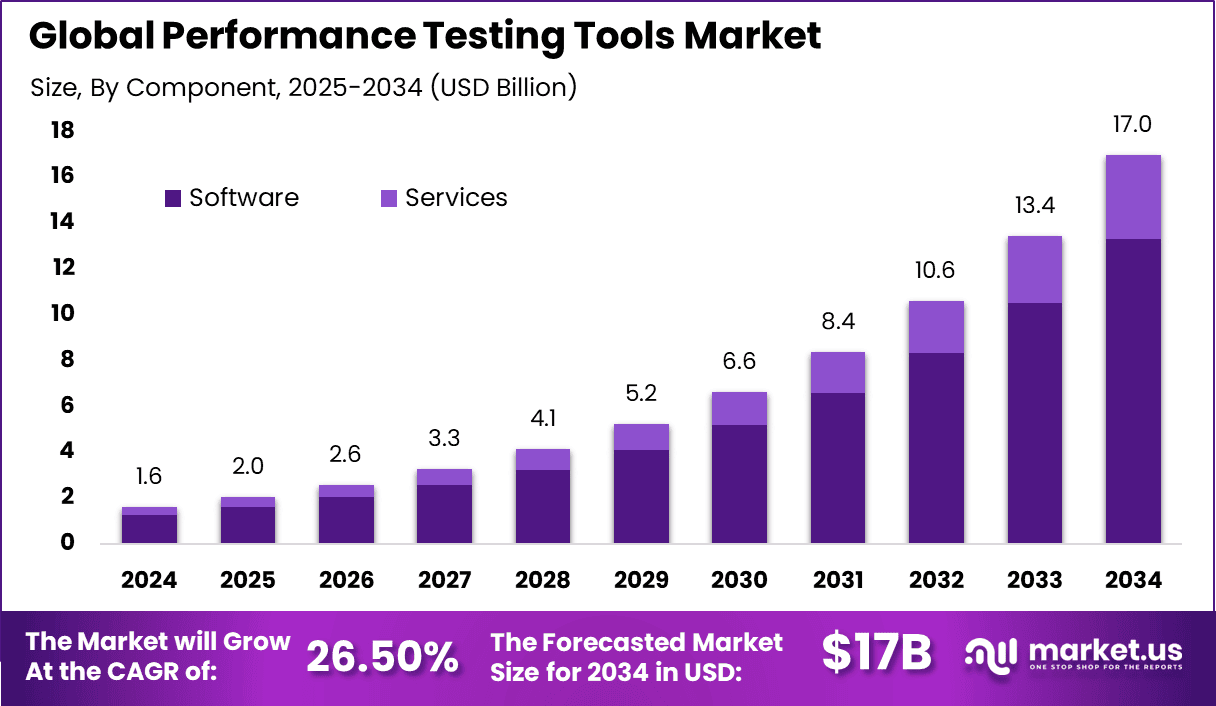
Performance testing tools are software solutions used to evaluate the speed, stability, and scalability of applications under different load conditions. These tools simulate real-world user activity to measure system performance, helping organisations identify bottlenecks, slow response times, and potential failures before software deployment or updates.
The growth of performance testing tools is driven by increasing software complexity, digital transformation, and rising expectations for seamless digital experiences. Organisations are adopting automated solutions to reduce manual testing efforts, accelerate release cycles, and maintain quality across development teams. Cloud migration, agile development, continuous delivery, and microservices architectures are further increasing the need for advanced performance validation.
Industries including banking, e-commerce, telecommunications, and healthcare are investing in performance testing tools to ensure reliable services, meet regulatory requirements, and protect customer trust. As digital platforms become essential for business operations, these solutions help organisations manage performance risks, support scalability, and deliver consistent user experiences.
Top Market Takeaways
- By component, software took 78.3% of the performance testing tools market, as it provides the main tools for running tests.
- By testing type, load testing held a 45.2% share, used to check how apps handle many users at once.
- By deployment mode, cloud-based solutions captured 68.7%, offering easy scaling and no need for their own servers.
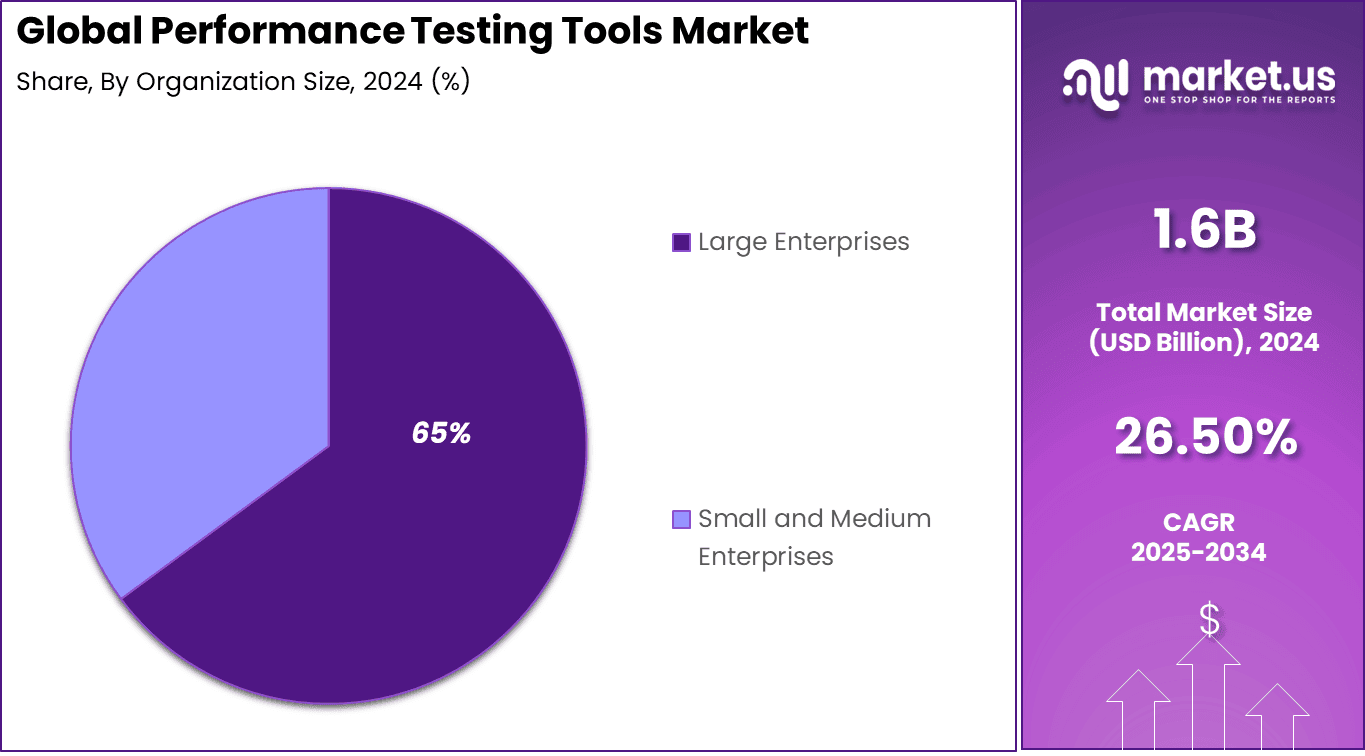
- By organization size, large enterprises accounted for 64.9%, needing strong tests for big systems.
- By end-user industry, IT and telecommunications led with 41.6%, testing networks and apps for speed.
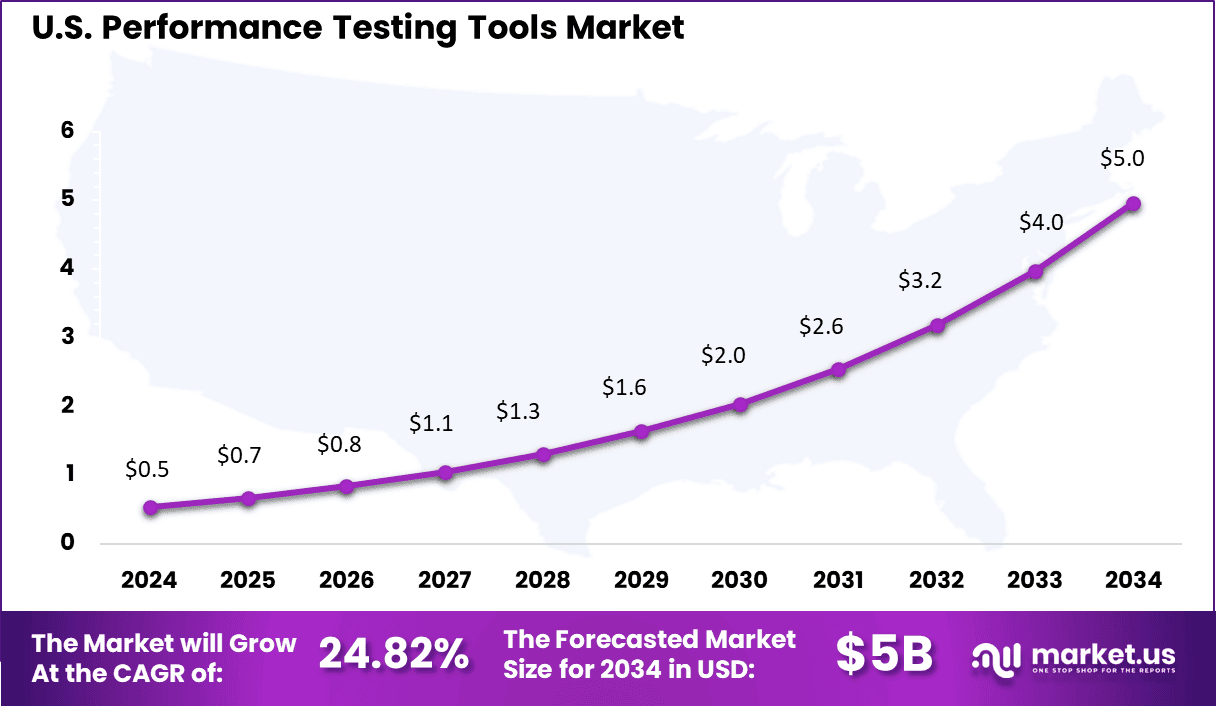
- North America had 36.1% of the global market, with the U.S. at USD 0.54 billion in 2025 and growing at a CAGR of 24.82%.
Component Analysis
The Software segment holds 78.3% of the Performance Testing Tools market, showing that most performance testing activities are driven by software-based solutions. These tools are used to evaluate system speed, stability, scalability, and reliability under different usage conditions. Software platforms allow testing teams to simulate real-world traffic, identify performance bottlenecks, and measure system behavior before applications go live.
From an enterprise standpoint, software tools provide flexibility and repeatability across testing cycles. They can be integrated into development pipelines and reused across multiple projects and applications. The strong share of this segment reflects the increasing complexity of digital applications and the need for continuous performance validation throughout the software development lifecycle.
Testing Type Analysis
Load testing accounts for 45.2% of the testing type segment, making it the most widely adopted approach within performance testing. Load testing helps organizations understand how applications behave under expected user volumes and transaction levels. It is commonly used to validate system readiness before product launches, updates, or peak usage periods.
Load testing is valued because it provides clear insight into system capacity and response time. Development teams use these results to optimize infrastructure and application design. The strong adoption of load testing reflects its role as a foundational practice for ensuring stable and reliable digital services.
Deployment Mode Analysis
Cloud-based deployment represents 68.7% of the market, driven by scalability and ease of access. Cloud platforms allow organizations to generate large volumes of virtual users without investing in physical infrastructure. This makes it easier to perform complex performance tests that reflect real-world usage scenarios.
Another key advantage of cloud deployment is flexibility. Testing environments can be created, modified, and scaled on demand. This reduces setup time and supports faster testing cycles. The dominance of cloud-based tools highlights the market’s shift toward agile and cost-efficient testing models.
Organization Size Analysis
Large enterprises account for 65% of the market, reflecting their extensive use of performance testing tools across multiple applications and systems. These organizations operate complex digital environments that require consistent monitoring and validation to maintain service quality. Performance testing helps large enterprises manage risk and avoid service disruptions.
Large enterprises also have dedicated testing teams and structured development processes. Performance testing tools are integrated into long-term quality assurance strategies. The strong presence of this segment indicates that performance testing is a critical requirement for enterprises managing high user volumes and mission-critical applications.
End-User Industry Analysis
The IT and telecommunications sector represents 41.6% of end-user demand, making it the leading industry segment. This sector relies on high system availability and fast response times to support digital services, networks, and communication platforms. Performance testing tools help ensure that systems can handle heavy traffic and maintain consistent performance.
In IT and telecom environments, even minor performance issues can impact large numbers of users. Testing tools are used regularly to validate network upgrades, software releases, and infrastructure changes. The strong share of this segment reflects the industry’s reliance on robust performance testing to maintain service reliability and customer satisfaction.
Key Market Segments
By Component
- Software
- Services
By Testing Type
- Load Testing
- Stress Testing
- Spike Testing
- Others
By Deployment Mode
- Cloud-based
- On-premises
By Organization Size
- Large Enterprises
- Small and Medium-sized Enterprises (SMEs)
By End-User Industry
- IT & Telecommunications
- Banking, Financial Services, and Insurance (BFSI)
- Retail & E-commerce
- Healthcare
- Others
Key Factors for Choosing a Tool
Project Requirements
The tool should match the nature of the application being tested. Factors such as application complexity, types of testing needed such as load, stress, or endurance testing, and support for required protocols like HTTP, JDBC, or SOAP should be carefully evaluated.
Team Expertise
The skills of the testing team play an important role in tool selection. Some tools require deeper technical knowledge and longer learning time, while others are more suitable for developers due to the use of familiar scripting languages such as JavaScript or Python.
Integration Capability
The selected tool should integrate smoothly with existing CI or CD pipelines and monitoring platforms. Compatibility with automation tools and dashboards helps support continuous testing and faster feedback during development cycles.
Scalability and Budget Considerations
Cost and scalability must be balanced. Open source tools are generally cost-effective but may require additional effort to scale using internal infrastructure. Commercial or cloud-based tools provide easier scalability, built-in support, and faster setup, but usually involve higher costs.
Top Open Source Tools
These tools are free to use and are supported by large user communities.
Apache JMeter
This is the most widely used open source performance testing tool. It provides a visual interface to create and manage test plans. It supports many protocols such as HTTP, SOAP, JDBC, and FTP, making it suitable for different application types.
k6 (Grafana Labs)
This tool is built mainly for developers and uses JavaScript for writing test scripts. It is designed for high speed testing, easy integration with CI or CD pipelines, and real-time performance tracking through Grafana dashboards.
Gatling
Gatling is known for strong performance and efficient resource usage. It uses a Scala-based scripting language and follows a non-blocking design, which helps simulate heavy user loads without high system overhead.
Locust
Locust is a lightweight tool written in Python. It allows teams to create flexible and scalable load tests using simple Python code. It is often preferred by developers who want full control over test behavior.
The Grinder
This is a Java-based testing framework that supports scripting in Python or Clojure. It is highly flexible and supports distributed testing, where multiple machines can generate load together.
Top Commercial and Enterprise Tools
These tools provide advanced reporting, automation features, and professional support.
LoadRunner Professional
This is a widely used tool for large enterprise applications. It supports a broad range of technologies such as SAP, Oracle, and .NET. It also includes intelligent analysis features to identify performance issues.
NeoLoad (Tricentis)
NeoLoad is designed for Agile and DevOps teams. It offers an easy-to-use interface with minimal coding and integrates well with container platforms such as Kubernetes and Docker for flexible scaling.
BlazeMeter
BlazeMeter is a cloud-based platform that builds on JMeter. It allows very large-scale testing and supports global load generation. It also provides detailed reports and test insights.
WebLOAD
WebLOAD is suitable for complex enterprise applications with many user actions. It includes automated script handling features that reduce manual effort and make test maintenance easier.
Emerging Trends
| Key Trend | Description |
|---|---|
| AI-Powered Testing | AI automatically detects issues and predicts performance and load problems. |
| Cloud-Based Tools | Applications are tested on real cloud environments at large scale. |
| Low Code Platforms | Testing workflows are created using drag-and-drop tools without heavy coding. |
| Shift Left Approach | Performance testing is done early in development to fix issues faster. |
| DevOps Integration | Tests run automatically inside daily code and deployment pipelines. |
Growth Factors
| Key Factors | Description |
|---|---|
| Complex Apps Rise | Microservices and APIs require strong and frequent performance checks. |
| Agile DevOps Spread | Fast-moving development teams need quick and continuous performance testing. |
| Mobile Cloud Growth | Applications running on mobile devices and cloud platforms must perform smoothly. |
| User Speed Demand | Slow websites lead to lost sales, pushing firms to test performance strictly. |
| AI Tool Advances | Smarter testing tools reduce test time and uncover more hidden issues. |
Key Reasons for Adoption
- The need to ensure stable application performance in complex and distributed IT environments has increased adoption.
- Faster software release cycles have encouraged teams to validate performance early in the development process.
- Rising user expectations for quick response times have made performance assurance a critical requirement.
- Growing use of cloud platforms and microservices has increased system complexity, requiring continuous performance checks.
- Service level commitments and regulatory requirements have strengthened the focus on consistent performance validation.
Benefits
- Performance issues are identified at early stages, reducing production risks and downtime.
- Clear visibility into system behavior under load supports informed technical and business decisions.
- Infrastructure planning is improved through better understanding of resource utilization patterns.
- Overall user experience is enhanced by maintaining consistent application speed and reliability.
- Cross-team collaboration is strengthened through shared performance data and standardized reporting.
Regional Analysis
North America accounted for a 36.1% share, supported by high adoption of cloud computing, DevOps practices, and continuous software delivery across enterprises. Organizations in the region increasingly rely on performance testing tools to ensure application stability under high user loads and complex system environments.
Demand has been driven by the growth of web applications, mobile platforms, and API based services, where performance issues directly affect user experience and revenue. As digital services scale rapidly, testing tools have become essential for identifying bottlenecks and improving system reliability before production release.
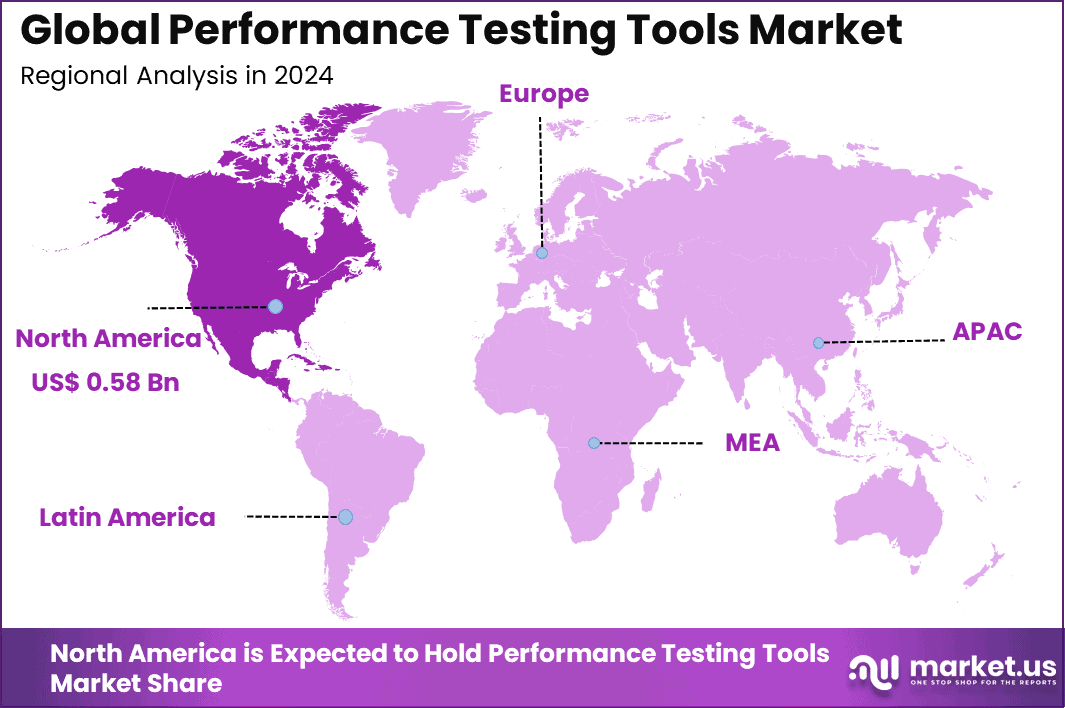
The U.S. market reached USD 0.54 Bn and is projected to grow at a 24.82% CAGR, reflecting rapid expansion of digital platforms and cloud native applications. Enterprises have increasingly adopted performance testing tools to manage peak traffic, ensure uptime, and support scalable system architectures. High adoption among technology firms, financial service providers, and e-commerce platforms has been a key driver, as these sectors require consistent performance during high demand periods.
Key Regions and Countries
- North America
- US
- Canada
- Europe
- Germany
- France
- The UK
- Spain
- Italy
- Russia
- Netherlands
- Rest of Europe
- Asia Pacific
- China
- Japan
- South Korea
- India
- Australia
- Singapore
- Thailand
- Vietnam
- Rest of APAC
- Latin America
- Brazil
- Mexico
- Rest of Latin America
- Middle East & Africa
- South Africa
- Saudi Arabia
- UAE
- Rest of MEA
Opportunities & Threats
The Performance Testing Tools market offers strong opportunities as businesses continue to rely on digital applications for daily operations and customer engagement. With the rise of cloud platforms, mobile apps, and online services, ensuring that systems perform well under high user load has become a priority.
Performance testing tools help organizations identify speed, stability, and scalability issues before deployment. Demand is growing across banking, e-commerce, healthcare, and government sectors where system downtime can directly affect revenue and user trust.
The market faces threats related to cost, complexity, and skills availability. Advanced performance testing tools often require experienced testers to design scenarios and interpret results, which can be a barrier for smaller organizations.
Budget constraints may push some companies to rely on basic or open-source tools that offer limited functionality. In fast-moving development environments, testing is sometimes rushed or skipped, reducing the perceived value of dedicated tools.
Competitive Analysis
The competitive landscape of the performance testing tools market is defined by a mix of enterprise software vendors, open source platforms, and specialized testing solution providers. IBM Corporation, Broadcom, Inc. through CA Technologies, Micro Focus International plc, OpenText Corporation, Oracle Corporation, and Progress Software Corporation hold strong positions due to their deep enterprise reach and ability to integrate performance testing with application lifecycle management and DevOps workflows.
Apache JMeter, supported by the Apache Software Foundation, remains widely adopted for its flexibility and strong community backing, while vendors such as SmartBear Software, Tricentis GmbH, Perforce Software, Inc., Neotys, Akamai Technologies through BlazeMeter, LoadNinja, Radview Software, Ltd., and QualiTest compete by offering cloud-based testing, real user simulation, and continuous testing capabilities.
Top Key Players in the Market
- Micro Focus International plc
- IBM Corporation
- Broadcom, Inc. (CA Technologies)
- SmartBear Software, Inc.
- Tricentis GmbH
- Perforce Software, Inc.
- Apache Software Foundation (JMeter)
- OpenText Corporation
- Oracle Corporation
- Progress Software Corporation
- Neotys
- Akamai Technologies, Inc. (BlazeMeter)
- LoadNinja (a SmartBear company)
- Radview Software, Ltd.
- QualiTest
- Others
Future Outlook
The future outlook for the Performance Testing Tools market is expected to remain strong as businesses rely more on digital platforms, cloud applications, and mobile services. Performance testing is becoming a regular part of software development to ensure systems can handle high user traffic, data loads, and real-time processing.
Wider use of agile and DevOps practices is supporting continuous testing across the development lifecycle. In the coming years, more testing tools are likely to include AI-based analysis, cloud native testing, and real user simulation to improve accuracy and reduce testing time.
Recent Developments
- In January 2024, Dynatrace reached a definitive agreement to acquire Runecast, an AI‑enhanced security and compliance provider, to integrate cloud security posture analytics into its observability and performance platform by the end of its fiscal year.
- In March 2025, Dynatrace announced the acquisition of Metis to expand AI‑driven database observability, helping developers and SREs troubleshoot, optimize, and automate database performance as part of its end‑to‑end performance stack.
Report Scope
| Report Features | Description |
|---|---|
| Market Value (2024) | USD 1.6 Bn |
| Forecast Revenue (2034) | USD 17.0 Bn |
| CAGR(2025-2034) | 26.5% |
| Base Year for Estimation | 2024 |
| Historic Period | 2020-2023 |
| Forecast Period | 2025-2034 |
| Report Coverage | Revenue forecast, AI impact on Market trends, Share Insights, Company ranking, competitive landscape, Recent Developments, Market Dynamics and Emerging Trends |
| Segments Covered | Global Performance Testing Tools Market By Component (Software, Services), By Testing Type (Load Testing, Stress Testing, Spike Testing, Others), By Deployment Mode (Cloud-based, On-premises), By Organization Size (Large Enterprises, Small and Medium-sized Enterprises (SMEs)), By End-User Industry (IT & Telecommunications, Banking, Others) |
| Regional Analysis | North America – US, Canada; Europe – Germany, France, The UK, Spain, Italy, Russia, Netherlands, Rest of Europe; Asia Pacific – China, Japan, South Korea, India, New Zealand, Singapore, Thailand, Vietnam, Rest of Latin America; Latin America – Brazil, Mexico, Rest of Latin America; Middle East & Africa – South Africa, Saudi Arabia, UAE, Rest of MEA |
| Competitive Landscape | Micro Focus International plc, IBM Corporation, Broadcom, Inc. (CA Technologies), SmartBear Software, Inc., Tricentis GmbH, Perforce Software, Inc., Apache Software Foundation (JMeter), OpenText Corporation, Oracle Corporation, Progress Software Corporation, Neotys, Akamai Technologies, Inc. (BlazeMeter), LoadNinja (a SmartBear company), Radview Software, Ltd., QualiTest, Others |
| Customization Scope | Customization for segments, region/country-level will be provided. Moreover, additional customization can be done based on the requirements. |
| Purchase Options | We have three licenses to opt for: Single User License, Multi-User License (Up to 5 Users), Corporate Use License (Unlimited Users and Printable PDF) |