


Report Overview
The Global Quality Assurance Software Market size is expected to be worth around USD 56.6 Billion By 2035, from USD 18.9 billion in 2025, growing at a CAGR of 11.6% during the forecast period from 2026 to 2035. North America held a dominant Market position, capturing more than a 39.7% share, holding USD 139.22 Billion revenue.
The Quality Assurance Software Market refers to digital solutions designed to ensure that products, applications, and systems meet defined performance, reliability, and compliance standards. These solutions support testing, monitoring, defect tracking, and process validation across software development and industrial operations. The market has evolved with the rise of agile development, continuous integration, and automation, where quality assurance is no longer a final step but an ongoing process embedded throughout the lifecycle.
Top driving factors are closely linked to the increasing complexity of software systems and the need for faster release cycles. It has been observed that nearly 70% of development teams follow agile or DevOps practices, which require continuous testing and validation to maintain quality. At the same time, software failures and downtime can result in significant financial and reputational losses, prompting organizations to adopt automated quality assurance tools that ensure reliability and performance at scale.
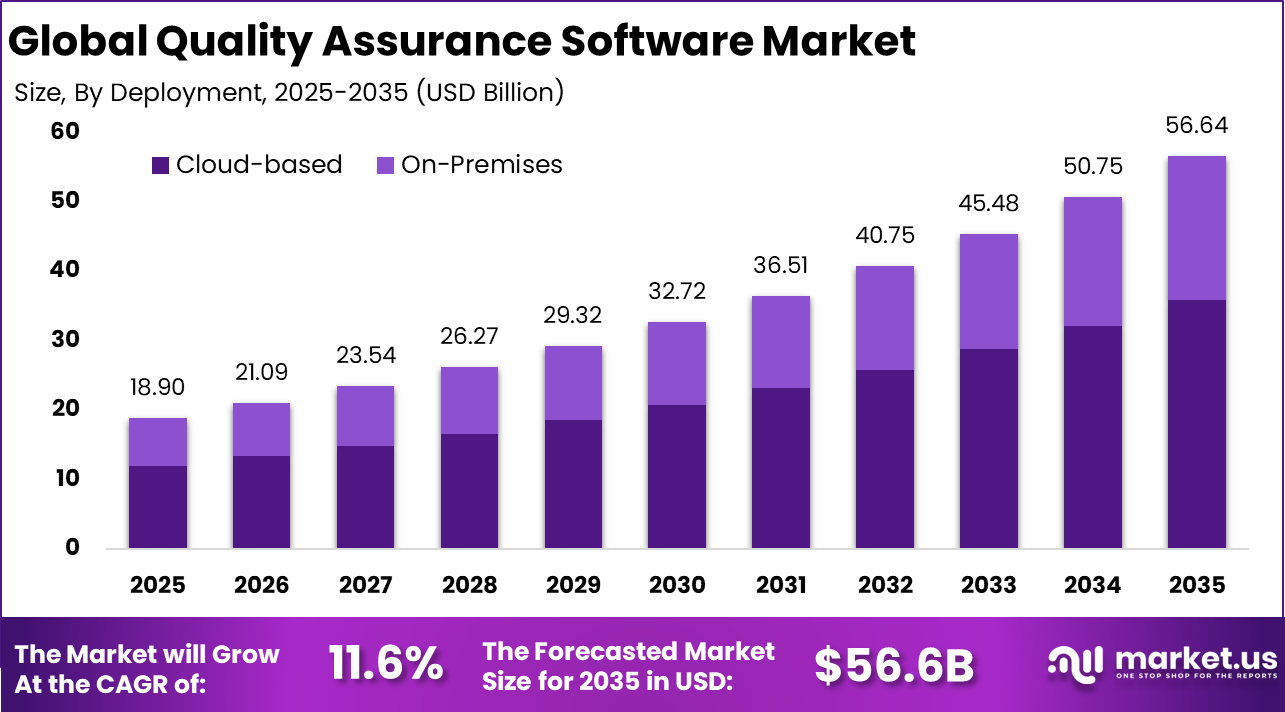
Top Market Takeaways
- In the quality assurance software market, the corrective and preventative action segment held a share of 24.8%.
- Cloud-based deployment led the market with 63.4%, reflecting strong preference for scalable and flexible solutions.
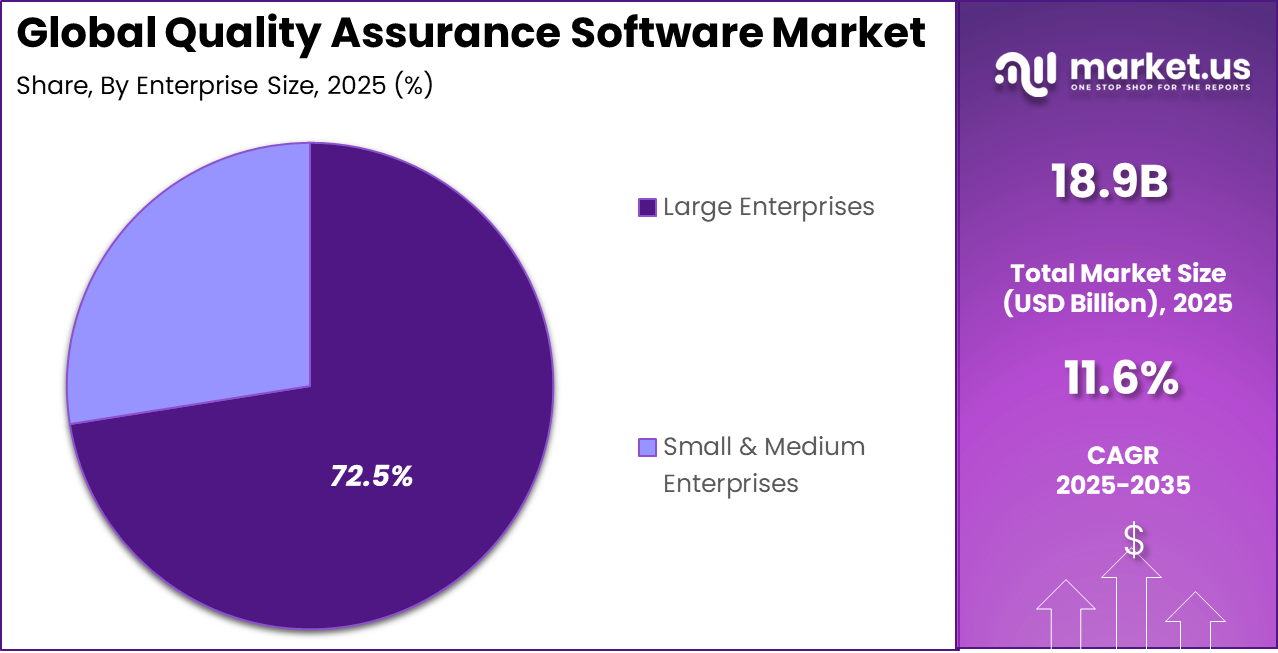
- Large enterprises accounted for 72.5% of the market, supported by wider compliance and process management needs.
- The BFSI sector captured 28.7%, making it a key end-use industry for quality assurance software adoption.
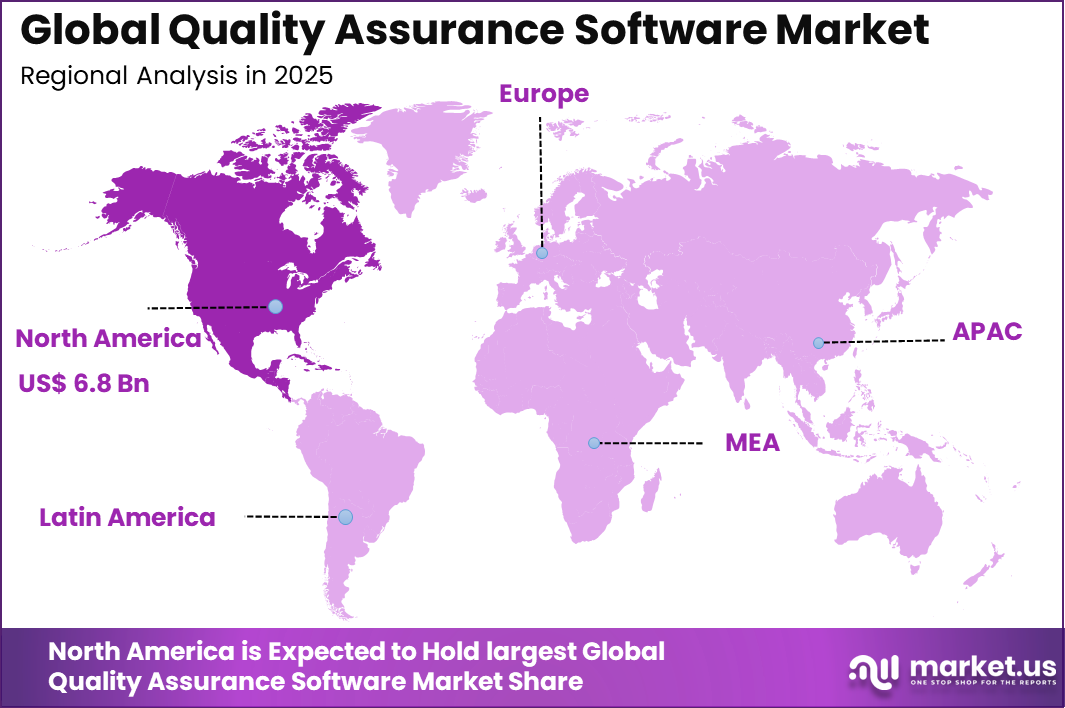
- North America held a leading market share of 36.4%, driven by early software adoption and strong regulatory focus.
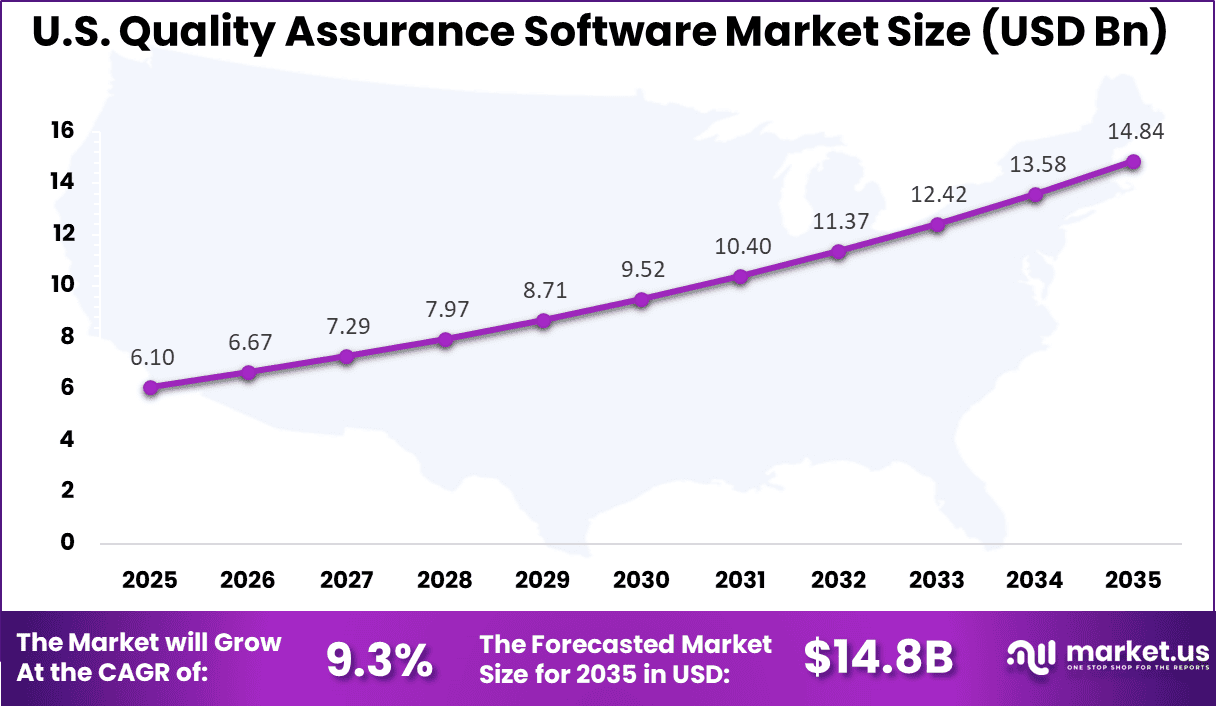
- The U.S. market was valued at USD 6.17 billion, and it is expected to expand at a CAGR of 9.3%.
Demand analysis indicates that the rapid growth of digital applications, cloud platforms, and mobile ecosystems is driving consistent demand for quality assurance solutions. Organizations implementing automated testing frameworks have reported up to 30% improvement in testing efficiency and faster release timelines. The need to maintain seamless user experiences across multiple devices and platforms is further increasing reliance on advanced testing tools across industries such as IT, banking, healthcare, and e-commerce.
The increasing adoption of technologies such as artificial intelligence, machine learning, and test automation is reshaping the quality assurance landscape. AI-driven testing tools are capable of identifying defects, predicting failure points, and optimizing test coverage with minimal human intervention. Cloud-based testing platforms are also gaining traction, allowing organizations to simulate real-world environments and scale testing processes efficiently. These advancements are enabling more accurate, faster, and cost-effective quality assurance practices.
Key reasons for adopting quality assurance software are centered on improving product reliability, reducing time-to-market, and ensuring compliance with industry standards. Automated testing can reduce manual testing efforts by more than 40%, leading to significant cost savings and improved accuracy. In addition, early detection of defects helps prevent costly post-release fixes and enhances overall product quality, which is critical for maintaining customer trust.
Key Insights Summary
- Statistical software quality assurance can reduce software defects by nearly 50% through better root-cause identification.
- Around 80% of defects are often linked to just 20% of underlying causes, which supports focused corrective action.
- In the United States, the cost of poor software quality reached USD 2.08 trillion in 2020, marking a 14% increase from 2018.
- High-performing teams target very low defect density, with benchmarks such as 3.4 defects per million opportunities under Six Sigma standards.
- About 67% of consumers leave because of poor experiences, showing the direct business value of strong quality assurance.
- Only 4% of unhappy customers formally complain, while most silently disengage or shift to alternatives.
By Type
In 2025, the corrective and preventative segment accounted for 24.8% of the quality assurance software market, as organizations focused on identifying defects early and preventing recurring issues. These solutions are designed to analyze root causes, implement corrective actions, and improve process consistency across operations. The increasing complexity of software systems has made it essential to adopt structured quality control frameworks. As a result, organizations are prioritizing proactive quality management approaches over reactive fixes.
The segment’s growth is also influenced by rising compliance requirements and the need to maintain high product standards. Industries are adopting corrective and preventative tools to reduce operational risks and improve reliability. Continuous monitoring and automated reporting features further support better decision-making and faster issue resolution. This has strengthened the role of preventive quality assurance in long-term operational efficiency.
By Deployment
In 2025, the cloud-based segment held 63.4% share, driven by the growing demand for scalable and flexible quality assurance solutions. Organizations are shifting toward cloud deployment to enable real-time collaboration, remote access, and faster implementation. Cloud platforms allow teams to manage testing, monitoring, and reporting processes more efficiently across distributed environments. This has made cloud-based solutions increasingly attractive for modern enterprises.
The adoption of cloud deployment is further supported by lower infrastructure costs and easier system upgrades. Companies benefit from automatic updates, enhanced data accessibility, and reduced maintenance efforts. The ability to integrate cloud-based QA tools with other enterprise systems also improves workflow efficiency. As digital transformation accelerates, cloud deployment continues to gain strong momentum across industries.
By Organization Size
In 2025, the large enterprises segment accounted for 72.5% of the market, supported by their complex IT environments and higher quality requirements. These organizations operate large-scale systems that require continuous testing, monitoring, and validation to ensure performance and reliability. Their financial capacity enables them to invest in advanced QA software solutions. This has resulted in higher adoption rates compared to smaller enterprises.
The dominance of large enterprises is also driven by strict compliance standards and customer expectations for high-quality products and services. They are implementing automated testing, performance monitoring, and analytics tools to enhance software quality. Continuous integration and deployment practices further increase the need for robust QA systems. This consistent investment has reinforced their leading position in the market.
By Industry Vertical
In 2025, the BFSI segment held 28.7% share, reflecting strong demand for quality assurance solutions in financial services. The sector requires highly reliable and secure systems to manage transactions, customer data, and digital services. Even minor software errors can result in financial losses and reputational damage, which drives the need for rigorous testing. As digital banking expands, QA software has become a critical component of operations.
The segment’s growth is also supported by strict regulatory requirements and increasing cybersecurity concerns. Financial institutions are adopting advanced QA tools to ensure system stability, compliance, and data protection. Automated testing and real-time monitoring help reduce system failures and improve service quality. This has positioned BFSI as a key contributor to the quality assurance software market.
Regional Analysis
In 2025, North America accounted for 36.4% of the quality assurance software market, supported by high technology adoption and strong presence of digital enterprises. Organizations in the region prioritize software quality to maintain competitive advantage and meet customer expectations. The widespread adoption of automation and cloud technologies has increased demand for advanced QA solutions. This has driven consistent market growth across industries.
The region’s leadership is further supported by strong regulatory frameworks and continuous innovation in software development practices. Companies are investing in advanced testing tools to ensure system reliability and performance. The presence of a mature IT ecosystem also encourages early adoption of new technologies. These factors collectively contribute to North America’s dominant position in the market.
Country Analysis
In 2025, the United States quality assurance software market reached USD 6.17 billion and is expanding at a CAGR of 9.3%, reflecting steady growth driven by digital transformation. The country has a large base of technology-driven enterprises that require continuous software testing and quality management. Industries such as finance, healthcare, and retail are investing heavily in QA solutions to improve system performance. This has supported strong market demand.
The growth in the U.S. is also influenced by increasing adoption of automation and agile development practices. Organizations are integrating QA tools into their development cycles to ensure faster and more reliable product delivery. Rising cybersecurity risks and compliance requirements further drive the need for advanced quality assurance systems. As a result, the United States continues to play a key role in global market expansion.
Key Market Segments
By Type
- Supplier Quality Management
- Corrective & Preventative
- Change Management
- Document Control
- Audit Management
- Complaint Handling
- Calibration Management
- Employee Training
- Others
By Deployment
- On-Premises
- Cloud-based
By Organization Size
- Large Enterprises
- Small & Medium Enterprises (SMEs)
By Industry Vertical
- BFSI
- IT & Telecom
- Retail
- Healthcare
- Manufacturing
- Others
Regional Analysis and Coverage
- North America
- US
- Canada
- Europe
- Germany
- France
- The UK
- Spain
- Italy
- Russia
- Netherlands
- Rest of Europe
- Asia Pacific
- China
- Japan
- South Korea
- India
- Australia
- Singapore
- Thailand
- Vietnam
- Rest of Latin America
- Latin America
- Brazil
- Mexico
- Rest of Latin America
- Middle East & Africa
- South Africa
- Saudi Arabia
- UAE
- Rest of MEA
Emerging Trends Analysis
In 2025, the quality assurance software market is being shaped by the rapid shift toward intelligent and automated testing practices. Artificial intelligence and machine learning are increasingly being embedded into testing tools to support automated test generation, defect prediction, and faster issue resolution. These capabilities are helping organizations move from manual testing processes to more efficient and continuous testing environments.
Another key trend is the deep integration of quality assurance within agile and DevOps workflows. QA is no longer treated as a final checkpoint but is embedded throughout the development lifecycle. Continuous testing, real-time feedback, and close collaboration between development and testing teams are becoming standard practices. This integration is improving product quality while enabling faster and more consistent software delivery across industries.
Growth Factors:
The rising dependence on digital platforms and software-driven operations is a key factor supporting market growth. Organizations are prioritizing high-quality applications to ensure better user experience, reduce downtime, and maintain operational continuity. In addition, increasing digital transformation initiatives across industries are driving demand for advanced QA tools and practices.
The expansion of mobile applications, cloud computing, and connected devices is also accelerating the need for comprehensive testing solutions. Businesses must ensure that applications perform consistently across multiple platforms and environments. This requirement is increasing the adoption of scalable and automated QA software. The demand for faster release cycles is further encouraging continuous testing adoption, strengthening overall market growth.
Driver Analysis
In 2025, the increasing demand for reliable and high-performing software is a major driver of the quality assurance software market. Organizations are heavily dependent on digital applications for customer interaction, operations, and service delivery. Any failure or downtime can directly impact business performance and reputation. Quality assurance tools help detect issues early and ensure that systems operate smoothly under different conditions.
The need to accelerate software development cycles is also driving adoption. Businesses are under pressure to release new features and updates quickly while maintaining high quality standards. Automated testing and continuous integration practices enable faster development without compromising reliability. This balance between speed and quality is making QA software a critical component of modern development environments.
Restraint Analysis
In 2025, the high cost of implementing advanced quality assurance solutions remains a key restraint in the market. Organizations must invest in testing tools, infrastructure, and skilled professionals to build effective QA systems. For small and mid-sized enterprises, these costs can be a significant barrier to adoption. As a result, many companies delay or limit their investment in advanced testing technologies.
Another restraint is the complexity involved in managing modern QA environments. Organizations often use multiple tools and platforms for testing across different systems. Coordinating these tools and ensuring smooth integration can be challenging. Without proper management, this complexity can reduce efficiency and increase operational risks.
Integration with legacy systems also presents a major limitation. Many organizations continue to operate on older infrastructure that does not easily support modern QA tools. This creates technical challenges during implementation and may require additional customization. Such complexities can slow down the transition to automated and continuous testing frameworks.
Opportunity Analysis
In 2025, the integration of artificial intelligence into quality assurance processes presents strong growth opportunities. AI-driven tools can analyze testing data, identify patterns, and predict potential defects before they occur. This improves testing efficiency and reduces the time required for issue resolution. As AI capabilities continue to evolve, their role in QA is expected to expand significantly.
There is also growing opportunity in cloud-based and on-demand QA services. Organizations are increasingly seeking flexible solutions that can scale based on project requirements. Cloud-based testing platforms provide access to advanced tools without the need for heavy infrastructure investment. This makes high-quality testing more accessible to a wider range of businesses.
Another opportunity lies in the increasing demand for security-focused testing. As cyber risks continue to grow, organizations are prioritizing application security as part of their QA strategy. QA software that includes security validation can help identify vulnerabilities early and reduce potential risks. This creates demand for integrated solutions that combine functional, performance, and security testing.
Challenge Analysis
In 2025, one of the major challenges in the quality assurance software market is the shortage of skilled professionals. Advanced testing tools and environments require specialized knowledge, which is not always readily available. Organizations often face difficulties in hiring and retaining experienced QA engineers. This skill gap can slow down implementation and limit the effective use of modern testing technologies.
Another challenge is the increasing complexity of modern software systems. Applications are now built using multiple technologies, platforms, and architectures, which makes testing more demanding. QA teams must ensure compatibility, performance, and security across all components. This complexity requires advanced tools and structured testing strategies to manage effectively.
The pressure to deliver software quickly also creates challenges for quality assurance processes. Short development cycles can reduce the time available for thorough testing. This increases the risk of defects and performance issues after deployment. Organizations must carefully balance speed and quality to maintain reliable software performance.
Competitive Analysis
The Quality Assurance Software Market is supported by global technology providers offering advanced testing and automation capabilities. Honeywell International Inc., Oracle Corporation, and Microsoft Corporation deliver enterprise-grade platforms for software validation and compliance. Siemens AG strengthens quality assurance through digital engineering tools. These companies invest in automation and AI-driven testing. Their solutions improve accuracy and reduce manual errors. This supports efficient quality control across industries.
Service providers and consulting firms play a vital role in customized testing solutions. Cognizant Technology Solutions Corporation and QA Consultants Inc. offer end-to-end testing services. Parasoft Corporation and A1QA focus on automated and continuous testing frameworks. These firms help enterprises accelerate product development cycles. Their expertise supports regulatory compliance and risk reduction. Increasing demand for agile development is driving adoption of their services.
Emerging players contribute to innovation in specialized testing and performance optimization. Sparta Systems, Performance Lab, and Lighthouse Technologies provide niche quality assurance solutions. Altexsoft and Digital Dream Forge support tailored testing and QA strategies. These companies enhance product reliability and user experience. Their role is expanding with increasing software complexity. Other key players continue to strengthen competition and drive technological advancements.
Top Key Players in the Market
- Honeywell International Inc.
- Digital Dream Forge
- QA COnsultants Inc.
- Oracle Corporation
- Cognizant Technology Solutions Corporation
- Microsoft Corporation
- Siemens AG
- Parasoft Corporation
- A1QA
- Sparta Systems
- Performance Lab
- Lighthouse Technologies
- Altexsoft
- Other Key Players
Recent Developments
- January, 2026 – Cognizant expanded its Quality Engineering services with AI-driven test orchestration. Platforms achieve 85% test coverage across microservices and legacy systems. Global 2000 clients reduced escape defects by 45%.
- February, 2026 – Parasoft SOAtest added NPU-accelerated fuzzing for APIs. Teams discover edge-case vulnerabilities 3x faster in REST and GraphQL endpoints. Automotive suppliers met ISO 26262 standards with automated compliance reporting.
Report Scope
| Report Features | Description |
|---|---|
| Market Value (2025) | USD 18.9 Bn |
| Forecast Revenue (2035) | USD 56.6 Bn |
| CAGR (2026-2035) | 116% |
| Base Year for Estimation | 2025 |
| Historic Period | 2020-2024 |
| Forecast Period | 2026-2035 |
| Report Coverage | Revenue forecast, AI impact on Market trends, Share Insights, Company ranking, competitive landscape, Recent Developments, Market Dynamics and Emerging Trends |
| Segments Covered | By Type (Supplier Quality Management, Corrective & Preventative, Change Management, Document Control, Audit Management, Complaint Handling, Calibration Management, Employee Training, Others), By Deployment (On-Premises, Cloud-based), By Organization Size (Large Enterprises, Small & Medium Enterprises (SMEs)), By Industry Vertical (BFSI, IT & Telecom, Retail, Healthcare, Manufacturing, Others) |
| Regional Analysis | North America – US, Canada; Europe – Germany, France, The UK, Spain, Italy, Russia, Netherlands, Rest of Europe; Asia Pacific – China, Japan, South Korea, India, New Zealand, Singapore, Thailand, Vietnam, Rest of Latin America; Latin America – Brazil, Mexico, Rest of Latin America; Middle East & Africa – South Africa, Saudi Arabia, UAE, Rest of MEA |
| Competitive Landscape | Honeywell International Inc., Digital Dream Forge, QA Consultants Inc., Oracle Corporation, Cognizant Technology Solutions Corporation, Microsoft Corporation, Siemens AG, Parasoft Corporation, A1QA, Sparta Systems, Performance Lab, Lighthouse Technologies, Altexsoft, Other Key Players |
| Customization Scope | Customization for segments, region/country-level will be provided. Moreover, additional customization can be done based on the requirements. |
| Purchase Options | We have three license to opt for: Single User License, Multi-User License (Up to 5 Users), Corporate Use License (Unlimited User and Printable PDF) |





























