


Report Overview
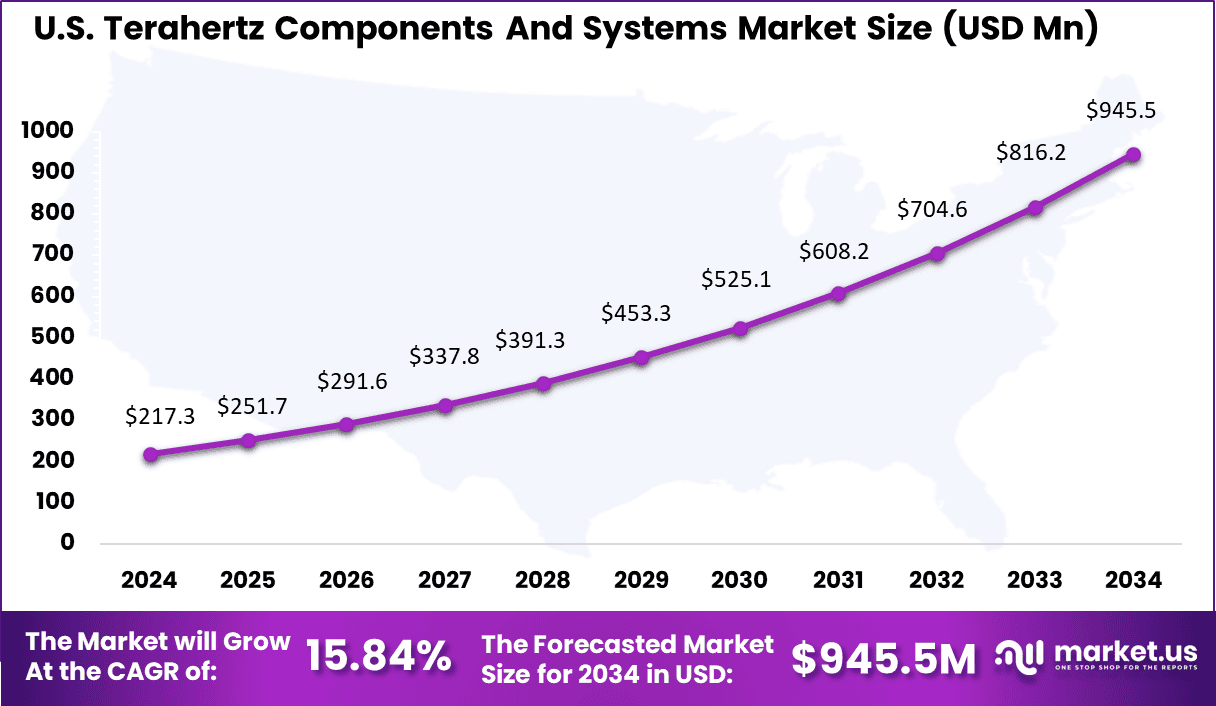
The Global Terahertz Components and Systems Market generated USD 623.4 million in 2024 and is predicted to register growth from USD 731.2 million in 2025 to about USD 3,074.3 million by 2034, recording a CAGR of 17.3% throughout the forecast span. In 2024, North America held a dominant market position, capturing more than a 38.5% share, with USD 240 million in revenue.
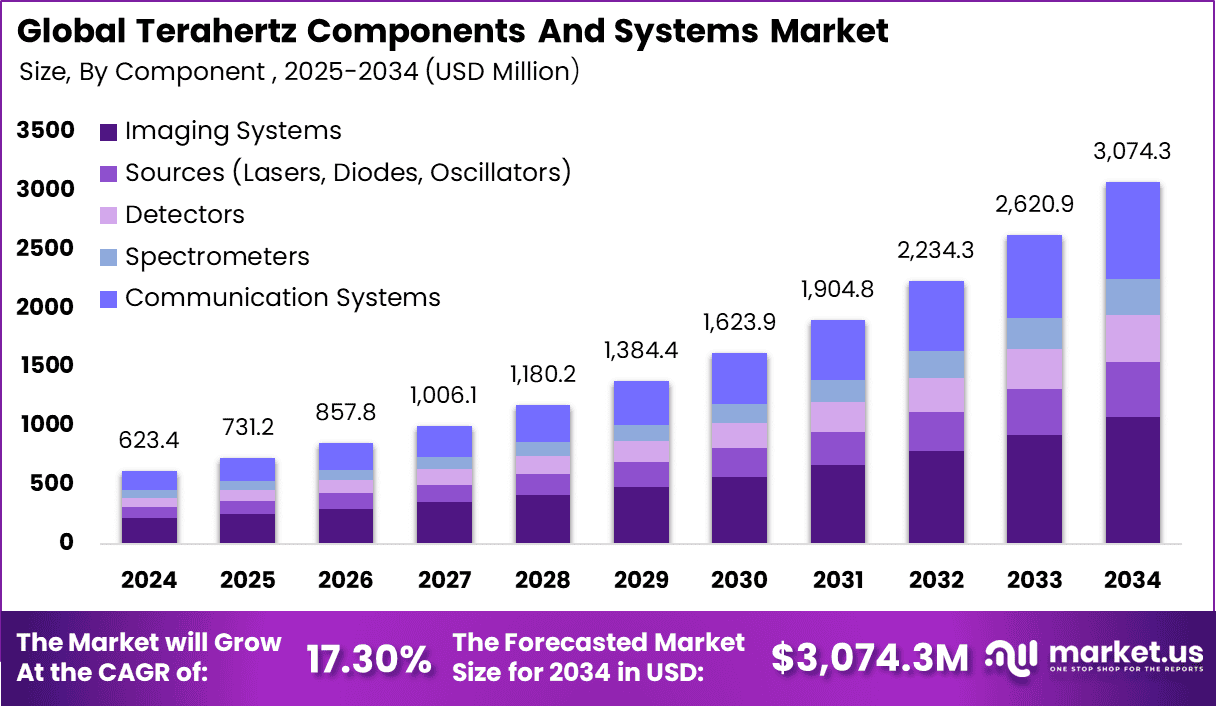
Terahertz Components and Systems market represents the global ecosystem of technologies, devices, and platforms operating within the terahertz frequency range of the electromagnetic spectrum, typically between 0.1 THz and 10 THz. The market includes source modules, detectors, waveguides, imaging systems, spectrometers, and communication subsystems that support the generation, control, and detection of terahertz radiation for various applications.
Terahertz waves can penetrate many non-conductive materials without causing ionizing damage, making these systems suitable for imaging, spectroscopy, sensing, and high-speed data links across healthcare, security, industrial inspection, and advanced communication sectors. The market covers research and commercial deployments where precise high-frequency measurement, material analysis, and detection capabilities are required.
Top Market Takeaways
- By component, imaging systems took 35.2% of the terahertz components and systems market, used for seeing through materials without damage.
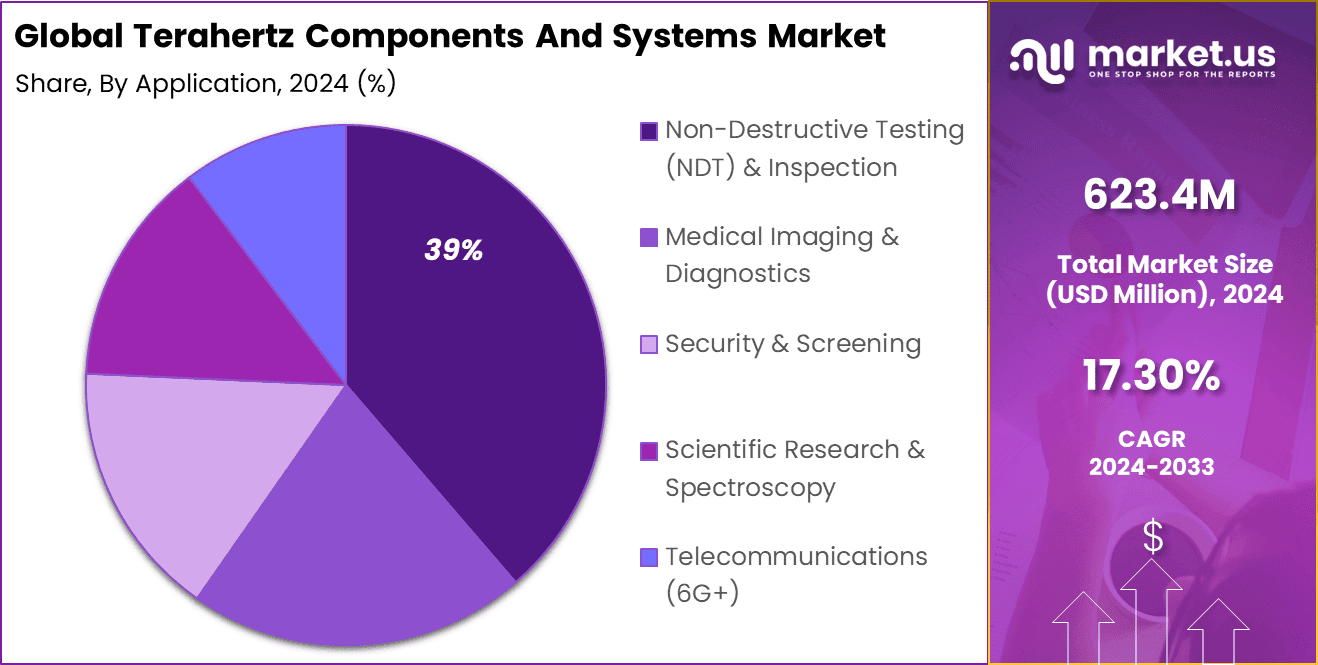
- By application, non-destructive testing and inspection held a 38.7% share, helping check products for flaws in factories.
- By end-user industry, industrial manufacturing led with 41.8%, applying terahertz tools for quality control and material checks.
- North America had 38.5% of the global market, with the U.S. at USD 217.3 million in 2025 and growing at a CAGR of 15.84%
Component Analysis
Imaging systems account for 35.2% of the Terahertz Components and Systems market, making them the leading component category. Terahertz imaging systems are widely used because they can capture detailed internal structures without damaging the object being inspected. These systems are effective in detecting defects, material inconsistencies, and hidden features that are not visible using conventional imaging technologies.
From an industry perspective, terahertz imaging systems offer a strong balance between accuracy and safety. They operate using non-ionizing radiation, which makes them suitable for continuous industrial use. The strong market share of this segment reflects increasing demand for advanced inspection tools that improve quality control while maintaining safe operating conditions in industrial and research environments.
Application Analysis
Non-destructive testing and inspection represent 39% of application demand, making it the largest application area for terahertz systems. Terahertz technology allows inspectors to analyze materials, coatings, and layered structures without altering or damaging the tested object. This is particularly valuable in industries where product integrity must be preserved during inspection.
The adoption of terahertz-based NDT is driven by its ability to detect internal flaws early in the production process. Manufacturers use these systems to improve quality assurance and reduce material waste. The strong presence of this segment highlights the growing importance of reliable inspection methods that support precision manufacturing and regulatory compliance.
End-User Industry Analysis
Industrial manufacturing accounts for 41.8% of end-user adoption, reflecting widespread use of terahertz systems in production environments. Manufacturers apply this technology to inspect components, validate assembly quality, and monitor material properties during processing. Terahertz systems support consistent product quality across high-volume production lines.
The technology also helps manufacturers reduce downtime and avoid costly recalls by identifying defects before final assembly. Its non-contact and real-time inspection capabilities make it suitable for automated manufacturing workflows. The strong share of industrial manufacturing reflects the sector’s focus on precision, efficiency, and advanced quality control solutions.
Key Market Segments
By Technology
- Sources (Lasers, Diodes, Oscillators)
- Detectors
- Spectrometers
- Imaging Systems
- Communication Systems
By Application
- Non-Destructive Testing (NDT) & Inspection
- Medical Imaging & Diagnostics
- Security & Screening
- Scientific Research & Spectroscopy
- Telecommunications (6G+)
By End-User Industry
- Industrial Manufacturing
- Healthcare & Life Sciences
- Defense & Homeland Security
- Academic & Research Institutes
- Others
Key reasons for adoption
- Demand for non-contact and non-destructive inspection is increasing across industrial and security environments. Terahertz technology supports safe material analysis without physical contact.
- Growth in high-speed communication research is driving interest in terahertz frequency bands. These systems enable exploration of ultra-high bandwidth data transmission.
- Advanced imaging needs in medical and scientific research are expanding. Terahertz waves offer unique capabilities to see beneath surfaces without harmful radiation.
- Semiconductor and electronics industries require precise material characterization. Terahertz components help analyze defects, layers, and composition with high accuracy.
- Defense and security agencies seek improved detection tools. Terahertz systems support concealed object detection and threat identification.
Benefits
- Safe operation is achieved as terahertz radiation is non-ionizing. This makes it suitable for sensitive applications involving people and delicate materials.
- High-resolution sensing improves detection of fine structural details. This supports better quality control and research outcomes.
- Enhanced material identification is possible due to unique spectral signatures. Different substances can be distinguished more clearly.
- Reduced inspection damage helps protect high-value components and products. Testing can be repeated without degrading materials.
- Strong research flexibility supports innovation across multiple fields. Systems can be adapted for imaging, spectroscopy, and communication studies.
Usage
- Security screening applications use terahertz imaging to detect concealed items under clothing or packaging. This is common in transportation and public facilities.
- Semiconductor manufacturing uses terahertz systems to inspect wafers and layered structures. This helps identify defects early in production.
- Medical research applies terahertz technology for skin and tissue analysis. It supports experimental diagnostics and imaging studies.
- Industrial quality inspection uses these systems to examine composites, coatings, and polymers. Internal flaws can be detected without cutting samples.
- Scientific laboratories use terahertz components for spectroscopy and fundamental research. This supports advances in physics, chemistry, and materials science.
Emerging Trends
| Key Trend | Description |
|---|---|
| 6G Wireless Push | Terahertz technology enables ultra-fast data transmission for next-generation wireless networks. |
| AI Imaging Boost | Artificial intelligence improves THz imaging accuracy for security checks and medical diagnostics. |
| Compact THz Chips | Smaller THz sources and detectors allow integration into smartphones, vehicles, and portable devices. |
| Non-Destructive Tests | THz systems inspect materials and components without causing physical damage in factories. |
| Hybrid THz Systems | THz is combined with optical technologies to improve signal range, stability, and power efficiency. |
Growth Factors
| Key Factors | Description |
|---|---|
| Security Screening Need | Airports and border facilities demand advanced scanning systems to detect concealed threats. |
| Medical Non-Invasive | THz imaging supports safe and non-invasive diagnosis for skin conditions and pharmaceutical testing. |
| Semiconductor Boom | Chip manufacturers adopt THz inspection to identify microscopic defects during production. |
| Defense Investments | Defense agencies invest in THz radar and communication technologies for advanced surveillance. |
| Research Funding Rise | Increased funding supports academic and industrial research into new THz materials and devices. |
Regional Analysis
North America accounted for a 38.5% share, supported by strong research activity and early commercialization of terahertz technologies across defense, aerospace, healthcare, and semiconductor inspection. The region has seen steady adoption of terahertz components and systems for non-destructive testing, security screening, and advanced imaging applications.
Demand has been driven by the need for high-resolution sensing and material characterization, where terahertz frequencies offer advantages over traditional microwave and infrared solutions. Strong presence of research institutions and technology developers has accelerated the transition from laboratory research to practical deployment.
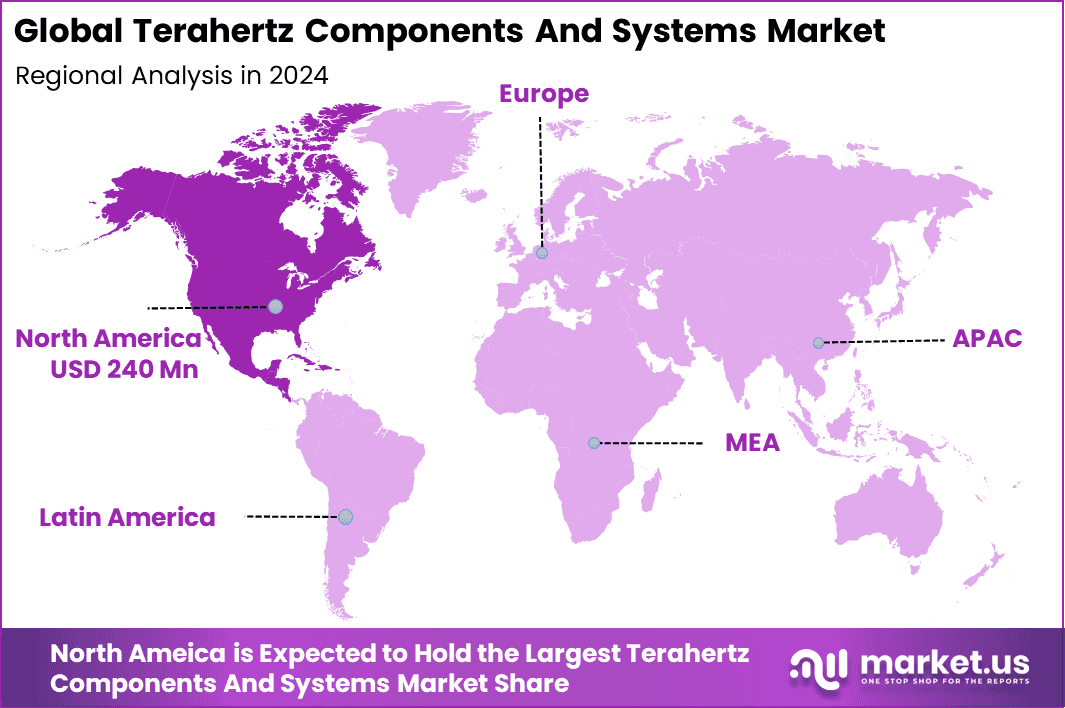
The U.S. market reached USD 217.3 Mn and is projected to grow at a 15.84% CAGR, reflecting increasing investment in advanced sensing and next-generation communication research. Adoption has been concentrated in aerospace, defense, and semiconductor manufacturing, where terahertz systems support precise inspection and fault detection. Growing demand for compact and higher-performance terahertz components has encouraged collaboration between universities, startups, and established technology firms.
Key Regions and Countries
- North America
- US
- Canada
- Europe
- Germany
- France
- The UK
- Spain
- Italy
- Russia
- Netherlands
- Rest of Europe
- Asia Pacific
- China
- Japan
- South Korea
- India
- Australia
- Singapore
- Thailand
- Vietnam
- Rest of APAC
- Latin America
- Brazil
- Mexico
- Rest of Latin America
- Middle East & Africa
- South Africa
- Saudi Arabia
- UAE
- Rest of MEA
Opportunities & Threats
The Terahertz Components and Systems market presents strong opportunities as terahertz technology moves from research into practical use. Terahertz waves are useful for high-resolution imaging, spectroscopy, and fast data transmission, which supports adoption across security screening, semiconductor inspection, medical imaging, and scientific research.
Growing demand for non-destructive testing and precise material analysis is encouraging investment in terahertz systems. Interest is also rising in wireless communication research, where terahertz frequencies are explored for future high-speed networks.
The market faces threats related to high costs and limited commercial readiness. Terahertz components and systems remain expensive to produce and deploy, which restricts adoption to research labs and specialized industries. Lack of standardization across components and measurement methods also slows commercialization. In some applications, alternative technologies such as X-ray, infrared, or microwave systems may offer lower-cost solutions.
Key Challenges
- High manufacturing and system integration costs
- Limited availability of standardized components
- Performance sensitivity to environment and signal loss
- Shortage of skilled engineers and researchers
- Slow transition from research to large-scale commercial use
Competitive Analysis
The competitive landscape of the terahertz components and systems market is shaped by a combination of photonics specialists, measurement equipment providers, and advanced electronics companies. Firms such as TOPTICA Photonics AG, Menlo Systems GmbH, HÜBNER GmbH & Co. KG, Batop GmbH, and Gentec-EO compete through strong expertise in laser-based terahertz sources, emitters, detectors, and precision optical components.
At the same time, companies including Advantest Corporation, NEC Corporation, Luna Innovations, Inc., and Daheng New Epoch Technology, Inc. leverage their background in test and measurement, electronics, and sensing technologies to support broader industrial, research, and security applications.
Competition is increasingly driven by performance parameters such as signal stability, bandwidth, sensitivity, and system integration flexibility. Players such as Terasense Group, Inc., Microtech Instruments, Inc., Teraphysics Corporation, Insight Product Company, and LongWave Photonics, LLC add competitive pressure by focusing on compact systems, imaging solutions, and application-specific designs for non-destructive testing, spectroscopy, and communications research.
Top Key Players in the Market
- TOPTICA Photonics AG
- Menlo Systems GmbH
- Terasense Group, Inc.
- Advantest Corporation
- Luna Innovations, Inc.
- HÜBNER GmbH & Co. KG
- Microtech Instruments, Inc.
- Batop GmbH
- NEC Corporation
- Daheng New Epoch Technology, Inc.
- Gentec-EO
- Teraphysics Corporation
- Insight Product Company
- LongWave Photonics, LLC
- Others
Future Outlook
The future outlook for the Terahertz Components and Systems market is expected to improve steadily as research moves into practical industrial and commercial use. Terahertz technology is gaining attention in imaging, spectroscopy, and high-speed communication because it can see through materials and detect fine details without causing damage.
Growing investment in advanced sensing, security screening, and semiconductor research is supporting wider adoption. Over the coming years, progress in compact sources, detectors, and system integration is likely to reduce costs and improve reliability, making terahertz solutions more suitable for real-world deployment.
Recent Developments
- In February 2025, Advantest Corporation signed a strategic partnership agreement with Micronics Japan Co., Ltd., including a plan to acquire a minority equity stake in MJC to jointly develop semiconductor test solutions relevant to advanced probe-card and testing equipment used in terahertz-adjacent chip validation workflows.
- In October 2025, TOPTICA Photonics AG launched the TeraScan ultra, a photonic terahertz system delivering 1 Hz spectral resolution and operating up to 5 THz, positioned for photonic vector network analysis and THz communication channel-sounding applications.
Report Scope
| Report Features | Description |
|---|---|
| Market Value (2024) | USD 623.4 Million |
| Forecast Revenue (2034) | USD 3,074.3 Million |
| CAGR(2025-2034) | 17.3% |
| Base Year for Estimation | 2024 |
| Historic Period | 2020-2023 |
| Forecast Period | 2025-2034 |
| Report Coverage | Revenue forecast, AI impact on Market trends, Share Insights, Company ranking, competitive landscape, Recent Developments, Market Dynamics and Emerging Trends |
| Segments Covered | By Component (Sources (Lasers, Diodes, Oscillators), Detectors, Spectrometers, Imaging Systems, Communication Systems), By Application (Non-Destructive Testing (NDT) & Inspection, Medical Imaging & Diagnostics), By End-User Industry (Industrial Manufacturing, Healthcare & Life Sciences, Defense & Homeland Security, Others) |
| Regional Analysis | North America – US, Canada; Europe – Germany, France, The UK, Spain, Italy, Russia, Netherlands, Rest of Europe; Asia Pacific – China, Japan, South Korea, India, New Zealand, Singapore, Thailand, Vietnam, Rest of Latin America; Latin America – Brazil, Mexico, Rest of Latin America; Middle East & Africa – South Africa, Saudi Arabia, UAE, Rest of MEA |
| Competitive Landscape | TOPTICA Photonics AG, Menlo Systems GmbH, Terasense Group, Inc., Advantest Corporation, Luna Innovations, Inc., HÜBNER GmbH & Co. KG, Microtech Instruments, Inc., Batop GmbH, NEC Corporation, Daheng New Epoch Technology, Inc., Gentec-EO, Teraphysics Corporation, Insight Product Company, LongWave Photonics, LLC, Others |
| Customization Scope | Customization for segments, region/country-level will be provided. Moreover, additional customization can be done based on the requirements. |
| Purchase Options | We have three licenses to opt for: Single User License, Multi-User License (Up to 5 Users), Corporate Use License (Unlimited Users and Printable PDF) |





































