Report Overview
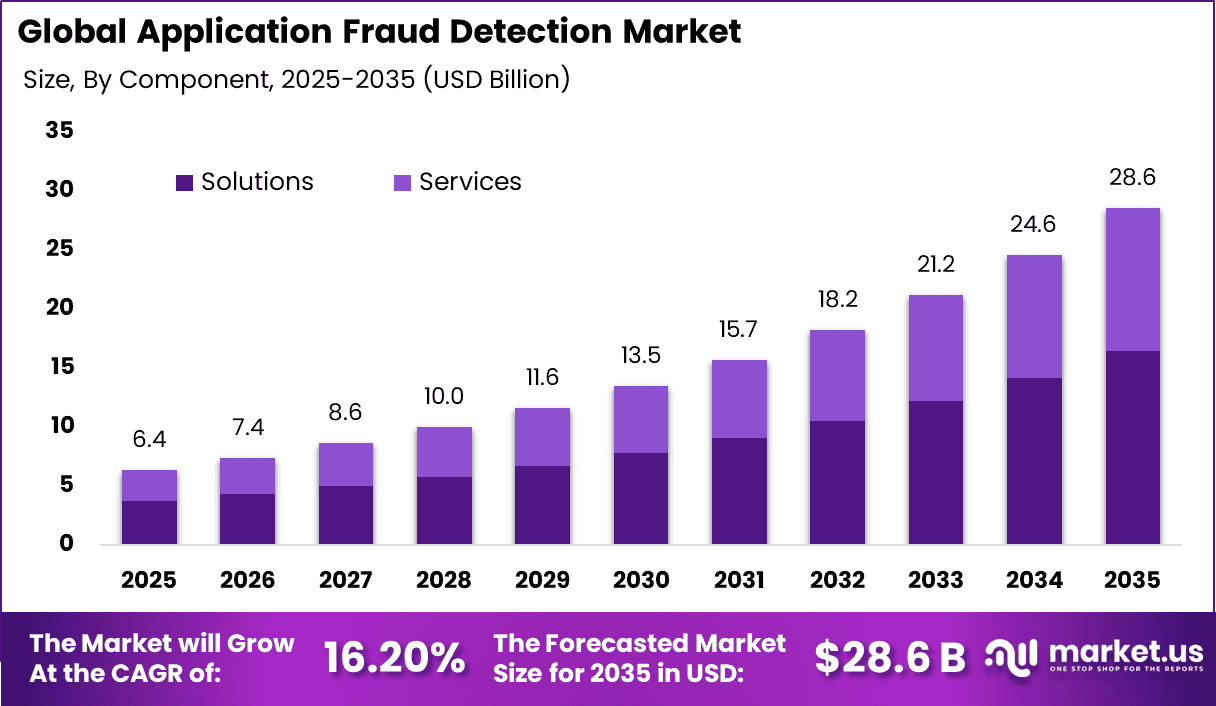
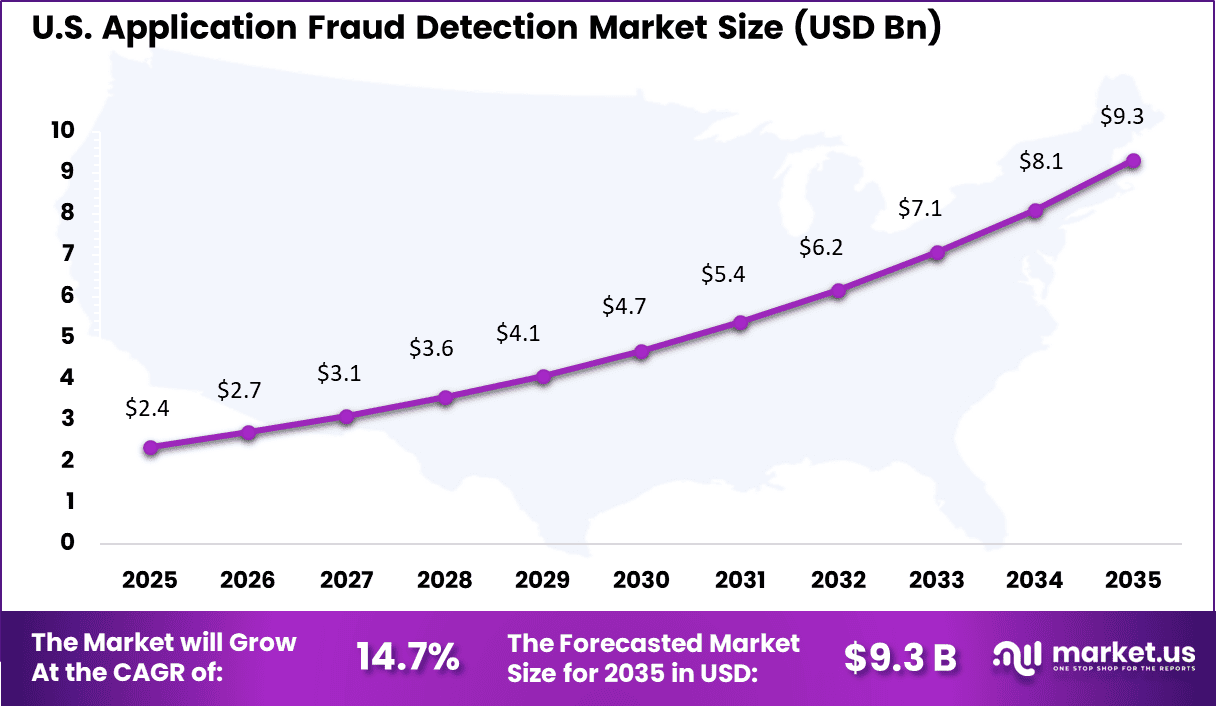
The Global Application Fraud Detection Market generated USD 6.4 billion in 2025 and is predicted to register growth from USD 7.4 billion in 2026 to about USD 28.6 billion by 2035, recording a CAGR of 16.2% throughout the forecast span. In 2025, North America held a dominant market position, capturing more than a 41.5% share, with USD 2.64 billion in revenue.
The application fraud detection market focuses on identifying and preventing fraudulent activities that occur during the account opening or credit application process. This includes detecting identity manipulation, synthetic identities, document forgery, and misrepresented financial information.
These solutions are widely used across banking, lending, insurance, and digital service platforms where remote onboarding has become common. The market is shaped by institutions seeking to approve legitimate applicants quickly while blocking high-risk profiles at the earliest stage.
A key driving factor is the sharp increase in digital onboarding and remote application channels. As more customers apply for products online, fraud attempts have shifted toward exploiting identity verification gaps. Traditional manual review processes are no longer sufficient to manage high application volumes and sophisticated fraud tactics. Institutions are therefore adopting automated detection systems that analyze behavioral signals, device information, and application consistency in real time.
Top Market Takeaways
- By component, solutions account for 57.6% of the market, deploying AI/ML models to flag synthetic identities, impersonation, and data fabrication during onboarding.
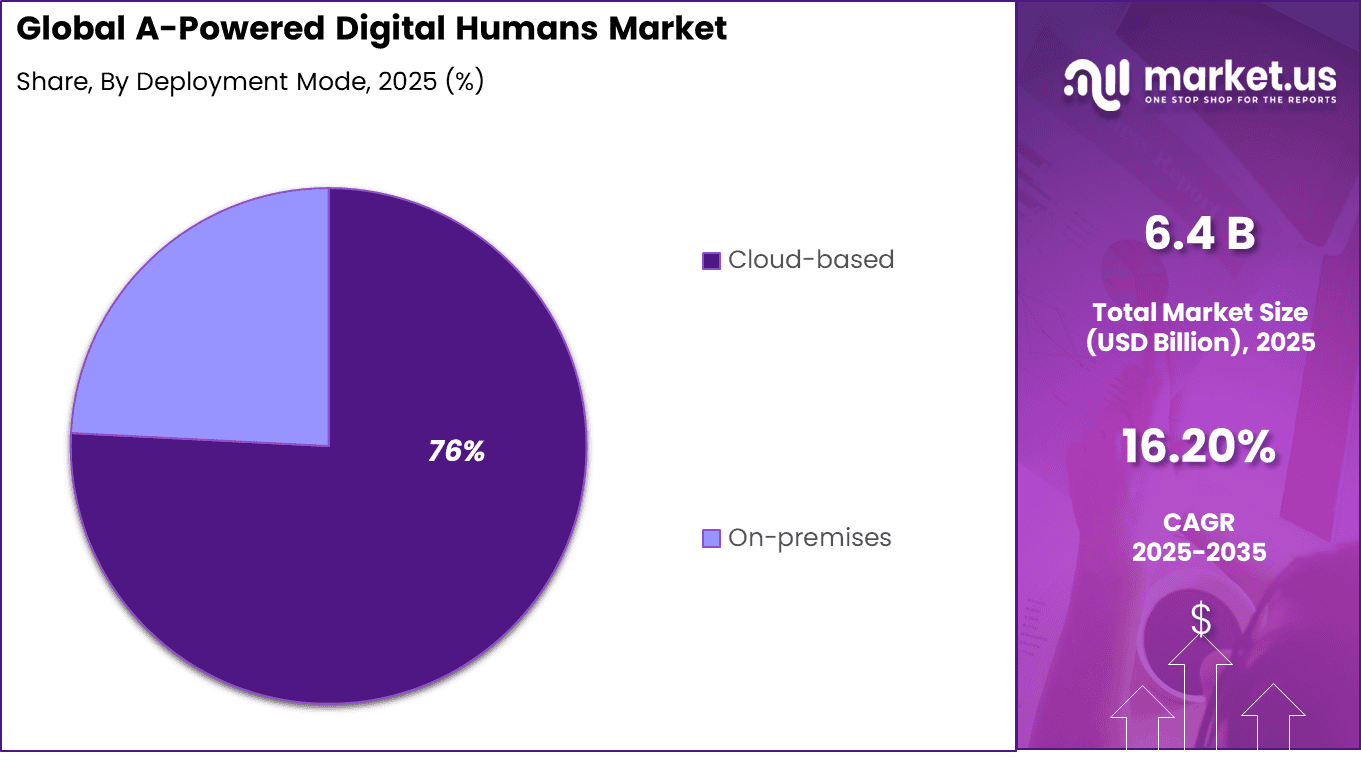
- By deployment mode, cloud-based platforms represent 75.8%, enabling real-time scoring, device intelligence, and scalability across digital channels.
- By organization size, large enterprises hold 74.3% share, managing high-volume applications with advanced orchestration of third-party data and behavioral signals.
- By end-user, BFSI commands 44.7%, combating loan stacking, identity theft, and bust-out schemes in lending and account opening.
- By region, North America leads with 41.5% of the global market, where the U.S. is valued at USD 2.36 billion with a projected CAGR of 14.7%, driven by digital lending surge and regulatory focus.
By Component
Solution based components represent 57.6% of adoption in the application fraud detection market, as organizations seek dedicated tools to identify and respond to fraudulent activities. These solutions combine rule based engines, behavioral analytics, and machine learning to assess user interactions in real time. This integrated approach helps reduce false positives while improving detection accuracy.
From an operational standpoint, solution focused platforms support centralized monitoring across digital touchpoints. They allow security teams to standardize fraud rules and response workflows. This functional strength continues to position solutions as the leading component in application fraud detection.
By Deployment Mode
Cloud based deployment holds 76%, reflecting the need for scalable and resilient fraud detection systems. Cloud environments support rapid data processing across distributed channels such as web, mobile, and API based access points. This capability is essential as transaction volumes and digital interactions grow.
Cloud platforms also facilitate frequent updates to detection algorithms. Security teams can deploy improved models without system downtime. These advantages reinforce cloud as the preferred deployment approach.
By Organization Size
Large enterprises account for 74.3% of adoption, driven by complex application environments and diverse customer bases. These organizations generate high volumes of user activity across services and geographies. Advanced fraud detection platforms help maintain control over exposure and protect reputation.
Large firms also face stricter regulatory scrutiny around fraud prevention. Centralized detection systems improve audit readiness and governance. This sustained operational need anchors strong adoption among large-scale entities.
By End User
The BFSI sector holds 44.7% of end user adoption, as financial institutions manage large volumes of sensitive transactions daily. Application-level fraud can involve account takeovers, unauthorized transfers, or credential misuse. Detection systems help monitor and block suspicious patterns before losses occur.
BFSI organizations also prioritize customer trust and service continuity. Effective fraud detection supports both security and user experience. This focus continues to position BFSI as a leading end-user industry.
Key Market Segments
By Component
- Solutions
- Risk Scoring & Decision Engines
- Identity Verification & Proofing
- Device Intelligence & Digital Fingerprinting
- Behavioral Analytics
- Data Consortium & Network Intelligence
- Others
- Services
- Implementation & Integration
- Managed Services & Outsourced Review
- Consulting & Model Tuning
By Deployment Mode
- Cloud-based
- On-Premises
By Organization Size
- Large Enterprises
- Small & Medium Enterprises (SMEs)
By End-User
- BFSI
- Retail
- Healthcare
- Government
- IT and Telecom
- Others
Driver Impact Analysis
| Key Driver | Impact on CAGR Forecast (~%) | Geographic Relevance | Impact Timeline |
|---|---|---|---|
| Rising digital loan and credit application volumes | +4.2% | North America, Asia Pacific | Short to medium term |
| Increasing identity theft and synthetic identity fraud | +3.8% | North America, Europe | Short term |
| Expansion of online banking, fintech, and BNPL platforms | +3.4% | Global | Medium term |
| Growing regulatory scrutiny on fraud prevention controls | +2.9% | North America, Europe | Medium term |
| Adoption of AI-driven risk scoring and decision automation | +2.6% | Global | Medium to long term |
Restraint Impact Analysis
| Key Restraint | Impact on CAGR Forecast (~%) | Geographic Relevance | Impact Timeline |
|---|---|---|---|
| High implementation and integration costs | −3.1% | Emerging Markets | Short to medium term |
| Model bias and explainability challenges | −2.7% | Europe, North America | Medium term |
| Data privacy and cross-border data sharing restrictions | −2.3% | Europe | Medium term |
| Limited fraud analytics maturity in smaller institutions | −1.9% | Asia Pacific, Latin America | Medium term |
| Operational resistance to automated decision systems | −1.6% | Global | Medium to long term |
Investor Type Impact Matrix
| Investor Type | Growth Sensitivity | Risk Exposure | Geographic Focus | Investment Outlook |
|---|---|---|---|---|
| Fraud analytics and risk platform providers | Very High | Medium | North America, Europe | Strong recurring SaaS growth |
| Banks and financial institutions | High | Low to Medium | Global | Mandatory risk mitigation investment |
| Fintech and digital lending platforms | High | Medium | North America, Asia Pacific | Core fraud prevention infrastructure |
| Private equity firms | Medium | Medium | North America, Europe | Consolidation of analytics vendors |
| Venture capital investors | High | High | North America | Innovation in AI-driven identity verification |
Technology Enablement Analysis
| Technology Enabler | Impact on CAGR Forecast (~%) | Primary Function | Geographic Relevance | Adoption Timeline |
|---|---|---|---|---|
| AI and machine learning-based application risk scoring | +4.5% | Real-time fraud detection | Global | Short to medium term |
| Behavioral biometrics and device fingerprinting | +3.8% | Identity validation | North America, Europe | Medium term |
| Real-time API integration with KYC and credit systems | +3.3% | Faster application screening | Global | Medium term |
| Cloud-based fraud analytics platforms | +2.8% | Scalability and performance | Global | Medium to long term |
| Explainable AI and compliance-ready reporting tools | +2.1% | Regulatory transparency | Europe, North America | Long term |
Key Challenges
- Rapid evolution of fraud techniques making detection models quickly outdated
- High false positive rates affecting genuine customer applications
- Dependence on high-quality real-time data for accurate fraud assessment
- Privacy and data protection concerns when analyzing personal information
- Integration challenges with existing loan origination and onboarding systems
Emerging Trends
In the Application Fraud Detection market, a growing trend is the integration of behavioural and device-centric signals into detection engines to identify fraudulent attempts at the point of application submission. Rather than solely relying on traditional checks such as identity documents or blacklist databases, systems now analyse user behaviour patterns, typing cadence, device fingerprints, and interaction flows to detect anomalies that might suggest synthetic identities or automated bots.
This trend reflects a shift toward more adaptive and layered defence methodologies that can surface subtle indicators of fraud earlier in the customer journey. Another emerging pattern is the use of explainable alerts, so risk analysts can understand why a particular application was flagged and respond with appropriate action, balancing security with a humane evaluation of ambiguous cases.
Growth Factors
A key growth factor in this market is the increasing sophistication of fraud attempts at the application stage, where organised actors use automated tools and fabricated credentials to bypass traditional identity checks. As fraud schemes evolve, institutions require detection systems that can recognise complex patterns across multiple data points, strengthening confidence in application outcomes and reducing operational losses.
Another important driver is the need to preserve the integrity of the customer experience while maintaining robust defence controls. Consumers expect quick, smooth onboarding, and detection platforms that can make accurate real-time assessments without unnecessary friction help organisations maintain trust and satisfaction. Together, these factors are driving sustained investment in advanced application fraud detection capabilities that protect both institutions and genuine applicants.
Regional Analysis
North America accounts for 41.5% of the application fraud detection market, supported by high volumes of digital loan, credit card, and online service applications. Financial institutions and fintech platforms in the region are deploying advanced identity verification and risk analytics tools to detect synthetic identities, document manipulation, and data inconsistencies at the onboarding stage. Demand is reinforced by increasing fraud sophistication, regulatory pressure to strengthen customer due diligence, and the need to reduce credit losses linked to fraudulent applications.
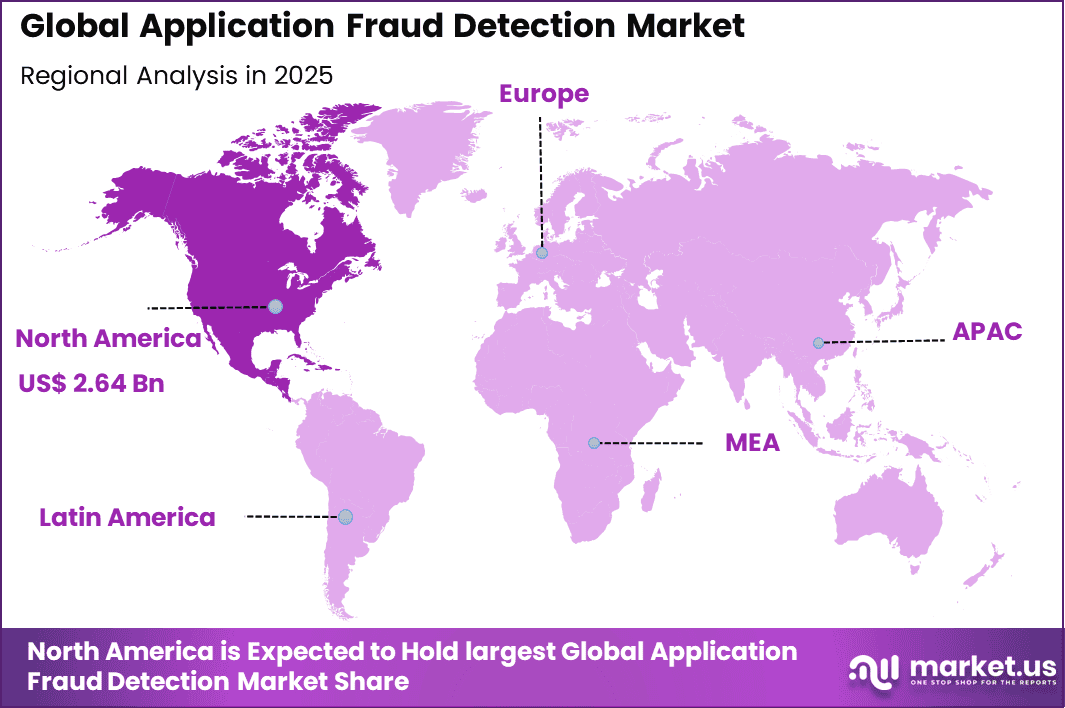
The United States market is valued at USD 2.36 Bn and is expanding at a CAGR of 14.7%, reflecting rapid growth in digital lending and remote account opening. Adoption is influenced by rising fraud attempts across consumer finance, mortgage, and small business lending segments. Growth is further supported by the integration of machine learning models, real-time risk scoring, and cross-channel data analysis to improve detection accuracy while minimizing friction for genuine applicants.
Key Regions and Countries
- North America
- US
- Canada
- Europe
- Germany
- France
- The UK
- Spain
- Italy
- Russia
- Netherlands
- Rest of Europe
- Asia Pacific
- China
- Japan
- South Korea
- India
- Australia
- Singapore
- Thailand
- Vietnam
- Rest of APAC
- Latin America
- Brazil
- Mexico
- Rest of Latin America
- Middle East & Africa
- South Africa
- Saudi Arabia
- UAE
- Rest of MEA
Competitive Analysis
The Application Fraud Detection market is led by established fraud analytics and payment technology providers such as ACI Worldwide, BAE Systems, Experian, FICO, IBM, LexisNexis Risk Solutions, NICE Actimize, Oracle, RSA Security, SAS Institute, SAP, TransUnion, ThreatMetrix, and Fiserv.
These companies compete on advanced risk models, large identity and transaction data sets, and strong integration with banking and digital onboarding systems. Their platforms are widely used by banks and financial institutions that require real time detection of synthetic identity, document fraud, and application misrepresentation.
Specialized and digital focused providers including Fraud.net, Gemalto under Thales Group, Kount under Equifax, and others compete through machine learning driven risk scoring and flexible API deployment. Competition in this segment is driven by accuracy, low false positives, and the ability to analyze behavioral and device intelligence during customer onboarding. These players are often selected by fintech firms and digital lenders that prioritize fast approvals with strong fraud control.
Top Key Players in the Market
- ACI Worldwide
- BAE Systems
- Experian
- FICO
- Fraud.net
- Gemalto (Thales Group)
- IBM Corporation
- Kount (Equifax)
- LexisNexis Risk Solutions
- NICE Actimize
- Oracle Corporation
- RSA Security (Dell Technologies)
- SAS Institute
- SAP SE
- TransUnion
- ThreatMetrix (LexisNexis Risk Solutions)
- Fiserv
- Others
Future Outlook
The future outlook for the Application Fraud Detection Market is positive as organizations increasingly focus on securing digital channels from fraud and unauthorized access. Demand for fraud detection solutions is expected to grow because these systems help identify suspicious activity during account openings and transactions in real time.
Adoption of artificial intelligence, machine learning, and behavioral analytics will improve detection accuracy and response speed. Growth can be attributed to rising digital adoption, stronger regulatory requirements, and increasing fraud attempts. Overall, the market is expected to expand as businesses prioritize secure and trustworthy application processes.
Recent Developments
- In May 2025, ACI Worldwide was recognized as a leading fraud orchestration provider by a Datos Insights report. Payments Intelligence Framework scales for global FIs with consortium benefits. Processes decisions in three hundred ms with AI models.
- In July 2025, the FICO Application Fraud Survey found one in three Americans accept credit fraud amid costs. Urges banks to balance security with experience using Falcon. Seventy-five percent tolerate checks for strong protection.
Report Scope
| Report Features | Description |
|---|---|
| Market Value (2025) | USD 6.4 Billion |
| Forecast Revenue (2035) | USD 28.6 Billion |
| CAGR(2025-2035) | 16.2% |
| Base Year for Estimation | 2024 |
| Historic Period | 2020-2024 |
| Forecast Period | 2025-2035 |
| Report Coverage | Revenue forecast, AI impact on Market trends, Share Insights, Company ranking, competitive landscape, Recent Developments, Market Dynamics and Emerging Trends |
| Segments Covered | By Component (Solutions, Services), By Deployment Mode (Cloud-based, On-Premises), By Organization Size (Large Enterprises, Small & Medium Enterprises (SMEs)), By End-User (BFSI, Retail, Healthcare, Government, IT and Telecom, Others) |
| Regional Analysis | North America – US, Canada; Europe – Germany, France, The UK, Spain, Italy, Russia, Netherlands, Rest of Europe; Asia Pacific – China, Japan, South Korea, India, New Zealand, Singapore, Thailand, Vietnam, Rest of Latin America; Latin America – Brazil, Mexico, Rest of Latin America; Middle East & Africa – South Africa, Saudi Arabia, UAE, Rest of MEA |
| Competitive Landscape | ACI Worldwide, BAE Systems, Experian, FICO, Fraud.net, Gemalto (Thales Group), IBM Corporation, Kount (Equifax), LexisNexis Risk Solutions, NICE Actimize, Oracle Corporation, RSA Security (Dell Technologies), SAS Institute, SAP SE, TransUnion, ThreatMetrix (LexisNexis Risk Solutions), Fiserv, Others |
| Customization Scope | Customization for segments, region/country-level will be provided. Moreover, additional customization can be done based on the requirements. |
| Purchase Options | We have three licenses to opt for: Single User License, Multi-User License (Up to 5 Users), Corporate Use License (Unlimited Users and Printable PDF) |