


Report Overview
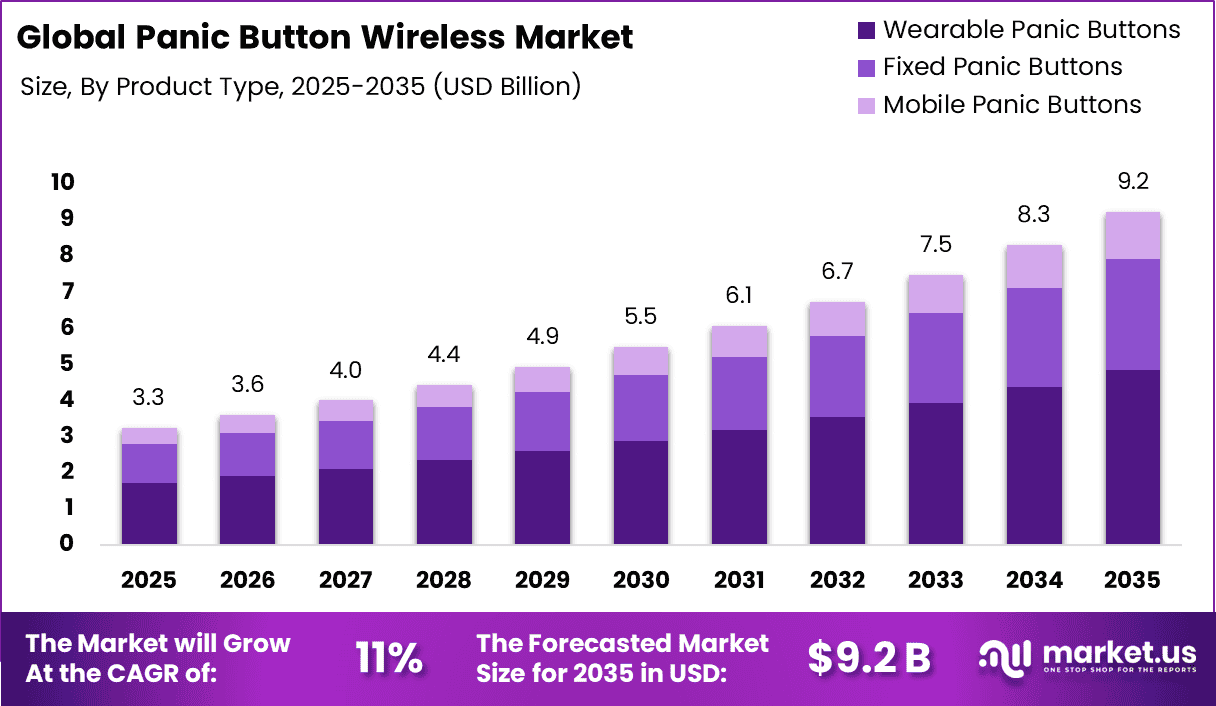
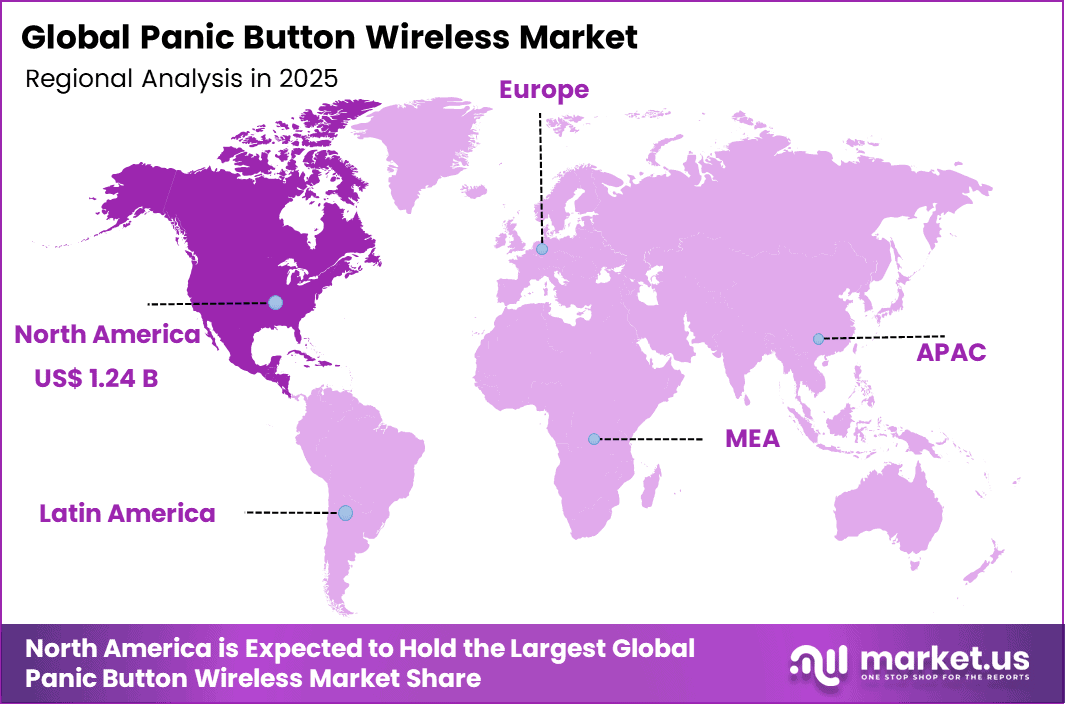
The Global Panic Button Wireless Market generated USD 3.3 billion in 2025 and is predicted to register growth from USD 3.6 billion in 2026 to about USD 9.2 billion by 2035, recording a CAGR of 11.0% throughout the forecast span. In 2025, North America held a dominant market position, capturing more than a 38.4% share, with USD 1.24 billion in revenue.
Panic Button Wireless market refers to portable or fixed wireless alert devices that allow users to send an immediate emergency signal to security teams, supervisors, caregivers, or emergency responders. These systems are used in schools, hospitals, hotels, offices, retail sites, factories, and residential settings where quick access to help is important. The market is expanding as organizations move away from fully manual emergency reporting and adopt faster alert systems that are easier to install and use across different indoor environments.
One of the main factors driving this market is the growing focus on personal safety and faster emergency response. Employers and institutions want wireless panic button systems that can send alerts quickly without depending on complex wiring or delayed phone-based communication. Another important driver is the wider use of connected safety infrastructure, where panic buttons can work with mobile apps, security platforms, access control systems, and location-based alerts to improve response coordination.
Top Market Takeaways
- By Product Type, wearable panic buttons dominate with a 52.6% share, enabling discreet keychain, wristband, or clip-on designs with one-touch SOS activation and GPS location sharing.
- By Technology, Bluetooth captures 38.6%, providing low-power pairing with smartphones, gateways, and smartwatches for seamless alert propagation.
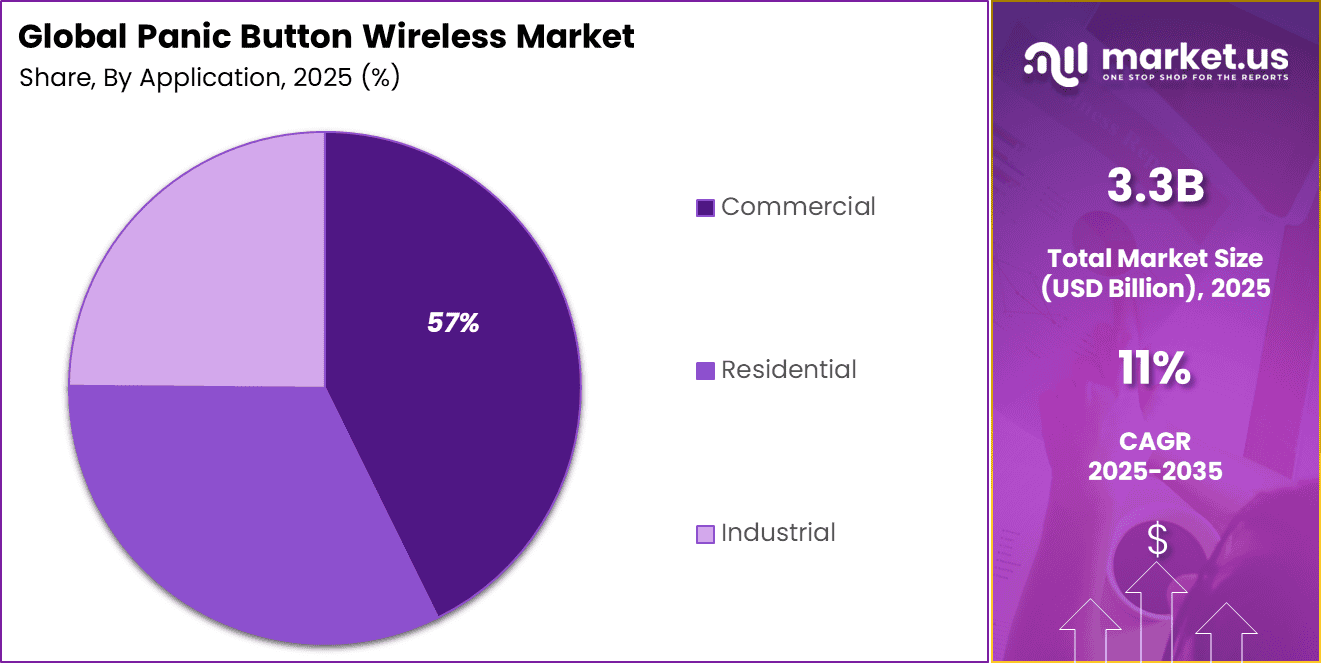
- By Application, commercial sectors claim 56.7%, powering employee duress alarms, lone worker protection, and retail hold-up response systems.
- By Distribution Channel, online sales lead at 54.2%, driving B2B procurement, subscription monitoring bundles, and direct-to-facility e-commerce.
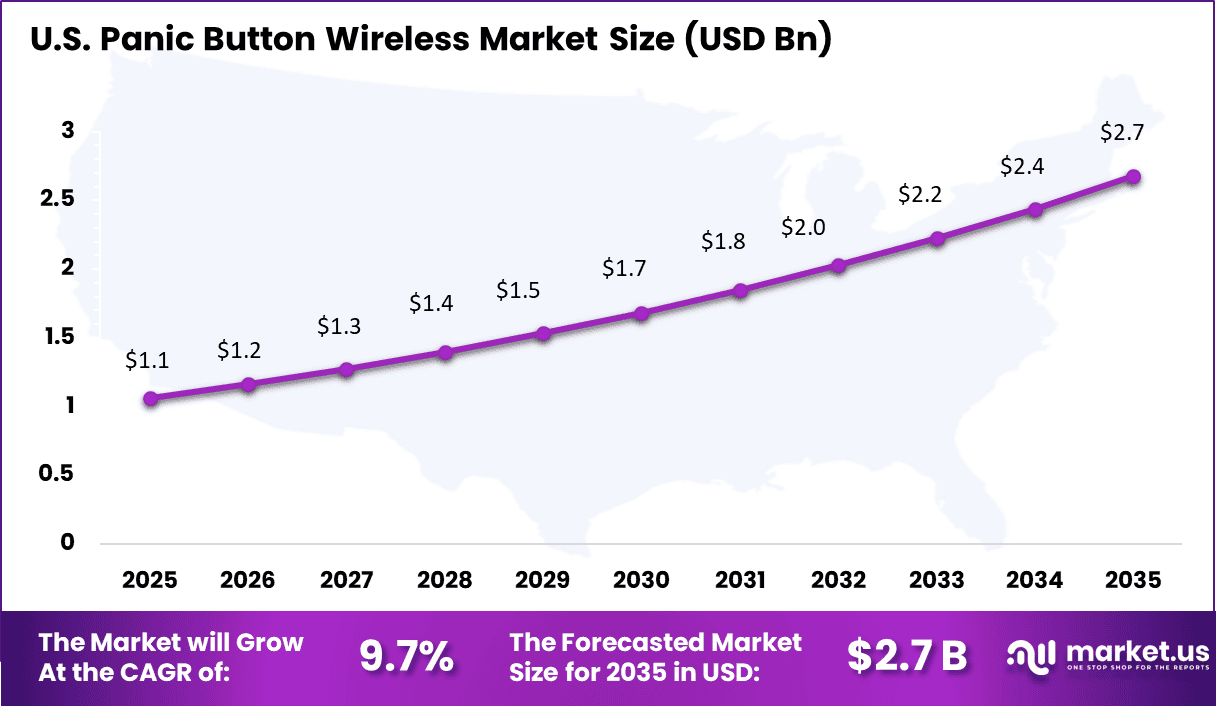
- Regionally, North America accounts for 38.4% global share, with the U.S. market valued at USD 1.06 billion and a CAGR of 9.7%, fueled by OSHA compliance and active shooter mitigation mandates.
By Product Type Analysis
Wearable panic buttons accounted for 52.6% of the Panic Button Wireless Market. This segment leads because wearable devices offer quick and discreet access to emergency alerts. Users can trigger assistance instantly without needing to reach fixed systems, which makes them highly suitable for personal safety and workplace environments.
The segment is also supported by growing demand for mobility and ease of use. Wearable designs such as pendants, wristbands, and clips allow continuous access to emergency support, which increases adoption across both individual users and employees in high-risk roles.
By Technology Analysis
Bluetooth held 38.6% of the market. This segment leads because Bluetooth technology enables reliable short-range communication between panic buttons and connected devices such as smartphones or central monitoring systems. It supports fast signal transmission and easy integration with existing digital ecosystems.
The segment is also driven by low power consumption and wide compatibility with consumer devices. Bluetooth-based panic systems are cost-effective and easy to deploy, which makes them a preferred choice for both personal and organizational safety solutions.
By Application Analysis
Commercial accounted for 57% of the Panic Button Wireless Market. This segment dominates because businesses such as offices, retail stores, hospitality venues, and healthcare facilities require emergency alert systems to protect staff and customers. Panic buttons help ensure quick response during incidents.
The segment is supported by increasing focus on workplace safety and compliance requirements. Organizations are adopting wireless panic systems to enhance security measures, reduce response time, and improve overall safety management across commercial environments.
By Distribution Channel Analysis
Online captured 54.2% of the market. This segment leads because consumers and businesses prefer purchasing safety devices through digital platforms that offer convenience, product comparisons, and wider availability. Online channels make it easier to access different models and features.
The segment is also supported by growing confidence in e-commerce and direct purchasing. Buyers benefit from detailed product information, user reviews, and home delivery options, which continues to drive the expansion of online sales in the panic button wireless market.
Key Market Segments
By Component
- Software
- Hardware
- Services
By Technology
- Bluetooth
- Wi-Fi
- Zigbee
- Cellular
- Others
By Application
- Residential
- Commercial
- Industrial
By Distribution Channel
- Online
- Offline
Regional Analysis
North America accounted for 38.4% of the Panic Button Wireless Market, reflecting strong adoption of personal safety and emergency alert systems across public and private environments. Organizations across sectors such as healthcare, hospitality, education, and retail increasingly deploy wireless panic buttons to ensure rapid response during emergencies.
The growing focus on employee safety, workplace regulations, and real-time communication systems has encouraged the use of connected alert devices that instantly notify security teams and authorities, supporting safer operational environments across the region.
The U.S. generated about USD 1.06 Bn within the regional market and is projected to expand at a CAGR of 9.7%. Businesses and institutions across the country continue to implement wireless panic button systems to enhance safety protocols and emergency response efficiency.
These devices are widely used by staff in high-risk environments to quickly signal distress situations. As awareness of workplace safety and compliance requirements increases, demand for reliable and easy-to-deploy wireless panic alert solutions continues to grow steadily across the US market.
Key Regions and Countries
- North America
- US
- Canada
- Europe
- Germany
- France
- The UK
- Spain
- Italy
- Russia
- Netherlands
- Rest of Europe
- Asia Pacific
- China
- Japan
- South Korea
- India
- Australia
- Singapore
- Thailand
- Vietnam
- Rest of APAC
- Latin America
- Brazil
- Mexico
- Rest of Latin America
- Middle East & Africa
- South Africa
- Saudi Arabia
- UAE
- Rest of MEA
Drivers Impact Analysis
| Key Driver | Impact on CAGR Forecast (~%) | Geographic Relevance | Impact Timeline | Strategic Effect |
|---|---|---|---|---|
| Increasing focus on personal and workplace safety | +2.6% | North America, Europe, Asia Pacific | Short to Mid Term (2025–2031) | Expands demand for emergency alert devices |
| Rising incidents of crime and emergencies | +2.3% | US, Europe, Latin America | Short to Mid Term (2025–2030) | Drives adoption in public and private spaces |
| Growing use in healthcare, hospitality, and education sectors | +2.1% | Global | Mid Term (2026–2032) | Improves staff and patient safety response |
| Expansion of smart security and connected device ecosystems | +1.9% | Global | Mid to Long Term (2026–2035) | Integrates panic buttons with security systems |
| Regulatory support for employee safety measures | +1.7% | North America, Europe | Mid to Long Term (2026–2035) | Encourages compliance-driven adoption |
Restraints Impact Analysis
| Key Restraint | Impact on CAGR Forecast (~%) | Geographic Relevance | Impact Timeline | Strategic Effect |
|---|---|---|---|---|
| False alarms and misuse of panic devices | -2.0% | Global | Short to Mid Term (2025–2031) | Reduces system reliability |
| Limited awareness in developing regions | -1.7% | Asia Pacific, Africa | Short to Mid Term (2025–2030) | Slows market penetration |
| Connectivity issues in remote areas | -1.6% | Emerging markets | Short to Mid Term (2025–2030) | Affects response effectiveness |
| Integration challenges with existing security systems | -1.5% | North America, Europe | Mid Term (2026–2032) | Increases deployment complexity |
| Cost constraints for small businesses | -1.3% | Global | Mid Term (2026–2032) | Limits adoption among SMEs |
Investor Type Impact Analysis
| Investor Type | Growth Sensitivity | Risk Exposure | Geographic Focus | Investment Outlook |
|---|---|---|---|---|
| Venture Capital Firms | High | Medium | US, Europe | Growth in safety tech startups |
| Private Equity Firms | High | Medium | North America, Europe | Expansion in security solutions |
| Strategic Technology Investors | High | Medium | US, China, South Korea | Strengthens IoT safety ecosystem |
| Corporate Venture Arms | Medium to High | Medium | Global | Partnerships with security platforms |
| Government and Public Safety Funds | Medium | Low | North America, Europe, Asia Pacific | Supports public safety initiatives |
Technology Enablement Analysis
| Technology Enabler | Impact on CAGR Forecast (~%) | Geographic Relevance | Impact Timeline | Implementation Significance |
|---|---|---|---|---|
| Wireless communication technologies including LTE and IoT | +2.7% | Global | Short to Mid Term (2025–2031) | Enables real-time alerts |
| Integration with mobile apps and GPS tracking | +2.4% | Global | Short to Mid Term (2025–2030) | Improves location-based response |
| Cloud-based alert management platforms | +2.1% | Global | Mid Term (2026–2032) | Supports centralized monitoring |
| AI-based emergency response analytics | +1.9% | North America, Europe | Mid to Long Term (2026–2035) | Enhances response efficiency |
| Integration with smart building and security systems | +1.7% | Global | Mid to Long Term (2026–2035) | Improves system coordination |
Key Challenges
- Signal coverage is a major challenge because wireless panic buttons may not work properly in basements, remote areas, large buildings, or places with network interference.
- Battery life can limit reliability because these devices need regular charging or replacement, and weak power can reduce emergency response readiness.
- False alarms remain a key issue because accidental button presses can create confusion, waste response time, and reduce trust in the system.
- Integration with existing safety and communication systems can be difficult because organizations often need the panic button system to connect with alarms, mobile devices, monitoring tools, and emergency workflows.
- Cost is another challenge because businesses may need to spend on devices, software, setup, maintenance, and employee training before the system works smoothly at scale.
Emerging Trends
A key trend in the Panic Button Wireless market is the growing integration of emergency alert devices with connected safety systems. Wireless panic buttons are increasingly linked with mobile applications, location tracking, and centralized monitoring platforms, allowing faster response during critical situations.
These devices are being used across workplaces, healthcare facilities, and public environments to provide instant alerts and real-time location details. This trend reflects a broader move toward smarter safety solutions where immediate communication and quick response play a crucial role in risk management.
Growth Factors
The rising focus on personal safety and workplace security is supporting the growth of wireless panic button solutions. Organizations aim to provide employees and individuals with quick access to emergency assistance in case of threats or medical incidents. These devices offer a simple and reliable way to trigger alerts without complex systems.
At the same time, increasing awareness about safety protocols and the need for faster emergency response encourages the adoption of wireless solutions that enhance protection and improve coordination during critical events.
Competitive Analysis
The competitive landscape of the Panic Button Wireless market includes security service providers, smart home companies, healthcare alert system firms, and wireless communication specialists. ADT Security Services, Stanley Black & Decker, Vivint Smart Home, and SimpliSafe hold strong positions through their broad safety portfolios, trusted service networks, and ability to support emergency response across homes, workplaces, and healthcare settings.
Other players such as Bay Alarm Medical, Life Alert Emergency Response, Inc., Tunstall Healthcare Group, GreatCall (Lively), MobileHelp, Medical Guardian, Alert1, SafeZone (CriticalArc), Inovonics Wireless Corporation, Guardian Protection Services, and V.ALRT (VSN Mobil) add competition by focusing on personal safety, elderly care, lone worker protection, and mobile emergency alerts.
Competition in this market is shaped by device reliability, response speed, wireless coverage, battery life, and ease of use. Overall, the market remains competitive as demand grows for simple and dependable emergency communication solutions.
Top Key Players in the Market
- ADT Security Services
- Stanley Black & Decker
- Honeywell International Inc.
- Tyco Integrated Security
- V.ALRT (VSN Mobil)
- Philips Lifeline
- Ascom Holding AG
- Securitas AB
- Guardian Protection Services
- Vivint Smart Home
- SimpliSafe
- Bay Alarm Medical
- Life Alert Emergency Response, Inc.
- Tunstall Healthcare Group
- GreatCall (Lively)
- MobileHelp
- Medical Guardian
- Alert1
- SafeZone (CriticalArc)
- Inovonics Wireless Corporation
- Others
Future Outlook
The future outlook for the Panic Button Wireless Market looks positive as workplaces, hotels, healthcare sites, schools, and public facilities place more focus on fast emergency response and staff safety. Recent industry guidance for hotels highlights growing use of employee safety devices, and workplace violence prevention guidance also points to alarms or panic buttons as part of effective protection systems. As wireless connectivity, location tracking, and certified security hardware continue to improve, demand for easy-to-use panic button solutions is expected to grow steadily in the coming years.
Recent Developments
- In September 2025, Alertus Technologies introduced a WiFi Alert Activation Module, a wireless wall‑mounted panic button that connects to its mass notification software via Wi‑Fi for easy battery‑powered installation.
- In June 2026, Silent Beacon released the Silent Beacon 2.0 wearable Bluetooth panic button featuring two‑way audio, six alert modes, and direct calling to any phone number.
Report Scope
| Report Features | Description |
|---|---|
| Market Value (2025) | USD 3.3 Billion |
| Forecast Revenue (2035) | USD 9.2 Billion |
| CAGR(2025-2035) | 11.0% |
| Base Year for Estimation | 2024 |
| Historic Period | 2020-2024 |
| Forecast Period | 2025-2035 |
| Report Coverage | Revenue forecast, AI impact on Market trends, Share Insights, Company ranking, competitive landscape, Recent Developments, Market Dynamics and Emerging Trends |
| Segments Covered | By Product Type (Wearable Panic Buttons, Fixed Panic Buttons, Mobile Panic Buttons), By Technology (Bluetooth, Wi-Fi, Zigbee, Cellular, Others), By Application (Residential, Commercial, Industrial), By Distribution Channel (Online, Offline) |
| Regional Analysis | North America – US, Canada; Europe – Germany, France, The UK, Spain, Italy, Russia, Netherlands, Rest of Europe; Asia Pacific – China, Japan, South Korea, India, New Zealand, Singapore, Thailand, Vietnam, Rest of Latin America; Latin America – Brazil, Mexico, Rest of Latin America; Middle East & Africa – South Africa, Saudi Arabia, UAE, Rest of MEA |
| Competitive Landscape | ADT Security Services, Stanley Black & Decker, Honeywell International Inc., Tyco Integrated Security, V.ALRT (VSN Mobil), Philips Lifeline, Ascom Holding AG, Securitas AB, Guardian Protection Services, Vivint Smart Home, SimpliSafe, Bay Alarm Medical, Life Alert Emergency Response, Inc., Tunstall Healthcare Group, GreatCall (Lively), MobileHelp, Medical Guardian, Alert1, SafeZone (CriticalArc), Inovonics Wireless Corporation, Others |
| Customization Scope | Customization for segments, region/country-level will be provided. Moreover, additional customization can be done based on the requirements. |
| Purchase Options | We have three licenses to opt for: Single User License, Multi-User License (Up to 5 Users), Corporate Use License (Unlimited Users and Printable PDF) |





























