Report Overview
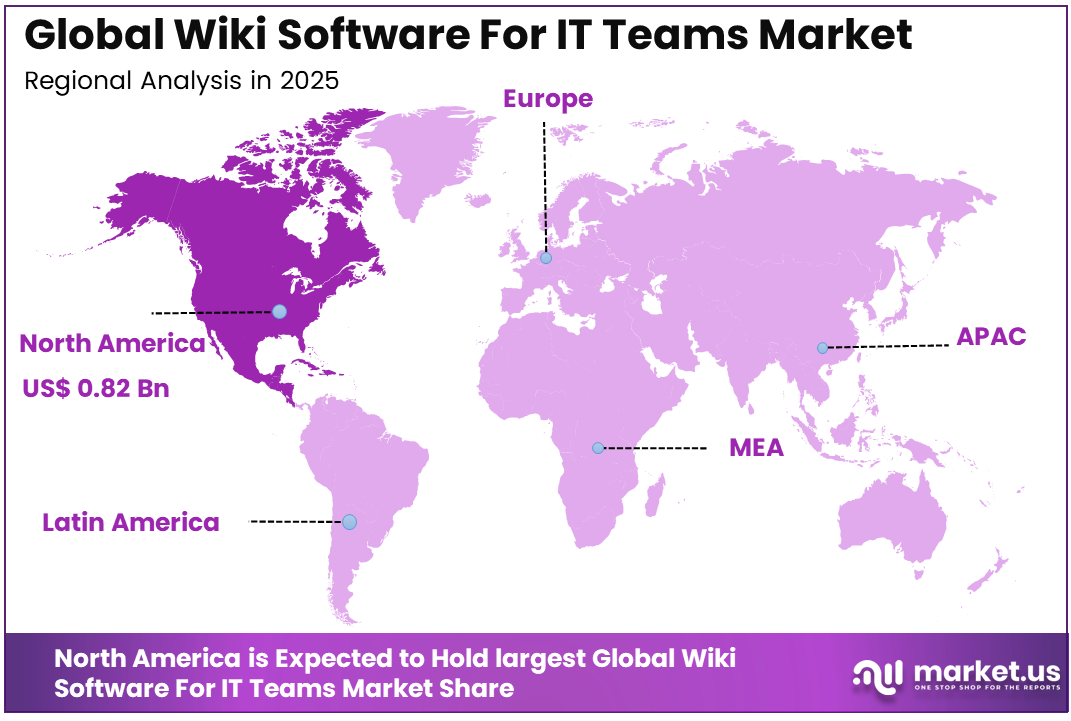
The Global Wiki Software For IT Teams Market size is expected to be worth around USD 15.23 billion by 2035, from USD 2.34 billion in 2025, growing at a CAGR of 20.6% during the forecast period from 2025 to 2035. North America held a dominant market position, capturing more than a 35.3% share, holding USD 0.82 billion in revenue.
Wiki Software For IT Teams refers to a digital platform used to create, organize, and share technical knowledge within an IT department. It helps teams document troubleshooting steps, system updates, processes, policies, and service information in one central place, making it easier to solve issues, train staff, and maintain consistent operations.
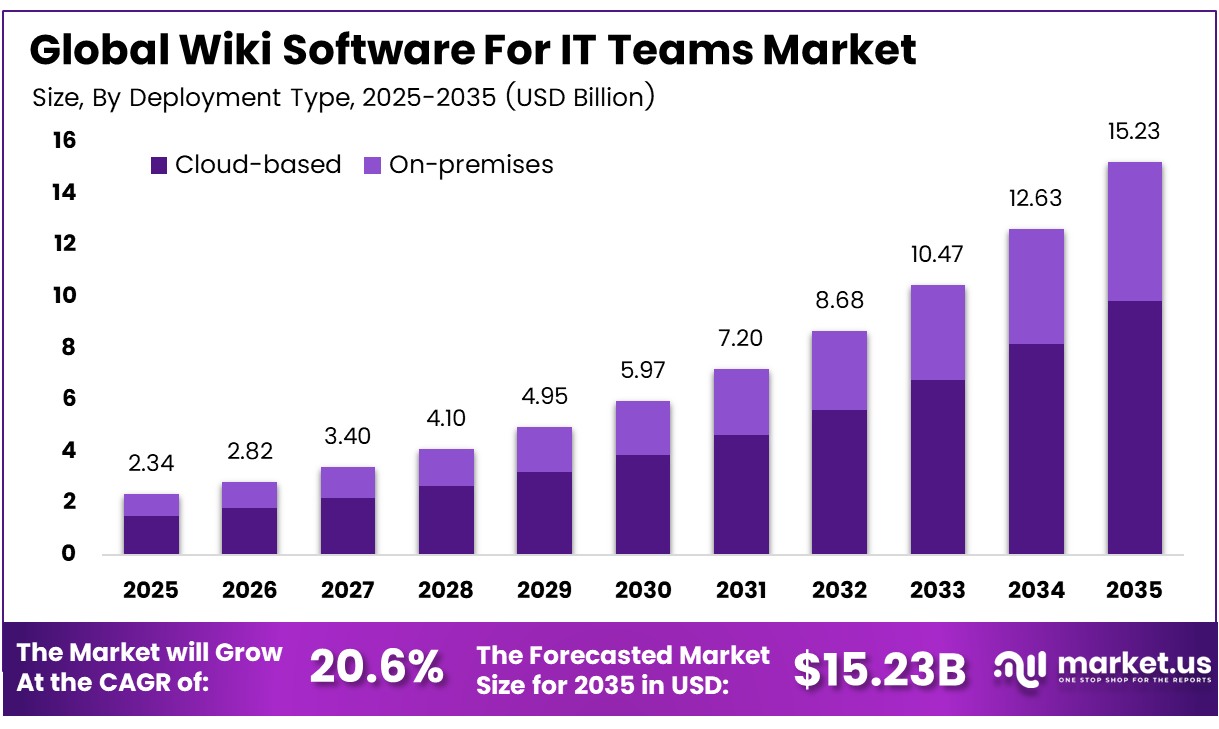
Top driving factors include the push for agile and DevOps practices, rising remote work, and the need to reduce incident resolution time. Collaborative tools such as wikis can cut documentation search time by nearly 30%, helping IT teams respond faster, improve service uptime, and support better user satisfaction across daily IT operations.
The market for Wiki Software for IT Teams is driven by the growing need for faster knowledge access, better team collaboration, and organized technical documentation. IT teams use these platforms to store runbooks, SOPs, incident notes, troubleshooting guides, and system updates in one place. Rising remote work, DevOps adoption, and complex IT environments are further supporting demand for secure, searchable wiki solutions.
Demand is strongest among mid-sized and large enterprises where IT teams handle thousands of tickets, system changes, and infrastructure updates. Adoption surveys indicate that more than 60% of enterprises plan to expand internal knowledge management tools, with wiki-style platforms preferred over static document repositories for faster access and team collaboration.
For instance, in May 2025, Slite featured prominently in wiki software guides as a lightweight alternative for distributed tech teams. Its focus on minimalist writing and async collaboration made it appealing for small IT squads that need structure, but don’t want the overhead of full-blown intranets.
Key Takeaway
- In 2025, the Cloud-Based segment held a dominant market position, capturing a 64.7% share of the Global Wiki Software for IT Teams Market.
- In 2025, the Large Enterprises segment held a dominant market position, capturing a 69.5% share of the Global Wiki Software for IT Teams Market.
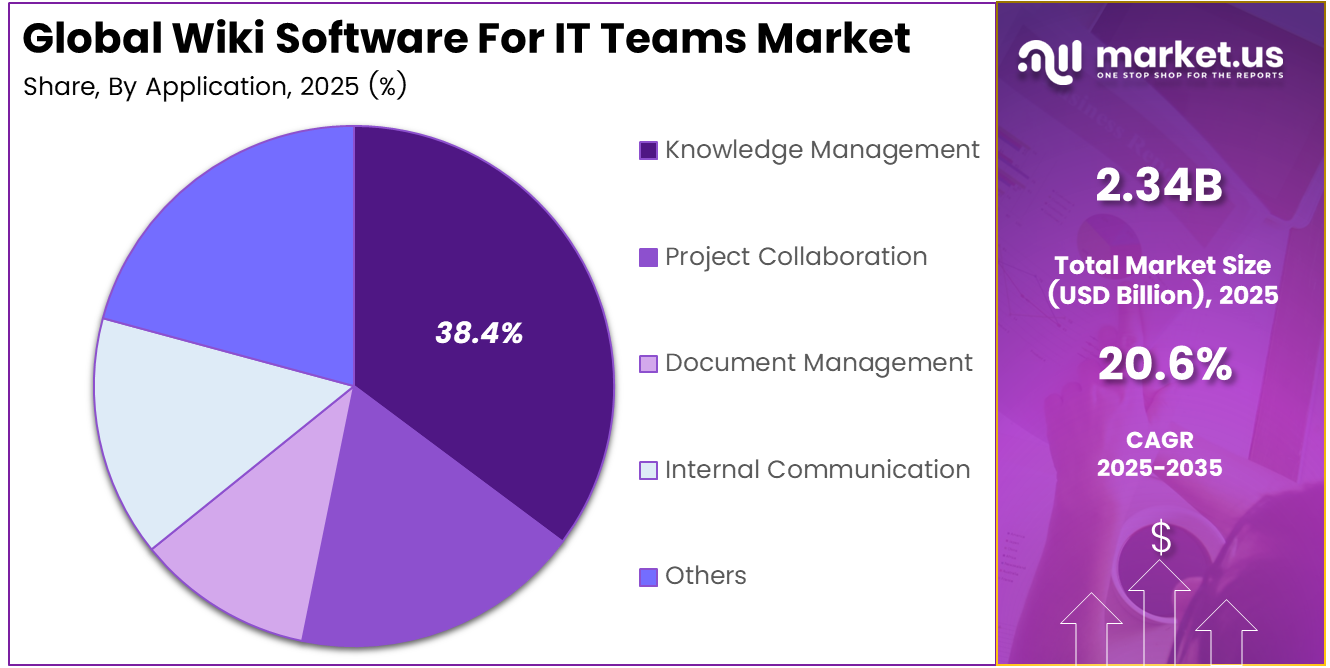
- In 2025, the Knowledge Management segment held a dominant market position, capturing a 38.4% share of the Global Wiki Software for IT Teams Market.
- In 2025, the IT & Telecom segment held a dominant market position, capturing a 35.5% share of the Global Wiki Software For IT Teams Market.
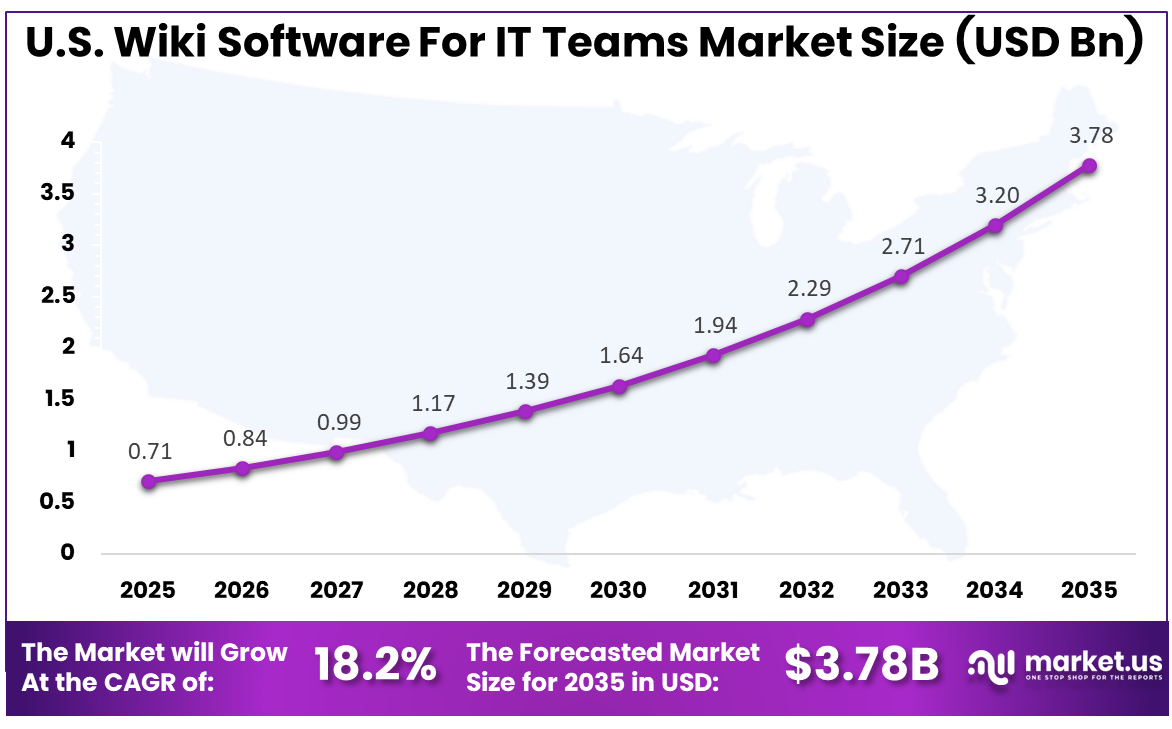
- The U.S. Wiki Software for IT Teams Market was valued at USD 0.71 Billion in 2025, with a robust CAGR of 18.2%.
- In 2025, North America held a dominant market position in the Global Wiki Software for IT Teams Market, capturing more than a 35.3% share.
Role of Generative AI
Generative AI is becoming a practical assistant inside IT wikis. It helps create starter runbooks, update old SOPs, and convert chat transcripts into clear knowledge articles. Enterprises using generative AI report productivity gains of around 20 to 25%, making it useful for reducing manual documentation work.
For IT leaders, Gen AI-powered wiki search improves how quickly engineers find the right answers. Workers using gen AI save about 5 to 6% of their weekly hours on average. These tools also detect duplicate or conflicting content, helping improve incident response, change management, and onboarding quality.
Investment and Business Benefits
Investment opportunities are emerging in vertical-specific IT wikis, security-compliant cloud platforms, and integrations with IT service management systems. Vendors serving regulated sectors can benefit from demand for audit trails, data residency, and fine-grained access control, as these customers account for nearly 35% of enterprise IT spending.
Business benefits extend beyond documentation, supporting productivity, cost control, and risk reduction. Shared knowledge spaces can reduce duplicated work by up to 25% and help IT teams resolve recurring issues faster. This improves operational continuity, limits downtime, and reduces overtime costs for enterprises managing complex IT environments.
Regional Analysis
In 2025, North America held a dominant market position in the Global Wiki Software for IT Teams Market, capturing more than a 35.3% share, holding USD 0.82 billion in revenue. This dominance is due to the strong presence of large enterprises, cloud-first IT teams, and advanced digital workplace adoption. The region has a high demand for centralized documentation, incident knowledge, DevOps runbooks, and secure collaboration tools. Strong spending on IT modernization, remote work systems, and cybersecurity compliance further supports wider use of wiki software across organizations.
For instance, in November 2024, Notion strengthened North America’s lead in wiki-style productivity platforms by signing a long-term lease for a 105,000 sq ft AI-driven headquarters in downtown San Francisco, doubling down on its unified workspace vision for global IT and knowledge teams and expanding its capacity to innovate in the enterprise wiki market.
U.S. Wiki Software For IT Teams Market Size
The market for Wiki Software for IT Teams within the U.S. is growing tremendously and is currently valued at USD 0.71 billion. The market has a projected CAGR of 18.2%. The market is growing due to the strong adoption of cloud tools, remote work models, and agile IT practices across enterprises. U.S. companies are investing in centralized knowledge platforms to manage runbooks, incident records, SOPs, and technical documents. Rising cybersecurity needs, faster software releases, and complex IT infrastructure are also increasing demand for secure, searchable, and collaborative wiki systems.
For instance, in February 2025, Helpjuice reinforced U.S. leadership in IT-focused wiki and knowledge base tools with the launch of Helpjuice 5.0, introducing an “auto-updating knowledge base” powered by AI, expert-driven article creation, performance boosts, and large-scale mass publishing, making it easier for IT teams to keep technical documentation accurate and continuously refreshed.
Key Regions and Countries
North America
- US
- Canada
Europe
- Germany
- France
- The UK
- Spain
- Italy
- Russia
- Netherlands
- Rest of Europe
Asia Pacific
- China
- Japan
- South Korea
- India
- Australia
- Singapore
- Thailand
- Vietnam
- Rest of APAC
Latin America
- Brazil
- Mexico
- Rest of Latin America
Middle East & Africa
- South Africa
- Saudi Arabia
- UAE
- Rest of MEA
Deployment Type Analysis
In 2025, the Cloud-Based segment held a dominant market position, capturing a 64.7% share of the Global Wiki Software for IT Teams Market. This dominance is due to the rising preference for cloud-based wiki platforms among IT teams that need quick deployment, remote access, and easier maintenance. Cloud delivery allows teams to manage technical documents, runbooks, and internal knowledge without depending heavily on local infrastructure or complex setup.
Cloud-based wiki software also supports distributed IT teams by giving employees access to updated knowledge from different locations. It helps improve collaboration, version control, and continuity across support, DevOps, and infrastructure teams. This makes cloud deployment more practical for organizations managing fast-changing IT operations.
For instance, in April 2026, Notion introduced API changes that let teams programmatically manage wiki verification states, along with improvements in AI-assisted meeting notes and views. For IT departments, this makes a cloud wiki easier to govern at scale, as automated workflows can keep critical pages up to date and trustworthy without manual follow-up.
Organization Size Analysis
In 2025, the Large Enterprises segment held a dominant market position, capturing a 69.5% share of the Global Wiki Software for IT Teams Market. This dominance stems from the complex documentation needs of large enterprises, where IT teams manage multiple systems, service requests, and internal processes. These organizations require structured wiki platforms to store troubleshooting guides, change records, security policies, and operational workflows in a controlled and easy-to-access format.
Large enterprises also prefer wiki software because it supports role-based access, content ownership, and team-level collaboration. As departments grow, internal knowledge can become scattered across tools and teams. A centralized wiki helps reduce information gaps and supports smoother onboarding, incident response, and compliance-related documentation.
For instance, in April 2026, Confluence shipped new data center releases focused on stability, permissions, and better control of advanced editors, clearly targeting larger enterprise environments. For big IT organizations, these changes help keep documentation consistent and safe while multiple teams work in the same large wiki space.
Application Analysis
In 2025, the Knowledge Management segment held a dominant market position, capturing a 38.4% share of the Global Wiki Software for IT Teams Market. This dominance is due to the core role of knowledge management in IT operations. IT teams depend on wiki software to document system details, SOPs, incident learnings, support guides, and infrastructure updates. This helps technical teams find reliable information faster and maintain consistency across daily service management activities.
Knowledge management applications also help reduce repeated questions and duplicated work inside IT departments. When information is stored in a searchable and organized wiki, engineers can reuse proven solutions and update content as systems change. This improves team efficiency and supports better continuity during staff changes.
For instance, in May 2025, Guru continued to position itself as a real-time knowledge layer by using AI features like smart suggestions across text and voice channels. For IT teams, this turns the wiki into an active assistant that surfaces relevant documentation inside tools they already use, which strengthens the knowledge management segment.
End-User Analysis
In 2025, the IT & Telecom segment held a dominant market position, capturing a 35.5% share of the Global Wiki Software for IT Teams Market. This dominance is due to the strong documentation requirements across IT and telecom environments. These teams manage complex networks, software systems, service platforms, and customer-facing infrastructure. Wiki software helps them organize technical knowledge, maintenance procedures, incident notes, and configuration details in one shared workspace.
IT and telecom teams also benefit from wiki platforms because their work often involves distributed teams and frequent operational updates. A centralized knowledge base supports faster coordination between support, engineering, and operations teams. It also helps preserve critical process knowledge when systems, tools, or team members change.
For instance, in December 2024, the MediaWiki 1.43 release improved security, namespace management, and multilingual capabilities, helping administrators handle large and complex wikis more safely. IT and telecom teams running internal or customer-facing portals can use these enhancements to manage wide contributor bases and diverse audiences more effectively.
Key Market Segments
By Deployment Type
- Cloud-Based
- On-Premises
By Organization Size
- Small and Medium Enterprises
- Large Enterprises
By Application
- Knowledge Management
- Project Collaboration
- Document Management
- Internal Communication
- Others
By End-User
- IT & Telecom
- BFSI
- Healthcare
- Education
- Retail
- Others
Market Dynamics
Drivers - Need for Faster IT Knowledge Access
The market for Wiki Software for IT Teams is driven by the need to access technical knowledge quickly during daily operations. IT teams use these platforms to find runbooks, troubleshooting steps, SOPs, and system notes without searching through scattered files, emails, or chat histories.
Faster knowledge access helps reduce delays in incident response, change management, and internal support. When trusted information is stored in one searchable place, engineers can solve recurring issues more efficiently. This improves team coordination and supports smoother IT service delivery across complex enterprise environments.
For instance, in April 2026, Atlassian launched Remix in open beta, a visual AI tool that transforms Confluence pages into charts, infographics, and scorecards directly within the platform without requiring users to switch applications. This development addresses the growing need for IT teams to access and visualize technical information instantly during troubleshooting sessions.
Restraint - Data Security and Compliance Concerns
Data security remains a key restraint because IT wikis often store sensitive operational details, system configurations, access procedures, and internal process records. Enterprises must ensure that only authorized users can view or edit critical information, especially in regulated industries where strict controls are required.
Compliance concerns also increase the need for audit trails, access logs, data residency, and strong permission settings. If these controls are weak, organizations may hesitate to store sensitive IT knowledge in wiki platforms. This can slow adoption, particularly among banking, healthcare, government, and telecom users.
For instance, in March 2026, the MediaWiki Foundation released security and maintenance updates across versions 1.43, 1.44, and 1.45, addressing vulnerabilities that could expose sensitive wiki content. These patches reflect ongoing efforts to maintain secure knowledge repositories for organizations managing confidential technical information.
Opportunities - Integration with Modern IT Toolchains
A strong opportunity exists in connecting wiki software with modern IT toolchains such as ticketing systems, DevOps platforms, chat tools, monitoring systems, and code repositories. These integrations help engineers access related knowledge directly inside their normal workflows, instead of switching between separate applications.
Integrated wiki platforms can support incident reviews, release documentation, change records, and troubleshooting guides more effectively. When knowledge is linked to tickets, alerts, and development tasks, documentation becomes easier to update and reuse. This creates higher value for IT teams managing fast-moving digital infrastructure.
For instance, in January 2026, Guru enhanced its browser extension functionality to surface knowledge directly within CRM, ticketing systems, and internal tools based on page context, eliminating the need for separate searches. The platform strengthened event-based content delivery, automatically providing relevant documentation when team members join projects or when products launch.
Challenges - User Adoption and Content Maintenance
User adoption remains a major challenge because IT teams often treat documentation as secondary work during busy operations. Engineers may delay updating pages after incidents, releases, or system changes. Without regular contribution habits, wiki content can become incomplete, outdated, or uneven across departments.
Content maintenance also requires clear ownership, review schedules, and simple writing standards. If pages are duplicated, poorly tagged, or difficult to search, users may lose trust in the platform. Long-term value depends on making wiki updates part of everyday IT workflows rather than a separate administrative task.
For instance, in March 2026, Tettra implemented knowledge verification workflows that assign document owners who must regularly confirm information accuracy, addressing the persistent problem of outdated content in internal wikis. The platform added AI-powered auto-answers through its Slack bot Kai, which automatically responds to questions in channels and captures existing conversations as reusable knowledge.
Emerging Trends
Wiki software for IT teams is shifting from static documentation pages to adaptive knowledge hubs. AI-driven search, automatic summarization, and smart recommendations are helping engineers find relevant playbooks and postmortems faster. Mobile first access and integration with ticketing, CI/CD, and chat tools are also becoming more important.
Security and compliance are also shaping product development. Regulated sectors are using IT wikis for change logs, incident reviews, and configuration data, which increases demand for fine-grained access controls, audit trails, and data residency. Usage analytics are also helping teams identify which articles support faster resolution.
Growth Factors
The growth of wiki software in IT teams can be linked to the rising importance of structured knowledge management. Remote and hybrid work has reduced informal desk-side support, making shared documentation more necessary. As digital transformation expands, IT leaders need one reliable place for systems, APIs, and process knowledge.
Cloud-based wiki platforms are also supporting wider adoption. IT teams prefer managed solutions that are easier to deploy, integrate, and scale without heavy maintenance. Small and medium-sized businesses are adopting these tools through flexible pricing and simpler onboarding, which is expanding the market beyond large enterprises.
Key Players Analysis
One of the leading players in January 2026, Atlassian quietly expanded Confluence’s AI features for IT teams, adding smarter page summaries and inline suggestions that sit directly in runbooks and post-mortems. These updates help busy engineers keep internal docs accurate without extra effort, which is crucial at scale in large DevOps environments.
Top Key Players in the Market
- Atlassian Confluence
- Notion
- MediaWiki
- Guru
- Slab
- Slite
- Tettra
- Zoho Wiki
- Nuclino
- DokuWiki
- BookStack
- XWiki
- Samepage
- Microsoft SharePoint
- Document360
- Helpjuice
- Bloomfire
- eXo Platform
- Quip
- KnowledgeOwl
- Others
Recent Developments
- In December 2025, Notion leaned further into its AI workspace positioning, promoting Notion AI as a way for IT teams to auto-generate onboarding pages, SOPs, and incident timelines from chat and ticket data. This move turns Notion from a simple wiki into a dynamic knowledge layer for technical teams.
- In February 2025, MediaWiki remained a popular choice in technical communities as new enterprise distributions bundled SSO, WYSIWYG editing, and API connectors out of the box. This made the classic wiki engine more attractive for internal IT teams that want open-source flexibility without heavy custom work.
Report Scope
| Report Features | Description |
|---|---|
| Market Value (2025) | USD 2.34 Billion |
| Forecast Revenue (2035) | USD 15.23 Billion |
| CAGR (2026-2035) | 20.6% |
| Base Year for Estimation | 2025 |
| Historic Period | 2020-2024 |
| Forecast Period | 2026-2035 |
| Report Coverage | Revenue Forecast, Market Dynamics, Competitive Landscape, Recent Developments |
| Segments Covered | By Deployment Type (Cloud-Based, On-Premises), By Organization Size (Small and Medium Enterprises, Large Enterprises), By Application (Knowledge Management, Project Collaboration, Document Management, Internal Communication, Others), By End-User (IT & Telecom, BFSI, Healthcare, Education, Retail, Others) |
| Regional Analysis | North America (US and Canada), Europe (Germany, France, The UK, Spain, Italy, and Rest of Europe), Asia Pacific (China, Japan, South Korea, India, Australia, and Rest of APAC), Latin America (Brazil, Mexico, and Rest of Latin America), Middle East & Africa (GCC, South Africa, and Rest of MEA) |
| Competitive Landscape | Atlassian Confluence, Notion, MediaWiki, Guru, Slab, Slite, Zoho Wiki, Nuclino, DokuWiki, BookStack, XWiki, Samepage, Microsoft SharePoint, Document360, Helpjuice, Bloomfire, eXo Platform, Quip, KnowledgeOwl, Others |
| Customization Scope | Customization at the segment and region/country levels will be provided. Moreover, customization can be tailored to the requirements. |
| Purchase Options | We have three licenses to opt for: Single User License, Multi-User License (Up to 5 Users), Corporate Use License (Unlimited Users and Printable PDF) |