


Report Overview
The Global Drone Aerospace Security System generated USD 1.5 billion in 2024 and is predicted to register growth from USD 1.8 billion in 2025 to about USD 8.9 billion by 2034, recording a CAGR of 19.60 % throughout the forecast span. North America held a dominant market position, capturing more than a 42.3% share, with USD 7.40 billion in revenue.
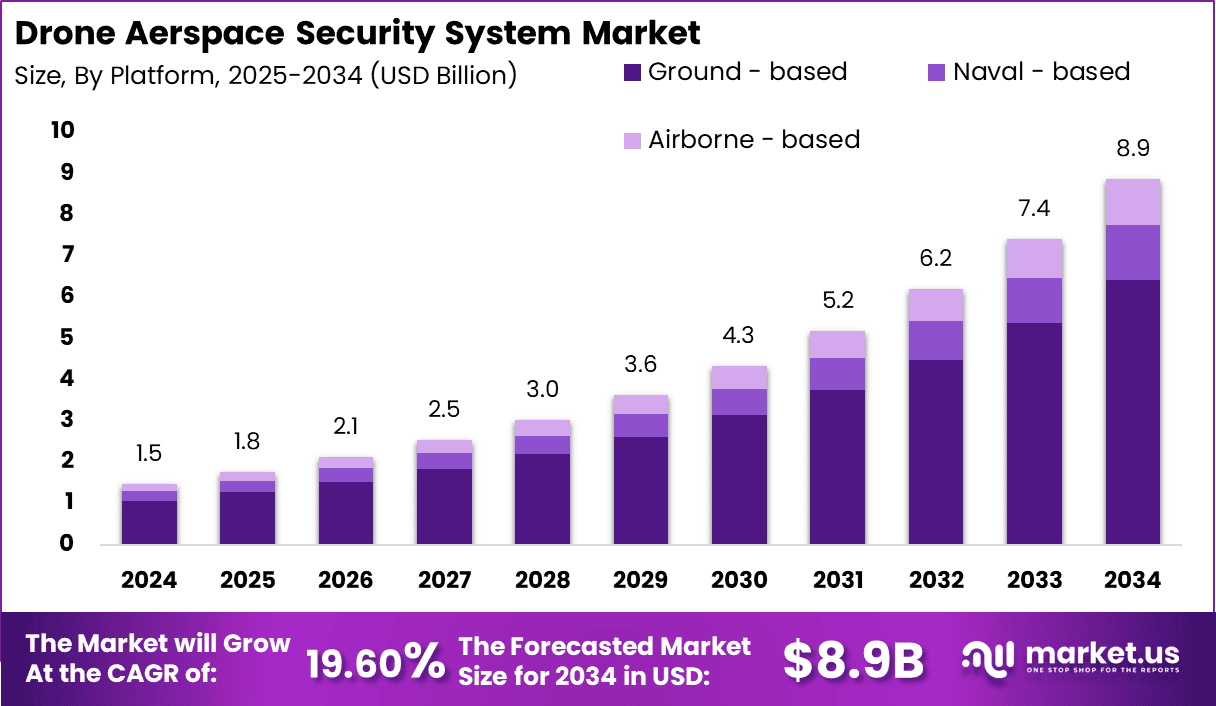
The market for aerospace security systems designed to counter and manage unmanned aerial vehicles (UAVs) or drones is evolving rapidly. These systems include detection, identification, tracking, disruption, and neutralisation tools to protect airspace around airports, military bases, critical infrastructure, and urban environments. Integration of radar, radio‑frequency sensing, electro‑optical/infrared cameras, and command‑and‑control software has become essential as drone incursions and threats rise.
Top Market Takeaways
- By component, hardware leads with 58.2%, driven by the demand for robust, high-performance drones and supporting equipment for security applications.
- By platform, ground-based systems dominate with 72.4%, reflecting their widespread use in monitoring and securing perimeters in various sectors, including military and critical infrastructure.
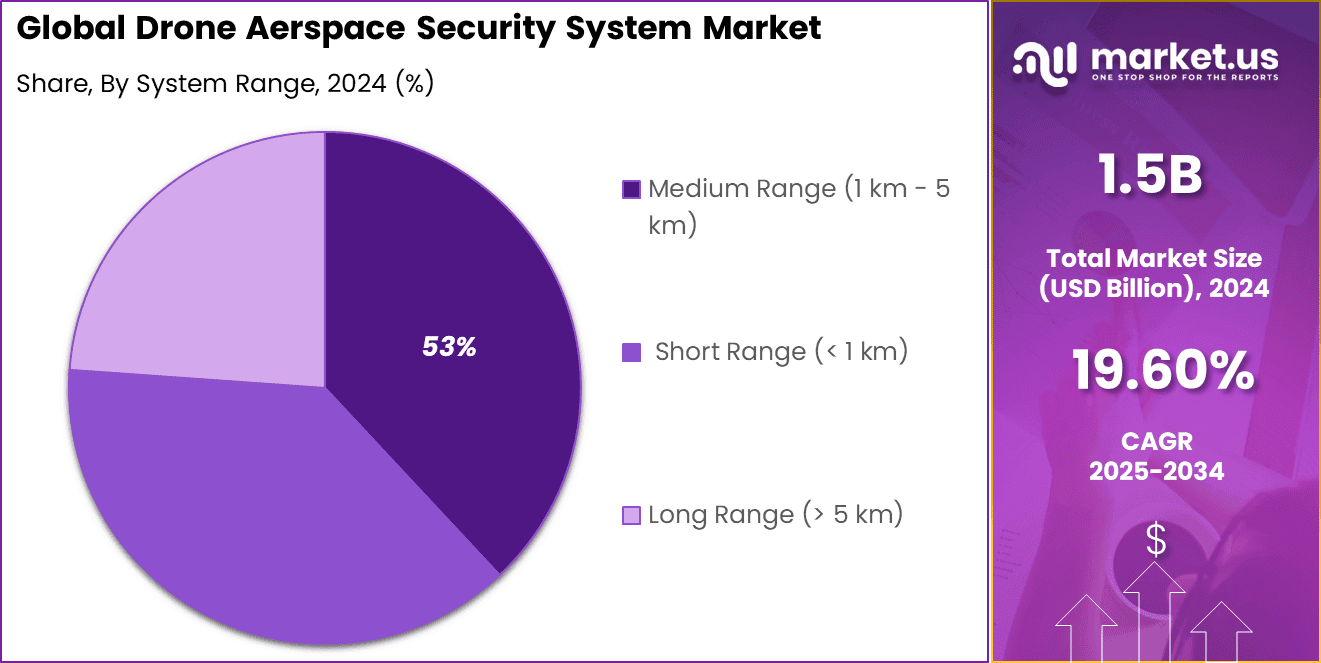
- By system range, medium range (1 km – 5 km) holds 52.6%, offering a balance between coverage and operational flexibility for security purposes.
- By end-user, military and defense account for 52.5%, reflecting the growing reliance on drones for surveillance, reconnaissance, and tactical operations in defense applications.
By Component
The Hardware segment accounts for a significant portion of the drone aerospace security system market, making up about 58.2% of the overall share. This is because hardware components like sensors, cameras, radar, and jammers are essential for detecting, tracking, and neutralizing unauthorized drones. Their role is critical in ensuring the security and effectiveness of these systems, especially in applications requiring real-time threat responses.
This high reliance on hardware reflects the market’s focus on robust and reliable physical equipment capable of operating in diverse environments. The strong presence of hardware in the market also highlights ongoing investments in innovation to improve performance and durability for aerospace security needs.
By Platform
Ground-based platforms dominate the market, with a share of roughly 72.4%. These systems are strategically installed at fixed locations like military bases, airports, and critical infrastructure sites, providing broad coverage and continuous monitoring. Their stability and integration capability with other defense systems make them the preferred choice for aerospace security.
This dominance is due to the operational advantages of ground-based deployment, such as easier maintenance and the ability to support larger, more powerful detection and countermeasure equipment. As drone threats grow, these platforms remain the frontline defense for airspace security.
By System Range
Medium-range systems hold about 53% of the market, representing the optimal balance between effective coverage and cost. These systems are suitable for protecting mid-sized areas such as industrial sites, transportation hubs, and military installations where a range of 1 to 5 kilometers offers practical surveillance and engagement capabilities.
This range is favored because it allows security operators to detect and respond to drone threats with enough lead time without the higher costs associated with long-range systems. The medium-range segment’s strength underlines the market’s focus on versatile and efficient drone monitoring solutions.
By End-User
The military and defense sector constitutes 52.5% of the drone aerospace security system market. This dominance is driven by the critical need to protect sensitive military sites, personnel, and operations from unauthorized or hostile drones. Defense applications require advanced detection, classification, and neutralization capabilities, prompting significant investment and development in this segment.
Military users lead in adopting these systems due to evolving threats and the strategic importance of airspace control. Their requirements for reliability, quick response, and integration with broader defense infrastructures make this sector central to market growth.
Key Market Segments
By Component
- Hardware
- Cameras
- Sensors
- Radars
- Anti-Drone Guns
- Others
- Software
- Detection and Tracking Software
- Threat Assessment and Analysis Software
- Command and Control (C2) Software
- AI-Based Autonomous Response Software
- Data Integration and Visualization Software
- Services
- Consulting and Advisory Services
- System Installation and Integration Services
- Maintenance and Support Services
- Training and Simulation Services
- Managed Security Services
By Platform
- Ground-based
- Naval-based
- Airborne-based
By System Range
- Short Range (< 1 km)
- Medium Range (1 km – 5 km)
- Long Range (> 5 km)
By End-User
- Military & Defense
- Homeland Security & Law Enforcement
- Critical Infrastructure
- Airport
- Prisons
- Others
- Commercial & Private Entities
- Others
Regional Analysis
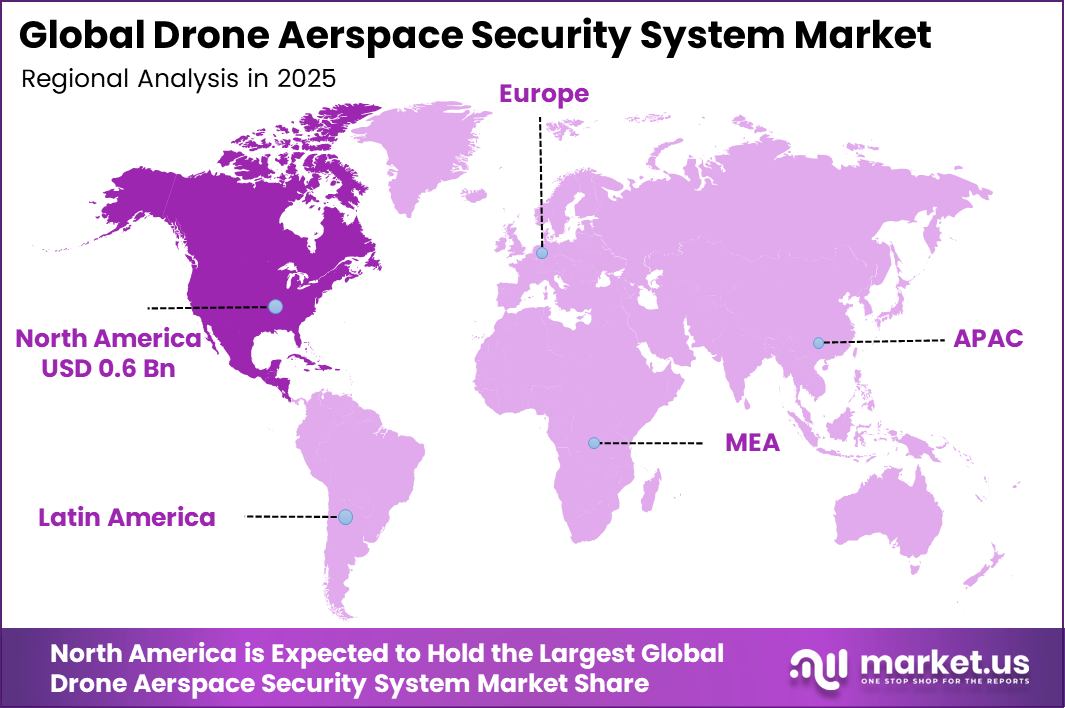
North America accounts for around 42.3% of the global drone aerospace security system market, reflecting strong regional leadership. The presence of advanced technology, regulatory support, and substantial defense spending all contribute to this dominance. The region continues to push adoption through innovation and integration of sophisticated security solutions.
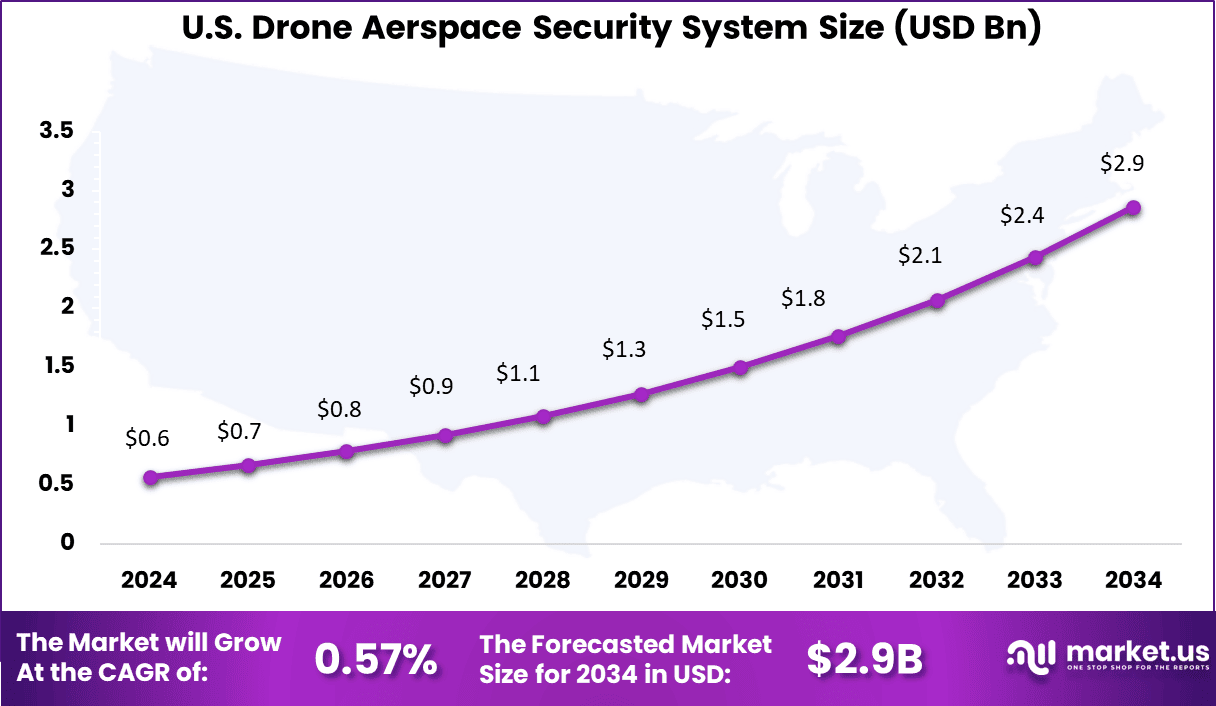
The United States is a key contributor within this region, with a particularly strong market presence estimated at USD 0.57 billion. The US defense sector’s focus on protecting critical infrastructure and national security against aerial threats sustains steady growth and technology advancements.
Key Regions and Countries
- North America
- US
- Canada
- Europe
- Germany
- France
- The UK
- Spain
- Italy
- Russia
- Netherlands
- Rest of Europe
- Asia Pacific
- China
- Japan
- South Korea
- India
- Australia
- Singapore
- Thailand
- Vietnam
- Rest of APAC
- Latin America
- Brazil
- Mexico
- Rest of Latin America
- Middle East & Africa
- South Africa
- Saudi Arabia
- UAE
- Rest of MEA
Market Dynamics
Drivers
| Driver | (~) % CAGR | Geographic Relevance | Impact Timeline |
|---|---|---|---|
| Mandatory Remote ID enforcement driving detection retrofits | +3.2% | North America, Europe | Short term (2 years or less) |
| Rising cross-border drone incursions at critical infrastructure | +2.8% | Global, concentrated in the Middle East and Eastern Europe | Short term (2 years or less) |
| Defense budget reallocation toward layered counter UAS systems | +2.5% | North America, Europe, Indo Pacific | Short term (2 years or less) |
| Airport and stadium mandatory drone mitigation deployments | +1.9% | North America, Europe, Gulf states | Medium term (2 to 4 years) |
| Integration of AI-based sensor fusion into existing radar networks | +1.4% | Global | Medium term (2 to 4 years) |
| Rising prison and correctional facility anti-drone procurement | +0.9% | North America, Europe | Short term (2 years or less) |
Mandatory Remote ID Enforcement Driving Detection Retrofits
The root cause of this driver is the shift from voluntary to mandatory drone identification, formalized when the FAA’s Remote ID enforcement discretion period expired on March 16, 2024, compelling operators to broadcast identification and location data or face certificate suspension, per FAA UAS Declaration of Compliance tracking.
The quantitative mechanism plays out as airport authorities, correctional facilities, and utility operators retrofit legacy perimeter radar with Remote ID-compatible receivers, a process that national aviation regulators estimate adds between 8% and 12% to per-site sensor integration costs while compressing average procurement lead times by roughly 6 weeks as vendors pre-certify hardware against the FAA Declaration of Compliance list.
Restraints
| Restraint | (~) % CAGR | Geographic Relevance | Impact Timeline |
|---|---|---|---|
| Legal bans on RF jamming and kinetic mitigation in civilian airspace | -2.6% | North America, European Union | Short term (2 years or less) |
| Elevated interest rates delaying municipal security CapEx cycles | -1.8% | North America, Europe | Short term (2 years or less) |
| Export licensing restrictions on directed energy countermeasures | -1.5% | Global, acute in Asia Pacific | Short term (2 years or less) |
| High capital cost barrier for small and mid-tier operators | -1.2% | Latin America, Africa, South Asia | Short term (2 years or less) |
| Frequency spectrum allocation conflicts with telecom regulators | -0.9% | North America, Europe | Short term (2 years or less) |
Legal Bans on RF Jamming and Kinetic Mitigation in Civilian Airspace
The root cause is that most civilian counter-drone deployment sites sit under statutes reserving active mitigation authority to federal agencies, so under 18 U.S.C. 32 and related Federal Communications Commission spectrum rules, private operators and even most state and local law enforcement bodies remain legally barred from jamming or physically downing unauthorized drones, a restriction the FCC and FAA jointly reaffirm in current enforcement guidance.
The quantitative bottleneck manifests as commercial sites limited to detection-only architectures, which, per industry association shipment tracking of counter UAS hardware, account for a disproportionate share of unit volume versus the smaller mitigation hardware segment, effectively freezing an estimated 30% to 40% of potential system value per deployment since neutralization modules cannot be activated without a federal waiver that historically takes 6 to 12 months to process.
Challenges
| Challenge | (~) % CAGR | Geographic Relevance | Mitigation Horizon |
|---|---|---|---|
| Sensor talent and RF engineering shortage | -1.7% | North America, Europe | Medium term (2 to 4 years) |
| Swarm drone detection blind spots | -1.4% | Global | Medium term (2 to 4 years) |
| Semiconductor and radar component lead times | -1.1% | Global, acute in Asia Pacific supply chains | Medium term (2 to 4 years) |
| Interoperability gaps across legacy defense networks | -0.8% | North America, Europe | Long term (4 years or more) |
| False positive rates near dense urban RF environments | -0.6% | Global, acute in dense metros | Medium term (2 to 4 years) |
Sensor Talent and RF Engineering Shortage
The structural vulnerability lies in the narrow global pool of engineers qualified in RF signal processing, electro optical sensor fusion, and embedded AI classification, a shortage that national manufacturing and defense industry associations describe as a persistent constraint on scaling counter UAS production lines; the quantitative friction shows up as extended hiring cycles averaging 4 to 6 months per specialized engineering role and as reported wage inflation of roughly 12% to 15% year over year for RF and signal processing talent, based on patterns consistent with defense sector compensation data disclosed in company annual reports and investor filings of listed aerospace and defense manufacturers.
Opportunities
| Opportunity | (~) % CAGR | Geographic Relevance | Execution Window |
|---|---|---|---|
| Counter UAS as a subscription-managed security service | +2.4% | North America, Europe | Medium term (2 to 4 years) |
| Adjacent expansion into critical infrastructure and utility corridors | +1.9% | Global, acute in Africa and Latin America grid networks | Medium term (2 to 4 years) |
| Commercial drone traffic management integration white space | +1.6% | North America, Europe, Asia Pacific | Long term (4 years or more) |
| M&A roll up of fragmented regional detection vendors | +1.2% | Europe, Asia Pacific | Medium term (2 to 4 years) |
| Emerging market government procurement in unaddressed regions | +0.9% | Middle East, Southeast Asia | Long term (4 years or more) |
Counter UAS as a Subscription Managed Security Service
This is explicitly untapped white space rather than a current driver because today’s revenue base, reflected in listed defense and security manufacturers’ annual reports, remains overwhelmingly hardware CapEx driven with one-time system sales, whereas a shift toward recurring detection-as-a-service contracts has not yet been meaningfully monetized at scale.
The unit economic shift would involve moving from hardware gross margins that industry filings typically show in the 35% to 45% range toward blended software and monitoring service margins that comparable managed security service providers report in the 60% to 70% range, per patterns observable in company investor decks for adjacent physical security monitoring firms, alongside a potential 20% to 25% reduction in customer per unit upfront cost that could unlock a meaningful share of the addressable market among mid sized airports, stadiums.
Emerging Trends
Emerging trends in the drone aerospace security system field are driven strongly by the integration of artificial intelligence and machine learning, with nearly 40% of systems now using AI-based monitoring to boost predictive threat detection. The combination of sensors, cameras, jammers, and advanced hardware has reshaped security, allowing for accurate identification of incoming drones, micro drones, birds, and other aerial obstacles.
Swarm technology is also making its way into leading security solutions, with real-time data processing, autonomous coordination, and energy-saving designs becoming more common throughout 2025. Notably, permanent drone stations and automated charging hubs are appearing in disaster-prone areas, ensuring rapid deployment and round-the-clock security presence.
Growth Factors
Current growth is fueled by increased drone deployment in delivery services and surveillance, which accounts for roughly 35% of overall adoption among security and defense organizations. Regionally, North America leads with around 38% market share, while Europe and Asia-Pacific are catching up fast through government funding and technological investments.
AI-enabled airspace monitoring saw a remarkable 28% adoption increase in 2023, directly improving real-time threat response and making security systems flexible and scalable for many use cases. However, high implementation costs remain a restraint, affecting about 22% of smaller agencies. Still, the wide acceptance of machine learning and AI, coupled with robust R&D, is setting a lively pace for the expansion of drone aerospace security worldwide.
Competitive Analysis
The Drone Aerospace Security System market is shaped by major defense contractors and innovative security providers offering advanced anti-drone and airspace monitoring solutions. Raytheon Company, Lockheed Martin Corporation, and Thales Group lead the market with high-end radar, counter-UAS, and integrated air defense technologies.
Specialized firms such as Dedrone, Fortem Technologies, and DroneShield focus on scalable, AI-based drone detection and mitigation platforms. These companies offer compact systems with radio frequency sensors, machine learning analytics, and jamming capabilities to counter illicit drone activity.
WhiteFox Defense Technologies and Blighter Surveillance Systems are known for their RF cyber-takeover and long-range ground surveillance radars, which enhance airspace visibility in urban areas and border regions.
Emerging players like DroniTech, Unifly, and Air Space Drone deliver unmanned traffic management (UTM) and airspace awareness solutions for public and commercial use cases. Hensoldt and NTT DATA Corporation contribute to the sector with integrated sensor fusion and real-time monitoring platforms designed for smart cities and autonomous flight ecosystems.
Top Key Players in the Market
- NTT DATA Corporation
- Air Space Drone
- Dedrone
- DroniTech
- Fortem Technologies
- Unifly
- WhiteFox Defense Technologies
- Blighter Surveillance Systems
- DroneShield
- Hensoldt
- Raytheon Company
- Lockheed Martin Corporation
- Thales Group
- Others
Recent Developments
- In October 2025, NTT DATA was recognized as an Emerging Leader in the Gartner® Innovation Guide for Generative AI Consulting, reflecting its strategic focus on AI-driven solutions for airspace and security management.
- In June 2025, Dedrone, a leading counter-drone solutions provider, released its 2025 Airspace Security Report, highlighting a 4.3x increase in DIY drone detections globally, driven by rising drone affordability and access. Dedrone’s scalable, AI-powered passive solutions remain central to the industry’s response to burgeoning drone threats.
Report Scope
| Report Features | Description |
|---|---|
| Market Value (2024) | USD 1.5 Billion |
| Forecast Revenue (2034) | USD 8.9 Billion |
| CAGR(2025-2034) | 19.6% |
| Base Year for Estimation | 2024 |
| Historic Period | 2020-2023 |
| Forecast Period | 2025-2034 |
| Report Coverage | Revenue forecast, AI impact on Market trends, Share Insights, Company ranking, competitive landscape, Recent Developments, Market Dynamics and Emerging Trends |
| Segments Covered | By Component (Hardware, Software, Services), (By Platform: Ground-based, Naval-based, Airborne-based), (By System Range: Short Range (<1 km), Medium Range (1 km – 5 km), Long Range (>5 km)), (By End-User: Military & Defense, Homeland Security & Law Enforcement, Critical Infrastructure: Airport, Prisons, Others, Commercial & Private Entities, Others) |
| Regional Analysis | North America – US, Canada; Europe – Germany, France, The UK, Spain, Italy, Russia, Netherlands, Rest of Europe; Asia Pacific – China, Japan, South Korea, India, New Zealand, Singapore, Thailand, Vietnam, Rest of Latin America; Latin America – Brazil, Mexico, Rest of Latin America; Middle East & Africa – South Africa, Saudi Arabia, UAE, Rest of MEA |
| Competitive Landscape | NTT DATA Corporation, Air Space Drone, Dedrone, DroniTech, Fortem Technologies, Unifly, WhiteFox Defense Technologies, Blighter Surveillance Systems, DroneShield, Hensoldt, Raytheon Company, Lockheed Martin Corporation, Thales Group, Others |
| Customization Scope | Customization for segments, region/country-level will be provided. Moreover, additional customization can be done based on the requirements. |
| Purchase Options | We have three licenses to opt for: Single User License, Multi-User License (Up to 5 Users), Corporate Use License (Unlimited Users and Printable PDF) |





































