Report Overview
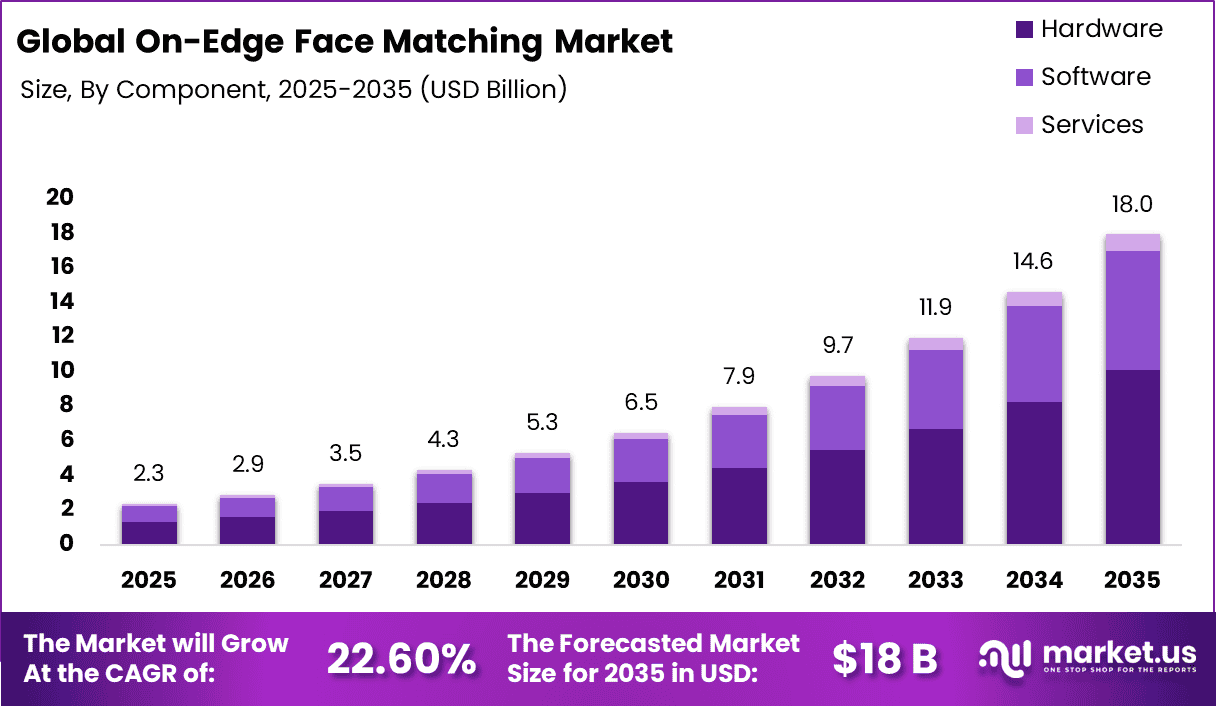
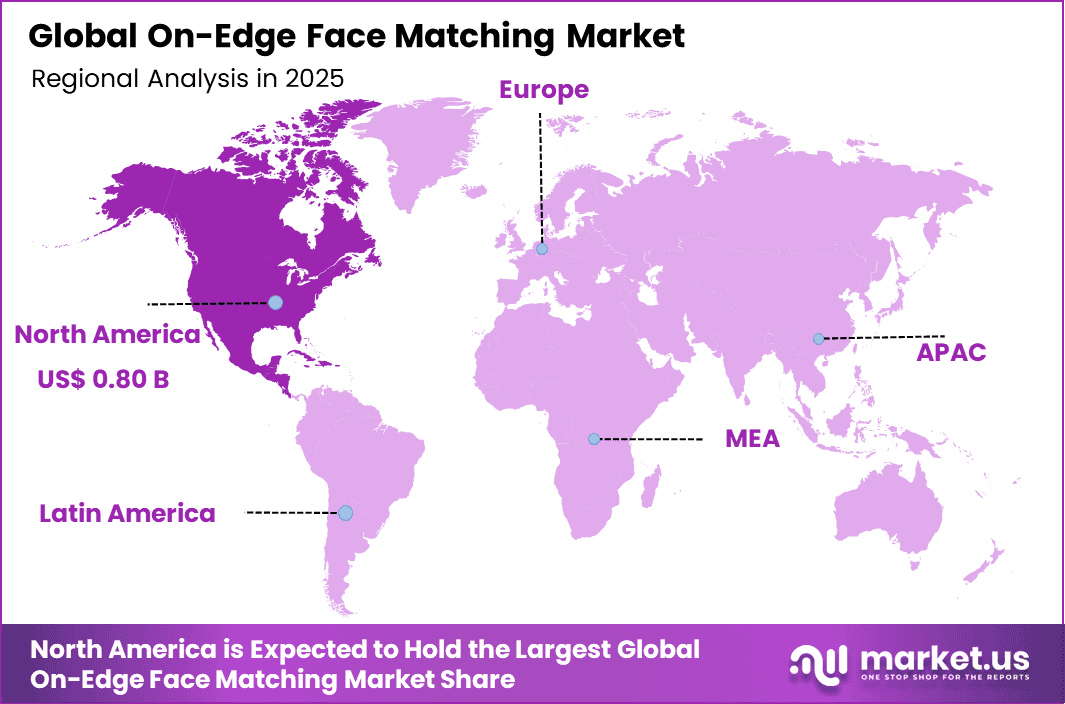
The Global On-Edge Face Matching Market generated USD 2.3 billion in 2025 and is predicted to register growth from USD 2.9 billion in 2026 to about USD 18.0 billion by 2035, recording a CAGR of 22.6% throughout the forecast span. In 2025, North America held a dominant market position, capturing more than a 34.3% share, with USD 0.8 billion in revenue.
One of the main factors driving this market is the growing need for secure and low-latency biometric authentication. Organizations increasingly prefer identity systems that can process face data locally, reduce exposure of sensitive personal information, and deliver faster user verification.
Another important driver is the wider use of edge AI hardware in cameras, smart devices, and access systems, which makes local face matching more practical across different security and authentication applications. On-Edge Face Matching market refers to facial verification systems that compare a person’s face directly on the device or at the edge, without sending all biometric data to a central server for processing.
Demand for On-Edge Face Matching is increasing across enterprise security, workplace access, consumer electronics, digital identity, and smart infrastructure. Buyers want face matching solutions that are fast, privacy-focused, and able to work reliably even in environments with limited network support. Demand is also rising because many organizations now prefer biometric systems that combine local processing, stronger security controls, and a smoother user experience in one solution.
Top Market Takeaways
- By Component, hardware dominates with a 56.2% share, delivering edge AI processors, optimized cameras, and low-latency inference engines for decentralized biometric processing.
- By Application, security & surveillance captures 37.4%, enabling instant watchlist matching, access control, and anomaly detection without cloud dependency.
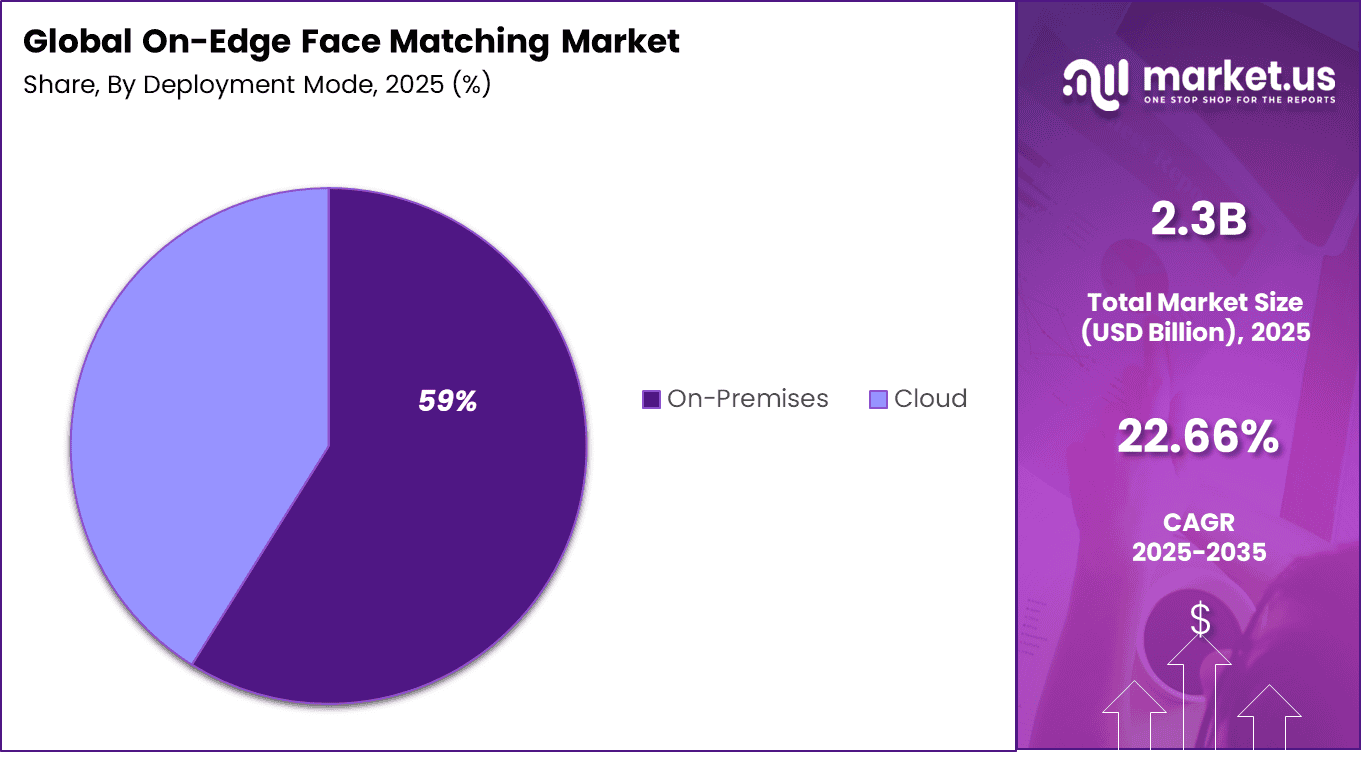
- By Deployment Mode, on-premises claims 58.9%, ensuring data sovereignty, sub-millisecond response times, and air-gapped compliance for sensitive environments.
- By End-User, BFSI holds 36.6%, powering branch authentication, ATM fraud prevention, and VIP identification through continuous edge-based face verification.
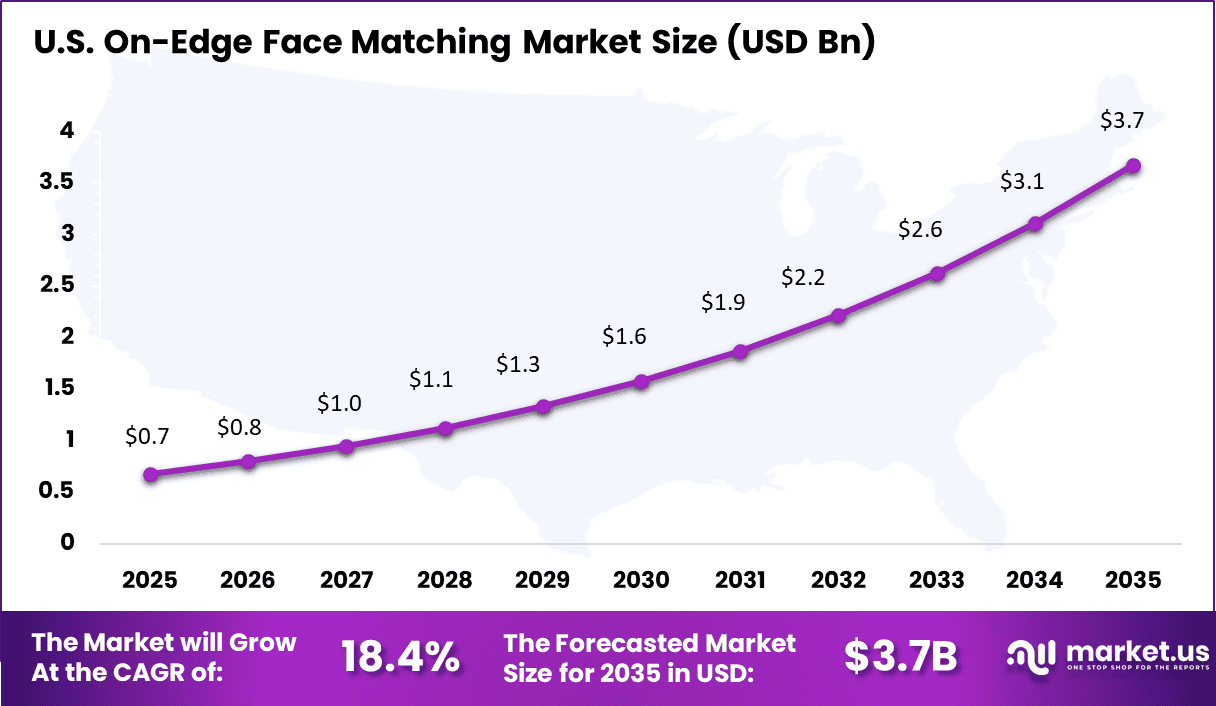
- North America accounts for 34.3% global share, with the U.S. market valued at USD 0.68 billion and a CAGR of 18.4%, driven by CCPA privacy mandates and financial sector biometric adoption.
By Component Analysis
Hardware accounted for 56.2% of the On Edge Face Matching Market. This segment leads because edge devices such as cameras, processors, and embedded systems are essential for running facial recognition directly at the source. These devices enable fast processing and reduce dependency on centralized systems.
The segment is also supported by the growing need for real-time identification in security environments. Hardware-based processing improves response speed and supports continuous monitoring, which strengthens its adoption across surveillance and access control applications.
By Application Analysis
Security and surveillance represented 37.4% of the market. This segment dominates because face matching technology is widely used to identify individuals, monitor restricted areas, and enhance overall security operations. It helps organizations detect unauthorized access and track activity across sensitive locations.
The segment continues to grow as security requirements increase across public and private spaces. Organizations rely on face matching systems to improve monitoring accuracy and strengthen protection measures, which keeps demand strong in this application area.
By Deployment Mode Analysis
On-premises deployment held 59% of the market. This segment leads because organizations prefer to process facial data within their own infrastructure to maintain control over sensitive biometric information. Keeping data locally supports privacy compliance and reduces exposure risks.
The segment is also driven by the need for reliable and low-latency performance. On-premises systems allow faster processing and consistent operation, which is important for real-time identification and decision-making in critical environments.
By End User Analysis
BFSI captured 36.6% of the market. This segment leads because financial institutions use face matching systems for identity verification, fraud prevention, and secure access to banking services. It helps strengthen authentication processes and protect customer accounts.
The segment is supported by increasing digital transactions and the need for secure verification methods. BFSI organizations invest in advanced biometric systems to improve customer trust and reduce fraud risks, which drives adoption of on-edge face matching solutions.
Key Market Segments
By Component
- Software
- Hardware
- Services
By Application
- Security & Surveillance
- Access Control
- Retail & E-commerce
- Healthcare
- Banking & Finance
- Transportation
- Others
By Deployment Mode
- On-Premises
- Cloud
By End-User
- Government
- BFSI
- Healthcare
- Retail
- Transportation
- Others
Regional Analysis
North America accounted for 34.3% of the On-Edge Face Matching Market, reflecting strong adoption of real-time biometric authentication across security, banking, and smart device applications. Organizations across the region increasingly deploy edge-based facial recognition systems that process data locally without relying on cloud infrastructure.
This approach improves response speed and enhances data privacy, which is important for sectors handling sensitive information. As demand rises for fast and secure identity verification, on-edge face matching solutions continue to gain traction across North America.
The U.S. generated about USD 0.68 Bn within the regional market and is projected to expand at a CAGR of 18.4%. Enterprises and public agencies across the country continue to integrate face matching technology into access control, surveillance, and digital identity systems. Edge-based processing allows faster authentication and reduces dependency on network connectivity.
As organizations focus on improving security, user convenience, and compliance with data protection requirements, demand for on-edge face matching solutions continues to grow rapidly across the US market.
Key Regions and Countries
- North America
- US
- Canada
- Europe
- Germany
- France
- The UK
- Spain
- Italy
- Russia
- Netherlands
- Rest of Europe
- Asia Pacific
- China
- Japan
- South Korea
- India
- Australia
- Singapore
- Thailand
- Vietnam
- Rest of APAC
- Latin America
- Brazil
- Mexico
- Rest of Latin America
- Middle East & Africa
- South Africa
- Saudi Arabia
- UAE
- Rest of MEA
Drivers Impact Analysis
| Key Driver | Impact on CAGR Forecast (~%) | Geographic Relevance | Impact Timeline | Strategic Effect |
|---|---|---|---|---|
| Rising demand for real-time biometric authentication at the edge | +4.1% | North America, Europe, Asia Pacific | Short to Mid Term (2025–2031) | Enables instant identity verification |
| Increasing adoption in security and surveillance systems | +3.8% | Global | Mid Term (2026–2032) | Improves threat detection and monitoring |
| Growth of smart devices and edge computing infrastructure | +3.5% | US, China, South Korea, Europe | Mid to Long Term (2026–2035) | Supports decentralized processing |
| Rising use in banking, travel, and access control applications | +3.2% | Global | Mid Term (2026–2032) | Enhances secure authentication |
| Need for low latency and offline biometric processing | +2.9% | Global | Mid to Long Term (2026–2035) | Reduces dependence on cloud systems |
Restraints Impact Analysis
| Key Restraint | Impact on CAGR Forecast (~%) | Geographic Relevance | Impact Timeline | Strategic Effect |
|---|---|---|---|---|
| Privacy concerns and regulatory restrictions | -2.6% | Europe, North America | Mid to Long Term (2026–2035) | Limits deployment in sensitive regions |
| High cost of edge AI hardware and devices | -2.3% | Global | Mid Term (2026–2032) | Slows adoption among smaller users |
| Accuracy challenges in diverse environmental conditions | -2.1% | Global | Mid Term (2026–2032) | Affects performance reliability |
| Integration complexity with legacy systems | -1.9% | North America, Europe | Mid Term (2026–2032) | Delays deployment |
| Lack of standardization in biometric systems | -1.7% | Global | Mid to Long Term (2026–2035) | Creates interoperability issues |
Investor Type Impact Analysis
| Investor Type | Growth Sensitivity | Risk Exposure | Geographic Focus | Investment Outlook |
|---|---|---|---|---|
| Venture Capital Firms | Very High | High | US, China, Israel | Strong biometric AI opportunity |
| Private Equity Firms | High | Medium | North America, Europe | Expansion in security technology |
| Strategic Technology Investors | Very High | Medium | US, Japan, South Korea | Strengthens edge AI ecosystem |
| Corporate Venture Arms | High | Medium | Global | Supports smart device integration |
| Government and Security Funds | Medium | Low to Medium | North America, Europe, Asia Pacific | Supports national security systems |
Technology Enablement Analysis
| Technology Enabler | Impact on CAGR Forecast (~%) | Geographic Relevance | Impact Timeline | Implementation Significance |
|---|---|---|---|---|
| Edge AI processors and neural processing units | +4.3% | Global | Short to Mid Term (2025–2031) | Enables on-device processing |
| Advanced facial recognition algorithms | +3.9% | Global | Mid Term (2026–2032) | Improves matching accuracy |
| Integration with IoT and smart surveillance systems | +3.5% | Global | Mid to Long Term (2026–2035) | Enhances system connectivity |
| Real-time video analytics and processing | +3.2% | North America, Europe, Asia Pacific | Mid Term (2026–2032) | Enables instant identification |
| Secure data encryption and privacy-preserving technologies | +2.9% | Global | Mid to Long Term (2026–2035) | Strengthens data protection |
Key Challenges
- Limited processing power is a major challenge because on-edge face matching systems must run quickly on local devices with restricted compute, memory, and power capacity.
- Accuracy can decline in real use because face matching performance is affected by poor image quality, low lighting, camera angles, and facial movement.
- Spoofing remains a serious issue because attackers may try to trick the system using photos, videos, masks, or other fake identity methods.
- Hardware dependency creates adoption barriers because reliable face matching often requires high-quality cameras, strong sensors, and compatible edge devices.
- Privacy and compliance are difficult to manage because facial data is sensitive, and many organizations must follow strict rules for storage, use, and user consent.
Emerging Trends
A key trend in the On-Edge Face Matching market is the increasing shift toward local processing of facial recognition data directly on devices such as cameras and access terminals. This approach reduces reliance on cloud systems and allows faster identity verification in real time.
Organizations are adopting edge-based solutions to improve privacy control and reduce data transfer risks. These systems analyze facial features instantly at the point of capture, which supports quicker decisions in security, access control, and authentication environments.
Growth Factors
The growing need for secure and efficient identity verification is supporting the expansion of on-edge face matching solutions. Businesses, public facilities, and transportation hubs require systems that can identify individuals quickly without delays. Edge-based matching helps reduce latency and improves system reliability in high-traffic environments.
At the same time, increasing concerns around data privacy encourage the use of local processing technologies, as they limit the exposure of sensitive biometric data while maintaining effective security operations.
Competitive Analysis
The competitive landscape of the On-Edge Face Matching market includes biometric technology companies, identity verification providers, and AI vision specialists that develop fast and secure facial recognition systems.
NEC Corporation, Thales Group, IDEMIA, Cognitec Systems, Ayonix Corporation, Herta Security, Aware, Inc., VisionLabs, Innovatrics, Tech5, BioID, and Veridas compete by offering edge-based face matching tools that support real-time identity checks with lower latency and stronger data control.
Other players such as FaceFirst, AnyVision (now Oosto), Trueface, SenseTime, Megvii (Face++), ZKTeco, Clearview AI, and Camvi Technologies strengthen competition by focusing on surveillance, processing speed, privacy controls, and the ability to run facial recognition directly on devices without heavy cloud dependence.
Top Key Players in the Market
- NEC Corporation
- Thales Group
- IDEMIA
- Cognitec Systems
- Ayonix Corporation
- Herta Security
- FaceFirst
- Aware, Inc.
- VisionLabs
- AnyVision (now Oosto)
- Trueface
- SenseTime
- Megvii (Face++)
- ZKTeco
- Innovatrics
- Tech5
- BioID
- Veridas
- Clearview AI
- Camvi Technologies
- Others
Future Outlook
The future outlook for the On-Edge Face Matching Market looks strong as more organizations want facial matching systems that work directly on devices for faster response, lower network use, and better privacy. IBM notes that edge AI reduces latency and keeps sensitive data on the device, while the European Data Protection Supervisor highlights that on-device AI is already being used for face recognition and is growing across more industries. As demand rises for real-time authentication, access control, and secure identity checks, this market is expected to expand steadily in the coming years.
Recent Developments
- In January 2026, NEC NeoFace Edge launched walk-through face/iris multimodal biometrics identifying from a 100M+ database at 6km/h speed using a single low-res camera up to 3m range with a foundation model learning tolerant to motion blur/glasses. PoC trials began across Japanese airports targeting 2027 production deployment. NIST #1 ranked accuracy maintained in real-world conditions.
- In February 2026, Thales RevealPlus driver licenses debuted in Oklahoma, featuring embedded facial templates for edge verification at DMV checkpoints nationwide. Digital ID wallet infrastructure enhanced on-device matching with FIDO2 standards across 10+ US states.
Report Scope
| Report Features | Description |
|---|---|
| Market Value (2025) | USD 2.3 Billion |
| Forecast Revenue (2035) | USD 18.0 Billion |
| CAGR(2025-2035) | 22.6% |
| Base Year for Estimation | 2024 |
| Historic Period | 2020-2024 |
| Forecast Period | 2025-2035 |
| Report Coverage | Revenue forecast, AI impact on Market trends, Share Insights, Company ranking, competitive landscape, Recent Developments, Market Dynamics and Emerging Trends |
| Segments Covered | By Component (Software, Hardware, Services), By Application (Security & Surveillance, Access Control, Retail & E-commerce, Healthcare, Banking & Finance, Transportation, Others), By Deployment Mode (On-Premises, Cloud), By End-User (Government, BFSI, Healthcare, Retail, Transportation, Others) |
| Regional Analysis | North America – US, Canada; Europe – Germany, France, The UK, Spain, Italy, Russia, Netherlands, Rest of Europe; Asia Pacific – China, Japan, South Korea, India, New Zealand, Singapore, Thailand, Vietnam, Rest of Latin America; Latin America – Brazil, Mexico, Rest of Latin America; Middle East & Africa – South Africa, Saudi Arabia, UAE, Rest of MEA |
| Competitive Landscape | NEC Corporation, Thales Group, IDEMIA, Cognitec Systems, Ayonix Corporation, Herta Security, FaceFirst, Aware, Inc., VisionLabs, AnyVision (now Oosto), Trueface, SenseTime, Megvii (Face++), ZKTeco, Innovatrics, Tech5, BioID, Veridas, Clearview AI, Camvi Technologies, Others |
| Customization Scope | Customization for segments, region/country-level will be provided. Moreover, additional customization can be done based on the requirements. |
| Purchase Options | We have three licenses to opt for: Single User License, Multi-User License (Up to 5 Users), Corporate Use License (Unlimited Users and Printable PDF) |