Report Overview
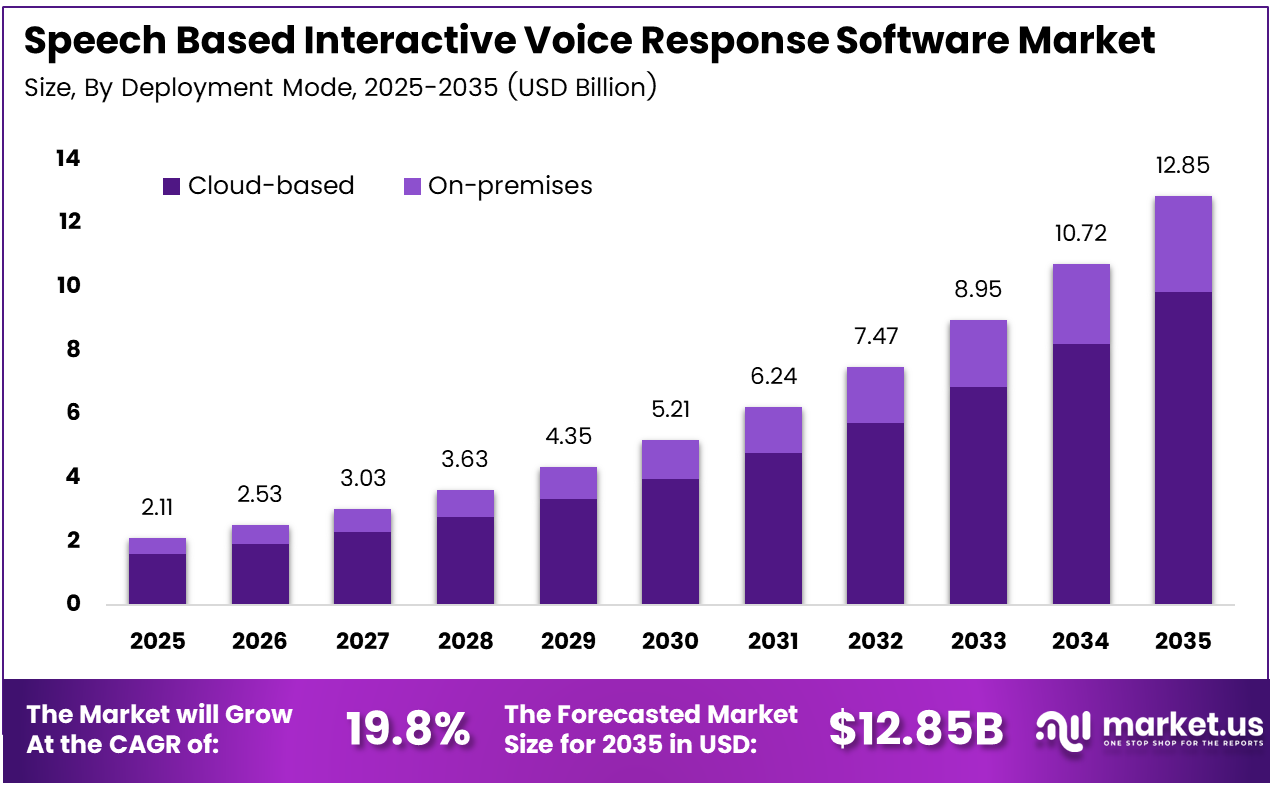
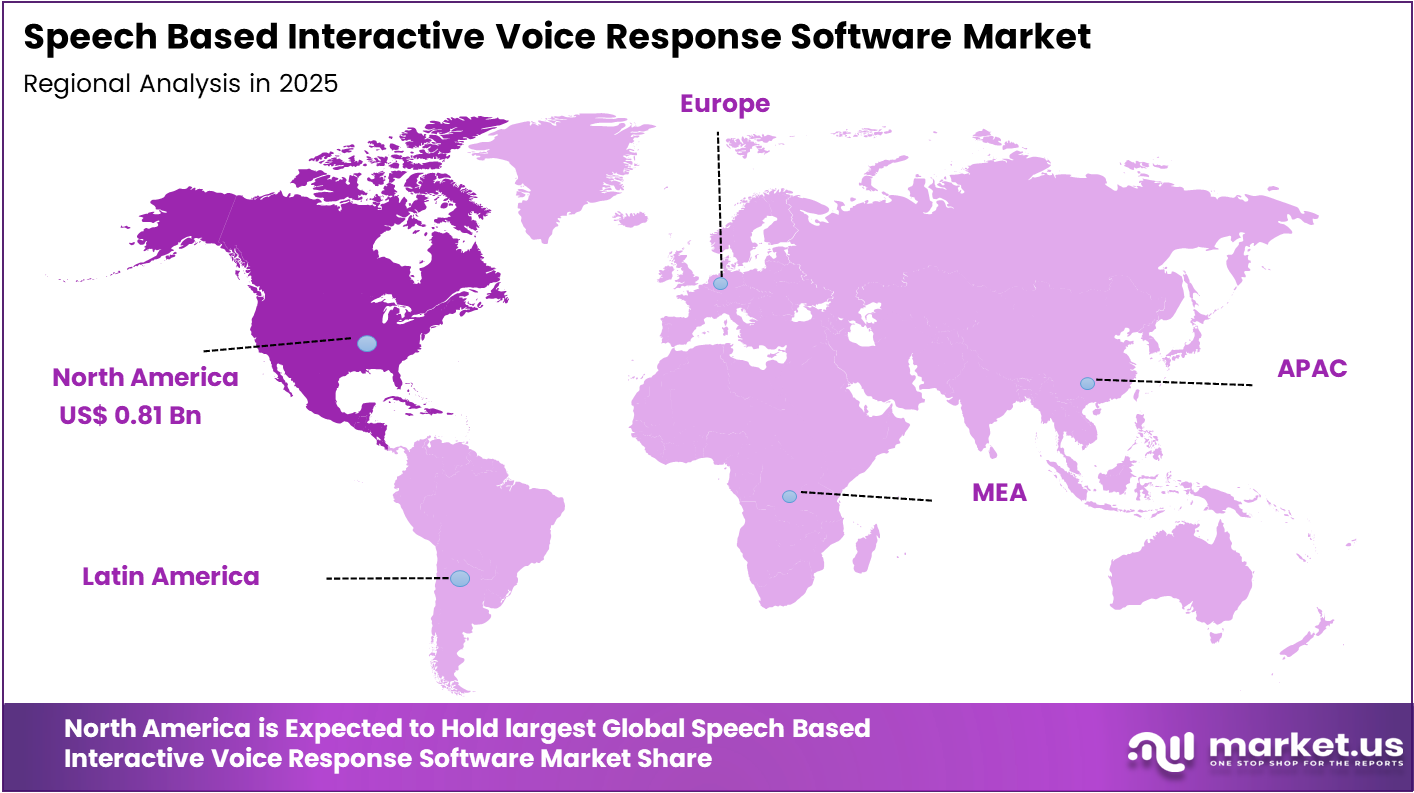
The Global Speech Based Interactive Voice Response Software Market size is expected to be worth around USD 12.85 billion by 2035, from USD 2.11 billion in 2025, growing at a CAGR of 19.8% during the forecast period from 2025 to 2035. North America held a dominant market position, capturing more than a 38.4% share, holding USD 0.81 billion in revenue.
Speech-based interactive voice response software refers to a system that allows users to interact with automated voice platforms using natural speech instead of keypad inputs. It uses speech recognition and language processing to understand queries, provide responses, and route calls. This technology helps organizations manage high call volumes while improving accessibility, efficiency, and overall customer interaction quality.
The growth of IVR systems is driven by pressure to reduce support cost per call, which can decline by 20 to 30% when self-service improves. Businesses also need to manage call spikes during billing cycles, outages, or campaigns. Adoption rises as conversational IVR systems resolve over 50% of routine queries.
The market for Speech-Based Interactive Voice Response Software is driven by the growing need to improve customer service efficiency while managing rising call volumes. Businesses are adopting voice-based systems to automate routine queries, reduce waiting time, and ensure continuous support. Increasing use of cloud platforms and better speech recognition capabilities are also encouraging wider adoption across multiple service-focused industries.
Demand is increasing across banking, telecom, healthcare, travel, and public services due to high call volumes. In many contact centers, speech IVR handles the first interaction for more than 60% of inbound calls. This allows organizations to streamline operations by directing only complex issues to human agents efficiently.
For instance, in December 2025, Cisco Systems continued to appear in core IVR market coverage as a primary vendor, leveraging its Webex Contact Center portfolio to add smarter self-service, speech recognition, and analytics on top of its established voice infrastructure. Cisco’s pitch increasingly centers on an end-to-end network plus CX stack for large enterprises.
Key Takeaway
- In 2025, the Cloud-based segment held a dominant market position, capturing a 76.5% share of the Global Speech Based Interactive Voice Response Software Market.
- In 2025, the Large Enterprises segment held a dominant market position, capturing a 68.9% share of the Global Speech-Based Interactive Voice Response Software Market.
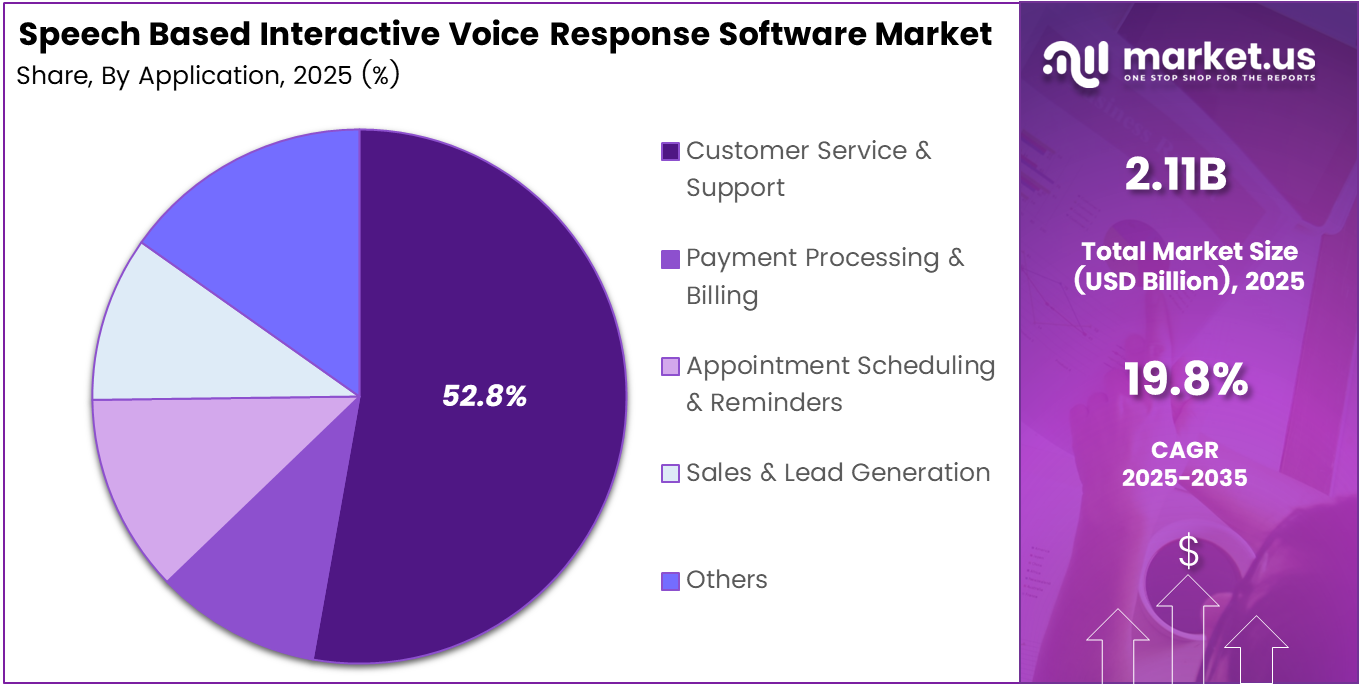
- In 2025, the Customer Service & Support segment held a dominant market position, capturing a 52.8% share of the Global Speech-Based Interactive Voice Response Software Market.
- In 2025, the BFSI segment held a dominant market position, capturing a 34.7% share of the Global Speech-Based Interactive Voice Response Software Market.
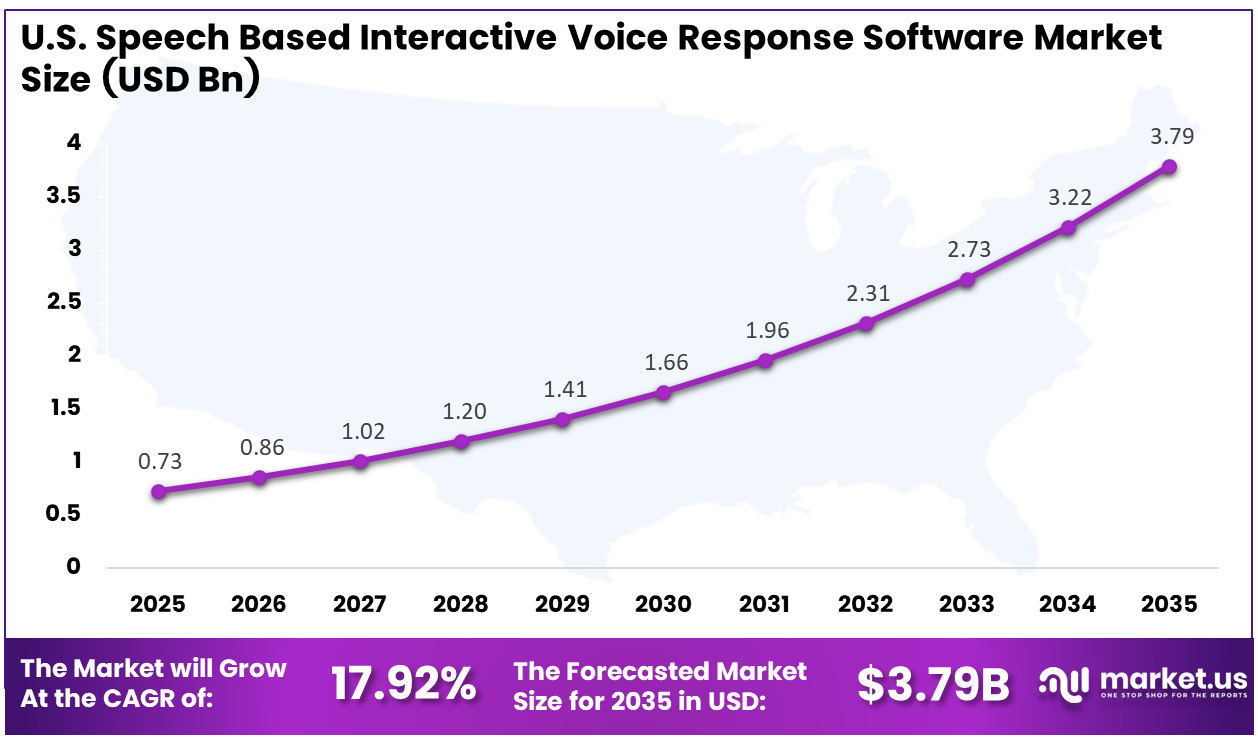
- The U.S. Speech-Based Interactive Voice Response Software Market was valued at USD 0.73 Billion in 2025, with a robust CAGR of 17.92%.
- In 2025, North America held a dominant market position in the Global Speech-Based Interactive Voice Response Software Market, capturing more than a 38.4% share.
Role of Generative AI
Generative AI is becoming central to modern IVR systems, transforming how customer interactions are handled. Contact centers adopting conversational AI report call containment improvements of 20 to 30%, as more queries are resolved automatically. This reduces dependency on agents and improves efficiency in handling high call volumes.
The quality of interactions is also improving with AI-driven voice systems. Over 60% of enterprises experimenting with generative AI report better first call resolution and improved sentiment scores. AI-led voice flows provide more natural conversations compared to traditional keypad systems, enhancing overall customer experience and satisfaction.
Investment and Business Benefits
Investment is expanding in domain-specific voice bots and industry-tuned language models that improve response accuracy. Integration platforms connecting IVR with CRM, payments, and ticketing systems are gaining attention. Regional language solutions, especially in India, present strong potential as many dialects remain underserved despite rising digital adoption.
IVR systems provide value beyond cost reduction by generating structured call data such as intent, journey stage, and outcomes. This data supports better product development and targeted marketing strategies. Organizations linking IVR analytics with CRM systems often achieve 10% or more improvement in cross-sell and upsell conversion over time.
Regional Analysis
In 2025, North America held a dominant market position in the Global Speech-Based Interactive Voice Response Software Market, capturing more than a 38.4% share, holding USD 0.81 billion in revenue. This dominance is due to its advanced contact center infrastructure, strong enterprise technology spending, and early adoption of AI-driven customer service tools. The region also has high demand from banking, healthcare, telecom, and retail sectors, where large call volumes require efficient automation. Strong cloud adoption and continued focus on customer experience improvement are also supporting market leadership.
For instance, in February 2025, Avaya continued expanding its OneCloud CCaaS and Experience Platform offerings in North America, embedding speech recognition, conversational IVR, and AI routing into existing contact center estates. By targeting large U.S. enterprises modernizing from TDM to cloud and hybrid deployments, Avaya helps sustain regional dominance in speech-driven voice response solutions.
U.S. Speech-Based Interactive Voice Response Software Market Size
The market for Speech-Based Interactive Voice Response Software within the U.S. is growing tremendously and is currently valued at USD 0.73 billion; the market has a projected CAGR of 17.92%. The market is growing due to rising pressure on businesses to improve customer service while controlling contact center costs. Strong demand for automated call handling in banking, healthcare, telecom, retail, and public services is supporting adoption. Growth is also being driven by wider use of cloud platforms, better speech recognition accuracy, and increasing interest in AI-based voice systems that can manage routine customer queries efficiently.
For instance, in March 2026, Nuance, now part of Microsoft, continued rolling out cloud-based speech and IVR capabilities through Azure AI and Dynamics 365 Contact Center, accelerating the migration away from legacy on-premise IVR in North America. This shift reinforces U.S. leadership in cloud-native, speech-driven customer engagement platforms across banking, healthcare, and telecom sectors.
Key Regions and Countries
North America
- US
- Canada
Europe
- Germany
- France
- The UK
- Spain
- Italy
- Russia
- Netherlands
- Rest of Europe
Asia Pacific
- China
- Japan
- South Korea
- India
- Australia
- Singapore
- Thailand
- Vietnam
- Rest of APAC
Latin America
- Brazil
- Mexico
- Rest of Latin America
Middle East & Africa
- South Africa
- Saudi Arabia
- UAE
- Rest of MEA
Deployment Mode Analysis
In 2025, the Cloud-based segment held a dominant market position, capturing a 76.5% share of the Global Speech Based Interactive Voice Response Software Market. This dominance is due to the growing need for flexible and scalable communication systems that can adapt to changing customer demand. Cloud deployment allows businesses to manage IVR operations centrally, reduce infrastructure burden, and roll out updates quickly without operational disruption across multiple service locations.
Organizations are also shifting toward cloud environments to support integration with advanced technologies such as AI and analytics. This setup improves system performance and enables faster innovation. It also allows businesses to handle peak call volumes efficiently while maintaining consistent service quality across different regions and customer touchpoints.
For instance, in April 2026, Amazon Web Services widened its focus on IVR modernization through new Amazon Connect guidance and tools that simplify migration from legacy systems. By making it easier to move complex call flows into a managed cloud service, AWS is helping more firms replace old IVR stacks with cloud native speech solutions.
Organization Size Analysis
In 2025, the Large Enterprises segment held a dominant market position, capturing a 68.9% share of the Global Speech-Based Interactive Voice Response Software Market. This dominance is due to the extensive customer base and complex service structures managed by large enterprises. These organizations require advanced IVR systems to handle large call volumes, ensure consistent communication, and maintain service quality across multiple departments and geographical locations in a structured and reliable manner.
Large enterprises also invest more in automation and digital transformation to improve efficiency and reduce operational costs. Speech-based IVR helps streamline processes, improve response accuracy, and support multiple languages. This enables large organizations to deliver better customer experiences while maintaining control over high-volume service environments.
For instance, in February 2026, Five9 positioned AI-powered customer experience as a core strategy, stressing how big enterprises are using its platform to automate more front-line interactions. As large customers shift from pilot projects to broad deployments, speech IVR becomes a central layer in their automation plans, driving segment growth.
Application Analysis
In 2025, the Customer Service & Support segment held a dominant market position, capturing a 52.8% share of the Global Speech-Based Interactive Voice Response Software Market. This dominance is due to the increasing reliance on IVR systems as the first point of contact for customer interactions. Businesses use these systems to manage inquiries, provide information, and route calls effectively, which helps reduce waiting times and improve the overall efficiency of customer service operations.
Customer service teams benefit from automation as it allows agents to focus on complex issues rather than routine queries. Speech-based IVR enhances interaction quality by understanding customer intent more accurately. This leads to improved satisfaction, faster resolution, and better handling of large volumes of incoming service requests.
For instance, in July 2024, Twilio introduced a private beta for Personalized IVR, designed to build conversational, data-driven self-service flows in hours rather than weeks. The focus on tailoring each call using real-time customer data reflects growing demand to use speech IVR as the first line of customer service and support.
End-User Industry Analysis
In 2025, the BFSI segment held a dominant market position, capturing a 34.7% share of the Global Speech-Based Interactive Voice Response Software Market. This dominance is due to the high volume of customer interactions in banking and financial services, where quick and secure communication is essential. IVR systems help manage account inquiries, transaction support, and service requests efficiently while maintaining accuracy and confidentiality in customer communication processes.
Financial institutions also prioritize reliability and security in customer interactions. Speech-based IVR supports authentication and continuous service availability, which improves trust and convenience. This allows banks and financial service providers to deliver consistent support while managing operational efficiency and meeting strict service expectations.
For instance, in March 2026, Avaya announced its Nexus mission-critical voice platform aimed at tightly regulated sectors, including financial services. The emphasis on secure, always available voice infrastructure aligns with how BFSI firms rely on speech IVR for fraud alerts, servicing, and transaction support, encouraging further investment.
Key Market Segments
By Deployment Mode
- Cloud-based
- On-premises
By Organization Size
- Large Enterprises
- Small and Medium-sized Enterprises (SMEs)
By Application
- Customer Service & Support
- Payment Processing & Billing
- Appointment Scheduling & Reminders
- Sales & Lead Generation
- Others
By End-User Industry
- Banking, Financial Services, and Insurance (BFSI)
- Telecommunications
- Healthcare
- Retail & E-commerce
- Travel & Hospitality
- Others
Emerging Trends
A major trend is the shift toward cloud-based IVR systems, where routing logic and speech models are managed centrally. Cloud deployments now account for well over 50% of new IVR projects, as organizations seek flexibility, faster updates, and the ability to scale operations without relying on physical infrastructure upgrades.
Another trend is the integration of speech recognition with analytics, biometrics, and sentiment tracking. Enterprise adoption in voice technologies is expanding at growth rates above 20% annually. Increasingly, organizations are using voice biometrics for authentication, replacing traditional PIN-based systems to improve security and user convenience.
Growth Factors
Self-service adoption is a key factor supporting IVR market expansion. In industries such as banking, telecom, and healthcare, around 40% to 60% of routine calls can be automated using well-designed speech IVR systems. This shift encourages businesses to replace older DTMF-based systems with more advanced solutions.
Another important factor is the growing accessibility of AI-driven IVR solutions for mid-sized and smaller organizations. With more than 70% of recent innovations focused on AI, natural language processing, and speech analytics, advanced capabilities such as multilingual support and predictive routing are now available beyond large enterprises.
Market Dynamics
Drivers - Shift Toward Automated, Always-Available Customer Service
Businesses are moving toward always available customer service to meet rising expectations for faster response and uninterrupted support. Speech-based IVR helps answer routine questions at any time of day, reducing dependency on agent availability. This makes service operations more stable and responsive across different customer touchpoints and demand periods.
The shift is also supported by the need to improve service efficiency without expanding support teams at the same pace. Automated voice systems help manage repetitive interactions, shorten wait times, and guide callers more smoothly. As customer contact volumes increase, this approach is becoming more practical for many organizations.
For instance, in May 2024, Genesys expanded AI automation and virtual agent features in its cloud platform to help enterprises handle more customer interactions without human agents. The update focused on using conversational intelligence to keep voice self-service available at all times, so callers can resolve routine issues faster while live agents focus on more complex conversations.
Restraint - Speech Accuracy Limits
Speech accuracy remains a restraint because voice systems do not always understand callers correctly in real conditions. Background noise, unclear pronunciation, fast speech, and mixed language use can affect how well the system captures intent. When this happens, the interaction may feel slow, repetitive, and less dependable for users.
This issue becomes more serious when the caller needs urgent help or is trying to explain a specific problem. A poor response from the system can lower satisfaction and create hesitation toward automated support. Because of this, some organizations still rely on human agents for situations requiring better listening and judgment.
For instance, in March 2026, Verint promoted its speech analytics solution as offering high transcription accuracy across large call volumes and many languages. The need for specialized analytics technology to reach high comprehension levels underlines how standard recognition tools can struggle with real-world accents, noise, and complex phrases, which remains a limiting factor for some IVR scenarios.
Opportunities - Multilingual Voice Support
Multilingual voice support creates a strong opportunity because many users are more comfortable speaking in their preferred language. Speech-based IVR can improve accessibility by helping businesses serve diverse customer groups more simply and naturally. This is especially valuable in markets with varied languages and regional speaking patterns.
The opportunity also extends to sectors that serve broad populations, such as healthcare, banking, travel, and public services. When customers can interact in familiar languages, service becomes easier to understand and more inclusive. This helps organizations reach more users while improving trust, comfort, and the overall service experience.
For instance, in May 2025, Nuance’s work on advanced voice biometrics for IVR payment flows, combined with its heritage in speech recognition across languages, positions the company to support secure multilingual caller authentication. As enterprises extend services into new regions, this capability can be used to maintain consistent identity checks in several languages while keeping voice menus accessible for diverse customer bases.
Challenges - Integration Complexity
Integration complexity is a major challenge because speech-based IVR works best when connected with existing business systems. These may include customer records, payment platforms, ticketing tools, and service databases. Linking everything smoothly can take time and careful planning, especially when older systems are already deeply embedded in operations.
The challenge also affects performance and consistency. If the IVR system is not connected properly, customers may receive incomplete responses or face delays during call transfers and service requests. Businesses must therefore manage both technical coordination and process alignment to ensure the system delivers a reliable and seamless experience.
For instance, in March 2026, AWS guidance on using Amazon Connect to modernize IVR highlights migration paths and tools to connect existing on-premises systems with cloud-based self-service. The emphasis on scalable migration and integration approaches reflects how difficult it can be for enterprises to shift from fragmented legacy IVR stacks to unified, AI-enabled platforms.
Key Players Analysis
One of the leading players in February 2026, Vonage, now part of Ericsson, continued to be benchmarked in IVR service-provider reports for its API-centric approach, letting businesses stitch programmable voice menus and speech bots directly into mobile apps and web experiences. This positions Vonage well with developers who want fine-grained control rather than monolithic contact-center stacks.
Top Key Players in the Market
- Nuance Communications, Inc.
- Genesys Telecommunications Laboratories, Inc.
- Avaya, Inc.
- Cisco Systems, Inc.
- Five9, Inc.
- Verint Systems, Inc.
- NICE, Ltd.
- Vonage Holdings Corp.
- 8×8, Inc.
- Twilio, Inc.
- Amazon Web Services, Inc.
- Google LLC
- Artificial Solutions, Inc.
- Omilia Natural Language Solutions, Ltd.
- Uniphore Software Systems Pvt. Ltd.
- Others
Recent Developments
- In April 2026, Genesys strengthened its position as an enterprise IVR and conversational AI leader, with analyst and buyer guides consistently ranking it among the top cloud IVR providers for AI-driven routing, speech input, and omnichannel orchestration. Its platform is now a default short-list option for large North American contact centers modernizing legacy IVR.
- In December 2025, Avaya remained a key name in global IVR system competitive landscapes, featuring in multi-vendor market assessments alongside Genesys, Cisco, 8×8, and Five9. Despite its restructuring journey, Avaya’s speech-enabled experience platform keeps it relevant for enterprises that still prefer hybrid deployments and tight PBX integration.
Report Scope
| Report Features | Description |
|---|---|
| Market Value (2025) | USD 2.11 Billion |
| Forecast Revenue (2035) | USD 12.85 Billion |
| CAGR (2026-2035) | 19.8% |
| Base Year for Estimation | 2025 |
| Historic Period | 2020-2024 |
| Forecast Period | 2026-2035 |
| Report Coverage | Revenue Forecast, Market Dynamics, Competitive Landscape, Recent Developments |
| Segments Covered | By Deployment Mode (Cloud-based, On-premises), By Organization Size (Large Enterprises, Small and Medium-sized Enterprises (SMEs)), By Application (Customer Service & Support, Payment Processing & Billing, Appointment Scheduling & Reminders, Sales & Lead Generation, Others), By End-User Industry (Banking, Financial Services, and Insurance (BFSI), Telecommunications, Healthcare, Retail & E-commerce, Travel & Hospitality, Others) |
| Regional Analysis | North America (US and Canada), Europe (Germany, France, The UK, Spain, Italy, and Rest of Europe), Asia Pacific (China, Japan, South Korea, India, Australia, and Rest of APAC), Latin America (Brazil, Mexico, and Rest of Latin America), Middle East & Africa (GCC, South Africa, and Rest of MEA) |
| Competitive Landscape | Nuance Communications, Inc., Genesys Telecommunications Laboratories, Inc., Avaya, Inc., Cisco Systems, Inc., Five9, Inc., Verint Systems, Inc., NICE, Ltd., Vonage Holdings Corp., 8×8, Inc., Twilio, Inc., Amazon Web Services, Inc., Google LLC, Artificial Solutions, Inc., Omilia Natural Language Solutions, Ltd., Uniphore Software Systems Pvt. Ltd., Others |
| Customization Scope | Customization at the segment and region/country levels will be provided. Moreover, customization can be tailored to the requirements. |
| Purchase Options | We have three licenses to opt for: Single User License, Multi-User License (Up to 5 Users), Corporate Use License (Unlimited Users and Printable PDF) |