Report Overview
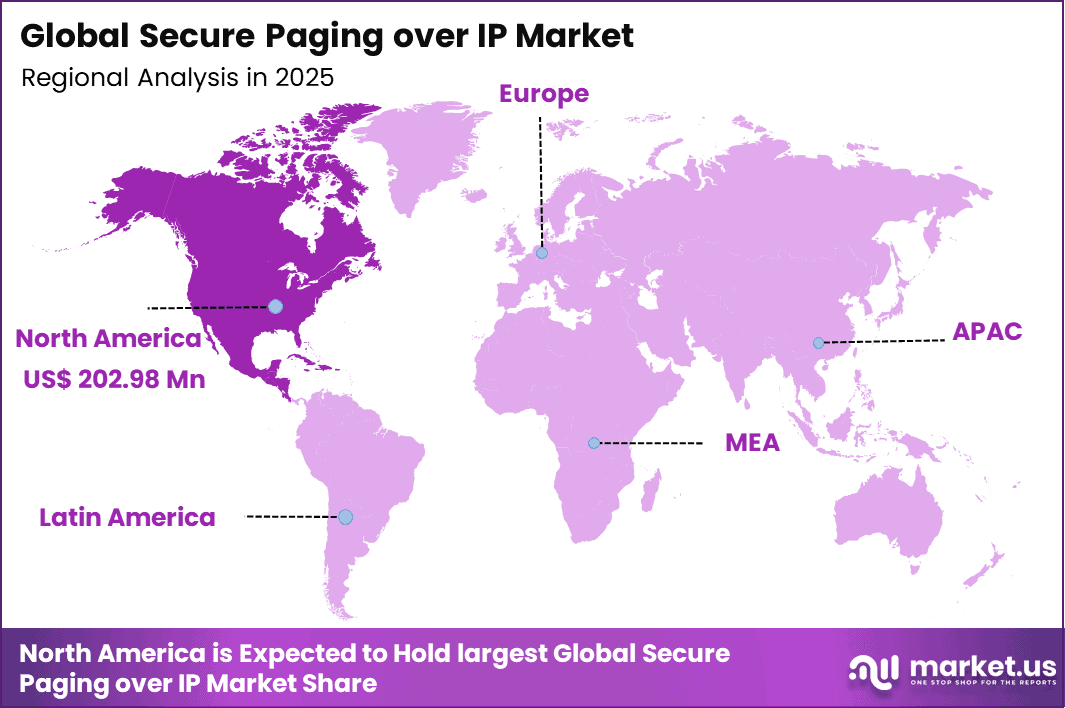
The Global Secure Paging over IP Market generated USD 512.6 million in 2025 and is predicted to register growth from USD 636.6 million in 2026 to about USD 4,477.1 million by 2035, recording a CAGR of 24.2% throughout the forecast span. In 2025, North America held a dominant market position, capturing more than a 39.6% share, with USD 202.98 million in revenue.
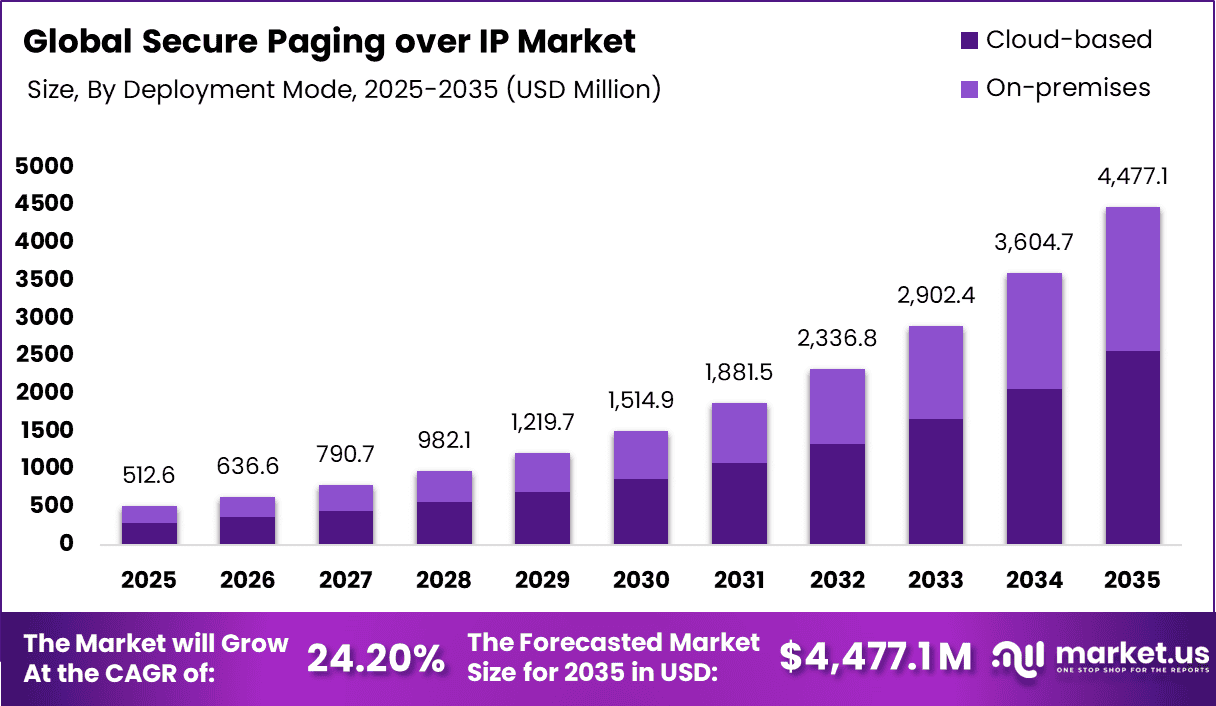
Secure Paging over IP market refers to network-based paging and alert systems that send voice announcements, emergency messages, and routine notifications through IP and VoIP infrastructure instead of traditional analog systems. These solutions are used in hospitals, schools, factories, transport facilities, offices, and large campuses where fast and reliable communication is important.
One of the main factors driving this market is the shift from legacy paging systems to IP-based communication environments. Organizations want systems that can support emergency alerts, routine announcements, and secure internal communication through a centralized platform. Another important factor is the growing need for better control across multiple buildings and operational zones, especially in large facilities where clear and timely communication is critical.
Demand for secure paging over IP solutions is increasing in sectors where immediate communication supports safety, coordination, and daily operations. Hospitals use these systems for staff alerts and emergency communication, while schools, industrial sites, and transport locations rely on them for announcements and rapid response. Demand is also rising because buyers now prefer communication systems that fit into broader security, monitoring, and facility management networks.
Top Market Takeaways
- By Deployment Mode, cloud-based dominates with a 57.3% share, enabling scalable encrypted alerts, multi-device reception, and seamless integration with nurse call systems.
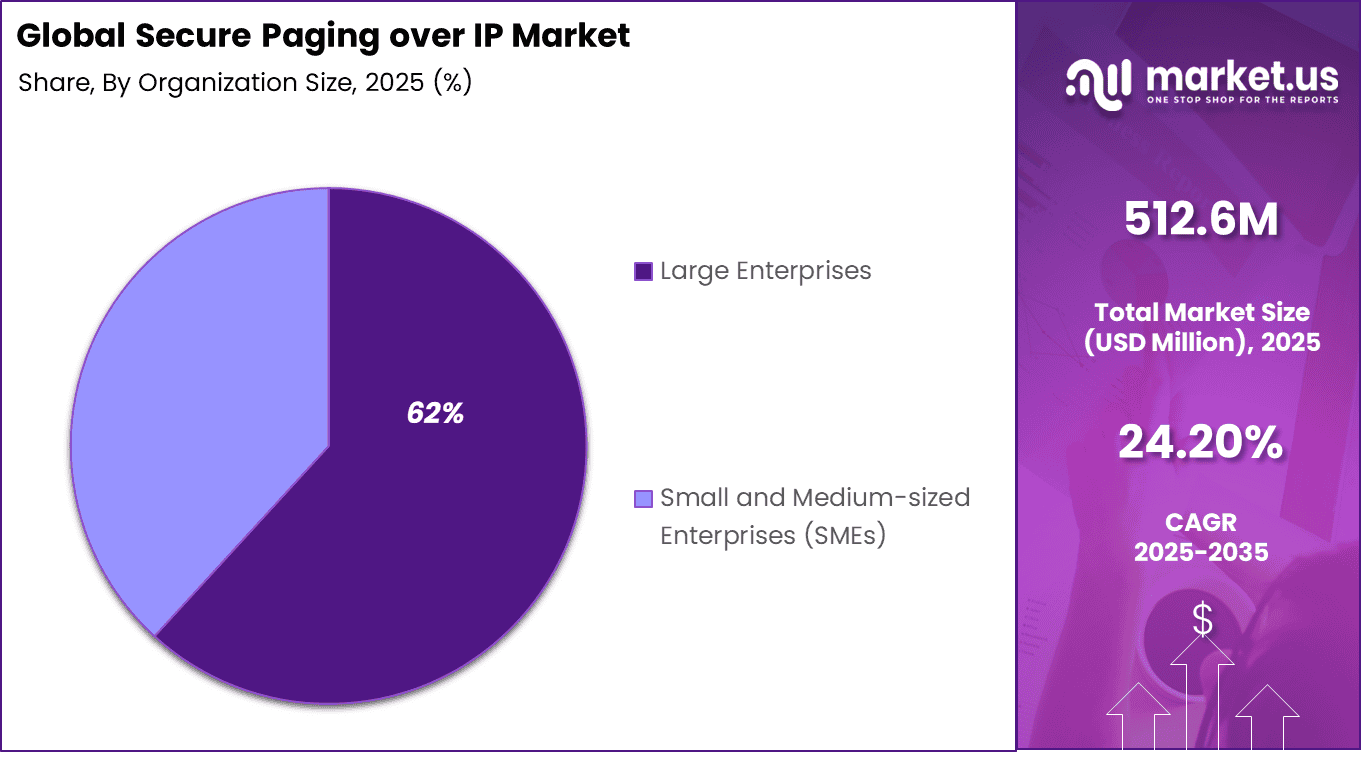
- By Organization Size, large enterprises capture 61.8%, orchestrating campus-wide paging with role-based escalation and audit trails across distributed facilities.
- By Application, healthcare & hospitals claim 45.2%, powering STAT orders, code blue notifications, and patient flow coordination with guaranteed delivery.
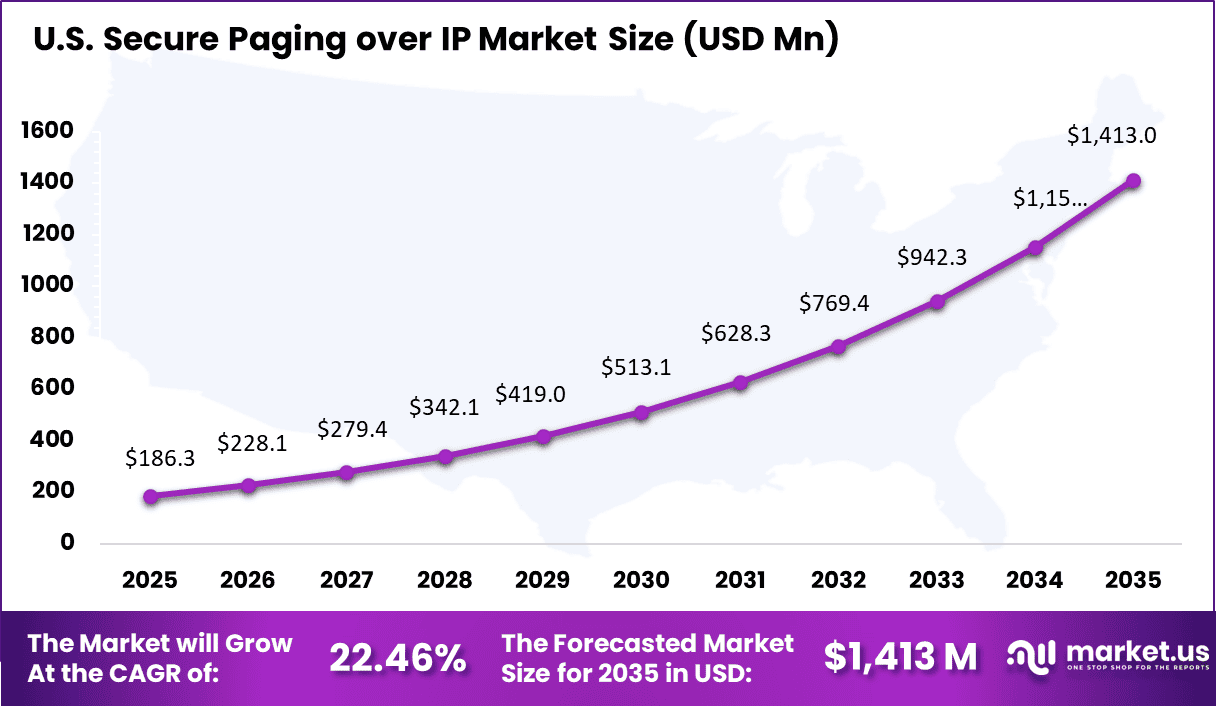
- North America accounts for 39.6% global share, with the U.S. market valued at USD 186.3 million and a CAGR of 22.46%, driven by Joint Commission standards and IoT medical device integration.
By Deployment Mode Analysis
Cloud-based deployment accounted for 57.3% of the Secure Paging over IP Market. This segment leads because organizations prefer flexible communication systems that can be accessed across multiple locations without heavy infrastructure setup. Cloud-based paging allows real-time message delivery, centralized control, and easier system management.
The segment is also supported by the growing need for scalable and remote communication solutions. As workplaces become more distributed, cloud platforms enable seamless integration with existing communication tools, which improves operational efficiency and supports faster adoption.
By Organization Size Analysis
Large enterprises held 62% of the market. This segment dominates because large organizations require reliable and instant communication systems to manage operations across multiple departments and locations. Secure paging solutions help them coordinate teams, deliver urgent alerts, and maintain smooth internal communication.
The segment is further driven by the complexity of enterprise environments. With larger workforces and critical operations, these organizations prioritize systems that ensure message security, fast delivery, and consistent performance, which keeps demand strong among large enterprises.
By Application Analysis
Healthcare and hospitals accounted for 45.2% of the market. This segment leads because medical environments require immediate and secure communication between staff for patient care, emergency response, and daily coordination. Paging systems remain a critical tool for delivering time-sensitive information.
The segment is also supported by the need for reliable communication in high-pressure situations. Hospitals rely on secure paging over IP to ensure that alerts reach the right personnel without delay, which improves response time and enhances overall patient management.
Key Market Segments
By Deployment Mode
- On-premises
- Cloud-based
By Organization Size
- Large Enterprises
- Small and Medium-sized Enterprises (SMEs)
By Application
- Healthcare & Hospitals
- Manufacturing & Industrial Facilities
- Education (Schools, Campuses)
- Hospitality & Retail
- Transportation & Logistics
- Others
Regional Analysis
North America accounted for 39.6% of the Secure Paging over IP Market, reflecting strong adoption of advanced communication systems across healthcare, emergency services, and enterprise environments. Organizations across the region increasingly replace traditional paging systems with secure IP-based solutions that offer encrypted messaging, real-time alerts, and integration with digital networks.
Hospitals, public safety agencies, and large facilities continue to prioritize reliable and secure communication channels to support critical operations, which strengthens demand for secure paging over IP solutions.
The U.S. generated about USD 186.3 Mn within the regional market and is projected to expand at a CAGR of 22.46%. Institutions across the country continue to upgrade legacy communication infrastructure to support faster, more secure, and scalable messaging systems.
Secure paging over IP platforms help ensure immediate delivery of alerts while maintaining data privacy and compliance requirements. As organizations focus on improving coordination during critical situations and reducing communication delays, demand for secure and connected paging systems continues to grow rapidly across the US market.
Key Regions and Countries
- North America
- US
- Canada
- Europe
- Germany
- France
- The UK
- Spain
- Italy
- Russia
- Netherlands
- Rest of Europe
- Asia Pacific
- China
- Japan
- South Korea
- India
- Australia
- Singapore
- Thailand
- Vietnam
- Rest of APAC
- Latin America
- Brazil
- Mexico
- Rest of Latin America
- Middle East & Africa
- South Africa
- Saudi Arabia
- UAE
- Rest of MEA
Investor Type Impact Analysis
| Investor Type | Growth Sensitivity | Risk Exposure | Geographic Focus | Investment Outlook |
|---|---|---|---|---|
| Venture Capital Firms | High | Medium | US, Europe | Growth in communication tech startups |
| Private Equity Firms | High | Medium | North America, Europe | Expansion of enterprise communication platforms |
| Strategic Technology Investors | Very High | Medium | US, Japan, South Korea | Strengthens IP communication ecosystem |
| Corporate Venture Arms | High | Medium | Global | Supports integration with enterprise systems |
| Government and Public Safety Funds | Medium | Low | North America, Europe, Asia Pacific | Supports emergency communication infrastructure |
Technology Enablement Analysis
| Technology Enabler | Impact on CAGR Forecast (~%) | Geographic Relevance | Impact Timeline | Implementation Significance |
|---|---|---|---|---|
| IP-based communication protocols and VoIP systems | +4.2% | Global | Short to Mid Term (2025–2031) | Enables scalable communication |
| Cloud-based paging and alert platforms | +3.8% | Global | Short to Mid Term (2025–2030) | Supports remote access and control |
| Encryption and secure communication technologies | +3.5% | North America, Europe | Mid to Long Term (2026–2035) | Enhances data protection |
| Integration with IoT and emergency alert systems | +3.2% | Global | Mid Term (2026–2032) | Improves automated alerts |
| Mobile device integration for paging systems | +2.9% | Global | Short to Mid Term (2025–2030) | Increases accessibility and responsiveness |
Drivers Impact Analysis
| Key Driver | Impact on CAGR Forecast (~%) | Geographic Relevance | Impact Timeline | Strategic Effect |
|---|---|---|---|---|
| Increasing need for real-time communication in critical environments | +4.1% | North America, Europe, Asia Pacific | Short to Mid Term (2025–2031) | Enhances emergency response coordination |
| Growing adoption in healthcare and hospital communication systems | +3.8% | US, Europe, Japan | Mid Term (2026–2032) | Improves patient and staff communication |
| Expansion of IP-based communication infrastructure | +3.5% | Global | Mid Term (2026–2032) | Enables scalable paging solutions |
| Rising demand for secure and encrypted communication systems | +3.2% | North America, Europe | Mid to Long Term (2026–2035) | Strengthens data security compliance |
| Integration with enterprise communication and alert systems | +2.9% | Global | Mid to Long Term (2026–2035) | Improves operational efficiency |
Restraints Impact Analysis
| Key Restraint | Impact on CAGR Forecast (~%) | Geographic Relevance | Impact Timeline | Strategic Effect |
|---|---|---|---|---|
| High deployment and infrastructure costs | -2.6% | Global | Mid Term (2026–2032) | Limits adoption in smaller facilities |
| Integration challenges with legacy communication systems | -2.3% | North America, Europe | Mid Term (2026–2032) | Slows system upgrades |
| Dependence on stable network connectivity | -2.1% | Global | Short to Mid Term (2025–2031) | Affects reliability in low connectivity areas |
| Data security and privacy concerns | -2.0% | Europe, North America | Mid to Long Term (2026–2035) | Requires strict compliance measures |
| Limited awareness in emerging markets | -1.8% | Asia Pacific, Latin America | Short to Mid Term (2025–2030) | Reduces adoption potential |
Key Challenges
- Integration with existing communication and emergency systems is a major challenge because many organizations still use older paging and telephony infrastructure.
- Network reliability is very important in this market, and any internet disruption, latency issue, or system outage can affect message delivery during critical situations.
- Cybersecurity remains a serious concern because IP-based paging systems connected to enterprise networks may face unauthorized access, hacking, or data misuse risks.
- Installation and upgrade costs can be high for some users because secure paging over IP often requires new hardware, software configuration, and network adjustments.
- Managing clear audio quality across different locations is also difficult because background noise, bandwidth limits, and device compatibility can reduce message clarity.
Emerging Trends
A clear trend in the Security Guard Robots market is the increasing use of autonomous patrol systems that combine surveillance, mobility, and real-time data analysis. These robots move across facilities such as campuses, warehouses, and public spaces while capturing video, detecting unusual activity, and sending alerts to control centers.
They are designed to operate continuously and support human security teams by covering large areas with consistent monitoring. This trend reflects a shift toward using intelligent machines to enhance physical security while improving visibility across complex environments.
Growth Factors
The rising need for continuous monitoring and improved security coverage is supporting the growth of security guard robots. Organizations seek solutions that can operate without fatigue and reduce dependence on manual patrol routines. These robots help improve safety by detecting potential risks early and providing timely alerts to security teams.
At the same time, increasing pressure to optimize operational costs encourages the adoption of automated security systems that can perform routine monitoring tasks while allowing human personnel to focus on more critical responsibilities.
Competitive Analysis
The competitive landscape of the Secure Paging over IP market includes communication technology providers, emergency notification specialists, and enterprise audio system companies. Singlewire Software, LLC, ATI Systems, Zenitel Norway AS, AVTECH Corporation, and Biamp Systems, LLC compete by offering IP-based paging, alerting, and secure communication solutions for schools, hospitals, factories, transport hubs, and enterprise buildings.
These companies focus on system reliability, network compatibility, and fast message delivery. Other players such as Barix AG, RTS Intercom Systems, Valcom, Inc., Atlas Sound, and TOA Corporation strengthen the market through intercom systems, audio distribution, and integrated paging platforms.
Competition in this market is shaped by sound clarity, cybersecurity support, ease of installation, and the ability to connect with broader safety and building management systems. Overall, the market remains competitive as organizations look for secure, real-time, and scalable paging solutions.
Top Key Players in the Market
- Singlewire Software, LLC
- ATI Systems
- Zenitel Norway AS
- AVTECH Corporation
- Algo Communication Products, Ltd.
- CyberData Corporation
- Teledyne FLIR LLC
- Barix AG
- RTS Intercom Systems
- Valcom, Inc.
- Atlas Sound
- TOA Corporation
- Alcatel-Lucent Enterprise
- Cisco Systems, Inc.
- Biamp Systems, LLC
- Others
Future Outlook
The future outlook for the Secure Paging over IP Market looks positive as hospitals, factories, commercial buildings, and emergency response teams continue to modernize communication systems. Demand is expected to grow because IP-based paging offers faster message delivery, better coverage, and easier integration with security and monitoring platforms. Rising focus on secure real-time communication, centralized control, and reliable alert systems is likely to support steady market growth in the coming years.
Recent Developments
-
In May 2025, Valcom launched its new ezIP product line, an affordable analog-to-IP hybrid paging solution featuring IP speakers, horns, gateways, and page controllers designed to bridge legacy 70V/25V analog systems with modern VoIP/SIP paging infrastructure.
-
In June 2025, CyberData announced major enhancements to its partner program, extending product warranties from two to five years and officially launching its Terminus Cloud Control platform for centralized management of VoIP paging and notification devices.
Report Scope
| Report Features | Description |
|---|---|
| Market Value (2025) | USD 512.6 Million |
| Forecast Revenue (2035) | USD 4,477.1 Million |
| CAGR(2025-2035) | 24.2% |
| Base Year for Estimation | 2024 |
| Historic Period | 2020-2024 |
| Forecast Period | 2025-2035 |
| Report Coverage | Revenue forecast, AI impact on Market trends, Share Insights, Company ranking, competitive landscape, Recent Developments, Market Dynamics and Emerging Trends |
| Segments Covered | By Deployment Mode (On-premises, Cloud-based), By Organization Size (Large Enterprises, Small and Medium-sized Enterprises (SMEs)), By Application (Healthcare & Hospitals, Manufacturing & Industrial Facilities, Education (Schools, Campuses), Hospitality & Retail, Transportation & Logistics, Others) |
| Regional Analysis | North America – US, Canada; Europe – Germany, France, The UK, Spain, Italy, Russia, Netherlands, Rest of Europe; Asia Pacific – China, Japan, South Korea, India, New Zealand, Singapore, Thailand, Vietnam, Rest of Latin America; Latin America – Brazil, Mexico, Rest of Latin America; Middle East & Africa – South Africa, Saudi Arabia, UAE, Rest of MEA |
| Competitive Landscape | Singlewire Software, LLC, ATI Systems, Zenitel Norway AS, AVTECH Corporation, Algo Communication Products, Ltd., CyberData Corporation, Teledyne FLIR LLC, Barix AG, RTS Intercom Systems, Valcom, Inc., Atlas Sound, TOA Corporation, Alcatel-Lucent Enterprise, Cisco Systems, Inc., Biamp Systems, LLC, Others |
| Customization Scope | Customization for segments, region/country-level will be provided. Moreover, additional customization can be done based on the requirements. |
| Purchase Options | We have three licenses to opt for: Single User License, Multi-User License (Up to 5 Users), Corporate Use License (Unlimited Users and Printable PDF) |