


Report Overview
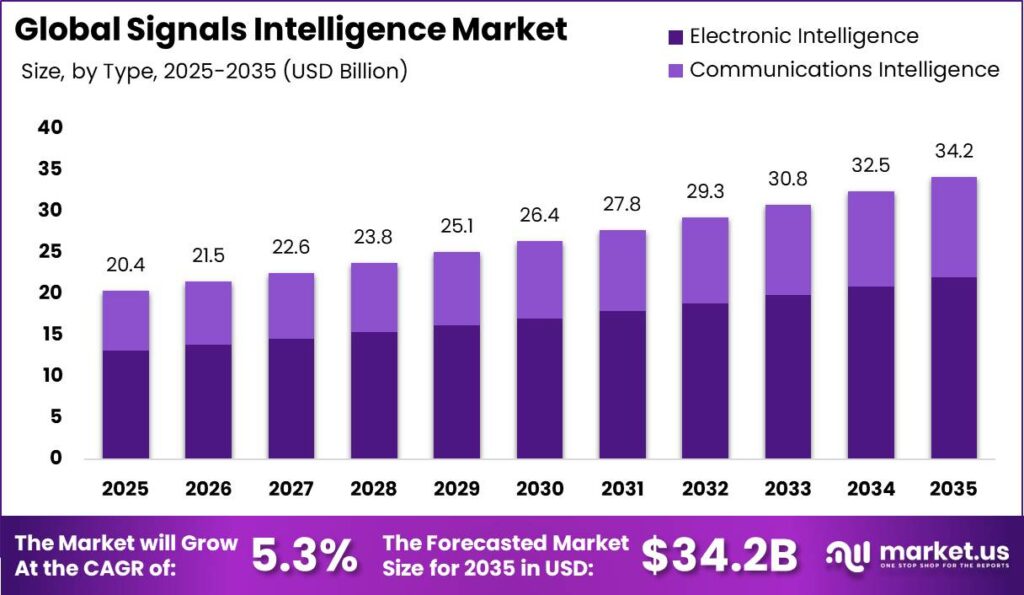
In 2025, the Global Signals Intelligence Market was valued at USD 20.4 billion. The market is projected to grow at a CAGR of 5.3% during 2026–2035, reaching approximately USD 34.2 billion by 2035. North America dominated the global market in 2025, accounting for more than 38.6% of the total market share and generating approximately USD 7.87 billion in revenue.
In 2025, world military expenditure reached USD 2,887 billion, marking the 11th consecutive year of growth and a 41% increase over 2016–2025, which directly raises budgets for intelligence, surveillance, and reconnaissance programs where SIGINT platforms, sensors, and processing systems are core line items.
The International Telecommunication Union estimates that around 6 billion people, or 74% of the world’s population, were using the internet in 2025, up from 60% in 2020, which has created a much larger volume of communications traffic and cyber signals that governments and defense agencies need to intercept, analyze, and protect, further reinforcing demand for advanced SIGINT capabilities.
North America’s position aligns with its outsized contribution to global defense spending and its leadership in network‑centric warfare and cyber defense. The United States alone requested USD 849.8 billion for the Department of Defense in FY 2025, and total U.S. defense outlays have been reported at around USD 962 billion.
NATO data show that European Allies and Canada together invested over USD 571 billion in defense in 2025, with European Allies and Canada increasing defense expenditure by nearly 20% versus 2024, which reinforces a strong pipeline of joint programs and interoperability requirements that favor North American vendors and technology standards in SIGINT deployments.
Key Takeaway
- The Global Signals Intelligence Market is projected to grow from USD 20.4 billion in 2025 to USD 34.2 billion by 2035, reflecting a 5.3% CAGR.
- Electronic Intelligence (ELINT) dominates by type, holding the largest market share at 64.5%.
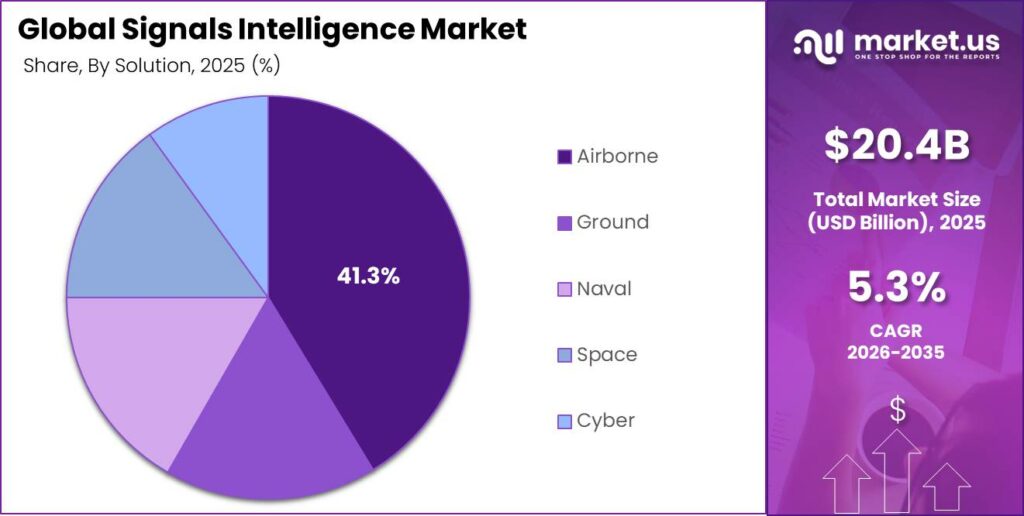
- Airborne solutions lead the market by solution, representing 41.3% of the total market.
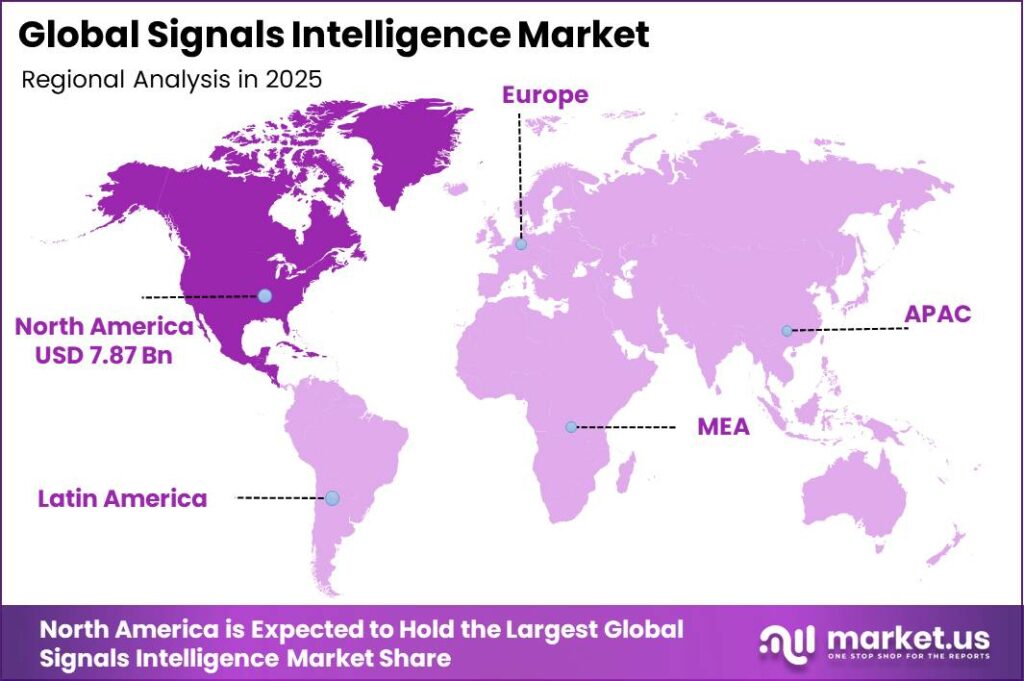
- North America leads the market, accounting for a 38.6% share and generating approximately USD 7.87 billion in 2025.
By Type
In 2025, Electronic Intelligence (ELINT) held a dominant market position, capturing more than a 64.5% share. ELINT systems saw strong adoption as armed forces expanded radar, missile, and electronic warfare detection networks, with several NATO members increasing electronic warfare squad deployments during March–September 2025 in response to rising airspace incursions.
That year, global ELINT-related spending was closely tied to modernization of air-defense radar grids, as over 40 countries upgraded long‑range surveillance radars to counter low‑observable aircraft and hypersonic threats. North America remained the largest ELINT revenue contributor in 2025, underpinned by wide deployment of advanced threat‑warning receivers across fighter fleets and naval vessels.
In 2026, growth accelerated as more than 300 new wideband spectrum‑monitoring and signal interception units were fielded across European and Asia‑Pacific borders between February and October, driven by tense maritime and land disputes. Adoption also widened in homeland security, where several governments rolled out electronic monitoring corridors along critical energy and transport infrastructure in mid‑2026.
By Solution
Airborne solutions held a significant share of the market in 2025, accounting for around 41.3% of signals intelligence deployments across aircraft and unmanned platforms. In 2025, airborne SIGINT platforms captured close to 25% of global application‑level spending, supported by rapid procurement of multi‑sensor payloads able to intercept radio, radar, and satellite signals over broad theaters.
Between April and November 2025, several air forces commissioned new reconnaissance squadrons equipped with upgraded pods and antennas, boosting mission hours for electronic and communications interception. Growth continued into 2026 as more than 200 next‑generation drone and manned aircraft integrations were reported worldwide.
Key Market Segments
By Type
- Electronic Intelligence (ELINT)
- Communications Intelligence (COMINT)
By Solution
- Airborne
- Ground
- Naval
- Space
- Cyber
Geopolitical Impact Analysis
Escalating geopolitical tensions are materially reshaping cost structures and delivery risk profiles across the global signals intelligence (SIGINT) value chain, from semiconductor fabs and RF front‑end modules to secure communications platforms and satellite payload electronics.
UNCTAD estimates that trade volume through the Suez Canal fell by 42% in early 2024, with over 20% of global container capacity rerouted and Shanghai–Europe spot container rates rising by 256%, directly inflating logistics costs for high‑value SIGINT electronics typically moved in containerized flows between East Asian foundries and European/US system integrators.
Concurrently, the OECD/ITF reports a 130% increase in global container freight rates between November 2023 and March 2024, adding double‑digit uplifts to end‑to‑end landed costs for RF receivers, antenna arrays, and secure server hardware used in SIGINT processing centers, while rerouting around the Cape of Good Hope extends transit times by 10–15 days on Asia–Europe lanes and forces higher in‑transit inventory buffers.
Trade policy fragmentation is further impacting core SIGINT electronics and encryption hardware. WTO dispute data show that India, a growing hub for telecom and electronics manufacturing, raised applied import duties on ICT products such as base stations, converters, and telecom conductors to the 7.5–20% range against bound rates of 0%, before partially rolling back in 2022, illustrating how sudden tariff shocks can compress margins on SIGINT‑relevant subassemblies and cabling sourced through Indian EMS providers.
On the energy side, IEA analysis indicates that if critical mineral prices had stayed at 2022 peaks, EV battery pack costs in 2023 would have been 13% higher, underscoring the sensitivity of advanced electronics manufacturing to mineral price volatility; similar dynamics apply to high‑purity copper, rare earths, and specialty gases used in SIGINT semiconductors and phased‑array radar modules.
These combined pressures are driving procurement teams to diversify away from single‑country dependency in China by 0.96–1.39 percentage points in import diversification probability (a 37–53% relative increase), shifting part of SIGINT electronics sourcing to ASEAN while accepting higher short‑term qualification, compliance, and multi‑jurisdiction export‑control overhead in program pricing.
Regional Analysis
North America holds the dominant position in the global Signals Intelligence (SIGINT) market, accounting for approximately 38.6% of the total market share, with a valuation of USD 7.87 billion. The region’s leadership is primarily driven by substantial defense budgets, advanced surveillance infrastructure, and continuous investments in next-generation intelligence, surveillance, and reconnaissance (ISR) systems.
The United States remains the key contributor, supported by strong funding from agencies such as the Department of Defense (DoD) and the National Security Agency (NSA), which prioritize SIGINT capabilities for national security, cybersecurity, and counter-terrorism operations. Additionally, the increasing integration of artificial intelligence (AI) and machine learning (ML) into signal processing and data analytics is enhancing the efficiency and responsiveness of intelligence systems across the region.
The presence of major industry players, robust R&D ecosystems, and strategic collaborations between government and private defense contractors further strengthen North America’s market position. Moreover, rising geopolitical tensions and the growing need for real-time electronic intelligence gathering are accelerating procurement of advanced SIGINT platforms, including cyber intelligence solutions and space-based signal monitoring systems.
Key Regions and Countries
North America
- US
- Canada
Europe
- Germany
- France
- The UK
- Spain
- Italy
- Rest of Europe
Asia-Pacific
- China
- Japan
- South Korea
- India
- Australia
- Rest of APAC
Latin America
- Brazil
- Mexico
- Rest of Latin America
Middle East & Africa
- GCC
- South Africa
- Rest of MEA
Market Dynamics
Drivers
| Driver | (~) % Impact on CAGR Forecast | Geographic Relevance | Impact Timeline |
|---|---|---|---|
| Escalating global military expenditure | +2.1% | North America, Europe, Asia-Pacific, Middle East | Short term (≤ 2 years) |
| Multi-domain ISR&SIGINT modernization | +1.4% | US, NATO allies, Indo-Pacific coalitions | Medium term (2–4 years) |
| AI-enabled automated signal analysis | +0.9% | US, Europe, advanced Asia-Pacific | Medium term (2–4 years) |
| Space-based SIGINT constellations | +0.6% | US, Europe, China, commercial LEO operators | Long term (≥ 4 years) |
| Cyber-threat-driven SIGINT demand | +0.5% | Global critical infrastructure | Short term (≤ 2 years) |
Escalating global military expenditure
Global military expenditure expanded by over 35% between 2015 and 2024, with a year-on-year increase of about 9–10% in 2024, directly enlarging the budget pool for intelligence, surveillance, reconnaissance, and signals intelligence programmes that underpin the current baseline growth in SIGINT.
This rising outlay, now consuming roughly 2.5% of world GDP and more than 7% of average government spending, shifts defence business models toward sustained multi-year procurement lines for SIGINT platforms rather than sporadic project-based buys.
For vendors, this manifests as higher backlog coverage (often exceeding 3–4 years of current revenue), improved capacity utilisation in specialized RF front-end and COMINT/ELINT processing lines, and more predictable cash flows that support the transition from one-off hardware license deals toward recurring upgrade, analytics, and software-support revenue streams.
Restraints
| Restraint | (~) % Impact on CAGR Forecast | Geographic Relevance | Impact Timeline |
|---|---|---|---|
| Export controls on advanced SIGINT | -1.8% | US, Europe, Asia-Pacific recipient states | Medium term (2–4 years) |
| Lengthy classified procurement cycles | -1.1% | US, NATO, major Asia-Pacific militaries | Medium term (2–4 years) |
| Budget crowd-out from other defence priorities | -0.9% | Emerging markets, fiscally constrained states | Short term (≤ 2 years) |
| Regulatory barriers to telecom interception | -0.7% | Europe, parts of Latin America, civil-law jurisdictions | Medium term (2–4 years) |
| High upfront CapEx for sovereign capability | -0.8% | Emerging and mid-income economies | Long term (≥ 4 years) |
Export controls on advanced SIGINT
US ITAR and EAR restrictions on sensitive RF, decryption, and electronic warfare technologies, combined with similar European export regimes, effectively block or delay the sale of high-end SIGINT subsystems into numerous recipient states, cutting off a meaningful portion of otherwise addressable demand.
For individual programmes, controlled content can represent more than 20–30% of system value, and the inability to license those elements either cancels projects or forces downgraded configurations that reduce realised revenue by mid- to high-single-digit percentages relative to original requirements.
At a portfolio level, vendors often report multi-year slippages where classified or export-controlled deals remain stuck in approval pipelines for more than 24–36 months, driving working-capital lock-up and depressing realised CAGR by around 1–2% versus unconstrained scenarios.
Challenges
| Challenge | (~) % CAGR Friction Drag | Geographic Relevance | Mitigation Horizon |
|---|---|---|---|
| Complex integration across space-air-cyber | -1.5% | US, Europe, advanced Asia-Pacific | Long term (≥ 4 years) |
| Acute shortage of SIGINT data scientists | -1.0% | Global, especially OECD economies | Medium term (2–4 years) |
| Rapid obsolescence of RF hardware | -0.8% | Global deployed fleets | Medium term (2–4 years) |
| Interoperability issues in coalition operations | -0.7% | NATO, Indo-Pacific security arrangements | Long term (≥ 4 years) |
| Cybersecurity and data-sovereignty constraints | -0.6% | Europe, APAC, regulated sectors | Medium term (2–4 years) |
Complex integration across space-air-cyber
The convergence of space-based, airborne, maritime, ground, and cyber-intelligence channels into unified SIGINT architectures introduces structural integration complexity that drags realizable growth below theoretical demand, even as multi-domain intelligence concepts gain traction.
Modern programmes may involve dozens of platforms and hundreds of distinct sensor and communication interfaces, with integration costs frequently reaching 15–25% of total programme budgets and schedules slipping by 12–24 months compared with initial plans. These overruns constrain how quickly defence ministries can field new capabilities and thereby cap annual contract awards.
On the corporate side, vendors must maintain overlapping hardware, middleware, and analytics stacks to support legacy fleets while rolling out software-defined and AI-augmented SIGINT, which elevates fixed engineering and support costs and compresses operating margins by an estimated 200–300 basis points until architectures standardise.
Opportunities
| Opportunity | (~) % Potential CAGR Upside | Geographic Relevance | Execution Window |
|---|---|---|---|
| Software-defined SIGINT and SaaS analytics | +1.9% | US, Europe, advanced Asia-Pacific | Medium term (2–4 years) |
| Commercial LEO partnerships for SIGINT payloads | +1.2% | Global space operators and defence agencies | Long term (≥ 4 years) |
| Critical infrastructure cyber-SIGINT services | +1.0% | North America, Europe, Asia-Pacific | Medium term (2–4 years) |
| Indigenous SIGINT capability development in emerging markets | +0.8% | Asia, Middle East, Latin America, Africa | Long term (≥ 4 years) |
| M&A roll-ups of niche SIGINT software vendors | +0.6% | US, Europe, Israel, Asia-Pacific | Short term (≤ 2 years) |
Software-defined SIGINT and SaaS analytics
This opportunity remains largely untapped because most current SIGINT deployments still rely on hardware-centric, project-based delivery, whereas a shift toward software-defined radios, virtualised processing chains, and subscription analytics could unlock recurring revenue streams and margin expansion above the baseline forecast.
Moving processing workloads from bespoke boxes to modular, upgradable software layers enables vendors to charge annual license and support fees that can amount to 10–20% of initial deployment value, lifting lifetime revenue per platform by high-double-digit percentages without equivalent increases in production cost.
At the unit-economics level, cloud- or edge-hosted analytics can cut per-mission data processing costs for defence customers by an estimated 20–30% while reducing system downtime and enabling faster feature roll-outs, creating room for price premia and gross-margin improvement of roughly 300–400 basis points for suppliers who execute the transition.
Strategically, this monetisation model also smooths cash flows, lowers working-capital intensity, and supports higher R&D intensity ratios, allowing early adopters to compound growth at incremental CAGRs of around 2% above the hardware-only baseline as software and analytics capture a growing share of SIGINT value creation.
Key Players Analysis
The global signals intelligence (SIGINT) market is led by major Tier-1 defense companies, including Lockheed Martin, BAE Systems, Northrop Grumman, RTX, Thales, and L3Harris. Together, these companies are estimated to account for around 55–65% of global SIGINT-related revenues across electronic warfare, ISR payloads, secure communications, and broader C4ISR programs.
Lockheed Martin reported 2025 sales of approximately USD 75.0 billion, supported by a record backlog of nearly USD 194 billion. Its Missiles and Fire Control segment generated about USD 14.45 billion in sales, increasing 14% year-on-year. Based on its strong presence in classified ISR, battle management, electronic support, and integrated defense systems, Lockheed Martin is estimated to hold around 12–15% of global SIGINT-adjacent revenues.
BAE Systems generated 2025 group sales of about GBP 30.7 billion, equivalent to roughly USD 39–40 billion. Its Cyber & Intelligence activities generated approximately GBP 2.4 billion, or around USD 3.0 billion, with sales increasing 2% in constant currency. BAE Systems is estimated to account for around 10–12% of global SIGINT software, analytics, and services revenues, supported by EBIT growth of 12%.
L3Harris reported 2025 revenue of approximately USD 21.9 billion. Its Space & Mission Systems and Communication & Spectrum Dominance businesses generated around USD 11.5 billion and USD 8.0 billion, respectively, representing nearly USD 19.5 billion of spectrum, ISR, and electronic warfare-related activities. L3Harris is estimated to hold around 10–13% of global SIGINT-addressable revenues, particularly across airborne, spaceborne, tactical communications, and signals exploitation systems.
Top Key Players in the Market
- BAE Systems
- Lockheed Martin Corporation
- Thales
- L3Harris Technologies
- Northrop Grumman
- General Dynamics
- Raytheon Technologies
- HENSOLDT AG
- Elbit Systems
- Saab
- Mercury Systems
Recent Developments
- In May 2026, Saab received an order from a European NATO country for a Sirius passive sensor system for signals intelligence and surveillance, with a total contract value of approximately EUR 130 million and deliveries scheduled through 2030, anchoring long‑term deployment of multi‑platform SIGINT sensors and associated services in the customer’s integrated ISR architecture.
- In February 2026, Pacific Defense secured the inaugural launch slot for its Moonraker Modular Open Systems Approach space RF payload on K2 Space’s Gravitas Mission, committing a multi‑mission, multi‑domain signals intelligence and electronic warfare payload into orbit and establishing a space‑based SIGINT capability that will operate over a multi‑year mission window for U.S. and allied defense customers.
Report Scope
| Report Features | Description |
|---|---|
| Market Value (2025) | USD 20.4 Billion |
| Forecast Revenue (2035) | USD 34.2 Billion |
| CAGR (2026-2035) | 5.3% |
| Base Year for Estimation | 2025 |
| Historic Period | 2020-2024 |
| Forecast Period | 2026-2035 |
| Report Coverage | Revenue Forecast, Market Dynamics, Competitive Landscape, Recent Developments |
| Segments Covered | By Type (Electronic Intelligence (ELINT), Communications Intelligence (COMINT)), By Solution (Airborne, Ground, Naval, Space, Cyber) |
| Regional Analysis | North America – US, Canada; Europe – Germany, France, The UK, Spain, Italy, Rest of Europe; Asia-Pacific – China, Japan, South Korea, India, Australia, Singapore, Rest of APAC; Latin America – Brazil, Mexico, Rest of Latin America; Middle East & Africa – GCC, South Africa, Rest of MEA |
| Competitive Landscape | BAE Systems, Lockheed Martin Corporation, Thales, L3Harris Technologies, Northrop Grumman, General Dynamics, Raytheon Technologies, HENSOLDT AG, Elbit Systems, Saab, Mercury Systems |
| Customization Scope | Customization for segments, region/country-level will be provided. Moreover, additional customization can be done based on the requirements. |
| Purchase Options | We have three licenses to opt for: Single User License, Multi-User License (Up to 5 Users), Corporate Use License (Unlimited Users and Printable PDF) |





































