Report Overview
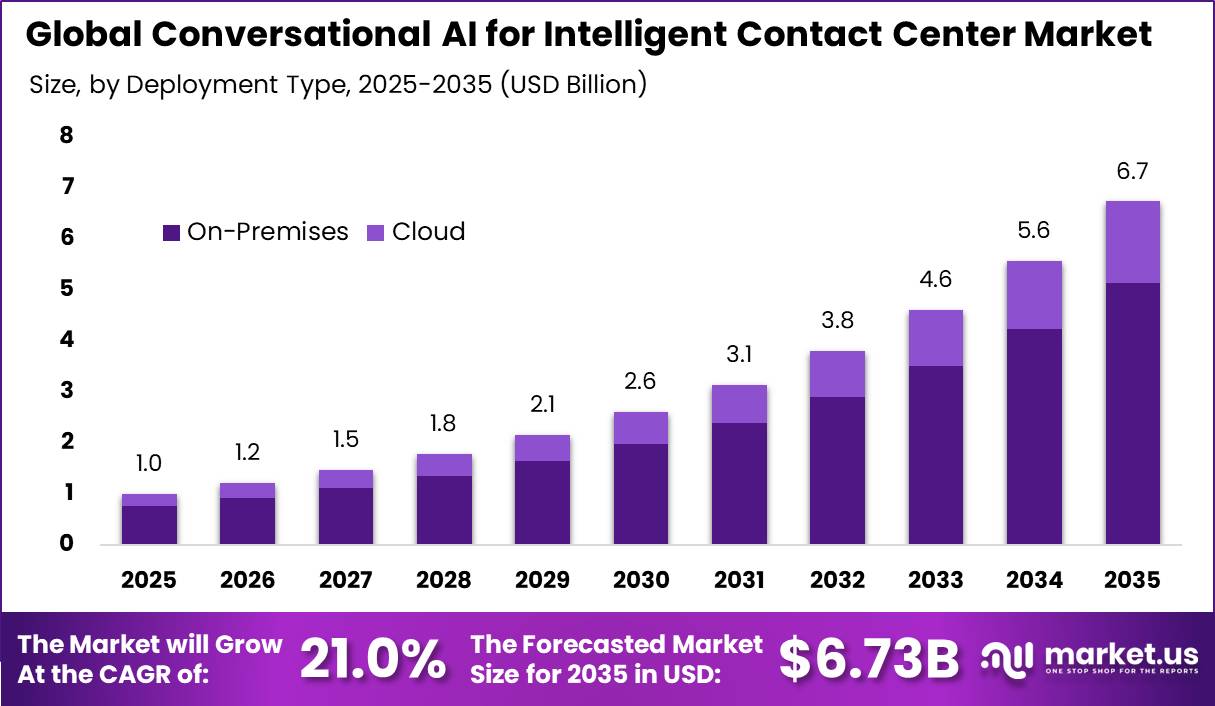
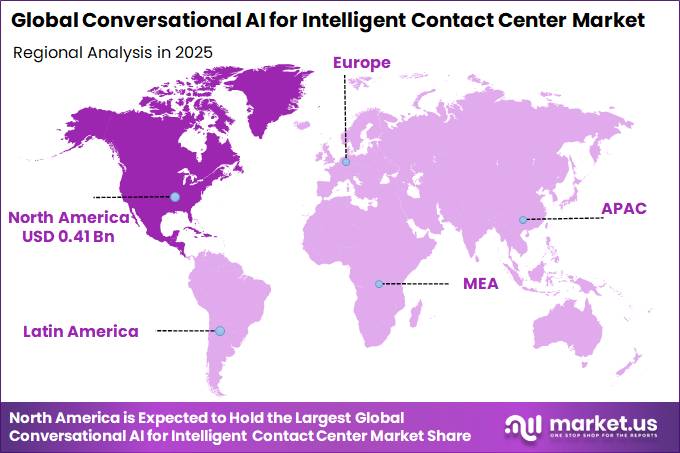
In 2025, the Global Conversational AI for Intelligent Contact Center Market was valued at USD 1.00 billion. The market is projected to grow at a CAGR of 21.0% during 2026–2035, reaching approximately USD 6.73 billion by 2035. North America dominated the global market in 2025, accounting for more than 41.0% of the total market share and generating approximately USD 0.41 billion in revenue.
Market growth is supported by rising internet use, expanding e-commerce activity, and increasing customer-service costs. According to the ITU, 5.5 billion people used the internet in 2024, an increase of 227 million from 2023, representing 68% of the global population. This growing digital population is creating higher volumes of customer calls, chats, complaints, and service requests.
E-commerce growth is also increasing demand for automated customer support. UNCTAD reported that business-to-business and business-to-consumer e-commerce sales across 45 major economies reached USD 28 trillion in 2024. These transactions generate regular inquiries related to orders, delivery, refunds, payments, and products.
Labor costs provide another strong growth factor. The U.S. BLS projects customer-service employment to decline by 5% between 2025 and 2035, while median pay stands at USD 21.53 per hour. These conditions are encouraging businesses to adopt AI-powered voice and chat systems to provide faster, scalable, and round-the-clock customer service.
Key Takeaway
- The Conversational AI for Intelligent Contact Center Market was valued at USD 1.00 billion in 2025 and is projected to reach USD 6.73 billion by 2035, growing at a CAGR of 21.0% (2026–2035).
- The On-Premises deployment segment held a dominant 76.1% share, driven by data-security and compliance needs.
- Large Enterprises accounted for a 60.9% share, supported by scale and investment capacity.
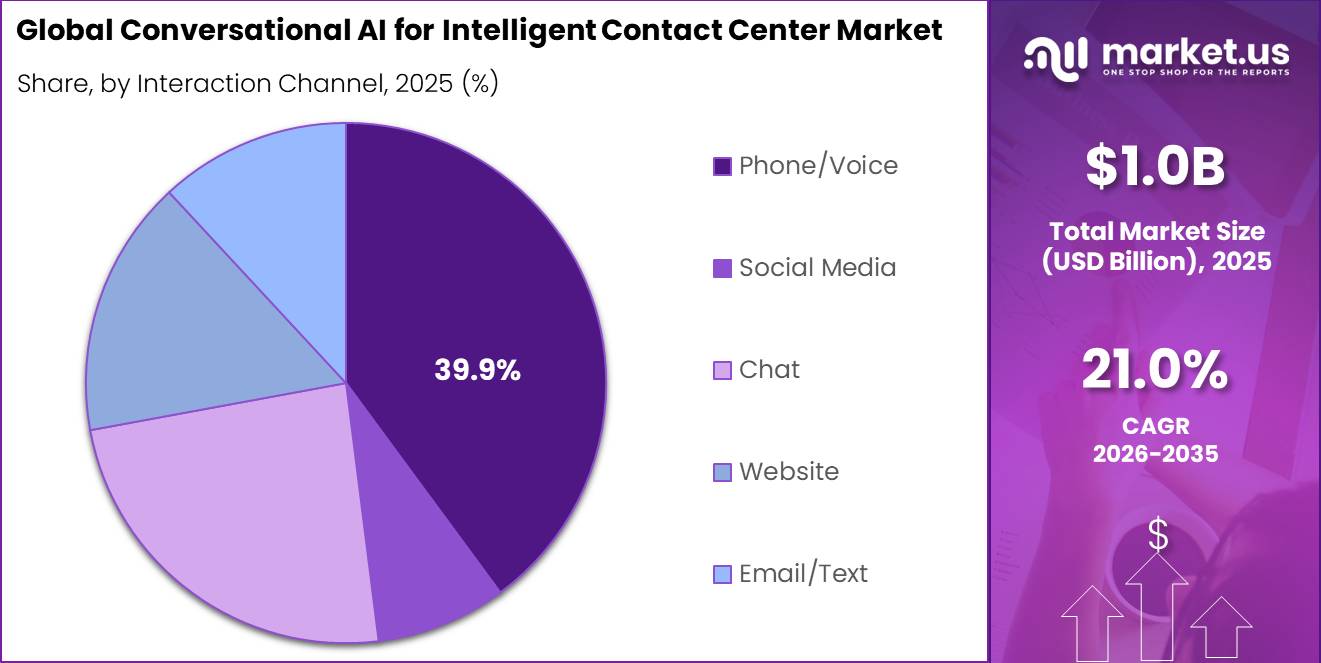
- Phone/Voice was the leading interaction channel, holding a 39.9% share.
- BFSI led among industry verticals with a 30.1% share, fueled by rising digital payment volumes.
- Natural Language Processing (NLP) was the dominant technology, holding a 46.3% share.
- North America led the market with a 41.0% share, generating around USD 0.41 billion in revenue in 2025.
Market Statistics and Data Insights
- Global internet usage reached 6.0 billion people in 2025, equal to 74% of the world population, up from 5.8 billion and 71% in 2024. More than 240 million additional people came online within one year, expanding the addressable population for digital customer support.
- Global mobile-cellular subscriptions reached 9.2 billion in 2025, equivalent to 112 subscriptions per 100 inhabitants. Active mobile-broadband subscriptions reached 99 per 100 inhabitants and represented 89% of total mobile subscriptions.
- Around 36% of mobile-broadband subscriptions were already 5G in 2025. Approximately 3 billion 5G subscriptions were active globally, while 5G networks covered 55% of the world population and 4G covered 93%.
- Business e-commerce sales across 45 developed and developing economies reached USD 28 trillion in 2024. These economies represented roughly three-quarters of global GDP and exports, while e-commerce sales increased 4.4% from 2023.
- The United States employed about 2.666 million customer service representatives in 2025. Their median hourly wage reached USD 21.53, equivalent to a median annual wage of USD 44,770.
- Paid cloud-computing adoption reached 52.7% of EU enterprises in 2025, increasing 7.4 percentage points from 2023 and rising sharply from 17.8% in 2014. This provides an established infrastructure base for cloud contact-center and AI services.
- AI adoption reached 20.0% of EU enterprises in 2025, compared with 13.5% in 2024. Adoption was around 55% among large companies versus 19% among SMEs. Around 12% of EU businesses used AI for analyzing written language, while 9% used it to generate written or spoken language.
- Genesys surveyed 5,232 consumers and 1,181 CX leaders and found that 82% of consumers believe a company is only as good as its customer service. Around 30% stopped doing business with a company during the previous year because of a bad experience, while 41% recommended a company following a positive service experience.
- Around 97% of consumers said being able to move between customer-service channels without repeating information is important. However, 84% of CX leaders reported that they do not yet offer multiple channels backed by completely integrated technology and connected data.
- Five9 found that 56% of consumers still preferred telephone support for general customer-service issues. The figure increased to 74% for complex or urgent problems, demonstrating the continued importance of conversational voice AI.
- Around 59% of consumers said their preferred customer-service channel changes depending on the situation, supporting demand for AI platforms capable of linking phone, chat, email, SMS, and self-service channels.
- NiCE surveyed 12,000 consumers across the U.S., UK, Australia, Japan, Mexico, and Brazil and found that 72% had already experienced benefits from AI and automation in customer service. Around 49% said faster issue resolution was the main way AI could improve their experience.
- Zendesk’s 2026 CX research found that 74% of consumers now expect customer service to be available 24/7 because of AI. Around 74% also find it frustrating to repeat their issue to different agents, while 95% expect explanations for decisions made by AI.
By Deployment Type
The On-Premises deployment segment held a dominant 76.1% share due to the high need for data security, regulatory compliance, and direct control over sensitive customer information. Contact centers serving banking, healthcare, and financial services often manage confidential payment, identity, and account data, encouraging companies to keep their systems within locally controlled infrastructure.
Data-security concerns are also strengthening demand for on-premises deployment. The Identity Theft Resource Center recorded 3,158 data compromise notices in the U.S. in 2024. Such incidents encourage regulated businesses to maintain stronger control over servers, encryption keys, user access, and security logs.
| By Deployment Type | Segment Shares |
|---|---|
| On-Premises | 76.1% |
| Cloud | 23.9% |
By Customer Type
Large Enterprises held a dominant 60.9% share, supported by their high transaction volumes, large customer bases, and strong investment capacity. These companies have the financial resources needed to deploy conversational AI platforms, integrate them with existing contact-center systems, and maintain advanced data infrastructure.
According to the U.S. Census Bureau’s Annual Business Survey, the 50 largest firms in the Information sector generated around USD 1.3 trillion in revenue, compared with approximately USD 2.2 trillion for the entire sector. This revenue concentration shows that a limited number of large companies account for a major portion of industry activity and have greater capacity to invest in enterprise-grade AI technologies.
The U.S. Small Business Administration also reports that companies with 500 or more employees account for a significant share of national payroll and business receipts. These enterprises often serve millions of customers across multiple regions and communication channels, creating strong demand for centralized AI platforms that can manage large volumes of calls, chats, and service requests efficiently.
| By Customer Type | Segment Shares |
|---|---|
| Small and Medium Businesses | 39.1% |
| Large Enterprises | 60.9% |
By Interaction Channel
The Phone/Voice channel held a dominant 39.9% share, supported by the continued importance of voice communication for urgent, sensitive, and complex customer-service needs. Consumers often prefer phone support for banking disputes, medical questions, payment issues, and other cases that require detailed explanations or immediate assistance.
| By Interaction Channel | Segment Shares |
|---|---|
| Social Media | 8.1% |
| Phone/Voice | 39.9% |
| Chat | 24.1% |
| Website | 16.0% |
| Email/Text | 11.9% |
According to the ITU, global mobile-cellular subscriptions reached 9.1 billion in 2024, exceeding the world’s population by 12.1%. This large mobile subscriber base provides businesses with a broad foundation for voice-based customer support across different regions and industries. The U.S. Federal Trade Commission also reported that the Do Not Call Registry contained more than 258 million active phone number registrations by the end of fiscal year 2025.
By Industry Vertical
The BFSI (Banking, Financial Services, and Insurance) segment held a dominant 30.1% share, driven by the rapid growth of digital banking and the rising volume of financial transactions. According to the Reserve Bank of India, digital payment transactions reached 20,849 crore (208.5 billion) in 2024, compared with 3,248 crore in 2019. The UPI system alone processed 17,221 crore transactions valued at ₹246.8 lakh crore.
The large volume of digital payments creates frequent customer-service requirements related to failed transactions, disputed payments, fraud alerts, account access, and identity verification. Banks and financial institutions therefore require fast and reliable support systems capable of handling customer queries at scale.
Globally, the World Bank’s Global Findex 2025 report showed that account ownership increased to 79% of adults, compared with 74% in 2021. This expanding banking population further increases demand for round-the-clock customer assistance. As financial transactions are highly time-sensitive and security-focused, BFSI companies are increasingly adopting conversational AI for voice and chat support, fraud detection, identity verification, and faster query resolution.
| By Industry Vertical | Segment Shares |
|---|---|
| Retail & E-Commerce | 17.9% |
| Healthcare & Life Sciences | 12.5% |
| BFSI | 30.1% |
| IT & Telecommunications | 16.0% |
| Media & Entertainment | 9.5% |
| Travel & Hospitality | 7.8% |
| Others | 6.2% |
By Technology
Natural Language Processing (NLP) held a dominant 46.3% share, as it is the key technology that allows conversational AI systems to understand, interpret, and respond to human language. NLP helps contact-center platforms identify customer intent, tone, context, and meaning across both voice and text interactions.
According to the World Intellectual Property Organization, generative AI patent families increased from only 733 in 2014 to more than 14,000 in 2023. This sharp rise reflects growing investment in language-based AI technologies that support text generation, speech understanding, and automated customer communication.
Language diversity also strengthens the need for NLP. UNESCO’s World Atlas of Languages records 8,324 spoken and signed languages currently in use worldwide. Contact centers serving customers across multiple countries therefore need systems that can understand different phrases, accents, expressions, and communication styles.
| By Technology | Segment Shares |
|---|---|
| Machine Learning | 14.1% |
| Generative AI/LLMs | 18.3% |
| Speech Recognition | 10.1% |
| Natural Language Processing | 46.3% |
| Sentiment Analysis | 6.1% |
| Agentic AI | 5.1% |
Key Market Segments
By Deployment Type
- On-Premises
- Cloud
By Customer Type
- Small and Medium Businesses
- Large Enterprises
By Interaction Channel
- Social Media
- Phone/Voice
- Chat
- Website
- Email/Text
By Industry Vertical
- Retail and E-Commerce
- Healthcare and Life Sciences
- BFSI
- IT and Telecommunications
- Media and Entertainment
- Travel and Hospitality
- Others
By Technology
- Machine Learning
- Generative AI/LLMs
- Speech Recognition
- Natural Language Processing
- Sentiment Analysis
- Agentic AI
Geopolitical Impact Analysis
Geopolitical disruptions are increasing the operating and infrastructure costs of conversational AI systems. According to the International Energy Agency, global data centres consumed around 415 terawatt-hours (TWh) of electricity in 2024, with demand growing at about 12% per year, more than four times faster than overall global electricity demand.
Rising energy use, combined with regional conflicts, sanctions, and power-market volatility, can increase the cost of running the GPUs and servers used for speech recognition, NLP, and conversational AI applications. Supply-chain disruption is creating additional pressure. UNCTAD reported that Suez Canal ship tonnage declined by 70%, while Gulf of Aden transits fell by 76% by mid-2024 due to Red Sea attacks.
Many vessels were redirected around the Cape of Good Hope, adding roughly 12 extra sailing days per journey. Since more than 80% of world trade moves by sea, these disruptions affect deliveries of servers, semiconductors, and networking equipment. Global vessel ton-mile demand increased by 3%, while container ship demand rose by 12%. Shipping costs also increased sharply.
UNCTAD reported that the China Containerized Freight Index climbed by approximately 120% between October 2023 and June 2024. Higher freight, energy, and hardware costs can raise the overall expense of building and operating AI infrastructure, which may eventually be reflected in conversational AI platform pricing for enterprise customers.
Regional Analysis
North America remained the leading region in the Conversational AI for Intelligent Contact Center Market, accounting for 41.0% of the market and generating around USD 0.41 billion in revenue. The region benefits from a mature digital economy, strong enterprise technology spending, and widespread adoption of advanced customer-service platforms.
| Region | Region Shares |
|---|---|
| North America | 41.0% |
| Asia Pacific | 26.3% |
| Europe | 20.0% |
| Latin America | 7.5% |
| Middle East & Africa | 5.2% |
According to the U.S. Bureau of Economic Analysis, the Information sector contributed USD 1,523.9 billion in nominal value added in Q1 2024, equal to 5.4% of U.S. GDP. Professional and business services contributed another USD 3,654.1 billion, representing 12.9% of GDP. This large technology and services base, together with higher labor costs, supports continued investment in AI-powered contact-center solutions.
Asia Pacific emerged as the fastest-growing region, holding a 26.2% share. According to the ITU, internet penetration across Asia Pacific reached 66% in 2024, supported by continued growth in digital connectivity. Southeast Asia’s digital economy reached USD 263 billion in gross merchandise value in 2024, increasing 15% year over year, while e-commerce contributed around USD 159 billion.
Key Regions and Countries
North America
- US
- Canada
Europe
- Germany
- France
- The UK
- Spain
- Italy
- Rest of Europe
Asia Pacific
- China
- Japan
- South Korea
- India
- Australia
- Rest of APAC
Latin America
- Brazil
- Mexico
- Rest of Latin America
Middle East and Africa
- GCC
- South Africa
- Rest of MEA
Market Dynamics
Drivers
| Driver | (~) % CAGR | Geographic Relevance | Impact Timeline |
|---|---|---|---|
| Cloud-native CCaaS migration | +4.2% | North America, Western Europe | Short term (2 years or less) |
| Agentic voicebot adoption in banking | +3.1% | Asia Pacific, North America | Short term (2 years or less) |
| Falling GPU inference cost per token | +2.8% | Global | Medium term (2 to 4 years) |
| Enterprise labor substitution economics | +2.3% | North America, Europe | Short term (2 years or less) |
| Omnichannel API standardization | +1.6% | Global | Medium term (2 to 4 years) |
Cloud-native CCaaS migration
The shift from on-premises PBX and legacy IVR systems toward subscription-based cloud contact-center platforms is a major driver supporting the market’s 21.0% growth trajectory. By 2024, stronger fixed and mobile connectivity across OECD economies had reduced latency barriers for real-time voice, speech-to-text, and conversational AI applications.
U.S. subscription software receipts also grew at a compound rate of more than 18% annually through 2024 and 2025, showing the wider movement from CapEx-based infrastructure spending toward flexible OpEx software budgets.
Cloud deployment also reduces the complexity and cost of adopting conversational AI. Compared with traditional on-premises sales models, cloud-based platforms can lower customer acquisition costs by an estimated 30% to 35% by removing lengthy hardware procurement and integration processes.
Restraints
| Restraint | (~) % CAGR | Geographic Relevance | Impact Timeline |
|---|---|---|---|
| Data localization mandates freezing cross-border AI hosting | -2.7% | India, Southeast Asia | Short term (2 years or less) |
| High central bank policy rates restricting SME CapEx | -1.9% | North America, Europe | Short term (2 years or less) |
| Explicit voice-biometric consent bans | -1.1% | European Union | Short term (2 years or less) |
| Legacy telecom contract lock-in clauses | -0.8% | Latin America, Africa | Medium term (2 to 4 years) |
Data localization mandates freezing cross-border AI hosting
Strict data-residency rules can slow conversational AI deployment, especially in regulated industries such as BFSI. The Reserve Bank of India’s payment-data storage requirement has been in force since 2018, with related technology and compliance requirements continuing into 2026. Such rules can require payment and customer data to remain within domestic infrastructure, increasing deployment costs by an estimated 18% to 22% when vendors need dedicated in-country servers or GPU capacity.
These requirements can also delay contracts and increase infrastructure duplication across regulated markets. Maintaining separate regional systems may reduce software gross margins by roughly 3 to 4 percentage points because vendors must absorb additional hosting, security, compliance, and infrastructure costs.
Challenges
| Challenge | (~) % CAGR | Geographic Relevance | Mitigation Horizon |
|---|---|---|---|
| NLP multilingual accuracy gaps | -1.8% | Asia Pacific, Africa | Medium term (2 to 4 years) |
| AI conversation engineer talent shortage | -1.4% | Global | Medium term (2 to 4 years) |
| Legacy CRM integration debt | -1.0% | North America, Europe | Medium term (2 to 4 years) |
| Rising GPU energy cost volatility | -0.9% | Global | Long term (4 years or more) |
| Customer trust deficit in full automation | -0.7% | Global | Long term (4 years or more) |
NLP multilingual accuracy gaps
Limited performance across low-resource languages remains an ongoing challenge for conversational AI. UNESCO’s World Atlas of Languages records more than 8,000 living languages worldwide, while most commercial language-model training data is concentrated in fewer than 100 languages. This gap can reduce intent-recognition accuracy by around 15 to 20 percentage points in tonal and low-resource languages compared with stronger English or Mandarin benchmarks.
In linguistically diverse markets, call-containment rates can be around 12% to 18% lower, increasing the need for human-agent escalation and reducing the cost benefits of automation. Addressing this issue requires long-term investment in localized model training, regional speech datasets, and language-specific fine-tuning. The mitigation period can extend beyond 4 years, meaning language limitations may continue to restrict adoption and performance in highly diverse markets without fully stopping market growth.
Opportunities
| Opportunity | (~) % CAGR | Geographic Relevance | Execution Window |
|---|---|---|---|
| Agentic AI cross-sell into adjacent BPO verticals | +2.9% | Global | Medium term (2 to 4 years) |
| SME-tier usage-based pricing unbundling | +2.1% | North America, Europe | Short term (2 years or less) |
| Sovereign AI infrastructure roll-ups | +1.7% | India, Middle East | Medium term (2 to 4 years) |
| Embedded voice-commerce monetization | +1.3% | Asia Pacific | Long term (4 years or more) |
Agentic AI cross-sell into adjacent BPO verticals
The largest untapped opportunity lies in expanding agentic conversational AI across the broader BPO workforce that has not yet adopted AI-assisted workflows. Customer-service and back-office roles still represent tens of millions of full-time-equivalent positions globally, while only a small share currently uses licensed AI agents. Early enterprise adoption patterns suggest that adding AI-agent capabilities could increase revenue per seat by around 25% to 40%.
Capturing this opportunity will require vendors to move beyond traditional per-user contact-center licenses toward outcome-based pricing, such as charging per resolved interaction. Company commentary on consumption-based models suggests this approach could improve gross margins by approximately 4 to 6 percentage points once scaled.
Key Players Analysis
The competitive landscape of the Conversational AI for Intelligent Contact Center Market can be divided into two major tiers based on company scale, cloud adoption, and RandD investment. Tier-1 players include NICE Ltd, Cisco Systems, and RingCentral. NICE reported total revenue of USD 2.7 billion in FY2024, increasing 15% year over year.
Its cloud revenue grew 25% to USD 1.98 billion, representing 73% of total sales, while the Customer Engagement segment generated USD 2.28 billion. These figures highlight NICE’s strong position in cloud-based and AI-driven contact-center software.
Cisco Systems generated USD 53.8 billion in revenue in FY2024 and completed its USD 28 billion acquisition of Splunk. Splunk contributed around USD 1.4 billion to Cisco’s FY2024 revenue, strengthening its capabilities in AI, observability, and enterprise collaboration. RingCentral reported USD 2.4 billion in FY2024 revenue, up 9%, while subscription revenue reached USD 2.29 billion and represented more than 95% of total revenue.
Among Tier-2 challengers, Five9 generated USD 1.042 billion in FY2024 revenue, increasing 14% year over year. The company invested USD 166.2 million, equal to 16% of revenue, in RandD. This level of investment supports faster development of AI-powered contact-center features and strengthens Five9’s competitive position against larger vendors.
Top Key Players in the Market
- Talkdesk
- NICE
- Genesys
- Five9
- Cisco Systems, Inc.
- Vonage
- RingCentral, Inc.
- ServiceNow, Inc.
- 8×8, Inc.
- Kore.ai
Recent Developments
- In 2025, on September 8, NICE Ltd completed its acquisition of Cognigy GmbH, a conversational and agentic AI company, for a total final consideration of approximately USD 887.3 million. The deal combines Cognigy’s conversational AI capabilities with NICE’s CXone platform and expands advanced AI solutions across NICE’s network of more than 25,000 existing customers.
- In 2025, on July 31, Genesys announced USD 1.5 billion in new investment commitments from Salesforce and ServiceNow, with both companies agreeing to invest equal amounts. The proceeds were planned for repurchasing shares from existing equity holders. Genesys Cloud had also reached nearly USD 2.1 billion in annual recurring revenue during the first quarter of fiscal 2026, with growth of more than 35% year over year.
Report Scope
| Report Features | Description |
|---|---|
| Market Value (2025) | USD 1.0 Billion |
| Forecast Revenue (2035) | USD 6.7 Billion |
| CAGR (2026-2035) | 21.0% |
| Base Year for Estimation | 2025 |
| Historic Period | 2020-2024 |
| Forecast Period | 2026-2035 |
| Report Coverage | Revenue Forecast, Market Dynamics, Competitive Landscape, Recent Developments |
| Segments Covered | By Deployment Type (On-Premises, Cloud); By Customer Type (Small and Medium Businesses, Large Enterprises); By Interaction Channel (Social Media, Phone/Voice, Chat, Website, Email/Text); By Industry Vertical (Retail and E-Commerce, Healthcare and Life Sciences, BFSI, IT and Telecommunications, Media and Entertainment, Travel and Hospitality, Others); By Technology (Machine Learning, Generative AI/LLMs, Speech Recognition, Natural Language Processing, Sentiment Analysis, Agentic AI) |
| Regional Analysis | North America – US, Canada; Europe – Germany, France, The UK, Spain, Italy, Rest of Europe; Asia Pacific – China, Japan, South Korea, India, Australia, Singapore, Rest of APAC; Latin America – Brazil, Mexico, Rest of Latin America; Middle East and Africa – GCC, South Africa, Rest of MEA |
| Competitive Landscape | Talkdesk, NICE, Genesys, Five9, Cisco Systems, Inc., Vonage, RingCentral, Inc., ServiceNow, Inc., 8×8, Inc., Kore.ai |
| Customization Scope | We will provide customization for segments and region/country levels. Moreover, additional customization can be done based on the requirements. |
| Purchase Options | We have three licenses to opt for: Single User License, Multi-User License (Up to 5 Users), Corporate Use License (Unlimited Users and Printable PDF) |