Report Overview
In 2025, the Global Generative AI in Marketing market was valued at USD 4.5 billion and is projected to grow at a CAGR of 31.8% from 2026 to 2035, reaching about USD 71.4 billion by 2035, with North America holding over 40.1% share and generating close to USD 1.8 billion in revenue.
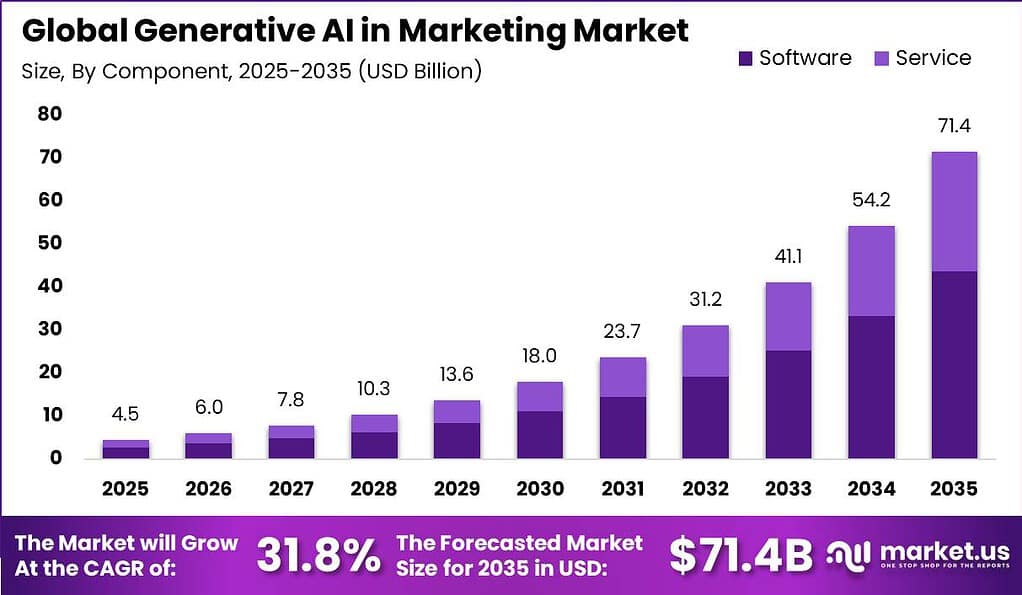
This steep growth is supported by the underlying expansion of digital advertising and AI use in marketing workflows. Global ad spend was around USD 1.1 trillion in 2024, and digital channels already capture well above 60 to 70% of that total, with digital spend forecast to grow at roughly 7 to 9% per year in 2025 and beyond.
As more of this USD 1 trillion-plus advertising budget moves into online formats that demand fast testing of thousands of messages and visuals, marketers rely on generative AI to create text, images, and videos in minutes instead of days. In parallel, surveys show that firms deploying AI rose from about 8% to 20% in just two years, a more than 2.5 times increase, which explains why spending on AI-enabled marketing tools is rising much faster than overall IT budgets.
North America’s 40%+ share is justified by its high AI readiness and deep digital marketing spend. The United States alone accounts for several hundred billion dollars of annual advertising expenditure and is one of the most mature digital ad markets globally, so even a modest 10% shift of this spend into campaigns that require generative AI can translate into tens of billions of dollars in tool and platform spend over the next decade.
Key Takeaway
- The global Generative AI in Marketing market was valued at USD 4.5 billion in 2025 and is projected to grow at a CAGR of 31.8% and is estimated to reach USD 71.4 billion by 2035.
- On the basis of component, the software segment dominated the market, accounting for 61.2% of the total market share.
- Based on system type, the text models segment dominated the market, accounting for 55.3% of the total market share.
- By application, the content creation segment dominated the market, accounting for 33.6% of the total market share.
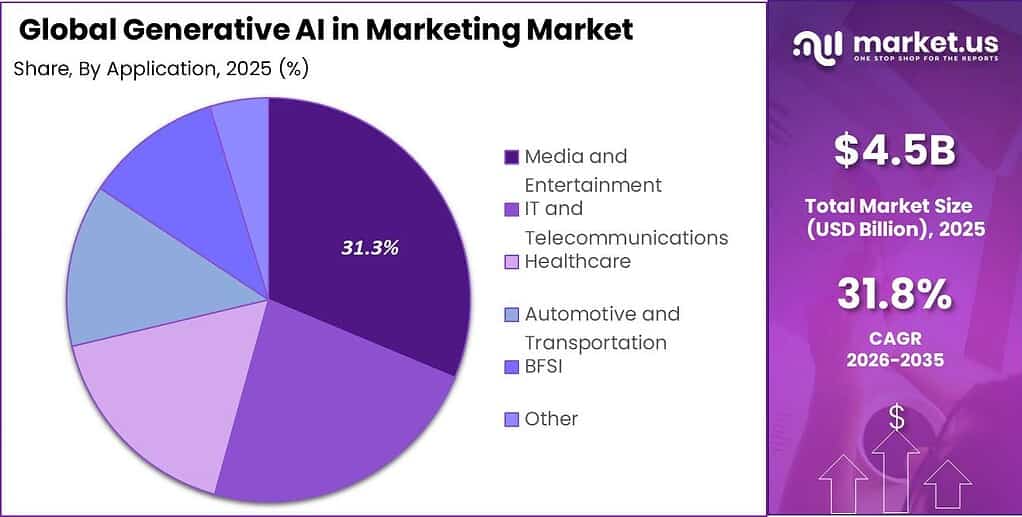
- On the basis of end-user industry, the media and entertainment segment dominated the market, accounting for 31.3% of the total market share.
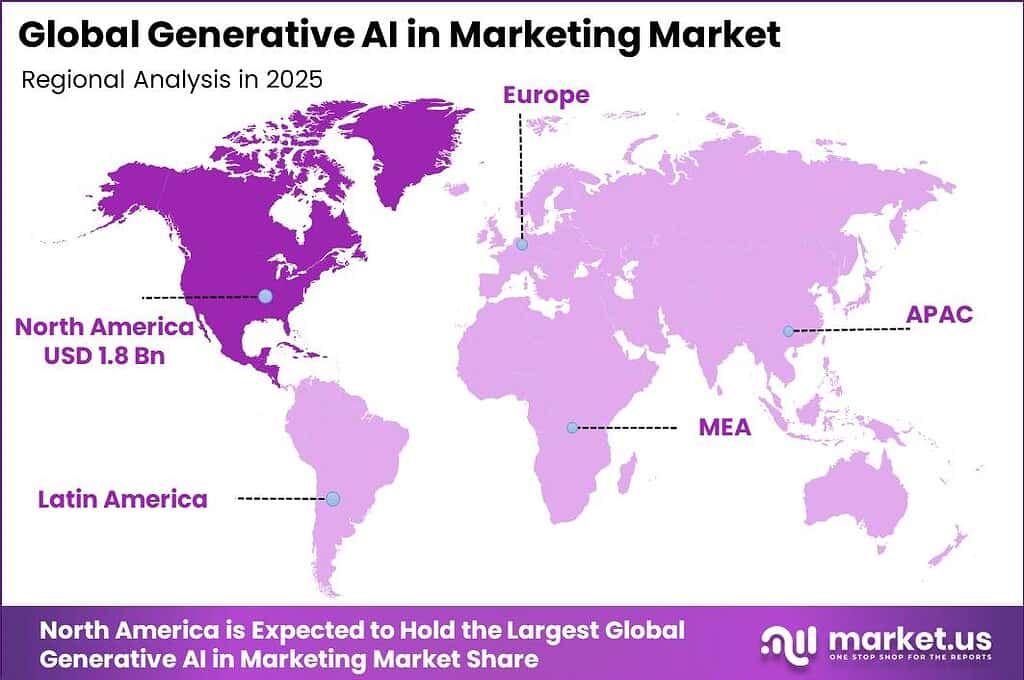
- In 2025, North America was the most dominant region in the Generative AI in Marketing market, accounting for 40.1% of the total market share, equivalent to approximately USD 1.8 billion.
By Component
In 2025, Software held a dominant market position, capturing more than a 61.2% share. Across marketing teams, software-based generative AI platforms became the primary way to deploy tools at scale, with 88% of marketers reporting daily use of AI solutions for tasks such as content optimization, personalization, and data analysis in mid-2025.
By March 2025, over half of marketing organizations said they were actively implementing AI tools, rather than just experimenting, which pushed demand for integrated software suites that combine text, image, and analytics capabilities in a single interface. Adoption continued to deepen through late 2025 as 73% of marketers used AI to personalize customer experiences, reinforcing the need for robust, configurable software rather than ad-hoc services.
In 2026, this trend is intensifying: 92% of businesses intend to invest in generative AI tools over the next three years, and companies using AI in marketing are shifting roughly 75% of staff time from production to strategy, which further boosts reliance on configurable software platforms that can automate routine work month after month.
By System Type
Text Models held a significant share of the market in 2025, driven by their central role in everyday marketing workflows. By mid-2025, 51% of marketers reported using AI tools to optimize written content, while 50% were directly generating copy for emails, ads, and webpages, reflecting how text models had become a practical workhorse rather than a niche tool. In March 2025, surveys showed 45% of marketers using AI to brainstorm content ideas and 41% using it to analyze data for insights, both of which depend heavily on generative text capabilities.
These models underpin chatbots, search-optimized blog writing, and automated campaign scripting, making them an essential component of marketing stacks. Moving into 2026, text models are becoming even more embedded in strategy, with 70% of marketers expecting AI to play a larger role in their work and 48% naming increased AI adoption as a top goal, reinforcing steady month-by-month growth in language-driven tools that can draft, refine, and personalize messaging at scale.
By Application
Content Creation is emerging as a fast-growing segment in 2025, as marketers turn to generative AI to keep up with the volume and variety of digital content. By July 2024, over 80% of marketers were already using AI for content creation, including email copy, and this momentum carried into 2025 with non-AI blog creation dropping from 65% to just 5% over two years.
Early 2025 data shows nearly 94% of marketers planning to use AI for content creation, with outlining and first-draft writing named among the top use cases, highlighting how AI tools are now embedded into everyday editorial workflows.
Short-form video, live video, and AI-generated visuals are also gaining traction, with around 75% of marketers relying on AI for video and image creation by March 2026, supporting multi-format campaigns that can be produced quickly and tested in real time.
By End-User Industry
Media and Entertainment is emerging as a fast-growing end-user segment in 2025, as studios, streaming platforms, and independent creators embrace generative AI to speed up production and experiment with new formats. In 2025, AI in media and entertainment was valued at about USD 33.7 billion, with projections indicating growth to USD 43.1 billion in 2026, reflecting accelerating adoption of AI-driven tools across scriptwriting, editing, and promotional campaigns.
Industry analyses published in August 2025 highlight how AI is transforming content creation and distribution, enabling automated generation of scenes, trailers, and localized assets that would previously require large teams.
Generative models lower barriers for small studios and creators, letting them produce high-quality visual stories and short-form content with limited budgets, particularly around key release months when marketing intensity spikes. As AI-powered sales and marketing tools help media companies run targeted campaigns and optimize audience engagement, the sector’s share within generative AI in marketing continues to grow steadily from 2025 into 2026.
Key Market Segments
By Component
- Service
- Software
By System Type
- Text Models
- GPT-3
- LaMDA
- LLaMA
- Multimodal Models
- GPT-4
- DALL-E
- Stable Diffusion
- Progen
By Application
- Content Creation
- Image or Video Production
- Search Engine Optimization (SEO)
- Sentiment Analysis
- Lead Generation
- Customer Support
- Other
By End-User Industry
- Media and Entertainment
- IT and Telecommunications
- Healthcare
- Automotive and Transportation
- BFSI
- Other
Market Dynamics
Drivers
| Driver | (~) % Impact on CAGR Forecast | Geographic Relevance | Impact Timeline |
|---|---|---|---|
| Hyper-personalized content automation | +6.0% | North America, Europe, Asia-Pacific | Short term (≤ 2 years) |
| Integration into marketing cloud stacks | +5.0% | Global | Medium term (2–4 years) |
| Creative production cost reduction | +4.0% | Global | Short term (≤ 2 years) |
| Performance marketing optimization | +3.5% | North America, Europe | Medium term (2–4 years) |
| Adoption by mid-market enterprises | +3.0% | North America, Europe, Asia-Pacific | Medium term (2–4 years) |
| Data-driven customer journey orchestration | +2.5% | Global | Long term (≥ 4 years) |
Hyper-personalized content automation
The root cause is the rapid deployment of generative AI into campaign workflows, where marketing teams automate high-volume assets such as emails, social posts, and product descriptions, replacing manual copywriting hours that historically consumed 20–30% of departmental budget and limited the number of variants per campaign to roughly 5–10 segments.
Between 2024 and 2026, surveys indicate that generative AI usage in marketing activities has moved from single-digit penetration to regular use in over 60% of organizations’ marketing and sales functions, with some reports showing adoption more than doubling in that period, which translates into a structural ability to generate hundreds of personalized variants per campaign at marginal cost approaching 0 per additional creative.
Quantitatively, the mechanism is a shift in unit cost per asset from tens of USD per piece (designer plus copywriter time) to low single-digit USD per asset equivalent, alongside uplift in click-through and conversion rates of 10–25% when moving from generic messaging to AI-driven micro-segmentation, thereby justifying incremental spend on generative AI tools equal to 5–10% of digital media budgets.
Strategically, this alters business models by pushing vendors toward subscription SaaS pricing tied to monthly asset volume and usage-based tokens rather than traditional licensing, compressing creative agency margins by an estimated 5–10 percentage points, while expanding software vendors’ recurring revenue and supporting the baseline generative AI in marketing CAGR by an incremental 6.0% through higher seat counts, upsell of advanced personalization modules, and deeper embedding into day-to-day campaign operations.
Restraints
| Restraint | (~) % Impact on CAGR Forecast | Geographic Relevance | Impact Timeline |
|---|---|---|---|
| Strict data protection enforcement | –4.5% | Europe, North America | Short term (≤ 2 years) |
| Emerging AI-specific regulatory compliance | –3.5% | Europe, Canada | Medium term (2–4 years) |
| High cost of enterprise-grade security | –3.0% | Global | Short term (≤ 2 years) |
| Conservative sectors’ content risk aversion | –2.5% | Financial services, healthcare, public sector | Medium term (2–4 years) |
| Capital expenditure caution under high rates | –2.0% | Global | Short term (≤ 2 years) |
| Brand reputation concerns over AI misuse | –1.8% | Global | Short term (≤ 2 years) |
Strict data protection enforcement
The root cause is the interaction of generative AI marketing tools with stringent data protection regimes such as GDPR in the EU and CCPA in California, which impose fines up to EUR 20 million or 4% of global annual turnover under GDPR and up to USD 7,500 per intentional violation under CCPA for mishandling personal data used in AI-driven targeting.
Quantitatively, marketing organizations must allocate 10–15% of AI tool budgets to compliance functions consent management, data minimization, anonymization, and audit trails- and, in heavily regulated verticals, are delaying or scaling back deployments covering millions of consumer profiles to avoid exposure to aggregate fine potential that can exceed 10% of annual marketing spend.
This compliance overhead manifests as a bottleneck: deployment cycles lengthen by 3–6 months, some use cases (e.g., automated profiling of sensitive cohorts) are excluded entirely, and vendors must invest 5–10% of revenue into legal, security, and governance capabilities, compressing operating margins by an estimated 3–5 percentage points.
Strategically, this restraint reduces near-term sales velocity in Europe and parts of North America, taking roughly 4.5% off the otherwise achievable CAGR by forcing enterprises to prioritize AI systems that can demonstrate robust privacy-by-design, delaying broader generative AI in marketing rollouts and causing postponement of large multi-market contracts until risk thresholds and safe-use guidelines are met.
Challenges
| Challenge | (~) % CAGR Friction Drag | Geographic Relevance | Mitigation Horizon |
|---|---|---|---|
| Marketing AI skills gap | –4.0% | Global | Medium term (2–4 years) |
| Fragmented martech data stacks | –3.5% | Global | Long term (≥ 4 years) |
| Model quality and brand safety tuning | –3.0% | Global | Medium term (2–4 years) |
| Measurement and attribution complexity | –2.8% | North America, Europe | Long term (≥ 4 years) |
| Vendor lock-in and switching costs | –2.5% | Global | Long term (≥ 4 years) |
| Internal governance and risk committees | –2.0% | Global | Medium term (2–4 years) |
Marketing AI skills gap
The structural vulnerability is the shortage of practitioners who can both design campaigns and operate generative AI tooling at scale, with industry surveys in 2024 showing that roughly 60–70% of marketing leaders cite lack of AI education and training as a top barrier to adoption, and this constraint persists despite rising experimentation with AI in marketing departments.
Quantitatively, this translates into organizations running generative AI pilots with fewer than 5 specialists per 100 marketing staff, resulting in under-utilization rates where only about 10% of licensed AI features are actively used, and content automation confined to a subset (5–15%) of campaigns rather than becoming the default.
The friction shows up as slower onboarding cycles (often 3–9 months) and the need to allocate 5–8% of annual marketing budgets to training, change management, and external consultants before efficiency gains materially improve margins.
Over the long term, corporate adjustments include creating dedicated marketing AI centers of excellence, redefining roles to embed prompt engineering and model governance skill sets, and restructuring vendor contracts to include training quotas and co-pilot tools, collectively reducing the market’s maximum achievable growth trajectory by an estimated 4.0% CAGR until the talent base expands sufficiently to normalize AI literacy across most of the millions of marketing professionals in major economies.
Opportunities
| Opportunity | (~) % Potential CAGR Upside | Geographic Relevance | Execution Window |
|---|---|---|---|
| Verticalized generative AI marketing suites | +5.5% | Global (industry-specific) | Medium term (2–4 years) |
| Usage-based pricing and revenue share models | +4.0% | North America, Europe | Short term (≤ 2 years) |
| Generative AI-powered SMB marketing platforms | +3.5% | Global | Medium term (2–4 years) |
| Cross-channel creative and media co-optimization | +3.0% | Global | Long term (≥ 4 years) |
| First-party data clean rooms for generative AI | +2.8% | North America, Europe | Medium term (2–4 years) |
| Agency–software hybrid operating models | +2.5% | Global | Long term (≥ 4 years) |
Verticalized generative AI marketing suites
This is untapped future upside because most current deployments of generative AI in marketing are horizontal tools layered onto existing workflows, whereas industry-specific suites tailored to sectors such as retail, banking, healthcare, and telecommunications can unlock new monetization by encoding domain-specific compliance, creative standards, and performance benchmarks directly into models.
Quantitatively, verticalization allows vendors to charge premiums of 20–30% over generic tools while lowering clients’ content production cost per unit by 40–60% and improving campaign ROI by 15–25% through templates and prompts tuned to each sector’s regulatory and brand constraints, translating into margin expansion of 5–8 percentage points for both software providers and sophisticated agencies that resell these suites.
Unit economics shift as deals move from small-team licenses to enterprise-wide contracts spanning hundreds or thousands of users, with bundled services (prompt libraries, compliance modules, workflow integrations) representing up to 30–40% of contract value instead of single-digit add-ons.
Geopolitical Impact Analysis
Geopolitical tensions are materially inflating input costs and elongating lead times across the generative AI in marketing stack, particularly GPUs, high-density servers, photonics components, and cloud data center capacity, forcing vendors to raise list prices and tighten distribution to enterprise marketing buyers.
WTO tariff data show that average applied tariffs on AI-enabling products such as semiconductors, computer parts, and related electronics now range from roughly 5 to 8 percent globally, with recent national security measures imposing targeted surcharges of up to 25 percent on advanced logic ICs used in cutting-edge AI accelerators.
At the same time, war related disruptions around the Suez and Red Sea corridor have pushed Asia to Europe sea transit times up by 10 to 14 days, with affected lanes representing close to 30 percent of global container traffic, while oil and LNG flows of around 20 to 30 percent through the same chokepoint drive freight and bunker fuel surcharges that inflate logistics costs for rack servers and networking hardware underpinning generative marketing platforms.
UNCTAD and IEA data have associated conflict-driven route diversion and risk premia with oil price spikes in the 20 to 30 percent range during acute Middle East escalations, raising electricity and cooling costs for hyperscale data centers that host generative models used for creative asset generation and customer journey orchestration.
Regional Analysis
North America currently dominates the generative AI in marketing market, accounting for an estimated 40.1% of global revenues and around USD 1.8 billion in market value, underpinned by a dense ecosystem of hyperscale cloud providers, leading marketing platforms, and early-adopter enterprises across retail, BFSI, technology, and media.
This region benefits from mature data infrastructure, high digital ad spend per capita, and rapid deployment of AI-driven personalization, content generation, and campaign optimization tools, with multiple studies indicating overall generative AI market shares above 40% and CAGRs in the low-to-mid-30% range through 2030.
In contrast, Asia Pacific is emerging as the fastest-growing region for generative AI in marketing, supported by strong digital-native consumer bases, rapid e-commerce expansion, and aggressive investment in AI capabilities in China, India, Japan, South Korea, and Southeast Asia.
Regional generative AI markets in Asia Pacific are posting annual growth rates often exceeding 33 to 35%, with marketing and sales applications among the leading use cases in broader AI spending. While Europe, Latin America, and the Middle East & Africa are expanding from smaller bases with growing regulatory clarity and digital transformation programs, their adoption pace still trails North America’s scale and Asia Pacific’s growth velocity.
Key Regions and Countries
North America
- US
- Canada
Europe
- Germany
- France
- The UK
- Spain
- Italy
- Rest of Europe
Asia Pacific
- China
- Japan
- South Korea
- India
- Australia
- Rest of APAC
Latin America
- Brazil
- Mexico
- Rest of Latin America
Middle East & Africa
- GCC
- South Africa
- Rest of MEA
Key Players Analysis
The generative AI in marketing landscape is led by Tier 1 platforms with broad cloud, CRM, and digital advertising footprints, primarily Adobe, Salesforce, Microsoft, Alphabet, and Meta. Adobe generated USD 19.41 billion in FY2025 revenue, including USD 4.26 billion from Digital Experience, and reported USD 1.77 billion in R&D expense, approximately 9% of revenue, supporting Firefly and AI-driven personalization.
Salesforce posted USD 35.6 billion in FY2025 revenue, with Sales, Service, and Marketing clouds representing over 75% of total, while R&D reached USD 4.83 billion, approximately 13.6% of revenue. Alphabet reported USD 345.4 billion in 2024 revenue, including USD 305.6 billion from Google Services, and invested USD 49.9 billion in R&D, approximately 14.4% of revenue.
These Tier 1 leaders plausibly control 55 to 65% of generative AI in marketing tool spend by value in 2026. Tier 2 challengers, including HubSpot, Klaviyo, Intuit Mailchimp, and Sprinklr, target mid-market marketers and direct revenue attribution. HubSpot reported USD 2.58 billion in 2024 revenue and USD 341 million in R&D, approximately 13.2% of revenue.
Klaviyo generated USD 739 million in 2024 revenue and invested USD 195 million in R&D, approximately 26%. Intuit’s Small Business & Self-Employed segment, including Mailchimp, generated USD 7.0 billion in FY2024 revenue, while company-wide R&D reached USD 2.9 billion, approximately 22% of revenue. Collectively, Tier 2 players likely capture 20 to 30% of spending in generative AI-enabled marketing platforms.
M&A and AI infrastructure investment are reinforcing market concentration. Adobe’s acquisition of Marketo for USD 4.75 billion and Magento Commerce for USD 1.68 billion strengthened its marketing automation and commerce capabilities. Meta spent USD 48.5 billion on R&D in 2024, approximately 36% of its USD 134.9 billion revenue, supporting AI infrastructure, ad ranking, and generative creative tools.
As global AI in marketing revenues approach roughly USD 47 billion by 2025, the combination of multi-billion-dollar R&D budgets, selective acquisitions, and high AI investment among Tier 2 vendors indicates a concentrated market where leading cloud and CRM platforms capture a substantial share of value.
Top Key Players in the Market
- Adobe Inc.
- Amazon Web Services Inc.
- Google LLC
- IBM Corporation
- Microsoft Corporation
- Salesforce
- HubSpot
- Jasper
- Anyword
- Persado
- Rephrase.ai
Recent Developments
- In March 2026, Salesforce, Inc. launched “Einstein Copilot for Marketers” as part of its Data Cloud expansion, committing approximately USD 500 million in incremental AI R&D and infrastructure spending over FY2026 to scale generative content, journey orchestration, and automated campaign optimization across more than 250,000 active Marketing Cloud and Pardot customers globally.
- In April 2026, Adobe Inc. announced a capacity expansion for Adobe Firefly-powered generative marketing services within Adobe Experience Cloud, adding an estimated 6,000 NVIDIA-GPU equivalents across its internal data centers and public cloud footprint, lifting total AI processing capacity for marketing workloads by roughly 40% versus 2025 to support thousands of enterprise brands’ automated creative and personalization at scale.
Report Scope
| Report Features | Description |
|---|---|
| Market Value (2025) | USD 4.5 Billion |
| Forecast Revenue (2035) | USD 71.4 Billion |
| CAGR (2026 to 2035) | 31.8% |
| Base Year for Estimation | 2025 |
| Historic Period | 2020 to 2024 |
| Forecast Period | 2026 to 2035 |
| Report Coverage | Revenue Forecast, Market Dynamics, Competitive Landscape, Recent Developments |
| Segments Covered | By Component (Service, Software), By System Type (Text Models (GPT-3, LaMDA, LLaMA), Multimodal Models (GPT-4, DALL-E, Stable Diffusion, Progen)), By Application (Content Creation, Image or Video Production, Search Engine Optimization (SEO), Sentiment Analysis, Lead Generation, Customer Support, Other Applications), By End-User Industry (Media and Entertainment, IT and Telecommunications, Healthcare, Automotive and Transportation, BFSI, Other End-Use Industries) |
| Regional Analysis | North America – US, Canada; Europe – Germany, France, The UK, Spain, Italy, Rest of Europe; Asia Pacific – China, Japan, South Korea, India, Australia, Singapore, Rest of APAC; Latin America – Brazil, Mexico, Rest of Latin America; Middle East & Africa – GCC, South Africa, Rest of MEA |
| Competitive Landscape | Adobe Inc., Amazon Web Services Inc., Google LLC, IBM Corporation, Microsoft Corporation, Salesforce, HubSpot, Jasper, Anyword, Persado, Rephrase.ai |
| Customization Scope | Customization for segments, region/country-level will be provided. Additional customization can be done based on requirements. |
| Purchase Options | We have three licenses to opt for: Single User License, Multi-User License (Up to 5 Users), Corporate Use License (Unlimited Users and Printable PDF) |