Report Overview
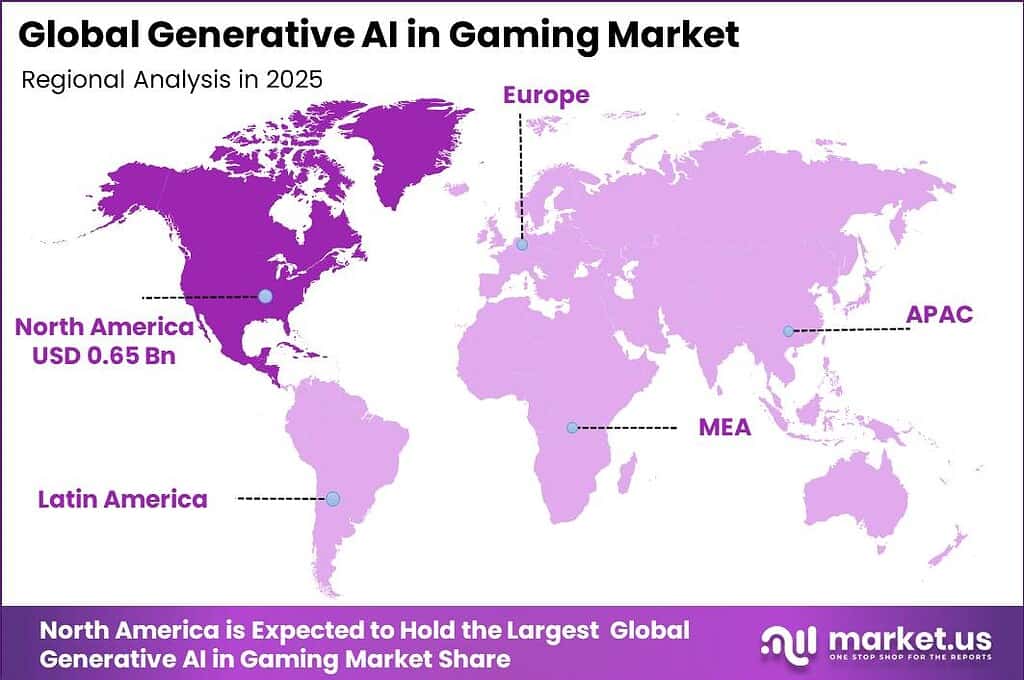
In 2025, the Generative AI in Gaming Market was valued at USD 1.7 billion. The market is projected to grow at a CAGR of 25.6% during 2026–2035, reaching approximately USD 17.0 billion by 2035. North America dominated the global market in 2025, accounting for more than 38% of the total market share and generating approximately USD 0.65 billion in revenue.
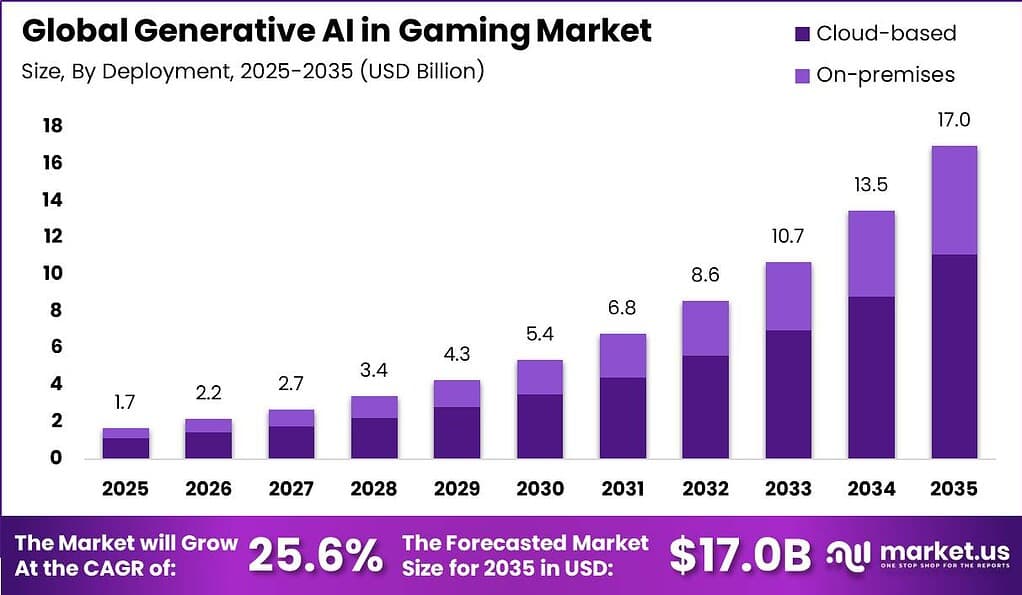
This growth is directly tied to the expanding size and economic weight of the global video game industry, which is the end-use base for generative AI tools. In the United States alone, the video game industry supported more than 350,000 jobs and contributed nearly USD 66 billion to GDP in 2023, with total economic output exceeding USD 101 billion, according to the Entertainment Software Association (ESA).
At the same time, the audience for games keeps growing worldwide: the International Telecommunication Union (ITU) reports that around 6 billion people, roughly three-quarters of the world’s population, were using the internet in 2025, up from 5.8 billion in 2024. More connected players means more demand for fresh, personalized game content delivered faster, and generative AI is the tool studios use to keep up with that demand without proportionally increasing headcount.
The link between digital economic expansion and AI tool adoption is also visible at the macro level. According to the U.S. Bureau of Economic Analysis (BEA), the U.S. digital economy added nearly USD 2.6 trillion in value to the overall economy in 2022, showing how fast digital and software-driven sectors, including gaming, are growing relative to traditional industries.
Generative AI directly answers this pressure by turning content creation into an automated, repeatable process, which explains why spending on these tools is rising over five times faster than the broader gaming market itself. North America’s lead in this market also lines up with its outsized share of global gaming industry output and job creation reported by the ESA, since the country’s mature and well-funded studio base adopts new production technology earliest.
Key Takeaway
- The global generative AI in gaming market was valued at USD 1.7 billion in 2025.
- The global generative AI in gaming market is projected to grow at a CAGR of 25.6% and is estimated to reach USD 17.0 billion by 2035.
- On the basis of deployment, the cloud-based segment dominated the market, constituting 65.3% of the total market share.
- Based on type, the nondeterministic segment dominated the market, accounting for 61.7% of the total market share.
- On the basis of application, the procedural content generation (PCG) segment dominated the market, accounting for 32.6% of the total market share.
- In 2025, North America was the most dominant region in the generative AI in gaming market, accounting for 38.0% of the total market share, equivalent to approximately USD 0.65 billion.
By Deployment
In 2025, Cloud-based deployment held a dominant market position, capturing more than a 65.3% share. This dominance ties directly to the explosion in streaming infrastructure that gaming platforms rolled out through the year. Xbox Cloud Gaming alone streamed 1.7 billion hours in 2025, up sharply from 1.2 billion hours in 2024, showing just how quickly players shifted toward running AI-driven experiences remotely rather than on local hardware. Subscriber numbers backed this up too, with Xbox Game Pass climbing from 37 million users in Q1 2025 to roughly 40 million by Q1 2026.
Mobile devices played an outsized role in this shift, accounting for close to 87% of cloud gaming traffic during the year, since generative AI features like real-time NPC dialogue and on-the-fly content creation demand processing power that phones and tablets simply cannot handle on their own. By early 2026, cloud infrastructure spending kept climbing as studios recognized that offloading AI computation to remote servers let them ship richer, smarter game worlds without forcing players to buy expensive gaming rigs.
By Type
In 2025, Nondeterministic systems held a dominant market position, capturing more than a 61.7% share, driven by developers moving away from scripted, rule-based responses toward AI logic that behaves differently every time a player interacts with it. KRAFTON’s inZOI, released in March 2025, showcased this shift clearly, running 300 autonomous non-player characters powered by on-device small language models that adapt personality-driven behavior on the fly rather than following fixed decision trees.
Suck Up!, launched in October 2025, pushed this further by building its entire gameplay loop around unpredictable AI-driven social deception, proving that variable, context-aware responses could carry a full commercial release rather than just serve as a side feature. The open-source Mantella mod also expanded nondeterministic dialogue to nearly 2,500 characters across Skyrim and Fallout 4, letting existing games gain adaptive conversation without a full rebuild.
By Application
Procedural Content Generation held a significant share of the market in 2025, capturing more than a 32.6% share, as studios leaned on algorithm-driven tools to build terrains, levels, and storylines without hand-crafting every detail. Academic reviews published through 2025 documented how generative adversarial networks, transformers, and diffusion models increasingly powered this kind of content creation, moving well past older rule-based generation methods used in earlier years.
Despite this momentum, actual hands-on use inside development pipelines stayed modest, with only about 10% of surveyed industry professionals at GDC 2026 reporting they applied generative AI specifically for procedural content tasks, compared to much higher usage in research and coding support. Still, real products showed what the technology could do practically. A conversational 3D scene-generation plugin from Alisa Interactive, built for Roblox creators, cut level design tasks from roughly 17 minutes down to under 20 seconds, a dramatic jump in speed that studios noticed heading into 2026.
Google-backed experiments, including a persistent survival simulation called Colony shown around GDC in March 2026, demonstrated procedurally generated worlds that kept evolving even while players were offline. This mix of academic advancement and scattered but striking real-world wins kept PCG relevant through the period, even as broader adoption lagged behind the hype.
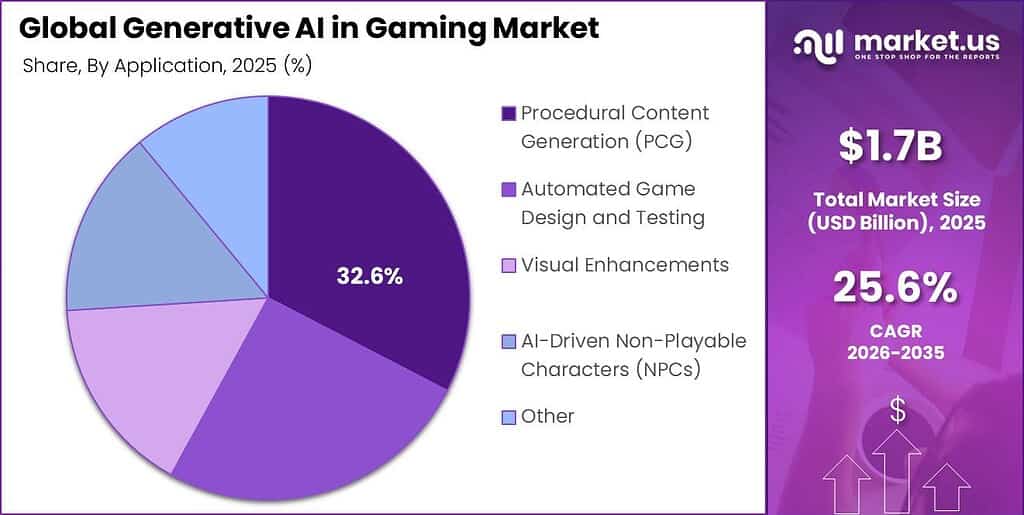
Key Market Segments
By Deployment
- On-premises
- Cloud-based
By Type
- Deterministic
- Nondeterministic
By Application
- Procedural Content Generation (PCG)
- Automated Game Design and Testing
- Visual Enhancements
- AI-Driven Non-Playable Characters (NPCs)
- Other
Market Dynamics
Drivers
| Driver | (~) % Impact on CAGR Forecast | Geographic Relevance | Impact Timeline |
|---|---|---|---|
| Live-service content refresh cycles | +3.2% | North America, Europe | Short term (≤ 2 years) |
| NPC and dialogue automation via LLMs | +2.8% | Global | Short term (≤ 2 years) |
| Procedural asset and level generation adoption | +2.1% | North America, East Asia | Short term (≤ 2 years) |
| Steam-driven platform disclosure normalization | +1.4% | Global | Short term (≤ 2 years) |
| Mobile and cloud gaming penetration growth | +1.2% | Asia-Pacific, Latin America | Medium term (2–4 years) |
| Rising commercial gaming revenue base | +0.9% | North America | Short term (≤ 2 years) |
Live-Service Content Refresh Cycles
The root cause is the structural shift of AAA and mid-tier studios toward live-service monetization, where retention depends on continuous content drops rather than a single box-office launch, and generative pipelines directly compress the marginal cost of producing that cadence; Bain and Company’s 2023-2024 executive survey found over half of respondents expect generative AI to absorb more than 50% of production-stage development workload within five to ten years, with early integration already visible in 2024-2025 pipelines for asset generation, live operations, and user-generated content.
Quantitatively, this manifests as a shift from per-seat art and animation licensing toward SaaS-style subscription tooling embedded directly into engine workflows, altering customer acquisition cost dynamics for tooling vendors and enabling smaller live-ops teams to sustain update frequency that previously required proportionally larger headcount.
Strategically, this compresses per-title content production cost as a share of live-service revenue and shortens the time between monetizable content drops, directly supporting the incremental 3.2% CAGR contribution above baseline by sustaining engagement-driven recurring revenue rather than one-time unit sales.
Restraints
| Restraint | (~) % Impact on CAGR Forecast | Geographic Relevance | Impact Timeline |
|---|---|---|---|
| AI-accelerator supply and compute scarcity | -3.1% | Global | Short term (≤ 2 years) |
| Human-authorship copyright registration bans | -2.4% | United States, United Kingdom | Short term (≤ 2 years) |
| Studio capital constraints amid high financing costs | -1.6% | North America, Europe | Short term (≤ 2 years) |
| Platform-level content takedown enforcement | -1.1% | Global | Short term (≤ 2 years) |
| Training-data licensing litigation exposure | -0.9% | United States, European Union | Medium term (2–4 years) |
AI-Accelerator Supply and Compute Scarcity
The root cause is that gaming-oriented generative AI workloads now compete directly with enterprise and hyperscaler demand for the same advanced GPU fabrication capacity, and industry commentary through 2025 points to months-long backorders on high-end AI accelerators driven by production bottlenecks at leading foundries.
Quantitatively, this bottleneck raises effective compute cost-per-inference for real-time generative features such as dynamic NPC dialogue and live asset rendering, forcing smaller studios to either delay feature rollout or absorb higher cloud-inference unit costs that were not budgeted into original title economics.
The strategic impact is a freeze on near-term CapEx for in-house generative infrastructure among mid-tier developers and a deduction of roughly 3.1% from the baseline CAGR, as studios reallocate budget toward third-party API access rather than owned model infrastructure, delaying the point at which margin benefits from AI-driven production efficiency can be realized.
Challenges
| Challenge | (~) % CAGR Friction Drag | Geographic Relevance | Mitigation Horizon |
|---|---|---|---|
| AI-specialized talent deficit | -1.8% | Global | Medium term (2–4 years) |
| System integration complexity in legacy engines | -1.5% | North America, Europe | Medium term (2–4 years) |
| Player trust and content authenticity concerns | -1.0% | Global | Medium term (2–4 years) |
| Fragmented cross-jurisdiction AI disclosure rules | -0.8% | European Union, Asia-Pacific | Long term (≥ 4 years) |
| Model output quality and hallucination control | -0.7% | Global | Medium term (2–4 years) |
AI-Specialized Talent Deficit
The structural vulnerability is that generative AI integration requires a hybrid skillset spanning machine learning engineering and traditional game design, yet Bain and Company’s executive survey found 60% of gaming leaders do not expect generative AI to alleviate the industry’s existing talent shortage, with system integration cited as the leading adoption barrier and technical capability gaps as a persistent pain point.
Quantitatively, this manifests as extended hiring timelines for ML-literate technical artists and prolonged internal retraining cycles, which continuously drag against the market’s maximum growth ceiling without halting current title production or sales, distinguishing it from an outright restraint.
The long-term corporate adjustment required is sustained investment in cross-functional training programs and technical-artist upskilling pipelines, representing an estimated 1.8% continuous friction drag on CAGR potential as studios must permanently allocate resources to bridging this skills gap rather than resolving it with a one-time fix.
Opportunities
| Opportunity | (~) % Potential CAGR Upside | Geographic Relevance | Execution Window |
|---|---|---|---|
| Player-personalized dynamic storyline monetization | +2.6% | Global | Medium term (2–4 years) |
| Metaverse-ready world-building tool licensing | +1.9% | Asia-Pacific, North America | Long term (≥ 4 years) |
| AI-driven QA and automated testing suites | +1.3% | Global | Medium term (2–4 years) |
| User-generated content marketplace roll-ups | +1.1% | North America, Europe | Long term (≥ 4 years) |
| Emerging-market mobile localization via generative voice | +0.8% | Latin America, Southeast Asia | Medium term (2–4 years) |
Player-Personalized Dynamic Storyline Monetization
This is classified as untapped white space rather than a current driver because, while personalization tools exist today, few studios have yet built pay-layer monetization on top of individually generated narrative branches, adaptive difficulty, and persistent AI companions; Technavio’s forward analysis for the adjacent AI-in-games category projects a substantially higher forecast CAGR through 2030, signaling headroom well above the generative-AI-in-gaming segment’s own baseline growth rate that remains uncaptured absent new monetization design.
The unit-economic shift comes from converting a fixed-content cost base into a variable, session-level personalization layer, where early tool vendors are pricing generative narrative add-ons as incremental in-app purchases rather than bundled base-game features, potentially lifting per-player average revenue without proportional increases in art or writing headcount.
If executed through dedicated monetization SKUs and adaptive-content subscription tiers over the next two to four years, this represents meaningful margin expansion potential by shifting cost structure from linear content production toward reusable generative infrastructure, capturing a sizable portion of currently unmet demand for individualized game experiences that sits above the market’s existing baseline trajectory.
Geopolitical Impact Analysis
Geopolitical tensions are directly reshaping the cost structure and supply security of the Generative AI in Gaming Market, which depends heavily on advanced GPUs, HBM memory, and cloud-compute infrastructure. The Section 232 semiconductor tariff enacted January 15, 2026 imposes a 25% duty on chips transiting the US en route to China, while broader US tariffs on Taiwanese and Indian semiconductor-linked exports have ranged between 15% and 50%, directly inflating input costs for GPUs used to train and run generative AI game engines.
A potential Phase 2 expansion of Section 232 tariffs, under Commerce Department review through July 2026, threatens to broaden duty coverage across additional chip categories critical to AI-rendering hardware, compounding pricing volatility for studios sourcing compute infrastructure. The WTO’s 2026 Global Trade Outlook projects world merchandise trade growth slowing sharply from 4.6% in 2025 to 1.9% in 2026, with economists flagging that continued Middle East conflict risks keeping energy prices elevated and further disrupting cross-border logistics for AI-hardware components.
Energy volatility compounds these pressures, since generative AI gaming platforms rely on power-intensive data centers. The IEA projects global data center electricity consumption doubling from 485 TWh in 2025 to 950 TWh in 2030, with AI-server inference load growing roughly 30% annually, driving up the energy-cost component embedded in cloud-based AI gaming services.
Maritime disruption adds further friction: the World Shipping Council’s 2026 report recorded an estimated 1,478 containers lost at sea in 2025, while rerouting around the Cape of Africa due to Red Sea instability has extended transit times and increased “bunching” congestion at major ports, delaying delivery of servers, GPUs, and peripheral gaming hardware. Combined, tariff-driven chip cost inflation, energy-price volatility, and rerouted logistics are compressing margins and elongating hardware procurement cycles across the generative AI gaming value chain.
Regional Analysis
North America’s AI-in-gaming leadership is grounded in enterprise-level AI adoption metrics: NVIDIA’s 2026 State of AI report found 70% of North American organizations are actively using AI in production, versus just 3% not using it at all, with 48% of firms planning to raise AI budgets by 10% or more this year.
Google Cloud’s 2025 developer survey (615 developers across the US, South Korea, Norway, Finland, and Sweden) found 90% of respondents already integrate generative AI into workflows, with the heaviest use in playtesting/balancing (47%), localization/translation (45%), and code generation/scripting (44%). The same study found 36% of developers personally use gen AI for dynamic level design, animation, and dialogue writing, and 94% believe it’s already driving industry-wide innovation.
However, adoption sentiment is cooling: the Game Developer Collective/Omdia survey shows developer-reported gen AI usage fell from 36% to 29% year-over-year, after rising from 24% in late 2024. The 2026 State of the Game Industry survey (2,300+ professionals via GDC Festival of Gaming) found only 30% of studio-based developers use gen AI tools, compared to 58% in publishing/marketing/business roles, while 52% believe gen AI has a negative industry impact.
Key Regions and Countries
North America
- US
- Canada
Europe
- Germany
- France
- The UK
- Spain
- Italy
- Rest of Europe
Asia Pacific
- China
- Japan
- South Korea
- India
- Australia
- Rest of APAC
Latin America
- Brazil
- Mexico
- Rest of Latin America
Middle East & Africa
- GCC
- South Africa
- Rest of MEA
Key Players Analysis
The Generative AI in Gaming market is dominated by a Tier-1 cluster of infrastructure and platform giants leveraging existing gaming ecosystems and compute scale, with NVIDIA and Microsoft commanding disproportionate influence.
NVIDIA’s Gaming and AI PC segment generated $11.4 billion in FY2025, up 9% YoY, while its dominant Compute and Networking segment hit $116.1 billion (89% of total revenue), funding continued rollout of NVIDIA ACE generative AI microservices and Neural Graphics for digital humans across over 600 RTX-enabled titles.
Microsoft, following its Activision Blizzard acquisition, posted Xbox content and services revenue reaching approximately $23.4 billion for FY2025, with Xbox content and services revenue up 13% in Q4 FY25, and Game Pass revenue nearing $5 billion, while corporate R&D investment ran near $8.1 billion (~10% of quarterly revenue) partly directed at Copilot-style generative tooling now permeating its Xbox and GitHub ecosystems.
Tier-2 Challengers are led by Unity Software, whose Create Solutions segment (engine tooling increasingly infused with generative AI features) posted $152 million in Q3 2025 revenue (up 3% YoY) against total company revenue of $471 million, with full-year 2025 revenue reaching $503.1 million in Q4 alone and 2025 annual revenue of roughly $1.9 billion.
Estimated segment dominance places NVIDIA and Microsoft controlling an outsized share of generative-AI-enabled gaming infrastructure spend given their combined compute and platform scale versus Unity’s tooling-layer footprint, reflecting a hierarchy driven by CapEx intensity, first-party IP control, and ecosystem lock-in rather than pure software differentiation.
Top Key Players in the Market
- NVIDIA Corporation
- Unity Technologies
- Luma AI Inc.
- IBM
- Charisma.ai
- Masterpiece Studio
- ZibraAI, Inc.
- DeepMotion
- Character Technologies, Inc.
- Kinetix
- Latent Technology
Recent Developments
- In March 2026, NVIDIA unveiled DLSS 5 at GTC 2026, introducing a generative AI model capable of dynamically transforming in-game character skins and models, while deepening its partnership with Adobe to scale the Firefly generative AI model into a full production pipeline for content creators.
- In November 2025, Luma AI closed a $900 million Series C funding round led by HUMAIN, valuing the company at approximately $4 billion, with participation from AWS and AMD Ventures; the funding will support a 2-gigawatt compute cluster and new offices in London and Riyadh to scale generative visual and 3D content models for gaming and interactive media.
Report Scope
| Report Features | Description |
|---|---|
| Market Value (2025) | USD 1.7 Billion |
| Forecast Revenue (2035) | USD 17.0 Billion |
| CAGR (2026-2035) | 25.6% |
| Base Year for Estimation | 2025 |
| Historic Period | 2020-2024 |
| Forecast Period | 2026-2035 |
| Report Coverage | Revenue Forecast, Market Dynamics, Competitive Landscape, Recent Developments |
| Segments Covered | By Deployment (On-premises, Cloud-based), By Type (Deterministic, Nondeterministic), By Application (Procedural Content Generation (PCG), Automated Game Design and Testing, Visual Enhancements, AI-Driven Non-Playable Characters (NPCs), Other Applications) |
| Regional Analysis | North America – US, Canada; Europe – Germany, France, The UK, Spain, Italy, Rest of Europe; Asia Pacific – China, Japan, South Korea, India, Australia, Singapore, Rest of APAC; Latin America – Brazil, Mexico, Rest of Latin America; Middle East & Africa – GCC, South Africa, Rest of MEA |
| Competitive Landscape | NVIDIA Corporation, Unity Technologies, Luma AI Inc., IBM, Charisma.ai, Masterpiece Studio, ZibraAI, Inc., DeepMotion, Character Technologies, Inc., Kinetix, Latent Technology |
| Customization Scope | Customization for segments, region/country-level will be provided. Additional customization can be done based on requirements. |
| Purchase Options | We have three licenses to opt for: Single User License, Multi-User License (Up to 5 Users), Corporate Use License (Unlimited Users and Printable PDF) |