Report Overview
In 2025, the Global Generative AI in Fashion Market was valued at USD 176.9 million and is projected to grow at a strong CAGR of 36.9% during 2026–2035, reaching about USD 4,090.8 million by 2035, with North America already accounting for over 34.2% of revenues, around USD 60.5 million.
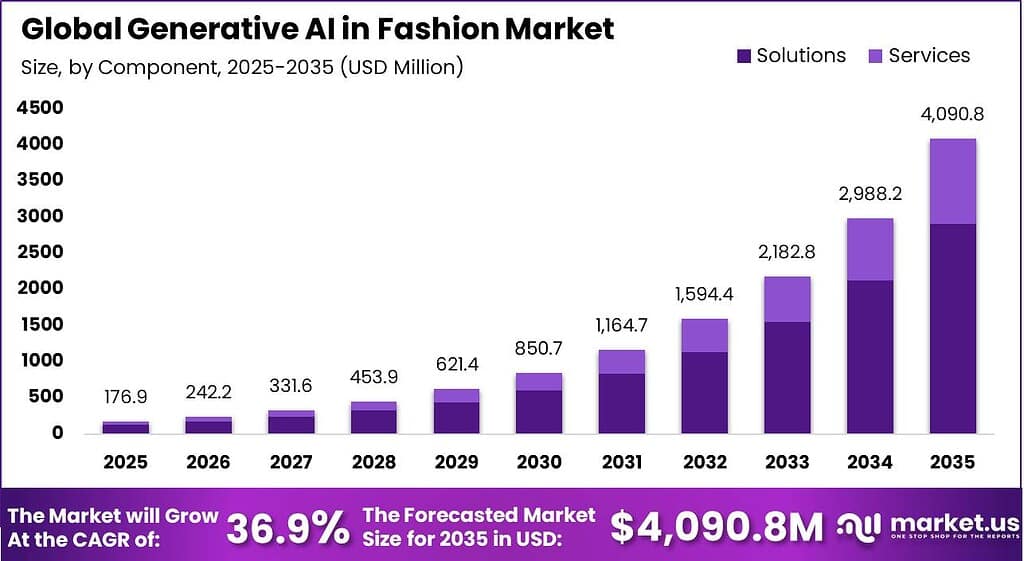
This steep curve is supported by the rapid expansion and digitalization of the core fashion value chain: according to the World Trade Organization, the global apparel market reached roughly USD 557.5 billion in 2024, up 7.08% from USD 520.6 billion a year earlier, while UNCTAD estimates the wider textile industry at about USD 1.6 trillion in 2023 and on track to double to USD 3.3 trillion by 2030, which creates a very large base where even a 0.5–1.0% productivity gain through AI in design.
North America’s leadership is underpinned by the scale of apparel spend and the fast shift to online and omnichannel retail, which structurally increases the need for AI‑generated images, descriptions, and personalized recommendations. U.S. apparel sales were around USD 359–366 billion in 2024–2025, with average monthly clothing store sales of about USD 25–26 billion and typical household spending near USD 1,900 per year on apparel.
The U.S. Census Bureau data shows e‑commerce already accounting for roughly 16.4–16.9% of total retail sales and growing faster than store-based sales, meaning more products, campaigns, and SKUs must be created and refreshed digitally every season.
As retailers and brands seek to shorten design cycles, test more styles in smaller runs, and localize assortments, generative AI directly supports these goals by cutting design and content lead times, enabling higher SKU throughput without linear increases in headcount; this explains why spending on generative AI in fashion can grow from USD 176.9 million in 2025 to over USD 4.0 billion by 2035 even if the broader apparel market grows at only low‑ to mid‑single‑digit rates.
Key Takeaway
- The global generative AI in fashion market was valued at USD 176.9 million in 2025.
- The global generative AI in fashion market is projected to grow at a CAGR of 36.9% and is estimated to reach USD 4,090.8 million by 2035.
- On the basis of component, the solutions segment dominated the market, constituting 71.2% of the total market share.
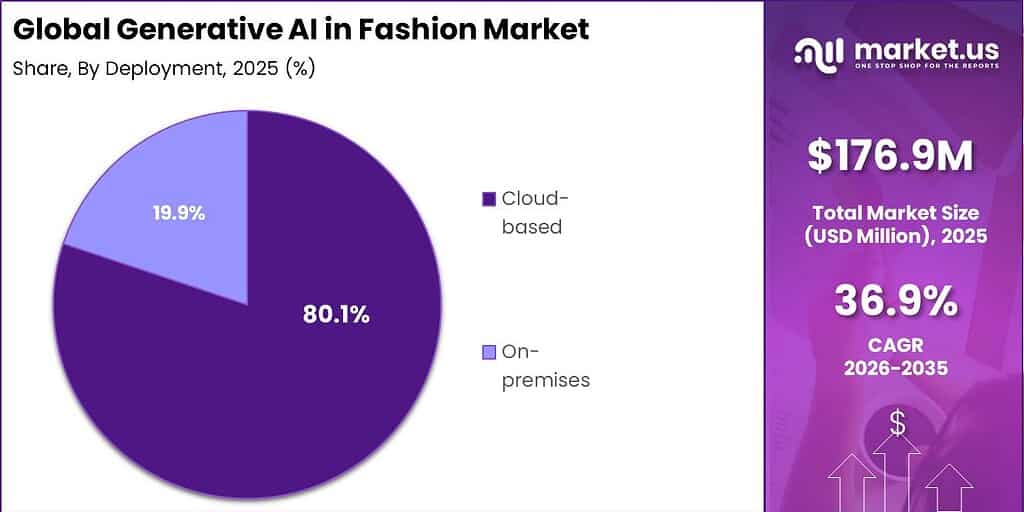
- Based on deployment, cloud-based deployment dominated the market, accounting for 80.1% of the total market share.
- Among the applications, creative design and trend forecasting held the largest share, accounting for 31.9% of the total market.
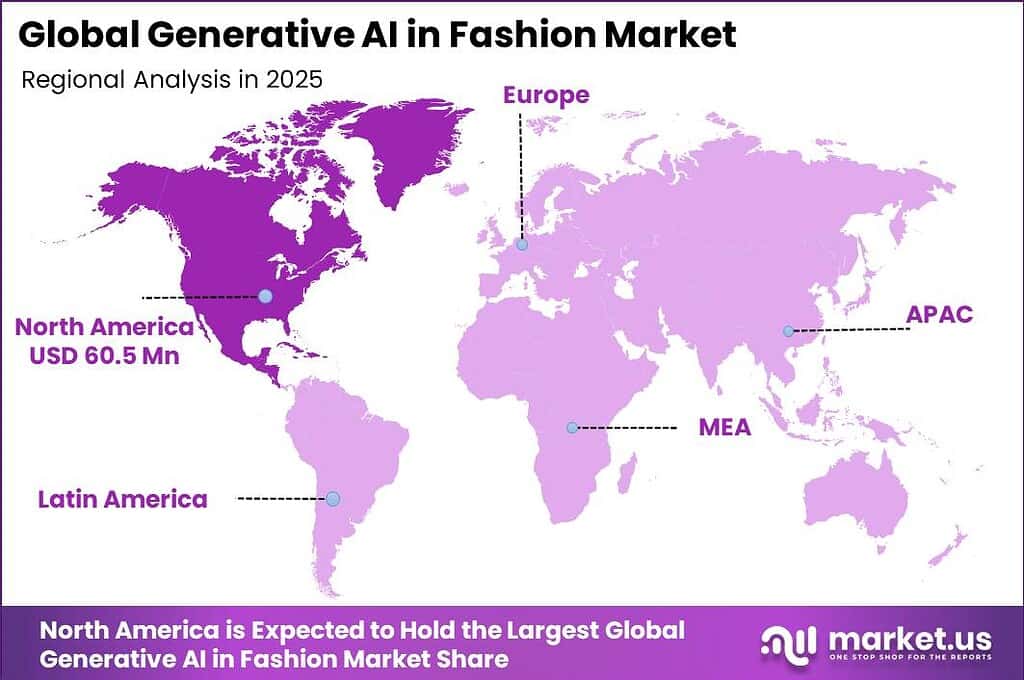
- In 2025, North America was the most dominant region in the generative AI in fashion market, accounting for 34.2% of the total market share, equivalent to approximately USD 60.5 million.
By Component
In 2025, solutions held a dominant market position, capturing more than 71.2% share of the global generative AI in fashion market by component. Fashion brands and retailers have leaned heavily on packaged software rather than services because these tools plug directly into existing design and merchandising workflows without lengthy consulting engagements.
Retailers such as Zalando used generative AI solutions to produce 70% of its Q4 2024 editorial content, cutting production time from six to eight weeks down to three to four days, a result driven purely by embedded software rather than outsourced services. Stitch Fix’s proprietary visualization tool, Stitch Fix Vision, keeps 75% of users returning in the following months, with spending rising over 100% within a 90-day window, showing how self-contained solutions drive repeat engagement.
Heading into 2026, over 40% of new product introductions across the textile sector now involve automated design and virtual prototyping software, according to early-2026 industry analysis, reinforcing why standalone solutions continue to outweigh service-based engagements. Vendors are also bundling pattern intelligence, fabric physics, and rendering into single platforms, reducing the need for third-party service providers and further cementing the solutions segment’s lead through 2026.
By Deployment
Cloud-based deployment held a significant share of the market in 2025, accounting for more than 80.1% of generative AI in fashion implementations, as brands avoided the capital costs of on-premises infrastructure. Enterprise-wide cloud usage has become nearly universal, with 94% of organizations already running workloads in some cloud environment by 2025, giving fashion companies a ready foundation to layer generative AI tools on top of.
Global cloud infrastructure spending exceeded $1.3 trillion in 2025, and infrastructure spend rose 29% year-over-year in the final quarter of the year alone, the sixth straight quarter of 20%-plus growth, showing how quickly compute capacity scaled to meet generative workloads. Nvidia’s January 2025 retail shopping assistant blueprint.
Google’s virtual try-on feature, now available in the US, UK, and India, similarly runs entirely through cloud-hosted models rather than local processing, letting shoppers upload photos and get instant renders. Through 2026, over half of enterprises plan to increase investment specifically in cloud-based AI and analytics, and roughly 65 to 70% of new digital initiatives are expected to be cloud-native, a trend fashion technology teams are following closely as they scale generative design and personalization tools.
By Application
Creative design and trend forecasting held a significant share of the market in 2025, accounting for more than 31.9% of generative AI in fashion applications, as brands shifted away from relying purely on traditional trend reports. Trend forecasting alone recorded the highest adoption rate among AI-driven fashion applications at 72%, with visual content creation following at 69% and pattern and textile design at 65%, together representing over $1.2 billion in cumulative industry investment.
Platforms including Heuritech and Designovel now scan runway imagery and social media visuals to detect emerging silhouettes and colors months before a season begins, letting design teams align collections with real demand signals instead of instinct. Brands applying AI-driven trend analysis have cut inventory waste by 30 to 50% and reduced stock unavailability by roughly 65%, since forecasting models flag which styles will sell before production even starts.
In February 2026, ASOS embedded generative AI tools directly into its design pipeline to speed up collection creation, while tools like Fashion Diffusion allow rapid restyling and texture testing during the same design cycle. Fashion executives have named scaling these creative and forecasting tools their single biggest opportunity heading into 2026, with 92% of fashion organizations planning to raise generative AI investment specifically in this area.
Key Market Segments
By Component
- Solutions
- Services
By Deployment
- Cloud-based
- On-premises
By Application
- Product Recommendation
- Product Search and Discovery
- Supply Chain Management and Demand Forecasting
- Creative Designing and Trend Forecasting
- Customer Relationship Management
- Virtual Assistants
- Other
Market Dynamics
Drivers
| Driver | (~) % Impact on CAGR Forecast | Geographic Relevance | Impact Timeline |
|---|---|---|---|
| Enterprise-wide GenAI adoption in fashion workflows | +6.0% | North America, Europe, East Asia | Short term (≤ 2 years) |
| Marketing & merchandising content automation | +4.0% | Global tier-1 retailers | Short term (≤ 2 years) |
| GenAI-assisted design and product development | +3.5% | Global fashion brands | Medium term (2–4 years) |
| Personalized recommendations & virtual try-ons | +3.0% | Online fashion marketplaces worldwide | Medium term (2–4 years) |
| Inventory optimization and demand forecasting | +2.0% | Global omni-channel retailers | Medium term (2–4 years) |
| Cloud-native AI tooling availability | +1.5% | Global | Long term (≥ 4 years) |
Enterprise-wide GenAI adoption in fashion workflows
Enterprise-wide generative AI adoption across design, merchandising, marketing, and customer experience is the primary driver lifting the baseline CAGR, as surveys in 2023–2024 show that roughly 40–45% of fashion companies already use AI in at least one business function and more than 70% of executives rank generative AI as a strategic priority, with over half already piloting or scaling deployments.
This adoption immediately alters operating models: creative and campaign teams are shifting from fully in‑house studio production to hybrid pipelines where GenAI generates large volumes of image variants, copy, and mood boards in seconds, compressing campaign cycle times by 30–50% and reducing per-asset production costs by an estimated 20–40% for mid-tier brands that traditionally spent millions annually on photo shoots and agency retainers.
This structural shift improves gross margins by 100–200 basis points for digitally mature retailers via lower content and marketing production costs, while also supporting top-line growth through more frequent, hyperlocalized campaigns and better sell-through, making a mid‑single‑digit percentage uplift to the already high baseline CAGR commercially plausible rather than speculative.
Restraints
| Restraint | (~) % Impact on CAGR Forecast | Geographic Relevance | Impact Timeline |
|---|---|---|---|
| Regulatory compliance burden from AI-specific laws | -4.0% | EU, UK, partially global | Medium term (2–4 years) |
| Copyright and training data litigation risk | -3.0% | US, EU, developed markets | Short term (≤ 2 years) |
| High compute and infrastructure costs | -2.5% | Global, especially SMB fashion brands | Short term (≤ 2 years) |
| Conservative brand governance on AI usage | -2.0% | Luxury & premium segments | Medium term (2–4 years) |
| Limited AI readiness in emerging-market retailers | -1.5% | Latin America, Africa, South Asia | Long term (≥ 4 years) |
| Data localization and cross-border transfer rules | -1.0% | EU, China, select APAC | Medium term (2–4 years) |
Regulatory compliance burden from AI-specific laws
The emerging AI-specific regulatory regime, exemplified by the EU Artificial Intelligence Act that entered into force on 1 August 2024 with most obligations applying from 2 August 2026, is already acting as a hard restraint on generative AI deployments in fashion by forcing vendors and large European retailers to slow or halt rollouts until systems are reclassified and documented.
For EU‑exposed fashion players that derive a substantial share of revenue from the bloc, this shifts capex from experimental GenAI pilots to compliance teams and external legal/technical consultants, delaying some deployment programs by 12–24 months and cutting near‑term AI project portfolios by an estimated 20–30% in scope to stay within risk and budget envelopes.
Challenges
| Challenge | (~) % CAGR Friction Drag | Geographic Relevance | Mitigation Horizon |
|---|---|---|---|
| Talent gap in GenAI and fashion | -3.5% | Global, concentrated in major fashion hubs | Medium term (2–4 years) |
| Fragmented legacy retail IT stacks | -3.0% | Global omni-channel retailers | Long term (≥ 4 years) |
| Bias and brand-safety issues in models | -2.5% | Global consumer-facing brands | Medium term (2–4 years) |
| Inconsistent data quality and tagging | -2.0% | Global, especially multi-brand retailers | Medium term (2–4 years) |
| Change-management resistance in creative teams | -1.5% | Europe, North America | Short term (≤ 2 years) |
| Measurement complexity for GenAI ROI | -1.0% | Global | Short term (≤ 2 years) |
Talent gap in GenAI and fashion
The structural shortage of professionals who combine deep fashion domain expertise with production-grade generative AI skills is a major challenge that drags on the market’s maximum achievable growth, as broader AI surveys indicate that only around 10–15% of companies globally have scaled AI across multiple business units, and fashion is competing for a shared, limited talent pool skewed toward tech and finance.
Fashion groups need profiles blending data engineering, prompt engineering, computer vision, and merchandising knowledge, but most established houses have small central data teams of a few dozen people compared with hundreds or thousands of designers, merchandisers, and marketers, creating ratios where one AI specialist may be expected to support 50–100 end users across brands and regions.
Opportunities
| Opportunity | (~) % Potential CAGR Upside | Geographic Relevance | Execution Window |
|---|---|---|---|
| Direct-to-avatar and virtual fashion creation | +5.0% | Global, especially Asia and North America | Long-term (≥ 4 years) |
| GenAI-powered on-demand microproduction | +4.0% | Europe, North America, East Asia | Medium term (2–4 years) |
| Licensing of proprietary fashion datasets | +3.0% | Global tier-1 brands | Medium term (2–4 years) |
| AI-native fashion design platforms for SMEs | +2.5% | Global emerging designers and small brands | Short term (≤ 2 years) |
| Sustainability optimization and waste reduction | +2.0% | Global, especially EU and UK | Medium term (2–4 years) |
| Retail media and dynamic creative optimization | +1.5% | Global marketplaces and large retailers | Short term (≤ 2 years) |
Direct-to-avatar and virtual fashion creation
Direct-to-avatar and virtual fashion creation is a future opportunity rather than a current driver because, although GenAI already underpins asset generation for marketing, the monetization of purely digital garments across gaming, social, and virtual environments remains nascent and fragmented, with only a small fraction of fashion revenue currently derived from virtual items despite large user bases in major game and creator platforms.
Generative models radically change the unit economics of virtual fashion by allowing a single designer or small team to create hundreds of high-fidelity, platform-optimized looks per month, cutting effective design and content-creation costs per SKU by an estimated 60–80% versus traditional 3D workflows and enabling A/B testing of styles with negligible marginal cost.
As platforms improve interoperability and payment rails, fashion brands can capture higher digital gross margins often exceeding 60–70% for virtual items after platform fees, compared with physical apparel margins that may sit in the 50% range before logistics and returns, creating headroom for incremental profit pools that materially lift overall growth if scaled.
Geopolitical Impact Analysis
Heightened geopolitical frictions are exerting direct cost and timing pressures on the global generative AI in fashion ecosystem, particularly across data-center infrastructure, GPU procurement, and digital fashion content workflows. In early 2024, disruptions at the Red Sea and Suez chokepoint cut Suez Canal trade volumes by 50% and increased average delivery times by 10 days or more, forcing carriers to reroute via the Cape of Good Hope and extending transit routes for both fashion products and the GPUs and servers used to run generative AI models for design and virtual try‑on applications.
For fashion brands deploying generative AI platforms in Europe and North America, these maritime delays have translated into multi‑week slippages in cloud hardware rollouts and higher freight and insurance costs, with oil benchmarks such as North Sea Dated rising by about 2.13 USD per barrel to 84.66 USD in February 2024 as tanker routes lengthened, directly inflating data-center cooling and logistics energy overheads embedded in AI‑enabled fashion pricing.
Concurrently, escalating trade tensions and tariff measures are inflating input costs across the apparel and digital fashion supply stack that underpins training datasets and AI‑driven design workflows. WTO tariff data show sustained elevation in applied duties, while policy scenarios for an “America First” trade framework envisage general tariffs of around 10% on all imports plus additional surcharges on strategic suppliers such as China; at the same time, sectoral analysis indicates apparel imports from China into the US have faced cumulative punitive increases pushing effective rates above 50–60% in 2025.
These surcharges directly raise landed costs for key textile inputs cotton fabrics, synthetic fibers, trims, and accessories that dominate image libraries and 3D asset pipelines used to train generative models, so a 20–30 percentage point tariff shock on those categories typically flows through to mid‑single‑digit increases in wholesale prices for AI‑assisted capsule collections.
Regional Analysis
North America dominates the global Generative AI in Fashion market, with an estimated value of USD 60.5 million. The region is a major demand and innovation hub, with the United States accounting for most regional spending through its concentration of fashion-tech start-ups, cloud providers, and enterprise AI platforms supporting design, merchandising, and marketing.
North American revenues are growing at a high double-digit rate, with adoption expanding quarter-on-quarter as companies achieve time-to-market reductions of several weeks, digital asset cost savings of 20–40%, and improved digital customer engagement.
Large brands and online platforms currently lead adoption, while mid-tier and niche labels are increasingly using subscription-based AI tools to scale design iterations and storytelling without proportional increases in creative headcount. As adoption moves from pilots to enterprise-wide workflows, North America is expected to remain the largest regional contributor and a key benchmark for AI implementation and ROI.
Key Regions and Countries
North America
- US
- Canada
Europe
- Germany
- France
- The UK
- Spain
- Italy
- Rest of Europe
North America
- China
- Japan
- South Korea
- India
- Australia
- Rest of APAC
Latin America
- Brazil
- Mexico
- Rest of Latin America
Middle East & Africa
- GCC
- South Africa
- Rest of MEA
Key Players Analysis
Tier-1 leadership in generative AI in fashion is concentrated among large platforms such as Microsoft, Google, Amazon, Adobe, SAP, and Oracle, which collectively capture an estimated 55–65% of generative AI value in fashion through cloud, design, data infrastructure, and SaaS-based tools. Tier-2 challengers, including Heuritech, Syte, Lily AI, FindMine, Intelistyle, Wide Eyes, Finesse, Daydream, and Raspberry AI, collectively account for roughly 20–30%, focusing on specialized fashion applications.
The global generative AI in fashion market was approximately USD 96.5 million in 2023, with solutions accounting for over 71% of revenue and cloud deployments exceeding 80%. By 2032, the market is projected to reach USD 2.23 billion at a 36.9% CAGR, while North America generated USD 32.81 million in 2023, representing about 34% of the market.
Tier-1 players reinforce their position through multi-billion-dollar R&D investments and AI platforms embedded across Azure, Google Cloud, AWS, Adobe Creative Cloud and Experience Cloud, SAP S/4HANA, and Oracle Retail. These technologies support visual search, generative content, personalization, and demand forecasting for brands including Nike, Zara, H&M, Gucci, Levi’s, and Burberry.
Their impact is reflected in reported operational gains: H&M attributes a 30% profit uplift, 25% waste reduction, and 14% fewer stockouts to AI-driven demand models; Zara reports 98% inventory accuracy and twice-weekly restocking; and Nike’s predictive analytics and RFID use have delivered approximately 50% faster order cycles.
Top Key Players in the Market
- Google AI
- IBM Watson
- Adobe
- Microsoft Azure AI
- Amazon Web Services, Inc.
- Steve.ai
- Azure
- AWS
- SAP S/4HANA
- Oracle
- Nike
- Zara
- H&M
- Levi’s
- Burberry
- Other
Recent Developments
- In December 2025, Phia, an AI-driven fashion shopping and styling startup co-founded by Phoebe Gates and Sophia Kianni, announced a new equity round of USD 30 million led by Notable Capital at a post-money valuation of USD 180 million, following an earlier USD 8 million seed round in September 2025, with proceeds allocated to expand its generative AI wardrobe-personalization engine and global fashion retail partnerships
- In February 2025, IBM published a watsonx.ai tutorial showing how to build a generative‑AI‑powered “AI stylist” using Granite Vision 3.2, which analyzes user photos and event context to recommend outfits from a wardrobe through a multi‑step vision‑plus‑text pipeline.
Report Scope
| Report Features | Description |
|---|---|
| Market Value (2025) | USD 176.9 Million |
| Forecast Revenue (2035) | USD 4,090.8 Million |
| CAGR (2026-2035) | 36.9% |
| Base Year for Estimation | 2025 |
| Historic Period | 2020-2024 |
| Forecast Period | 2026-2035 |
| Report Coverage | Revenue Forecast, Market Dynamics, Competitive Landscape, Recent Developments |
| Segments Covered | By Component (Solutions, Services), By Deployment (Cloud-based, On-premises), By Application (Product Recommendation, Product Search and Discovery, Supply Chain Management and Demand Forecasting, Creative Designing and Trend Forecasting, Customer Relationship Management, Virtual Assistants, Other Applications) |
| Regional Analysis | North America – US, Canada; Europe – Germany, France, The UK, Spain, Italy, Rest of Europe; North America – China, Japan, South Korea, India, Australia, Singapore, Rest of APAC; Latin America – Brazil, Mexico, Rest of Latin America; Middle East & Africa – GCC, South Africa, Rest of MEA |
| Competitive Landscape | Google AI, IBM Watson, Adobe, Microsoft Azure AI, Amazon Web Services, Inc., Steve.ai, Azure, AWS, SAP S/4HANA, Oracle, Nike, Zara, H&M, Levi’s, Burberry |
| Customization Scope | Customization for segments and region/country levels will be provided. Moreover, customization can be tailored to the requirements. |
| Purchase Options | We have three licenses to opt for: Single User License, Multi-User License (Up to 5 Users), Corporate Use License (Unlimited Users and Printable PDF) |