


Report Overview
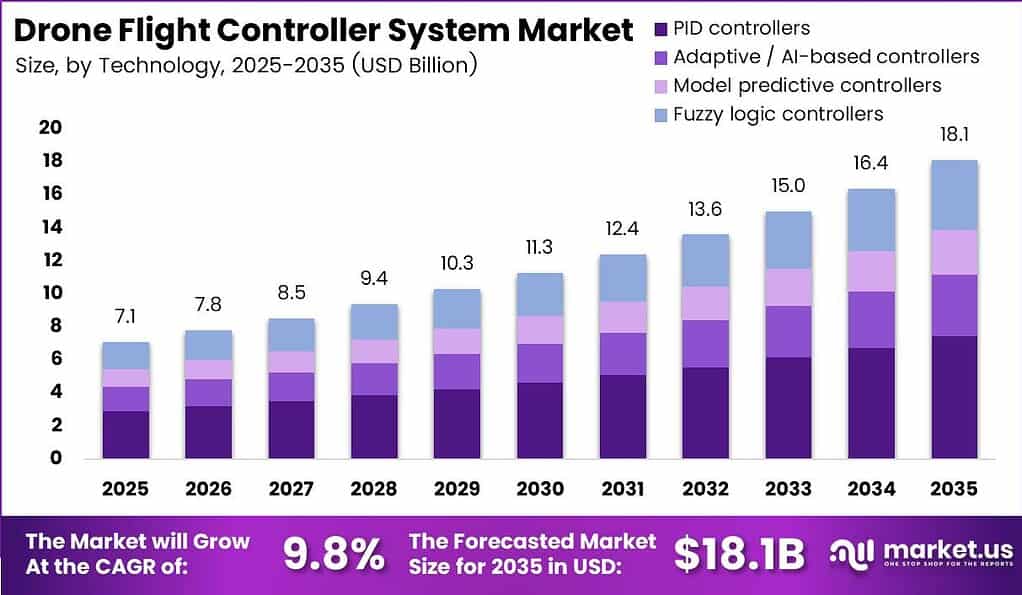
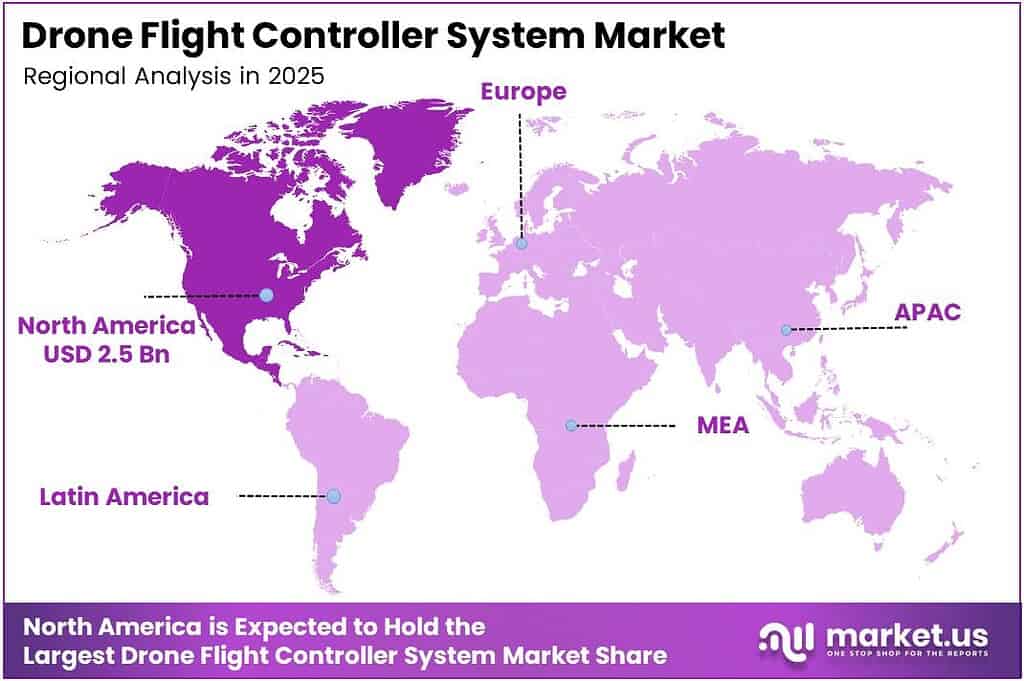
In 2025, the Global Drone Flight Controller System Market was valued at US$ 7.1 billion, and between 2026 and 2035, this market is estimated to register a CAGR of 9.8%, reaching about US$ 18.1 billion by 2035. In 2025, North America led the market, achieving over 35.60% share with a revenue of US$ 2.53 Billion.
Drone Flight controller is the core of the unmanned aircraft systems (UAS). This technology performs sensor data integration and flight command processing for aircraft stabilization and autonomy. Commercial use cases include aerial mapping, infrastructure inspection, agriculture, and logistics. In these industries, the demand for precision, autonomy, and beyond-visual-line-of-sight (BVLOS) solutions grows.
- Currently, regulatory oversight is largely dominated by mature aviation markets. As per the U.S. Federal Aviation Administration (FAA), as of November 2025, there are a total of 837,513 registered drones, of which commercial registrations amount to 453,635 (about 54%) while recreational users account for 371,334.
Technological innovation tends to move towards AI-powered, highly redundant, and autonomous drone flight control platforms. Contemporary flight controllers utilize multisensory integration (GPS, magnetometer, barometer, visual odometry) and real-time kinematic positioning for precise navigation. Additionally, the creation of regulations related to BVLOS (e.g., FAA Part 107 waivers) allows for scaling commercial operations, thus boosting long-term demand for sophisticated flight controllers with DAA and automated emergency response systems.
Key Takeaways
- The global drone flight controller system market was valued at US$7.1 billion in 2025.
- The global drone flight controller system market is projected to grow at a CAGR of 9.8% and is estimated to reach US$18.1 billion by 2035.
- On the basis of Technology, PID controllers dominated the market, constituting 40.30% of the total market share.
- Based on the drone type, Multirotor drones dominated the with a substantial market share of around 60%.
- Based on application, Agricultural monitoring and crop spraying led the market, comprising 30.3% of the total market.
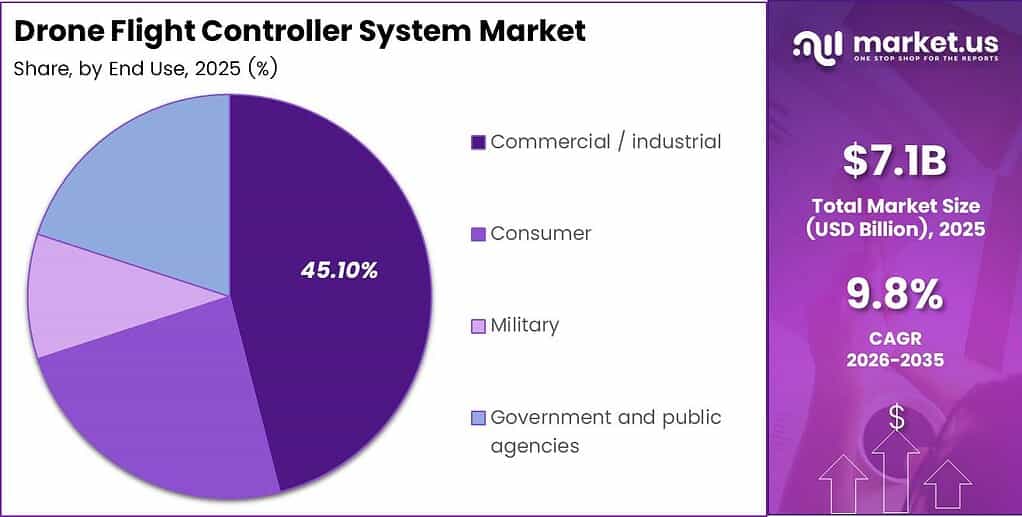
- Among the end-uses Commercial / industrial held a major share in market, 45.10% of the market share.
- Among the sales channel, the Offline channel is the most considerable within the market, accounting for around 70.40% of the revenue.
- In 2025, the North America was the most dominant region in the global drone flight controller system market, accounting for 35.60% of the total global consumption.
Global Drone Flight Controller System Market Scope:
Technology Type Analysis
PID controllers represents dominant Segment in the Market.
PID controllers dominates the market with a share of 40.30% which is is attributed to reliability and consistent flight performance in diverse drone models. These increasing numbers depend heavily on PID controllers because of easy implementation and effectiveness in stable environments. Furthermore, FAA certifies remote pilots to fly drones, and currently, there are 481,760 certified remote pilots, indicating that professionals require reliable flight controls.
Adaptive and AI-based controllers, with 24.90% market share, are the fastest-growing controllers. Their growth is attributed to the proposal for Part 108 BVLOS rule by FAA, dated August 2025. The proposal intends to move from the current waiver-based process to performance-based rules for BVLOS flights for delivery, infrastructure inspection, and precision agriculture. Since the rule requires automated processes and decisions, drones will need AI-integrated flight controllers to operate effectively. The notice of proposed rulemaking has gathered over 3,000 public comments so far, with the final rule expected in March/April 2026.
Drone Type Analysis
Multirotor drones a significant type.
The multirotor type constitutes the highest market share of 60.00%, thanks to their wide adoption in surveying, agriculture, and security. The European Union Aviation Safety Agency (EASA) has reported that more than 70% of all registered commercial drone operators within the EU utilize solely the multirotor platform because of their hovering accuracy and maneuverability at lower altitudes.
The hybrid/VTOL type is the fastest growing drone type, constituting 15.00% of the market. The U.S. Department of Energy (DOE) has confirmed that hybrid VTOL platforms constitute more than 40% of newly adopted drones for long-range linear infrastructure inspections (pipelines and power lines). This is according to the U.S. Department of Energy statistics up to the year 2025.
Application Type Analysis
Agricultural monitoring and crop spraying are the most widely used application.
Monitoring agriculture and spraying crops is currently the leading segment of the Global Drone Flight Controller System Market with the biggest market share of 30.30%, driven by the increased government-led adoption. The USDA Economic Research Service states that aerial photography using drones helps in mapping crops, livestock monitoring, surveying land, and crop spraying in U.S. farms. Government grants have been instrumental in this development. For instance, in October 2024, the USDA launched up to $7.7 billion in assistance in fiscal year 2025, almost twice the 2023 figures and the most significant investment in conservation programs ever made by USDA.
Commercial drones for photography and video production a 25.00% stake, which makes it the fastest growing segment. In accordance with the FAA’s Aerospace Forecast, the commercial drone population will be around 1,083,000 aircraft registered by 2026, increasing from 842,000 aircraft in 2023 due to their continued growth in commercial uses related to photography. It should also be noted that commercial photography using unmanned aircraft is specified in the FAA’s Part 107 regulations.
Sales Channel Analysis
Offline channel Held a Major Share of the sales channel.
Offline sales channels have the most dominant market share of 70.40%, attributed to the enterprise procurement approach, which needs technical consultation, customization, and after-sales support. Drone flight controller systems consist of complex hardware-software integration in which customers depend on the distributors and integrators physically to install, calibrate, and maintain the system.
- The Bureau of Labor Statistics, U.S. Department of Labor, report of 2025 forecasts a reduction of 181,900 jobs in retail trade by 2034 due to automation that changes sales channels, but specialized drone hardware sales will still be predominantly offline because of its value and technicality.
The fastest-growing sales channel segment is represented by the online sales channel, which has a current market share of 29.60%. This growth is expected from the FAA’s proposed Part 108 BVLOS rule, which favors manufacturer-based airworthiness approvals to facilitate direct consumer online sales channels.
End Use Analysis
Drone Flight Controller System Are Mostly Utilized in Commercial / industrial.
The commercial and industrial sector takes the largest market share of 45.10%, due to the high usage of UASs in mapping, surveying, and inspection activities. The FAA’s proposed Part 108 BVLOS rule (August 2025) is likely to further expand the commercial market, implementing a set of scalable rules for inspection, agricultural, and delivery operations, with the final rule being expected in March-April 2026.
Government and public agencies are the fastest-growing end-use segment, currently taking up 6.90% market share. In the course of 2025, the Los Angeles Police Department used drones more than 3,500 times within its “Drone as First Responder” pilot project, carrying out more than 3,000 drone flights in 2025 and 2,550 public safety missions. In turn, the New York Police Department carried out 6,546 drone flights during the first six months of 2025, an increase of 3,200% compared to 2022. Overall, roughly 1,500 law enforcement agencies have launched drone programs in the United States.
Key Market Segments
By Technology
- PID controllers
- Adaptive / AI‑based controllers
- Model predictive controllers
- Fuzzy logic controllers
By Drone Type
- Multirotor drones
- Fixed‑wing drones
- Hybrid / VTOL drones
By Application
- Agricultural monitoring and crop spraying
- Aerial photography and videography
- Infrastructure inspection and surveying
- Search and rescue and public safety
- Delivery and logistics services
By Sales Channel
- Offline
- Online
By End Use
- Consumer
- Commercial / industrial
- Military
- Government and public agencies
Market Drivers
| Driver | (~) % Impact on CAGR Forecast | Geographic Relevance | Impact Timeline |
|---|---|---|---|
| Commercial autonomy and BVLOS demand | +2.4% | North America, Europe, East Asia | Short term (≤ 2 years) |
| Defense reconnaissance procurement | +1.9% | Europe, North America, Middle East, Asia-Pacific | Short term (≤ 2 years) |
| Precision agriculture automation | +1.4% | North America, Latin America, Asia-Pacific | Medium term (2–4 years) |
| Remote ID hardware refresh | +1.0% | North America, Europe, Japan | Short term (≤ 2 years) |
| Inspection and surveying deployment | +0.8% | Global | Medium term (2–4 years) |
| Onboard AI sensor fusion | +0.6% | North America, Europe, East Asia | Medium term (2–4 years) |
Commercial autonomy and BVLOS demand
Commercial operators increasingly require controllers that can execute autonomous missions, maintain command-link integrity, manage contingency behaviors and interface with remote-identification and traffic-management systems. In August 2025, the Federal Aviation Administration proposed a Beyond Visual Line of Sight framework intended to enable drone operations such as package delivery, agriculture, aerial surveying, public-safety work and flight testing; the proposal includes requirements for lighting, Remote ID broadcasting, operational authorization and safe separation from manned aircraft.
This shifts controller demand from low-cost stabilization boards toward higher-value autopilots combining redundant inertial measurement, navigation, geofencing, detect-and-avoid interfaces and secure telemetry. An integrated controller can reduce ground-operator intervention by an estimated 20–40% per mission and increase usable mission radius several-fold where authorization permits, supporting higher software and support revenue per aircraft. These capability upgrades contribute an estimated +2.4% to the 9.8% baseline CAGR.
Market Restraints
| Restraint | (~) % Impact on CAGR Forecast | Geographic Relevance | Impact Timeline |
|---|---|---|---|
| BVLOS approval and airspace limits | -1.8% | North America, Europe, Asia-Pacific | Short term (≤ 2 years) |
| Export-control and sourcing restrictions | -1.2% | North America, Europe, East Asia | Short term (≤ 2 years) |
| Certification cost barriers | -0.9% | Global commercial markets | Medium term (2–4 years) |
| Public procurement funding volatility | -0.6% | North America, Europe, developing markets | Short term (≤ 2 years) |
| Low-cost hobbyist commoditization | -0.4% | Global | Short term (≤ 2 years) |
BVLOS approval and airspace limits
Beyond-visual-line-of-sight operations remain constrained by authorization, airspace and safety requirements, limiting immediate demand conversion for high-end autonomous flight controllers. Current Federal Aviation Administration guidance requires pilots to maintain visual line of sight, remain below 400 feet and avoid restricted or prohibited airspace unless operating under an applicable authorization; the proposed BVLOS framework would still require approval for the intended operational area and disclosure of boundaries, daily operational volume, takeoff, landing and loading areas.
These rules can delay commercial rollouts by roughly 6–18 months, hold back fleet purchase orders and force operators to fund route studies, safety cases and specialist compliance resources before scaling. Controller manufacturers bear related costs for documentation, Remote ID integration, evidence packages and hardware redesign, increasing development expense by an estimated 8–15% for commercial-grade platforms. The direct delay in authorized operating scale deducts an estimated -1.8% from the baseline CAGR.
Market Challenges
| Challenge | (~) % CAGR Friction Drag | Geographic Relevance | Mitigation Horizon |
|---|---|---|---|
| GNSS denial resilience engineering | -1.4% | Defense, critical infrastructure, global | Long term (≥ 4 years) |
| Cybersecure command-link integration | -1.1% | Global | Long term (≥ 4 years) |
| Sensor fusion calibration complexity | -0.8% | Global | Medium term (2–4 years) |
| Aviation software talent scarcity | -0.6% | North America, Europe, East Asia | Long term (≥ 4 years) |
| Safety-critical chip availability | -0.5% | Global | Medium term (2–4 years) |
GNSS denial resilience engineering
Commercial and defense drones remain vulnerable when satellite-navigation signals are jammed, spoofed, obstructed or degraded by dense urban, mountainous and electromagnetic environments. A controller designed primarily around GNSS positioning can experience drift, mission interruption or loss of navigation confidence, forcing manufacturers to combine inertial navigation, visual odometry, terrain references, radio-frequency sensing and fault-detection logic.
Achieving resilient performance increases controller processor load, sensor count, power draw and validation complexity; a multi-sensor architecture can add an estimated 15–30% to controller hardware cost and extend development plus flight-test cycles by roughly 9–18 months. The strategic adjustment requires modular sensor interfaces, rigorous simulation, electronic-warfare testing and field-update capability, but does not halt existing consumer or basic commercial controller sales. It therefore creates an estimated -1.4% drag on maximum achievable market growth.
Market Opportunities
| Opportunity | (~) % Potential CAGR Upside | Geographic Relevance | Execution Window |
|---|---|---|---|
| Controller software subscription platforms | +2.0% | North America, Europe, Asia-Pacific | Medium term (2–4 years) |
| Swarm mission orchestration modules | +1.5% | Defense, logistics, public safety | Long term (≥ 4 years) |
| Certified agricultural autopilot kits | +1.1% | North America, Latin America, Asia-Pacific | Medium term (2–4 years) |
| Retrofit autonomy upgrade packages | +0.8% | Global installed drone fleets | Medium term (2–4 years) |
| U-space interoperability services | +0.6% | Europe, North America, East Asia | Long term (≥ 4 years) |
Controller software subscription platforms
Controller software subscriptions are future white space because most flight-controller suppliers still derive the majority of revenue from one-time hardware sales rather than recurring mission-management, health-monitoring, fleet analytics and feature-activation services. A secure cloud-connected offering can monetize flight logs, predictive maintenance alerts, geofence updates, compliance reporting and configurable autonomy modes across the controller’s operating life. This opportunity is supported by the growing requirement for Remote ID: registered drones used for recreation, business or public safety must comply with the Federal Aviation Administration’s Remote ID rule, and compliant aircraft broadcast drone and control-station identification and location information.
Moving to a hardware-plus-software model can reduce customer acquisition costs by an estimated 10–20% through higher retention, increase lifetime revenue per controller by approximately 25–50% and expand gross margins by roughly 300–600 basis points once software development is scaled. This remains untapped because it requires interoperable firmware, secure data infrastructure and customer acceptance of recurring fees, but can add an estimated +2.0% above the 9.8% baseline CAGR.
Geopolitical Impact Analysis
Geopolitical Realignment and Supply Chain Fragmentation Reshaping Drone Flight Controller System Manufacturing.
The export controls by China and Western nations have resulted in a split of the global flight controller market for drones into two different chains, directly affecting the conflict zones.
With China being the provider of nearly about 97% of the key parts in Ukraine’s drones including flight controllers, motors, and sensors, the strict export controls implemented in October 2025 have shut down the Baltic and Polish transshipment of parts for Ukraine, effectively limiting their drone manufacturing capabilities to the point of production lines stopping. In contrast, Russia has found an effective way to bypass the same restrictions through the creation of a black market via Iran, allowing Russia to manufacture 90% of its drones domestically, while still acquiring Western microelectronics from the U.S.-based companies, such as Texas Instruments.
In response to the vulnerabilities and to limit foreign dependence, Western nations have launched programs to increase demand for domestic drones, such as the U.S. Department of Defense’s “Replicator” project, which is working on creating several thousand drones by August 2025.
Regional Analysis
North America Held the Largest Share of the Global Drone Flight Controller System Market.
North America occupies the leading position with 35.60% market share due to high procurement of defense systems and the adoption of highly advanced commercial drones in agriculture, infrastructure inspection, and logistics sectors. The United States Department of Defense Fiscal Year 2025 Budget Request shows that funding of unmanned systems has been raised to approximately $14.6 billion due to consistent demand for advanced flight controller technology across military divisions.
Latin America, with a market share of 15.40%, ranks first as the fastest-growing segment. Argentina National Civil Aviation Administration (ANAC) has issued resolution No. 550/2025 effective from August 8, 2025, removing all permits and training for drones weighing less than 25 kilograms and rural operations, thus creating a “completely open” airspace for agricultural, commercial, and medical delivery purposes. Brazilian ANAC will soon pass RBAC No. 100 in the first half of 2026, which would simplify the BVLOS authorizations process.
Key Regions and Countries Covered in this Report:
North America
- The US
- Canada
Europe
- Germany
- France
- The UK
- Spain
- Italy
- Russia & CIS
- Rest of Europe
APAC
- China
- Japan
- South Korea
- India
- ASEAN
- Rest of APAC
Latin America
- Brazil
- Mexico
- Rest of Latin America
Middle East & Africa
- GCC
- South Africa
- Rest of MEA
Manufacturers of drone flight controllers work on increasing technology differentiation, integration into software ecosystems, and adherence to regulations. One of the most important aspects is continuous innovation in algorithms, including the creation of AI-powered flight stacks, real-time path planning capabilities, DAA systems, and redundant sensor fusion systems to enhance the safety of autonomous operations and prepare for BVLOS certifications. Manufacturers also put a lot of effort into supporting open-source hardware platforms like Pixhawk (ArduPilot and PX4 ecosystems), which currently prevail in the commercial and academic sectors due to modularity and open-source nature.
Vertical integration with sensor manufacturers (IMU, GPS modules, barometers, magnetometers) and communication modules allows securing component stability and reducing latency in control loops in light of semiconductor supply chain instability across the globe. Capacity expansion initiatives, especially in North America and Europe, enable manufacturers to align with defense procurements and nascent BVLOS commercial opportunities in the FAA Part 108 context.
Moreover, firmware security hardening, optimizing real-time operating systems, and obtaining DO-178C certifications are crucial for flight controller manufacturing, along with establishing long-term exclusive supply partnerships with leading drone OEMs (DJI, Skydio, AeroVironment) and defense companies.
The following are some of the major players in the industry:
- SZ DJI Technology Co., Ltd. (DJI)
- Parrot SA
- 3D Robotics, Inc. (3DR)
- Autel Robotics
- Yuneec International Co. Ltd.
- Intel Corporation (Aero / RealSense–based controllers)
- HobbyKing
- Pixhawk / PX4 open‑source ecosystem (managed by Dronecode)
- Hex Technology (Hex/ProfiCNC, CUAV etc.)
- Skydio Inc.
- Honeywell International Inc. (Honeywell Aerospace)
- BAE Systems plc
- Lockheed Martin Corporation
- Collins Aerospace (Raytheon / RTX)
- Moog Inc.
- Safran Electronics & Defense
- Sky-Drones Technologies Ltd.
- Fusion Engineering
- JIYI Robot (Shanghai) Co., Ltd.
- Delair
Key Development
- March 2025, Skydio received a $230 million contract from the U.S. Department of Defense on Replicator for its autonomous flight controllers, speeding up the adoption of AI-enabled DAA technology for small tactical UAVs.
- August 2025, Dronecode Foundation introduced Pixhawk v2.0 flight controller standards as an open-source standard requiring mandatory ISO 26262 ASIL-B safety certification, endorsed by over 15+ hardware providers.
Report Scope:
| Report Features | Description |
|---|---|
| Market Value (2025) | US$7.1 Bn |
| Forecast Revenue (2035) | US$18.1 Bn |
| CAGR (2026–2035) | 9.8% |
| Base Year for Estimation | 2025 |
| Historic Period | 2020–2024 |
| Forecast Period | 2026–2035 |
| Report Coverage | Revenue Forecast, Market Dynamics, Competitive Landscape, Recent Developments |
| Segments Covered | By Technology (PID controllers, Adaptive / AI‑based controllers, Model predictive controllers, Fuzzylogic controllers), By Drone Type (Multirotor drones, Fixed‑wing drones, Hybrid / VTOL drones), By Application (Agricultural monitoring and crop spraying, Aerial photography and videography, Infrastructure inspection and surveying, Search and rescue and public safety, Delivery and logistics services), By Sales Channel (Offline, Online), By End Use (Consumer, Commercial / industrial, Military, Government and public agencies) |
| Regional Analysis | North America – The US & Canada; Europe – Germany, France, The UK, Spain, Italy, Russia & CIS, Rest of Europe; APAC- China, Japan, South Korea, India, ASEAN & Rest of APAC; Latin America- Brazil, Mexico & Rest of Latin America; Middle East & Africa- GCC, South Africa, & Rest of MEA |
| Competitive Landscape | SZ DJI Technology Co., Ltd. (DJI), Parrot SA, 3D Robotics, Inc. (3DR), Autel Robotics, Yuneec International Co. Ltd., Intel Corporation (Aero / RealSense–based controllers), HobbyKing, Pixhawk / PX4 open‑source ecosystem (managed by Dronecode), Hex Technology (Hex/ProfiCNC, CUAV etc.), Skydio Inc., Honeywell International Inc. (Honeywell Aerospace), BAE Systems plc, Lockheed Martin Corporation, Collins Aerospace (Raytheon / RTX), Moog Inc., Safran Electronics & Defense, Sky-Drones Technologies Ltd., Fusion Engineering, JIYI Robot (Shanghai) Co., Ltd., Delair |
| Customization Scope | Customization for segments, region/country-level will be provided. Moreover, additional customization can be done based on the requirements. |
| Purchase Options | We have three licenses to opt for: Single User License, Multi-User License (Up to 5 Users), Corporate Use License (Unlimited Users and Printable PDF) |





































