Report Overview
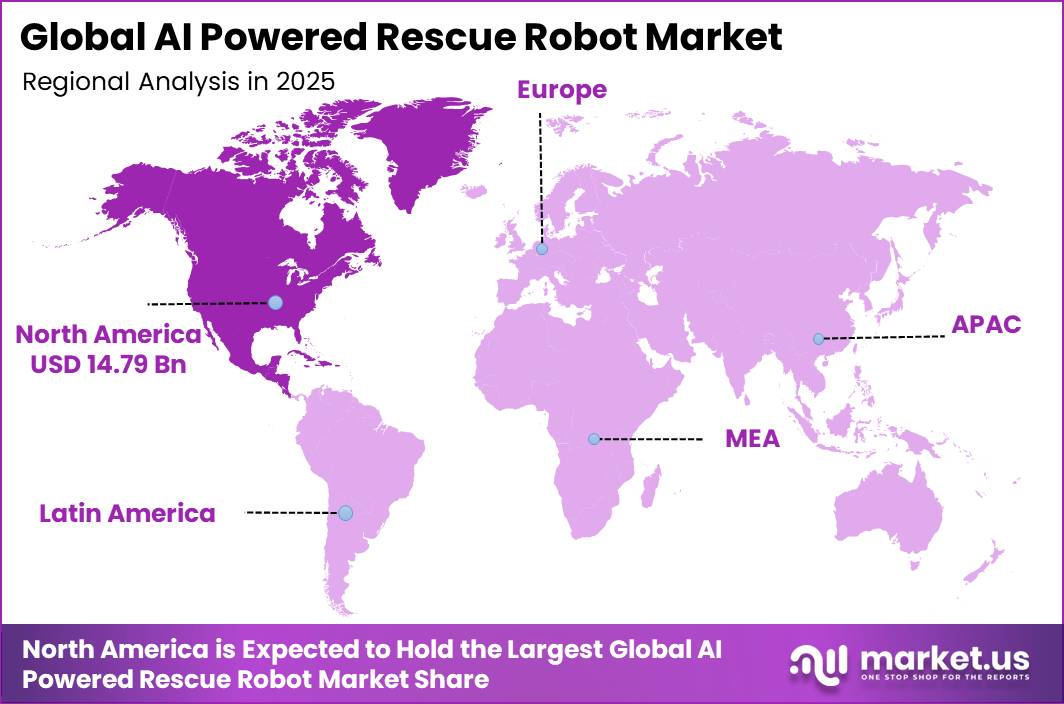
In 2025, the Global AI-Powered Rescue Robot Market was valued at USD 35.9 billion. The market is projected to grow at a CAGR of 15.1% during 2026–2035, reaching approximately USD 146.5 billion by 2035. North America dominated the global market in 2025, with artificial intelligence accounting for more than 41.2% of the total market share and generating approximately USD 14.79 billion in revenue.
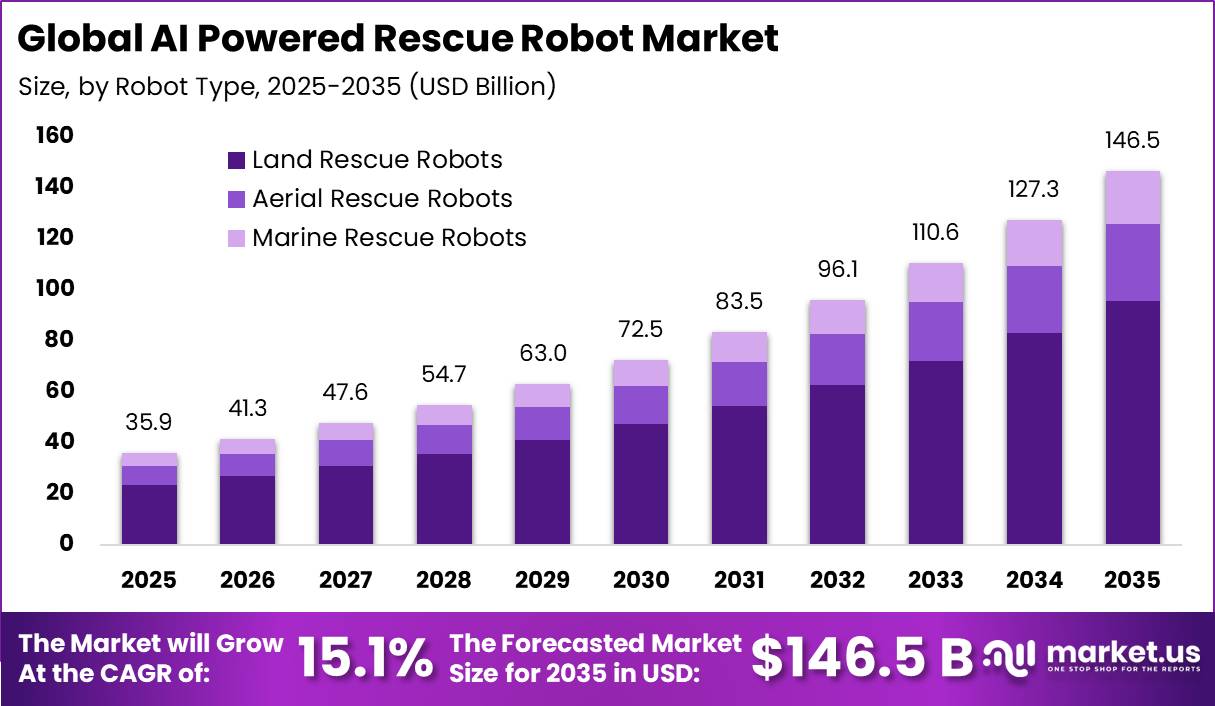
Market growth is being supported by the increasing frequency and financial impact of natural disasters, which is encouraging governments and emergency agencies to adopt advanced robotic rescue systems. CRED recorded 393 natural hazard-related disasters in 2024, resulting in more than 16,750 deaths, affecting 167.2 million people, and causing economic losses of USD 241.95 billion.
In the United States, NOAA reported 27 weather and climate disasters in 2024 that each caused more than USD 1 billion in losses, with total damages reaching USD 182.7 billion. The 2020–2024 average annual disaster cost reached USD 149.3 billion, around 50% higher than during the 2010s.
Government funding and wider robotics adoption are also supporting market expansion. FEMA received USD 29 billion for major disaster response under the American Relief Act, 2025. IFR reported that sales of search, rescue, and security robots increased by 19% in 2024 to 3,100 units, while total professional service robot sales rose 9% to nearly 199,000 units.
Key Takeaway
- The AI-Powered Rescue Robot Market was valued at USD 35.9 billion in 2025 and is projected to reach USD 146.5 billion by 2035 at a CAGR of 15.1%.
- Land Rescue Robots dominated the market in 2025 with a 65.1% share, supported by strong use in ground-based rescue operations.
- Fully Autonomous Robots led with a 61.1% share in 2025, driven by the need for faster and safer emergency response.
- AI-Based Navigation and SLAM accounted for 37.2% of the market in 2025, reflecting growing demand for autonomous mapping and navigation.
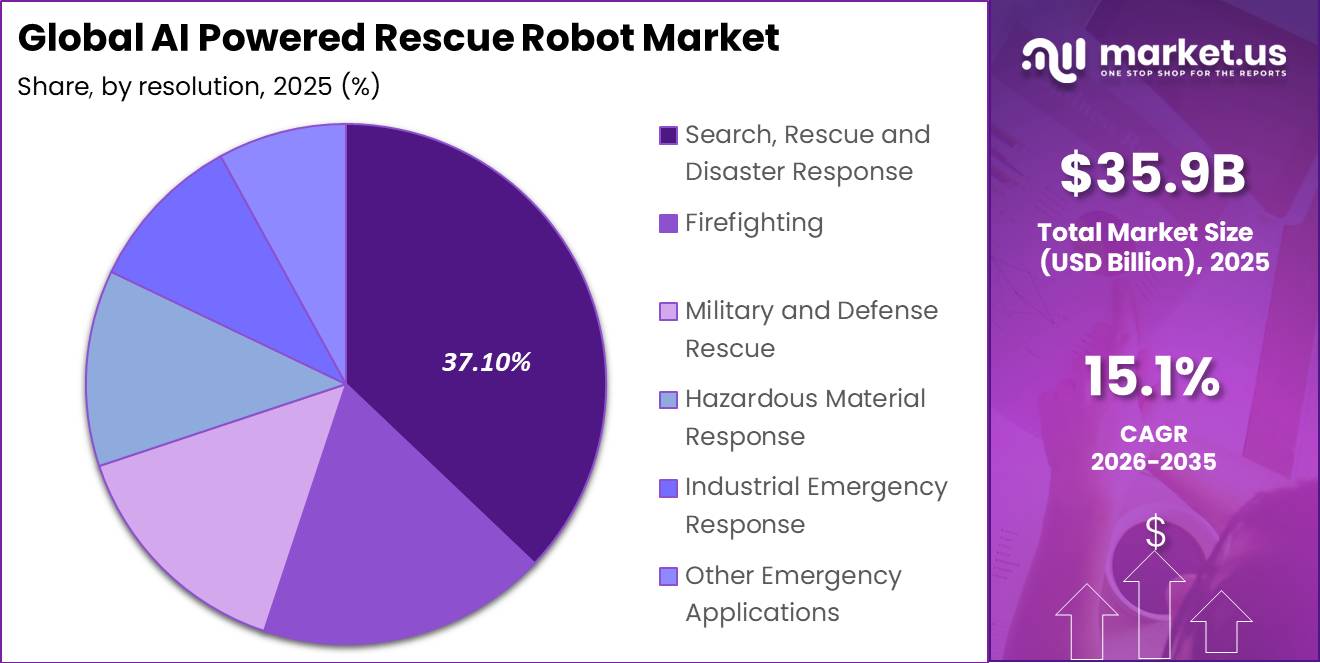
- Search, Rescue and Disaster Response held a 37.1% share in 2025, remaining the leading application area.
- Wheeled/Tracked Ground Platforms captured 55.9% of the market in 2025, supported by strong mobility across difficult terrain.
- Government and Emergency Response Agencies led end-user demand with a 45.3% share in 2025, backed by public safety spending and procurement.
- North America led the market in 2025 with a 41.2% share and USD 14.8 billion in revenue.
Market Statistics and Data Insights
- Global disaster costs are already extremely high. UNDRR reports that officially recorded direct disaster losses are about USD 202 billion per year, while the wider economic impact exceeds USD 2.3 trillion annually, equal to roughly 2% of global GDP.
- The United States experienced 27 weather and climate disasters in 2024 with losses above USD 1 billion each. These events caused about USD 182.7 billion in damage and at least 568 deaths.
- During 2020–2024, the United States recorded 115 billion-dollar disasters, averaging 23 events and USD 149.3 billion in losses per year. The annual cost was about USD 99.5 billion during the 2010s.
- Developing countries experienced more than 7,200 disasters between 2000 and 2024, resulting in approximately 1.25 million deaths, affecting more than 4.6 billion people, and generating about USD 1.48 trillion in economic losses.
- The U.S. Fire Administration listed 27,166 registered fire departments as of January 2024, representing approximately 92% of estimated U.S. fire departments. This creates a large institutional buyer base for emergency-response robotics.
- More than 19,000 U.S. fire departments had already joined the new NERIS system by 2026. From January through June 2026, participating departments reported 15,339,154 calls, including 9,469,294 EMS-related responses, equal to about 62% of reported runs.
- NIST has developed more than 50 standard test methods covering ground, aerial, and aquatic response robots, while more than 20 have already been standardized. A single emergency mission profile can require a combination of around 20–30 different tests.
- NIST robot testing includes increasingly difficult operating conditions, such as stair inclines of 30°, 35°, 40°, and 45°, illumination above 300 lux versus below 0.1 lux, and dry versus wet operating environments. These requirements show the qualification burden for field-ready rescue platforms.
- China accounted for more than 70% of global rare-earth extraction and about 87% of processing, including 100% of dysprosium and terbium heavy-rare-earth processing, according to USGS. China’s 2024 quotas reached 270,000 tonnes for mining and 254,000 tonnes for smelting and separation.
- IFR recorded 3,128 search, rescue, and security robots sold in 2024, an increase of 19%. This category was among the top five professional service-robot applications worldwide.
- Worldwide professional service-robot sales increased 9% in 2024 to more than 199,000 units. At the same time, the Robot-as-a-Service fleet expanded 31% to more than 24,500 units, supporting future leasing and subscription models for rescue robots.
- U.S. municipal firefighters experienced an estimated 53,575 line-of-duty injuries in 2024. Around 16,275 injuries, or 30%, occurred during fireground operations, while approximately 9,100 injuries, or 17%, resulted in lost work time.
- NIST’s nationwide first-responder technology study surveyed 7,182 emergency professionals. Among fire-service respondents, 70.9% considered drones useful during a major disaster, while 13.58% selected robots. Among law-enforcement respondents, 71.9% selected drones and 24.89% selected robots. This is older survey evidence, but it is one of the strongest direct government studies of first-responder technology preferences.
By Robot Type
In 2025, Land Rescue Robots held a dominant position in the AI-Powered Rescue Robot Market, accounting for 65.1% of the total market share. Their strong position is mainly linked to the large number of rescue operations carried out on land, particularly in collapsed buildings, landslide zones, tunnels, and debris-filled areas.
Wheeled and tracked rescue robots can move through narrow spaces, unstable surfaces, and rubble where aerial or underwater robots have limited use. According to the US Geological Survey (USGS), 14,132 earthquakes with a magnitude of 4.0 or higher were recorded worldwide in 2024, including 99 events above magnitude 6.0. Such earthquakes can cause major structural damage and increase the need for ground-based search and rescue equipment.
The UN INSARAG network, coordinated by OCHA, includes more than 90 member countries and organizations and has 56 classified international Urban Search and Rescue teams from 46 countries. These teams are trained for structural collapse emergencies, creating continued demand for land rescue robots that can assist human responders in dangerous and difficult environments.
| By Robot Type | Segment Shares |
|---|---|
| Land Rescue Robots | 65.1% |
| Aerial Rescue Robots | 22.8% |
| Marine Rescue Robots | 12.1% |
By Autonomy Level
In 2025, the Fully Autonomous segment held a dominant position in the AI-Powered Rescue Robot Market, accounting for 61.1% of the total market share. The segment’s leadership is mainly supported by the need for faster decision-making and safer operations in hazardous areas where direct human involvement can be risky.
The US Bureau of Labor Statistics reported 5,070 fatal work injuries in 2024, including 844 deaths caused by falls, slips, and trips and 687 deaths linked to exposure to harmful substances or dangerous environments. The National Fire Protection Association also estimated 53,575 firefighter injuries in the line of duty in 2024, showing the high physical risks faced by emergency responders.
Fully autonomous rescue robots can reduce this exposure by navigating rubble, detecting gas leaks, mapping damaged structures, and carrying out search activities with limited operator involvement. NIST has also developed more than 50 standard test methods for evaluating autonomous navigation, sensing, and durability in emergency-response robots. These capabilities support faster rescue operations while reducing human exposure to unstable and dangerous environments.
| By Autonomy Level | Segment Shares |
|---|---|
| Semi-Autonomous | 38.9% |
| Fully Autonomous | 61.1% |
By Technology
In 2025, the AI-Based Navigation and SLAM segment held a dominant position in the AI-Powered Rescue Robot Market, accounting for 37.2% of the total market share. Its leadership is mainly supported by the need for reliable navigation in GPS-denied locations such as collapsed tunnels, caves, mines, and damaged buildings.
DARPA supported this technology through its three-year, USD 82 million Subterranean (SubT) Challenge, which focused on autonomous mapping, navigation, and search in difficult underground environments. The program funded seven teams, with each receiving up to USD 4.5 million to develop advanced robotic navigation and mapping systems.
During the SubT Challenge finals, robots from Team CERBERUS autonomously travelled about 1.75 km underground using onboard SLAM technology without direct human piloting. This showed how AI-based navigation can improve search speed and route mapping. NIST and the US Department of Defense have also supported GPS-denied navigation for public safety and defense applications.
| By Technology | Segment Shares |
|---|---|
| Machine Learning | 20.1% |
| Computer Vision | 8.0% |
| AI-Based Navigation and SLAM | 37.2% |
| Sensor Fusion | 15.6% |
| Natural Language and Voice Interaction | 7.0% |
| Edge AI | 12.10% |
By Application
In 2025, the Search, Rescue and Disaster Response segment held a dominant position in the AI-Powered Rescue Robot Market, accounting for 37.1% of the total market share. The segment leads because rescue robots are mainly designed to locate victims quickly and support emergency teams during floods, building collapses, storms, and other disasters.
The Internal Displacement Monitoring Centre recorded 45.8 million disaster-related internal displacements worldwide in 2024, the highest level ever reported. Disaster events accounted for around 70% of all new displacements during the year. In the United States alone, more than 11 million movements were linked to major hurricanes, showing the large population exposed to disaster risks.
Search and rescue robots can enter flooded homes, damaged buildings, and debris-filled areas to locate trapped people before or alongside human teams. The World Bank reported that disasters caused approximately USD 1.48 trillion in economic losses across vulnerable countries between 2000 and 2024. This large disaster burden continues to support demand for AI-powered systems that can improve search speed, response efficiency, and responder safety.
| By Application | Segment Shares |
|---|---|
| Search, Rescue and Disaster Response | 37.1% |
| Firefighting | 18.00% |
| Military and Defense Rescue | 14.8% |
| Hazardous Material Response | 12.2% |
| Industrial Emergency Response | 9.9% |
| Other Emergency Applications | 8.0% |
By Mobility
In 2025, Wheeled/Tracked Ground Platforms held a dominant position in the AI-Powered Rescue Robot Market, accounting for 55.9% of the total market share. Their leadership is mainly supported by strong performance in collapsed buildings, rubble fields, flooded streets, and other difficult environments where stable movement and high carrying capacity are important.
The US Army spent USD 22 million in 2024 to procure and test eight Unmanned Ground Vehicles from Rheinmetall/Textron and HDT Expeditionary Systems. It also plans to acquire up to 2,195 similar wheeled and tracked systems by FY2027, showing strong government demand for rugged ground platforms designed for harsh and unstable terrain.
| By Mobility | Segment Shares |
|---|---|
| Wheeled/Tracked Ground Platforms | 55.9% |
| Flying | 18.70% |
| Legged | 13.30% |
| Marine/Underwater | 12.1% |
By End User
In 2025, Government and Emergency Response Agencies held a dominant position in the AI-Powered Rescue Robot Market, accounting for 45.3% of the total market share. These agencies lead demand because they have the legal responsibility, trained personnel, and public budgets needed to respond quickly during major disasters and emergency situations.
The US Fire Administration’s National Fire Department Registry listed 27,166 registered fire departments across the United States as of January 2024, creating a large potential user base for robotic tools used in structural collapse, hazardous environments, and search-and-rescue operations. In Europe, the EU’s Union Civil Protection Mechanism and rescEU reserve committed around EUR 3.2 billion between 2019 and 2024.
The same European emergency mechanism has been activated more than 700 times since 2001, showing the continued need for organized public response systems. Dedicated government funding allows agencies to test, purchase, and deploy advanced AI rescue robots that may be too costly for smaller private operators, supporting steady demand from this end-user segment.
| By End User | Segment Shares |
|---|---|
| Government and Emergency Response Agencies | 45.3% |
| Military and Defense | 22.3% |
| Law Enforcement | 14.0% |
| Industrial Safety Operators | 10.6% |
| Other End Users | 7.8% |
Key Market Segments
By Robot Type
- Land Rescue Robots
- Aerial Rescue Robots
- Marine Rescue Robots
By Autonomy Level
- Semi-Autonomous
- Fully Autonomous
By Technology
- Machine Learning
- Computer Vision
- AI-Based Navigation and SLAM
- Sensor Fusion
- Natural Language and Voice Interaction
- Edge AI
By Application
- Search, Rescue and Disaster Response
- Firefighting
- Military and Defense Rescue
- Hazardous Material Response
- Industrial Emergency Response
- Other Emergency Applications
By Mobility
- Wheeled/Tracked Ground Platforms
- Flying
- Legged
- Marine/Underwater
By End User
- Government and Emergency Response Agencies
- Military and Defense
- Law Enforcement
- Industrial Safety Operators
- Other End Users
Geopolitical Impact Analysis
Geopolitical tensions between the United States and China are becoming an important cost factor for the AI-Powered Rescue Robot Market. Rescue robots depend on rare-earth magnets, semiconductors, sensors, and power electronics, while the supply of many of these materials remains concentrated in China.
China refines around 85% of the world’s rare earths and produces nearly 94% of sintered NdFeB magnets used in robotic motors and actuators. Following export licensing controls on seven heavy rare earths introduced in April 2025, Chinese magnet exports declined by 73% in May 2025. Supply restrictions are also affecting other critical materials.
Gallium and germanium, which are widely used in sensors and advanced electronics, recorded European price increases of about 365% and 400%, respectively, following Chinese export controls. Higher material prices and longer sourcing times are increasing manufacturing costs for robot navigation systems, motors, cameras, and control electronics.
Trade measures are adding further pressure. The US Section 232 order introduced a 25% tariff on advanced computing chips from January 2026, while an additional Section 301 action imposed a 12.5% tariff on Chinese goods from July 2026, raising the effective US tariff rate on Chinese-origin components to around 22.2%.
A July 2026 FCC restriction on foreign-made advanced robotic devices has also encouraged manufacturers to shift assembly toward Southeast Asia and US production facilities, increasing supply-chain costs and production lead times.
Regional Analysis
In 2025, North America held a dominant position in the AI-Powered Rescue Robot Market, accounting for 41.2% of the global market and generating approximately USD 14.79 billion in revenue. The region benefits from strong government spending on artificial intelligence, autonomous systems, defense technology, and emergency response.
| Region | Region Shares |
|---|---|
| North America | 41.2% |
| Europe | 19.9% |
| Asia Pacific | 26.0% |
| Latin America | 6.9% |
| Middle East & Africa | 6.0% |
The US Department of Defense allocated around USD 25.2 billion to AI and autonomous systems programs in FY2025, including nearly USD 21.8 billion for research and development. Strong federal disaster-response agencies, established robotics companies, and continued defense-related R&D provide North America with a solid base for the development, testing, and deployment of advanced rescue robots.
Asia Pacific emerged as the fastest-growing regional market, accounting for 26.0% of the global market. Growth is supported by high exposure to natural disasters and a strong robotics manufacturing ecosystem. According to the Asian Development Bank, its member countries represented around 43% of global disaster fatalities and 73% of people affected by disasters between 2005 and 2024, creating continued demand for advanced emergency-response technologies.
Asia Pacific also benefits from large-scale robot production and deployment. IFR reported that Asia accounted for about 74% of newly deployed industrial and service robots worldwide in 2024, while China alone installed 295,045 units. This combination of high disaster risk and strong manufacturing capacity is supporting faster adoption of AI-powered rescue robots across the region.
Key Regions and Countries
North America
- US
- Canada
Europe
- Germany
- France
- The UK
- Spain
- Italy
- Rest of Europe
Asia Pacific
- China
- Japan
- South Korea
- India
- Australia
- Rest of APAC
Latin America
- Brazil
- Mexico
- Rest of Latin America
Middle East & Africa
- GCC
- South Africa
- Rest of MEA
Market Dynamics
Drivers
| Driver | (~) % CAGR | Geographic Relevance | Impact Timeline |
|---|---|---|---|
| Rising Disaster-Response Budget Allocations | +3.2% | North America, Europe | Short term (2 years or less) |
| Autonomous Navigation Maturity in Hazard Zones | +2.8% | Global | Short term (2 years or less) |
| Defense-to-Civil Technology Transfer | +2.1% | North America, Asia Pacific | Medium term (2 to 4 years) |
| First-Responder Occupational Safety Mandates | +1.6% | North America, Europe | Short term (2 years or less) |
| Sensor and Edge-Compute Cost Deflation | +1.4% | Global | Medium term (2 to 4 years) |
Rising Disaster-Response Budget Allocations
Rising national emergency-response budgets between 2024 and 2026 are supporting a shift from one-time rescue-robot purchases toward longer-term fleet contracts. FEMA’s Disaster Relief Fund provided roughly USD 29 billion for major disaster response in fiscal year 2025, while Europe’s rescEU mechanism has also seen increasing use since 2024.
At the same time, global professional service robot sales increased by nearly 9% in 2024, showing stronger demand for advanced robotic systems. Larger public budgets and repeat procurement could shorten customer acquisition cycles and increase recurring maintenance and software revenue, potentially improving blended gross margins by around 3 to 5 percentage points.
Restraints
| Restraint | (~) % CAGR | Geographic Relevance | Impact Timeline |
|---|---|---|---|
| Critical Mineral Export Licensing Restrictions | -2.4% | Global, China-dependent supply chains | Short term (2 years or less) |
| Elevated Procurement Interest Rate Environment | -1.3% | North America, Europe | Short term (2 years or less) |
| Cross-Border Robotic Device Import Restrictions | -1.1% | North America | Short term (2 years or less) |
| Fragmented Autonomy Certification Regimes | -0.9% | Europe, Asia Pacific | Medium term (2 to 4 years) |
Critical Mineral Export Licensing Restrictions
A major restraint comes from China’s expanded rare-earth and magnet export licensing rules introduced in April 2025 and tightened further in October 2025. These measures reportedly reduced sintered neodymium-iron-boron magnet exports by around 73% in a single month, creating supply pressure for motors, actuators, sensors, and other rescue-robot components.
The disruption also contributed to sharp increases in European gallium and germanium prices of roughly 365% and 400%, respectively. Higher material costs could reduce rescue-robot component gross margins by an estimated 4 to 6 percentage points and may delay planned manufacturing investments by around 6 to 9 months while suppliers qualify alternative non-Chinese sources.
Challenges
| Challenge | (~) % CAGR Friction Drag | Geographic Relevance | Mitigation Horizon |
|---|---|---|---|
| Autonomy Engineering Talent Shortage | -1.8% | Global | Medium term (2 to 4 years) |
| GPS-Denied Navigation Reliability Gaps | -1.2% | Global, subterranean/urban collapse zones | Medium term (2 to 4 years) |
| Multi-Agency Interoperability Standards Gap | -0.9% | North America, Europe | Long term (4 years or more) |
| Battery Endurance Limitations in Field Ops | -0.7% | Global | Medium term (2 to 4 years) |
| Shipping and Component Lead-Time Volatility | -0.6% | Global | Short term (2 years or less) |
Autonomy Engineering Talent Shortage
A major challenge is the shortage of engineers skilled in simultaneous localization and mapping, sensor fusion, and reinforcement learning for hazardous-environment robotics. This talent gap can slow development and deployment of autonomous rescue systems, particularly in complex multi-year government programs.
For example, the USD 231.5 million MUX TACAIR award announced in January 2026 involves development periods that can require staffing ramp-ups of around 18 to 24 months. Such shortages may extend program timelines by an estimated 15 to 20% and can force manufacturers to direct roughly 1 to 2 percentage points of revenue toward internal training and university partnerships instead of direct product development.
Opportunities
| Opportunity | (~) % CAGR | Geographic Relevance | Execution Window |
|---|---|---|---|
| Robotics-as-a-Service Subscription Monetization | +2.6% | Global | Medium term (2 to 4 years) |
| Underwater and Maritime Rescue White Space | +2.0% | Asia Pacific, Europe | Medium term (2 to 4 years) |
| Emerging Market Municipal Fleet Roll-Outs | +1.7% | Latin America, Southeast Asia, Africa | Long term (4 years or more) |
| Cross-Sector M&A Consolidation of Niche Robotics Firms | +1.3% | North America, Europe | Medium term (2 to 4 years) |
Robotics-as-a-Service Subscription Monetization
This white-space opportunity remains largely unexploited because the current procurement model is still dominated by outright equipment purchases and milestone-based contracts rather than subscription billing. Shifting toward hardware bundled with software updates, analytics, and predictive maintenance could potentially improve blended operating margins by around 6 to 8 percentage points compared with one-time hardware sales.
A subscription or leasing model could also reduce the annual adoption cost for smaller emergency agencies by roughly 30 to 40%. With more than 27,000 registered U.S. fire departments, many smaller-budget agencies remain potential customers that may be priced out under traditional upfront-purchase models.
Key Players Analysis
The AI-powered Rescue Robot Market shows a clear two-tier competitive structure. Tier-1 leadership is mainly held by large defense and aerospace companies with strong R&D budgets, while Tier-2 players include specialized robotics, sensing, and marine-technology firms. Lockheed Martin reported USD 75.0 billion in sales in 2025 and increased independent R&D and capital expenditure to USD 3.6 billion.
For 2026, investment is planned to rise by nearly 35% to around USD 5 billion, strengthening its position in autonomous and unmanned systems. Northrop Grumman invested about USD 2.5 billion in combined R&D and capital spending in 2025, including USD 1.1 billion in company-sponsored IR&D.
Teledyne FLIR reported total 2025 net sales of USD 6.1 billion, including roughly USD 500 million from unmanned air, ground, and underwater systems. Its Aerospace and Defense Electronics segment grew 36% to USD 1.1 billion, supporting its role in sensors and imaging systems.
Among Tier-2 challengers, Thales generated €22.1 billion in 2025 sales, while its Defence segment recorded €15.1 billion in order intake, up 3% year-on-year. Kongsberg Maritime reported NOK 27.1 billion in revenue, up 10%, with a NOK 27.9 billion order backlog. Boston Dynamics has deployed more than 2,000 Spot and Stretch units and is linked to a USD 26 billion US investment commitment targeting 30,000 Atlas-class units annually by 2028.
Top Key Players in the Market
- Teledyne FLIR
- Boston Dynamics
- Lockheed Martin Corporation
- Northrop Grumman Corporation
- Shark Robotics
- DEEP Robotics
- Howe & Howe Technologies
- Kongsberg Maritime
- Hydronalix
- Thales Group
- Roboteam
Recent Developments
- In 2026, Thales signed a binding agreement to acquire the Gorgé family’s 35.51% stake in Exail Technologies for EUR 134 per share, implying an enterprise value of approximately EUR 3.9 billion. Thales plans to pursue 100% ownership through a mandatory tender offer, strengthening its capabilities in maritime robotics, autonomous underwater systems, and inertial navigation. Completion of the initial stake acquisition is expected by Q3 2027, with the full offer expected to close by early 2028.
- In 2026, Boston Dynamics announced a USD 100 million investment in a new 323,000-square-foot robotics and AI facility at 1601 Trapelo Road in Waltham, Massachusetts. The center will expand advanced manufacturing, artificial intelligence, workforce training, and R&D for Atlas, Spot, and Stretch. The project is also expected to create 1,250 new jobs by 2033, with phased occupancy beginning in mid-2027.
Report Scope
| Report Features | Description |
|---|---|
| Market Value (2025) | USD 35.9 Billion |
| Forecast Revenue (2035) | USD 146.5 Billion |
| CAGR (2026-2035) | 15.1% |
| Base Year for Estimation | 2025 |
| Historic Period | 2020-2024 |
| Forecast Period | 2026-2035 |
| Report Coverage | Revenue Forecast, Market Dynamics, Competitive Landscape, Recent Developments |
| Segments Covered | By Robot Type (Land Rescue Robots, Aerial Rescue Robots, Marine Rescue Robots); By Autonomy Level (Semi-Autonomous, Fully Autonomous); By Technology (Machine Learning, Computer Vision, AI-Based Navigation and SLAM, Sensor Fusion, Natural Language and Voice Interaction, Edge AI); By Application (Search, Rescue and Disaster Response, Firefighting, Military and Defense Rescue, Hazardous Material Response, Industrial Emergency Response, Other Emergency Applications); By Mobility (Wheeled/Tracked Ground Platforms, Flying, Legged, Marine/Underwater); By End User (Government and Emergency Response Agencies, Military and Defense, Law Enforcement, Industrial Safety Operators, Other End Users) |
| Regional Analysis | North America – US, Canada; Europe – Germany, France, The UK, Spain, Italy, Rest of Europe; Asia Pacific – China, Japan, South Korea, India, Australia, Singapore, Rest of APAC; Latin America – Brazil, Mexico, Rest of Latin America; Middle East & Africa – GCC, South Africa, Rest of MEA |
| Competitive Landscape | Teledyne FLIR, Boston Dynamics, Lockheed Martin Corporation, Northrop Grumman Corporation, Shark Robotics, DEEP Robotics, Howe & Howe Technologies, Kongsberg Maritime, Hydronalix, Thales Group, Roboteam |
| Customization Scope | We will provide customization for segments and region/country levels. Moreover, additional customization can be done based on the requirements. |
| Purchase Options | We have three licenses to opt for: Single User License, Multi-User License (Up to 5 Users), Corporate Use License (Unlimited Users and Printable PDF) |