


Overview
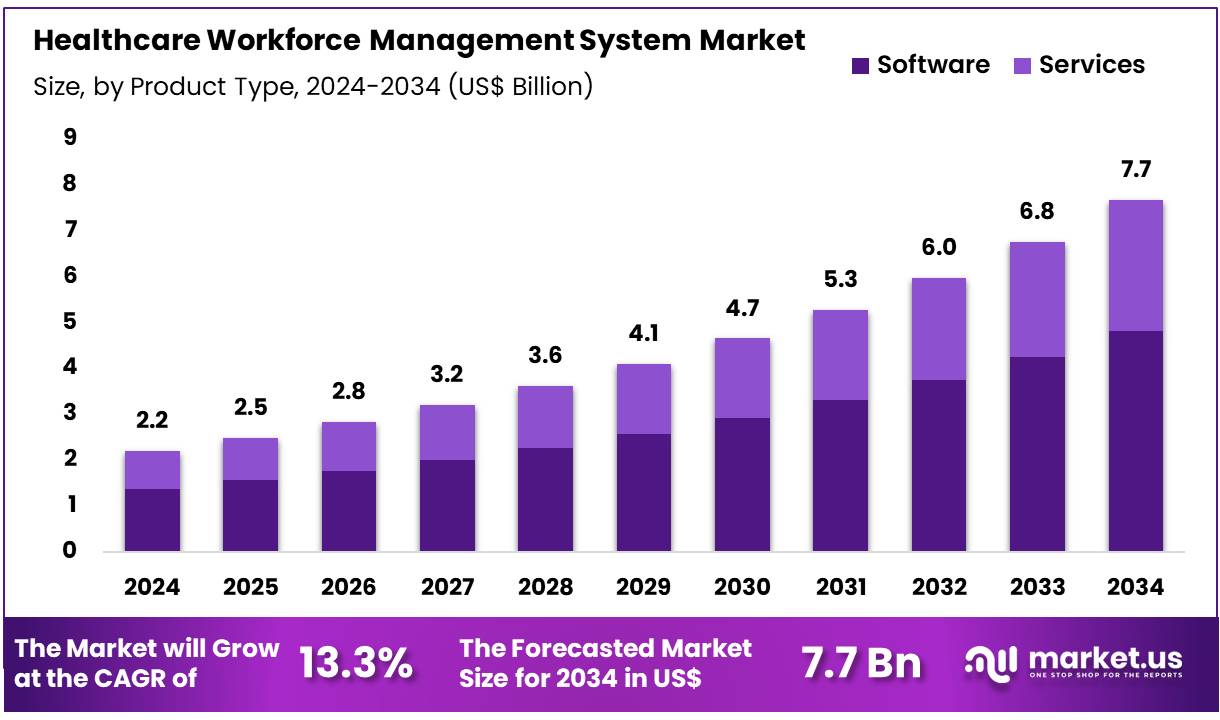
Global Healthcare Workforce Management System Market size is expected to be worth around US$ 7.7 Billion by 2034 from US$ 2.2 Billion in 2024, growing at a CAGR of 13.3% during the forecast period 2025 to 2034. In 2024, North America led the market, achieving over 38.9% share with a revenue of US$ 0.9 Billion.
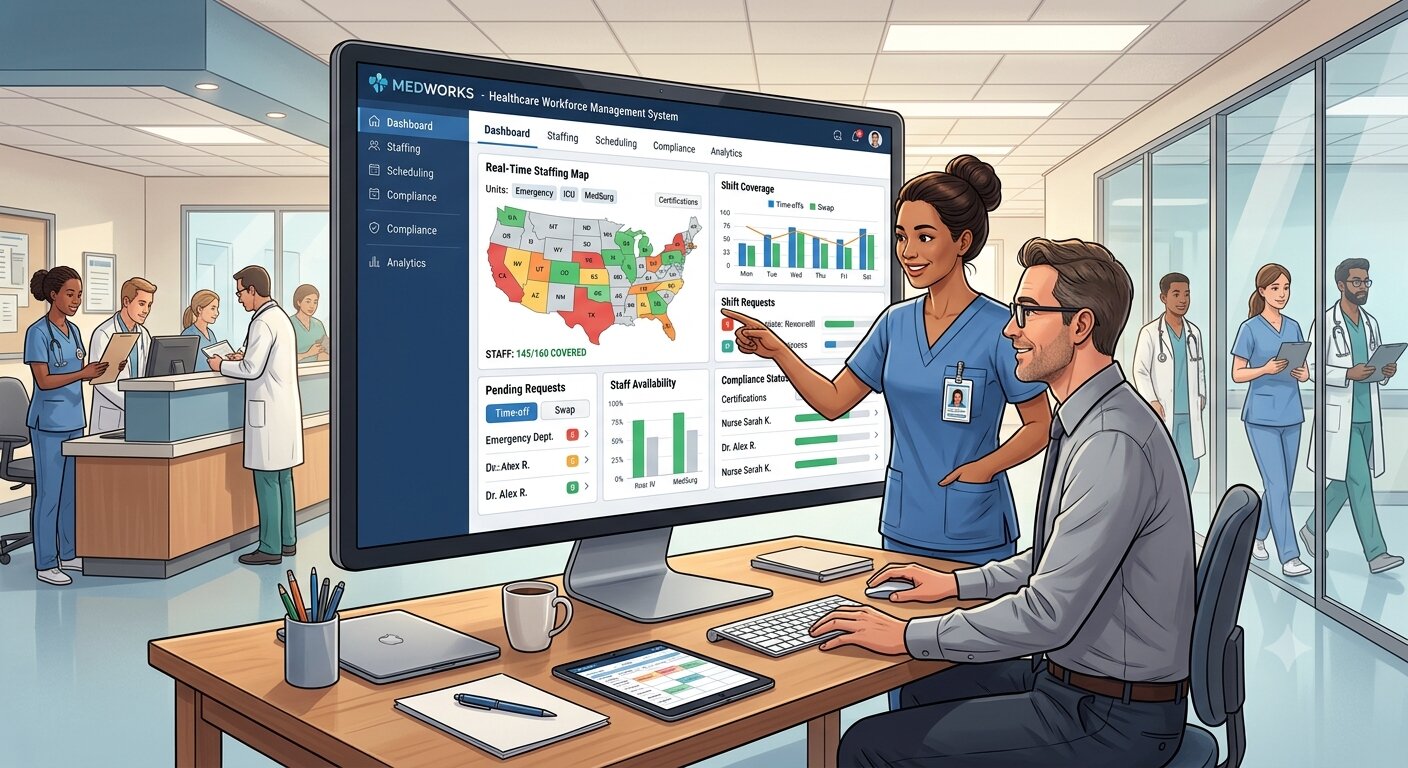
The Healthcare Workforce Management System market is gaining momentum as healthcare organizations prioritize efficient staff scheduling, labor cost optimization, and workforce productivity. Hospitals, clinics, and long-term care facilities are increasingly adopting digital workforce management platforms to address persistent staffing shortages, rising patient volumes, and evolving regulatory requirements.
These systems integrate scheduling, time and attendance, leave management, credential tracking, payroll, and workforce analytics, enabling healthcare providers to improve operational efficiency while maintaining high-quality patient care. The growing shift toward cloud-based platforms, artificial intelligence-driven workforce planning, and predictive analytics is further accelerating market adoption across both public and private healthcare settings.
Healthcare systems worldwide continue to face significant workforce challenges, creating strong demand for advanced workforce management technologies. According to the U.S. Health Resources and Services Administration (HRSA), more than 20% of the U.S. population lives in Primary Care Health Professional Shortage Areas (HPSAs), underscoring the ongoing need for efficient workforce allocation and staffing strategies.
Additionally, the American Hospital Association reports that labor accounted for 56% of total hospital expenses in 2024, making workforce optimization a top operational priority for healthcare providers seeking to balance staffing needs with financial sustainability.
Government initiatives supporting digital health transformation, workforce planning, and healthcare interoperability are also encouraging broader adoption of workforce management systems. Healthcare providers are increasingly investing in automated scheduling, mobile workforce applications, and real-time staffing intelligence to improve employee satisfaction, reduce administrative burden, and ensure compliance with labor regulations.
As healthcare demand continues to rise due to aging populations and chronic disease prevalence, workforce management solutions are expected to play a critical role in strengthening healthcare delivery, improving resource utilization, and supporting resilient healthcare operations.
Key Takeaways
- Market Size: The Healthcare Workforce Management System market generated US$ 2.2 billion in revenue in 2024 and is projected to reach US$ 7.7 billion by 2034, expanding at a CAGR of 13.3% during the forecast period.
- By Product Type: The market is segmented into Software and Services. The Software segment dominated the market in 2024, accounting for 62.7% of the total market share.
- By Mode of Delivery: Based on deployment, the market is categorized into Web & Cloud-Based and On-Premise solutions. The Web & Cloud-Based segment led the market with a 68.4% share in 2024.
- By End User: The market is segmented into Hospitals, Long-Term Care Centers, Nursing Homes, Assisted Living Centers, and Others. Among these, Hospitals emerged as the leading end-user segment, capturing 55.9% of the market revenue in 2024.
- By Region: North America held the largest regional share of the Healthcare Workforce Management System market, accounting for 38.9% of the global market in 2024.
Statistical Information
- The U.S. Bureau of Labor Statistics projects employment in healthcare occupations to grow 13% between 2023 and 2033, adding approximately 1.9 million new jobs, making healthcare the fastest-growing occupational group in the country.
- The Health Resources and Services Administration (HRSA) maintains national workforce projection models that help healthcare organizations forecast future shortages and staffing demand across physicians, nurses, behavioral health professionals, and allied health occupations, reinforcing the need for workforce planning technologies.
- According to HRSA’s 2022 National Sample Survey of Registered Nurses, the U.S. registered nurse workforce grew by about 400,000 nurses compared with 2018, highlighting the increasing complexity of scheduling and workforce coordination across healthcare systems.
- The same HRSA national nursing survey found that 80% of registered nurses reported being satisfied with their jobs, despite experiencing significant workplace stress and burnout during and after the pandemic, emphasizing the importance of workforce engagement and retention strategies.
- The Centers for Medicare & Medicaid Services (CMS) requires Medicare- and Medicaid-certified nursing homes to electronically report daily staffing hours through the Payroll Based Journal (PBJ) system, increasing demand for automated workforce tracking and compliance solutions.
- CMS publicly releases facility-level daily staffing datasets covering registered nurses, licensed practical nurses, certified nurse aides, therapists, and other care staff, supporting transparency and encouraging healthcare providers to improve workforce management practices.
- A CDC-supported national analysis found that 11.1% of emergency nurses who changed jobs cited insufficient staffing as the primary reason for leaving their positions, demonstrating how staffing challenges directly influence workforce retention.
- The same CDC-supported study reported that 11.5% of emergency nurses who changed employers identified better pay elsewhere as the leading reason for turnover, highlighting the importance of workforce analytics and labor management.
Regional Analysis
North America dominated the Healthcare Workforce Management System market in 2024, accounting for the largest regional share due to widespread adoption of digital healthcare technologies, a well-established hospital network, and increasing emphasis on workforce optimization. Healthcare providers across the U.S. and Canada are investing in workforce management solutions to improve staff scheduling, reduce labor costs, and maintain compliance with evolving healthcare regulations.
According to the Peterson-KFF Health System Tracker, healthcare employment in the United States has continued to recover and expand following the pandemic, increasing the need for advanced workforce planning tools across hospitals and outpatient settings. In addition, the U.S. Health Resources and Services Administration (HRSA) reports that nearly one in five Americans lives in a primary care Health Professional Shortage Area, highlighting the importance of efficient workforce allocation and staffing management.
Asia Pacific is projected to register the fastest CAGR during the forecast period, driven by expanding healthcare infrastructure, rapid digital transformation, and rising healthcare demand from growing and aging populations. Governments across countries such as China, India, Japan, and Australia are investing in hospital modernization and digital health initiatives, encouraging healthcare providers to adopt workforce management platforms that enhance operational efficiency, optimize staffing resources, and improve patient care delivery. These developments are expected to support strong market growth across the region.
Emerging Trends
- Cloud-based workforce management is becoming the standard as healthcare providers seek real-time access to scheduling and staffing data. CMS requires nursing homes to electronically submit staffing information through the Payroll-Based Journal (PBJ), encouraging cloud-enabled workforce systems that simplify compliance, payroll integration, and workforce reporting.
- AI-powered workforce forecasting is gaining momentum as health systems prepare for future staffing needs. HRSA’s Workforce Projections Dashboard now provides projections through 2038, allowing organizations to compare workforce supply and demand and improve long-term staffing decisions using predictive analytics.
- Data-driven staffing transparency is increasing across healthcare organizations. CMS updates its Payroll-Based Journal datasets quarterly, providing standardized staffing information that encourages providers to adopt automated workforce management platforms for accurate reporting and operational efficiency.
- Digital workforce planning is expanding across multiple healthcare occupations. HRSA’s Health Workforce Explorer now tracks more than 40 healthcare occupations, enabling providers to monitor workforce trends and make evidence-based staffing decisions across diverse clinical specialties.
- Workforce compliance automation is becoming a strategic priority. CMS continues updating PBJ technical standards, including enhanced payroll submission validation and electronic reporting requirements, prompting healthcare organizations to invest in automated workforce management software that reduces manual administrative work and improves data accuracy.
Use Cases
- Hospital staff scheduling and shift optimization help managers automatically assign nurses, physicians, and support staff based on availability, qualifications, and patient demand. HRSA workforce projections support these planning efforts by forecasting future workforce supply and demand across healthcare professions.
- Nursing home staffing compliance is a major use case for workforce management systems. CMS requires certified facilities to electronically report daily staffing hours through the Payroll-Based Journal system, making automated tracking and reporting essential for regulatory compliance.
- Payroll and attendance management enables healthcare organizations to accurately capture employee work hours, overtime, agency staff, and contract labor. CMS PBJ datasets record paid staff hours by job category, supporting accurate payroll processing and workforce monitoring.
- Healthcare workforce planning helps organizations prepare for future staffing shortages using workforce analytics. HRSA’s national projection models estimate future healthcare workforce supply and demand, allowing providers to strengthen recruitment and retention strategies before shortages occur.
- Performance reporting and operational benchmarking allow healthcare providers to compare staffing levels across facilities and improve care delivery. CMS publicly updates Payroll-Based Journal staffing datasets four times each year, enabling organizations to evaluate workforce performance using standardized operational data.
Conclusion
The Healthcare Workforce Management System market is poised for strong long-term growth as healthcare organizations increasingly prioritize efficient workforce planning, regulatory compliance, and cost optimization. Rising healthcare employment, ongoing workforce shortages, and the shift toward cloud-based and AI-enabled workforce solutions are accelerating adoption across hospitals and long-term care facilities. Government initiatives promoting digital health and standardized workforce reporting further support market expansion.
As healthcare providers continue investing in automated scheduling, analytics, and workforce intelligence, these systems will play a vital role in improving staff productivity, operational efficiency, and patient care quality while helping organizations build resilient and future-ready healthcare workforces.




















