



Overview
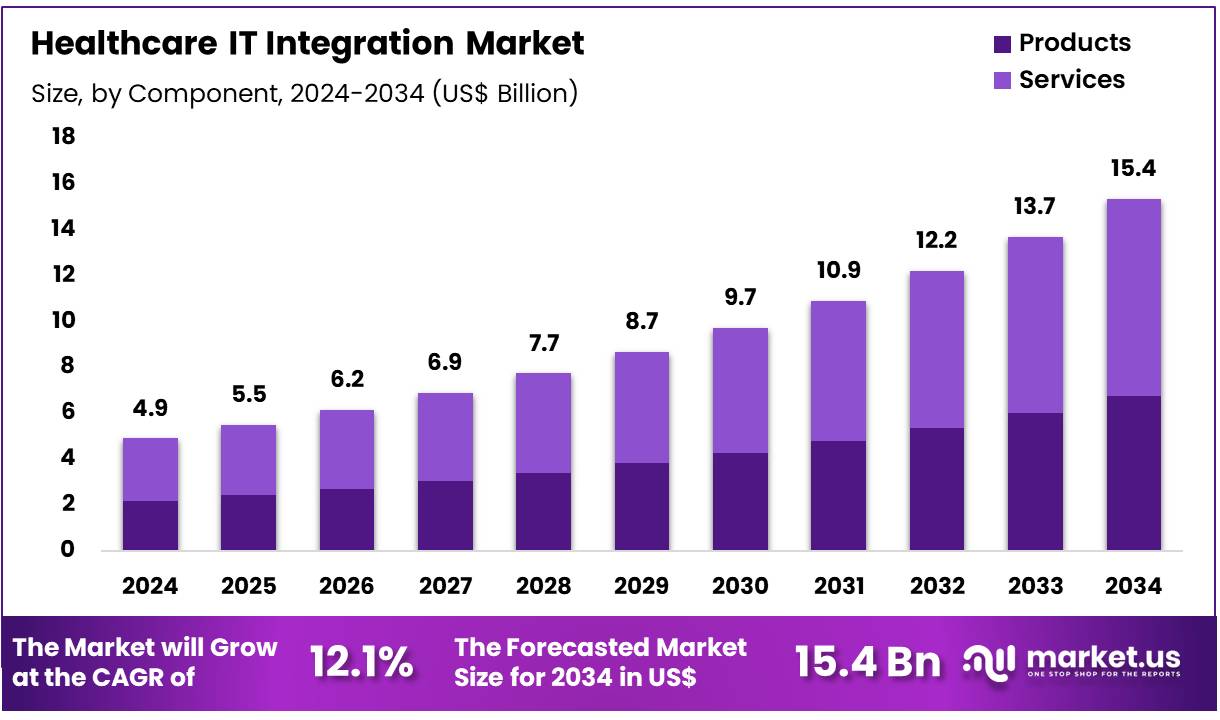
Global Healthcare IT Integration Market size is expected to be worth around US$ 15.4 Billion by 2034 from US$ 4.9 Billion in 2024, growing at a CAGR of 12.1% during the forecast period 2025 to 2034. In 2024, North America led the market, achieving over 41.6% share with a revenue of US$ 2.0 Billion.
The healthcare IT integration landscape is becoming increasingly important as healthcare providers seek to improve care coordination, patient safety, and operational efficiency. Integration technologies enable secure data exchange between electronic health records (EHRs), laboratory systems, imaging platforms, pharmacy applications, and other clinical information systems. Governments and healthcare organizations are also prioritizing interoperability to reduce fragmented care, streamline workflows, and support value-based healthcare delivery.
The growing adoption of digital health technologies, cloud computing, and interoperability standards such as HL7 FHIR is accelerating the implementation of integrated healthcare ecosystems. Hospitals are investing in unified platforms that enable clinicians to access comprehensive patient information in real time, leading to better clinical decision-making and improved patient outcomes. Rising demand for telehealth, remote patient monitoring, and AI-enabled healthcare solutions further strengthens the need for seamless integration across healthcare networks.
According to the U.S. Centers for Disease Control and Prevention (CDC), 96% of non-federal acute care hospitals in the United States had adopted a certified electronic health record system by 2021, demonstrating the widespread digital transformation of healthcare infrastructure. Additionally, the Office of the National Coordinator for Health Information Technology (ONC) reported that approximately 70% of hospitals engaged in all four domains of interoperable electronic health information exchange in recent years, highlighting continued progress toward connected healthcare systems.
Supportive government initiatives promoting health information exchange, stronger cybersecurity frameworks, and increasing investments in digital infrastructure are expected to create significant opportunities for healthcare IT integration providers. As healthcare systems continue modernizing worldwide, integrated digital platforms will remain essential for delivering efficient, coordinated, and patient-centered care.
Key Takeaways
- Market Size: The global Healthcare IT Integration market is projected to expand from US$ 4.9 Billion in 2024 to approximately US$ 15.4 Billion by 2034.
- Market Growth: The market is anticipated to register a CAGR of 12.1% throughout the 2025–2034 forecast period.
- Component Analysis: Services led the market with a 56.1% share, driven by their vital role in ensuring interoperability, system integration, and efficient healthcare data exchange.
- Deployment Mode Analysis: The on-premise deployment model held the largest 63.5% market share, supported by healthcare providers’ preference for greater control over data security and infrastructure.
- Application Analysis: The Electronic Health Records (EHR) segment captured a leading 39.7% market share, owing to its importance in enhancing clinical workflows, patient data management, and compliance.
- Organization Size Analysis: Large enterprises dominated the market, accounting for 68.8% of the overall share due to their extensive IT infrastructure and higher digital transformation investments.
- End-Use Analysis: Hospitals and clinics represented the largest end-user segment with a 67.0% market share, fueled by increasing adoption of integrated healthcare information systems.
- Regional Analysis: North America remained the leading regional market in 2024, securing a 41.6% share and generating approximately US$ 2.0 Billion in revenue.
Statistical Information
- Approximately 9 in 10 hospitals enabled patient access to their health information via an API in 2024.
- Seven in 10 hospitals reported using standards-based APIs (HL7 FHIR) to enable patient access in 2024.
- Two-thirds of hospitals enabled patient-generated health data (PGHD) submission into electronic health record (EHR) systems.
- About half of hospitals used standards-based APIs to enable electronic submission of patient-generated health data.
- 91% of hospitals integrated data from third-party technologies for at least one clinical purpose.
- 87% of hospitals integrated third-party technologies for at least one administrative purpose.
- 83% of hospitals provided clinical data to third-party technologies to support healthcare delivery.
- 86% of hospitals shared administrative data with third-party technologies.
- 52% of hospitals used standards-based APIs to integrate data for at least one clinical purpose.
- 39% of hospitals used standards-based APIs to provide clinical data to third-party applications.
Regional Analysis
North America dominated the healthcare IT integration market with a 41.6% revenue share in 2024, supported by advanced healthcare infrastructure and strong government initiatives promoting interoperability. The U.S. Department of Health and Human Services (HHS) and the Office of the National Coordinator for Health Information Technology (ONC) continue to advance secure health information exchange through the 21st Century Cures Act and nationwide interoperability programs. According to the Centers for Disease Control and Prevention (CDC), Non-federal acute care hospitals in the U.S. had adopted certified electronic health record (EHR) systems, creating a solid foundation for healthcare IT integration.
Meanwhile, Asia Pacific is projected to register the fastest CAGR during the forecast period, driven by rapid healthcare digitalization and expanding government investments in health information technology. Countries such as China, India, Japan, and Australia are implementing national digital health strategies, expanding EHR adoption, and strengthening health information exchange networks. Growing healthcare infrastructure, rising public-private collaborations, and increasing demand for connected healthcare systems are expected to accelerate regional market growth.
Emerging Trends
- Routine interoperable health information exchange is increasing across hospitals. According to the ONC, the share of U.S. hospitals that routinely engaged in all four interoperability domains (find, send, receive, and integrate) increased from 29% in 2021 to 43% in 2023, reflecting stronger adoption of integrated healthcare IT systems.
- Nationwide interoperability networks are expanding through the Trusted Exchange Framework and Common Agreement (TEFCA). The framework enables healthcare providers, payers, patients, and public health agencies to securely exchange health information across different systems, reducing data silos and improving coordinated care nationwide.
- Government-led interoperability regulations are driving integration investments. CMS now requires impacted health plans to implement FHIR-based Patient Access, Provider Access, Payer-to-Payer, and Prior Authorization APIs, with major compliance milestones beginning in 2026 and 2027, encouraging broader healthcare data connectivity.
- Healthcare organizations are joining nationwide interoperability networks. As of 2026, the CMS Interoperability Framework includes more than 20 early adopter organizations, including major EHR vendors, health information exchanges, and digital health companies working to improve secure, standards-based data sharing across healthcare systems.
- Cloud-enabled digital health ecosystems are strengthening healthcare connectivity. CMS and ONC continue promoting standardized APIs and secure electronic data exchange, allowing providers and patients to access clinical information across multiple healthcare organizations while supporting value-based and patient-centered care.
Use Cases
- Integrated Electronic Health Records (EHRs) allow clinicians to access complete patient histories from multiple care settings through interoperable systems, improving treatment decisions and reducing duplicate diagnostic tests during care transitions.
- Digital patient access applications enable individuals to securely retrieve claims, encounter records, and clinical information through standardized FHIR APIs, giving patients greater control over their healthcare information and supporting informed medical decisions.
- Provider-to-provider data exchange helps physicians, hospitals, and specialists securely share laboratory results, medications, diagnoses, and treatment histories, improving care coordination and reducing delays during referrals and emergency treatment.
- Electronic prior authorization integration connects healthcare providers and health plans using standardized APIs, reducing paperwork, accelerating approval decisions, and improving administrative efficiency across healthcare organizations.
- Healthcare IT integration is improving care coordination across healthcare organizations. Integrated health information exchange enables hospitals, physicians, laboratories, pharmacies, public health agencies, and payers to securely access and share patient records, reducing duplicate tests, supporting faster referrals, improving treatment decisions, and ensuring patients receive continuous, coordinated care across multiple healthcare settings.
Conclusion
The Healthcare IT Integration market is witnessing steady growth as healthcare organizations prioritize interoperability, secure data exchange, and digital transformation. Rising adoption of electronic health records, cloud platforms, AI-enabled solutions, and standardized technologies such as HL7 FHIR is strengthening integrated healthcare ecosystems. Government initiatives, including nationwide interoperability frameworks and health information exchange programs, continue to accelerate market development while improving patient care and operational efficiency.
Hospitals, clinics, laboratories, and payers are increasingly investing in connected healthcare infrastructure to streamline workflows and enhance clinical decision-making. As healthcare systems become more data-driven and patient-centric, healthcare IT integration will remain a critical enabler of coordinated, efficient, and high-quality healthcare delivery worldwide.




















