



Overview
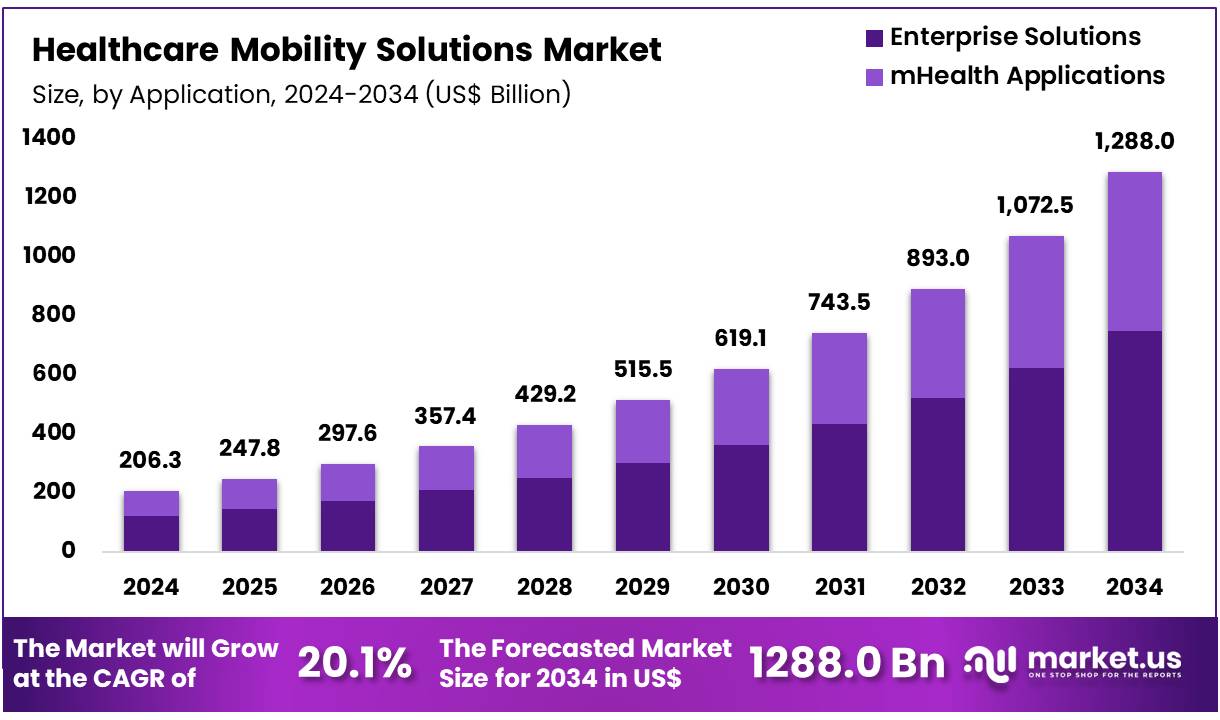
The Global Healthcare Mobility Solutions Market size is expected to be worth around US$ 1288.0 Billion by 2034 from US$ 206.3 Billion in 2024, growing at a CAGR of 20.1% during the forecast period 2025 to 2034. In 2024, North America led the market, achieving over 43.2% share with a revenue of US$ 89.1 Billion.
The Healthcare Mobility Solutions market is being driven by the rapid digital transformation of healthcare systems, increasing use of mobile-enabled clinical workflows, electronic health records (EHRs), telehealth platforms, and connected medical devices. Healthcare providers are adopting secure mobile technologies to improve clinical decision-making, streamline communication among care teams, and expand access to healthcare beyond traditional hospital settings.
Governments and public health organizations continue to support interoperable digital infrastructure that enables efficient, patient-centered care across hospitals, clinics, and home healthcare environments. The World Health Organization (WHO) identifies digital health as a strategic priority for strengthening health systems, promoting interoperability, and improving equitable access to quality healthcare services worldwide.
Healthcare investment continues to provide a strong foundation for the adoption of mobility solutions. According to the U.S. Centers for Medicare & Medicaid Services (CMS), U.S. national health expenditures reached US$ 5.3 trillion in 2024, reflecting sustained investment in healthcare infrastructure and digital innovation. Additionally, hospital care spending totaled US$ 1.63 trillion in 2024, creating significant opportunities for mobile technologies that enhance workflow efficiency, real-time data access, and patient care coordination.
The increasing integration of cloud computing, artificial intelligence, telemedicine, Internet of Medical Things (IoMT), and secure mobile applications is further transforming healthcare delivery. Mobile platforms enable clinicians to access patient information securely, support remote monitoring, facilitate virtual consultations, and improve collaboration across multidisciplinary care teams.
These technologies also contribute to faster clinical decision-making, reduced administrative burden, improved patient engagement, and better continuity of care. As countries continue implementing national digital health strategies, healthcare mobility solutions are expected to play an increasingly important role in building resilient, connected, and sustainable healthcare systems.
Key Takeaways
- The global Healthcare Mobility Solutions market was valued at US$ 206.3 billion in 2024 and is projected to reach US$ 1,288.0 billion by 2034, expanding at a CAGR of 20.1% during the forecast period.
- By product type, the market is segmented into enterprise mobility platforms, mobile applications, and mobile devices. Mobile devices emerged as the leading segment, accounting for 47.5% of the market share in 2024.
- Based on application, the market is categorized into enterprise solutions and mHealth applications. Enterprise solutions dominated the segment with a 58.3% market share in 2024.
- By end user, the market is classified into healthcare payers, healthcare providers, and patients. Healthcare providers held the largest share, capturing 54.6% of the global market in 2024.
- North America dominated the global Healthcare Mobility Solutions market in 2024, accounting for 43.2% of the total market share.
Statistical Information
- U.S. national health expenditures reached US$ 5.3 trillion in 2024, reflecting continued investment in healthcare infrastructure and digital technologies.
- Hospital care spending totaled US$ 1.6347 trillion in 2024, the largest healthcare spending category in the United States.
- Physician and clinical services expenditures reached US$ 1.1097 trillion in 2024, supporting continued adoption of digital and mobile clinical solutions.
- Private health insurance spending increased to US$ 1.6446 trillion in 2024, highlighting growing investment in digitally enabled healthcare services.
- Medicare spending reached US$ 1.118 trillion in 2024, supporting broader reimbursement for digital health and remote care services.
- Medicaid spending totaled US$ 931.7 billion in 2024, reflecting continued public investment in healthcare delivery.
- Prescription drug spending reached US$ 467.0 billion in 2024, increasing demand for digital medication management and mobile healthcare applications.
- Out-of-pocket healthcare spending reached US$ 556.6 billion in 2024, emphasizing consumer demand for convenient and digitally accessible healthcare services.
- Medicare payments for Remote Patient Monitoring (RPM) exceeded US$ 500 million in 2024, demonstrating rapid adoption of connected care technologies.
- Medicare covers remote patient monitoring for both chronic and acute conditions using FDA-defined connected medical devices that digitally transmit patient data to providers.
- CMS reports that remote patient monitoring has experienced significant year-over-year growth since Medicare began covering the service in 2018, indicating increasing adoption among healthcare providers.
- The U.S. Department of Health and Human Services (HHS) identifies remote patient monitoring as a key component of telehealth, enabling continuous management of chronic and acute conditions through connected digital devices.
Regional Analysis
North America is Leading the Healthcare Mobility Solutions Market
North America dominated the Healthcare Mobility Solutions market in 2024 due to its advanced healthcare IT infrastructure and widespread adoption of electronic health records (EHRs). According to the U.S. Office of the National Coordinator for Health Information Technology (ONC), nearly all non-federal acute care hospitals have adopted certified EHR systems, supporting secure mobile access to patient data. Rising adoption of telehealth, remote patient monitoring, and mobile clinical applications continues to strengthen regional market growth.
Asia Pacific is Expected to Register the Fastest CAGR During the Forecast Period
Asia Pacific is expected to record the fastest growth during the forecast period, driven by rapid digitalization of healthcare systems and increasing smartphone adoption. Government initiatives such as India’s Ayushman Bharat Digital Mission (ABDM) are promoting interoperable digital health infrastructure and expanding access to electronic health records and telemedicine services.
Rising healthcare investments, growing internet connectivity, and increasing use of mobile health applications are expected to accelerate the adoption of healthcare mobility solutions across the region.
Emerging Trends
- Expansion of Remote Patient Monitoring (RPM): Healthcare providers are increasingly using connected devices that automatically transmit patient data such as blood pressure, glucose, and weight. CMS requires at least 2 days of transmitted readings every 30 days for Medicare-covered RPM services, encouraging broader adoption of mobile healthcare technologies.
- Government Focus on Interoperable Digital Health: Healthcare systems are moving toward secure data sharing through interoperable platforms. In 2025, CMS announced initiatives including a national provider directory, expanded Blue Button 2.0 API, and enhanced trusted data exchange to improve digital healthcare connectivity and patient access.
- Growth in Telehealth Across Healthcare Facilities: Telehealth continues to become part of routine healthcare delivery. According to HHS, 95% of HRSA-funded health centers provided primary care through telehealth in 2024, reflecting increasing reliance on mobile-enabled healthcare services and virtual consultations.
- Broader Adoption of Mobile Medical Technologies: The FDA identifies digital health as encompassing mobile health (mHealth), wearable devices, telehealth, health IT, and AI-enabled software, showing that healthcare mobility solutions are evolving beyond communication tools into comprehensive patient care platforms.
- Expansion of Medicare Telehealth Services: CMS continues to strengthen digital healthcare by updating Medicare telehealth coverage. For CY 2026, CMS added 5 new CPT and HCPCS codes and extended payment support for Rural Health Clinics and Federally Qualified Health Centers through December 31, 2026.
Use Cases
- Chronic Disease Management: Healthcare mobility solutions enable clinicians to remotely monitor patients with hypertension, diabetes, heart disease, and other chronic illnesses through connected devices that securely transmit health information, allowing timely treatment adjustments without requiring frequent hospital visits.
- Virtual Primary Care Delivery: Mobile applications and telehealth platforms allow patients to consult healthcare professionals from home. HHS reports that more than 20% of U.S. adults had a telehealth visit in July 2022, demonstrating continued consumer acceptance of virtual healthcare services.
- Home-Based Patient Monitoring: Healthcare providers increasingly use mobile-connected blood pressure monitors, pulse oximeters, glucose monitors, and weight scales to continuously monitor patients at home, improving clinical decision-making while reducing unnecessary in-person appointments.
- Secure Patient Access to Health Information: Healthcare mobility solutions allow patients to securely access medical records, prescriptions, laboratory reports, and insurance information through mobile applications. CMS is expanding Blue Button 2.0 to improve digital access and healthcare data sharing.
- Mobile Clinical Workflow Management: Physicians and healthcare staff increasingly use smartphones and tablets to access patient records, communicate securely, review diagnostic information, and coordinate care. CMS continues investing in digital infrastructure to reduce administrative burden and improve healthcare efficiency.
Conclusion
The Healthcare Mobility Solutions market is witnessing strong growth as healthcare organizations accelerate digital transformation and invest in mobile technologies that improve patient care and operational efficiency. The increasing adoption of telehealth, electronic health records, remote patient monitoring, cloud computing, and artificial intelligence is creating new opportunities for healthcare providers worldwide. Government initiatives promoting interoperability and secure digital health infrastructure are further supporting market expansion.
As mobile-enabled healthcare becomes an essential part of modern clinical practice, demand for connected and patient-centric solutions is expected to rise steadily. Continued technological advancements, supportive healthcare policies, and growing investments in digital health will position healthcare mobility solutions as a critical component of future healthcare delivery, enabling more accessible, efficient, and high-quality care across diverse healthcare settings.




















