Report Overview
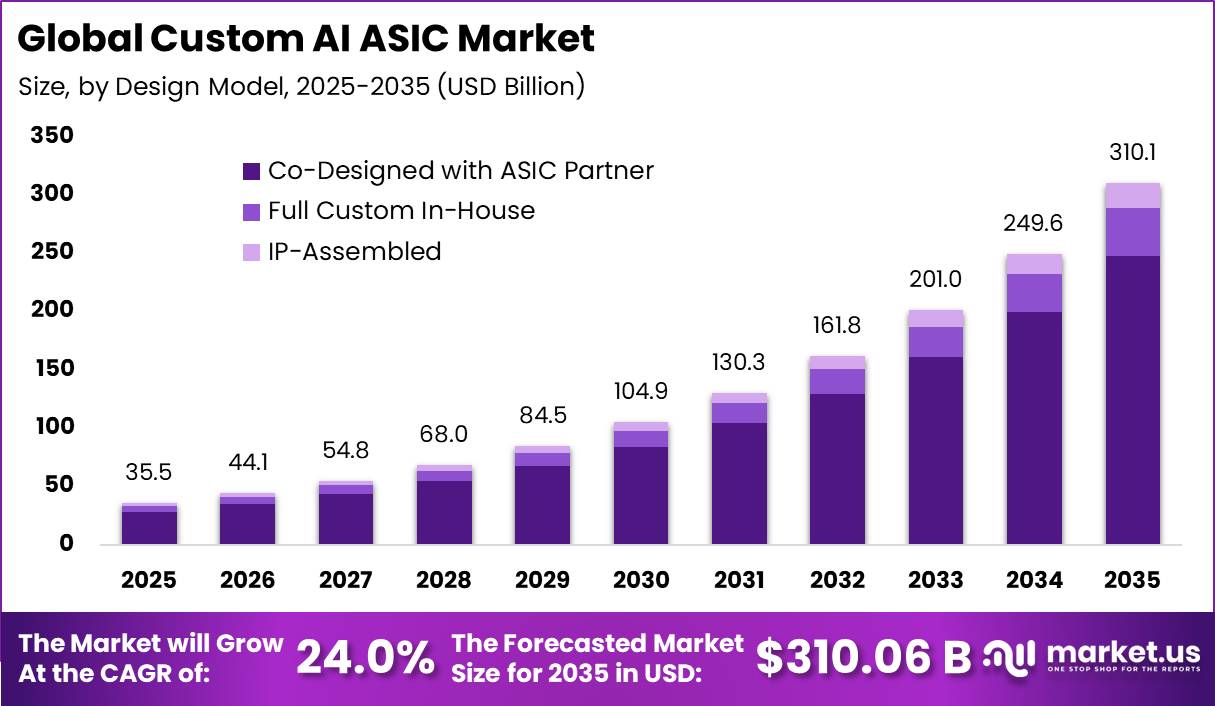
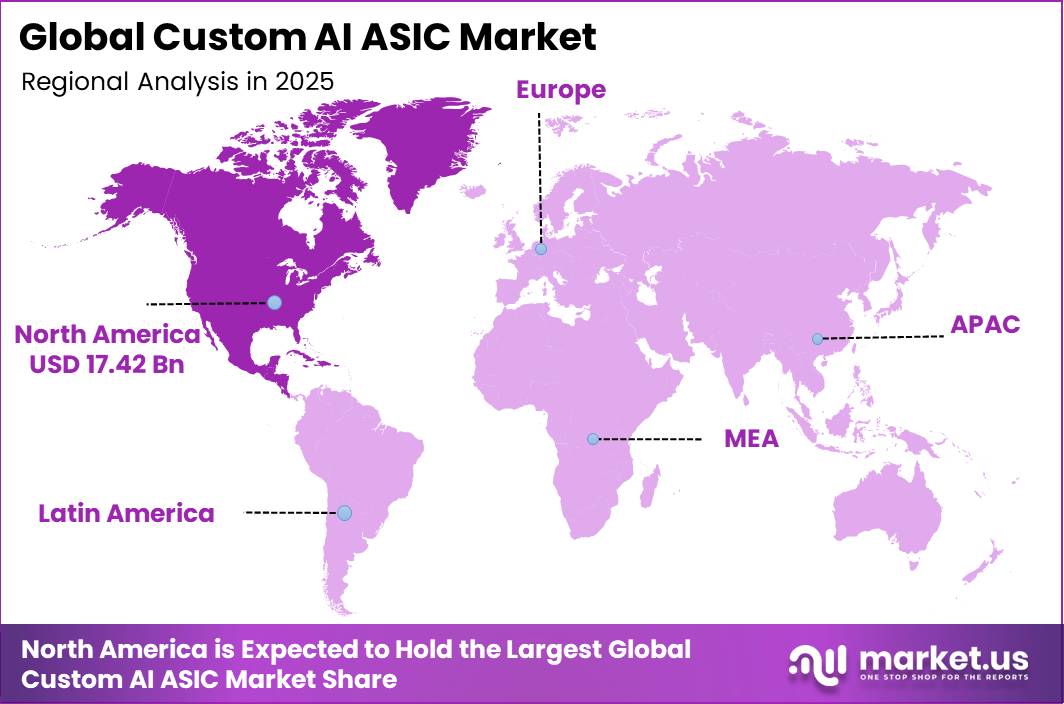
In 2025, the Global Custom AI ASIC Market was valued at USD 35.5 billion. The market is projected to grow at a CAGR of 24.0% during 2026–2035, reaching approximately USD 310.06 billion by 2035. North America dominated the global market in 2025, accounting for more than 49.1% of the total market share and generating approximately USD 17.42 billion in revenue.
Growing AI training and inference workloads are encouraging hyperscalers and cloud providers to adopt custom ASICs, which can deliver higher computing efficiency and lower power consumption than general-purpose processors. The Semiconductor Industry Association reported that global semiconductor sales reached a record USD 791.7 billion in 2025, rising 25.6% from 2024. Logic semiconductor sales increased 39.9% to USD 301.9 billion, while total industry sales are projected to exceed USD 1 trillion in 2026.
Major U.S. technology companies, including Meta, Amazon, Alphabet, and Microsoft, committed nearly USD 320 billion to AI and data center investments in 2025, compared with USD 230 billion a year earlier. U.S. electricity demand is also expected to increase by 5% in 2026, reaching a record 4,283 billion kWh, further supporting large-scale semiconductor and custom ASIC deployment.
Key Takeaway
- The Custom AI ASIC Market was valued at USD 35.5 billion in 2025 and is projected to reach USD 310.06 billion by 2035, growing at a CAGR of 24.0%.
- Co-Designed with ASIC Partner dominated the Custom AI ASIC Market with a 79.9% share, supported by strong demand for specialized design and manufacturing expertise.
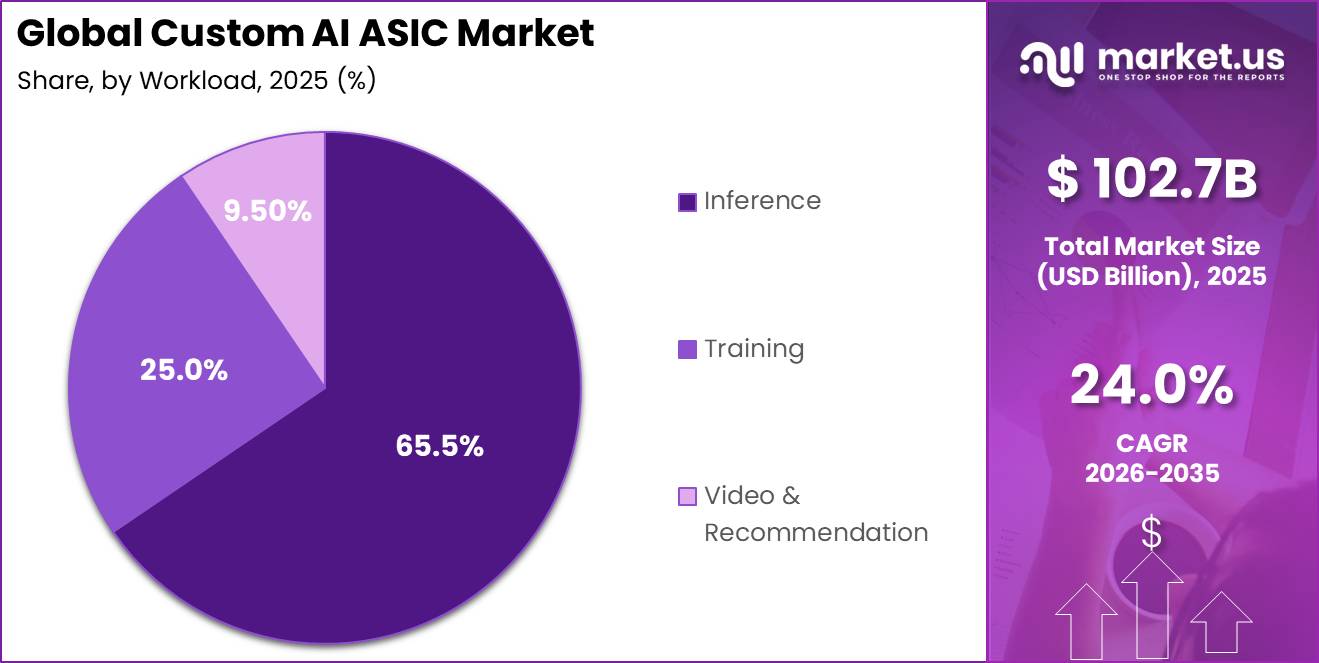
- Inference held a dominant 65.5% share, driven by growing real-time AI workloads across chatbots, search, recommendations, and enterprise applications.
- Google TPU led the program-owner segment with a 65.1% share, supported by Google’s large-scale AI infrastructure and proprietary accelerator deployment.
- North America led the market in 2025 with a 49.1% share and approximately USD 17.4 billion in revenue.
Market Statistics and Data Insights
- In North America, 74% of surveyed organizations reported using generative AI in at least one business function in 2024, up from 40% in 2023. Europe increased from 31% to 73%, while Greater China increased from 31% to 73%. This indicates a sharp increase in enterprise inference workloads across three major Custom AI ASIC demand regions.
- The cost of running a model at approximately GPT-3.5 performance fell from USD 20.00 per million tokens in November 2022 to USD 0.07 by October 2024, representing a more than 280-fold reduction. Stanford also reported that AI hardware price-performance improved by about 30% annually, while hardware energy efficiency increased by around 40% per year.
- U.S. private AI investment reached USD 109.1 billion in 2024, nearly 12 times China’s USD 9.3 billion and 24 times the U.K.’s USD 4.5 billion. This investment concentration supports large proprietary ASIC programs among U.S. hyperscalers and AI developers.
- Amazon reported in 2026 that its Trainium and Graviton custom-chip businesses had a combined annual revenue run rate exceeding USD 10 billion and were growing at a triple-digit percentage rate year over year.
- AWS had deployed 1.4 million Trainium2 chips by early 2026. More than 500,000 Trainium2 chips were operating in Project Rainier, which Amazon described as the world’s largest operational AI compute cluster.
- Amazon Bedrock was being used by more than 125,000 customers in 2026, and almost 80% of Fortune 100 companies were using the platform. Amazon stated that most Bedrock inference runs on Trainium, directly showing enterprise adoption of custom ASIC-based inference infrastructure.
- Google’s seventh-generation Ironwood TPU can scale to 9,216 chips and provide approximately 42.5 exaflops of computing capacity. Google stated that Ironwood delivers about 2 times the performance per watt of its sixth-generation Trillium TPU.
- Global data centers consumed approximately 415 TWh of electricity in 2024, equal to about 1.5% of worldwide electricity consumption. The IEA projects consumption to reach approximately 945 TWh by 2030, just under 3% of global electricity demand.
- Electricity consumption by accelerated servers, primarily driven by AI, is projected to increase approximately 30% per year through 2030, compared with 9% annual growth for conventional servers. Accelerated servers are expected to account for almost half of the net increase in global data-center electricity consumption.
- In April 2025, Google disclosed that its seventh-generation Ironwood TPU can scale to 9,216 chips in one pod and deliver 42.5 exaflops of total compute, with each chip providing up to 4,614 TFLOPs of peak FP8 performance.
By Design Model
The “Co-Designed with ASIC Partner” segment holds a dominant 79.9% share of the custom AI ASIC market, mainly because advanced AI chips require specialized skills that many cloud providers and AI companies do not fully manage in-house. Custom AI accelerators must combine computing architecture, high-bandwidth memory, advanced packaging, power management, networking, physical design, verification, and foundry-specific manufacturing requirements.
The strength of this ecosystem is reflected in TSMC’s operations. In 2025, the company deployed 305 process technologies and manufactured 12,682 products for 534 customers. Its advanced technologies represented 74% of wafer revenue, showing strong demand for leading-edge processes used in power-efficient AI chips.
The UCIe Consortium also had more than 140 member companies in 2025, including cloud providers, foundries, IP suppliers, chip designers, and packaging companies. This broad industry collaboration makes co-design a practical model for reducing development risk, improving validation speed, and achieving better performance per watt.
| Design Model | Segment Shares |
|---|---|
| Co-Designed with ASIC Partner | 79.9% |
| Full Custom In-House | 13.1% |
| IP-Assembled | 7.0% |
By Workload
The Inference segment holds a dominant 65.5% share of the custom AI ASIC market because trained AI models must process large numbers of real-time requests across search, chatbots, recommendation systems, fraud detection, translation, image analysis, and enterprise automation. Unlike model training, which happens at selected intervals, inference runs every time a user or business application submits a request. This makes inference demand grow quickly as AI adoption expands.
| Workload | Segment Shares |
|---|---|
| Inference | 65.5% |
| Training | 25.0% |
| Video and Recommendation | 9.5% |
Stanford University’s 2025 AI Index reported that 78% of organizations used AI in 2024, compared with 55% in 2023. The use of generative AI in at least one business function also increased from 33% to 71%. At the same time, the cost of GPT-3.5-level inference declined from USD 20 to USD 0.07 per million tokens between November 2022 and October 2024, representing a reduction of more than 280-fold.
Lower inference costs support wider AI deployment and higher query volumes. Custom AI ASICs are well suited to these workloads because they can deliver high processing speed with lower energy use per request, helping cloud providers reduce operating costs and improve response times.
By Program Owner
The Google TPU segment holds a dominant 65.1% share of the custom AI ASIC market’s program-owner segment, supported by Google’s large AI infrastructure and broad use of TPUs across consumer services, Gemini models, and Google Cloud. Alphabet invested USD 91.4 billion in capital expenditure during 2025, compared with USD 52.5 billion in 2024.
| Program Owner | Segment Shares |
|---|---|
| Google TPU | 65.1% |
| AWS Trainium/Inferentia | 14.5% |
| Meta MTIA | 9.1% |
| Microsoft Maia | 6.1% |
| OpenAI and Emerging Programs | 5.2% |
Around 60% of this spending was directed toward servers, while the remaining investment supported data centers and networking. This large infrastructure base allows Google to deploy TPUs at significant scale across training and inference workloads. Google’s sixth-generation Trillium TPU further strengthens its market position. Compared with TPU v5e, Trillium delivers 4.7 times higher peak compute performance per chip and 67% better energy efficiency.
It also doubles high-bandwidth memory capacity, memory bandwidth, and inter-chip bandwidth. Google states that its Jupiter network can connect up to 100,000 Trillium chips, supporting very large AI computing clusters. By combining chip design, software, memory, and networking within one platform, Google can improve processing speed, reduce energy use per AI task, and lower infrastructure costs, supporting TPU’s leading position in the program-owner segment.
Key Market Segments
By Design Model
- Full Custom In-House
- Co-Designed with ASIC Partner
- IP-Assembled
By Workload
- Training
- Inference
- Video & Recommendation
By Program Owner
- Google TPU
- AWS Trainium/Inferentia
- Meta MTIA
- Microsoft Maia
- OpenAI & Emerging Programs
Geopolitical Impact Analysis
Geopolitical risk is increasing both costs and supply uncertainty across the custom AI ASIC market. The supply chain depends heavily on foundry-made logic chips, high-bandwidth memory, advanced substrates, packaging materials, networking components, and semiconductor equipment sourced mainly from East Asia.
U.S.–China trade restrictions are an important cost pressure, as the United States maintains an additional 50% Section 301 tariff on Chinese semiconductor imports. The U.S. Trade Representative has also announced another semiconductor tariff action scheduled to begin in June 2027. These measures raise the landed cost of China-origin chips and related electronics and are encouraging companies to diversify sourcing toward Taiwan, South Korea, Japan, Southeast Asia, and the United States.
This shift can also increase supplier qualification, testing, inventory, and compliance costs. Shipping disruptions create another challenge for ASIC suppliers. UNCTAD reported that Suez Canal transits were 70% lower in June 2024 than in mid-December 2023. A Shenzhen-to-Rotterdam shipment routed around the Cape of Good Hope increases the distance from 10,000 to 13,000 nautical miles and extends delivery time from about 31 to 41 days.
UNCTAD also found that Red Sea disruption contributed 148 percentage points to a cumulative 120% increase in the China Containerized Freight Index between October 2023 and June 2024. Energy costs add further pressure, with the World Bank projecting average energy prices to rise 24% in 2026, while Brent crude is expected to average USD 86 per barrel, around USD 26 above its January forecast.
Regional Analysis
North America dominated the global Custom AI ASIC Market in 2025, accounting for 49.1% of total revenue and generating about USD 17.4 billion. The region benefits from a strong concentration of hyperscale cloud providers, AI developers, chip-design companies, semiconductor software firms, and advanced data-center infrastructure.
| Region | Region Shares |
|---|---|
| North America | 49.1% |
| Asia Pacific | 25.0% |
| Europe | 15.5% |
| Latin America | 6.0% |
| Middle East and Africa | 4.4% |
Major technology companies are increasingly using proprietary AI accelerators for cloud services, enterprise AI, search, recommendation systems, cybersecurity, and generative AI workloads. Custom ASICs are well suited to these applications because they can be optimized for specific models and inference tasks, helping improve processing speed, reduce energy use per query, and control infrastructure costs.
Government support is also strengthening the regional ecosystem. The U.S. CHIPS and Science Act provides USD 39 billion for semiconductor manufacturing incentives and USD 11 billion for semiconductor research and development. In January 2025, the U.S. Department of Commerce also finalized USD 1.4 billion in funding under the National Advanced Packaging Manufacturing Program.
Asia Pacific held an estimated 25% share of the global market and is expected to be the fastest-growing region. The area has strong semiconductor fabrication, memory, packaging, substrate, electronics manufacturing, and server-assembly capabilities across Taiwan, South Korea, China, Japan, Singapore, and Southeast Asia. Rising cloud capacity, AI adoption, smart manufacturing, telecom deployment, financial services, and digital public infrastructure are supporting demand.
Key Regions and Countries
North America
- US
- Canada
Europe
- Germany
- France
- The UK
- Spain
- Italy
- Rest of Europe
Asia Pacific
- China
- Japan
- South Korea
- India
- Australia
- Rest of APAC
Latin America
- Brazil
- Mexico
- Rest of Latin America
Middle East & Africa
- GCC
- South Africa
- Rest of MEA
Market Dynamics
Drivers
| Driver | (~) % CAGR | Geographic Relevance | Impact Timeline |
|---|---|---|---|
| Hyperscale AI inference expansion | +4.0% | North America, East Asia, Europe | Short term (2 years or less) |
| Purpose-built cloud silicon adoption | +3.2% | North America, Asia Pacific | Short term (2 years or less) |
| Advanced packaging scale-up | +2.4% | Taiwan, South Korea, United States | Medium term (2 to 4 years) |
| Enterprise AI deployment | +1.8% | Global | Medium term (2 to 4 years) |
| National semiconductor incentives | +1.5% | United States, Japan, European Union | Long term (4 years or more) |
Hyperscale AI inference expansion
Hyperscale operators are moving from periodic AI model training toward continuous, high-volume inference, creating more recurring demand for custom AI ASICs. The International Energy Agency reported that electricity use by AI-focused data centres increased 50% in 2025, compared with 17% growth for overall data-centre electricity use. Total data-centre consumption is projected to increase from 485 TWh in 2025, encouraging operators to adopt workload-optimized ASICs that reduce energy use per inference request.
Large-scale deployments already reflect this shift. Alphabet introduced its seventh-generation TPU in 2025, designed specifically for large-scale inference, while AWS deployed nearly 500,000 Trainium2 chips through Project Rainier. Growing inference volumes can increase accelerator purchases, shorten hardware refresh cycles, and strengthen demand for integrated memory, packaging, and networking solutions. This trend is estimated to contribute approximately +4.0% to the market’s baseline CAGR.
Restraints
| Restraint | (~) % CAGR | Geographic Relevance | Impact Timeline |
|---|---|---|---|
| Advanced-chip export restrictions | -3.0% | United States, China, Middle East | Short term (2 years or less) |
| High development entry costs | -2.1% | Global | Medium term (2 to 4 years) |
| Foundry capacity concentration | -1.8% | Taiwan, United States, South Korea | Short term (2 years or less) |
| High-bandwidth memory constraints | -1.4% | East Asia, North America | Medium term (2 to 4 years) |
| Data-centre permitting limits | -1.1% | North America, Europe | Medium term (2 to 4 years) |
Advanced-chip export restrictions
Export-control uncertainty remains an immediate restraint for the custom AI ASIC market because changing rules can delay shipments, tape-out decisions, and customer contracts. The U.S. Department of Commerce issued the AI Diffusion Rule on January 15, 2025, with compliance originally planned for May 15, 2025, before announcing its rescission on May 13, 2025. However, existing controls on advanced computing products and licensing requirements for China and other restricted destinations remain important supply-chain considerations.
For ASIC program owners, changing export rules can increase customer screening, legal, logistics, inventory, and product-configuration costs. Overall, export-control uncertainty is estimated to create around a -3.0% drag on the market’s baseline CAGR by reducing deployment flexibility and increasing compliance costs.
Challenges
| Challenge | (~) % CAGR | Geographic Relevance | Mitigation Horizon |
|---|---|---|---|
| Grid connection bottlenecks | -2.6% | North America, Europe, Asia Pacific | Long term (4 years or more) |
| Advanced packaging yield complexity | -2.0% | Taiwan, South Korea, United States | Medium term (2 to 4 years) |
| Memory bandwidth scaling | -1.7% | Global | Medium term (2 to 4 years) |
| ASIC design talent shortage | -1.3% | North America, East Asia, Europe | Long term (4 years or more) |
| Thermal density management | -1.1% | Global | Medium term (2 to 4 years) |
Grid connection bottlenecks
Electric-grid capacity remains a major operational challenge for the custom AI ASIC market because new data centres require reliable power and timely grid connections. The International Energy Agency estimates that global data-centre electricity demand could reach nearly 950 TWh by 2030, representing around 3% of global electricity demand. AI workloads can also create rapid power swings, while reliable on-site gas generation may require 30% to 70% more capacity than actual demand.
Power constraints can delay new AI cluster deployments and increase spending on grid connections, backup generation, and energy procurement. The U.S. Energy Information Administration expects U.S. electricity consumption to reach 4,283 billion kWh in 2026, partly supported by rising data-centre demand. These infrastructure limits may delay accelerator installations and revenue recognition, creating an estimated -2.6% drag on the market’s maximum attainable CAGR until generation, transmission, and grid-equipment capacity improves.
Opportunities
| Opportunity | (~) % CAGR | Geographic Relevance | Execution Window |
|---|---|---|---|
| Enterprise inference ASIC platforms | +3.5% | North America, Europe, Asia Pacific | Medium term (2 to 4 years) |
| Edge AI silicon deployment | +2.8% | Asia Pacific, North America, Europe | Long term (4 years or more) |
| Chiplet design monetization | +2.2% | Global | Medium term (2 to 4 years) |
| Sovereign AI infrastructure | +1.9% | Middle East, Europe, Asia Pacific | Long term (4 years or more) |
| Automotive AI accelerator integration | +1.4% | China, Europe, North America | Long term (4 years or more) |
Enterprise inference ASIC platforms
Enterprise inference platforms remain a strong untapped opportunity because custom AI ASIC deployment is still concentrated among large cloud providers. Stanford University’s 2025 AI Index reported that 78% of organizations used AI in 2024, while GPT-3.5-level inference costs fell from USD 20 per million tokens in November 2022 to USD 0.07 by October 2024, a decline of more than 99%.
ASIC vendors can address this opportunity through managed-capacity, appliance, and usage-based models designed for enterprises that require controlled and auditable AI infrastructure. Such solutions could potentially lower per-query infrastructure costs by around 20% to 40% compared with broadly configured computing platforms. Wider enterprise adoption could also improve software-linked margins and contribute approximately +3.5% to the baseline CAGR.
Key Players Analysis
The Custom AI ASIC Market is led by a concentrated Tier-1 group that includes Google, AWS, Meta, Microsoft, Broadcom, and TSMC. Google, AWS, Meta, and Microsoft manage very large internal AI workloads and act as program owners for chip specifications, software, and deployment volumes. Broadcom is a major external supplier of custom AI accelerators and networking products.
Its fiscal 2025 AI semiconductor revenue reached USD 20.2 billion, increasing 65% year on year and representing 55% of its USD 36.9 billion semiconductor revenue. Broadcom also supported six hyperscale XPU customers. TSMC remains a key manufacturing partner because advanced ASICs require leading-edge process nodes and advanced packaging.
Tier-2 competitors include Marvell, Alchip, and OpenAI. Marvell generated USD 6.1 billion in data-center revenue in fiscal 2026, equal to 74% of total revenue, compared with USD 4.16 billion in fiscal 2025. The company invested USD 2.08 billion in R&D, representing 25.3% of revenue. At Alchip, AI and high-performance-computing programs contributed 94% of 2025 revenue, while advanced process nodes represented 97%.
Broadcom is estimated to hold 35–45% of the external merchant market, while Marvell and Alchip together account for around 10–15%. These are analytical estimates rather than company-reported market shares. Competitive strength increasingly depends on accelerator design, high-bandwidth memory, advanced packaging, optical connectivity, networking, and software integration.
Top Key Players in the Market
- Google LLC
- Amazon Web Services, Inc.
- Meta Platforms, Inc.
- Microsoft Corporation
- OpenAI
- Taiwan Semiconductor Manufacturing Company Limited (TSMC)
- Alchip Technologies Ltd.
- Broadcom Inc.
- Marvell Technology, Inc.
Recent Developments
- In 2026, Marvell completed the acquisition of Celestial AI for approximately USD 3.5 billion. The transaction was completed on February 2, 2026, adding Celestial AI’s Photonic Fabric technology to Marvell’s data-center portfolio. The technology provides high-bandwidth and low-latency optical connectivity for large AI systems.
- In 2025, TSMC announced an additional USD 100 billion investment in U.S. semiconductor manufacturing, increasing its planned U.S. investment to USD 165 billion. Announced on March 4, 2025, the expansion includes three new fabrication plants, two advanced packaging facilities, and a major R&D center.
Report Scope
| Report Features | Description |
|---|---|
| Market Value (2025) | USD 35.5 Billion |
| Forecast Revenue (2035) | USD 310.06 Billion |
| CAGR (2026-2035) | 24.0% |
| Base Year for Estimation | 2025 |
| Historic Period | 2020-2024 |
| Forecast Period | 2026-2035 |
| Report Coverage | Revenue Forecast, Market Dynamics, Competitive Landscape, Recent Developments |
| Segments Covered | By Design Model – (Full Custom In-House, Co-Designed with ASIC Partner, IP-Assembled); By Workload – (Training, Inference, Video & Recommendation); By Program Owner – (Google TPU, AWS Trainium/Inferentia, Meta MTIA, Microsoft Maia, OpenAI & Emerging Programs) |
| Regional Analysis | North America – US, Canada; Europe – Germany, France, The UK, Spain, Italy, Rest of Europe; Asia Pacific – China, Japan, South Korea, India, Australia, Singapore, Rest of APAC; Latin America – Brazil, Mexico, Rest of Latin America; Middle East & Africa – GCC, South Africa, Rest of MEA |
| Competitive Landscape | Google LLC, Amazon Web Services, Inc., Meta Platforms, Inc., Microsoft Corporation, OpenAI, Taiwan Semiconductor Manufacturing Company Limited (TSMC), Alchip Technologies Ltd., Broadcom Inc., Marvell Technology, Inc. |
| Customization Scope | Customization for segments, region/country-level will be provided. Moreover, additional customization can be done based on the requirements. |
| Purchase Options | We have three licenses to opt for: Single User License, Multi-User License (Up to 5 Users), Corporate Use License (Unlimited Users and Printable PDF) |