


Report Overview
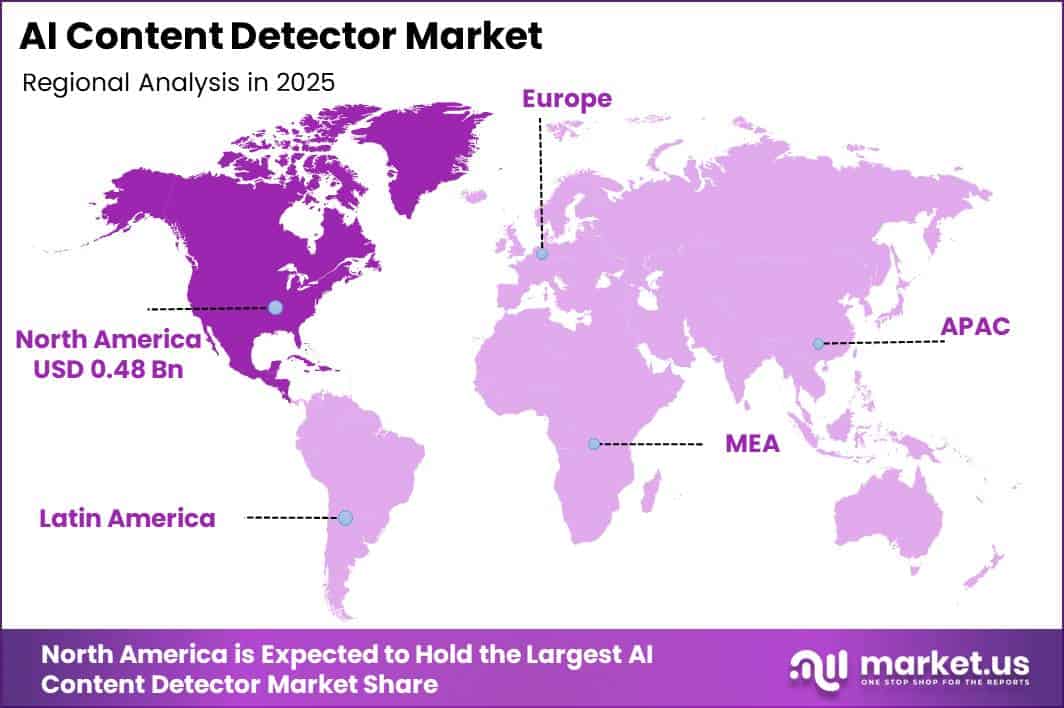
In 2025, the Global AI Content Detector Market was valued at USD 1.3 billion. The market is projected to grow at a CAGR of 19.0% during 2026–2035, reaching approximately USD 7.3 billion by 2035. North America dominated the global market in 2025, accounting for more than 37.1% of the total market share and generating approximately USD 0.4 billion in revenue.
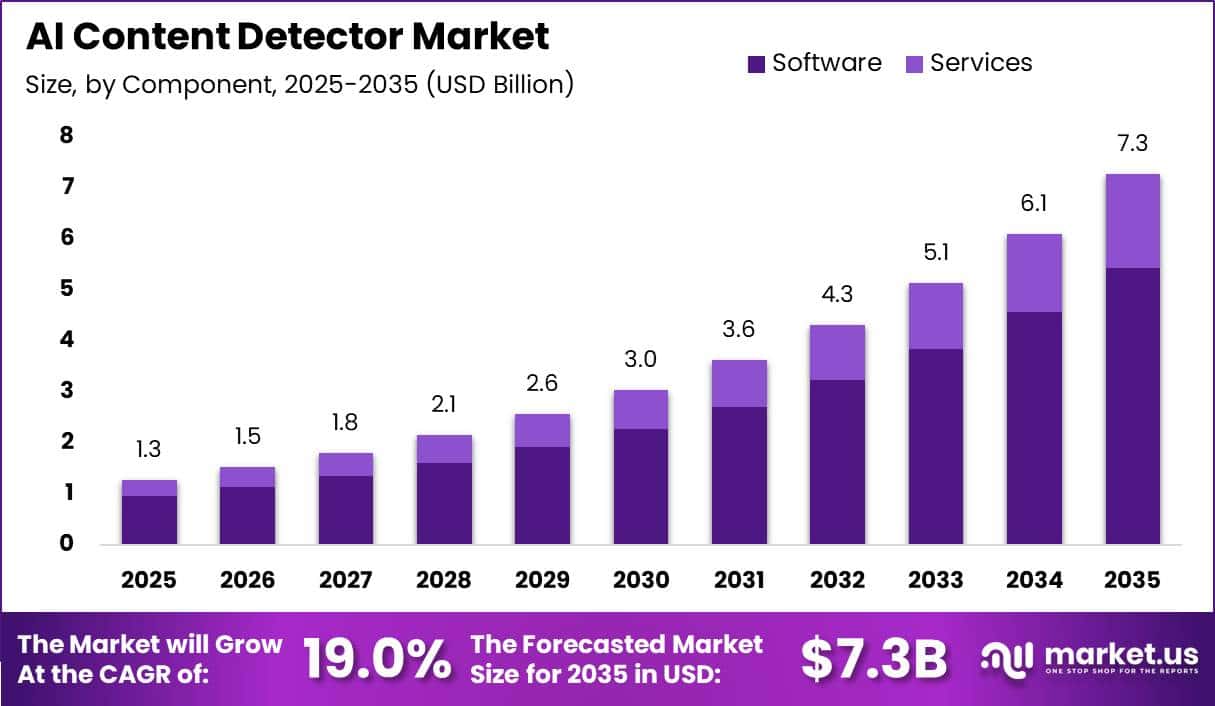
This growth is supported by the rapid adoption of generative AI and the rising volume of AI-created text, images, videos, and code. According to the World Bank, the top 60 consumer-facing generative AI tools received nearly 3 billion visits per month by early 2024. ChatGPT traffic increased by 113% year-on-year and represented 77–82.5% of visits to leading AI platforms.
This expansion has increased concerns regarding plagiarism, misinformation, deepfakes, and unauthorized content generation. UNESCO reported that more than two-thirds of secondary school students in high-income countries use generative AI for schoolwork, while only around 10% of institutions have formal AI-use frameworks. The World Bank also estimated that the generative AI market would increase from approximately USD 1.5 billion in 2021 to USD 6.5 billion by 2026, creating steady demand for content verification tools.
OECD data showed that United States AI investment in 2025 was more than twice that of other OECD economies. Generative AI usage reached 24% of internet users in high-income countries, compared with 5.8% in upper-middle-income economies and under 1% in low-income economies. Strong AI adoption, regulatory pressure, and growing compliance requirements across education, media, enterprises, and digital platforms are expected to support sustained market expansion during 2026–2035.
Key Takeaway
- The AI Content Detector Market was valued at USD 1.3 billion in 2025 and is projected to reach USD 7.3 billion by 2035, growing at a CAGR of 19.0%.
- The software segment accounted for 74.8% of the total component share.
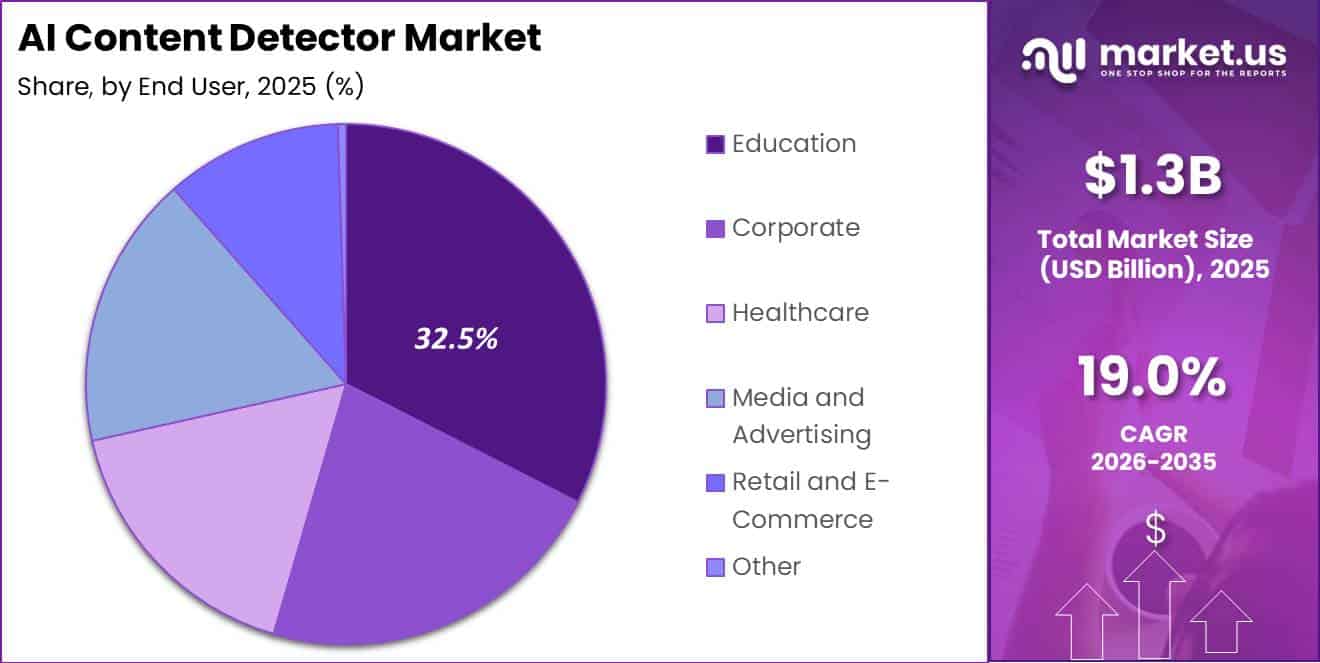
- The education segment led end-user demand with a 32.5% share.
- North America led the market in 2025 with a 37.1% share and USD 0.4 billion in revenue.
Market Statistics and Data Insights
- The OECD reported that more than one-third of individuals across OECD countries used generative AI tools in 2025, showing rapid consumer adoption of AI-generated content platforms. Among students aged 16 years and above, around 75% reported using generative AI tools, increasing the requirement for content verification in education and professional environments.
- In 2025, 20.2% of firms across OECD countries used AI, compared with 14.2% in 2024 and 8.7% in 2023, increasing the need for AI governance, monitoring, and content authentication systems. Large enterprises showed higher adoption, with 52.0% of large firms using AI compared with 17.4% of small firms.
- Copyleaks AI Detector V10 testing in 2025 reported AI-text detection accuracy of 98.64% under the Extra Safe sensitivity setting while maintaining a 99.99% human-text recognition rate.
- An academic study published in July 2025 evaluating AI text detectors against DeepSeek-generated content found that humanization attacks reduced Copyleaks detection accuracy to 71%, QuillBot accuracy to 58%, and GPTZero accuracy to 52%.
- A 2025 academic evaluation of AI detectors tested 6 AI detection tools against DeepSeek-generated text, using 49 human-authored samples, 49 AI-generated samples, and 196 adversarially modified samples created through paraphrasing and humanization techniques.
- NVIDIA’s Synthetic Video Detector, introduced in 2026, achieved up to 92% accuracy in identifying AI-generated videos and processed video analysis in approximately 22 milliseconds on RTX GPUs and 30 milliseconds on NVIDIA workstations.
- Copyleaks AI Detector supports detection across 30+ languages and tests AI identification capabilities across models including ChatGPT, Gemini, Claude, and DeepSeek, supporting multilingual content verification workflows.
- Copyleaks AI Detector platform testing reported language-level AI detection performance in 2025, including 99.20% AI detection accuracy for English, 96.18% for French, 95.63% for German, 97.00% for Italian, 93.08% for Portuguese, and 98.02% for Spanish.
- In 2025, GPTZero reported performance on the RAID benchmark dataset with 95.7% AI-text detection capability while incorrectly classifying only 1% of human-written text as AI-generated.
- A 2025 peer-reviewed evaluation of GPTZero tested 28 AI-generated essays and 50 human-written essays across short (40–100 words), medium (100–350 words), and long (350–800 words) formats. The study found that most AI-generated essays were detected with 91%–100% AI probability, while some human-written essays received false-positive classifications.
By Component
The Software segment held a leading position in the AI content detector market, accounting for 74.8% of the total component share. Its dominance is supported by the growing need for scalable and automated systems that can identify AI-generated text, images, videos, and code. Unlike static hardware or manual services, software-based detectors can be delivered through cloud platforms, APIs, and SaaS models, allowing them to receive regular updates as generative AI technologies evolve.
As of March 2024, the World Bank estimated that the top 40 generative AI tools attracted nearly 3 billion visits per month. Chatbots represented approximately 95% of the leading tools, while a single platform generated more than 80% of total traffic. This high usage creates tens of billions of digital content items that require automated screening across publishing platforms, learning management systems, and enterprise applications.
In 2025, AI infrastructure and service companies attracted around USD 109.3 billion in private investment, while AI-related businesses represented 61% of total venture funding. Rising generative AI adoption across education and workplaces is further increasing demand for software detectors that can track new AI models, adversarial prompts, and multilingual content in real time.
By End User
The Education segment held a leading position in the AI content detector market, accounting for 32.5% of total end-user demand. Its dominance is supported by the rising use of generative AI in assignments, research papers, examinations, admissions, and classroom activities. Educational institutions increasingly require automated tools to identify AI-generated content, protect academic integrity, and support fair assessment practices.
According to UNESCO’s Higher Education Global Trends Report, global higher-education enrolment more than doubled over the past 20 years, reaching approximately 269 million students in 2024. This large student population generates a substantial volume of digital assignments and academic content that must be reviewed and verified.
UNESCO also reported that only around 10% of surveyed institutions had introduced an official framework for generative AI use in 2023. The limited availability of clear policies increases the risk of plagiarism, unauthorized AI assistance, and unreliable assessment outcomes. Schools and universities are integrating AI content detection tools into learning management systems, plagiarism-checking platforms, and online examination solutions.
Key Market Segments
By Component
- Software
- Services
By End User
- Education
- Corporate
- Healthcare
- Media and Advertising
- Retail and E-Commerce
- Other
Geopolitical Impact Analysis
Geopolitical tensions are increasing the cost and complexity of delivering AI content detector solutions, particularly for cloud-based providers that depend on advanced semiconductors, high-capacity storage systems, networking equipment, and energy-intensive data centers. According to the WTO, the value of global goods imports affected by new tariffs and import restrictions increased more than fourfold between mid-October 2024 and mid-October 2025, reaching the highest level recorded in over 15 years.
World Tariff Profiles 2025 also showed that applied tariffs on several non-agricultural manufactured products in major economies were moving toward average rates of 6–8%. These measures raise the purchase and installation costs of servers, high-performance GPUs, and other infrastructure used to process and detect AI-generated content.
Logistics disruptions are adding further pressure. UNCTAD and WTO reports indicated that the rerouting of Asia–Europe shipping traffic around the Red Sea and Suez Canal increased transit times by approximately 10–15 days. Freight rates on some container routes also rose by more than 200% during periods of severe disruption in 2024–2025. This situation delays the delivery of on-premise detection systems, replacement components, and data-center equipment.
Energy costs remain another major concern. The IEA reported that European wholesale electricity markets experienced negative pricing periods as well as price increases above EUR 200 per MWh in certain markets during 2023–2024. Combined tariff, freight, and electricity pressures are influencing subscription prices, equipment costs, and regional deployment plans. Vendors may apply price increases of around 5–10%, expand usage-based billing, and establish computing capacity closer to major demand centers to protect profitability.
Regional Analysis
North America remained the leading region in the AI content detector market, accounting for approximately 37.1% of global revenue and generating nearly USD 0.4 billion in 2025. The region’s dominance is supported by the widespread use of generative AI across universities, digital publishing companies, enterprises, and SaaS platforms.
In the broader AI content verification industry, North America also represents the largest revenue-generating region. The related global market was valued at around USD 3.8 billion in 2024 and is projected to reach USD 12.0 billion by 2030, expanding at a 21% CAGR.
Asia Pacific is expected to register the fastest growth, with related content detection revenue projected to increase at approximately 16.4% CAGR between 2025 and 2030. The broader regional market could reach an estimated USD 9.2 billion by 2030. This growth is supported by expanding internet and smartphone use, rapid digitalization, and the rising adoption of online education and creator platforms across China, India, Indonesia, and ASEAN countries.
The region’s market share is expected to increase from the mid-20% range and gradually move closer to North America. Vendors are therefore developing detectors for Asian languages, adapting solutions to local compliance rules, and expanding regional cloud infrastructure to support hundreds of millions of potential users.
Key Regions and Countries
North America
- US
- Canada
Europe
- Germany
- France
- The UK
- Spain
- Italy
- Rest of Europe
Asia Pacific
- China
- Japan
- South Korea
- India
- Australia
- Rest of APAC
Latin America
- Brazil
- Mexico
- Rest of Latin America
Middle East & Africa
- GCC
- South Africa
- Rest of MEA
Market Dynamics
Drivers
| Driver | (~) % CAGR | Geographic Relevance | Impact Timeline |
|---|---|---|---|
| Explosion of generative AI content volume | +4.0% | Global | Short term (<= 2 years) |
| Institutional adoption in education & research | +3.0% | North America, Europe, Asia Pacific | Medium term (2–4 years) |
| Platform integration via APIs into CMS/LMS | +2.0% | Global | Medium term (2–4 years) |
| Growth in creator & marketing economies | +1.5% | Global, especially Asia Pacific | Medium term (2–4 years) |
| Enterprise compliance & audit requirements | +1.0% | North America, Europe | Long term (>4 years) |
Explosion of generative AI content volume
The largest driver of AI content detector growth is the rapid rise of generative AI across text, image, and code creation. World Bank data showed that leading generative AI applications received more than 3 billion monthly visits in 2024, with chatbots accounting for over 80% of traffic.
Generative AI adoption among internet users in high-income economies reached around 20–25% by 2025, according to OECD indicators. Platforms are using detection systems to keep misleading content below internal limits of approximately 1%–3%.
UNESCO findings also suggest that more than 50% of surveyed universities were testing or using AI tools in assessment by 2025, increasing demand for systems that can review millions of assignments and reduce manual assessment time by around 30%–50% per course. Together, these factors could add nearly 4.0 percentage points to the market’s baseline CAGR.
Restraints
| Restraint | (~) % CAGR | Geographic Relevance | Impact Timeline |
|---|---|---|---|
| High false-positive rates & legal liability exposure | -3.0% | Global | Short term (<= 2 years) |
| Limited institutional budgets in emerging markets | -2.0% | Asia Pacific, Latin America, Africa | Medium term (2–4 years) |
| Unclear regulatory standards for AI detection use | -1.5% | Global | Medium term (2–4 years) |
| Data-privacy constraints on scanning user content | -1.0% | Europe, North America | Long term (>4 years) |
| Conservative adoption in regulated sectors | -0.5% | Financial services, healthcare | Long term (>4 years) |
High false-positive rates & legal liability exposure
The main restraint for the AI content detector market is the risk of false positives and related legal disputes when human-written work is wrongly classified as AI-generated. University studies referenced in academic integrity discussions indicate false-positive rates of around 5%–15% across diverse content samples.
In large institutions, these errors can affect thousands of students or authors and require an additional 10%–20% of staff time for reviews and appeals. European data-protection authorities reported that complaints involving automated decision-making increased by more than 30% between 2023 and 2025, showing growing regulatory pressure.
In North America, disputes linked to academic misconduct allegations can cost large institutions several hundred thousand dollars per case. Many buyers use double-review systems or limit detector coverage, reducing automation benefits by up to 40%. These risks could lower the market’s baseline CAGR by around 3.0 percentage points until detection accuracy and legal standards improve.
Challenges
| Challenge | (~) % CAGR | Geographic Relevance | Mitigation Horizon |
|---|---|---|---|
| Rapid model evolution & detector obsolescence | -2.5% | Global | Short term (<= 2 years) |
| Compute & storage cost pressures for SaaS vendors | -2.0% | Global | Medium term (2–4 years) |
| Talent scarcity in AI safety & evaluation | -1.5% | North America, Europe | Medium term (2–4 years) |
| Interoperability and standards fragmentation | -1.0% | Global | Long term (>4 years) |
| Adversarial content designed to evade detection | -0.8% | Global online platforms | Long term (>4 years) |
Rapid model evolution & detector obsolescence
A major challenge for the AI content detector market is the rapid evolution of generative AI models, which can reduce detector accuracy and require continuous retraining. OECD AI tracking indicates that model parameter counts and training-token volumes increased by more than 10 times between 2020 and 2025, while major model updates now occur every 6–12 months instead of over several years.
AI-related computing usage has also grown by more than 30% annually, increasing the cost of inference, testing, and model evaluation. Revalidating detectors against new AI systems may require hundreds of millions of labeled tokens and several months of expert work.
This creates pressure on smaller vendors whose research and development budgets are often below 10% of revenue. These challenges could reduce the market’s maximum achievable CAGR by around 2.5 percentage points, as companies must spend more resources maintaining accuracy rather than expanding commercially.
Opportunities
| Opportunity | (~) % CAGR | Geographic Relevance | Execution Window |
|---|---|---|---|
| Multimodal detection across text, image, video & audio | +3.5% | Global | Medium term (2–4 years) |
| Sector-specific compliance suites for finance & healthcare | +2.5% | North America, Europe, Asia Pacific | Medium term (2–4 years) |
| Low-cost detectors for emerging-market education | +2.0% | Asia Pacific, Africa, Latin America | Long term (>4 years) |
| Integration into productivity suites and workflows | +1.5% | Global | Medium term (2–4 years) |
| Enterprise-grade audit trails & forensics services | +1.0% | Global | Long term (>4 years) |
Multimodal detection across text, image, video & audio
The largest future opportunity for the AI content detector market lies in multimodal platforms that can identify AI-generated text, images, video, audio, and code. Social media platforms receive hundreds of millions of image and video uploads daily, while AI-generated or AI-edited content was estimated to represent more than 10%–20% of new uploads in 2025.
Advertiser surveys indicate that brands may pay a 5%–10% premium for verified and brand-safe advertising inventory. GPU-based image and video detection costs can also be reduced by approximately 30%–40% through model compression and batch processing.
This would help vendors offer profitable services to high-volume customers. New multimodal models, APIs, and advertising technology integrations could add nearly 3.5 percentage points to the market’s baseline CAGR if successfully developed and deployed.
Key Players Analysis
Tier-1 companies in the AI content detector market include Grammarly Inc., Learneo, Inc., and AI21 Labs. These companies benefit from large language-technology platforms, established customer bases, and strong financial resources. Grammarly generated approximately USD 700 million in revenue in 2024, compared with around USD 379 million in 2023.
Its user base exceeds tens of millions, while premium writing tools, plagiarism checks, and AI-content detection features contribute a significant share of recurring revenue. AI21 Labs generates estimated annual revenue of around USD 20 million and has received approximately USD 2.1 billion in total funding. This financial support enables the company to invest in large language models, text classification, enterprise applications, and continuous improvements in AI-detection accuracy.
Learneo also strengthens its position through digital education, writing, and assessment platforms that increasingly include academic-integrity and AI-verification features. Together, Tier-1 companies are estimated to account for around 35–45% of monetized AI-detection and writing-assistance transactions.
Tier-2 participants include Originality.ai, Copyleaks, GPTZero, ZeroGPT, WRITER, Scribbr, ContentDetector. AI, AI21-powered detectors, and Leap Labs. These specialized companies generally generate between USD 5 million and USD 20 million in annual revenue per company. Originality.ai and GPTZero have reportedly scanned hundreds of millions of documents and webpages.
Tier-2 companies collectively represent an estimated 25–35% share of dedicated AI content detection spending. Their growth strategies include API integration with LMS and CMS platforms, enterprise dashboards, multilingual detection, and funding rounds ranging from USD 5 million to USD 50 million.
Top Key Players in the Market
- Grammarly Inc.
- Originality.ai
- ZeroGPT.com
- Copyleaks
- Learneo, Inc.
- WRITER
- Scribbr
- ContentDetector.AI
- GPTZero
- AI21 Labs
- Writesonic, Inc.
- Leap Labs Inc.
Recent Developments
- In 2025, Copyleaks launched AI Logic on May 23 to make AI-generated content detection clearer and more explainable. The solution introduced 2 major analysis components, known as AI Source Match and AI Phrases. AI Source Match checks whether flagged AI content has appeared elsewhere, while AI Phrases identifies language patterns commonly associated with machine-generated writing.
- In 2025, Stanford University Libraries introduced iThenticate on February 26 in partnership with the Office of the Provost and the Vice Provost and Dean of Research. Turnitin reports that iThenticate checks around 10 million documents annually. Its database includes approximately 244 million subscription sources, 54 billion current and archived webpages, and more than 200 million open-access materials.
Report Scope
| Report Features | Description |
|---|---|
| Market Value (2025) | USD 1.3 Billion |
| Forecast Revenue (2035) | USD 7.3 Billion |
| CAGR (2026-2035) | 19.0% |
| Base Year for Estimation | 2025 |
| Historic Period | 2020-2024 |
| Forecast Period | 2026-2035 |
| Report Coverage | Revenue Forecast, Market Dynamics, Competitive Landscape, Recent Developments |
| Segments Covered | By Component (Software, Services); By End User (Education, Corporate, Healthcare, Media and Advertising, Retail and E-Commerce, Other) |
| Regional Analysis | North America – US, Canada; Europe – Germany, France, The UK, Spain, Italy, Rest of Europe; Asia Pacific – China, Japan, South Korea, India, Australia, Singapore, Rest of APAC; Latin America – Brazil, Mexico, Rest of Latin America; Middle East & Africa – GCC, South Africa, Rest of MEA |
| Competitive Landscape | Grammarly Inc., Originality.ai, ZeroGPT.com, Copyleaks, Learneo, Inc., WRITER, Scribbr, ContentDetector.AI, GPTZero, AI21 Labs, Writesonic, Inc., Leap Labs Inc. |
| Customization Scope | Customization for segments, region/country-level will be provided. Moreover, additional customization can be done based on the requirements. |
| Purchase Options | We have three licenses to opt for: Single User License, Multi-User License (Up to 5 Users), Corporate Use License (Unlimited Users and Printable PDF) |





























