


Report Overview
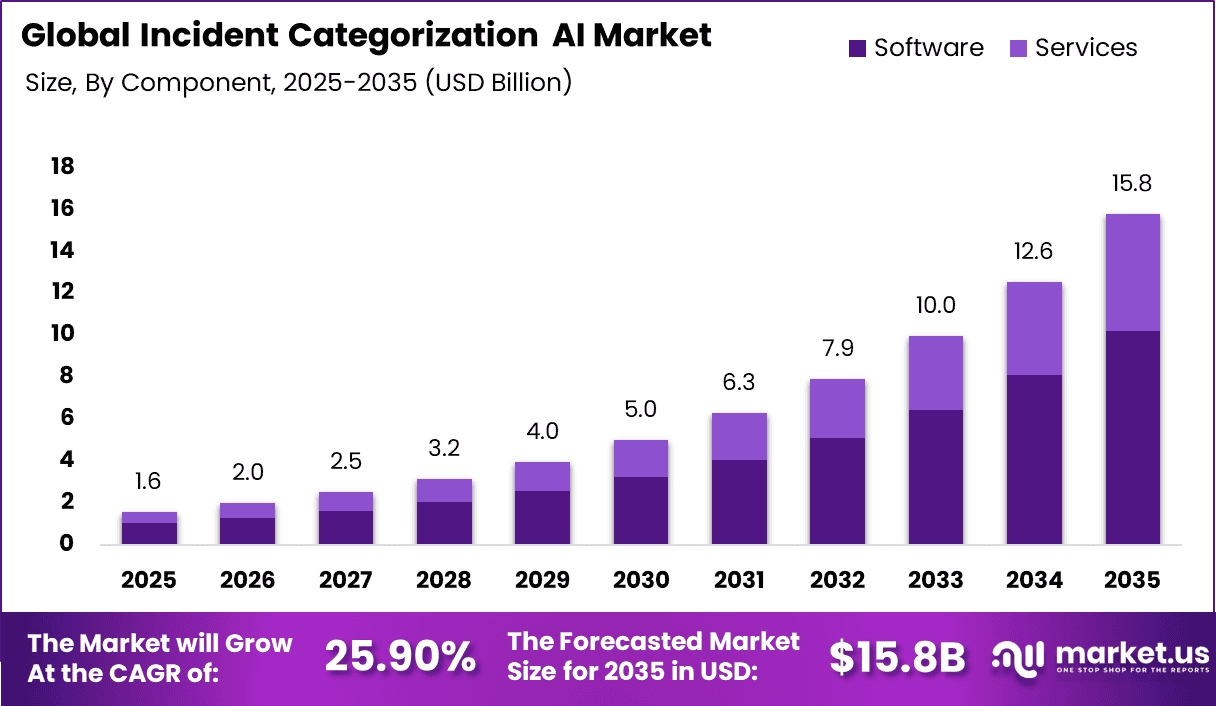
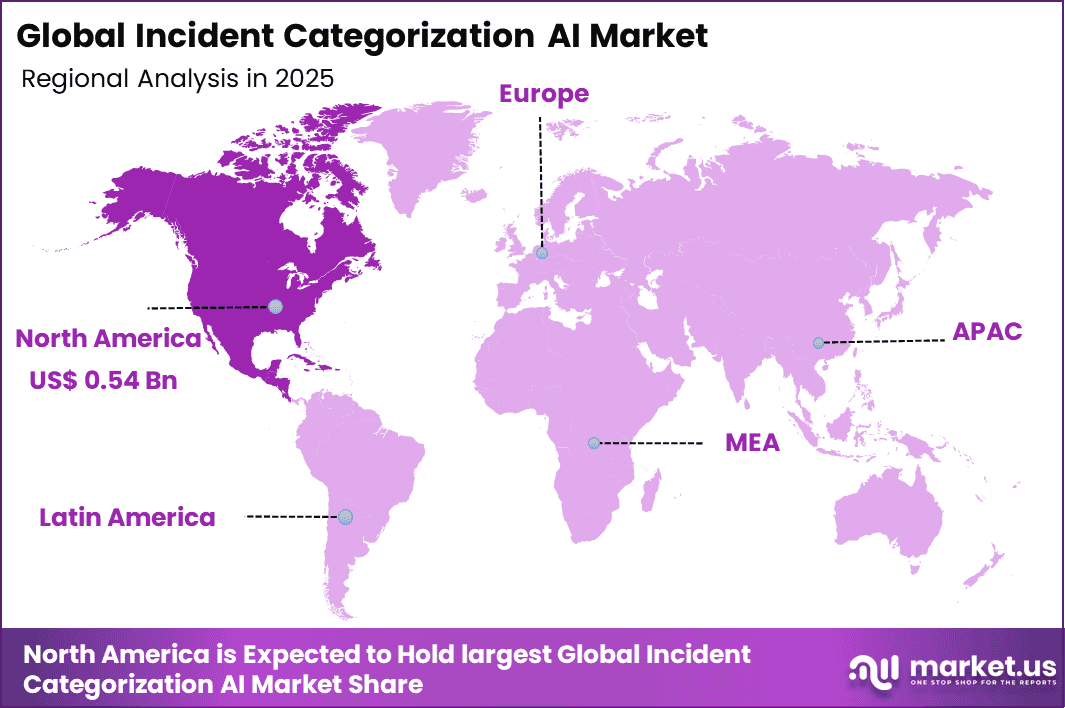
The Global Incident Categorization AI Market generated USD 1.6 billion in 2025 and is projected to grow from USD 2.0 billion in 2026 to about USD 15.8 billion by 2035, recording a CAGR of 25.9% over the forecast period. In 2025, North America held a dominant market position, capturing more than a 34.6% share, with USD 0.54 billion in revenue.
Incident Categorization AI refers to artificial intelligence systems used to sort, label, and prioritize incidents based on their type, severity, root cause, and operational impact. These solutions are widely used in IT operations, cybersecurity, customer support, industrial systems, and enterprise service management where large volumes of alerts, tickets, and incident records must be handled quickly.
As businesses depend more on digital systems and always-on operations, the need for automated incident categorization is becoming more important across many industries. A major factor driving this market is the rising volume of incidents generated by cloud platforms, connected devices, enterprise software, and digital service channels. Manual sorting of alerts and service tickets often slows response time and creates inconsistencies in issue handling.
Top Market Takeaways
- By Component, software dominates with a 64.5% share, leveraging NLP classifiers, genAI summarization, and auto-triage engines to slash MTTR across ITSM platforms.
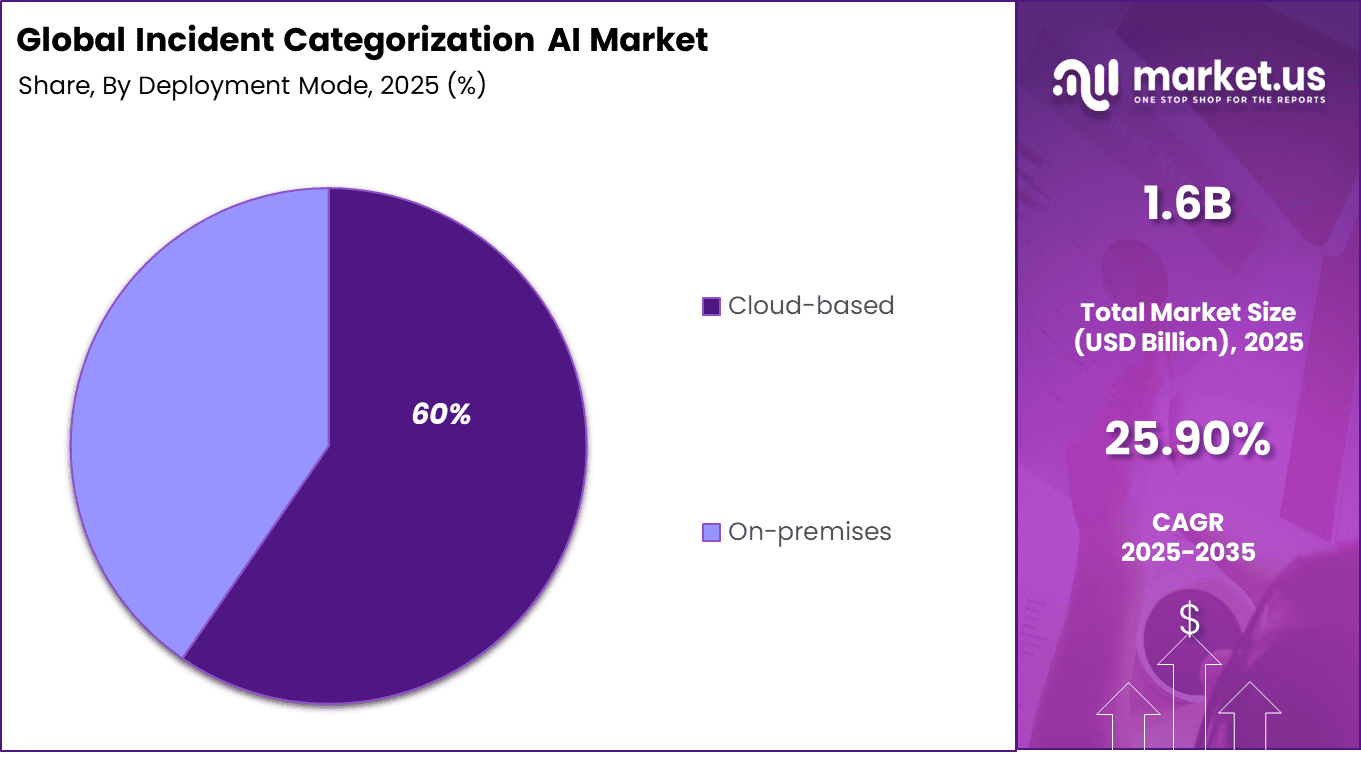
- By Deployment Mode, cloud-based captures 59.6%, enabling elastic scaling, cross-platform integration, and continuous model retraining on enterprise incident corpora.
- By Application, IT operations leads at 32.1%, automating ticket routing, root cause clustering, and predictive escalation for service desk efficiency.
- By End-User, BFSI holds 27.3%, powering fraud incident prioritization, compliance event correlation, and 24/7 operational resilience.
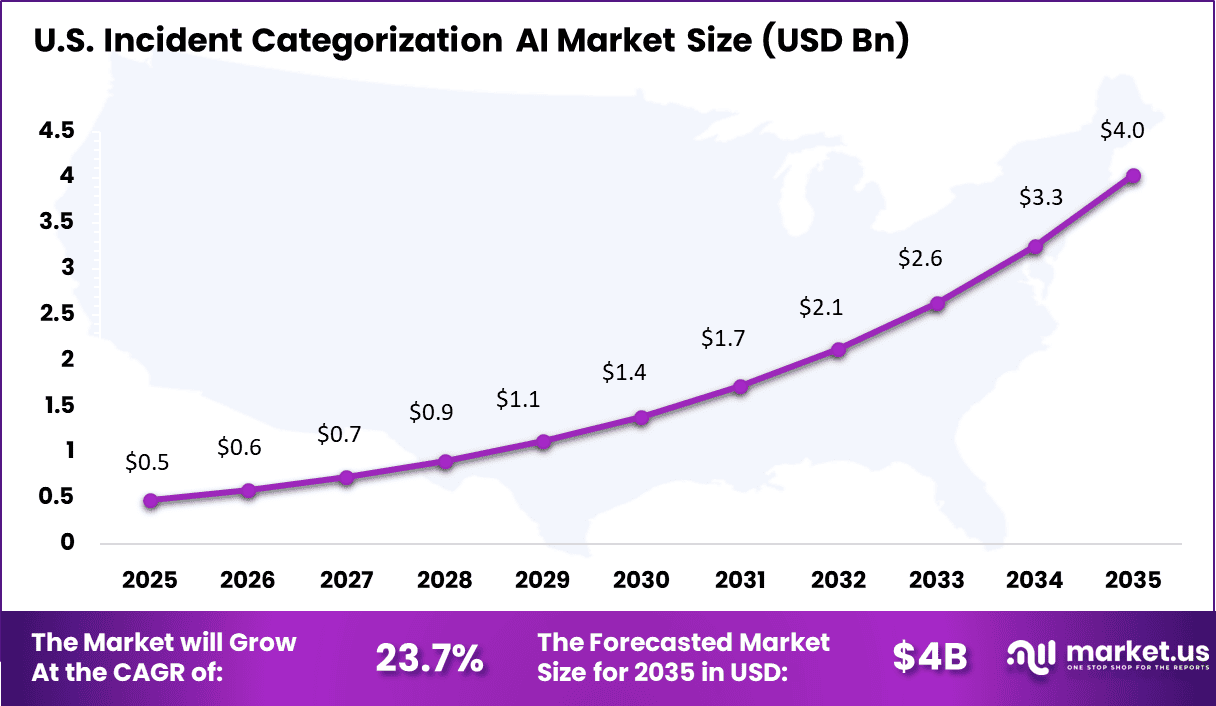
- Regionally, North America accounts for 34.6% global share, with the U.S. market valued at USD 0.48 billion and a CAGR of 23.7%, driven by digital transformation and zero-downtime mandates.
By Component Analysis
Software accounted for 64.5% of the Incident Categorization AI Market. This segment leads because organizations need fast and structured tools to classify incidents, route alerts, and reduce manual effort in service environments. Software platforms help teams standardize incident tagging, improve response workflows, and build stronger visibility across operations.
Its growth is also supported by the rising need for automation in high-volume incident environments. Enterprises want systems that can process large data flows, identify issue patterns, and support faster decision-making. As digital operations become more complex, software remains the core layer for incident categorization and workflow control.
By Deployment Mode Analysis
Cloud-based deployment held 60% of the market. Many organizations prefer cloud models because they offer flexibility, easier scaling, and quicker implementation than traditional on-premises systems. This is especially useful for businesses that manage distributed teams and require centralized monitoring across multiple locations.
Cloud deployment also supports continuous updates and smoother integration with IT service management, security, and monitoring platforms. These advantages make it easier for companies to expand AI-based incident categorization without heavy infrastructure investment, which strengthens the position of cloud-based solutions in the market.
By Application Analysis
IT operations represented 32.1% of the Incident Categorization AI Market. This segment dominates because IT teams handle a large number of system alerts, service tickets, and infrastructure incidents every day. AI-based categorization helps reduce confusion, improve prioritization, and direct issues to the right teams more efficiently.
The segment is also growing due to the increasing pressure on IT departments to maintain uptime and service quality. As enterprise systems become more connected, IT operations teams need tools that can quickly sort incidents and support faster root cause analysis. This keeps IT operations at the center of market demand.
By End User Analysis
BFSI captured 27.3% of the market. Banks, financial institutions, and insurance companies generate large volumes of transactions and digital interactions, which creates constant demand for incident monitoring and classification. AI-based categorization helps these firms manage service disruptions, fraud-related alerts, and system issues with greater speed and accuracy.
The sector also values operational continuity and customer trust, making incident handling a critical function. Since BFSI environments depend on secure and uninterrupted digital services, organizations in this sector actively invest in tools that strengthen response efficiency and reduce the risk of delayed incident resolution.
Key Market Segments
By Component
- Software
- Machine Learning Algorithms
- Natural Language Processing Models
- Predictive Analytics Tools
- Workflow Automation Platforms
- Data Integration Solutions
- Incident Detection Systems
- Others
- Services
- Implementation Services
- Consulting Services
- Training and Support Services
- Managed Services
By Deployment Mode
- On-Premises
- Cloud-based
By Application
- IT Operations
- Security Operations
- Customer Support
- Risk Management
- Other Applications
By End-User
- BFSI
- Healthcare
- IT and Telecom
- Government
- Retail
- Manufacturing
- Other End-Users
Regional Analysis
North America accounted for 34.6% of the Incident Categorization AI Market, reflecting strong adoption of artificial intelligence in IT service management and cybersecurity operations. Enterprises across the region increasingly deploy AI tools to classify and prioritize incidents automatically within service desks and network monitoring systems.
The presence of advanced digital infrastructure and widespread use of cloud platforms has increased the number of IT events that organizations must manage. As a result, companies across sectors such as finance, technology, and telecommunications continue to adopt AI-driven categorization systems to improve response time and operational efficiency.
The United States generated about USD 0.48 Bn within the regional market and is projected to expand at a CAGR of 23.7%. Businesses in the country continue to strengthen automated incident management as IT environments grow more complex with hybrid cloud systems, remote work networks, and large volumes of security alerts.
AI-based categorization tools help service teams quickly identify the nature and severity of incidents while reducing manual ticket classification. As organizations focus on faster resolution of operational disruptions and better system reliability, demand for incident categorization AI platforms continues to rise across the US market.
Key Regions and Countries
- North America
- US
- Canada
- Europe
- Germany
- France
- The UK
- Spain
- Italy
- Russia
- Netherlands
- Rest of Europe
- Asia Pacific
- China
- Japan
- South Korea
- India
- Australia
- Singapore
- Thailand
- Vietnam
- Rest of APAC
- Latin America
- Brazil
- Mexico
- Rest of Latin America
- Middle East & Africa
- South Africa
- Saudi Arabia
- UAE
- Rest of MEA
Drivers Impact Analysis
| Key Driver | Impact on CAGR Forecast (~%) | Geographic Relevance | Impact Timeline | Strategic Effect |
|---|---|---|---|---|
| Rising volume of IT and security incidents | +4.2% | North America, Europe, Asia Pacific | Short to Mid Term (2025–2030) | Speeds triage and improves response accuracy |
| Growing enterprise adoption of AIOps and ITSM automation | +3.8% | US, Canada, Western Europe | Mid Term (2026–2032) | Expands AI use in service desk workflows |
| Need for faster incident prioritization in complex digital environments | +3.5% | Global | Short to Mid Term (2025–2031) | Reduces manual classification effort |
| Increased demand from cybersecurity operations centers | +3.1% | US, Europe, Japan | Mid to Long Term (2026–2035) | Strengthens alert handling and threat response |
| Cloud platform expansion and multi-system monitoring | +2.7% | North America, Asia Pacific | Mid to Long Term (2026–2035) | Supports scalable cross-platform categorization |
Restraints Impact Analysis
| Key Restraint | Impact on CAGR Forecast (~%) | Geographic Relevance | Impact Timeline | Strategic Effect |
|---|---|---|---|---|
| Limited training data quality and label consistency | -2.4% | Global | Short to Mid Term (2025–2030) | Lowers model accuracy in real cases |
| Integration issues with legacy ITSM and SOC tools | -2.1% | North America, Europe | Mid Term (2026–2032) | Slows deployment across enterprise systems |
| Great concern around false tagging and missed critical incidents | -2.3% | Global | Short to Mid Term (2025–2031) | Reduces trust in automated workflows |
| Data privacy and compliance constraints | -1.8% | Europe, North America | Mid to Long Term (2026–2035) | Limits broad use in regulated sectors |
| Shortage of skilled AI operations teams | -1.6% | Asia Pacific, Latin America, MEA | Mid Term (2026–2032) | Delays model tuning and adoption maturity |
Investor Type Impact Analysis
| Investor Type | Growth Sensitivity | Risk Exposure | Geographic Focus | Investment Outlook |
|---|---|---|---|---|
| Venture Capital Firms | Very High | High | US, Europe, Israel | Strong AI ops startup opportunity |
| Private Equity Firms | High | Medium | North America, Europe | Attractive platform consolidation play |
| Strategic Technology Investors | Very High | Medium | US, Japan, South Korea | Good fit for automation expansion |
| Corporate Venture Arms | High | Medium | Global | Useful for product portfolio synergy |
| Government and Innovation Funds | Medium | Low to Medium | US, Europe, Asia Pacific | Selective support for secure AI systems |
Technology Enablement Analysis
| Technology Enabler | Impact on CAGR Forecast (~%) | Geographic Relevance | Impact Timeline | Implementation Significance |
|---|---|---|---|---|
| Natural language processing for ticket and log classification | +4.0% | Global | Short to Mid Term (2025–2031) | Improves text-based incident labeling |
| Machine learning models for pattern recognition | +3.7% | North America, Europe, Asia Pacific | Mid Term (2026–2032) | Enhances classification precision |
| Generative AI for summarization and routing support | +3.3% | US, Europe | Mid to Long Term (2026–2035) | Speeds operator decisions |
| Cloud native integration with ITSM and SIEM platforms | +2.9% | Global | Short to Mid Term (2025–2030) | Simplifies deployment and scaling |
| Real-time analytics and event correlation engines | +2.6% | North America, Japan, Europe | Mid to Long Term (2026–2035) | Strengthens incident context mapping |
Key Challenges
- Many organizations face difficulty in training incident categorization AI models because incident data is often unstructured, inconsistent, and spread across multiple systems.
- The market faces accuracy challenges when AI tools misclassify complex or rare incidents, which can affect response speed and decision quality.
- Integration with existing IT service management and security platforms remains a major challenge, as many enterprises still rely on legacy systems.
- Data privacy and security concerns create barriers to adoption because incident records may contain sensitive operational, customer, or business information.
- User trust and internal adoption remain limited in some organizations because teams may hesitate to depend fully on AI for critical incident handling tasks.
Emerging Trends
A prominent trend shaping the Incident Categorization AI market is the shift toward automated incident understanding within IT service and operational environments. Organizations increasingly deploy intelligent systems that analyze service tickets, system alerts, and support requests to determine the nature of incidents automatically.
This trend reflects a broader effort by enterprises to reduce manual workloads for support teams and improve the speed of incident handling. As digital operations expand and service platforms grow more complex, companies prefer solutions that organize incident data efficiently and help teams respond to problems with greater clarity and coordination.
Growth Factors
The expansion of digital infrastructure across enterprises is a major factor strengthening demand for incident categorization AI solutions. Businesses operate large volumes of applications, cloud services, and connected systems that generate continuous alerts and operational incidents. Manually sorting and classifying these incidents often consumes valuable time and creates inconsistencies in support processes.
Intelligent categorization tools help organizations structure incoming incidents more effectively, which improves troubleshooting workflows and accelerates service restoration. Enterprises are placing stronger emphasis on operational efficiency and service reliability. This focus encourages the adoption of advanced tools that assist support teams in understanding issues quickly and maintaining stable digital operations across complex technology environments.
Competitive Analysis
The competitive landscape of the Incident Categorization AI market includes a mix of enterprise software, IT service management, and cybersecurity companies. IBM Corporation, HCL Technologies Limited, ServiceNow Inc., Atlassian Corporation Plc, Ivanti Inc., Freshworks Inc., and PagerDuty Inc. focus on AI-based ticket classification, workflow automation, and incident response improvement.
Cybersecurity and monitoring-focused players such as Palo Alto Networks Inc., Fortinet Inc., Splunk Inc., CrowdStrike Holdings Inc., Check Point Software Technologies Ltd., Datadog Inc., Elastic NV, Rapid7 Inc., and Qualys Inc. strengthen the market through threat detection, log analysis, and security incident prioritization.
Their platforms use AI to identify patterns, classify alerts, and reduce noise in complex IT environments. Together, these companies create a competitive market centered on automation, accuracy, and faster incident handling.
Top Key Players in the Market
- IBM Corporation
- HCL Technologies Limited
- ServiceNow Inc.
- Palo Alto Networks Inc.
- Fortinet Inc.
- Splunk Inc.
- Atlassian Corporation Plc
- CrowdStrike Holdings Inc.
- Check Point Software Technologies Ltd.
- Datadog Inc.
- Elastic NV
- Rapid7 Inc.
- Ivanti Inc.
- Freshworks Inc.
- Qualys Inc.
- PagerDuty Inc.
- Others
Future Outlook
The future outlook for the Incident Categorization AI Market appears strong as more organizations look for faster and more accurate ways to manage rising volumes of incidents across IT, cybersecurity, and customer support functions.
Businesses are expected to adopt AI tools that can sort, label, and prioritize incidents with less manual effort, helping teams respond more quickly and improve service quality. Growing digital operations, increasing data flow, and the need for better workflow automation are likely to support steady demand for incident categorization AI solutions in the coming years.
Recent Developments
- In May 2025, Fortra acquired Lookout Cloud Security to build a more complete stack combining data protection and secure service edge, supporting AI‑driven incident analysis across cloud environments.
- In July 2025, Concentric AI acquired Swift Security and Acante to expand its AI‑based data protection and Gen‑AI governance tooling, which includes sophisticated classification that can feed incident categorization.
- In October 2024, PagerDuty introduced new AI-driven capabilities focused on operational resilience, including features to help predict, manage, and mitigate the impact of service outages, thereby enhancing automated incident triage and categorization
Report Scope
| Report Features | Description |
|---|---|
| Market Value (2025) | USD 1.6 Billion |
| Forecast Revenue (2035) | USD 15.8 Billion |
| CAGR(2025-2035) | 25.9% |
| Base Year for Estimation | 2024 |
| Historic Period | 2020-2024 |
| Forecast Period | 2025-2035 |
| Report Coverage | Revenue forecast, AI impact on Market trends, Share Insights, Company ranking, competitive landscape, Recent Developments, Market Dynamics and Emerging Trends |
| Segments Covered | By Component Software (Machine Learning Algorithms, Natural Language Processing Models, Predictive Analytics Tools, Workflow Automation Platforms, Others), Services (Implementation Services, Consulting Services, Training and Support Services, Managed Services), By Deployment Mode (On-Premises, Cloud-based), By Application (IT Operations, Security Operations, Customer Support, Risk Management, Other Applications), By End-User (BFSI, Healthcare, Other End-Users) |
| Regional Analysis | North America – US, Canada; Europe – Germany, France, The UK, Spain, Italy, Russia, Netherlands, Rest of Europe; Asia Pacific – China, Japan, South Korea, India, New Zealand, Singapore, Thailand, Vietnam, Rest of Latin America; Latin America – Brazil, Mexico, Rest of Latin America; Middle East & Africa – South Africa, Saudi Arabia, UAE, Rest of MEA |
| Competitive Landscape | IBM Corporation, HCL Technologies Limited, ServiceNow Inc., Palo Alto Networks Inc., Fortinet Inc., Splunk Inc., Atlassian Corporation Plc, CrowdStrike Holdings Inc., Check Point Software Technologies Ltd., Datadog Inc., Elastic NV, Rapid7 Inc., Ivanti Inc., Freshworks Inc., Qualys Inc., PagerDuty Inc., Others |
| Customization Scope | Customization for segments, region/country-level will be provided. Moreover, additional customization can be done based on the requirements. |
| Purchase Options | We have three licenses to opt for: Single User License, Multi-User License (Up to 5 Users), Corporate Use License (Unlimited Users and Printable PDF) |





































