


Report Overview
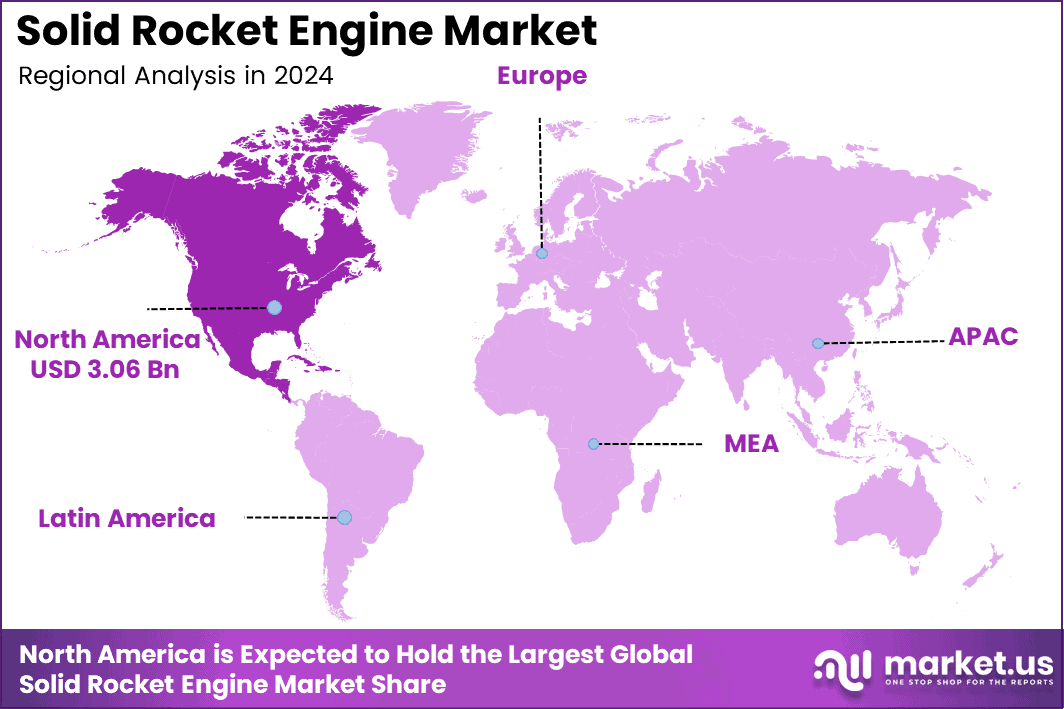
In 2024, the Global Solid Rocket Engine Market was valued at USD 7.6 billion. The market is projected to grow at a CAGR of 9.6% during 2025–2034, reaching approximately USD 19.01 billion by 2034. North America dominated the global market in 2024, accounting for more than 40.3% of the total market share and generating approximately USD 3.06 billion in revenue.
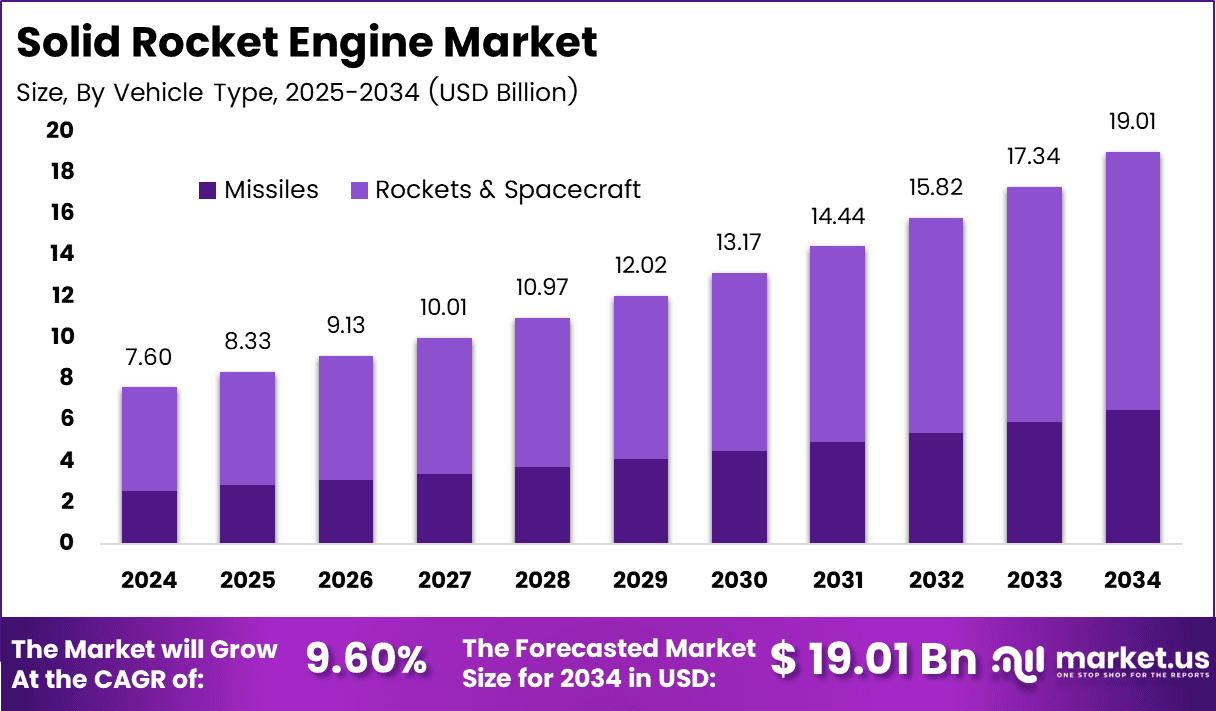
Growth in the Solid Rocket Engine Market is supported by rising spending on missiles, air defense, and space-launch programs. The U.S. Department of Defense requested USD 167.5 billion for procurement and USD 143.2 billion for research, development, test, and evaluation in its FY2025 budget. This included USD 28.4 billion for missile-defense capabilities, directly supporting demand for solid rocket motors used in interceptors, tactical missiles, and strategic systems.
The U.S. request included USD 35.7 billion for missile and munitions procurement and R&D. The U.S. Army’s missile-procurement budget also supported the purchase of 5,974 rockets with USD 1.168 billion in base FY2026 funding. These programs increase repeat demand for motor cases, propellants, nozzles, and ignition systems.
North America remains the leading regional market due to the strong U.S. defense budget and established missile-production base. NATO reported that European Allies and Canada increased defense spending by almost 20% in 2025, adding more than USD 90 billion in constant 2021 prices. This higher spending also supports export demand for U.S.-made missile-defense and strike systems.
Northrop Grumman signed two multi-year framework agreements worth more than USD 3 billion, including a USD 2 billion agreement to expand PAC-3 MSE solid rocket motor production over 7 years. The U.S. Department of Defense also committed USD 32.7 million through two 2025 Defense Production Act investments.
Key Takeaways
- The Solid Rocket Engine Market was valued at USD 7.6 billion in 2024 and is projected to reach USD 19.01 billion by 2034, expanding at a CAGR of 9.6% from 2025 to 2034.
- Ballistic missiles accounted for 34.2%, supported by increasing intercontinental and submarine-launched missile developments for national security.
- Missiles led the market with a 67.5% share, attributed to continuous advancements in propulsion technologies and government defense investments.
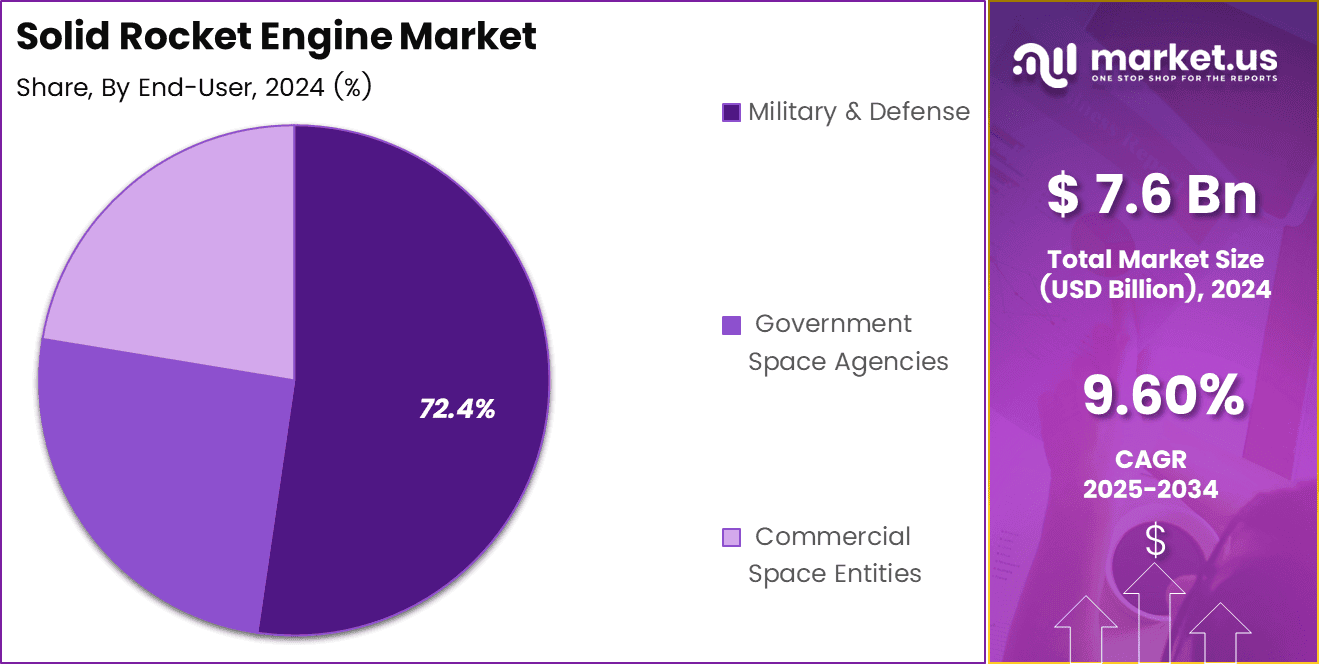
- Military and defense applications dominated the market with a 72.4% share in 2024, driven by the modernization of missile systems and national defense initiatives.
- North America held the largest regional share with a valuation of USD 3.06 billion in 2024, supported by heavy defense expenditure and active space missions conducted by NASA and private entities.
- The US solid rocket engine market is projected to grow from USD 2.67 billion in 2024 to USD 5.35 billion by 2034, registering a CAGR of 7.2%, primarily driven by defense modernization and space exploration programs.
Role of Generative AI
Generative AI is expected to play a key role in the solid rocket engine market by enhancing design optimisation, accelerating simulation cycles, and enabling rapid prototyping of propulsion systems. It is projected to support advanced modelling of propellant behaviour, structural dynamics, and combustion processes.
For instance, AI-driven platforms can generate multiple design variants, identify optimal geometries for thrust and mass reduction, and support predictive maintenance of motor systems. By integrating with digital twins and manufacturing execution systems, generative AI tools are anticipated to reduce development lead times and improve cost-efficiencies across R&D and production lines.
Investment and Business Benefit
From an Investment standpoint, increased spending in the solid rocket engine sector is projected to deliver substantial returns, with investments expected to grow by around 15 % annually across key defence and aerospace players.
Business entities adopting advanced solid propulsion systems are anticipated to capture up to 20% higher margins compared to legacy systems due to reduced manufacturing costs, faster production cycles, and improved reliability.
A company that transitions to modular solid motor architecture and lean supply-chain practices may improve its operating margin by approximately 8-10 % within three years. These benefits translate into stronger revenue growth, enhanced investor confidence, and accelerated market entry for new propulsion platforms.
By Application
By application, the solid rocket engine market is primarily segmented into ballistic missiles, space launch vehicles, tactical missiles, orbital maneuvering and satellite propulsion, and others. Ballistic missiles held 34.2% of the market in 2024, driven by the expansion of long-range and intercontinental missile programs across major defense economies. Space launch vehicles accounted for 27.8%, supported by the increasing number of satellite launches and reusable booster technologies.
Tactical missiles contributed 22.8%, fueled by rapid-response defense strategies and precision-guided systems. Orbital maneuvering and satellite propulsion captured 9.5%, reflecting demand for satellite repositioning and low-orbit operations. The remaining 5.7% share came from other applications, including experimental propulsion systems, indicating a broadening scope for next-generation solid rocket technologies.
By Deployment
The solid rocket engine market is primarily categorized into missiles, rockets & and spacecraft. Missiles accounted for 67.5% of the total market share in 2024, driven by large-scale defense modernization programs, tactical missile procurements, and increasing government emphasis on domestic production capabilities.
This segment is expected to grow by an additional 6.3% through 2030 as nations strengthen their deterrence capabilities using solid propulsion for reliability and instant launch readiness. Meanwhile, rockets and spacecraft represented 32.5% of the market, benefiting from advancements in reusable solid boosters and rising satellite launch frequency.
The segment is projected to expand by 4.2% due to growing commercial participation in low-Earth orbit missions and enhanced collaboration between national space agencies and private firms.
By End-User
The solid rocket engine market is segmented into Military and defense, government space agencies, and commercial space entities. Military & defense accounted for 72.4% of the global share in 2024, reflecting extensive investments in missile development, tactical weapons, and strategic deterrence programs.
The segment is expected to rise by 5.8% by 2030, driven by increasing defense budgets and cross-border security initiatives. Government space agencies held 18.3%, supported by expanding satellite deployment programs and planetary exploration missions, with an anticipated 3.9% growth through 2030.
Meanwhile, commercial space entities captured 9.3%, showcasing rapid expansion due to small satellite launches, reusable propulsion technologies, and private-sector partnerships, with a forecast growth of 4.5% by 2030.
Key Market Segment
By Application
- Ballistic Missiles
- Space Launch Vehicles
- Tactical Missiles
- Orbital Maneuvering & Satellite Propulsion
- Others
By Vehicle Type
- Missiles
- Rockets & Spacecraft
By End-User
- Military & Defense
- Government Space Agencies
- Commercial Space Entities
Regional Analysis
North America held the largest regional share with a valuation of USD 3.06 billion in 2024, supported by heavy defense expenditure and active space missions conducted by NASA and private entities.
The Asia-Pacific region is anticipated to register the fastest growth rate owing to rising defence budgets, expanding space programmes, and increased domestic manufacturing initiatives. Europe also shows strong momentum as countries seek greater strategic autonomy in propulsion supply chains.
US Market Size
The US solid rocket engine market is projected to grow from USD 2.67 billion in 2024 to USD 5.35 billion by 2034, registering a CAGR of 7.2%, primarily driven by defense modernization and space exploration programs.
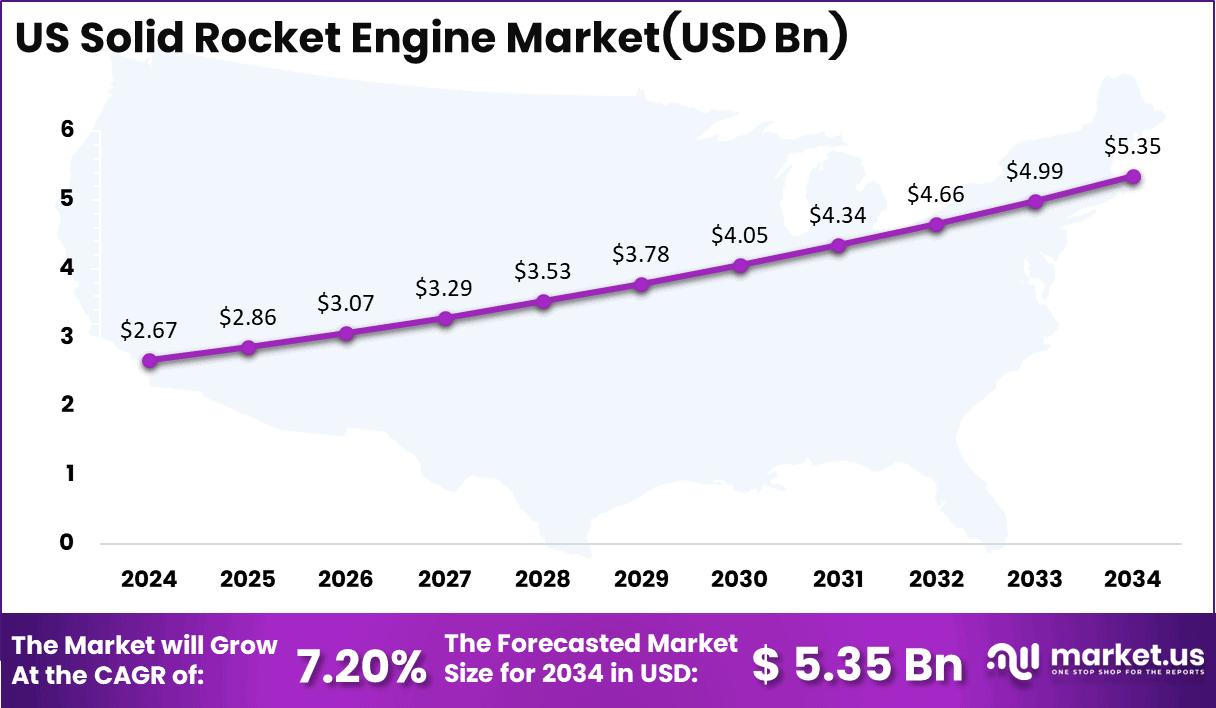
This proportion highlights the strategic importance of the US market both in defence procurement and space-launch applications. The larger global expansion suggests growing opportunities outside the US as well.
Key Regions and Countries
- North America
- US
- Canada
- Europe
- Germany
- France
- The UK
- Spain
- Italy
- Rest of Europe
- Asia Pacific
- China
- Japan
- South Korea
- India
- Australia
- Singapore
- Rest of Asia Pacific
- Latin America
- Brazil
- Mexico
- Rest of Latin America
- Middle East & Africa
- South Africa
- Saudi Arabia
- UAE
- Rest of MEA
Market Dynamics
Drivers
| Driver | (~) % Impact on CAGR Forecast | Geographic Relevance | Impact Timeline |
|---|---|---|---|
| Missile Stockpile Replenishment | +2.6% | North America, Europe, Indo-Pacific | Short-term (2 years or less) |
| Integrated Air Defense Procurement | +1.8% | Europe, Middle East, Asia-Pacific | Short-term (2 years or less) |
| Long-Range Precision Fires Expansion | +1.5% | North America, Europe | Medium term (2 to 4 years) |
| Hypersonic Weapon Propulsion Demand | +1.2% | North America, Asia-Pacific | Medium term (2 to 4 years) |
| Space Launch Booster Orders | +0.9% | North America, Europe, India, Japan | Medium term (2 to 4 years) |
Missile Stockpile Replenishment
Accelerated replenishment of guided-missile inventories is a major demand driver for the Solid Rocket Engine Market. NATO reported that European Allies and Canada spent more than USD 571 billion in constant 2021 prices during 2025, nearly 20% higher than in 2024. The U.S. Department of Defense also invested nearly USD 822 million in the missile and munitions industrial base since fiscal 2023.
In fiscal 2025, the DPA Purchases Office reported 21 investments totaling USD 939.7 million, including 8 solid rocket motor awards worth USD 120.0 million. These multi-year procurement programs improve factory utilization and give suppliers longer order visibility across mixing, casting, curing, and testing operations. This replenishment cycle could contribute an estimated +2.6% to the market’s 9.6% baseline CAGR.
Restraints
| Restraint | (~) % Impact on CAGR Forecast | Geographic Relevance | Impact Timeline |
|---|---|---|---|
| Single-Source Perchlorate Supply | -1.7% | North America | Short term (2 years or less) |
| Export-Controlled Technology Transfers | -1.1% | Global | Short term (2 years or less) |
| Energetics Permitting Delays | -0.9% | North America, Europe | Medium term (2 to 4 years) |
| Restricted Sovereign Procurement Budgets | -0.7% | Latin America, Africa, Southeast Asia | Medium term (2 to 4 years) |
| Propellant Storage Compliance Costs | -0.5% | Global | Short term (2 years or less) |
Single-Source Perchlorate Supply
The main restraint is the concentration of U.S. ammonium perchlorate supply, a key oxidizer used in composite solid propellant. American Pacific Corporation is identified as the only U.S.-based producer, and its parent approved up to USD 100 million in capacity investment on April 15, 2025. By the end of fiscal 2025, the Department of Defense had also committed USD 120.0 million across 8 solid rocket motor industrial-base investments.
This supply concentration creates a direct production risk because motor casting cannot proceed without qualified oxidizer availability. Manufacturers may need to hold larger inventories, absorb higher storage and qualification costs, and delay capacity expansion until more resilient supply is secured. This constraint could reduce the market’s 9.6% baseline CAGR by an estimated 1.7%.
Challenges
| Challenge | (~) % CAGR Friction Drag | Geographic Relevance | Mitigation Horizon |
|---|---|---|---|
| Skilled Energetics Workforce Gap | -1.2% | North America, Europe | Long term (4 years or more) |
| Motor Qualification Cycle Length | -1.4% | Global | Long term (4 years or more) |
| Composite Case Supply Volatility | -0.8% | North America, Europe, Asia-Pacific | Medium term (2 to 4 years) |
| Static-Test Infrastructure Constraints | -0.7% | North America, Europe | Medium term (2 to 4 years) |
| Digital Manufacturing Cyber Risk | -0.5% | Global | Medium term (2 to 4 years) |
Motor Qualification Cycle Length
Long qualification cycles remain a major growth challenge because new propellant formulations, motor designs, insulation systems, and supplier changes require extensive testing before entering serial production. The U.S. Air Force Research Laboratory awarded a USD 28.6 million propulsion contract in May 2025, while Ursa Major completed multiple static fires of a 5-inch solid rocket motor during the same month to validate its manufacturing process.
Ursa Major later announced a 400-acre Colorado test and qualification site in September 2025 to expand readiness testing capacity. These lengthy qualification steps increase engineering costs, occupy test facilities, and delay commercial-scale production. Without faster testing, digital traceability, and streamlined qualification standards, this bottleneck could reduce the market’s attainable growth rate by an estimated 1.4%.
Opportunities
| Opportunity | (~) % Potential CAGR Upside | Geographic Relevance | Execution Window |
|---|---|---|---|
| Automated Digital Propellant Factories | +1.9% | North America, Europe, Asia-Pacific | Medium term (2 to 4 years) |
| Allied Second-Source Motor Production | +1.6% | Europe, Australia, Indo-Pacific | Long term (4 years or more) |
| Common Modular Motor Families | +1.3% | North America, Europe | Medium term (2 to 4 years) |
| Commercial Launch Booster Partnerships | +0.9% | North America, Europe, Asia-Pacific | Long term (4 years or more) |
| Lifecycle Sustainment Data Services | +0.7% | Global | Long-term (4 years or more) |
Automated Digital Propellant Factories
Automated and digitally traceable propellant factories represent a major future opportunity for solid rocket engine manufacturers. In fiscal 2025, the U.S. Department of Defense allocated USD 939.7 million across 21 DPA Purchases Office awards, while nearly USD 822 million had been invested in missile and munitions industrial capacity since fiscal 2023. Northrop Grumman also plans to increase annual solid rocket motor output from 13,000 units to 25,000 units by 2029.
The main opportunity is to convert this new capacity into automated production lines covering mixing, casting, curing, inspection, and quality tracking. Greater automation could reduce conversion costs per motor by around 10% to 15% and improve gross margins by 3 to 5 percentage points after production stabilizes. This shift could contribute an estimated
Key Player Analysis
Tier-1 leadership is concentrated in the U.S., led by Northrop Grumman, L3Harris/Aerojet Rocketdyne, and RTX’s Raytheon business. Northrop reported USD 42.0 billion in 2025 sales, including USD 8.0 billion from Defense Systems. Capital expenditure represented 3.5% of group revenue, or about USD 1.47 billion. Its solid rocket motor output is expected to increase from 13,000 units to 25,000 units by 2029, supporting an estimated 25–30% share of Western demand.
L3Harris’ Aerojet Rocketdyne segment generated USD 2.845 billion in 2025 revenue, up from USD 2.347 billion in 2024. The company remains a major competitor in tactical and strategic propulsion. In January 2026, L3Harris agreed to sell a controlling stake in its Space Propulsion & Power business at an enterprise value of USD 845 million, allowing greater focus on missile propulsion.
RTX’s Raytheon business forms the third major Tier-1 pillar through Patriot, GEM-T, ESSM, Tomahawk, and SM-family missile programs. RTX reported USD 88.6 billion in 2025 sales, while Raytheon generated USD 7.657 billion in Q4 sales, up 7%. During the first 9 months, Raytheon recorded USD 20.4 billion in sales and USD 2.01 billion in company-funded R&D. Its estimated Western market share is around 15–20%, while the top 3 firms together account for roughly 55–65% of the North American industrial base.
Tier-2 challengers include Nammo, MBDA, Avio, Roketsan, MHI, BAE Systems, General Dynamics, Anduril, Ursa Major, and ArianeGroup. L3Harris began 4 new Camden facilities under a USD 215.6 million Defense Production Act agreement and announced nearly USD 500 million in additional large-motor capacity investment. Anduril received USD 43.7 million in Defense Production Act Title III support, while Ursa Major is developing a new 400-acre Colorado solid rocket motor test and qualification site.
Top Key Players
- Northrop Grumman Corporation
- L3Harris Technologies
- ArianeGroup
- Aerojet Rocketdyne
- Nammo
- Lockheed Martin Corporation
- Raytheon Technologies (Raytheon Missiles & Defense)
- BAE Systems
- MBDA
- Avio S.p.A.
- Roketsan
- Avibras
- Mitsubishi Heavy Industries (MHI)
- CASIC (China Aerospace Science & Industry Corporation)
- Ursa Major Technologies
- Anduril Industries
- General Dynamics
- Others
Recent Developments
- In January 2026, L3Harris Technologies and the U.S. Department of War agreed to a proposed $1.0 billion convertible-preferred-equity investment in L3Harris’ planned Missile Solutions spin-off. The investment is intended to expand domestic solid rocket motor capacity, with an IPO of the standalone business targeted for the second half of 2026, subject to congressional authorization and appropriations.
- In September 2025, Ursa Major broke ground on a 400-acre solid rocket motor test and qualification site in Weld County, Colorado. The facility was designed for large-article SRM testing and qualification, with initial testing planned for Q4 2025; the expansion followed a $10 million U.S. Navy MK 104 motor-development contract.
Report Scope
| Report Features | Description |
|---|---|
| Market Value (2024) | USD 7.6 Billion |
| Forecast Revenue (2034) | USD 19.01 billion. |
| CAGR(2025-2034) | 9.6% |
| Base Year for Estimation | 2024 |
| Historic Period | 2020-2023 |
| Forecast Period | 2025-2034 |
| Report Coverage | Revenue forecast, AI impact on Market trends, Share Insights, Company ranking, competitive landscape, Recent Developments, Market Dynamics, nd Emerging Trends |
| Segments Covered | By Application (Ballistic Missiles, Space Launch Vehicles, Tactical Missiles, Orbital Maneuvering & Satellite Propulsion, Others), By Vehicle Type (Missiles, Rockets & Spacecraft), By End-User (Military & Defense, Government Space Agencies, Commercial Space Entities) |
| Regional Analysis | North America – US, Canada; Europe – Germany, France, The UK, Spain, Italy, Russia, Netherlands, Rest of Europe; Asia Pacific – China, Japan, South Korea, India, New Zealand, Singapore, Thailand, Vietnam, Rest of Latin America; Latin America – Brazil, Mexico, Rest of Latin America; Middle East & Africa – South Africa, Saudi Arabia, UAE, Rest of MEA |
| Competitive Landscape | Northrop Grumman Corporation, L3Harris Technologies, ArianeGroup, Aerojet Rocketdyne, Nammo, Lockheed Martin Corporation, Raytheon Technologies (Raytheon Missiles & Defense), BAE Systems, MBDA, Avio S.p.A., Roketsan, Avibras, Mitsubishi Heavy Industries (MHI), CASIC (China Aerospace Science & Industry Corporation), Ursa Major Technologies, Anduril Industries, General Dynamics, Others |
| Customization Scope | Customization for segments, region/country-level will be provided. Moreover, additional customization can be done based on the requirements. |
| Purchase Options | We have three licenses to choose from: Single User License, Multi-User License (Up to 5 Users), Corporate Use License (Unlimited Users, Printable PDF) |





































