


Report Overview
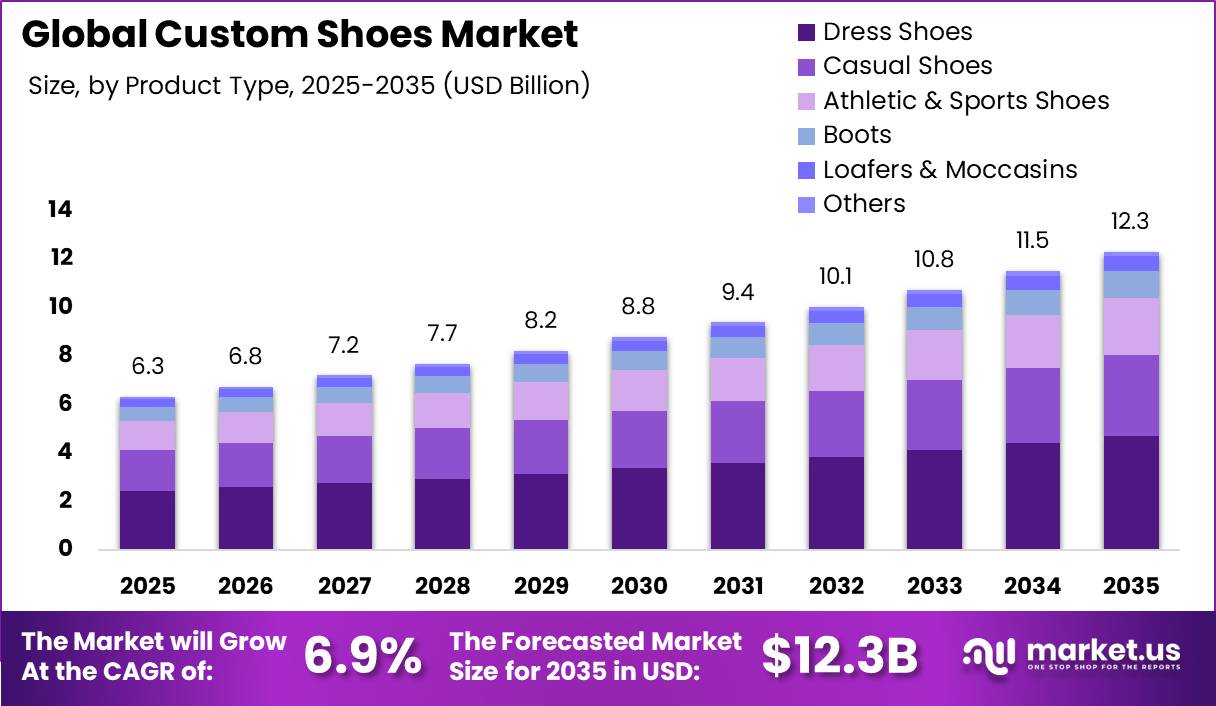
Global Custom Shoes Market size is expected to be worth around USD 12.3 Billion by 2035 from USD 6.33 Billion in 2025, growing at a CAGR of 6.9% during the forecast period 2026 to 2035.
The custom shoes market covers footwear products that are designed, fitted, or manufactured according to individual consumer specifications. This includes made-to-measure construction, bespoke craftsmanship, and design customization options offered across dress shoes, athletic footwear, boots, and casual categories. The market serves men, women, and children through both offline boutiques and online platforms, spanning premium, mid-range, and luxury price tiers.
Key Takeaways
- Market size in 2025: USD 6.33 Billion
- Market forecast by 2035: USD 12.3 Billion
- CAGR (2026 to 2035): 6.9%
- Dominant product type segment: Dress Shoes with 38.40% share
- Dominant material segment: Leather with 52.70% share
- Dominant end user segment: Men with 64.80% share
- Dominant distribution channel: Offline Stores and Boutiques with 61.50% share
- Dominant customization type: Made-to-Measure with 46.90% share
- Dominant price range segment: Premium with 44.30% share
- Dominant region: Europe with 36.20% share, valued at USD 2.3 Billion
- Fastest-growing region: Asia-Pacific
Government bodies and trade bodies across Europe actively support regional footwear manufacturing through industrial policy and export promotion programs. Portugal alone produced approximately 85 million pairs of footwear in 2022, underscoring the depth of Europe’s manufacturing infrastructure. This production base gives European custom shoe brands a structural cost and quality advantage that competitors in less-developed manufacturing regions cannot easily replicate.
According to Volumental, more than 66 million real 3D foot scans have been collected and used to train footwear fit technology. This scale of scan data gives technology-integrated brands a measurable accuracy edge in fit prediction. Brands without access to comparable proprietary datasets face a growing disadvantage in delivering consistent, personalized fit outcomes at scale.
As reported by Volumental, its mobile foot-scanning solution was built using measurement and purchase data from more than 10 million shoppers. This positions mobile scanning as a commercially validated input channel rather than an experimental feature. In June 2026, Vivobarefoot launched the VivoBiome Tabi Gen 02, a made-to-order sandal manufactured from individual 3D foot scans using Carbon’s additive manufacturing technology, reflecting how scan-to-production pipelines are reaching consumer-ready formats.
Product Type Analysis
Dress Shoes dominates with 38.40% due to professional demand and premium positioning.
In 2025, Dress Shoes held a dominant market position in the By Product Type segment of the Custom Shoes Market, with a 38.40% share. Professional and formal occasions drive consistent order volumes for dress shoe customization. Buyers in this segment prioritize fit precision and material quality over price, supporting higher average order values and stronger margins for custom producers.
Casual Shoes occupy the second position in the product type segment. Consumer appetite for personalized everyday footwear has expanded well beyond formal settings. This sub-segment attracts a wider demographic than dress shoes, including younger buyers seeking identity expression through design customization rather than pure fit optimization.
Athletic and Sports Shoes represent the fastest-growing sub-segment within the product type category. Performance demands in sports footwear align naturally with custom fit, as biomechanical requirements vary significantly between athletes. This creates a direct commercial case for custom athletic products tied to injury prevention and performance enhancement rather than lifestyle preference alone.
Boots, Loafers and Moccasins, and Others collectively account for the remaining share within the product type segment. These categories serve niche functional and stylistic needs, and while their individual shares are smaller, they represent stable demand pools for specialty custom producers focused on heritage craftsmanship and occupational end uses.
Material Analysis
Leather dominates with 52.70% due to durability, fit retention, and premium buyer expectations.
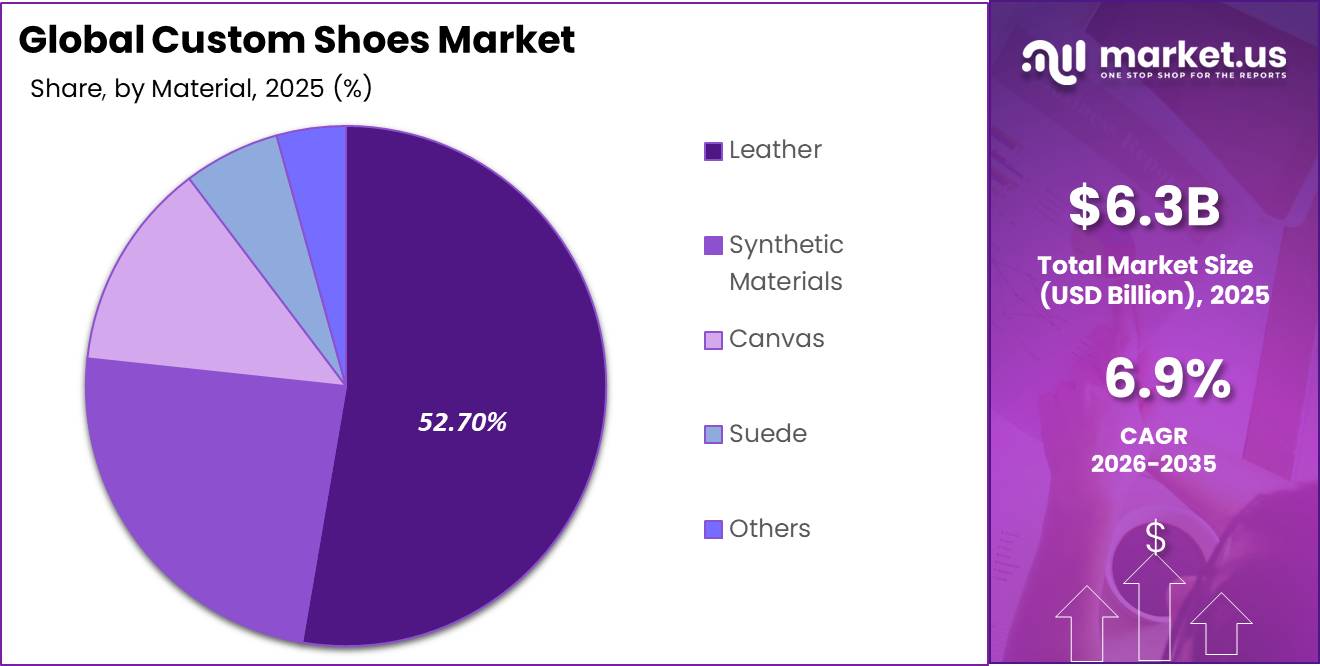
In 2025, Leather held a dominant market position in the By Material segment of the Custom Shoes Market, with a 52.70% share. Leather’s structural properties, including its ability to mold to the foot and retain shape over time, make it the preferred material for both bespoke and made-to-measure construction. Suppliers that source certified or traceable leather carry an additional advantage in premium and luxury channels where provenance matters.
Synthetic Materials rank second in the material segment and represent the fastest-growing sub-category. Advances in synthetic performance fabrics and bio-based alternatives have closed the gap with natural leather in durability and appearance. This growth signals a shift in buyer acceptance, particularly among younger consumers and athletic footwear buyers who prioritize sustainability and weight reduction over traditional material heritage.
Canvas, Suede, and Others hold the remaining share within the material segment. Canvas suits casual and lifestyle-oriented custom designs, while suede serves premium dress and casual hybrid categories. These materials give producers differentiation tools when targeting specific aesthetic segments without competing directly on the technical performance expectations set by leather and synthetics.
End User Analysis
Men dominate with 64.80% due to established bespoke traditions and formal footwear spending.
In 2025, Men held a dominant market position in the By End User segment of the Custom Shoes Market, with a 64.80% share. Historically, bespoke shoemaking developed around men’s dress and occupational footwear, and this heritage continues to anchor male purchasing behavior. Custom shoe investments among male buyers correlate strongly with professional status and wardrobe longevity, producing repeat purchasing patterns that support customer lifetime value.
Women represent the fastest-growing end user sub-segment. Custom footwear adoption among women is accelerating across dress, casual, and athletic categories. This reflects both rising purchasing power and unmet fit needs, since women’s foot shapes are more anatomically variable than standardized mass-market lasts typically accommodate, creating a structural demand case for custom fitting.
Children form the third end user sub-segment and serve a functionally distinct need within the market. Orthopedic and developmental fit requirements for growing feet create a clinical demand channel separate from aesthetic customization. Brands entering this sub-segment can build early customer relationships that extend into adult purchasing stages over time.
Distribution Channel Analysis
Offline Stores and Boutiques dominate with 61.50% due to fit consultation and tactile product experience needs.
In 2025, Offline Stores and Boutiques held a dominant market position in the By Distribution Channel segment of the Custom Shoes Market, with a 61.50% share. The physical measurement, last-fitting, and material selection process creates a high-touch sales environment that online channels have not yet fully replicated. Boutique operators benefit from this channel dependency, as it keeps entry barriers high for pure digital competitors targeting the upper end of the market.
Online Platforms represent the fastest-growing distribution channel. Digital configurators, 3D foot scanning apps, and at-home fitting kits are steadily reducing the friction that previously confined custom purchases to physical locations. Brands that invest in seamless digital-to-production pipelines now position themselves to capture the next phase of market expansion before offline-only competitors can respond.
Customization Type Analysis
Made-to-Measure dominates with 46.90% due to scalable production fit and accessible price positioning.
In 2025, Made-to-Measure held a dominant market position in the By Customization Type segment of the Custom Shoes Market, with a 46.90% share. Made-to-measure strikes a practical balance between personalization and production efficiency, using standardized construction adjusted to individual measurements. This model supports broader consumer access to custom footwear without the extended lead times and higher costs associated with fully bespoke processes.
Bespoke customization occupies the second position in the customization type segment. Bespoke production, built from individually crafted lasts, commands the highest price points and longest production cycles in the market. This sub-segment is structurally insulated from commoditization because the process itself, including hand-lasting and individual fitting appointments, cannot be easily automated or replicated at volume.
Design Customization represents the fastest-growing sub-segment within customization type. Consumer demand for visual personalization, including color selection, material mixing, and embroidery, is expanding the addressable market well beyond fit-driven buyers. In June 2026, Vivobarefoot launched the VivoBiome Tabi Gen 02, a made-to-order sandal manufactured from individual 3D foot scans using Carbon’s additive manufacturing technology, demonstrating how design and fit customization are increasingly converging in new product formats.
Price Range Analysis
Premium dominates with 44.30% due to quality positioning and professional buyer concentration.
In 2025, Premium held a dominant market position in the By Price Range segment of the Custom Shoes Market, with a 44.30% share. Premium positioning reflects the inherent cost structure of custom production, where individualized fitting, quality materials, and skilled labor justify above-standard pricing. Buyers in this tier demonstrate stronger price resilience than mid-range consumers, making the premium segment a more reliable margin engine for producers during periods of input cost pressure.
Mid-Range holds the second position in the price range segment. Mid-range custom footwear serves consumers seeking personalization beyond mass-market options without committing to luxury price levels. This sub-segment has the largest addressable population, but producers here face the sharpest trade-offs between customization depth, production efficiency, and sustainable pricing.
Luxury represents the fastest-growing price range sub-segment. Affluent consumers and collectors are allocating a larger share of footwear spending to ultra-premium bespoke products. Luxury custom footwear functions as a status asset rather than a commodity purchase, reducing price sensitivity and enabling brands at this tier to sustain high margins even as raw material and labor costs rise.
Key Market Segments
By Product Type
- Dress Shoes
- Casual Shoes
- Athletic and Sports Shoes
- Boots
- Loafers and Moccasins
- Others
By Material
- Leather
- Synthetic Materials
- Canvas
- Suede
- Others
By End User
- Men
- Women
- Children
By Distribution Channel
- Offline Stores and Boutiques
- Online Platforms
By Customization Type
- Made-to-Measure
- Bespoke
- Design Customization
By Price Range
- Premium
- Mid-Range
- Luxury
Regional Analysis
Europe Dominates the Custom Shoes Market with a Market Share of 36.20%, Valued at USD 2.3 Billion
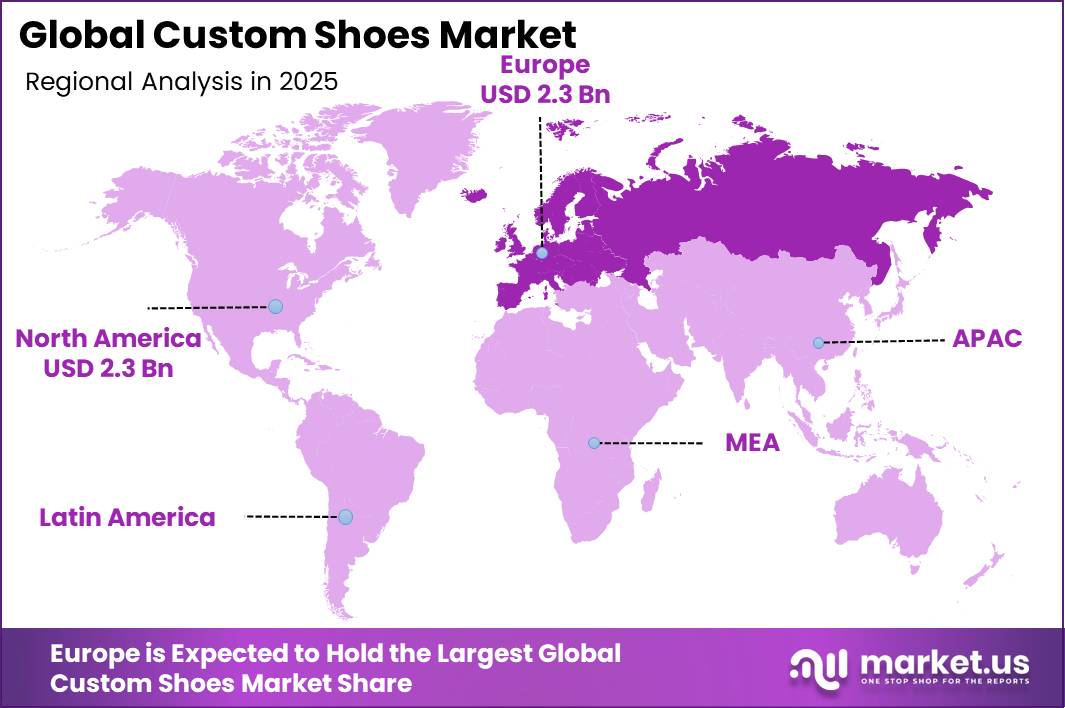
Europe holds the largest regional share in the custom shoes market at 36.20%, valued at USD 2.3 Billion. The region’s dominance traces to deep manufacturing heritage, with countries such as Portugal, Italy, and the UK sustaining skilled artisan labor pools and specialized material supply chains. This infrastructure enables European brands to deliver higher craft standards at commercially viable production scales, reinforcing buyer preference for European-origin custom footwear.
North America represents the second-largest regional market. Strong consumer spending on personalized goods, combined with the rapid adoption of digital foot-scanning technology by DTC brands, supports consistent order growth in this region. The premium and luxury custom shoe segments are particularly active in the US, where professional and lifestyle buyers demonstrate above-average willingness to pay for fit-driven footwear.
Asia-Pacific is the fastest-growing regional market in the custom shoes sector. Rising disposable incomes in urban centers across China, South Korea, and India are expanding the consumer base for personalized footwear beyond traditional luxury buyers. The region’s advanced digital retail infrastructure also accelerates adoption of online custom shoe platforms, giving Asia-Pacific producers and brands an early structural advantage in digital-first customization.
Key Regions and Countries
North America
- US
- Canada
Europe
- Germany
- France
- The UK
- Spain
- Italy
- Rest of Europe
Asia Pacific
- China
- Japan
- South Korea
- India
- Australia
- Rest of APAC
Latin America
- Brazil
- Mexico
- Rest of Latin America
Middle East and Africa
- GCC
- South Africa
- Rest of MEA
Drivers
Regional footwear production depth is a key driver for the custom shoes market because strong manufacturing hubs provide access to skilled labor, specialized suppliers, and flexible production capacity. Portugal produced approximately 85 million pairs of footwear in 2022, reflecting substantial industrial capability within a major European footwear cluster. Proximity to established production ecosystems reduces lead times and improves coordination between design, manufacturing, and quality control stages.
Regional manufacturing also supports smaller batch sizes that are uneconomical in large-scale offshore systems. Faster feedback loops allow quicker adjustments to fit, materials, and craftsmanship requirements. As a result, strong regional production networks improve delivery reliability, enhance product consistency, and support the expansion of custom footwear businesses beyond local artisan workshops into commercially scalable operations.
| Driver | (~) % Impact on CAGR Forecast | Geographic Relevance | Impact Timeline |
|---|---|---|---|
| Scan-led fit precision adoption | +1.9% | North America core; East Asia; GCC premium retail | Short term (≤ 2 years) |
| Diabetic foot-care footwear demand | +1.6% | North America; EU; Japan; urban India | Short term (≤ 2 years) |
| Smartphone foot-capture usability | +1.5% | Global DTC corridors; APAC digital retail | Medium term (2-4 years) |
| Premium comfort price resilience | +1.3% | U.S.; Germany; UK; South Korea | Short term (≤ 2 years) |
| Regional footwear production depth | +1.4% | Portugal; Turkey; Mexico; Southern Europe | Medium term (2-4 years) |
| Data-rich orthotic customization workflows | +1.7% | Clinical retail hubs; North America; Western Europe | Medium term (2-4 years) |
Restraints
Footwear price pass-through ceilings remain a significant restraint for the custom shoes market because customized products already command substantially higher prices than standard footwear. Trade analyses of tariff-related sourcing disruptions show that a shoe retailing near $100 may need to be priced at approximately $156 to maintain the same gross-margin structure under certain cost scenarios. For custom producers, this challenge is amplified by additional costs tied to personalized fitting, specialized labor, and low-volume production.
When material, logistics, or compliance expenses rise, many consumers postpone purchases or shift toward semi-custom and mass-market alternatives. This limits brands from fully transferring higher costs to customers without affecting order volumes. Companies often face difficult trade-offs between margin preservation, material quality, and expansion into price-sensitive customer segments, constraining broader adoption of custom footwear across lower income tiers.
| Restraint | (~) % Impact on CAGR Forecast | Geographic Relevance | Impact Timeline |
|---|---|---|---|
| U.S. tariff cost shock | -1.4% | U.S.; Vietnam; Indonesia; China supply chains | Short term (≤ 2 years) |
| EU GPSR compliance load | -1.1% | EU; UK exporters; U.S. and Asia sellers | Medium term (2-4 years) |
| Footwear price pass-through ceiling | -1.0% | North America core; EU retail | Short term (≤ 2 years) |
| Small-batch margin compression | -1.2% | Global custom ateliers; DTC brands | Medium term (2-4 years) |
| Import dependence on Asia | -0.9% | U.S.; EU; nearshore challengers | Medium term (2-4 years) |
| Input-cost index elevation | -0.8% | EU manufacturing belts; Turkey; Portugal | Short term (≤ 2 years) |
Challenges
3D-print throughput limits remain a significant challenge for the custom footwear market because additive manufacturing capacity is constrained by machine productivity and downstream processing requirements. Custom production often requires multiple stages, including printing, depowdering, cleaning, curing, finishing, and assembly, each of which can become a bottleneck during demand surges. Because every customized design may require unique print parameters, throughput is generally lower than in standardized mass production.
Capacity expansion typically depends on adding machines, increasing automation, or redesigning products to reduce print-intensive components. These limitations extend delivery times and increase unit costs when handling numerous low-volume orders simultaneously. As a result, many manufacturers combine 3D-printed elements with conventionally produced components to maintain commercial viability while still offering meaningful customization to buyers at accessible price points.
| Challenge | (~) % CAGR Friction Drag | Geographic Relevance | Mitigation Horizon |
|---|---|---|---|
| 3D-print throughput limits | -1.1% | North America; EU tech hubs; Indonesia | Medium term (2-4 years) |
| Producer price volatility | -1.0% | EU; export-focused Asia; Turkey | Medium term (2-4 years) |
| Diabetic footwear access gaps | -0.9% | India; SE Asia; Africa; Latin America | Long term (≥ 4 years) |
| Skilled orthotic workflow scarcity | -1.0% | North America; EU; urban Asia clinics | Long term (≥ 4 years) |
| Fragmented scan–design pipelines | -1.1% | Global custom footwear corridors | Medium term (2-4 years) |
| On-demand logistics coordination strain | -0.8% | U.S.; EU; nearshore microfactories | Medium term (2-4 years) |
Opportunities
Custom insole subscription programs represent a monetization opportunity because digital foot-scan and gait-analysis data can be reused beyond the initial footwear purchase. Brands can offer replacement insoles, seasonal performance variants, and usage-based refresh plans rather than treating fitting as a one-time transaction. A subscription model can generate approximately 2 to 4 repeat purchases within a 24-month customer lifecycle, creating more predictable revenue streams for producers.
Insoles require less material input, lower labor intensity, and faster production than fully customized footwear, supporting stronger margins. This approach expands the customer base beyond custom-shoe buyers to include runners, workers in high-standing occupations, and consumers seeking comfort improvements. By converting fit data into an ongoing service relationship, footwear companies can increase retention, improve lifetime value, and generate recurring revenue from existing digital assets.
| Opportunity | (~) % Potential CAGR Upside | Geographic Relevance | Execution Window |
|---|---|---|---|
| Scan-to-shoe retail networks | +2.1% | North America core; East Asia; Gulf malls | Short term (≤ 2 years) |
| Orthopedic and diabetic expansion | +1.8% | North America; EU; Japan | Medium term (2-4 years) |
| Custom insole subscription stacks | +1.5% | U.S.; Germany; UK; South Korea | Short term (≤ 2 years) |
| Nearshore microfactory roll-ups | +1.7% | EU; Mexico; Turkey; Portugal | Medium term (2-4 years) |
| Team-sport fit customization | +1.4% | North America; Western Europe; Australia | Medium term (2-4 years) |
| White-label fit data platforms | +1.6% | Global DTC footwear corridors | Long term (≥ 4 years) |
Key Company Insights
Nike operates as Nike’s primary consumer-facing custom footwear platform, giving buyers direct control over colorways, materials, and design elements across multiple silhouettes. Data from the Nike By You × BTS 2026 program shows the platform introduced 10 exclusive customizable design templates, demonstrating Nike’s ability to scale co-creation with global cultural properties. This cultural partnership strategy generates engagement beyond standard product launches and positions Nike By You as a discovery channel for new consumer cohorts entering the custom footwear category.
In June 2026, Syntilay and Terrell Owens introduced the TO Reset recovery shoe, a custom-fit 3D-printed product produced from customer foot scans and AI-generated design inputs, signaling that athlete-branded custom footwear is becoming a credible product tier distinct from mass performance.
Adidas anchors its competitive positioning in additive manufacturing at commercial scale, distinguishing its approach from brands relying on traditional last-based customization. The platform integrates 3D-printed construction with consumer-facing design configuration, targeting performance and lifestyle buyers who prioritize both fit and visual differentiation.
However, Adidas Made For You faces the same throughput constraints affecting the broader 3D-print segment, where downstream processing stages can compress production margins during high-demand periods. Brands that resolve these bottlenecks through automated finishing lines or hybrid construction models will gain a durable cost advantage in the performance custom segment.
Key Players
- Nike
- Adidas
- AliveShoes
- ID Shoes
- Shoes of Prey
- Allen Edmonds
- John Lobb
- Edward Green
- Gaziano and Girling
- Barker Shoes
- Carmina Shoemaker
- Crockett and Jones
- Velasca
- Myrqvist
- Ace Marks
Recent Developments
- October 2025 – Coats Group completed its acquisition of OrthoLite, strengthening its footwear technology portfolio including comfort and insole technologies used in premium and customized footwear products.
- July 2025 – Adidas launched the Climacool Laced, an upgraded version of its fully 3D-printed footwear platform featuring lace-based fit adjustment and additive-manufactured construction.
Report Scope
| Report Features | Description |
|---|---|
| Market Value (2025) | USD 6.33 Billion |
| Forecast Revenue (2035) | USD 12.3 Billion |
| CAGR (2026-2035) | 6.9% |
| Base Year for Estimation | 2025 |
| Historic Period | 2020-2024 |
| Forecast Period | 2026-2035 |
| Report Coverage | Revenue Forecast, Market Dynamics, Market Opportunity Analysis, Technology and Innovation Landscape, Competitive Landscape, Recent Developments |
| Segments Covered | By Product Type (Dress Shoes, Casual Shoes, Athletic and Sports Shoes, Boots, Loafers and Moccasins, Others), By Material (Leather, Synthetic Materials, Canvas, Suede, Others), By End User (Men, Women, Children), By Distribution Channel (Offline Stores and Boutiques, Online Platforms), By Customization Type (Made-to-Measure, Bespoke, Design Customization), By Price Range (Premium, Mid-Range, Luxury) |
| Regional Analysis | North America (US and Canada), Europe (Germany, France, The UK, Spain, Italy, and Rest of Europe), Asia Pacific (China, Japan, South Korea, India, Australia, and Rest of APAC), Latin America (Brazil, Mexico, and Rest of Latin America), Middle East and Africa (GCC, South Africa, and Rest of MEA) |
| Competitive Landscape | Nike By You, Adidas Made For You, AliveShoes, ID Shoes, Shoes of Prey, Allen Edmonds, John Lobb, Edward Green, Gaziano and Girling, Barker Shoes, Carmina Shoemaker, Crockett and Jones, Velasca, Myrqvist, Ace Marks |
| Customization Scope | Customization for segments, region/country-level will be provided. Additional customization can be done based on requirements. |
| Purchase Options | We have three licenses to opt for: Single User License, Multi-User License (Up to 5 Users), Corporate Use License (Unlimited User and Printable PDF) |





































