


Overview
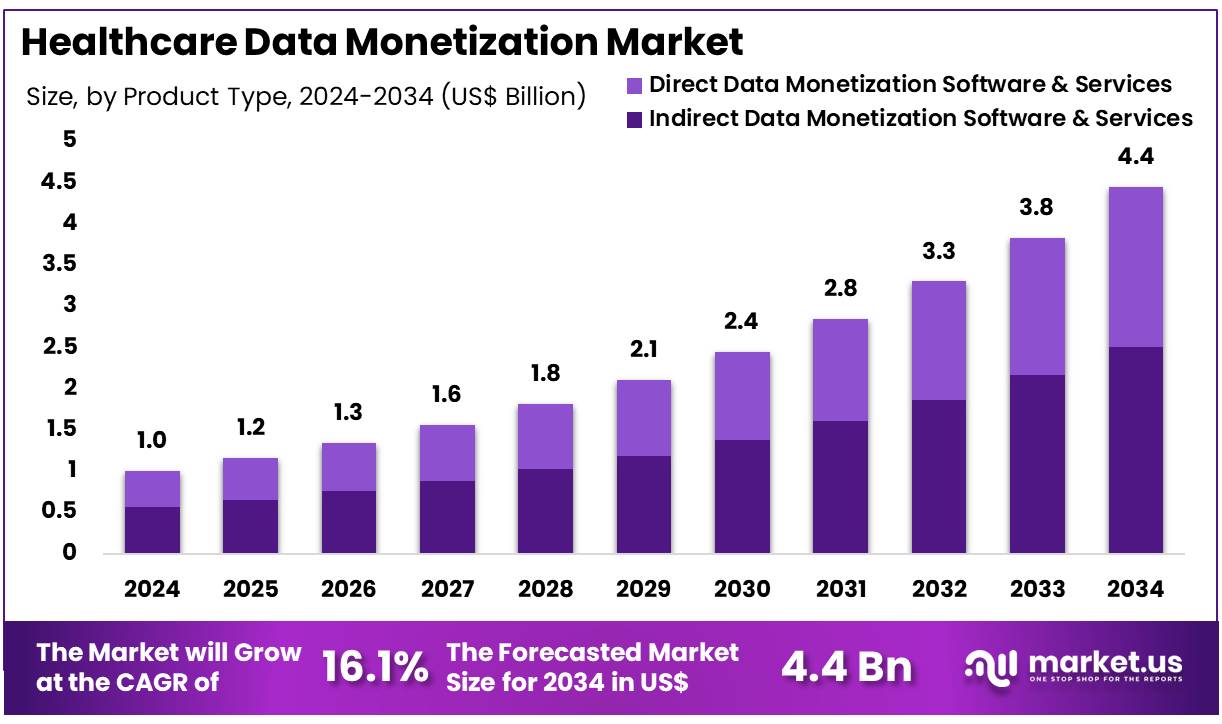
Global Healthcare Data Monetization Market size is expected to be worth around US$ 4.4 Billion by 2034 from US$ 1.0 Billion in 2024, growing at a CAGR of 16.1% during the forecast period 2025 to 2034. In 2024, North America led the market, achieving over 41.6% share with a revenue of US$ 0.4 Billion.
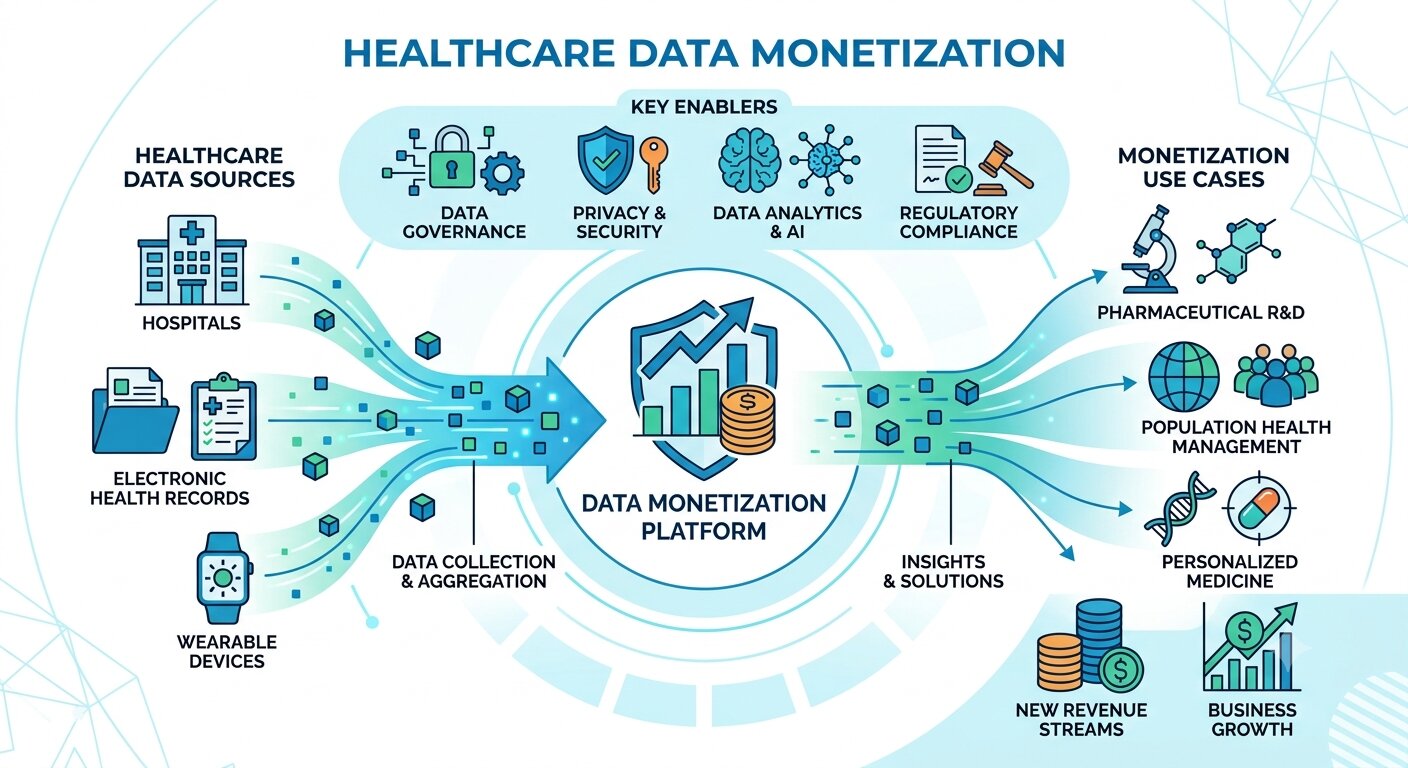
The global Healthcare Data Monetization market is gaining momentum as healthcare organizations increasingly recognize the value of securely transforming clinical, operational, and administrative data into actionable insights. The growing adoption of electronic health records (EHRs), artificial intelligence (AI), cloud computing, and advanced analytics is enabling healthcare providers, payers, pharmaceutical companies, and research institutions to improve patient outcomes while optimizing operational efficiency.
At the same time, governments and regulatory bodies are strengthening data governance frameworks to promote responsible data sharing, interoperability, and privacy protection. According to the U.S. Department of Health and Human Services (HHS), data is considered a strategic asset that supports evidence-based decision-making and advances healthcare innovation through secure governance and standardized data management.
The market is also benefiting from the increasing volume of digital health information generated worldwide. According to the World Health Organization (WHO), approximately 4.5 billion people more than half of the global population were covered by essential health services in recent years, highlighting the growing need for efficient digital health data management.
Additionally, the U.S. Centers for Medicare & Medicaid Services (CMS) reported national health expenditure reaching approximately US$ 4.9 trillion in 2023, reflecting the expanding scale of healthcare systems that rely on data-driven decision-making. Secure data sharing agreements, interoperability initiatives, and AI-enabled analytics are creating new opportunities for healthcare organizations to extract value from health information while maintaining compliance with privacy regulations such as HIPAA.
As investments in digital transformation continue to accelerate, healthcare data monetization is expected to play a vital role in supporting precision medicine, population health management, clinical research, and value-based care across global healthcare ecosystems.
Key Takeaways
- In 2024, the global Healthcare Data Monetization Market was valued at US$ 1.0 billion and is projected to reach US$ 4.4 billion by 2034, expanding at a CAGR of 16.1% during the forecast period.
- By product type, Indirect Data Monetization Software & Services dominated the market, accounting for a 56.4% share.
- Based on deployment mode, the Cloud segment held the largest market share of 61.3%, driven by increasing adoption of scalable and secure cloud-based data platforms.
- By facility size, Large Facilities emerged as the leading segment, capturing 59.8% of the global market revenue.
- In terms of end use, Healthcare Payers accounted for the highest market share, contributing 44.9% of total revenue.
- North America led the global Healthcare Data Monetization market in 2024, holding a 41.6% market share.
Statistical Information
- More than 1 billion health records have been securely exchanged through the U.S. TEFCA® nationwide interoperability network as of June 2026, demonstrating the rapid expansion of secure health data exchange across providers and healthcare organizations.
- In February 2026, HHS announced that the TEFCA network had already reached nearly 500 million health records exchanged, highlighting the accelerating adoption of nationwide health information sharing.
- The 2024 CMS Interoperability and Prior Authorization Final Rule requires broader implementation of standardized APIs and electronic health information exchange to improve access to patient data and reduce administrative burden.
- The Office of the National Coordinator (ONC) states that TEFCA establishes a nationwide “network-of-networks” allowing providers, payers, patients, and public health agencies to securely exchange health information regardless of where it is stored.
- The CDC’s National Electronic Health Records Survey (NEHRS) continues to monitor U.S. physician adoption of Electronic Health Records (EHRs) and interoperability capabilities, providing national data on digital healthcare utilization.
- The GAO reported that the 2024 HHS Health Data, Technology, and Interoperability Rule strengthens algorithm transparency, information sharing, EHR certification, and interoperability standards under the 21st Century Cures Act.
- CMS is promoting nationwide adoption of FHIR® (Fast Healthcare Interoperability Resources) standards to enable secure, standardized exchange of healthcare data across digital health systems.
- The OECD reports that the United States’ interoperability framework promotes standardized APIs and HL7 FHIR to improve patient access to electronic health records and facilitate secure secondary use of healthcare data.
- The ONC maintains national datasets tracking non-federal acute care hospital EHR adoption, interoperable exchange, and patient engagement capabilities, supporting evidence-based digital health policies.
- CMS states that improving interoperability enables timely and accurate health data exchange, helping reduce administrative burden while improving care coordination and patient access to healthcare information.
Regional Analysis
North America dominated the Healthcare Data Monetization Market, accounting for the largest revenue share of 41.6%. The region’s leadership is supported by its advanced digital healthcare infrastructure, widespread adoption of electronic health records (EHRs), and strong regulatory framework for health data privacy.
The U.S. Department of Health and Human Services (HHS) continues to promote secure health information sharing through HIPAA, enabling healthcare organizations to use de-identified data for clinical research, operational improvements, and innovation while protecting patient privacy.
In addition, the National Institutes of Health (NIH) encourages responsible data sharing to accelerate biomedical research and improve healthcare outcomes. These initiatives have increased collaboration among healthcare providers, pharmaceutical companies, technology firms, and research institutions, driving greater adoption of healthcare data monetization solutions.
Asia Pacific is projected to register the fastest CAGR during the forecast period due to rapid digital transformation across healthcare systems. Governments are investing in national digital health programs, including India’s Ayushman Bharat Digital Mission (ABDM), which promotes consent-based health data exchange through ABHA, and Australia’s My Health Record, which enables secure electronic health information sharing.
These initiatives are expanding interoperable digital health ecosystems, supporting data-driven healthcare delivery, research, and innovation while maintaining strong privacy and security standards.
Emerging Trends
- Growing use of secure health data exchange networks: Healthcare organizations are increasingly sharing patient information through secure interoperability frameworks to improve care coordination and research. In 2026, the U.S. nationwide TEFCA network surpassed 1 billion health records exchanged, highlighting rapid growth in trusted health data sharing ecosystems.
- Expansion of secondary use of health data: Governments are enabling anonymized healthcare data to support medical research, public health planning, and innovation. The OECD’s 2025 report emphasizes improving cross-border governance and harmonized rules for secondary health data use to maximize public health benefits while protecting privacy.
- Rising patient control over personal health data: Healthcare systems are giving patients greater access to their electronic health information through digital portals and secure identity systems. The OECD (2025) found that countries with mature personal health data systems have stronger interoperability, privacy safeguards, and patient engagement practices.
- Stronger privacy-first data monetization models: Organizations are increasingly using anonymization, pseudonymization, and secure processing environments before allowing health data reuse. The European Health Data Space (EHDS) requires strict access controls and data minimization for secondary use, supporting trusted healthcare data innovation.
- Increasing focus on healthcare interoperability: Healthcare providers are investing in interoperable digital systems that allow information to move securely across organizations. The OECD (2026) identifies interoperability as a key priority for improving healthcare efficiency, supporting digital innovation, and enabling broader use of healthcare data.
Use Cases
- Drug discovery and clinical research: Pharmaceutical companies use de-identified clinical data to identify disease patterns, recruit patients for trials, and evaluate treatment effectiveness. Secure secondary use of healthcare data is becoming an important resource for accelerating biomedical research and evidence generation.
- Population health management: Government agencies and healthcare providers analyze large health datasets to identify disease trends, monitor public health outcomes, and improve preventive care strategies. These data-driven insights help allocate healthcare resources more efficiently and improve policy decisions.
- AI model development and validation: Healthcare organizations are using high-quality clinical datasets to train and validate artificial intelligence models for diagnosis, workflow automation, and decision support. Reliable healthcare data improves AI accuracy while supporting responsible deployment in clinical settings.
- Healthcare quality improvement: Hospitals analyze operational and clinical data to reduce treatment delays, improve care coordination, and monitor performance indicators. The CDC’s National Electronic Health Records Survey tracks interoperability and health information exchange to support continuous quality improvement across healthcare systems.
- Cross-border health data collaboration: Healthcare institutions increasingly collaborate across countries using secure governance frameworks to support public health research and innovation. The OECD 2025 highlights that harmonized health data policies can expand international research while maintaining privacy and public trust.
Conclusion
The Healthcare Data Monetization Market is witnessing strong growth as healthcare organizations increasingly leverage secure, data-driven insights to improve clinical outcomes, operational efficiency, and research capabilities. Advances in cloud computing, artificial intelligence, interoperability, and electronic health records are expanding opportunities for responsible data utilization while ensuring compliance with evolving privacy regulations.
Government initiatives supporting standardized data exchange and secure governance are further strengthening market development. As healthcare providers, payers, pharmaceutical companies, and research institutions continue investing in digital transformation, healthcare data monetization is expected to play a critical role in enabling precision medicine, population health management, value-based care, and evidence-based decision-making across global healthcare ecosystems.




















