



Overview
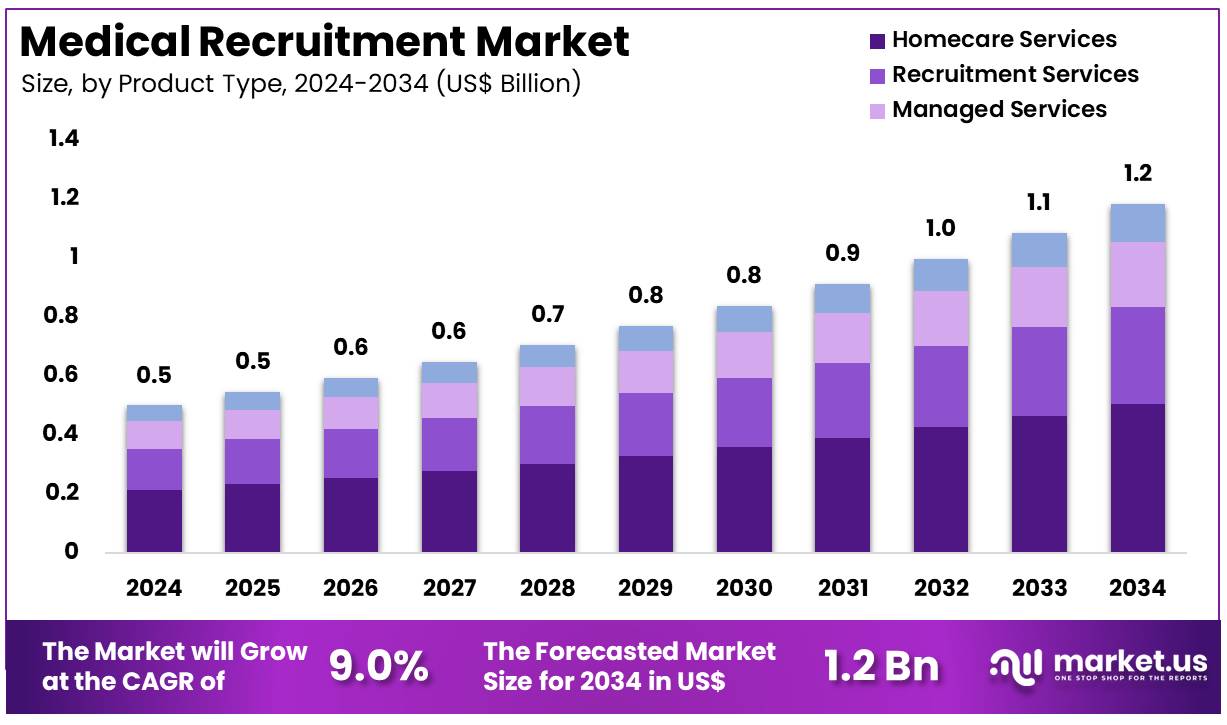
Global Medical Recruitment Market size is expected to be worth around US$ 1.2 Billion by 2034 from US$ 0.5 Billion in 2024, growing at a CAGR of 9.0% during the forecast period 2025 to 2034. In 2024, North America’s market share exceeded 37.2%, translating into a revenue of US$ 0.2 Billion.
Healthcare systems worldwide continue to face mounting workforce challenges, making medical recruitment an increasingly important component of healthcare delivery. Rising demand for healthcare services, aging populations, and expanding access to specialized care have intensified the need for qualified physicians, nurses, allied health professionals, and support staff.
Healthcare organizations are increasingly adopting strategic recruitment models, digital hiring platforms, and international talent sourcing to reduce vacancy rates and maintain continuity of patient care. Governments and healthcare providers are also investing in workforce planning initiatives to strengthen long-term staffing resilience and improve healthcare accessibility.
The World Health Organization (WHO) estimates that the world could face a shortage of approximately 11 million health workers by 2030, with the greatest impact expected in low- and lower-middle-income countries. Additionally, the global health workforce currently exceeds 70 million workers, highlighting both the scale of the sector and the ongoing challenge of ensuring an equitable distribution of skilled professionals. These trends are encouraging healthcare organizations to expand recruitment efforts, improve workforce retention, and invest in professional development programs.
International recruitment has also become a critical strategy for addressing workforce shortages. Governments, healthcare institutions, and educational organizations are strengthening partnerships to enhance workforce mobility, training capacity, and data-driven recruitment planning. These initiatives are expected to support sustainable healthcare delivery while improving access to skilled medical professionals across developed and emerging healthcare markets.
Key Takeaways
- The global medical recruitment market generated US$ 0.5 billion in revenue in 2024 and is projected to reach US$ 1.2 billion by 2034, expanding at a CAGR of 9.0% during the forecast period.
- By service type, the market is segmented into recruitment services, homecare services, managed services, and specialist care services. Among these, homecare services emerged as the leading segment, accounting for 42.7% of the market in 2024.
- Based on application, the market comprises pharmaceuticals & biotechnology, nursing/healthcare, medical devices, and others. The pharmaceuticals & biotechnology segment held the largest share, contributing 47.5% of the global market in 2024.
- North America maintained its leading position in the global medical recruitment market, capturing 37.2% of the total market share in 2024.
Statistical Information
- The U.S. Bureau of Labor Statistics projects that employment in healthcare occupations will grow 13% between 2023 and 2033, much faster than the average for all occupations, creating about 1.9 million job openings each year from growth and replacement needs.
- According to the U.S. Health Resources and Services Administration (HRSA), the United States is projected to experience continued shortages of several healthcare professions through 2037, including registered nurses and primary care providers, increasing demand for specialized medical recruitment services.
- The OECD reports that its member countries employed more than 4.5 million doctors and 12.3 million nurses in 2023, reflecting sustained expansion of the healthcare workforce and continued recruitment needs.
- Foreign-born doctors across OECD countries have increased by 86% over the past two decades, while foreign-born nurses have increased by 136%, demonstrating growing reliance on international medical recruitment.
- In 2023, OECD countries employed more than 606,000 foreign-trained physicians and 732,000 foreign-trained nurses, highlighting the importance of cross-border hiring in addressing workforce shortages.
- Foreign-trained physicians represented 20% of the medical workforce across OECD countries in 2023, up from 16% in 2010, indicating increasing international mobility of healthcare professionals.
- The United States remains the largest destination for internationally recruited healthcare professionals, hosting 36% of all foreign-born doctors and 42% of all foreign-born nurses practicing across OECD countries.
- OECD data show that 24% of doctors and 15% of nurses working across member countries are foreign-born, underscoring the growing dependence on international recruitment pipelines.
- Surveys summarized by the OECD indicate that more than one in five nurses in several member countries have considered leaving their jobs due to burnout and job dissatisfaction, increasing replacement hiring needs.
- Healthcare employment in the United States expanded from 9.3 million workers in 1990 to 18.1 million in 2022, making healthcare the country’s largest employment sector and reinforcing long-term demand for recruitment services.
Regional Analysis
North America accounted for the largest share of the medical recruitment market in 2024, supported by sustained demand for healthcare professionals and persistent workforce shortages across the United States and Canada. The U.S. Health Resources and Services Administration (HRSA) continues to project supply-demand gaps across several healthcare occupations, encouraging hospitals, clinics, and long-term care providers to expand recruitment initiatives and workforce planning.
In addition, the U.S. Bureau of Labor Statistics projects healthcare occupations to grow much faster than the average for all occupations, driven by rising healthcare utilization and an aging population. These factors continue to strengthen demand for specialized medical recruitment services across the region.
Asia Pacific is anticipated to register the fastest growth during the forecast period, supported by expanding healthcare infrastructure, growing elderly populations, and increasing healthcare expenditure across major economies.
Governments are investing in workforce development and healthcare capacity to improve access to medical services, while the rapid expansion of private healthcare providers is intensifying competition for skilled professionals. According to the OECD, demographic changes and population aging are significantly increasing demand for healthcare workers, reinforcing the need for efficient recruitment and workforce management solutions across the region.
Emerging Trends
- AI-powered hiring is becoming more common across healthcare organizations to speed up candidate screening, credential verification, and workforce planning. At the same time, OECD recommends combining digital tools with better staff retention and modern training to address long-term workforce shortages rather than relying only on recruitment.
- International recruitment continues to expand as healthcare systems struggle to meet staffing needs. Since 2010, the number of foreign-trained doctors has increased by 62% and foreign-trained nurses by 71% across OECD countries, making cross-border hiring an important recruitment strategy.
- Healthcare employment is growing faster than most industries, creating sustained recruitment demand. OECD reports that 10.9% of all jobs in member countries were in health and social care in 2023, compared with 10.1% in 2013, reflecting continuous workforce expansion.
- Digital workforce planning is gaining importance as governments and healthcare providers increasingly use workforce data to forecast shortages, monitor staffing levels, and improve recruitment decisions. OECD regularly updates healthcare workforce datasets covering physicians, nurses, pharmacists, and other professionals across member countries.
- Retention-focused recruitment strategies are becoming a priority because replacing experienced healthcare professionals is increasingly difficult. OECD recommends improving working conditions, strengthening career development, and supporting flexible work models alongside recruitment to build a sustainable healthcare workforce.
Use Cases
- Hospitals use specialized recruitment firms to rapidly fill vacancies in emergency medicine, intensive care, surgery, and other high-demand specialties, reducing hiring delays and maintaining uninterrupted patient services during periods of workforce shortages.
- Home healthcare providers recruit mobile clinical staff including nurses, therapists, and caregivers to support the growing number of older adults receiving treatment at home instead of hospitals, helping improve care access and reduce pressure on inpatient facilities.
- Pharmaceutical and biotechnology companies use medical recruitment agencies to hire clinical research professionals, regulatory experts, medical affairs specialists, and laboratory scientists, supporting faster drug development, clinical trials, and commercialization activities.
- Healthcare systems recruit internationally to address domestic workforce shortages by hiring qualified physicians and nurses from overseas while following national licensing and immigration requirements, improving access to skilled professionals in underserved regions.
- Healthcare organizations use workforce analytics to identify future staffing gaps, estimate retirement-related vacancies, and plan recruitment campaigns before shortages affect patient care. This data-driven approach supports more efficient hiring and long-term workforce sustainability.
Conclusion
The medical recruitment market is poised for sustained growth as healthcare systems worldwide respond to rising workforce shortages, increasing patient demand, and expanding healthcare infrastructure. Growing adoption of digital recruitment platforms, AI-enabled hiring tools, workforce analytics, and international recruitment strategies is helping employers attract qualified professionals more efficiently. Demand from hospitals, home healthcare providers, pharmaceutical companies, and biotechnology firms will continue to support market expansion.
Government initiatives focused on workforce planning, education, and retention are also strengthening recruitment activities. As the global health workforce faces evolving demographic and care delivery challenges, medical recruitment will remain a critical function for ensuring timely access to skilled healthcare professionals and maintaining high-quality patient care.




















