


Overview
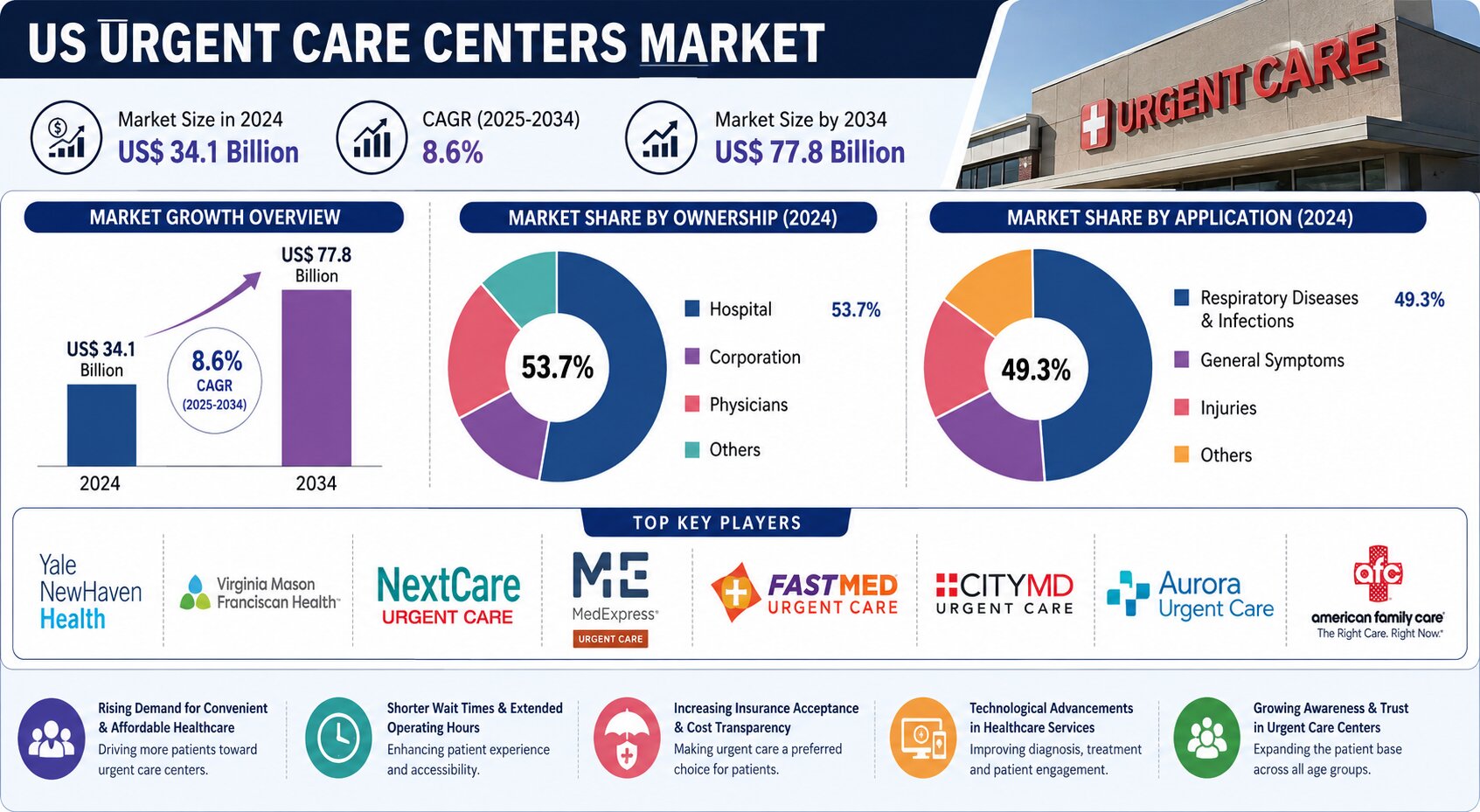
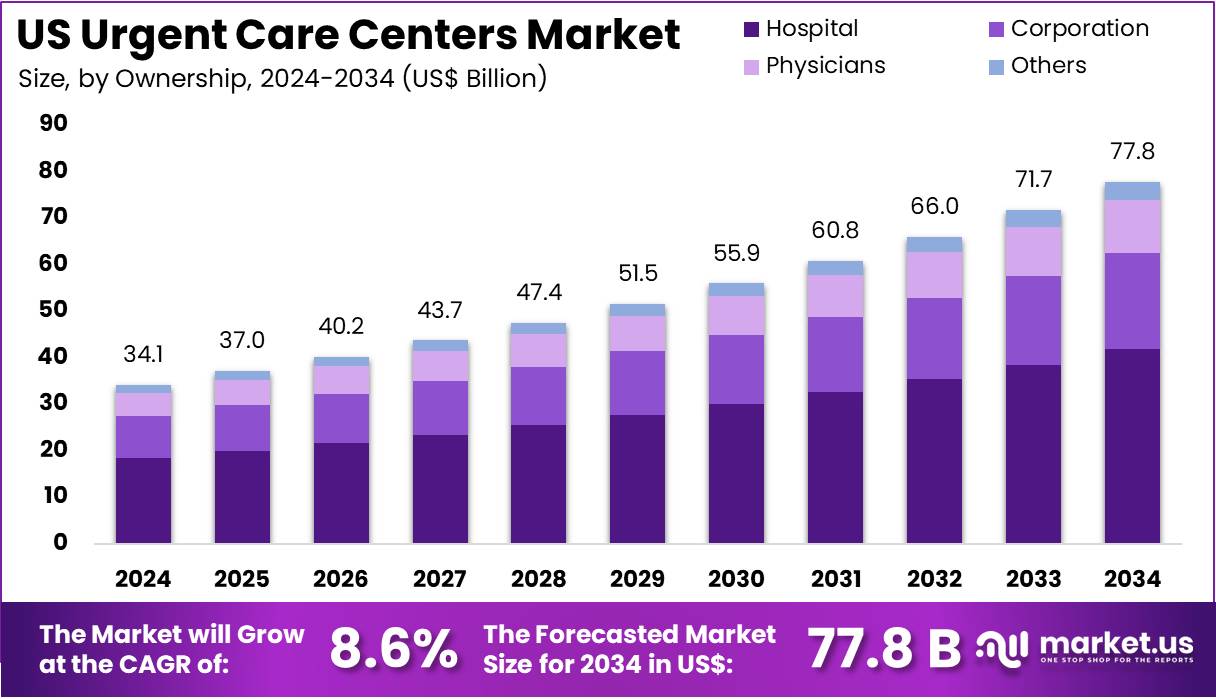
The US Urgent Care Centers Market size is expected to be worth around US$ 77.8 Billion by 2034 from US$ 34.1 Billion in 2024, growing at a CAGR of 8.6% during the forecast period 2025 to 2034
The United States urgent care centers sector continues to strengthen its role in the healthcare system by providing fast, convenient, and cost-effective treatment for non-life-threatening illnesses and injuries. These facilities help reduce pressure on hospital emergency departments while improving access to same-day medical care for patients seeking treatment for minor infections, fractures, respiratory illnesses, vaccinations, and diagnostic services. Growing consumer preference for walk-in care, extended operating hours, and digital appointment scheduling is supporting the expansion of urgent care services across urban and suburban communities.
The increasing burden on traditional healthcare infrastructure, combined with physician shortages and rising demand for accessible outpatient services, is encouraging healthcare providers to expand urgent care networks. Integration of telehealth, electronic health records, point-of-care diagnostics, and digital patient engagement tools is further improving operational efficiency and patient experience. Healthcare organizations are also expanding partnerships with hospitals and primary care networks to ensure continuity of care and better referral management.
According to the U.S. Centers for Disease Control and Prevention (CDC), 27.6% of Americans reported at least one visit to an urgent care center during 2024, highlighting the growing reliance on these facilities for timely medical services. Additionally, 28.9% of adults aged 18–64 years visited an urgent care center, demonstrating particularly strong utilization among the working-age population.
These trends reflect the increasing importance of urgent care centers in improving healthcare accessibility, reducing emergency department congestion, and supporting efficient delivery of outpatient medical services across the United States.
Key Takeaways
- In 2024, the US Urgent Care Centers Market generated US$ 34.1 billion in revenue and is projected to reach US$ 77.8 billion by 2034, expanding at a CAGR of 8.6% during the forecast period.
- Based on ownership, the market is segmented into hospital, corporation, physicians, and others. Among these, the hospital segment dominated the market in 2024, accounting for a 53.7% share.
- By application, the market is categorized into respiratory diseases & infections, general symptoms, injuries, and others. The respiratory diseases & infections segment emerged as the leading application, capturing a 49.3% market share in 2024.
Statistical Information
- 31.5% of adults aged 18–64 living in large fringe metropolitan areas visited an urgent care center in 2024, compared with 26.6% in large central metropolitan areas, indicating stronger demand in suburban communities.
- Among adults aged 18–64 years, 30.6% of those living in medium and small metropolitan areas reported at least one urgent care center visit in 2024, highlighting continued expansion opportunities outside major cities.
- 28.5% of U.S. children (0–17 years) visited an urgent care center at least once in 2024, demonstrating strong utilization for pediatric acute illnesses and injuries.
- 21.9% of adults aged 65 years and older used an urgent care center in 2024, reflecting increasing adoption among older adults for non-emergency healthcare needs.
- 19.0% of Americans visited a retail health clinic during 2024, illustrating continued consumer preference for convenient, same-day outpatient healthcare options that complement urgent care services.
- According to the National Health Interview Survey, 8.6% of U.S. adults identified an urgent care center or clinic in a drug store or grocery store as their usual source of healthcare in 2024.
- 12.2% of adults aged 18–34 reported using an urgent care or retail clinic as their usual source of healthcare in 2024, compared with 3.8% of adults aged 65 and older, showing stronger reliance among younger adults.
- 90% of U.S. adults reported having a regular source of healthcare in 2024, creating opportunities for urgent care providers to integrate with primary care and referral networks.
- The CDC reports that urgent care centers have become mainstream access points for treating acute, non-life-threatening illnesses and injuries, helping improve healthcare accessibility and reducing pressure on hospital emergency departments.
- The National Hospital Ambulatory Medical Care Survey estimated an overall 47 emergency department visits per 100 people in the United States during 2022, reinforcing the importance of alternative care settings such as urgent care centers for appropriate non-emergency cases.
Market Segmentation Analysis
Ownership Analysis
The hospital segment accounted for the largest share of the US urgent care centers market, representing 53.7% in 2024. Growth is driven by hospitals expanding outpatient services to improve access to timely medical care for non-emergency conditions while reducing pressure on emergency departments. Hospital-owned urgent care centers offer integrated care through shared electronic health records, specialist referrals, and coordinated follow-up treatment.
Increasing demand for convenient, walk-in healthcare, combined with hospitals’ focus on enhancing patient experience and lowering healthcare costs, continues to support the expansion of this segment. Strong healthcare infrastructure and ongoing investments in community-based care are expected to reinforce the segment’s leading position.
Application Analysis
The respiratory diseases & infections segment captured a leading 49.3% market share in 2024, reflecting the high demand for prompt diagnosis and treatment of respiratory conditions. Urgent care centers are widely utilized for managing influenza, COVID-19, bronchitis, pneumonia, asthma flare-ups, and other seasonal respiratory illnesses. Their ability to provide same-day consultations, rapid diagnostic testing, and immediate treatment makes them a preferred healthcare option.
Rising awareness of early intervention, recurring seasonal infections, and increasing accessibility of walk-in services continue to drive patient volumes. Continued investment in point-of-care diagnostics and respiratory care capabilities is expected to sustain the segment’s strong market position.
Business Opportunities
The US urgent care centers market presents significant business opportunities as healthcare providers, hospital systems, and investors focus on expanding access to convenient outpatient care. Rising patient preference for same-day treatment, extended operating hours, and lower-cost alternatives to emergency departments is encouraging the development of new urgent care facilities in suburban and underserved communities.
Healthcare organizations can capitalize on opportunities by integrating urgent care centers with primary care networks, specialty services, and digital health platforms to improve care coordination and patient retention. The expansion of telehealth, supported by CMS reimbursement policies, enables urgent care providers to offer virtual consultations, remote triage, and follow-up care, creating additional revenue streams while improving patient access.
Further opportunities exist in deploying point-of-care diagnostics, AI-enabled patient scheduling, electronic health records, and retail-based urgent care models that enhance operational efficiency. The growing prevalence of respiratory infections, seasonal illnesses, and minor injuries is expected to sustain patient volumes, while partnerships with employers, insurers, and accountable care organizations can strengthen referral networks and expand preventive, occupational, and chronic disease management services.
Emerging Trends
- Telehealth integration is becoming a standard urgent care service. CMS continues to support Medicare telehealth services, with Q4 2025 data showing telehealth remains in routine use after the pandemic. Many urgent care providers now combine virtual triage with in-person treatment to improve patient flow and reduce waiting times.
- Electronic data sharing is improving continuity of care. The U.S. healthcare system continues expanding interoperable electronic health records, allowing urgent care centers to exchange patient information with hospitals and primary care providers. This reduces duplicate testing, speeds referrals, and improves follow-up care across healthcare settings.
- Urgent care centers are expanding point-of-care diagnostics. Rapid testing for influenza, COVID-19, strep throat, RSV, and urinary tract infections enables diagnosis and treatment during a single visit. Faster laboratory technology is helping providers improve clinical decisions while shortening patient visit times.
- Consumer preference is shifting toward convenient outpatient care. CDC recognizes urgent care centers as mainstream healthcare access points for treating acute, non-life-threatening conditions. This is encouraging health systems to expand extended evening and weekend operating hours to meet growing patient expectations for accessible care.
- Health systems are strengthening coordinated outpatient networks. Hospitals increasingly connect urgent care, primary care, specialty clinics, and virtual care into unified care pathways, enabling smoother referrals, shared patient records, and better long-term disease management while improving operational efficiency.
Use Cases
- Virtual-first patient triage is becoming a common use case. Patients can complete online symptom screening before visiting an urgent care center, allowing providers to determine whether virtual consultation, urgent care treatment, or emergency department referral is the most appropriate option.
- Same-day laboratory diagnostics allow urgent care centers to evaluate common infectious diseases without requiring hospital visits. Rapid molecular and antigen testing supports immediate treatment decisions and helps reduce unnecessary antibiotic use through faster diagnosis.
- Occupational medicine services continue expanding beyond injury treatment. Urgent care centers increasingly perform workplace physical examinations, vaccination programs, respiratory clearance testing, return-to-work evaluations, and regulatory health screenings for employers across multiple industries.
- Post-discharge follow-up care is becoming an important application. Hospitals increasingly refer patients with uncomplicated recovery needs to urgent care centers for wound checks, medication monitoring, and symptom assessment, reducing unnecessary emergency department revisits while improving continuity of care.
- Digital appointment scheduling and online registration are improving operational efficiency. Many urgent care providers now enable patients to reserve visit times, complete registration electronically, and receive digital updates, reducing administrative workload while improving the overall patient experience.
Recent Developments
- In August 2026, Yale New Haven Health opened its 23rd urgent care center in Darien, Connecticut. The center features seven examination rooms and same-day laboratory testing, expanding urgent care access in Fairfield County, with an additional Stamford location already planned
- In September 2025, Yale New Haven Health opened its 22nd urgent care center in Wallingford, Connecticut. The new facility includes six examination rooms, an on-site testing laboratory, X-ray services, and 24/7 telehealth access, supporting the health system’s statewide outpatient expansion.
- In February 2025, American Family Care (AFC) acquired five Physician One Urgent Care centers in the Boston metropolitan area. The acquisition expanded AFC’s Massachusetts footprint to 35 clinics and increased its nationwide network to more than 400 urgent care centers.
- In January 2025, Ardent Health announced the acquisition of 18 urgent care clinics from NextCare Urgent Care, including 12 clinics in Oklahoma and 6 clinics in New Mexico. The acquisition expands Ardent’s ambulatory care network through Hillcrest HealthCare System and Lovelace Health System.
Conclusion
The US Urgent Care Centers Market is poised for sustained growth as demand for accessible, affordable, and same-day healthcare services continues to increase across the country. Expanding hospital-owned networks, growing adoption of telehealth, digital patient engagement, and advanced point-of-care diagnostics are transforming urgent care delivery while improving patient outcomes.
Rising utilization among children, working-age adults, and older populations highlights the sector’s expanding role in the healthcare ecosystem. Strategic acquisitions, facility expansions, and investments by leading providers further strengthen market prospects. As healthcare systems prioritize convenience and operational efficiency, urgent care centers are expected to remain a critical component of outpatient care in the United States.




















