
Introduction
The Wearable Technology Market is moving beyond basic activity tracking toward continuous health monitoring, AI-enabled coaching, connected fitness ecosystems, and subscription-led monetization models.
Current market dynamics show a bifurcation between high-volume entry wearables and premium, data-rich platforms, with companies such as Huawei, Apple, Xiaomi, Samsung, Garmin, Oura, and WHOOP shaping category direction through health analytics, ecosystem integration, and specialized device innovation.
Market Size & Statistics
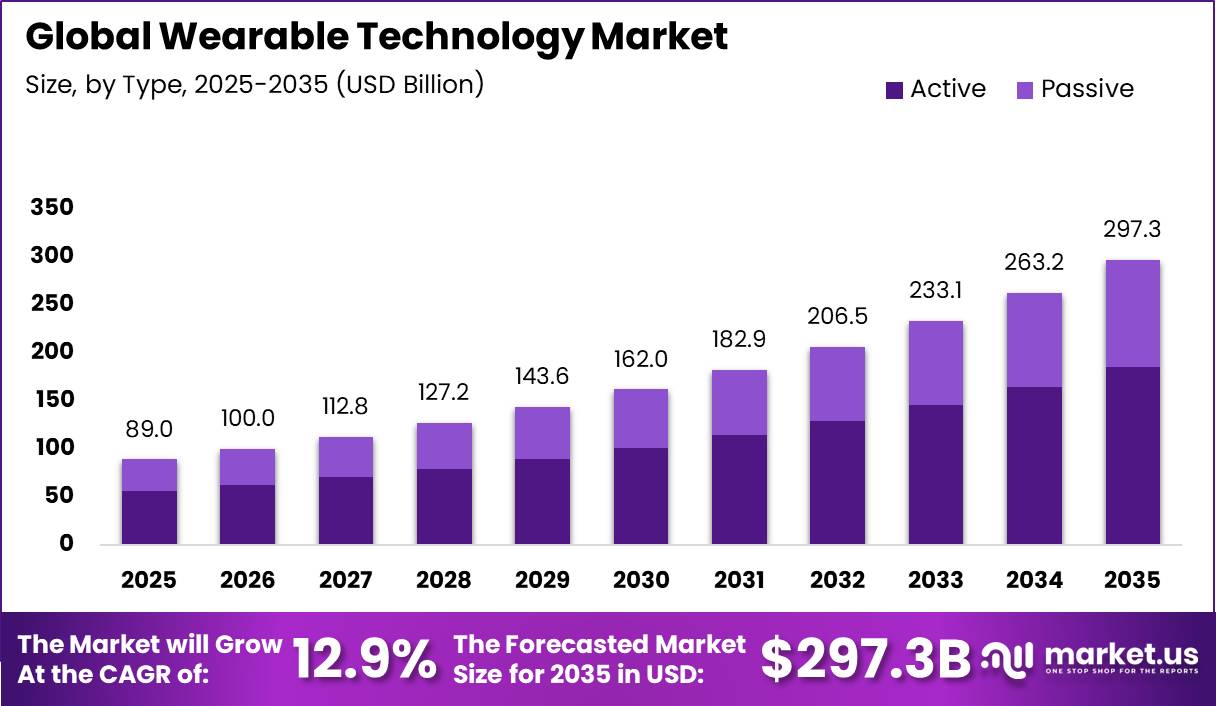
- The global wearable technology market was valued at USD 89.0 billion in 2025.
- The market is projected to reach USD 297.3 billion by 2035.
- Global revenue is forecast to expand at a CAGR of 12.9% between 2026 and 2035.
- Active wearable products accounted for 62.5% of the market.
- IoT-based wearable technology represented 68.7% of 2025 revenue.
- Health and fitness applications held a 41.2% end-use share.
- North America led the market with a 36.5% share in 2025.
- North American wearable technology revenue amounted to approximately USD 32.5 billion in 2025.
- The top five wearable vendors collectively represented an estimated 55% to 60% of global device shipments and revenue.
- Global wearable-device shipments reached 145.7 million units in Q1 2026, up 4.3% year over year.
| Rank | Company | Approximate Share / Positioning | Market Definition |
|---|---|---|---|
| 1 | Huawei Technologies Co., Ltd. | 19% | Global wrist-worn wearables, Q2 2026 |
| 2 | Xiaomi | 18% | Global wrist-worn wearables, Q2 2026 |
| 3 | Apple Inc. | 16% | Global wrist-worn wearables, Q2 2026 |
| 4 | Samsung Electronics Co., Ltd. | 6% | Global wearable bands, Q2 2026 |
| 5 | Garmin Ltd. | 6% | Global wrist-worn wearables, Q2 2026 |
| 6 | WHOOP | 54% | Global non-display bands, Q2 2026 |
| 7 | Oura Health Oy | Category leader; 3.6 million rings sold in the 12 months to June 2026 | Smart rings |
| 8 | Google LLC | Tier-2 ecosystem participant | Pixel Watch and Fitbit wearables |
| 9 | Polar Electro | 14% | Global non-display bands, Q2 2026 |
| 10 | Imagine Marketing Ltd. | Strong regional challenger | India smartwatches and audio wearables |
| 11 | SUUNTO | Premium niche participant | Outdoor and endurance watches |
| 12 | Sony Corporation | Specialist participant | Hearables and connected audio |
| 13 | Fossil Group | Retracting smartwatch participant | Fashion smartwatches and hybrid watches |
| 14 | Nike, Inc. | Ecosystem partner | Apple Watch Nike and connected running platform |
| 15 | Adidas AG | Adjacent wearable participant | Performance apparel and sports technology |
Top Companies List
- Apple Inc.
- Huawei Technologies Co., Ltd.
- Xiaomi
- Samsung Electronics Co., Ltd.
- Garmin Ltd.
- Google LLC
- Oura Health Oy
- WHOOP
- Imagine Marketing Ltd.
- Sony Corporation
- Polar Electro
- SUUNTO
- Fossil Group
- Nike, Inc.
- Adidas AG
1. Apple Inc.
About Apple Inc.: Apple operates one of the most integrated wearable ecosystems in the market through Apple Watch, AirPods, Health, Fitness+, and iPhone connectivity. Its moat is built on proprietary silicon, operating-system control, premium industrial design, strong health-data integration, and high user retention across its installed device base.
Company Overview Table
| Attribute | Company Data |
|---|---|
| Company Name | Apple Inc. |
| Ticker Symbol | NASDAQ: AAPL |
| Industry | Consumer electronics, software, digital health, and wearable technology |
| Headquarters | Cupertino, California, United States |
| Founded | 1976 |
| Founders | Steve Jobs, Steve Wozniak, and Ronald Wayne |
| Latest Quarterly Revenue | USD 109.4 billion, Q3 FY2026 |
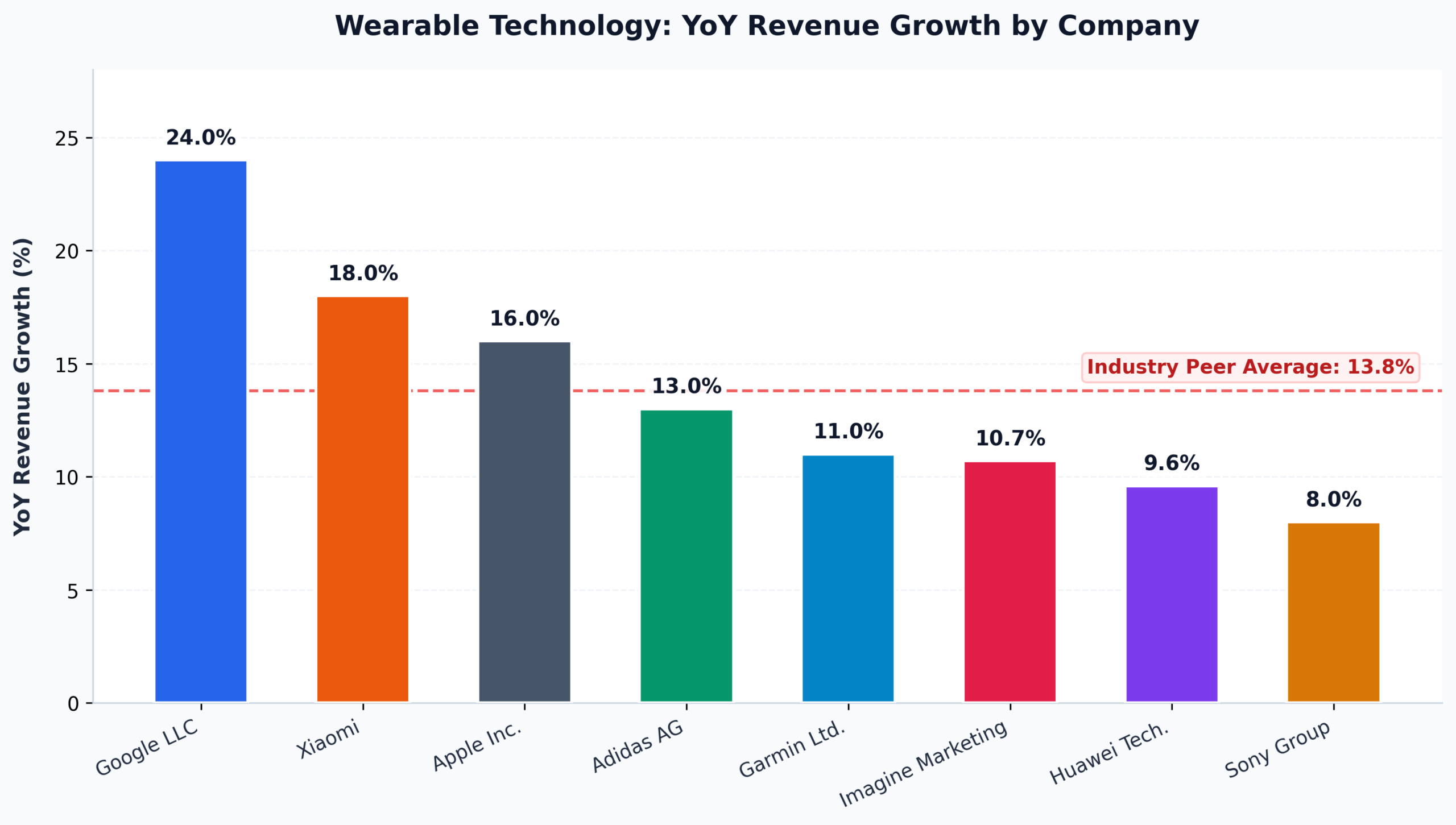
| YoY Revenue Growth | 16% |
| Primary Segments | iPhone; Mac; iPad; Wearables, Home and Accessories; Services |
Financial Details
Apple reported USD 109.4 billion in Q3 FY2026 revenue, up 16% year over year. Its Wearables, Home and Accessories segment generated USD 7.883 billion, increasing from USD 7.404 billion a year earlier, indicating resilient growth in Apple’s wearable-adjacent business despite maturity in mainstream smartwatch demand.
Strategic Developments
- Apple acquired AI startup Q.ai in January 2026, expanding its capabilities in intelligent consumer-device experiences.
- Apple continues its long-running Nike partnership through Apple Watch Nike bands, watch faces, and Nike Run Club integration.
- Apple held approximately 20% global smartwatch share in Q2 2026 and recorded 14% year-over-year shipment growth under Counterpoint’s market view.
2. Huawei Technologies Co., Ltd.
About Huawei Technologies Co., Ltd.: Huawei combines smartwatches, fitness bands, health algorithms, HarmonyOS integration, and strong China-led scale. Its moat rests on vertical hardware-software coordination, broad domestic distribution, brand strength in connected devices, and growing sports-performance and health-monitoring partnerships.
Company Overview Table
| Attribute | Company Data |
|---|---|
| Company Name | Huawei Technologies Co., Ltd. |
| Industry | ICT infrastructure, smart devices, consumer electronics, and wearables |
| Headquarters | Shenzhen, China |
| Founded | 1987 |
| Founders | Ren Zhengfei |
| Current CEO | Ren Zhengfei |
| Primary Segments | ICT Infrastructure; Consumer; Cloud Computing; Digital Power; Intelligent Automotive Solutions |
Financial Details
Huawei generated CNY 467.82 billion in first-half 2026 revenue, up 9.6% year over year. In 2025, its Consumer business, which includes wearable devices, generated CNY 344.5 billion, up 1.6% year over year.
Strategic Developments
- Huawei partnered with RacePace to integrate AI trail coaching into its wearable ecosystem.
- Huawei partnered with the dsm-firmenich Running Team to support next-generation running-watch development.
- Huawei reached a record 22% global smartwatch shipment share in Q2 2026.
3. Xiaomi
About Xiaomi: Xiaomi competes through high-volume smart bands and watches integrated into its AIoT ecosystem. Its moat is defined by aggressive price-performance positioning, fast product-refresh cycles, broad retail and online reach, and strong cross-device connectivity with smartphones and smart-home products.
Company Overview Table
| Attribute | Company Data |
|---|---|
| Company Name | Xiaomi Corporation |
| Ticker Symbol | HKEX: 1810 |
| Industry | Consumer electronics, smartphones, AIoT, and wearables |
| Headquarters | Beijing, China |
| Founded | 2010 |
| Current CEO | Lei Jun |
| Latest Quarterly Revenue | CNY 108.9 billion, Q2 2026 |
| Primary Segments | Smartphone and AIoT; Smart EV and Other New Initiatives |
Financial Details
Xiaomi generated CNY 108.9 billion in Q2 2026 revenue. Its IoT business delivered CNY 31.3 billion in revenue, while the broader Smartphone × AIoT segment contributed CNY 84.0 billion, underscoring the importance of wearables and connected devices within Xiaomi’s consumer-technology model.
Strategic Developments
- Xiaomi launched the Watch S5 46mm and Smart Band 10 Pro internationally in May 2026.
- Xiaomi expanded its overseas Xiaomi Home store footprint to more than 640 stores by June 2026, strengthening wearable-device distribution.
- Xiaomi held approximately 18% of global wrist-worn wearable shipments in Q2 2026.
4. Samsung Electronics Co., Ltd.
About Samsung Electronics Co., Ltd.: Samsung positions Galaxy Watch as a core layer in its digital-health and connected-device ecosystem. Its moat includes sensor integration, display and chip capabilities, Galaxy smartphone interoperability, Samsung Health, and a growing partner network across fitness and clinical research.
Company Overview Table
| Attribute | Company Data |
|---|---|
| Company Name | Samsung Electronics Co., Ltd. |
| Ticker Symbol | KRX: 005930 |
| Industry | Semiconductors, consumer electronics, mobile devices, and wearables |
| Headquarters | Suwon, South Korea |
| Founded | 1969 |
| Founders | Established under Lee Byung-chul |
| Latest Quarterly Revenue | Approximately KRW 171 trillion, Q2 2026 guidance |
| Primary Segments | Device eXperience; Device Solutions; Samsung Display; Harman |
Financial Details
Samsung issued Q2 2026 revenue guidance of approximately KRW 171 trillion in consolidated sales. The company’s mobile and connected-device stack continues to use Galaxy Watch as a central platform for AI-led health and wellness services.
Strategic Developments
- Samsung expanded its partnership with Strava for Galaxy Watch9 and Galaxy Watch Ultra2, including pre-installs and route integration into Samsung Health.
- Samsung and Massachusetts General Hospital launched a joint study examining Galaxy Watch-based monitoring during GLP-1 treatment.
- Samsung introduced next-generation Galaxy Watch health features in 2026 focused on AI-powered sleep, energy, and preventive wellness guidance.
5. Garmin Ltd.
About Garmin Ltd.: Garmin is a leading specialist in premium sports and outdoor wearables. Its moat comes from high-accuracy GPS, long battery life, rugged product design, multi-sport software depth, strong physiological metrics, and increasing integration with coaching and training platforms.
Company Overview Table
| Attribute | Company Data |
|---|---|
| Company Name | Garmin Ltd. |
| Ticker Symbol | NYSE: GRMN |
| Industry | GPS technology, wearable devices, navigation, aviation, and marine electronics |
| Headquarters | Schaffhausen, Switzerland |
| Founded | 1989 |
| Founders | Gary Burrell and Min Kao |
| Current CEO | Clifton Pemble |
| Latest Quarterly Revenue | USD 2.022 billion, Q2 2026 |
| YoY Revenue Growth | 11% |
| Primary Segments | Fitness; Outdoor; Aviation; Marine; Auto OEM |
Financial Details
Garmin reported Q2 2026 revenue of USD 2.022 billion, up 11% year over year. Fitness revenue rose 25% to USD 756.8 million, while Outdoor revenue was USD 482.7 million, confirming strong momentum in performance-oriented wearables despite slower demand in some adventure subcategories.
Strategic Developments
- Garmin acquired TrainingPeaks and TrainHeroic to deepen its training, coaching, and connected-fitness platform.
- Garmin acquired Moxy Monitor, adding muscle-oxygen sensing capability to its wearable ecosystem.
- Garmin’s strategy is increasingly shifting from device-only monetization toward integrated hardware, software, and coaching value capture.
6. Google LLC
About Google LLC: Google participates in wearables through Pixel Watch, Fitbit trackers, Fitbit Premium, Wear OS, and AI-enabled health services. Its advantage comes from Android distribution, Google AI infrastructure, Fitbit’s established biometric and wellness capabilities, and a broad developer and services ecosystem.
Company Overview Table
| Attribute | Company Data |
|---|---|
| Company Name | Google LLC |
| Ticker Symbol | Parent: NASDAQ: GOOG / GOOGL |
| Industry | Internet services, software, AI, digital health, and consumer devices |
| Headquarters | Mountain View, California, United States |
| Founded | 1998 |
| Founders | Larry Page and Sergey Brin |
| Current CEO | Sundar Pichai |
| Latest Quarterly Revenue | Parent Alphabet: USD 119.8 billion, Q2 2026 |
| YoY Revenue Growth | 24% |
| Primary Segments | Google Services; Google Cloud; Other Bets |
Financial Details
Alphabet generated USD 119.8 billion in Q2 2026 revenue, up 24.23% year over year. Google subscriptions, platforms, and devices revenue reached approximately USD 12.91 billion, up 15%, supported by devices and recurring subscription growth relevant to the company’s wearable ecosystem.
Strategic Developments
- Google continues to absorb Fitbit capabilities into Pixel Watch while retaining Fitbit-branded trackers in the market.
- Fitbit’s roadmap increasingly centers on personalized health guidance, premium subscriptions, and Google-account integration.
- Google’s Fitbit acquisition remains the foundation of its consumer wearable-health strategy.
7. Oura Health Oy
About Oura Health Oy: Oura is the leading smart-ring specialist, combining miniaturized biosensing hardware with sleep, recovery, readiness, and metabolic-health analytics. Its moat is built on always-on comfort, a strong subscription model, rich longitudinal health datasets, and clear category leadership in ring-based wearables.
Company Overview Table
| Attribute | Company Data |
|---|---|
| Company Name | Oura Health Oy / Oura |
| Industry | Health technology, smart rings, wearable sensors, and subscription software |
| Headquarters | San Francisco, California, United States |
| Current CEO | Tom Hale |
| Primary Segments | Smart-ring hardware; Membership software; Health-data services |
Financial Details
Oura generated USD 1.21 billion in revenue in the nine months ended June 30, 2026, representing approximately 74% year-over-year growth. Membership software revenue reached about USD 240.5 million, up 121% year over year, highlighting the company’s increasing mix of recurring software monetization.
Strategic Developments
- Oura purchased 500 Pine Street in San Francisco as its permanent headquarters.
- Oura pursued a U.S. redomiciliation to support its next stage of growth.
- Oura postponed its planned Nasdaq IPO after initially targeting a valuation of up to roughly USD 15.6 billion.
- Oura projected approximately 5.7 million paid members by the end of fiscal 2026.
8. WHOOP
About WHOOP: WHOOP is a subscription-led wearable company focused on recovery, strain, sleep, and performance optimization. Its moat lies in a screenless form factor, strong athlete adoption, high-frequency biometric analytics, and a recurring membership model designed around behavioral outcomes rather than hardware replacement cycles.
Company Overview Table
| Attribute | Company Data |
|---|---|
| Company Name | WHOOP, Inc. |
| Industry | Wearable health technology, fitness analytics, and subscription software |
| Headquarters | Boston, Massachusetts, United States |
| Founded | 2012 |
| Founders | Will Ahmed, John Capodilupo, and Aurelian Nicolae |
| Current CEO | Will Ahmed |
| Primary Segments | WHOOP membership; Wearable hardware; Advanced Labs; Enterprise and athlete services |
Financial Details
WHOOP exited 2025 at an annual bookings run rate of approximately USD 1.1 billion, with bookings rising 103% during the year. The company also reported more than 2.5 million members globally, supporting its scale in subscription-based wearables.
Strategic Developments
- WHOOP raised USD 575 million in 2026 at a USD 10.1 billion valuation.
- Mubadala invested USD 75 million to support WHOOP’s UAE expansion, localized health services, and research initiatives.
- WHOOP held an estimated 54% share of the global non-display band segment in Q2 2026.
9. SUUNTO
About SUUNTO: Suunto is a premium outdoor and endurance wearable brand known for sports watches, dive computers, and adventure-navigation products. Its moat is rooted in rugged engineering, long battery performance, trusted GPS capability, endurance-sport credibility, and strong utility in trail, mountaineering, and diving environments.
Company Overview Table
| Attribute | Company Data |
|---|---|
| Company Name | Suunto Oy |
| Industry | Outdoor wearables, sports watches, dive computers, and navigation |
| Headquarters | Vantaa, Finland |
| Founded | 1936 |
| Founders | Tuomas Vohlonen |
| Primary Segments | Sports watches; Dive products; Compasses; Digital training services; Accessories |
Financial Details
Suunto’s wearable business remains concentrated in premium sports watches, trail and endurance devices, diving products, and digital training tools.
Strategic Developments
- Suunto launched the Race 3S performance watch in 2026 with dual-band GPS, offline maps, and Suunto AI Coach.
- Suunto continues to leverage its outdoor-performance heritage while expanding software-led training functionality within its app and watch ecosystem.
10. Sony Corporation
About Sony Corporation: Sony’s wearable exposure is concentrated in hearables, premium headphones, gaming audio, and sensor-enabled personal devices rather than mainstream smartwatches. Its competitive strength comes from audio engineering, miniaturization, premium branding, semiconductor capabilities, and content-linked hardware ecosystems.
Company Overview Table
| Attribute | Company Data |
|---|---|
| Company Name | Sony Group Corporation |
| Ticker Symbol | TSE: 6758; NYSE: SONY |
| Industry | Electronics, entertainment, gaming, sensors, and personal audio |
| Headquarters | Tokyo, Japan |
| Founded | 1946 |
| Founders | Masaru Ibuka and Akio Morita |
| Current CEO | Hiroki Totoki |
| Latest Quarterly Revenue | JPY 2.8378 trillion, Q1 FY2026 |
| YoY Revenue Growth | 8% |
| Primary Segments | Game & Network Services; Music; Pictures; Entertainment, Technology & Services; Imaging & Sensing Solutions |
Financial Details
Sony recorded JPY 2.8378 trillion in Q1 FY2026 revenue, up 8% year over year. Its Entertainment, Technology & Services segment generated JPY 543.9 billion in sales, up 2%, representing the company’s closest reported segmental exposure to connected audio and wearable-adjacent consumer devices.
Strategic Developments
- Sony’s 2026 corporate strategy emphasized AI-supported creation technology and deeper integration between entertainment assets and hardware platforms.
- In wearables, Sony remains most relevant in premium personal-audio and sensor-based consumer electronics rather than health watches.
11. Polar Electro
About Polar Electro: Polar is a long-established sports-technology company focused on heart-rate sensing, training analytics, and fitness watches. Its moat comes from recognized measurement accuracy, strong sports-science credibility, and an entrenched position among endurance athletes, coaches, wellness programs, and sensor-focused third-party collaborations.
Company Overview Table
| Attribute | Company Data |
|---|---|
| Company Name | Polar Electro Oy |
| Industry | Sports technology, heart-rate sensors, fitness watches, and physiological analytics |
| Headquarters | Kempele, Finland |
| Founded | 1977 |
| Current CEO | Sander Werring |
| Primary Segments | Sports watches; Fitness trackers; Heart-rate sensors; Training software; Enterprise wellness |
Financial Details
Polar’s current wearable portfolio spans sports watches, chest-strap heart-rate monitors, biometric sensors, corporate wellness solutions, and screenless tracking devices.
Strategic Developments
- Polar partnered with Motorola to power fitness features in the new Moto Watch.
- Polar launched the screenless Polar Loop, extending its position in non-display wearables.
- Polar held approximately 14% share of the global non-display band market in Q2 2026.
12. Imagine Marketing Ltd.
About Imagine Marketing Ltd.: Imagine Marketing, the parent of boAt, is a major India-focused consumer-technology brand spanning smartwatches, hearables, chargers, and accessories. Its moat is built on brand visibility, value pricing, local-market relevance, digital-first distribution, and strengthening international expansion from an Indian manufacturing base.
Company Overview Table
| Attribute | Company Data |
|---|---|
| Company Name | Imagine Marketing Ltd. |
| Industry | Consumer electronics, audio wearables, smartwatches, and accessories |
| Headquarters | Mumbai, Maharashtra, India |
| Founders | Aman Gupta and Sameer Mehta |
| Current CEO | Gaurav Nayyar |
| Latest Quarterly Revenue | INR 628.1 crore, Q1 FY2026 |
| YoY Revenue Growth | 10.7% |
| Primary Segments | Personal audio; Wearables; Charging products; Audio-visual products; Accessories |
Financial Details
Imagine Marketing reported Q1 FY2026 revenue from operations of INR 628.1 crore, up 10.7% year over year, with profit of INR 21.3 crore. For FY2026, revenue from operations reached INR 2,931 crore, while its wearables unit moved into profit at approximately INR 7 crore.
Strategic Developments
- boAt expanded distribution in Sri Lanka through a partnership with Nexus Communications.
- The company is preparing for an IPO targeting around INR 1,500 crore.
- International revenue more than doubled in FY2026, supported by expansion into Sri Lanka and Bhutan.
13. Fossil Group
About Fossil Group: Fossil Group remains a fashion-led connected-watch participant with legacy strength in branded watches, hybrid models, and Wear OS smartwatches. Its wearable positioning has weakened as category leadership has consolidated around larger technology ecosystems with stronger software, semiconductor, and services capabilities.
Company Overview Table
| Attribute | Company Data |
|---|---|
| Company Name | Fossil Group, Inc. |
| Ticker Symbol | NASDAQ: FOSL |
| Industry | Watches, fashion accessories, hybrid watches, and smartwatches |
| Headquarters | Richardson, Texas, United States |
| Founded | 1984 |
| Founders | Tom Kartsotis |
| Current CEO | Franco Fogliato |
| Latest Quarterly Revenue | USD 209.7 million, Q2 2026 |
| YoY Revenue Growth | -4.9% |
| Primary Segments | Americas; Europe; Asia |
Financial Details
Fossil reported Q2 2026 net sales of USD 209.7 million, down 4.9% year over year. Gross margin improved to 62.4% and operating income turned positive, but smartwatch-specific sales remain a small and undisclosed share of the overall business.
Strategic Developments
- Fossil’s connected-wearable platform remains anchored around Gen 6 and its hybrid-watch portfolio.
- The company’s broader turnaround strategy includes reduced discounting, archive-led design, and selective product innovation.
14. Nike, Inc.
About Nike, Inc.: Nike’s wearable technology exposure is ecosystem-driven rather than device-led, centered on Nike Run Club, digital coaching, and its Apple Watch collaboration. Its advantage in wearables comes from brand authority in sports, athlete partnerships, performance insights, and global consumer engagement in connected running and training.
Company Overview Table
| Attribute | Company Data |
|---|---|
| Company Name | NIKE, Inc. |
| Ticker Symbol | NYSE: NKE |
| Industry | Athletic footwear, apparel, equipment, and digital fitness |
| Headquarters | Beaverton, Oregon, United States |
| Founded | 1964 |
| Founders | Phil Knight and Bill Bowerman |
| Current CEO | Elliott Hill |
| Latest Quarterly Revenue | USD 11.213 billion, Q1 FY2027 |
| YoY Revenue Growth | -4% |
| Primary Segments | Footwear; Apparel; Equipment; Converse; Digital and Direct-to-Consumer Channels |
Financial Details
Nike reported Q1 FY2027 revenue of USD 11.213 billion, down 4% year over year. Its wearable relevance is tied less to owned hardware and more to software, community engagement, and the Apple Watch Nike integration model.
Strategic Developments
- Nike continues to support Apple Watch through co-branded bands, watch faces, training plans, and Nike Run Club services.
- Nike’s wearable strategy remains focused on digital engagement and ecosystem partnerships rather than direct smartwatch manufacturing.
15. Adidas AG
About Adidas AG: Adidas participates in wearable technology mainly through performance apparel innovation, biomechanics-informed product development, and connected-fitness adjacencies. Its moat lies in sports science, material engineering, global athlete validation, and the translation of movement-performance data into apparel and footwear systems.
Company Overview Table
| Attribute | Company Data |
|---|---|
| Company Name | adidas AG |
| Ticker Symbol | XETRA: ADS |
| Industry | Sportswear, athletic footwear, performance apparel, and sporting goods |
| Headquarters | Herzogenaurach, Germany |
| Founded | 1949 |
| Founders | Adolf “Adi” Dassler |
| Current CEO | Bjørn Gulden |
| Latest Quarterly Revenue | EUR 6.743 billion, Q2 2026 |
| YoY Revenue Growth | 13% reported; 14% currency-neutral |
| Primary Segments | Europe; Emerging Markets; North America; Greater China; Latin America; Japan and South Korea; Other Businesses |
Financial Details
Adidas generated EUR 6.743 billion in Q2 2026 net sales, representing 13% reported growth and 14% currency-neutral growth year over year. Its wearable-technology relevance is concentrated in performance-driven apparel systems and smart-fitness adjacencies rather than smartwatch hardware.
Strategic Developments
- Adidas is scaling its TECHFIT platform across strength, endurance, and high-performance training categories.
- The company launched the Adizero Dropset Elite in 2026 as a hybrid performance training product.
Conclusion
The wearable technology market remains on a structurally attractive growth path, but value creation is shifting away from commoditized step-counting devices toward premium sports watches, smart rings, screenless biomonitoring bands, and subscription-led health platforms. Over the next 12 to 24 months, competitive advantage will depend less on sensor quantity and more on data interpretation, AI coaching, health-platform integration, and recurring software monetization.
Huawei, Apple, Xiaomi, and Samsung will continue to defend scale through ecosystem breadth, while Garmin, Oura, WHOOP, Polar, and Suunto are better positioned in specialist and performance-led niches. The market trajectory remains positive, with the strongest companies likely to be those that combine validated sensing, meaningful user engagement, software monetization, and durable device ecosystems.