Introduction
Digital transformation is evolving from stand-alone cloud migrations and application upgrades into enterprise-wide redesign of infrastructure, data, workflows, and operating models. The market is being propelled by AI deployment, cloud modernization, cybersecurity requirements, data-platform consolidation, and the need to automate customer and back-office processes.
Hyperscalers are capturing AI-compute demand, software vendors are embedding automation into business workflows, and consultancies are monetizing implementation complexity. The strategic imperative is shifting toward measurable productivity, faster decision-making, and scalable digital operations.
Market Size & Statistics
- All figures in this section are drawn exclusively from the supplied Market.us report.
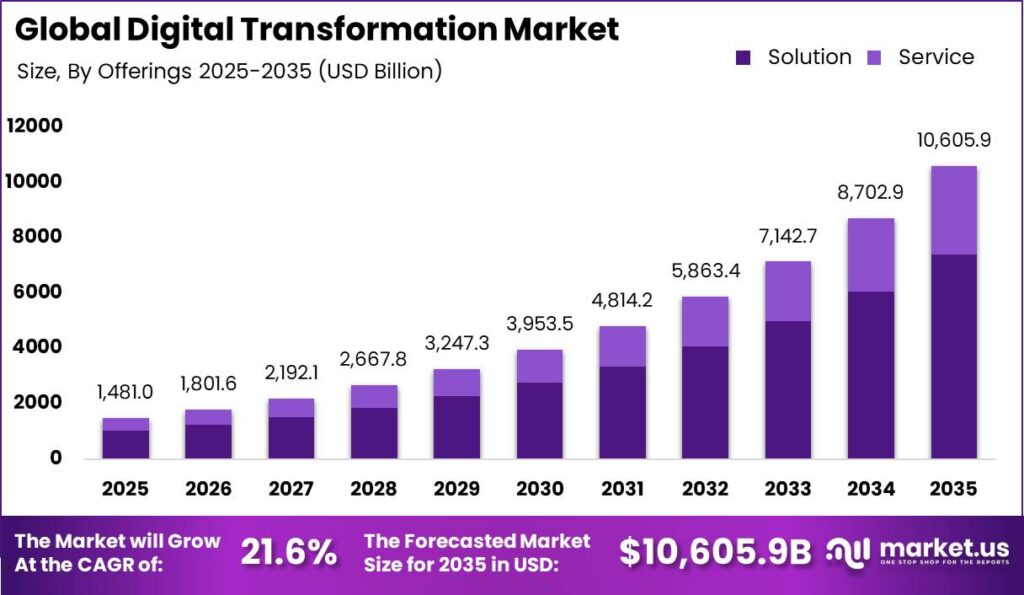
- The global digital transformation market was valued at USD 1,481.0 billion in 2025.
- The market is projected to reach USD 10,605.9 billion by 2035.
- The forecast compound annual growth rate for 2026–2035 is 21.6%.
- Solutions represented 69.7% of the market in 2025.
- Big data and analytics accounted for 30.1% of the market.
- On-premise deployment represented 63.9% of spending.
- Large enterprises accounted for 61.5% of market demand.
- Banking, financial services, and insurance represented 27.4% of market demand.
- Operational transformation accounted for 36.5% of spending.
- North America accounted for approximately 42.0% of global market revenue.
- North American market revenue was approximately USD 622 billion.
Companies Positioning and Competitive Info
Digital transformation does not operate as a single, directly measurable supplier market. Revenue is distributed across cloud infrastructure, enterprise software, IT consulting, systems integration, cybersecurity, industrial automation, and managed services. Therefore, the following reflects relative market position rather than precise company-level percentages.
| Company | Relative Position | Digital Transformation Positioning |
|---|---|---|
| Microsoft Corporation | Leading platform provider | Azure, enterprise AI, productivity, data, security, and business applications |
| Amazon Web Services, Inc. | Leading cloud infrastructure provider | Cloud infrastructure, managed services, AI platforms, analytics, and custom silicon |
| Accenture plc | Leading transformation integrator | Strategy, implementation, enterprise application modernization, cloud, and managed operations |
| Google LLC | Leading cloud and AI platform provider | Cloud infrastructure, data analytics, enterprise AI, and collaboration |
| IBM Corporation | Leading hybrid-enterprise specialist | Hybrid cloud, consulting, enterprise software, AI, and regulated-industry modernization |
| SAP SE | Leading enterprise-process platform | Cloud ERP, finance, supply chain, procurement, business-process transformation |
| Oracle Corporation | Major cloud and applications provider | Cloud infrastructure, databases, enterprise applications, and AI computing |
| Salesforce, Inc. | Major enterprise workflow platform | Customer applications, enterprise data, workflow automation, collaboration, and agentic AI |
| Deloitte Touche Tohmatsu Ltd. | Major consulting competitor | Business transformation, technology implementation, operating-model redesign, and managed services |
| Tata Consultancy Services Limited | Major IT-services competitor | Application modernization, cloud migration, engineering, managed technology operations |
| Capgemini | Major transformation integrator | Strategy, applications, cloud, engineering, AI, and intelligent operations |
| Dell Inc. | Major infrastructure enabler | Servers, storage, enterprise computing, AI infrastructure, and hybrid IT modernization |
| Cisco Systems, Inc. | Major networking and security enabler | Enterprise networking, security, observability, collaboration, and AI-ready connectivity |
| Hewlett Packard Enterprise | Major hybrid infrastructure competitor | Cloud and AI infrastructure, enterprise networking, and hybrid computing |
| Cognizant | Major application-services competitor | Enterprise modernization, digital engineering, cloud, data, and managed operations |
| Siemens AG | Leading industrial transformation specialist | Industrial software, automation, digital engineering, and smart manufacturing |
| Adobe Inc. | Leading creative and experience platform | Content workflows, document productivity, customer experience, and AI-enabled marketing |
| HP Inc. | Workplace transformation enabler | Commercial computing, managed devices, workforce productivity, and endpoint infrastructure |
| Cognex Corporation | Specialized industrial automation competitor | Machine vision, industrial inspection, identification, and intelligent automation |
| Hakuna Matata Solutions | Specialist digital engineering provider | Enterprise application development, custom digital solutions, and implementation services |
Top Companies List
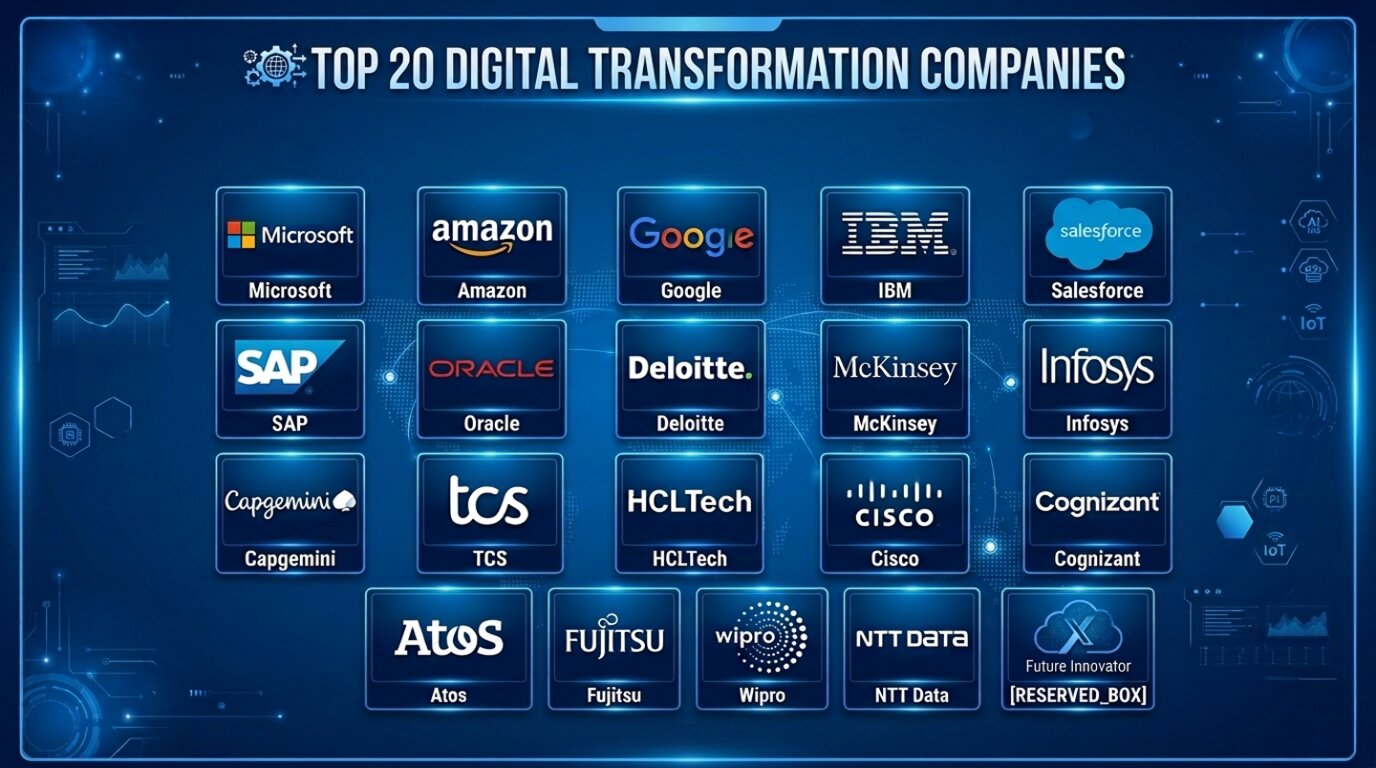
- Microsoft Corporation
- Amazon Web Services, Inc.
- Accenture plc
- Google LLC
- IBM Corporation
- SAP SE
- Oracle Corporation
- Salesforce, Inc.
- Deloitte Touche Tohmatsu Ltd.
- Tata Consultancy Services Limited
- Capgemini
- Dell Inc.
- Cisco Systems, Inc.
- Hewlett Packard Enterprise
- Cognizant
- Siemens AG
- Adobe Inc.
- HP Inc.
- Cognex Corporation
- Hakuna Matata Solutions
1. Microsoft Corporation
About Microsoft Corporation: Microsoft is a leading enterprise transformation platform provider spanning cloud infrastructure, business applications, productivity software, cybersecurity, data platforms, and generative AI. Its principal advantage is an integrated technology stack that allows organizations to modernize infrastructure, employee workflows, data estates, and customer operations through a common platform.
| Attribute | Company Data |
|---|---|
| Company Name | Microsoft Corporation |
| Ticker Symbol | NASDAQ: MSFT |
| Industry | Enterprise software, cloud computing, and AI |
| Headquarters | Redmond, Washington, United States |
| Founded | 1975 |
| Founders | Bill Gates and Paul Allen |
| Current CEO | Satya Nadella |
| Primary Segments | Azure and cloud services; productivity software; business applications; enterprise security; data and AI |
Financial Details: Microsoft’s digital-transformation exposure is concentrated in Azure, Microsoft 365, Dynamics 365, Power Platform, security offerings, and Copilot-related AI services. Azure is the core infrastructure and platform layer for enterprise modernization, while Microsoft 365, Dynamics, and Power Platform extend the company’s role into workflow automation, data integration, employee productivity, and business-process transformation.
Strategic Developments
- Microsoft continues to embed generative AI and Copilot capabilities across Azure, Microsoft 365, Dynamics 365, Power Platform, and security products.
- The company is expanding AI infrastructure capacity to support enterprise demand for model training, inference, data modernization, and agentic workflows.
- Microsoft’s enterprise strategy increasingly emphasizes cross-selling cloud, AI, security, productivity, and business applications through a unified commercial platform.
2. Amazon Web Services, Inc.
About Amazon Web Services, Inc.: AWS is a global cloud infrastructure and platform provider supporting enterprise migration, modernization, analytics, cybersecurity, machine learning, and AI deployment. Its principal competitive advantages are infrastructure scale, broad managed-service coverage, custom silicon, ecosystem depth, and strong positioning in enterprise AI workloads.
| Attribute | Company Data |
|---|---|
| Company Name | Amazon Web Services, Inc. |
| Ticker Symbol | NASDAQ: AMZN, through Amazon.com, Inc. |
| Industry | Cloud infrastructure, platform services, and enterprise AI |
| Headquarters | Seattle, Washington, United States |
| Founded | 2006 |
| Founders | Developed within Amazon |
| Current CEO | Matt Garman |
| Latest Quarterly Revenue | USD 42.2 billion, AWS segment, Q2 2026 |
| YoY Revenue Growth | 37%, AWS segment, Q2 2026 |
| Primary Segments | Compute; storage; databases; analytics; AI; cybersecurity; managed cloud services |
Financial Details: AWS generated USD 42.2 billion in Q2 2026 revenue, increasing 37% year over year. Segment operating income reached USD 16.6 billion, demonstrating that AWS remains both a major transformation platform and Amazon’s primary profit engine. AWS also indicated that its AI business had exceeded a USD 25 billion annualized revenue run rate, confirming that AI infrastructure, managed AI services, and enterprise model deployment have become major contributors to growth.
Strategic Developments
- AWS committed USD 1 billion to Forward Deployed Engineering, placing AI engineers closer to enterprise customers to accelerate deployment of production AI systems.
- AWS expanded enterprise relationships with organizations including Vodafone, Siemens Energy, Ryanair, Danske Bank, and Fiserv.
- The company continues to scale custom AI chips, including Trainium and Inferentia, to improve workload economics and reduce reliance on third-party accelerator supply.
3. Accenture plc
About Accenture plc: Accenture is one of the largest global providers of digital transformation consulting and implementation services. Its competitive moat lies in enterprise-scale delivery capacity, industry specialization, strategic advisory capabilities, and deep partnerships with hyperscalers, enterprise application vendors, cybersecurity providers, and data-platform companies.
| Attribute | Company Data |
|---|---|
| Company Name | Accenture plc |
| Ticker Symbol | NYSE: ACN |
| Industry | Technology consulting and transformation services |
| Headquarters | Dublin, Ireland |
| Founded | 1989 as Andersen Consulting; renamed Accenture in 2001 |
| Founders | Originated from Andersen Consulting |
| Current CEO | Julie Sweet |
| Primary Segments | Consulting; technology implementation; managed services; cloud; AI; security; operations |
Financial Details: Accenture’s transformation-related business is driven by enterprise cloud migration, ERP modernization, AI implementation, customer-experience transformation, cybersecurity, and managed technology operations. The company has disclosed substantial revenue across major ecosystem partners, including AWS, Microsoft Azure, Google Cloud, SAP, Salesforce, and Oracle. Its generative and agentic AI business is increasingly important because enterprises require external support to redesign processes, build data foundations, integrate models, and operationalize AI at scale.
Strategic Developments
- Accenture is expanding its generative AI and agentic AI service portfolio across enterprise strategy, data preparation, application modernization, software engineering, and managed operations.
- The company continues to deepen strategic partnerships with Microsoft, AWS, Google Cloud, SAP, Oracle, Salesforce, NVIDIA, and other technology providers.
- Accenture is emphasizing industry-specific AI transformation programs in financial services, healthcare, communications, public sector, manufacturing, and retail.
4. Google LLC
About Google LLC: Google is a major enterprise cloud, data, analytics, and AI provider. Its role in digital transformation is centered on Google Cloud, data platforms, cybersecurity, collaboration tools, and AI services, with particular relevance for organizations seeking to modernize data-intensive workloads and deploy AI across business functions.
| Attribute | Company Data |
|---|---|
| Company Name | Google LLC |
| Ticker Symbol | NASDAQ: GOOG / GOOGL, through Alphabet Inc. |
| Industry | Cloud computing, enterprise software, data, and AI |
| Headquarters | Mountain View, California, United States |
| Founded | 1998 |
| Founders | Larry Page and Sergey Brin |
| Current CEO | Sundar Pichai |
| Primary Segments | Google Cloud; enterprise AI; data analytics; cybersecurity; collaboration software |
Financial Details: Google’s digital-transformation exposure is concentrated in Google Cloud rather than its advertising operations. The business competes in infrastructure, data engineering, analytics, cybersecurity, application modernization, and AI deployment. Google Cloud’s strategic differentiation is strongest in data and AI, where its proprietary model capabilities, data platform, analytics tools, and cloud-native architecture support customers building AI-enabled digital products and modernizing operational decision systems.
Strategic Developments:
- Google Cloud continues to commercialize AI services across data analytics, enterprise search, developer tools, customer operations, and industry applications.
- The company is integrating generative AI across Google Cloud services, including data platforms, developer environments, and productivity offerings.
- Google is expanding its cloud-partner ecosystem to improve implementation capacity across regulated and industry-specific customer environments.
5. IBM Corporation
About IBM Corporation: IBM is a major hybrid-cloud, enterprise-software, consulting, and AI provider. It is particularly relevant to large organizations with complex legacy technology estates, regulated workloads, mission-critical applications, and significant integration requirements across on-premise, private-cloud, and public-cloud environments.
| Attribute | Company Data |
|---|---|
| Company Name | International Business Machines Corporation |
| Ticker Symbol | NYSE: IBM |
| Industry | Enterprise software, hybrid cloud, AI, infrastructure, and consulting |
| Headquarters | Armonk, New York, United States |
| Founded | 1911 |
| Founders | Charles Ranlett Flint, organizer of the predecessor combination |
| Current CEO | Arvind Krishna |
| Primary Segments | Software; consulting; infrastructure; hybrid cloud; automation; enterprise AI |
Financial Details: IBM’s transformation business is concentrated in software, consulting, infrastructure modernization, hybrid-cloud integration, automation, and AI. Its strategic relevance is strongest in organizations that cannot replace legacy systems outright and instead require phased modernization. IBM’s consulting organization supports implementation and integration, while its software portfolio supports automation, security, data management, AI, and hybrid-cloud operations.
Strategic Developments
- IBM acquired Logiq Consulting to expand secure transformation, cybersecurity, and sovereign-technology capabilities in the United Kingdom.
- IBM entered a five-year technology modernization agreement with Abertis covering systems modernization and digitalization across selected subsidiaries.
- IBM expanded its government-ready software portfolio through AWS collaboration, including FedRAMP-authorized AI and enterprise software capabilities.
6. SAP SE
About SAP SE: SAP is one of the most important enterprise software providers in digital transformation because its applications sit at the center of finance, procurement, supply chain, manufacturing, human capital, and operational planning. Its competitive strength is rooted in its installed base and the business-critical role of its ERP platform.
| Attribute | Company Data |
|---|---|
| Company Name | SAP SE |
| Ticker Symbol | Xetra: SAP; NYSE: SAP |
| Industry | Enterprise applications and cloud software |
| Headquarters | Walldorf, Germany |
| Founded | 1972 |
| Founders | Dietmar Hopp, Hasso Plattner, Klaus Tschira, Hans-Werner Hector, and Claus Wellenreuther |
| Current CEO | Christian Klein |
| Primary Segments | Cloud ERP; enterprise applications; business data; analytics; process automation |
Financial Details: SAP’s transformation exposure is primarily driven by cloud ERP migration, application modernization, business-process standardization, data integration, and enterprise AI. The company benefits from customer migration from legacy ERP environments toward cloud-based systems, where recurring cloud revenue, implementation activity, data services, analytics, and business-process automation expand its commercial relationship with enterprise customers.
Strategic Developments
- SAP is advancing cloud ERP migration through its S/4HANA transformation roadmap.
- The company is embedding AI capabilities into enterprise applications through its Joule assistant and business-data architecture.
- SAP continues to expand partnerships with hyperscalers and consulting firms to accelerate complex ERP modernization programs.
7. Oracle Corporation
About Oracle Corporation: Oracle is a major provider of cloud infrastructure, databases, enterprise applications, and AI computing. It benefits from its strong installed base in mission-critical databases and enterprise applications, allowing it to monetize infrastructure migration, cloud application modernization, and AI-capacity demand across existing customer relationships.
| Attribute | Company Data |
|---|---|
| Company Name | Oracle Corporation |
| Ticker Symbol | NYSE: ORCL |
| Industry | Cloud infrastructure, databases, and enterprise applications |
| Headquarters | Austin, Texas, United States |
| Founded | 1977 |
| Founders | Larry Ellison, Bob Miner, and Ed Oates |
| Primary Segments | Cloud infrastructure; cloud applications; enterprise databases; enterprise software; consulting services |
Financial Details: Oracle reported Q1 FY2027 cloud revenue of USD 11.607 billion, increasing 62% year over year. Cloud infrastructure revenue reached approximately USD 7.4 billion and increased 121%, while cloud application revenue reached approximately USD 4.2 billion and increased 10%. This performance demonstrates that Oracle’s fastest expansion is occurring in infrastructure and AI computing, while cloud applications provide a more stable modernization and recurring-revenue base.
Strategic Developments
- Oracle disclosed more than USD 30 billion in additional AI cloud contracts during the quarter.
- The company delivered approximately 850 MW of additional data-center capacity to serve rising cloud and AI demand.
- Oracle completed a USD 20 billion common-stock sale through an at-the-market program to support infrastructure investment and capacity expansion.
8. Salesforce, Inc.
About Salesforce, Inc.: Salesforce is a major enterprise software platform for customer operations, sales, service, marketing, data integration, collaboration, and AI-enabled workflow automation. Its transformation proposition is increasingly defined by the combination of customer data, enterprise applications, Slack collaboration, integration tools, and agentic AI.
| Attribute | Company Data |
|---|---|
| Company Name | Salesforce, Inc. |
| Ticker Symbol | NYSE: CRM |
| Industry | Enterprise SaaS, customer applications, data, and AI automation |
| Headquarters | San Francisco, California, United States |
| Founded | 1999 |
| Founders | Marc Benioff, Parker Harris, Dave Moellenhoff, and Frank Dominguez |
| Current CEO | Marc Benioff |
| Latest Quarterly Revenue | USD 10.82 billion, subscription and support revenue, Q2 FY2027 |
| YoY Revenue Growth | 12%, subscription and support revenue, Q2 FY2027 |
| Primary Segments | Customer applications; data cloud; integration; collaboration; AI and automation |
Financial Details: Salesforce generated USD 10.82 billion in subscription and support revenue in Q2 FY2027, increasing 12% year over year. Current remaining performance obligations increased approximately 14%, indicating continued demand visibility for its application and platform portfolio. Its digital-transformation strategy increasingly relies on connecting customer applications with enterprise data, collaboration tools, workflow automation, and AI agents.
Strategic Developments
- Salesforce integrated Informatica to strengthen enterprise data-management, integration, and governance capabilities.
- The company continued expansion of Agentforce as a platform for enterprise AI agents across sales, service, marketing, and operational workflows.
- Salesforce is using Slack as a collaboration layer supporting AI-enabled workflows, enterprise knowledge access, and employee productivity.
9. Deloitte Touche Tohmatsu Ltd.
About Deloitte Touche Tohmatsu Ltd.: Deloitte is a major consulting-led digital transformation competitor. It integrates strategy, enterprise technology implementation, organizational change, risk management, cybersecurity, and operating-model design, allowing it to participate in broad transformation programs where business redesign and technology implementation must proceed together.
| Attribute | Company Data |
|---|---|
| Company Name | Deloitte Touche Tohmatsu Limited |
| Industry | Professional services and transformation consulting |
| Headquarters | London, United Kingdom |
| Founded | 1845, predecessor practice |
| Founders | William Welch Deloitte, predecessor practice |
| Current CEO | Joe Ucuzoglu |
| Primary Segments | Transformation consulting; technology implementation; cybersecurity; organizational change; managed services |
Financial Details: Deloitte’s digital-transformation activity spans enterprise applications, cloud migration, cybersecurity, AI strategy, operational transformation, risk management, and workforce redesign. Its advantage is its ability to combine technology transformation with regulatory, financial, operational, and organizational advisory services an important differentiator for large enterprises undertaking multi-year change programs.
Strategic Developments
- Deloitte continues to expand AI transformation capabilities across advisory, industry solutions, technology implementation, risk, and managed services.
- The organization maintains extensive alliance relationships with major cloud, enterprise software, data, and cybersecurity providers.
- Deloitte is focusing on responsible AI governance, enterprise operating-model redesign, and AI-enabled professional-services delivery.
10. Tata Consultancy Services Limited
About Tata Consultancy Services Limited: TCS is one of the world’s largest IT-services and technology-transformation providers. It supports clients through application modernization, cloud migration, enterprise implementation, software engineering, data transformation, AI deployment, and managed operations, with particular strength in large-scale global delivery.
| Attribute | Company Data |
|---|---|
| Company Name | Tata Consultancy Services Limited |
| Ticker Symbol | NSE: TCS; BSE: 532540 |
| Industry | IT services, consulting, and enterprise modernization |
| Headquarters | Mumbai, India |
| Founded | 1968 |
| Founders | Established within the Tata Group |
| Current CEO | K. Krithivasan |
| Primary Segments | Application services; cloud transformation; data and AI; engineering; managed operations |
Financial Details: TCS’s transformation business is anchored in long-duration enterprise technology programs. Its exposure includes cloud adoption, legacy application modernization, industry-platform development, data engineering, AI implementation, and managed technology services. The company’s large global delivery model enables it to provide both transformation execution and ongoing operational support after implementation.
Strategic Developments
- TCS is expanding its AI and cloud transformation service portfolio across enterprise applications, engineering, operations, and industry solutions.
- The company is increasing investment in generative AI, data platforms, automation, and delivery models that combine consulting with scaled engineering execution.
- TCS continues to strengthen partnerships with hyperscalers, enterprise software providers, and semiconductor companies.
11. Capgemini
About Capgemini: Capgemini is a major global transformation services provider spanning strategy, applications, cloud, engineering, data, AI, and operations. Its market position is strengthened by the ability to combine consulting-led transformation design with technical implementation, engineering depth, and managed business-process delivery.
| Attribute | Company Data |
|---|---|
| Company Name | Capgemini SE |
| Ticker Symbol | Euronext Paris: CAP |
| Industry | Technology consulting, engineering, and transformation services |
| Headquarters | Paris, France |
| Founded | 1967 |
| Founders | Serge Kampf |
| Current CEO | Aiman Ezzat |
| Latest Quarterly Revenue | EUR 6.139 billion, Q2 2026 group services revenue |
| YoY Revenue Growth | 10.5% reported; 11.6% constant currency, Q2 2026 |
| Primary Segments | Strategy & Transformation; Applications & Technology; Operations & Engineering |
Financial Details: Capgemini reported Q2 2026 revenue of EUR 6.139 billion, increasing 10.5% on a reported basis and 11.6% at constant currency. Strategy & Transformation grew 12.2% at constant exchange rates, Applications & Technology grew 5.3%, and Operations & Engineering increased 24.2%. The results reflect growing demand for AI-enabled transformation and intelligent operations, supported partly by acquired capabilities.
Strategic Developments
- Capgemini completed the acquisitions of WNS and Cloud4C, expanding intelligent business operations and cloud capabilities.
- The company integrated Capgemini and WNS digital business-process capabilities into an Intelligent Business Operations unit.
- Capgemini is increasing investment in agentic AI, enterprise cloud transformation, engineering, and AI-enabled operations.
12. Dell Inc.
About Dell Inc.: Dell is a major enterprise infrastructure provider supporting transformation through servers, storage, high-performance computing, data-center systems, and commercial technology. Its sector relevance is strongest in the underlying infrastructure required for cloud modernization, data-intensive workloads, cybersecurity, and enterprise AI deployment.
| Attribute | Company Data |
|---|---|
| Company Name | Dell Inc., within Dell Technologies Inc. |
| Ticker Symbol | NYSE: DELL |
| Industry | Enterprise computing and infrastructure |
| Headquarters | Round Rock, Texas, United States |
| Founded | 1984 |
| Founders | Michael Dell |
| Current CEO | Michael Dell |
| Primary Segments | Servers; storage; infrastructure solutions; commercial computing; AI infrastructure |
Financial Details: Dell’s digital-transformation role is centered on enterprise infrastructure rather than transformation consulting or application ownership. The company participates in AI infrastructure investment, private-cloud deployments, storage modernization, enterprise computing refresh cycles, and hybrid workload management. Its performance is therefore highly connected to enterprise capital expenditure, infrastructure-refresh requirements, and data-center demand.
Strategic Developments
- Dell continues to expand AI-optimized infrastructure offerings for enterprise and service-provider deployments.
- The company is strengthening relationships with AI-chip and cloud ecosystem partners to support accelerated-computing workloads.
- Dell is increasing focus on modern data centers, storage, private AI, and hybrid enterprise infrastructure.
13. Cisco Systems, Inc.
About Cisco Systems, Inc.: Cisco supports digital transformation through enterprise networking, cybersecurity, observability, collaboration, and AI-ready infrastructure. Its importance rises as organizations move more data, applications, and AI workloads across distributed environments requiring secure, high-performance, and observable connectivity.
| Attribute | Company Data |
|---|---|
| Company Name | Cisco Systems, Inc. |
| Ticker Symbol | NASDAQ: CSCO |
| Industry | Enterprise networking, security, observability, and collaboration |
| Headquarters | San Jose, California, United States |
| Founded | 1984 |
| Founders | Leonard Bosack and Sandy Lerner |
| Current CEO | Chuck Robbins |
| Primary Segments | Networking; security; observability; collaboration; AI infrastructure connectivity |
Financial Details: Cisco’s transformation exposure is primarily tied to networking and security requirements created by cloud adoption, hybrid work, application modernization, data growth, and AI deployment. Its AI infrastructure orders demonstrate increasing exposure to hyperscaler and high-performance networking demand, while enterprise customers continue to require secure connectivity across offices, data centers, cloud environments, and edge deployments.
Strategic Developments
- Cisco is expanding AI-networking capabilities to support hyperscale and enterprise AI environments.
- The company continues integrating security, observability, and networking to provide a unified infrastructure-management proposition.
- Cisco is strengthening recurring software and subscription revenue across security, networking management, collaboration, and observability.
14. Hewlett Packard Enterprise
About Hewlett Packard Enterprise: HPE is a major enterprise infrastructure provider focused on cloud, AI, networking, high-performance computing, and hybrid environments. Its core transformation position is enabling organizations to deploy modern infrastructure across data centers, edge locations, private clouds, and AI-intensive workloads.
| Attribute | Company Data |
|---|---|
| Company Name | Hewlett Packard Enterprise Company |
| Ticker Symbol | NYSE: HPE |
| Industry | Enterprise infrastructure, cloud, AI, and networking |
| Headquarters | Spring, Texas, United States |
| Founded | 2015 |
| Founders | Created through the Hewlett-Packard separation |
| Current CEO | Antonio Neri |
| Latest Quarterly Revenue | USD 9.0 billion, Cloud & AI; USD 2.9 billion, Networking, Q3 FY2026 |
| YoY Revenue Growth | 25%, Cloud & AI; 75% reported, Networking, Q3 FY2026 |
| Primary Segments | Cloud & AI; Networking; enterprise infrastructure; hybrid computing |
Financial Details: HPE reported Q3 FY2026 Cloud & AI revenue of USD 9.0 billion, increasing 25% year over year. Networking revenue reached USD 2.9 billion, increasing 75% on a reported basis, with acquisition effects contributing significantly to reported growth. Cloud & AI generated a 17.0% operating margin, while Networking generated a 22.0% operating margin, demonstrating the strategic and financial importance of infrastructure and connectivity in HPE’s portfolio.
Strategic Developments
- HPE continued integrating Juniper Networks to expand its enterprise networking, AI networking, and hybrid-cloud capabilities.
- The company increased its cumulative Networks for AI orders target after reaching approximately USD 2.2 billion in cumulative orders.
- HPE is expanding its GreenLake model to position enterprise infrastructure as a consumption-based service.
15. Cognizant
About Cognizant: Cognizant is a global technology-services provider focused on application modernization, cloud, data, digital engineering, AI, and managed operations. Its competitive strength lies in industry-specific technology delivery and the ability to modernize complex enterprise application portfolios while supporting clients through multi-year transformation programs.
| Attribute | Company Data |
|---|---|
| Company Name | Cognizant Technology Solutions Corporation |
| Ticker Symbol | NASDAQ: CTSH |
| Industry | IT consulting, engineering, and enterprise services |
| Headquarters | Teaneck, New Jersey, United States |
| Founded | 1994 |
| Founders | Kumar Mahadeva and Francisco D’Souza |
| Current CEO | Ravi Kumar S |
| Primary Segments | Application modernization; digital engineering; cloud; data; AI; managed services |
Financial Details: Cognizant participates in digital transformation through application services, cloud modernization, data engineering, AI, digital operations, and industry-specific technology consulting. The company’s business model is built around helping customers modernize legacy systems, improve customer and employee experiences, automate operations, and run transformed technology environments on an ongoing basis.
Strategic Developments
- Cognizant continues to invest in generative AI delivery, enterprise data modernization, engineering services, and cloud transformation.
- The company is expanding partnerships with major hyperscalers, application vendors, and AI technology providers.
- Cognizant is increasingly positioning AI-enabled software engineering and managed operations as core growth areas.
16. Siemens AG
About Siemens AG: Siemens is a leading industrial digital-transformation provider. It combines industrial automation, engineering software, digital twins, manufacturing systems, and operational technology to help customers modernize design, production, energy, infrastructure, and asset-management processes.
| Attribute | Company Data |
|---|---|
| Company Name | Siemens AG |
| Ticker Symbol | Xetra: SIE |
| Industry | Industrial technology, automation, and software |
| Headquarters | Munich and Berlin, Germany |
| Founded | 1847 |
| Founders | Werner von Siemens and Johann Georg Halske |
| Current CEO | Roland Busch |
| Primary Segments | Industrial automation; industrial software; digital engineering; smart infrastructure; mobility technology |
Financial Details: Siemens’ transformation exposure is concentrated in industrial automation, industrial software, digitally enabled production, engineering tools, and infrastructure systems. Unlike hyperscalers and enterprise SaaS providers, Siemens monetizes transformation in physical operating environments, including factories, energy systems, buildings, transportation, and industrial supply chains.
Strategic Developments
- Siemens is expanding industrial AI, digital-twin, automation, and engineering-software capabilities.
- The company continues to position software-defined automation as a foundation for next-generation manufacturing transformation.
- Siemens is deepening partnerships across industrial technology, cloud computing, AI infrastructure, and engineering ecosystems.
17. Adobe Inc.
About Adobe Inc.: Adobe is a leading provider of creative software, document productivity solutions, digital-experience platforms, and AI-enabled content workflows. Its transformation relevance is strongest in marketing, customer experience, content production, document automation, and enterprise communication.
| Attribute | Company Data |
|---|---|
| Company Name | Adobe Inc. |
| Ticker Symbol | NASDAQ: ADBE |
| Industry | Creative software, document productivity, and customer-experience technology |
| Headquarters | San Jose, California, United States |
| Founded | 1982 |
| Founders | John Warnock and Charles Geschke |
| Current CEO | Shantanu Narayen |
| Latest Quarterly Revenue | USD 4.65 billion, Creative & Marketing Professionals subscription revenue, Q3 FY2026 |
| YoY Revenue Growth | 13% reported; 12% constant currency, Q3 FY2026 |
| Primary Segments | Creative workflows; document productivity; digital experience; marketing automation; AI-enabled content creation |
Financial Details: Adobe generated USD 4.65 billion in Creative & Marketing Professionals subscription revenue in Q3 FY2026, increasing 13% year over year. Business Professionals & Consumers subscription revenue reached USD 1.91 billion and increased 16%. Adobe’s AI-first annualized recurring revenue grew by more than 150%, indicating accelerating adoption of AI-enhanced creative, productivity, and customer-experience products.
Strategic Developments
- Adobe expanded its collaboration with NVIDIA to optimize creative and customer-experience tools for AI-enabled production and personalization.
- Anil Chakravarthy is scheduled to become Adobe president and CEO on December 1, 2026, with Shantanu Narayen moving to executive chair.
- Adobe continues to embed Firefly and other AI capabilities across Creative Cloud, Acrobat, Experience Cloud, and enterprise workflow products.
18. HP Inc.
About HP Inc.: HP participates in digital transformation through commercial personal systems, workplace technology, endpoint management, collaboration hardware, and printing solutions. Its strategic role is enabling the digitally managed workplace, where employee productivity, device security, hybrid work, and commercial endpoint refresh cycles are increasingly interconnected.
| Attribute | Company Data |
|---|---|
| Company Name | HP Inc. |
| Ticker Symbol | NYSE: HPQ |
| Industry | Commercial computing and workplace technology |
| Headquarters | Palo Alto, California, United States |
| Founded | 1939; current corporate structure established in 2015 |
| Founders | William Hewlett and David Packard |
| Current CEO | Bruce Broussard, Interim CEO |
| Latest Quarterly Revenue | USD 8.579 billion, Commercial Personal Systems, Q3 FY2026 |
| YoY Revenue Growth | Approximately 22%, Commercial Personal Systems, Q3 FY2026 |
| Primary Segments | Commercial personal systems; workplace devices; managed endpoint infrastructure; commercial printing |
Financial Details: HP’s Commercial Personal Systems revenue reached USD 8.579 billion in Q3 FY2026, increasing approximately 22% year over year. Commercial unit shipments declined 14%, showing that revenue growth was driven materially by pricing, mix, and higher-value product configurations rather than shipment volume. HP’s digital-transformation relevance is focused on workplace modernization rather than enterprise cloud or large-scale systems-integration services.
Strategic Developments
- HP appointed Bruce Broussard as interim CEO effective February 3, 2026.
- The company continues to advance AI-powered commercial device offerings and workplace technology.
- HP is emphasizing managed endpoints, device security, hybrid work solutions, and commercial PC lifecycle services.
19. Cognex Corporation
About Cognex Corporation: Cognex is a specialized industrial-automation company focused on machine vision, identification, inspection, and intelligent manufacturing workflows. Its digital-transformation relevance lies in applying AI-enabled visual analysis to automate physical processes across logistics, electronics, semiconductor, packaging, and industrial production environments.
| Attribute | Company Data |
|---|---|
| Company Name | Cognex Corporation |
| Ticker Symbol | NASDAQ: CGNX |
| Industry | Machine vision and industrial automation |
| Headquarters | Natick, Massachusetts, United States |
| Founded | 1981 |
| Founders | Robert Shillman, Marilyn Matz, and Bill Silver |
| Current CEO | Matt Moschner |
| Primary Segments | Machine vision; industrial inspection; identification; logistics automation; semiconductor automation |
Financial Details: Cognex reported record Q2 2026 revenue performance, with demand supported by logistics, semiconductor, electronics, and packaging applications. Management provided full-year revenue guidance of USD 1.13–1.15 billion, representing approximately 15% growth at the midpoint. The company’s transformation role is specialized but strategically important because visual inspection and identification technologies directly automate physical workflows and improve process-quality control.
Strategic Developments
- Cognex continues to expand AI-enabled machine-vision capabilities across logistics, semiconductor, electronics, packaging, and manufacturing.
- The company is investing in automated inspection, identification, and vision systems that support smart-factory modernization.
- Cognex is focusing on technology that improves industrial accuracy, throughput, traceability, and operational resilience.
20.Hakuna Matata Solutions
About Hakuna Matata Solutions: Hakuna Matata Solutions is a specialist digital-engineering and enterprise-technology provider. Its role in the market is implementation-focused, supporting organizations with custom applications, enterprise digital solutions, workflow modernization, and technology delivery suited to specific business requirements.
| Attribute | Company Data |
|---|---|
| Company Name | Hakuna Matata Solutions Private Limited |
| Industry | Digital engineering and enterprise transformation services |
| Headquarters | Chennai, India |
| Founded | 2006 operating origin; incorporated in 2011 |
| Current CEO | Gengarajan PV |
| Primary Segments | Enterprise digital solutions; custom application development; implementation services |
Financial Details: Hakuna Matata Solutions operates in the implementation segment of digital transformation, delivering customized technology solutions rather than large-scale global cloud infrastructure or enterprise software platforms. Its market relevance is primarily in tailored project execution, application development, mobile and digital-product engineering, and business-specific modernization engagements.
Strategic Developments
- The company continues to position its service portfolio around scalable enterprise digital solutions, custom development, and industry-specific transformation requirements.
- Its delivery strategy emphasizes solution engineering, faster implementation cycles, and technology support for organizations digitizing customer, operational, and internal processes.
Conclusion
The digital transformation market is expanding rapidly, but value capture is becoming more concentrated around platforms that combine AI capability, proprietary enterprise data, infrastructure scale, workflow ownership, and implementation expertise. Microsoft, AWS, Google, Oracle, SAP, Salesforce, IBM, and Adobe increasingly compete for control of the enterprise technology stack, while Accenture, Deloitte, TCS, Capgemini, and Cognizant compete to manage transformation execution and operational change.
Over the next 12–24 months, enterprise AI deployment will become the most important determinant of competitive momentum. Demand is likely to shift from experimentation toward production-grade AI agents, AI-enabled software engineering, automated customer operations, intelligent business processes, secure data modernization, and AI-ready infrastructure. Suppliers able to combine technology platforms with implementation services, governance, cybersecurity, and measurable productivity outcomes will be best positioned to capture disproportionate market growth.