Introduction
The Digital Twin Market is moving from stand-alone asset models toward connected engineering, simulation, and operational platforms. Market.us estimates the market at USD 28.2 billion in 2025, with manufacturing and predictive maintenance representing major demand categories.
Recent supplier initiatives combine physics-based simulation, industrial data, and AI to support virtual commissioning, production optimization, and infrastructure management. Competitive differentiation increasingly depends on interoperability: connecting engineering models with operational conditions to improve asset utilization, energy efficiency, and lifecycle decision-making.
Market Size & Statistics
- The global digital twin market reached USD 28.2 billion in 2025.
- Market.us projects global market revenue of USD 722.5 billion by 2035.
- The market’s projected CAGR for 2026–2035 is 38.2%.
- System twins represented 40.9% of the market in 2025.
- On-premise deployments accounted for 63.0% of the market.
- Large enterprises held a 67.0% market share.
- Predictive maintenance represented 31.0% of applications.
- Manufacturing accounted for 36.0% of end-use demand.
- North America generated USD 10.7 billion, representing 38.0% of global revenue.
- Asia Pacific’s projected regional CAGR is 25.5%.
Companies Positioning and Competitive Info
The following assessment uses relative market positioning rather than numerical revenue shares. Positioning reflects digital twin portfolio breadth, engineering and operational integration, specialization, and documented strategic developments.
| Company | Relative Market Positioning | Competitive Basis |
|---|---|---|
| Siemens AG | Leading end-to-end industrial platform contender | Connects product engineering, simulation, manufacturing, and automation; NVIDIA collaboration extends twins into AI-supported production and inspection. |
| Dassault Systèmes SE | Leading product-centric virtual twin provider | The 3DEXPERIENCE platform integrates design, simulation, manufacturing, and lifecycle collaboration. |
| Schneider Electric | Leading process, energy, and infrastructure contender | AVEVA and ETAP connect industrial engineering, electrical models, and operating data. |
| ANSYS, Inc. | Leading physics-based simulation specialist | Twin Builder and multiphysics technologies support simulation-based twins; Synopsys ownership extends system-level integration. |
| Bentley Systems, Incorporated | Infrastructure digital twin specialist | iTwin combines engineering, geospatial, reality-capture, and operational information. |
| PTC Inc. | Prominent product lifecycle and digital-thread provider | CAD, PLM, application lifecycle management, and service lifecycle software support product-centric twins. |
| Microsoft Corporation | Major cloud and data-platform enabler | Azure Digital Twins supplies connected-environment modeling, complemented by cloud, analytics, AI, and partner simulation capabilities. |
| IBM Corporation | Established asset-management and engineering integration provider | Maximo, Rhapsody, and Siemens integrations connect engineering information with asset operations. |
| ABB | Industrial automation and electrification specialist | Industrial technology and engineering partnerships support factory modernization and operational twin applications. |
| General Electric Company | Aerospace engine lifecycle twin specialist | GE Aerospace uses engine configuration and service-history models to support lifecycle management. |
Ownership is material to interpreting this landscape. Synopsys completed its acquisition of Ansys on July 17, 2025. Schneider Electric announced its proposed PTC acquisition on October 5, 2026, with completion anticipated by Q3 2027, subject to approvals. Schneider and PTC are therefore assessed separately at the research cut-off.
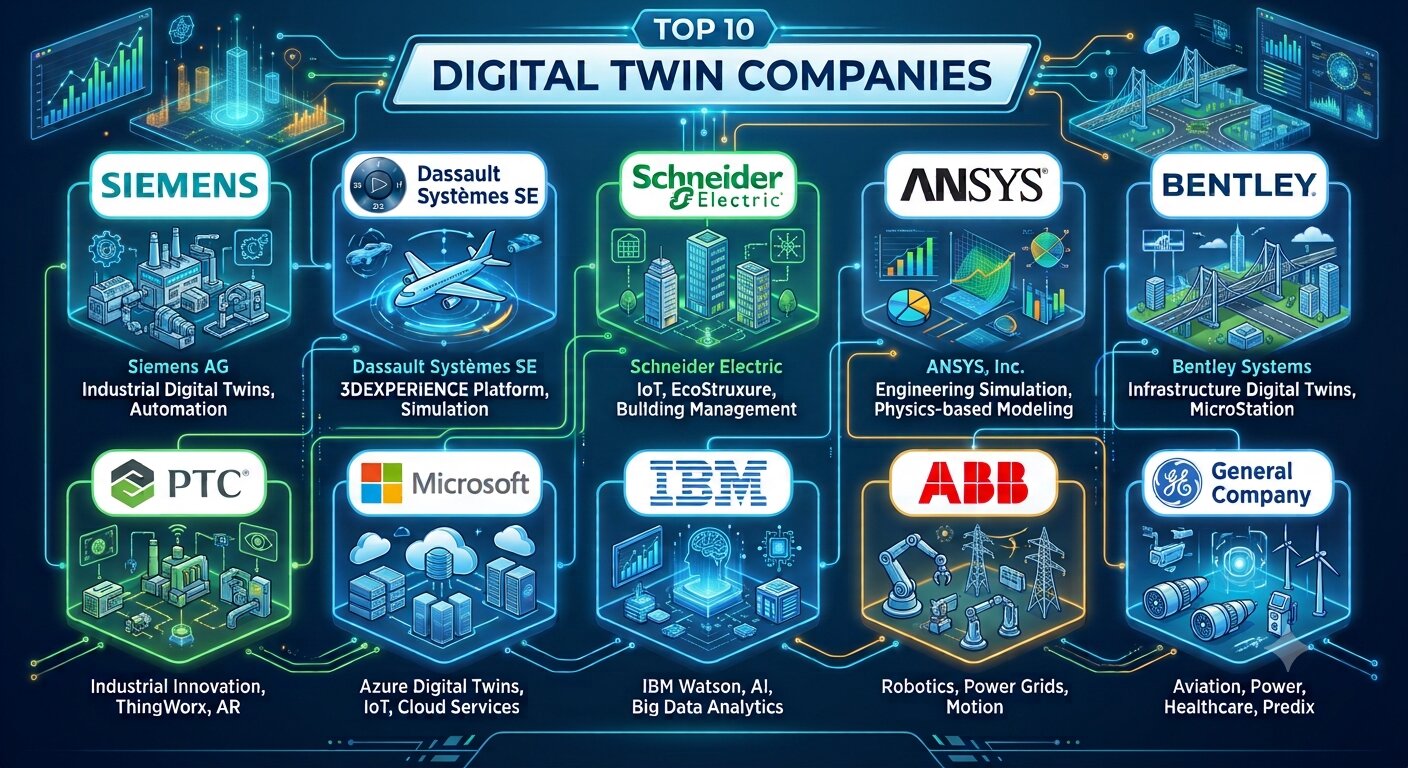
Top Companies List
- Siemens AG
- Dassault Systèmes SE
- Schneider Electric
- ANSYS, Inc.
- Bentley Systems, Incorporated
- PTC Inc.
- Microsoft Corporation
- IBM Corporation
- ABB
- General Electric Company
1. Siemens AG
About Siemens AG: Siemens connects product engineering, manufacturing simulation, industrial automation, and operational data through its software ecosystem. Its digital twin advantage lies in linking engineering models with factory execution, supported by Teamcenter, simulation technologies, and NVIDIA collaboration extending virtual models into AI-assisted production and inspection.
Company Overview Table
| Attribute | Company Data |
|---|---|
| Company Name | Siemens AG |
| Ticker Symbol | Xetra: SIE |
| Industry | Industrial technology; digital twin software and automation |
| Headquarters | Munich, Germany |
| Founded | 1847; present Siemens AG formed in 1966 |
| Founders | Werner von Siemens and Johann Georg Halske, founders of the predecessor business |
| Current CEO | Roland Busch |
| Primary Segments | Product and production twins; PLM; simulation; virtual commissioning; operational integration |
Financial Details
Siemens’ USD 10.3 billion acquisition of Altair represents a substantial capital commitment to simulation, high-performance computing, and AI capabilities relevant to digital twins. Strategically, the transaction broadens the simulation tools available within Siemens’ engineering ecosystem rather than constituting a separately identifiable digital twin revenue stream.
Strategic Developments
- Siemens completed its acquisition of Altair in March 2025, expanding simulation, computational intelligence, and engineering capabilities.
- On October 21, 2026, Siemens announced an NVIDIA collaboration connecting Teamcenter and Process Preparation X with NVIDIA Cosmos to generate virtual reference boards and synthetic inspection data before physical production.
- Its IBM partnership connects systems engineering and product lifecycle workflows, supporting traceability across engineering disciplines and operational processes.
2. Dassault Systèmes SE
About Dassault Systèmes SE: Dassault Systèmes provides product-centric virtual twins through 3DEXPERIENCE, combining engineering, simulation, manufacturing, and lifecycle collaboration. Its competitive strength is a shared product-data environment supporting cross-disciplinary development, with current investment emphasizing cloud delivery and AI-assisted virtual twin workflows.
Company Overview Table
| Attribute | Company Data |
|---|---|
| Company Name | Dassault Systèmes SE |
| Ticker Symbol | Euronext Paris: DSY |
| Industry | Engineering software; virtual twin platforms |
| Headquarters | Vélizy-Villacoublay, France |
| Founded | 1981 |
| Founders | Francis Bernard; established from Dassault’s engineering software activities |
| Current CEO | Pascal Daloz |
| Primary Segments | 3DEXPERIENCE; product design; simulation; manufacturing virtual twins; lifecycle collaboration |
Corporate identity, history, and leadership are supported by company disclosures and corporate-history reporting.
Financial Details
In its July 23, 2026 second-quarter release, Dassault reported 14% growth in both 3DEXPERIENCE software revenue and cloud software revenue, primarily driven by Manufacturing Industries. These platform-level indicators are relevant to virtual twin adoption, but they cover broader software activities and should not be interpreted as standalone digital twin revenue growth.
Strategic Developments
- In July 2026, Dassault expanded its AI-native 3DEXPERIENCE platform with additional Virtual Companion skills for human–AI engineering collaboration.
- Management identified enterprise-scale AI-powered virtual twins and 3DEXPERIENCE Cloud adoption as strategic priorities in its second-quarter commentary.
- Platform development continues to integrate engineering data, simulation, and AI within a common lifecycle environment.
3. Schneider Electric
About Schneider Electric: Schneider Electric addresses digital twins through AVEVA industrial software, ETAP electrical modeling, and energy-management technologies. Its differentiation is strongest where engineering models must connect to process, power, cooling, and operational data, particularly in industrial facilities and increasingly complex AI data centers.
Company Overview Table
| Attribute | Company Data |
|---|---|
| Company Name | Schneider Electric SE |
| Ticker Symbol | Euronext Paris: SU |
| Industry | Energy technology; industrial software and automation |
| Headquarters | Rueil-Malmaison, France |
| Founded | 1836 |
| Founders | Adolphe Schneider and Joseph-Eugène Schneider |
| Current CEO | Olivier Blum |
| Primary Segments | AVEVA lifecycle twins; ETAP electrical twins; process simulation; energy and data-center twins |
Corporate history, headquarters, and leadership are documented in company and corporate-profile materials.
Financial Details
Schneider’s proposed acquisition of PTC carries an announced enterprise value of approximately USD 23.7 billion and equity value of approximately USD 22.6 billion. This transaction would expand the engineering and lifecycle-data capabilities supporting Schneider’s industrial intelligence strategy. The consideration is a corporate acquisition valuation, not a measure of digital twin revenue.
Strategic Developments
- On March 16, 2026, Schneider, AVEVA, and NVIDIA announced lifecycle digital twin architecture for AI factories, including simulation of power distribution, thermal dynamics, airflow, and controls.
- On October 21, 2026, Schneider, AVEVA, Nscale, and Start Campus announced an Immersive Twin pilot at Portugal’s SINES campus, connecting AI workload requirements with engineering and operating models.
- On October 5, 2026, Schneider agreed to acquire PTC for USD 205 per share. Completion is anticipated by Q3 2027, subject to customary conditions and approvals.
4. ANSYS, Inc.
About ANSYS, Inc.: Ansys supplies physics-based simulation technology underpinning engineering and operational digital twins. Twin Builder links simulation models with system behavior, while ownership by Synopsys extends its strategic reach into integrated electronics, software, and multiphysics development, connecting semiconductor design with complete-system engineering.
Company Overview Table
| Attribute | Company Data |
|---|---|
| Company Name | ANSYS, Inc., part of Synopsys |
| Ticker Symbol | Formerly Nasdaq: ANSS; parent Synopsys trades as Nasdaq: SNPS |
| Industry | Engineering simulation; multiphysics digital twins |
| Headquarters | Canonsburg, Pennsylvania, United States |
| Founded | 1970 |
| Founders | John A. Swanson |
| Primary Segments | Twin Builder; multiphysics simulation; reduced-order modeling; electronics and system simulation |
Founding, headquarters, and ownership are documented in corporate-history and acquisition sources.
Strategic Developments
- Synopsys completed its acquisition of Ansys on July 17, 2025, combining electronic design automation with physics-based simulation and analysis.
- The combined roadmap targets integrated multiphysics capabilities and virtualization of complex intelligent systems, including automotive applications.
- In October 2026, Synopsys described physical-AI workflows involving Ansys Twin Builder and NVIDIA technologies, demonstrating continued development of simulation-based twins.
5. Bentley Systems, Incorporated
About Bentley Systems, Incorporated: Bentley specializes in infrastructure digital twins through iTwin and related engineering applications. Its competitive position rests on connecting engineering models, geospatial context, reality capture, and asset information across infrastructure lifecycles, with Cesium extending visualization from individual assets to larger infrastructure networks.
Company Overview Table
| Attribute | Company Data |
|---|---|
| Company Name | Bentley Systems, Incorporated |
| Ticker Symbol | Nasdaq: BSY |
| Industry | Infrastructure engineering software; digital twins |
| Headquarters | Exton, Pennsylvania, United States |
| Founded | 1984 |
| Founders | Keith Bentley and Barry Bentley |
| Current CEO | Nicholas Cumins |
| Primary Segments | iTwin; infrastructure modeling; asset operations; construction simulation; geospatial integration |
Corporate background and current leadership are supported by Bentley’s company materials and founding-history reporting.
Financial Details
Bentley’s Q2 2026 earnings commentary reported 12% year-over-year constant-currency growth in companywide annual recurring revenue and emphasized digital twin opportunities among infrastructure owner-operators. This provides context for its subscription expansion, although the measure encompasses the wider software portfolio rather than digital twins alone.
Strategic Developments
- Bentley acquired Cesium in September 2024, connecting 3D geospatial capabilities with iTwin engineering, subsurface, IoT, and enterprise information.
- Its 2026 earnings commentary identifies infrastructure operations and maintenance as a digital twin growth opportunity.
- Bentley’s infrastructure strategy links project delivery with asset operations through iTwin, ProjectWise, SYNCHRO, and AssetWise.
6. PTC Inc.
About PTC Inc.: PTC provides engineering and lifecycle software forming the product-data foundation for digital twins. Its current proposition centers on CAD, PLM, application lifecycle management, and service lifecycle management. The 2026 sale of ThingWorx and Kepware shifted its positioning away from ownership of those operational IoT platforms.
Company Overview Table
| Attribute | Company Data |
|---|---|
| Company Name | PTC Inc. |
| Ticker Symbol | Nasdaq: PTC |
| Industry | Industrial engineering software; digital-thread platforms |
| Headquarters | Boston, Massachusetts, United States |
| Founded | 1985 |
| Founders | Samuel P. Geisberg |
| Current CEO | Neil Barua |
| Primary Segments | Creo CAD; Windchill PLM; application lifecycle management; service lifecycle management |
Corporate background and leadership are documented in PTC materials.
Financial Details
For Q3 FY2026, ended June 30, PTC reported 9.1% constant-currency growth in annual run rate excluding divested businesses, while reported annual run rate was flat. These portfolio-wide measures illustrate the importance of adjusting comparisons for the ThingWorx and Kepware disposal; they are not standalone digital twin financial results.
Strategic Developments
- PTC completed the ThingWorx and Kepware divestiture to TPG on March 16, 2026, receiving USD 523 million in closing cash proceeds. Those businesses are excluded from PTC’s ongoing portfolio in this assessment.
- On October 5, 2026, Schneider Electric announced its agreement to acquire PTC, linking PTC’s product and engineering data with Schneider’s process and energy information architecture.
- Closing is anticipated by Q3 2027, subject to shareholder and regulatory approvals.
7. Microsoft Corporation
About Microsoft Corporation: Microsoft supplies cloud infrastructure and data integration for digital twins rather than a single vertically integrated engineering suite. Azure Digital Twins models connected environments using a graph-based architecture, while Microsoft’s industrial ecosystem combines Azure, Fabric, AI, and partner simulation technologies for operational applications.
Company Overview Table
| Attribute | Company Data |
|---|---|
| Company Name | Microsoft Corporation |
| Ticker Symbol | Nasdaq: MSFT |
| Industry | Cloud platforms; digital twin infrastructure and AI |
| Headquarters | Redmond, Washington, United States |
| Founded | 1975 |
| Founders | Bill Gates and Paul Allen |
| Current CEO | Satya Nadella |
| Primary Segments | Azure Digital Twins; IoT integration; cloud data and analytics; AI-supported simulation workflows |
Corporate history and leadership are documented separately from Azure Digital Twins’ product capabilities.
Strategic Developments
- At Hannover Messe 2026, Microsoft described collaboration with NVIDIA to integrate Omniverse libraries with Microsoft Fabric, connecting real-time information and virtual simulation.
- Microsoft highlighted Krones’ filling-line twin, developed with Ansys, NVIDIA, SoftServe, and CADFEM, which reduced reported simulation time from four hours to under five minutes.
- In March 2026, Microsoft announced an NVIDIA collaboration for nuclear-energy workflows spanning design, permitting, and operations, with digital twins and high-fidelity simulation included in the architecture.
8. IBM Corporation
About IBM Corporation: IBM’s digital twin relevance centers on connecting engineering information with asset management and maintenance execution. Maximo and Rhapsody support operational context and systems engineering, while integration with Siemens Teamcenter links product definitions, service planning, and asset histories across the lifecycle.
Company Overview Table
| Attribute | Company Data |
|---|---|
| Company Name | International Business Machines Corporation |
| Ticker Symbol | NYSE: IBM |
| Industry | Enterprise software; asset-management and engineering systems |
| Headquarters | Armonk, New York, United States |
| Founded | 1911, as Computing-Tabulating-Recording Company |
| Founders | Charles Ranlett Flint, organizer of the founding consolidation |
| Current CEO | Arvind Krishna |
| Primary Segments | Maximo asset management; Rhapsody systems engineering; lifecycle integration; predictive asset analytics |
Corporate identity and leadership are supported by corporate reporting; digital twin-related activities are documented in IBM’s Siemens partnership materials.
Strategic Developments
- IBM and Siemens expanded their partnership in April 2023 to connect engineering, service lifecycle management, and asset-management offerings, including Maximo and Teamcenter.
- The partnership architecture includes SysML v2-based systems engineering and integration across Rhapsody, Teamcenter, Polarion, and Capital.
- Published Maximo–Teamcenter materials demonstrate connected asset and lifecycle-data applications for energy and utility operations.
9. ABB
About ABB: ABB participates in digital twins through industrial automation, electrification, and engineering integration. Its position is linked to operational technology and factory modernization. Current collaboration emphasizes industrial AI, digital twins, and convergence between operational systems and enterprise information technology.
Company Overview Table
| Attribute | Company Data |
|---|---|
| Company Name | ABB Ltd |
| Ticker Symbol | SIX Swiss Exchange: ABBN |
| Industry | Electrification and automation; industrial digitalization |
| Headquarters | Zurich, Switzerland |
| Founded | 1988 |
| Founders | Formed through the merger of ASEA and Brown, Boveri & Cie |
| Current CEO | Morten Wierod |
| Primary Segments | Twin-enabled industrial engineering; factory modernization; automation; electrical-system applications |
Corporate formation and current leadership are supported by corporate-history and company reporting.
Strategic Developments
- In March 2026, ABB and Tata Consultancy Services announced an expanded strategic relationship covering industrial AI, digital twins, factory modernization, and operational technology–information technology convergence.
- The collaboration combines ABB’s industrial capabilities with TCS’ engineering, AI, data, and implementation resources, supporting integrated industrial digitalization initiatives.
10. General Electric Company
About General Electric Company: General Electric Company operates as GE Aerospace, making engine lifecycle twins its relevant footprint in this analysis. GE documents digital replicas and configuration histories across engine programs, supporting parts tracking, flight-cycle monitoring, maintenance planning, and information continuity from assembly through retirement.
Company Overview Table
| Attribute | Company Data |
|---|---|
| Company Name | General Electric Company, doing business as GE Aerospace |
| Ticker Symbol | NYSE: GE |
| Industry | Aerospace; engine lifecycle digital twins |
| Headquarters | Evendale, Ohio, United States |
| Founded | 1892 legal entity; aviation business dates to 1917 |
| Founders | Formed through the Edison General Electric–Thomson-Houston merger |
| Current CEO | H. Lawrence Culp Jr. |
| Primary Segments | Engine configuration twins; lifecycle records; maintenance and fleet-support applications |
Corporate continuity, headquarters, founding history, and leadership are supported by corporate and historical sources.
Strategic Developments
- GE’s documented engine-twin architecture maintains digital configuration and service histories across GE and CFM engine programs, including GE9X, establishing its engine lifecycle footprint.
- The corporate boundary is important: GE Vernova completed the USD 600 million sale of Proficy to TPG on March 2, 2026. Proficy is therefore excluded from GE Aerospace’s competitive positioning.
Conclusion
The digital twin market is converging around three complementary competitive layers: engineering and simulation platforms, operational asset and process intelligence, and cloud-based data infrastructure.
Siemens and Dassault are prominent in engineering-led lifecycle coverage; Schneider’s AVEVA and ETAP portfolio addresses process, energy, and infrastructure applications; Ansys and Bentley retain specialized positions in physics simulation and infrastructure twins.