Introduction
The Global Smart Homes Market is shifting from standalone connected products toward coordinated residential ecosystems spanning security, appliances, lighting, climate control, and energy management. Market.us estimates market revenue at USD 174.7 billion in 2025, with retrofit installations and wireless technologies accounting for the largest shares.
Energy-efficiency requirements, household security spending, and AI-enabled automation support expansion, while interoperability and installation complexity remain constraints. Recent developments—including Google’s Gemini-powered home services and Apple’s collaboration with LG Electronics and Schneider Electric—illustrate intensifying competition to control the connected-home interface.
Market Size & Statistics
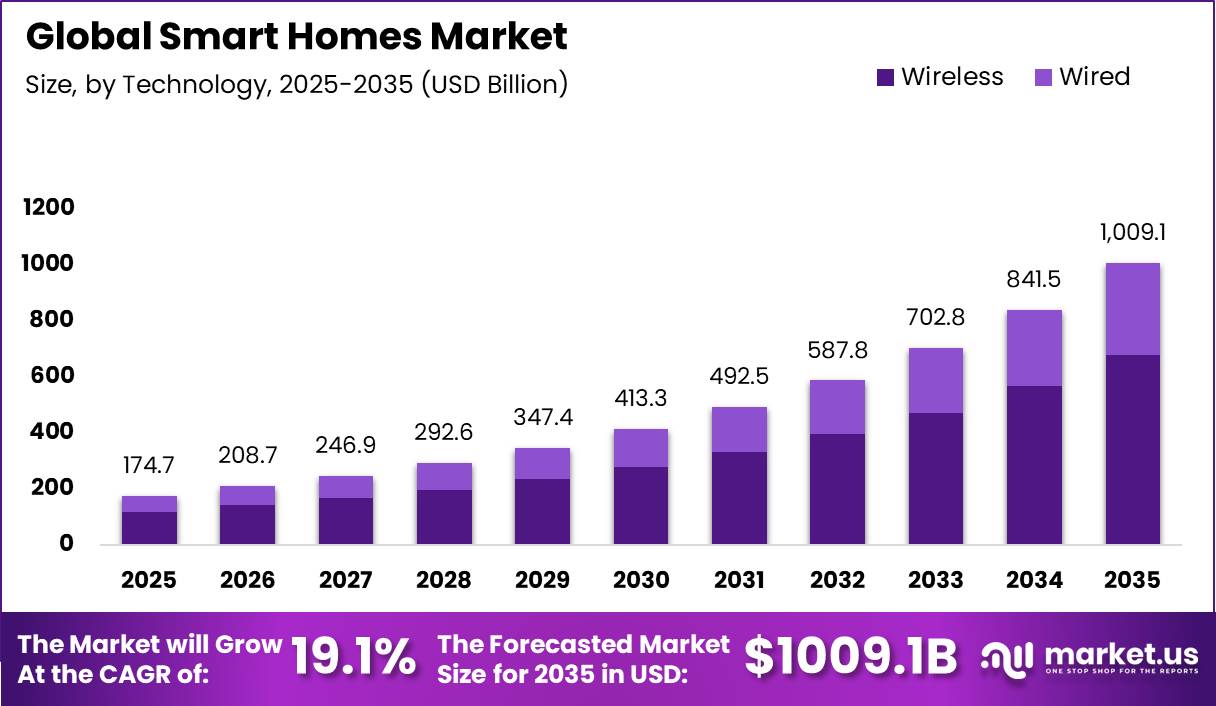
- The global smart homes market generated USD 174.7 billion in 2025.
- Market.us projects market revenue to reach USD 1,009.1 billion by 2035.
- The market is forecast to expand at a CAGR of 19.1% during 2026–2035.
- Wireless technologies accounted for 67.3% of market revenue in 2025.
- Retrofit installations represented 56.4% of the market in the base year.
- Security and access controls held a leading product share of approximately 26.8%.
- Individual homeowners accounted for 72.3% of smart homes market revenue.
- North America generated USD 61.8 billion, representing 35.4% of global revenue in 2025.
The competitive assessment below uses relative positioning rather than assigning unsupported global revenue percentages. Market.us evaluates prominence through connected-home ecosystem breadth, relevant product scale, distribution reach, installed relationships, and platform capabilities. These positions compare different business models and should not be interpreted as audited market-share rankings.
Methodology: Device connections, platform users, appliance sales, and monitored households measure different aspects of competitive scale. They are not interchangeable market-share denominators.
| Company | Relative smart homes positioning | Basis of positioning |
|---|---|---|
| Samsung | Leading integrated appliance and platform participant | SmartThings connects the company’s appliance and entertainment portfolio; its Visual Display and Digital Appliances businesses provide substantial residential hardware scale. |
| Xiaomi | Leading mass-market connected-device ecosystem | Its AIoT platform connected 1,160.8 million devices, excluding smartphones and tablets, at June 30, 2026; this installed base extends beyond strictly residential automation. |
| LG Electronics | Leading connected-appliance participant with an expanding orchestration platform | ThinQ, Homey, and the Apple Home Collection collaboration combine appliance distribution with third-party connectivity and residential security expansion. |
| Alphabet | Leading cross-brand home-control and AI-services platform | Google Home combines Nest hardware, third-party device control, Gemini features, and paid home subscriptions. |
| Apple | Leading premium ecosystem and interoperability participant | Apple Home, HomePod, Apple TV, Matter support, and its new accessory collaborations strengthen its control-layer position. |
| Signify Holdings | Established connected-lighting specialist | Philips Hue provides a focused position in residential connected lighting, supported by an expanding ecosystem and consumer distribution. |
| Schneider Electric | Established home energy-management and electrical-controls specialist | Wiser and Schneider Home address lighting, HVAC, electrical loads, and residential energy optimization. |
| Vivint, LLC | Major professionally installed residential security and automation provider | NRG reports Vivint as a dedicated Smart Home segment with recurring service economics and an expanding customer base. |
| Snap One, LLC | Major professional-integration ecosystem participant | Control4 and OvrC combine residential automation, remote management, and installer relationships within ADI. |
| Crestron Electronics, Inc. | Established premium whole-home automation specialist | Crestron Home OS integrates residential audiovisual systems, lighting, climate, and other third-party equipment through professional integrators. |
| Robert Bosch Smart Home GmbH | Established European residential automation specialist | Its controller-based ecosystem integrates heating, security, and connected accessories, with Matter bridging and native Matter products. |
| Fantasia Trading LLC | Channel-level participant associated with Anker’s smart-home portfolio | Its relevant exposure is through Anker/eufy commercial activities rather than a separately identifiable global automation platform. |
| Siemens | Selective residential infrastructure and automation participant | Residential relevance includes connected-home monitoring and control through projects such as the ADMARES platform powered by Siemens Industrial Edge. |
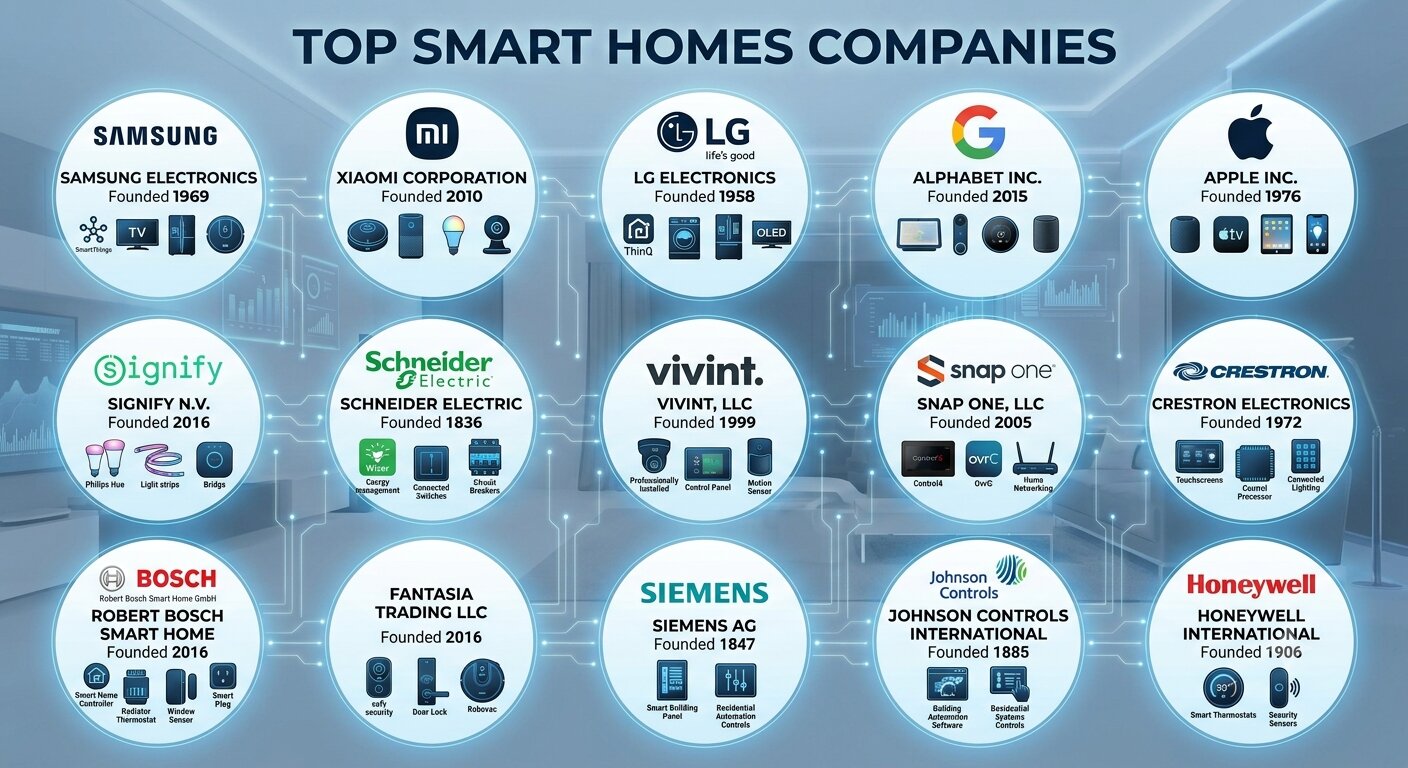
Top Companies List
The following is Market.us’s analytical ranking of the supplied companies by smart-home-specific prominence, ecosystem breadth, and commercial footprint—not by consolidated corporate revenue.
- Samsung
- Xiaomi
- LG Electronics
- Alphabet, Inc.
- Apple, Inc.
- Signify Holdings
- Schneider Electric
- Vivint, LLC
- Snap One, LLC
- Crestron Electronics, Inc.
- Robert Bosch Smart Home GmbH
- Fantasia Trading LLC
- Siemens
- Johnson Controls International plc
- Honeywell International, Inc.
1. Samsung
About Samsung: Samsung competes through SmartThings, connected appliances, televisions, and residential device coordination. Its principal advantage is the combination of widely distributed household hardware and a common control platform, allowing connected-home capabilities to be embedded into appliance replacement purchases rather than sold exclusively as separate automation installations.
Company Overview Table
| Attribute | Company Data |
|---|---|
| Company Name | Samsung Electronics Co., Ltd. |
| Ticker Symbol | KRX: 005930 |
| Industry | Connected appliances, consumer electronics, and residential IoT |
| Headquarters | Suwon, South Korea |
| Founded | 1969 |
| Founders | Lee Byung-chul |
| Current CEO | TM Roh and Young Hyun Jun (co-CEOs) |
| Latest Quarterly Revenue | KRW 14.5 trillion, Visual Display and Digital Appliances combined (Q2 2026) |
| Primary Segments | SmartThings; connected kitchen and laundry appliances; residential climate control; connected TVs and entertainment |
Financial Details
In Q2 2026, Samsung’s Visual Display and Digital Appliances businesses reported combined revenue of KRW 14.5 trillion and a slight operating loss. Stronger air-conditioner demand lifted Digital Appliances revenue, but cost pressures weighed on profitability. The results show a core tension in the sector: connected features help differentiate products, but manufacturing, distribution, and input costs still drive near-term earnings.
Strategic Developments
- Samsung named expanding AI-based product sales as a second-half 2026 priority for its home hardware businesses.
- SmartThings remains the integration layer across Samsung’s connected products, enabling coordination between devices.
- In 2026, Samsung expanded “The Brief” internationally for its AI-powered home appliances, moving further into household information and automation services.
2. Xiaomi
About Xiaomi: Xiaomi’s smart-home offering combines competitively priced connected appliances, televisions, sensors, and control software. Its strength is the breadth of its ecosystem and repeat device adoption. Households can grow their installed base step by step on a common AIoT platform with a shared software experience.
Company Overview Table
| Attribute | Company Data |
|---|---|
| Company Name | Xiaomi Corporation |
| Ticker Symbol | HKEX: 1810 |
| Industry | Consumer IoT, connected appliances, and smart-home ecosystems |
| Headquarters | Beijing, China |
| Founded | 2010 |
| Founders | Lei Jun and co-founding team, including Lin Bin and Liu De |
| Current CEO | Lei Jun |
| Latest Quarterly Revenue | RMB 31.3 billion, IoT and lifestyle products (Q2 2026) |
| YoY Revenue Growth | -19.2%, IoT and lifestyle products (Q2 2026) |
| Primary Segments | Connected major appliances; smart TVs; household IoT devices; AIoT platform and home automation |
Financial Details
Xiaomi’s IoT and lifestyle products business generated RMB 31.3 billion in Q2 2026, down 19.2% year over year, at a gross margin of 20.1%. At June 30, 2026, the AIoT platform connected 1,160.8 million devices. Users with five or more connected devices reached 24.6 million, up 20.2%, which points to deeper adoption within households and not just first-device purchases.
Strategic Developments
- Xiaomi launched Miloco 2.0, an AI agent built for whole-home device collaboration, household memory, and longer-running tasks.
- Its connected-device installed base grew 17.4% year over year by June 2026, widening the base for additional products and services.
- Overseas expansion stayed a commercial priority for the IoT portfolio as reduced domestic subsidies weighed on demand.
3. LG Electronics
About LG Electronics: LG pairs ThinQ-connected appliances with Homey’s multi-brand integration capabilities. Its smart-home strategy goes beyond connecting appliances to orchestrating the household, including security, access, and climate control. The result is a large appliance channel combined with software that coordinates devices from multiple manufacturers.
Company Overview Table
| Attribute | Company Data |
|---|---|
| Company Name | LG Electronics Inc. |
| Ticker Symbol | KRX: 066570 |
| Industry | Connected home appliances and residential automation |
| Headquarters | Seoul, South Korea |
| Founded | 1958 (as GoldStar) |
| Founders | Koo In-hwoi |
| Current CEO | Lyu Jae-cheol |
| Latest Quarterly Revenue | KRW 7.08 trillion, Home Appliance Solution (Q2 2026) |
| Primary Segments | ThinQ; Homey/Athom; connected kitchen and laundry appliances; residential security, access, and climate products |
Financial Details
LG’s Home Appliance Solution business reported Q2 2026 revenue of KRW 7.08 trillion and operating profit of KRW 686 billion. LG credited the results to execution in both premium and volume markets, cost optimization, and supply-chain improvements. Its appliance subscription business added recurring service revenue, showing a way to earn beyond the initial hardware sale.
Strategic Developments
- In July 2024, LG acquired an 80% stake in Athom and agreed to buy the remaining 20% within three years. Homey adds multi-brand, multi-protocol connectivity to ThinQ.
- In October 2026, LG joined Apple’s Home Collection with cameras, a video doorbell, a smart deadbolt, thermostats, and temperature sensors. Availability starts in December, with some accessories following in early 2027.
- The Apple partnership gives LG’s home security and access products a premium distribution and control channel.
4. Alphabet, Inc.
About Alphabet: Alphabet competes through Google Home, Nest, and Gemini-enabled home services. Its advantage is a cross-brand control platform that combines voice interaction, cameras, thermostats, automation software, and subscriptions. Its focus is moving toward context-aware household assistance and recurring AI services built on top of connected hardware.
Company Overview Table
| Attribute | Company Data |
|---|---|
| Company Name | Alphabet Inc. |
| Ticker Symbol | NASDAQ: GOOGL; GOOG |
| Industry | Smart-home platforms, connected devices, and AI-enabled services |
| Headquarters | Mountain View, California, United States |
| Founded | 2015 (Google holding-company restructuring) |
| Founders | Larry Page and Sergey Brin |
| Current CEO | Sundar Pichai |
| Primary Segments | Google Home; Nest cameras and doorbells; thermostats; speakers and displays; Google Home Premium |
Financial Details
Google Home makes money from both device sales and recurring subscriptions. In the United States, Google Home Premium Standard costs USD 10 per month or USD 100 per year, and Advanced costs USD 20 per month or USD 200 per year. Advanced adds longer video history and more detailed camera intelligence.
Strategic Developments
- In October 2025, Google introduced its Gemini-powered Google Home, with a redesigned app, new hardware, and Google Home Premium.
- The Spring 2026 update expanded conversational assistance, household preferences, and automation. Early-access voice-assistant availability reached 16 countries and 10 languages.
- Google Home Premium is bundled with selected Google AI subscription plans, tying home services to Alphabet’s wider consumer AI strategy.
5. Apple, Inc.
About Apple: Apple’s smart-home position is built on the Home app, home hubs, privacy-focused processing, and accessory interoperability. Its advantage is integration with the iPhone installed base and a tightly controlled user experience. New partnerships extend the platform into coordinated security, access, and climate-control accessories.
Company Overview Table
| Attribute | Company Data |
|---|---|
| Company Name | Apple Inc. |
| Ticker Symbol | NASDAQ: AAPL |
| Industry | Smart-home platforms, hubs, and connected-home services |
| Headquarters | Cupertino, California, United States |
| Founded | 1976 |
| Founders | Steve Jobs, Steve Wozniak, and Ronald Wayne |
| Current CEO | John Ternus (effective September 1, 2026) |
| Primary Segments | Apple Home; HomePod; Apple TV home hub; HomeKit Secure Video; Apple Home Collection ecosystem |
Financial Details
Apple earns from the home through hardware sales, ecosystem retention, and iCloud+ services that support HomeKit Secure Video. Its October 2026 Home Collection announcement set partner accessory prices, with thermostats starting at USD 199.95 and temperature sensors at USD 39.95. This model makes Apple the access and service platform while partners supply much of the accessory hardware.
Strategic Developments
- On October 13, 2026, Apple announced Home Collection accessories developed with LG Electronics and Schneider Electric. Availability begins in December 2026, with some products following in early 2027.
- The collection includes cameras, doorbells, locks, thermostats, and sensors, taking Apple’s home offering beyond speakers and software.
- Apple announced professional installation by ADT at Apple Retail stores in the United States, alongside DIY setup.
6. Signify Holdings
About Signify Holdings: Signify’s main smart-home business is Philips Hue, which covers connected lighting, entertainment sync, controls, and a growing range of accessories. Its advantage combines lighting expertise, strong consumer brand recognition, and integrations that add more uses, and more connected light points, in each home.
Company Overview Table
| Attribute | Company Data |
|---|---|
| Company Name | Signify N.V. |
| Ticker Symbol | Euronext Amsterdam: LIGHT |
| Industry | Connected residential lighting and controls |
| Headquarters | Eindhoven, Netherlands |
| Founded | 2016 as an independently listed company; renamed Signify in 2018 |
| Founders | Formed through the separation of Philips’ lighting business |
| Current CEO | As Tempelman |
| Primary Segments | Philips Hue; connected consumer lighting; residential switches and lighting controls |
Financial Details
In Q2 2026, Signify reported strong consumer sell-out of connected lighting, while retailer inventory adjustments held back sell-in. This means end-customer demand can recover before the manufacturer’s reported shipments do. Management also reported a lower contribution from the Consumer business and pointed to targeted price increases and cost measures to lift second-half profitability.
Strategic Developments
- Signify’s 2026 Philips Hue launches expanded the portfolio in AI, immersive entertainment, design, wired switches, and Play lamps.
- At IFA 2026, Signify announced a collaboration with Nanoleaf that extends Hue integration to more decorative lighting products.
- Consumer connected lighting remains a growth priority in Signify’s “Build” portfolio.
7. Schneider Electric
About Schneider Electric: Schneider Electric serves smart homes through Wiser, Schneider Home, connected electrical controls, and energy-management software. Its edge is linking a home’s electrical infrastructure with automation, so lighting, climate, appliance loads, and electrification can be managed as one household energy system.
Company Overview Table
| Attribute | Company Data |
|---|---|
| Company Name | Schneider Electric SE |
| Ticker Symbol | Euronext Paris: SU |
| Industry | Residential energy management and electrical automation |
| Headquarters | Rueil-Malmaison, France |
| Founded | 1836 |
| Founders | Adolphe Schneider and Joseph-Eugène Schneider |
| Current CEO | Olivier Blum |
| Primary Segments | Wiser; Schneider Home; connected switches and thermostats; home energy management |
Financial Details
Schneider Electric’s residential opportunity covers both connected controls and software-led energy optimization. Through its October 2026 Apple collaboration, it priced the Schneider Home Smart Thermostat from USD 199.95 and the Room Sensor from USD 39.95. These products open the door to wider household energy management, while Apple’s interface makes setup and control simpler.
Strategic Developments
- Schneider Electric worked with Apple on Home Collection climate-control products, available from December 2026.
- Wiser Home can be commissioned into Matter ecosystems, which widens platform compatibility.
- Schneider’s 2026 home-energy strategy centers on Wiser Home AI and coordinated management of heating, cooling, hot water, EV charging, and appliances.
8. Vivint, LLC
About Vivint: Vivint provides professionally installed home security and automation, including cameras, sensors, locks, thermostats, monitoring, and customer support. Its advantage is the managed-service relationship. Installation, recurring monitoring, and integrated devices give it a different economic model from retail hardware sales.
Company Overview Table
| Attribute | Company Data |
|---|---|
| Company Name | Vivint, LLC (Vivint Smart Home, part of NRG Energy) |
| Ticker Symbol | Parent NRG Energy: NYSE: NRG |
| Industry | Residential security, monitoring, and home automation |
| Headquarters | Provo, Utah, United States |
| Founded | 1999 (as APX Alarm) |
| Founders | Todd Pedersen and Keith Nellesen |
| Current CEO | Robert Gaudette (CEO of parent NRG Energy) |
| Primary Segments | Professionally installed security; video monitoring; access control; thermostats; integrated home automation |
Financial Details
Vivint Smart Home generated adjusted EBITDA of USD 301 million in Q2 2026, up from USD 259 million a year earlier. First-half adjusted EBITDA reached USD 595 million, compared with USD 539 million in the prior-year period. NRG credited the gains to more new-customer additions and a better monthly recurring service margin per customer.
Strategic Developments
- Vivint is part of NRG’s combined energy and home-services platform, which can connect household energy relationships with security and automation services.
- Vivint ended Q2 2026 with about 2.45 million smart-home customers, up 8% year over year.
- The higher recurring service margin shows a continued focus on earning more from existing customers alongside new installations.
9. Snap One, LLC
About Snap One: Snap One serves professional home integrators with Control4 automation, OvrC remote management, networking, AV products, and related equipment. Its advantage is the combination of its own platforms with installer distribution. Integrators can design, install, and maintain whole-home systems through a single supplier relationship.
Company Overview Table
| Attribute | Company Data |
|---|---|
| Company Name | Snap One, LLC (part of ADI) |
| Ticker Symbol | Parent ADI Global Distribution: NYSE: ADIG |
| Industry | Professionally installed smart-home automation and integration |
| Headquarters | Charlotte, North Carolina, United States |
| Founded | 2005 (as SnapAV) |
| Founders | Jay Faison |
| Current CEO | Rob Aarnes (CEO of parent ADI Global Distribution) |
| Primary Segments | Control4; OvrC; residential networking; lighting and control; AV integration; surveillance |
Financial Details
ADI’s Q2 2026 results noted softness in residential AV tied to the U.S. housing market, while other distribution categories grew. This sets the demand backdrop for Snap One’s integrator-led residential business. The key financial balance for Snap One is between premium home-project demand, distributor reach, and the economics of its own control and remote-management platforms.
Strategic Developments
- Resideo acquired Snap One in June 2024 and combined it with ADI, bringing its home-integration capabilities into a larger distribution business.
- ADI completed its separation from Resideo and began trading on its own on August 4, 2026, under the ticker ADIG.
- ADI leadership positions the Snap One combination as part of its growth in technology platforms, distribution, and integrator services.
10. Crestron Electronics, Inc.
About Crestron Electronics: Crestron targets premium home automation through professionally installed control systems and Crestron Home OS. Its strength is managing complex homes in one system, covering AV, lighting, climate, and more. Third-party drivers and integrator expertise allow a level of customization beyond typical plug-and-play consumer products.
Company Overview Table
| Attribute | Company Data |
|---|---|
| Company Name | Crestron Electronics, Inc. |
| Ticker Symbol | Privately held |
| Industry | Residential automation, control, and AV integration |
| Headquarters | Rockleigh, New Jersey, United States |
| Founded | 1972 |
| Founders | George Feldstein |
| Current CEO | Dan Feldstein |
| Primary Segments | Crestron Home OS; control processors and touchscreens; lighting; shades; climate and AV integration |
Financial Details
Crestron earns from project hardware, control interfaces, software integration, and professional deployment. Adding new interfaces and integration drivers increases the range of equipment integrators can bring into a Crestron-controlled home. That supports higher system value per project and keeps the platform relevant.
Strategic Developments
- In August 2026, Crestron announced more than 80 new and updated Home OS drivers from nine development partners.
- Crestron Home OS 4.12 added built-in Multiview functionality for more advanced home entertainment setups.
- In October 2026, Crestron announced new 8-inch and 10-inch touchscreens with native Crestron Home OS integration.
5.11. Robert Bosch Smart Home GmbH
About Robert Bosch Smart Home: Bosch Smart Home offers an integrated home ecosystem covering heating control, security, sensors, and connected accessories. It combines its own coordinated system with Matter compatibility. Households keep Bosch’s integrated features while connecting selected devices to wider multi-brand platforms.
Company Overview Table
| Attribute | Company Data |
|---|---|
| Company Name | Robert Bosch Smart Home GmbH |
| Ticker Symbol | Privately held Bosch subsidiary |
| Industry | Residential automation, connected security, and heating controls |
| Headquarters | Stuttgart-Vaihingen, Germany |
| Founded | 2016 |
| Founders | Established by Robert Bosch GmbH |
| Current CEO | Gabriel Wetzel |
| Primary Segments | Smart Home Controller; radiator thermostats; security sensors; smart plugs; Matter-compatible accessories |
Financial Details
Bosch Smart Home’s current focus is expanding its ecosystem and device compatibility. Its controller works as a Matter bridge, and the product line lets selected accessories run in either Bosch’s system or a compatible Matter setup. This reaches buyers who are not committed to a single proprietary controller and encourages repeat purchases across heating, sensing, and electrical control.
Strategic Developments
- Bosch’s April 2026 anniversary announcement highlighted the Smart Home Controller II’s role as a Matter bridge.
- The range includes radiator thermostats, door/window contacts, and smart plugs that work in both Bosch and Matter environments.
- Bosch continues to put privacy, security, and cross-brand compatibility at the center of its product development.
12. Fantasia Trading LLC
About Fantasia Trading: Fantasia Trading’s role in smart homes comes from its commercial link to Anker’s consumer-device ecosystem, including eufy. It works mainly as a sales and distribution entity. Relevant products include home security cameras, doorbells, smart locks, and robot cleaners.
Company Overview Table
| Attribute | Company Data |
|---|---|
| Company Name | Fantasia Trading LLC |
| Industry | Consumer-electronics distribution and smart-home devices |
| Headquarters | Ontario, California, United States |
| Founded | 2016 (Washington incorporation) |
| Primary Segments | Distribution of Anker/eufy home security, smart access, and robot cleaning products |
Financial Details
The eufy portfolio it distributes competes on local storage and device coordination through HomeBase. HomeBase S380 supports up to 16 cameras and 34 sensors, with expandable storage. This approach competes on hardware capability and local recording instead of requiring a subscription for core security features.
Strategic Developments
- At CES 2026, eufy announced new smart locks, video doorbells, and security cameras, expanding the portfolio Fantasia distributes.
- The HomeBase architecture coordinates cameras and sensors with centralized analysis and storage.
- Eufy’s 2026 marketing continues to stress local storage and no required monthly fees across its featured lineup.
13. Siemens
About Siemens: Siemens takes part in home automation selectively, through infrastructure, controls, and technology partnerships rather than a mass-market consumer ecosystem. Its relevance is in integrated monitoring and control for engineered housing. Industrial-grade software and sensors connect energy, water, air quality, appliances, and building systems.
Company Overview Table
| Attribute | Company Data |
|---|---|
| Company Name | Siemens AG |
| Ticker Symbol | Xetra: SIE |
| Industry | Residential infrastructure automation and connected building controls |
| Headquarters | Munich, Germany (Smart Infrastructure: Zug, Switzerland) |
| Founded | 1847 |
| Founders | Werner von Siemens and Johann Georg Halske |
| Current CEO | Roland Busch |
| Primary Segments | Residential controls; connected-home infrastructure; Industrial Edge-enabled home monitoring and automation |
Financial Details
Siemens’ home-market opportunity is driven by projects and technology enablement. In the ADMARES example, a platform powered by Siemens Industrial Edge is installed in homes to monitor energy and water, detect leaks, track air quality, and coordinate appliances, HVAC, and lighting. The model is tied to factory-built housing and embedded infrastructure rather than retail device sales.
Strategic Developments
- In January 2026, Siemens described its ADMARES collaboration, in which smart-home software and sensors are built into homes during manufacturing.
- The platform gives residents smartphone and in-home touchscreen access to monitoring and connected systems.
- Siemens’ wider 2026 building-technology agenda focuses on moving toward more autonomous infrastructure.
14. Johnson Controls International plc
About Johnson Controls: Johnson Controls remains relevant to connected buildings through controls and building systems. Its direct residential footprint changed significantly after it sold its residential and light-commercial HVAC operations. Its current smart homes role is therefore narrower than its past appliance and HVAC presence.
Company Overview Table
| Attribute | Company Data |
|---|---|
| Company Name | Johnson Controls International plc |
| Ticker Symbol | NYSE: JCI |
| Industry | Building controls and connected building systems |
| Headquarters | Cork, Ireland |
| Founded | 1885 (current plc structure formed in 2016) |
| Founders | Warren Johnson and William Plankinton |
| Current CEO | Joakim Weidemanis |
| Primary Segments | Controls and building systems used in residential properties |
Financial Details
The most significant recent residential financial event was the completed sale of the residential and light-commercial HVAC business to Bosch on August 1, 2025. The transaction was valued at USD 8.1 billion in total. About USD 6.7 billion of the consideration went to Johnson Controls, with about USD 5.0 billion in net proceeds after tax and transaction costs.
Strategic Developments
- The Bosch deal included Johnson Controls’ North American ducted HVAC business and its global residential joint venture with Hitachi.
- The sale sped up Johnson Controls’ shift toward a more focused building-solutions business.
- As a result, the transferred residential HVAC operations now sit with Bosch.
15. Honeywell International, Inc.
About Honeywell International: Honeywell stays visible in homes through the Honeywell Home brand, but the brand and the product business are separate. Resideo manufactures and sells Honeywell Home devices under license. Honeywell’s role in smart homes is therefore mainly indirect, through brand licensing.
Company Overview Table
| Attribute | Company Data |
|---|---|
| Company Name | Honeywell International Inc. |
| Ticker Symbol | NASDAQ: HON |
| Industry | Automation and licensed residential controls branding |
| Headquarters | Charlotte, North Carolina, United States |
| Founded | 1906 (predecessor); modern company formed through a 1999 combination |
| Founders | Mark C. Honeywell |
| Current CEO | Vimal Kapur |
| Primary Segments | Honeywell Home trademark licensing; residential products made and sold by Resideo |
Financial Details
Resideo’s 2026 disclosures state that it uses the Honeywell Home trademark under a long-term license and that Resideo and its affiliates manufacture the products. Honeywell’s exposure to smart homes therefore comes through brand licensing rather than direct product sales.
Strategic Developments
- Resideo’s Honeywell Home X8S thermostat won a 2026 connected-product award. It can display video from compatible doorbells, monitor indoor air quality, and send HVAC performance alerts.
- Resideo’s 2026 ElitePRO thermostat launch also confirms the licensed-brand arrangement, with Resideo as manufacturer.
- Honeywell’s 2026 corporate restructuring continues alongside the separately operated Honeywell Home product business.
Conclusion
Market.us sees the smart homes market as a contest between three overlapping business models: integrated appliance ecosystems, cross-brand software platforms, and professionally installed home systems. Samsung, Xiaomi, and LG use their appliance distribution to grow connected-device adoption.
Alphabet and Apple compete to own the control interface and the service relationship. Specialists hold their ground in lighting, energy management, monitoring, and premium integration.