Introduction
The Metaverse Market is developing across three commercially distinct layers: immersive consumer platforms, real-time 3D creation tools, and industrial simulation infrastructure. Market.us estimates the market at USD 149.6 billion in 2025, with expansion supported by connected devices, digital content, and enterprise digitalization.
However, adoption is increasingly selective: NVIDIA is extending industrial digital-twin partnerships, Roblox is integrating commerce, and Microsoft is withdrawing dedicated immersive collaboration products. Competitive advantage therefore depends on monetizable engagement, reusable developer ecosystems, and measurable enterprise outcomes rather than virtual-world investment alone.
Market Size & Statistics
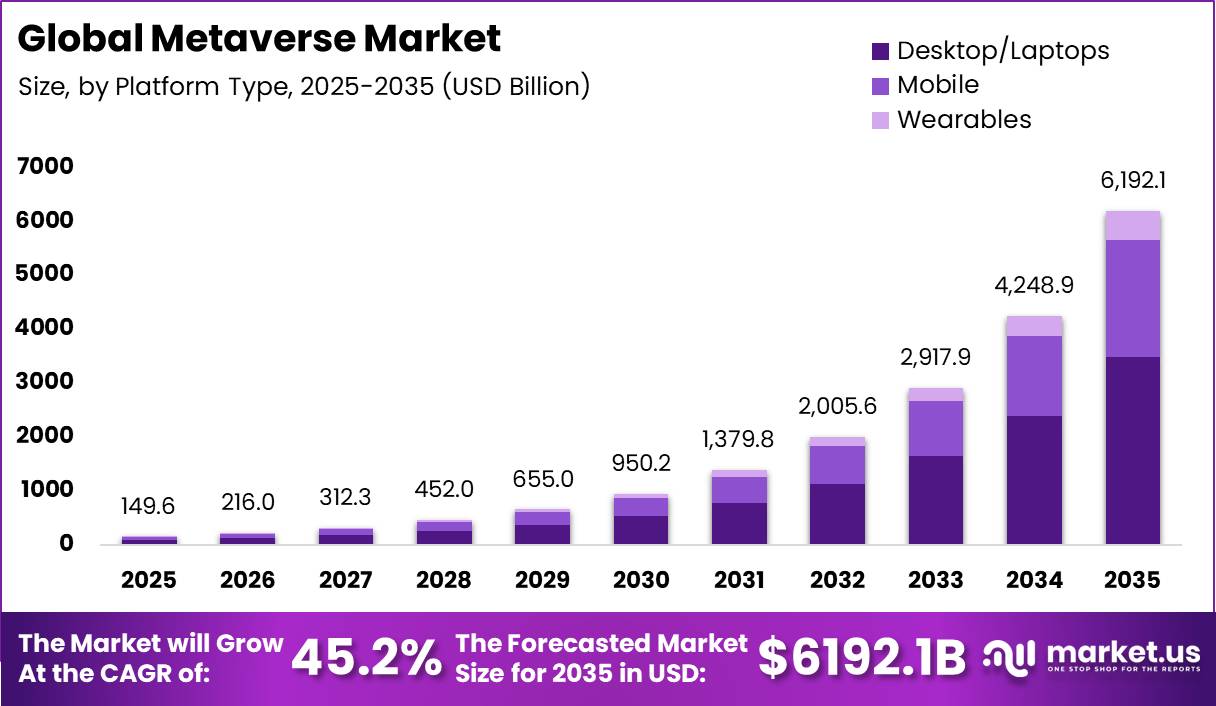
- The global metaverse market generated USD 149.6 billion in revenue in 2025.
- The market is projected to reach USD 6,192.1 billion by 2035.
- The forecast compound annual growth rate is 45.2% during 2026–2035.
- Hardware accounted for 38.7% of the market in the base year.
- Desktop and laptop platforms captured a leading 56.4% market share.
- Mixed reality represented 51.2% of the market by technology.
- Media and entertainment accounted for 26.5% of market revenue by end-use industry.
- North America held 42.4% of global market revenue in 2025.
- North America generated approximately USD 63.4 billion in metaverse market revenue in 2025.
Market.us assesses relative competitive positioning by operating layer rather than assigning a single revenue-share percentage across structurally different businesses. Platform revenue, engine subscriptions, headset sales, cloud infrastructure, and virtual-asset transactions measure different activities and should not be treated as interchangeable market-share denominators.
The following positioning reflects disclosed operating scale, sector-specific products, developer ecosystems, and strategic commitments.
| Company | Relative market positioning | Sector-specific basis |
|---|---|---|
| Meta | Leading consumer XR ecosystem | Reality Labs combines immersive hardware, operating systems, software, and content; the segment generated USD 431 million in Q2 2026 revenue. |
| Roblox Corporation | Leading directly monetized social-world platform | Its Q2 2026 investor dashboard reported approximately USD 1.5 billion in revenue, 123 million daily active users, and 29 billion engagement hours. |
| NVIDIA Corporation | Leading industrial metaverse infrastructure provider | Omniverse supports industrial simulation and digital twins, including an expanded 2026 partnership with Siemens. |
| Epic Games, Inc. | Leading immersive content and engine ecosystem | Fortnite, Unreal Engine, and the Disney collaboration combine distribution, development infrastructure, and entertainment intellectual property. |
| Unity Technologies | Leading cross-platform real-time 3D tool provider | Unity supplies XR development infrastructure and extended its platform-support agreement with Meta in April 2026. |
| Tencent Holdings Ltd. | Major ecosystem investor and enterprise technology participant | Its immersive-convergence strategy connects digital twins, distributed cloud, XR, and real-time interaction. |
| ByteDance Ltd. | Significant consumer XR challenger | PICO provides ByteDance with an owned headset and spatial-computing ecosystem; its next flagship remained targeted for Q4 2026. |
| Microsoft | Major adjacent infrastructure participant; retreating from dedicated immersive collaboration | Mesh retired in December 2025, while its Teams immersive-events successor is scheduled to retire in April 2027. |
| NetEase, Inc. | Established China-focused immersive-platform participant | Yaotai applies gaming infrastructure to avatar-based conferences, exhibitions, and virtual events. finance. |
| The Sandbox | Specialist blockchain-based virtual-world platform | Its creator economy combines user-generated experiences and digital ownership, supported by a USD 20 million convertible-note financing announced in 2024. |
| Decentraland | Specialist community-governed virtual-world ecosystem | Its positioning centers on social interaction, creator content, digital assets, and community governance rather than vertically integrated hardware. |
| Lilith Games | Emerging social-world and user-generated-content participant | Project Party extends its gaming capabilities into customizable environments, avatars, and player-created experiences. |
| Nextech AR Solutions Inc. | Specialist spatial-content and AR infrastructure provider | Operating as Nextech3D.ai, it supplies 3D modeling, AR visualization, and spatial-computing technologies. |
| Active Theory | Specialist immersive-experience developer | Dreamwave supports browser-based multiplayer experiences across desktop, mobile, and XR devices. |
| Antier Solutions | Specialist enterprise metaverse development provider | Its offering includes immersive environments, avatars, virtual economies, and custom metaverse engineering. |
Top Companies List
The following Market.us analytical ranking prioritizes direct metaverse operating footprint, monetized platform scale, enabling technology, and ecosystem influence not consolidated corporate revenue. It is an ordinal competitive assessment rather than a calculated global revenue-share ranking.
- Meta
- Roblox Corporation
- NVIDIA Corporation
- Epic Games, Inc.
- Unity Technologies
- Tencent Holdings Ltd.
- ByteDance Ltd.
- Microsoft
- NetEase, Inc.
- The Sandbox
- Decentraland
- Lilith Games
- Nextech AR Solutions Inc.
- Active Theory
- Antier Solutions
1. Meta
About Meta: Meta operates an integrated consumer XR ecosystem spanning devices, operating systems, developer distribution, and immersive content. Reality Labs provides its principal sector exposure, while the company’s developer relationships and hardware-software integration support content availability across successive generations of immersive devices.
Company Overview Table
| Attribute | Company Data |
|---|---|
| Company Name | Meta Platforms, Inc. |
| Ticker Symbol | NASDAQ: META |
| Industry | Consumer XR hardware, immersive software, and spatial computing |
| Headquarters | Menlo Park, California, United States |
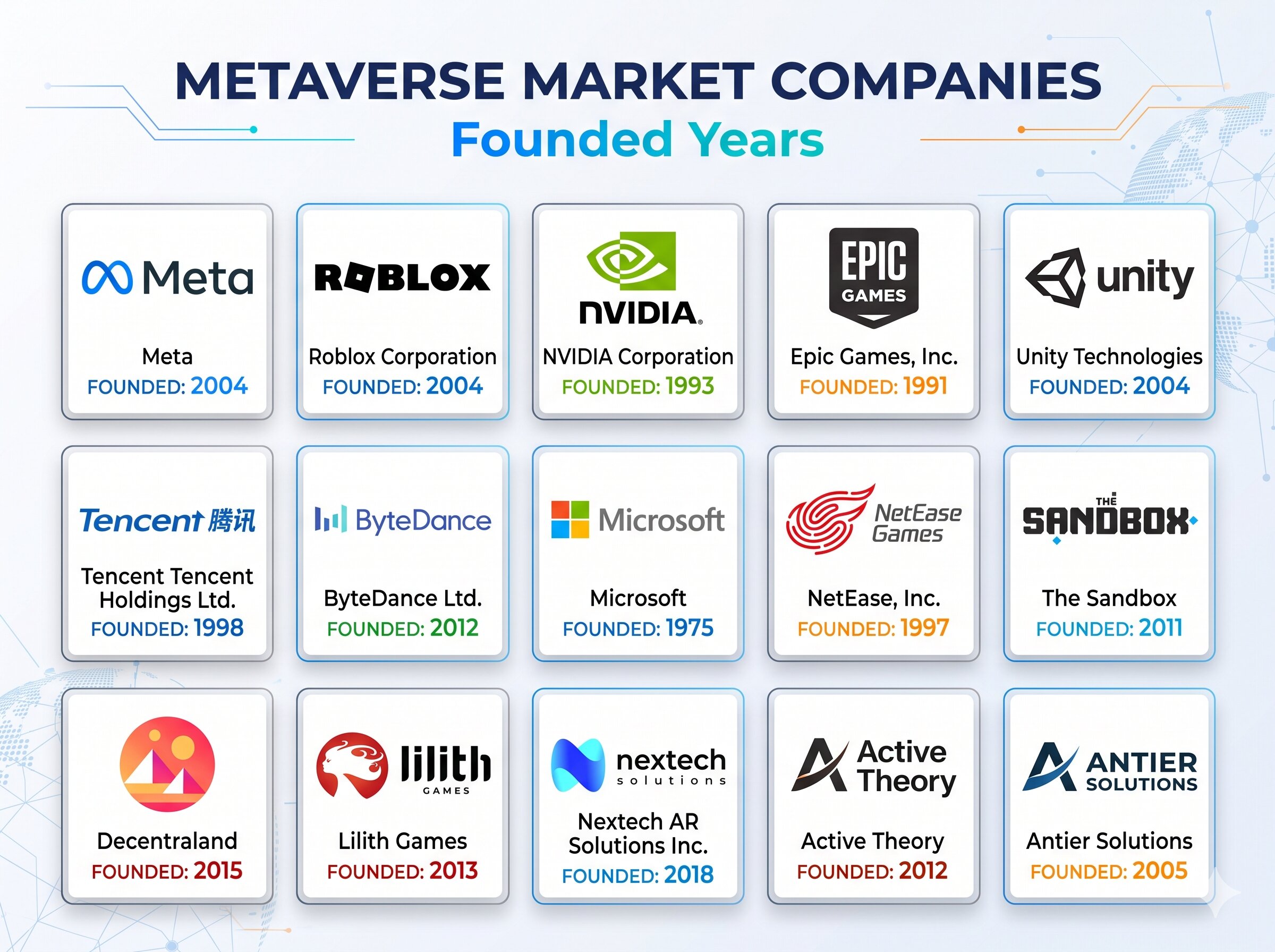
| Founded | 2004; renamed Meta in 2021 |
| Founders | Mark Zuckerberg, Eduardo Saverin, Dustin Moskovitz, Andrew McCollum, and Chris Hughes |
| Current CEO | Mark Zuckerberg |
| Latest Quarterly Revenue | USD 431 million, Reality Labs, Q2 2026 |
| YoY Revenue Growth | Approximately 16%, Reality Labs, Q2 2026 |
| Primary Segments | Reality Labs: VR/AR consumer hardware, software, and content |
Corporate information and segment financials are supported by company disclosures and corporate-history records.
Financial Details
Reality Labs generated USD 431 million in Q2 2026 revenue, compared with USD 370 million a year earlier. Its operating loss reached USD 4.619 billion, versus USD 4.530 billion in Q2 2025. First-half segment revenue totaled USD 833 million against an operating loss of USD 8.647 billion.
These figures demonstrate the substantial gap between current immersive-product monetization and the cost of sustaining the ecosystem. Reality Labs also includes AR-related products, so its revenue should not be interpreted as Horizon-specific revenue.
Strategic Developments
- In April 2026, Meta and Unity extended their multiyear platform-support and enterprise agreement, reinforcing development infrastructure for Meta’s VR ecosystem.
- In September 2026, Unity announced immediate development support for Meta VR Glasses, ahead of their planned spring 2027 retail launch.
2. Roblox Corporation
About Roblox Corporation: Roblox operates a social co-experience platform in which developers build and monetize immersive multiplayer environments. Its competitive moat combines a large recurring audience, proprietary creation tools, virtual-economy infrastructure, and a developer community that continually expands available content without requiring Roblox to produce every experience internally.
Company Overview Table
| Attribute | Company Data |
|---|---|
| Company Name | Roblox Corporation |
| Ticker Symbol | NYSE: RBLX |
| Industry | Immersive social gaming and user-generated virtual experiences |
| Headquarters | San Mateo, California, United States |
| Founded | 2004 |
| Founders | David Baszucki and Erik Cassel |
| Current CEO | David Baszucki |
| Latest Quarterly Revenue | Approximately USD 1.5 billion, Q2 2026, rounded company dashboard figure |
| YoY Revenue Growth | Approximately 36%, Q2 2026 |
| Primary Segments | Roblox platform, Roblox Studio, virtual goods, immersive advertising, and commerce |
Corporate details and operating figures are supported by Roblox’s company information, investor dashboard, and quarterly-results coverage.
Financial Details
For Q2 2026, Roblox’s investor dashboard reported approximately USD 1.5 billion in revenue, USD 1.6 billion in bookings, and USD 318 million in operating cash flow.
The platform recorded 123 million daily active users and 29 billion hours engaged. Revenue and bookings must remain separate: bookings reflect purchasing activity, whereas revenue recognition follows the company’s accounting treatment for its virtual economy.
Strategic Developments
- Roblox launched Commerce APIs with Shopify as its first integrated commerce partner in May 2025, enabling eligible merchants to sell physical merchandise within experiences.
- Its Approved Merchandiser Program connects physical purchases with virtual goods and benefits, extending monetization beyond conventional in-experience spending.
- In 2026, Roblox introduced revised advertising policies, registration, and labeling requirements, alongside migration toward Roblox-owned rewarded-video formats.
3. NVIDIA Corporation
About NVIDIA Corporation: NVIDIA supplies enabling infrastructure for industrial virtual environments through Omniverse, GPU-accelerated rendering, simulation libraries, and related computing technologies. Its sector advantage lies in connecting physically accurate digital twins with enterprise engineering workflows, allowing customers to test facilities, equipment, and operational changes before physical deployment.
Company Overview Table
| Attribute | Company Data |
|---|---|
| Company Name | NVIDIA Corporation |
| Ticker Symbol | NASDAQ: NVDA |
| Industry | Accelerated computing, industrial simulation, and digital twins |
| Headquarters | Santa Clara, California, United States |
| Founded | 1993 |
| Founders | Jensen Huang, Chris Malachowsky, and Curtis Priem |
| Current CEO | Jensen Huang |
| Primary Segments | Omniverse libraries and APIs, industrial digital twins, rendering, and simulation infrastructure |
Corporate information and sector activities are supported by NVIDIA’s history and industrial-partnership disclosures.
Financial Details
NVIDIA’s sector commercialization is increasingly embedded in industrial software and simulation workflows rather than confined to a standalone virtual-world product.
Its Siemens collaboration combines NVIDIA infrastructure, simulation libraries, models, frameworks, and blueprints with Siemens industrial software and engineering expertise. This creates exposure to enterprise deployment spending across engineering, factory planning, and operational optimization.
Strategic Developments
- In January 2026, NVIDIA and Siemens expanded their partnership to develop an industrial AI operating system connecting simulation, automation, and operational intelligence.
- The partners identified Siemens’ electronics factory in Erlangen, Germany, as the first blueprint for adaptive AI-driven manufacturing sites beginning in 2026.
- Siemens has integrated Omniverse capabilities into engineering and visualization workflows, including Teamcenter and Simcenter STAR-CCM+.
4. Epic Games, Inc.
About Epic Games, Inc.: Epic Games combines a large interactive entertainment platform with real-time 3D development infrastructure. Fortnite provides distribution and social engagement, while Unreal Engine supports immersive-content production.
Its ecosystem strategy connects creators, entertainment franchises, and development tools within persistent, interoperable digital experiences.
Company Overview Table
| Attribute | Company Data |
|---|---|
| Company Name | Epic Games, Inc. |
| Industry | Interactive entertainment, real-time 3D engines, and creator platforms |
| Headquarters | Cary, North Carolina, United States |
| Founded | 1991 |
| Founders | Tim Sweeney |
| Current CEO | Tim Sweeney |
| Primary Segments | Fortnite, Unreal Engine, and immersive creator tools |
Corporate details and sector positioning are supported by Epic’s company overview and its Disney collaboration announcement.
Financial Details
Disney announced a USD 1.5 billion equity investment in Epic alongside a multiyear entertainment-universe collaboration in February 2024. This represents strategic financing, not operating revenue.
The project’s commercial significance lies in combining Disney intellectual property with Fortnite distribution and Unreal Engine production capabilities, potentially supporting digital merchandise, interactive entertainment, and creator participation.
Strategic Developments
- Disney and Epic announced an entertainment universe connected to Fortnite, incorporating franchises from Disney, Pixar, Marvel, Star Wars, and Avatar.
- In October 2026, reporting described delays and an AI-first production shift affecting a Disney-linked shooter under development, highlighting execution risk within the broader collaboration. The project should not be treated as already launched.
5. Unity Technologies
About Unity Technologies: Unity provides real-time 3D tools for building interactive applications across mobile, desktop, console, and XR devices. Its sector moat consists of established developer workflows, cross-platform deployment, and deep hardware-platform integration, positioning it as an enabling technology supplier rather than a single consumer virtual-world operator.
Company Overview Table
| Attribute | Company Data |
|---|---|
| Company Name | Unity Software Inc., operating as Unity Technologies |
| Ticker Symbol | NYSE: U |
| Industry | Real-time 3D development software and XR tools |
| Headquarters | San Francisco, California, United States |
| Founded | 2004 |
| Founders | David Helgason, Nicholas Francis, and Joachim Ante |
| Current CEO | Matt Bromberg |
| Latest Quarterly Revenue | USD 158 million, Create Solutions, Q2 2026; broader 3D-development business |
| YoY Revenue Growth | 2%, Create Solutions, Q2 2026 |
| Primary Segments | Create Solutions; XR development and cross-platform interactive-content tools |
Corporate history and financial information are supported by Unity’s quarterly disclosure and company records.
Financial Details
Create Solutions generated USD 158 million in Q2 2026, increasing 2% year over year. Within that business, strategic Create revenue reached USD 157.456 million, up 5% on the reported comparison.
Unity stated that growth was 14% after excluding a USD 12 million one-time item in the prior-year quarter. These figures cover broader development activity and are not standalone metaverse revenue. Subscription growth was partly offset by lower cloud and hosting revenue.
Strategic Developments
- Unity and Meta extended their multiyear VR platform-support agreement in April 2026.
- In September 2026, Unity added day-one engine support for Meta VR Glasses through Unity 6.6 and OpenXR-based workflows, allowing existing Quest projects to carry forward with limited workflow changes.
6. Tencent Holdings Ltd.
About Tencent Holdings Ltd.: Tencent participates through immersive technology infrastructure, digital twins, gaming ecosystems, and enterprise cloud services. Its industrial approach emphasizes two-way connections between physical operations and digital environments, combining real-time communication, distributed computing, sensing, and simulation rather than relying exclusively on headset-based consumer adoption.
Company Overview Table
| Attribute | Company Data |
|---|---|
| Company Name | Tencent Holdings Limited |
| Ticker Symbol | HKEX: 0700 |
| Industry | Immersive digital platforms, enterprise cloud, and digital twins |
| Headquarters | Shenzhen, Guangdong, China |
| Founded | 1998 |
| Founders | Ma Huateng, Zhang Zhidong, Xu Chenye, Chen Yidan, and Zeng Liqing |
| Current CEO | Ma Huateng |
| Primary Segments | Digital twins, immersive-convergence solutions, and supporting cloud infrastructure |
Corporate details and sector activities are supported by corporate-history records and Tencent technology disclosures.
Financial Details
Tencent’s industrial metaverse exposure is commercially linked to cloud-enabled digital-twin deployments and enterprise integration. The collaboration with ZainTECH integrates Tencent Cloud digital-twin technology into enterprise solutions across the Middle East and North Africa.
Its monetization opportunity therefore includes implementation, cloud consumption, and operational applications supporting physical-asset simulation and optimization.
Strategic Developments
- In November 2024, ZainTECH announced a collaboration with Tencent Cloud to incorporate digital-twin technology into enterprise offerings across MENA.
- Tencent and Accenture jointly published an immersive-convergence framework connecting digital twins, remote interaction, computing, and enterprise applications.
7. ByteDance Ltd.
About ByteDance Ltd.: ByteDance’s direct immersive-computing exposure centers on PICO, the headset business it acquired in 2021. Its sector footprint spans standalone XR hardware, operating-system development, spatial interfaces, and developer content, with the next product generation positioned toward more capable mixed-reality computing.
Company Overview Table
| Attribute | Company Data |
|---|---|
| Company Name | ByteDance Ltd. |
| Industry | Consumer XR hardware and spatial-computing platforms |
| Headquarters | Beijing, China |
| Founded | 2012 |
| Founders | Zhang Yiming and Liang Rubo |
| Current CEO | Liang Rubo |
| Primary Segments | PICO XR devices, operating systems, and immersive application ecosystem |
Corporate information and sector exposure are supported by ByteDance’s founding account, company records, and PICO product reporting.
Financial Details
PICO’s current sector investment cycle centers on operating-system upgrades and a new premium headset. As of October 2026, PICO Space Pro remained targeted for a Q4 2026 launch after an earlier launch event was canceled.
Accordingly, the forthcoming device represents a product-development and commercialization commitment rather than an established contribution from a completed launch.
Strategic Developments
- PICO introduced OS 6 and publicly teased Project Swan in March 2026, extending its software strategy toward broader spatial-computing applications.
- Reporting in October 2026 identified the next headset as PICO Space Pro and documented images appearing in Japanese regulatory filings; the launch remained targeted for Q4 2026.
- ByteDance confirmed a PICO leadership transition in July 2026, with Li Xiaokai replacing founder Zhou Hongwei as business head.
8. Microsoft
About Microsoft: Microsoft’s metaverse participation combines enterprise collaboration, supporting cloud capabilities, and immersive software. Its direct collaboration strategy has contracted materially: standalone Mesh products have retired, and the subsequent Teams immersive-events offering is also scheduled for retirement, distinguishing its current position from earlier expansion plans.
Company Overview Table
| Attribute | Company Data |
|---|---|
| Company Name | Microsoft Corporation |
| Ticker Symbol | NASDAQ: MSFT |
| Industry | Enterprise immersive collaboration and enabling software infrastructure |
| Headquarters | Redmond, Washington, United States |
| Founded | 1975 |
| Founders | Bill Gates and Paul Allen |
| Current CEO | Satya Nadella |
| Primary Segments | Teams immersive collaboration and supporting enterprise infrastructure |
Corporate information and product status are supported by Microsoft’s corporate facts and official product documentation.
Financial Details
The defining commercial development is product rationalization rather than a disclosed standalone metaverse earnings stream. Microsoft retired Mesh applications and the immersive-space view in Teams meetings on December 1, 2025.
Its successor, immersive events in Teams, remains supported until its scheduled April 2, 2027 retirement. This shortens the investment horizon for customers considering deployments dependent on that specific product.
Strategic Developments
- Microsoft consolidated standalone Mesh experiences into immersive events in Teams following the December 2025 retirement.
- Official documentation subsequently established April 2, 2027 as the retirement date for immersive events, marking a further withdrawal from dedicated enterprise virtual-event functionality.
9. NetEase, Inc.
About NetEase, Inc.: NetEase applies its gaming-engine and interactive-content expertise to immersive events through Yaotai. The platform supports avatar-based conferences, exhibitions, and social interaction, positioning the company within enterprise virtual experiences while drawing on technical capabilities originally developed for large-scale online games.
Company Overview Table
| Attribute | Company Data |
|---|---|
| Company Name | NetEase, Inc. |
| Ticker Symbol | NASDAQ: NTES; HKEX: 9999 |
| Industry | Immersive virtual events and interactive digital environments |
| Headquarters | Hangzhou, Zhejiang, China |
| Founded | 1997 |
| Founders | Ding Lei, also known as William Ding |
| Current CEO | William Ding |
| Primary Segments | Yaotai immersive events, avatar-based interaction, and supporting gaming technologies |
Corporate information and sector activities are supported by NetEase’s executive disclosures and reporting on Yaotai.
Financial Details
Yaotai’s commercial model extends NetEase’s existing gaming technology into institutional and corporate events. In a disclosed operating milestone reported in September 2022, the platform had hosted nearly 200 virtual events and served nearly 100,000 users across more than 100 countries and regions. These are historical deployment indicators rather than current revenue measures, but they establish a documented enterprise application base.
Strategic Developments
- NetEase expanded Yaotai’s accessibility beyond conventional desktop participation through mobile-oriented development, supporting broader attendance and avatar-based interaction.
- NetEase Games’ official corporate-responsibility site reported that Yaotai received a virtual-scene-design digital-marketing award in January 2024.
10. The Sandbox
About The Sandbox: The Sandbox operates a blockchain-based virtual-world platform where creators build and monetize interactive experiences. Its differentiation combines user-generated environments, branded intellectual property, digital assets, and creator tools. The platform is operated by Bacasable Global Limited within the Animoca Brands ecosystem.
Company Overview Table
| Attribute | Company Data |
|---|---|
| Company Name | The Sandbox; operated by Bacasable Global Limited |
| Industry | Blockchain gaming and user-generated virtual worlds |
| Headquarters | San Francisco, California, United States, as listed in company directories |
| Founded | 2011 corporate origins; blockchain virtual-world platform released in 2021 |
| Founders | Arthur Madrid and Sébastien Borget; original Pixowl founding team also included Adrien Duermaël |
| Current CEO | Robby Yung |
| Primary Segments | Virtual experiences, creator tools, digital assets, and branded environments |
The corporate timeline, directory location, operating entity, and current leadership are supported by the cited records.
Financial Details
The Sandbox announced USD 20 million in convertible promissory notes in June 2024, with a USD 1 billion valuation cap. Kingsway Capital and Animoca Brands led the financing, with participation from LG Tech Ventures and True Global Ventures.
The valuation cap defines conversion economics for the notes; it should not be presented as recognized revenue or an independently established current equity valuation.
Strategic Developments
- The 2024 financing was designated to advance the platform’s creator economy and decentralized virtual-world strategy.
- In August 2026, CEO Robby Yung described Sandbox Studio as an AI-focused toolset aimed at experienced developers, with October discussed as a tentative release window.
11. Decentraland
About Decentraland: Decentraland is a community-oriented virtual world built around social interaction, creator content, and blockchain-based digital assets. Its organizational structure differs from a conventional software company: platform governance and the supporting Foundation have distinct roles, while community participation shapes experiences and ecosystem priorities.
Company Overview Table
| Attribute | Company Data |
|---|---|
| Company Name | Decentraland ecosystem; supported by the Decentraland Foundation |
| Industry | Community-governed virtual worlds and digital experiences |
| Headquarters | Distributed ecosystem; Foundation administrative presence in Panama |
| Founded | Development began in 2015; token launch in 2017; public world opened in 2020 |
| Founders | Ari Meilich and Esteban Ordano |
| Current CEO | No conventional platform CEO; Esteban Ordano became interim Foundation Executive Director in May 2026 |
| Primary Segments | Social virtual environments, creator content, digital wearables, and virtual events |
The table distinguishes the decentralized platform from its supporting Foundation and reflects the announced leadership transition.
Financial Details
Decentraland’s economic activity involves several separate categories: ecosystem funding, Foundation expenditure, virtual-asset transactions, and creator monetization. These should not be combined into a conventional corporate revenue figure. Its historical 2017 token offering raised more than USD 24 million to support development, while its current commercial proposition emphasizes social participation and creator-led virtual experiences.
Strategic Developments
- In May 2026, Yemel Jardi stepped down as Foundation Executive Director and moved into an advisory role; Esteban Ordano assumed the interim executive-director position.
- Decentraland’s current platform positioning includes mobile access, extending participation beyond its desktop experience.
- Metaverse Fashion Week continues to position Decentraland as a venue for digital-fashion showcases and avatar-oriented brand experiences.
12. Lilith Games
About Lilith Games: Lilith Games’ metaverse-adjacent exposure centers on social simulation and user-generated environments rather than immersive hardware. Project Party combines customizable avatars, personal spaces, multiplayer activities, and creation tools, extending the company’s game-development capabilities into shared digital environments with a stronger social and participatory emphasis.
Company Overview Table
| Attribute | Company Data |
|---|---|
| Company Name | Lilith Games |
| Industry | Social simulation, user-generated experiences, and interactive entertainment |
| Headquarters | Shanghai, China |
| Founded | 2013 |
| Founders | Wang Xinwen and Yuan Shuai |
| Current CEO | Wang Xinwen, also known as Kenny Wang |
| Primary Segments | Project Party/Life Party social environments and player-created experiences |
Corporate details and sector exposure are supported by company profiles, leadership information, and product reporting.
Financial Details
Lilith’s relevant investment is product-led: Project Party expands its portfolio into shared social spaces and player-authored content. The disclosed design includes an in-game editor, customizable environments, and multiplayer mini-games.
Its financial relevance is therefore the potential creation of a recurring social-content ecosystem, distinct from attributing the company’s wider mobile-game sales to the metaverse sector.
Strategic Developments
- Lilith unveiled Project Party in June 2024 for mobile and PC, emphasizing avatars, environmental customization, and social gameplay.
- Product reporting identified an in-game editor enabling players to create and share experiences; the Chinese version, Life Party, had entered open beta at that time.
- The official Life Party website continues to present the product around virtual identities and shared multiplayer activities.
13. Nextech AR Solutions Inc.
About Nextech AR Solutions Inc.: The business now operating as Nextech3D.ai supplies spatial-content technologies rather than a mass-market social world. Its relevant capabilities include AI-assisted 3D modeling, AR product visualization, spatial mapping, and immersive digital experiences, supporting enterprise creation and deployment of interactive three-dimensional content.
Company Overview Table
| Attribute | Company Data |
|---|---|
| Company Name | Nextech3D.ai Corp., formerly Nextech AR Solutions |
| Ticker Symbol | CSE: NTAR; OTC: NEXCF |
| Industry | 3D content, augmented reality, and spatial computing |
| Headquarters | Toronto, Ontario, Canada |
| Founded | 2018 |
| Founders | Evan Gappelberg |
| Current CEO | Evan Gappelberg |
| Primary Segments | ARitize3D, ARway.ai, Toggle3D.ai, and spatial-content solutions |
Corporate identity, leadership, and product information are supported by company disclosures and corporate records.
Financial Details
In March 2026, Nextech announced a three-year ARitize3D agreement valued at approximately USD 175,000. The contract covers about 2,500 product SKUs and includes 3D modeling, AR e-commerce visualization, hosting, and integration. This provides a directly relevant spatial-commerce commercialization indicator, although the total contract value is not equivalent to revenue recognized in a single quarter.
Strategic Developments
- Nextech signed the three-year ARitize3D enterprise agreement in March 2026, supporting recurring delivery of 3D content and AR visualization services.
- In July 2026, Nextech entered a definitive agreement to acquire the remaining outstanding shares of ARway, consolidating its proposed ownership of spatial-computing capabilities.
- Supplemental transaction disclosure was issued in October 2026; the acquisition should therefore be described according to its announced transaction status rather than assumed completed.
14. Active Theory
About Active Theory: Active Theory develops immersive digital experiences using proprietary browser-based technology and creative production capabilities. Its Dreamwave platform supports multiplayer events and branded virtual environments across desktop, mobile, and XR, differentiating the studio through accessible deployment without requiring every participant to own a dedicated headset.
Company Overview Table
| Attribute | Company Data |
|---|---|
| Company Name | Active Theory |
| Industry | Immersive digital production and virtual-experience development |
| Headquarters | Los Angeles, California, United States |
| Founded | 2012 |
| Founders | Michael Anthony, Andy Thelander, and Nick Mountford |
| Current CEO | Nick Mountford |
| Primary Segments | Dreamwave virtual events, branded microverses, and immersive web experiences |
Corporate history, leadership, and product positioning are supported by founder interviews, executive records, and the studio’s platform materials.
Financial Details
Active Theory’s sector business model combines custom immersive-experience development with its Dreamwave technology platform. Dreamwave is marketed for virtual events and branded microverses, allowing the studio to commercialize technical infrastructure alongside creative execution. The relevant competitive differentiator is reusable delivery capability across devices, rather than ownership of a large virtual-goods marketplace.
Strategic Developments
- Active Theory developed Dreamwave as a proprietary multiplayer platform supporting desktop, mobile, and XR participation.
- Its documented collaboration with Spotify dates to 2017 and demonstrates an established client relationship in interactive digital experiences and data-driven storytelling.
15. Antier Solutions
About Antier Solutions: Antier Solutions provides custom metaverse engineering within a broader blockchain and AI development business. Its relevant offering spans immersive environments, avatars, virtual economies, and platform-specific AI capabilities. Its role is primarily that of an enterprise development and integration partner rather than an owned consumer-world operator.
Company Overview Table
| Attribute | Company Data |
|---|---|
| Company Name | Antier Solutions |
| Industry | Enterprise metaverse development, blockchain, and immersive AI |
| Headquarters | Mohali, Punjab, India |
| Founded | 2005 |
| Founders | Vikram R. Singh |
| Current CEO | Vikram R. Singh |
| Primary Segments | Custom virtual environments, avatar systems, virtual economies, and metaverse AI development |
Corporate information and sector offerings are supported by Antier’s company materials and its founder’s executive record.
Financial Details
Antier’s metaverse commercialization centers on project-based development and integration services. Its disclosed offering adapts avatar intelligence, world-generation systems, and virtual-economy models to individual customer platforms. This positions the business within the implementation layer of the market, where delivery capabilities and client requirements are more relevant than consumer-platform engagement metrics.
Strategic Developments
- Antier publicly announced a partnership with CRISIL Limited to develop a metaverse platform, providing a named enterprise reference for its immersive-development capabilities.
- Its current metaverse AI offering extends into avatar behavior, environment generation, and virtual-economy functionality for customized immersive platforms.
Conclusion
Market.us expects competitive value creation over the next 12–24 months to concentrate in three areas: monetized social platforms, cross-platform creation infrastructure, and industrial digital twins. Roblox’s commerce integration illustrates the first model; Unity’s hardware-platform relationships demonstrate the second; and NVIDIA’s expanded Siemens partnership supports the third.
These businesses compete through different revenue mechanisms and should be assessed separately rather than grouped under a uniform metaverse market-share calculation.
Capital discipline will remain decisive. Meta’s Reality Labs results show that substantial revenue growth can coexist with multibillion-dollar quarterly operating losses, while Microsoft’s scheduled withdrawal from Teams immersive events demonstrates that enterprise distribution alone does not ensure sustained product adoption.
Our near-term outlook favors platforms that convert existing audiences into commerce, tools that reduce immersive-content production costs, and enterprise deployments tied to measurable operational improvements. The market’s trajectory remains expansionary, but commercial progress will be uneven: scalable developer ecosystems and demonstrable customer value are likely to outperform standalone virtual environments without durable engagement or monetization.