


Overview
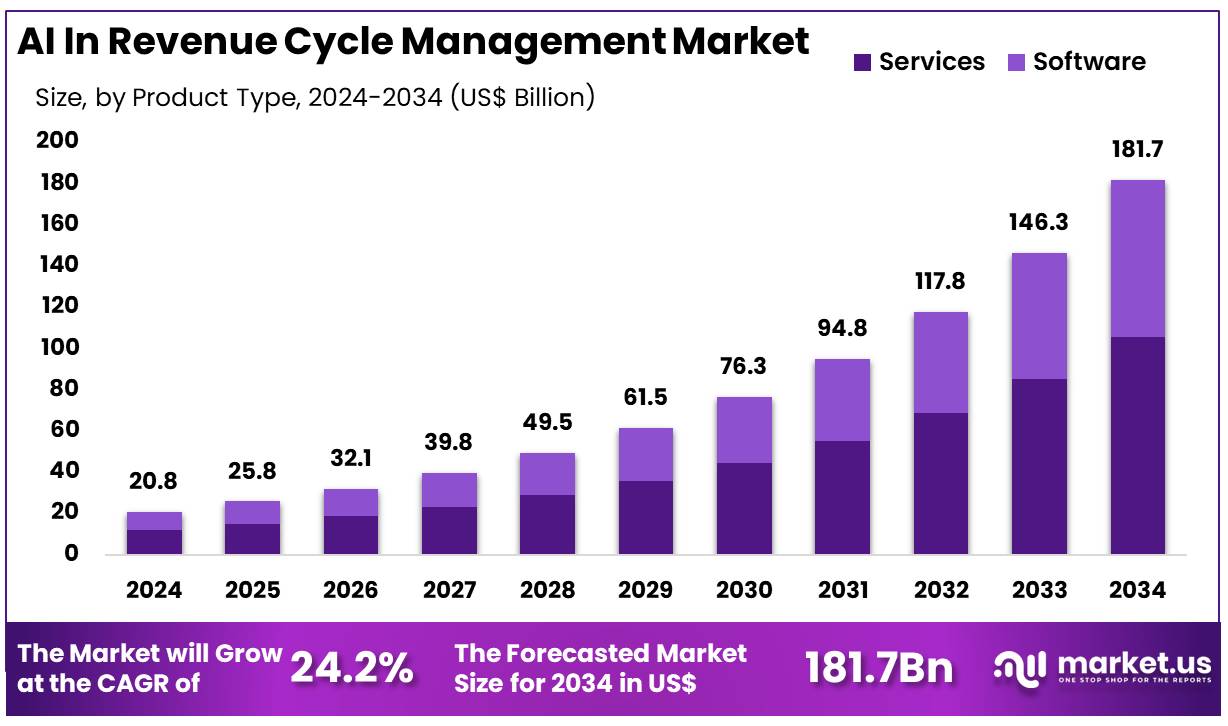
Global AI In Revenue Cycle Management Market size is expected to be worth around US$ 181.7 Billion by 2034 from US$ 20.8 Billion in 2024, growing at a CAGR of 24.2% during the forecast period 2025 to 2034. In 2024, North America led the market, achieving over 48.1% share with a revenue of US$ 10.0 Billion.
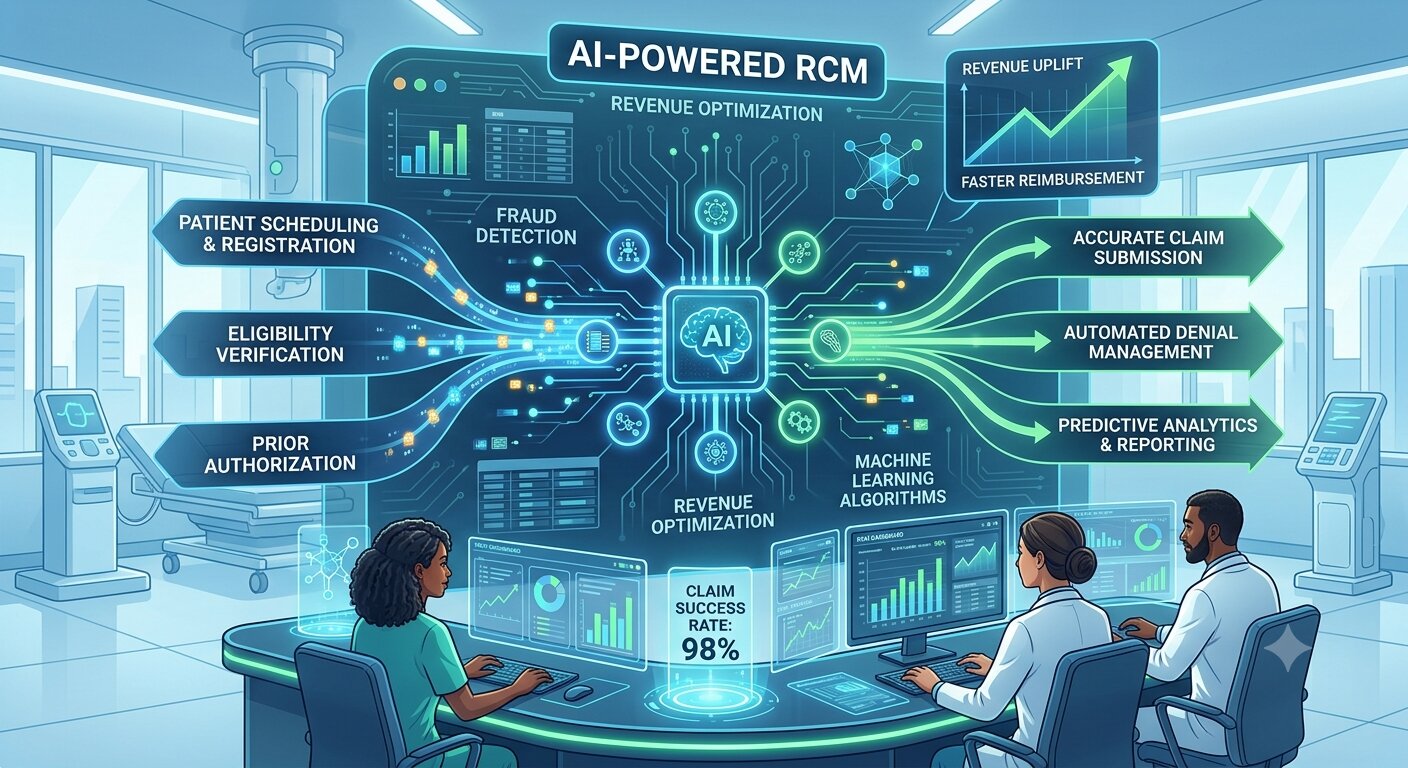
Artificial Intelligence (AI) is transforming healthcare revenue cycle management by improving administrative efficiency, reducing manual workloads, and enabling faster processing of claims, billing, coding, and payment workflows. Healthcare providers are increasingly adopting AI-powered solutions to address challenges such as claim denials, documentation gaps, insurance verification delays, and complex reimbursement procedures.
AI technologies, including machine learning, natural language processing, and automation tools, are helping organizations analyze large volumes of healthcare data and improve financial decision-making.
Government healthcare agencies are also exploring AI adoption to enhance operational performance. The Centers for Medicare & Medicaid Services (CMS) has highlighted AI as a tool to improve productivity, strengthen data-driven decision-making, and support healthcare program operations. CMS reported the deployment of multiple AI and automation solutions that improved efficiency across internal processes and reduced administrative workloads.
The increasing focus on digital healthcare infrastructure, electronic claims processing, and value-based care models is encouraging hospitals, clinics, and healthcare organizations to integrate AI into revenue cycle workflows.
According to an American Medical Association (AMA) survey, 57% of physicians identified reducing administrative burdens through automation as one of the biggest opportunities for AI adoption. AI-powered revenue cycle solutions are helping healthcare organizations improve claims accuracy, streamline coding processes, and reduce operational complexity.
AI-driven revenue cycle platforms are expected to play a significant role in creating more accurate billing systems, improving reimbursement timelines, and allowing healthcare professionals to focus more on patient-centered activities.
As healthcare organizations continue investing in automation and responsible AI implementation, revenue cycle management is becoming a key area for digital transformation.
Key Takeaways
- In 2024, the AI in Revenue Cycle Management Market generated US$ 20.8 billion in revenue and is projected to reach US$ 181.7 billion by 2034, growing at a CAGR of 24.2% during the forecast period.
- Based on product type, the market is segmented into software and services. The services segment dominated in 2024, accounting for a 58.2% market share.
- By technology, the market is categorized into integrated and standalone solutions. The integrated segment held a leading position, capturing a 63.5% share of the market.
- By application, the market is segmented into claims management, revenue integrity, prior authorization, patient eligibility verification, denials management, coding and billing, and others. Among these, claims management emerged as the dominant segment, holding the largest revenue share of 25.5%.
- Based on delivery mode, the market is divided into web-based and cloud-based platforms. The web-based segment led the market with a 54.1% revenue share.
- By end-user, the market is segmented into hospitals, diagnostic laboratories, physician practices, and others. The hospitals segment accounted for a significant market share of 45.3%.
- Regionally, North America dominated the AI in Revenue Cycle Management Market in 2024, capturing a 48.1% market share.
Statistical Information
- A 2024 American Medical Association (AMA) physician survey found that 66% of physicians were already using AI tools in their practices, increasing significantly from 38% in 2023, showing rapid adoption of AI across healthcare workflows.
- According to the AMA survey, 57% of physicians identified reducing administrative burden through automation as the biggest opportunity for AI, highlighting strong demand for AI-driven revenue cycle solutions such as automated documentation, coding, and claims processing.
- The AMA survey showed that 75% of physicians believed AI could improve work efficiency, while 54% expected AI tools to help reduce stress and burnout, demonstrating the importance of automation in healthcare operations.
- Physician adoption of AI depends heavily on workflow integration and trust. The AMA reported that 84% of physicians considered seamless EHR integration an important factor for advancing AI adoption, supporting the need for integrated revenue cycle management platforms.
- The U.S. Department of Health and Human Services (HHS) reported that its 2024 AI Use Case Inventory included 271 AI applications, representing a 66% increase compared with 163 use cases in 2023. These applications cover operational, administrative, and healthcare-related functions.
- HHS has documented AI applications across agencies including the Centers for Medicare & Medicaid Services (CMS), where AI is being explored for operational improvements, automation, and enhanced data-driven decision-making.
- Healthcare organizations are increasingly prioritizing AI solutions that improve financial workflows. According to AMA physician feedback, 54% of physicians believed AI could provide benefits in revenue-related activities, showing growing acceptance of AI in healthcare financial operations.
- Data privacy and governance remain key considerations for healthcare AI adoption. The AMA survey found that 87% of physicians identified data privacy assurances as an important requirement for increasing trust in AI tools.
- AI-driven automation is becoming a strategic focus for healthcare organizations as administrative complexity increases. HHS continues to maintain annual AI inventories to improve transparency, accountability, and responsible AI implementation across government healthcare operations.
- CMS has incorporated AI-related initiatives within its operational environment, including AI tools focused on improving processes, analyzing information, and supporting healthcare program administration.
- The AMA survey indicated that 88% of physicians valued having a feedback channel for AI systems, reflecting the importance of continuous monitoring and improvement for AI-based healthcare administration tools.
Regional Analysis
North America Leads the AI in Revenue Cycle Management Market
North America dominated the AI in Revenue Cycle Management Market with a 48.1% market share in 2024, supported by advanced healthcare infrastructure, strong digital health adoption, and increasing demand for automation in administrative workflows. Healthcare organizations in the region are implementing AI solutions to improve claims processing, coding accuracy, payment operations, and revenue optimization.
The U.S. healthcare sector is also witnessing growing government support for responsible AI adoption. The U.S. Department of Health and Human Services (HHS) maintains an AI Use Case Inventory to improve transparency and track AI applications across healthcare and administrative functions. The 2024 HHS AI Use Case Inventory included 271 AI use cases, representing a 66% increase from 163 use cases in 2023.
Asia Pacific Expected to Register Fastest Growth
Asia Pacific is projected to witness the fastest growth due to expanding digital healthcare initiatives, rising healthcare investments, and government-led technology modernization programs. Countries including India, China, and Australia are strengthening digital health ecosystems to improve healthcare accessibility and operational efficiency.
India’s Ayushman Bharat Digital Mission (ABDM) has accelerated digital healthcare adoption, with the government reporting more than 730 million Ayushman Bharat Health Accounts (ABHA) created by early 2025. These digital foundations are expected to support AI-driven healthcare administration, including automated billing, claims management, and financial workflow optimization.
Emerging Trends
- AI-Based Claims Automation and Denial Management: AI is increasingly being used to automate claim review, identify errors before submission, and reduce payment delays. Healthcare organizations are adopting AI tools that analyze payer rules and claim patterns to prevent denials. Myriad Genetics rebuilt its AI document platform and reduced prior authorization document processing time from 10 minutes to 20 seconds.
- Generative AI for Administrative Workflow Improvement: Generative AI is becoming an important technology for reducing repetitive revenue cycle tasks such as documentation review, coding assistance, and insurance communication. Healthcare providers are exploring AI assistants that summarize records, extract billing information, and support faster administrative decisions, helping staff focus on complex cases.
- Rise of AI Agents in Revenue Cycle Operations: Healthcare organizations are moving toward AI agents capable of performing multi-step administrative activities, including eligibility checks, claims follow-up, denial resolution, and payer communication. Companies developing AI RCM platforms are focusing on autonomous workflows that operate continuously across existing healthcare systems.
- Integrated AI Platforms Connecting End-to-End RCM Processes: Hospitals are shifting from separate automation tools toward integrated AI platforms covering coding, billing, claims, payment tracking, and analytics. AI solutions that connect with existing healthcare systems are gaining attention because they reduce manual data movement and improve workflow visibility.
- Predictive Analytics for Revenue Optimization: Predictive AI models are being adopted to identify revenue risks, forecast payment delays, and improve financial performance. These solutions analyze historical claims and payer behavior to support proactive decisions. Healthcare AI analysts estimate that AI-enabled revenue cycle improvements could reduce cost-to-collect by 30% to 60%.
Use Cases
- Automated Medical Coding and Documentation Review: AI-powered coding systems analyze clinical documentation, suggest appropriate codes, and identify missing information before claims are submitted. This helps healthcare providers improve coding accuracy, reduce compliance risks, and accelerate reimbursement workflows. AI platforms are increasingly supporting coding validation and documentation improvement processes.
- Prior Authorization Automation: AI is being used to simplify prior authorization by extracting patient information, reviewing documentation requirements, and preparing submissions. Myriad Genetics’ AI platform processed 9,000 prior authorizations after redesigning its workflow with generative AI technology.
- Intelligent Eligibility Verification: Healthcare providers are implementing AI tools to automatically verify insurance eligibility, analyze patient coverage details, and reduce front-office workload. These systems help improve claim readiness by identifying coverage issues before treatment billing begins.
- AI-Based Patient Payment and Financial Engagement: AI solutions are being used to improve patient billing communication, payment reminders, and financial assistance workflows. These tools help organizations provide personalized financial interactions while reducing manual administrative efforts for revenue cycle teams.
- Automated Accounts Receivable and Denial Follow-Up: AI agents are supporting accounts receivable management by tracking unpaid claims, identifying denial reasons, and recommending next actions. Some AI RCM platforms report automation of repetitive payer interactions, helping organizations reduce manual follow-up activities.
Frequently Asked Questions About AI in Revenue Cycle Management
- What is AI in Revenue Cycle Management?
AI in Revenue Cycle Management refers to the use of artificial intelligence technologies to automate healthcare financial processes, including claims processing, coding, billing, eligibility verification, and denial management. It helps healthcare providers improve accuracy, reduce manual tasks, and enhance financial operations. - How does AI improve revenue cycle management in healthcare?
AI improves revenue cycle management by analyzing large healthcare datasets, identifying claim issues, automating repetitive workflows, and supporting faster financial decisions. Healthcare organizations use AI to improve reimbursement processes, reduce administrative workload, and strengthen overall revenue performance. - How is generative AI used in revenue cycle management?
Generative AI supports revenue cycle operations by analyzing documents, summarizing information, assisting administrative communication, and automating workflow tasks. Healthcare organizations are using generative AI to improve processes such as prior authorization, documentation review, and claims-related activities. - What role do AI agents play in revenue cycle management?
AI agents are emerging as advanced automation tools capable of handling multi-step administrative activities. They can support claims follow-up, eligibility verification, denial management, and patient financial engagement by reducing repetitive manual work and improving operational speed. - Is AI in revenue cycle management secure for healthcare data?
AI solutions must follow strict healthcare privacy, security, and governance standards because they process sensitive patient and financial information. CMS emphasizes responsible AI adoption with proper safeguards to protect healthcare data while improving operational efficiency. - What technologies support AI in revenue cycle management?
AI revenue cycle platforms commonly use machine learning, natural language processing, predictive analytics, and automation technologies. These tools help extract information from healthcare documents, identify financial patterns, improve coding accuracy, and optimize administrative workflows. - What is the future outlook for AI in revenue cycle management?
The future of AI in revenue cycle management will focus on integrated automation, predictive analytics, AI agents, and smarter financial workflows. Healthcare organizations are expected to increase AI adoption to improve claims accuracy, reduce administrative burden, and create more efficient revenue operations.
Conclusion
The AI in Revenue Cycle Management Market is witnessing significant growth as healthcare organizations increasingly adopt artificial intelligence to improve financial operations, automate administrative workflows, and enhance revenue optimization. AI-powered solutions are transforming claims processing, coding, denial management, and payment systems by reducing manual efforts and improving accuracy.
Government initiatives and healthcare organizations are supporting responsible AI adoption to strengthen operational efficiency. With rising demand for automation, integrated platforms, and predictive analytics, AI is expected to become a critical component of modern healthcare revenue cycle strategies. The continued adoption of AI technologies will drive smarter, faster, and more efficient healthcare financial management worldwide.




















