


Overview
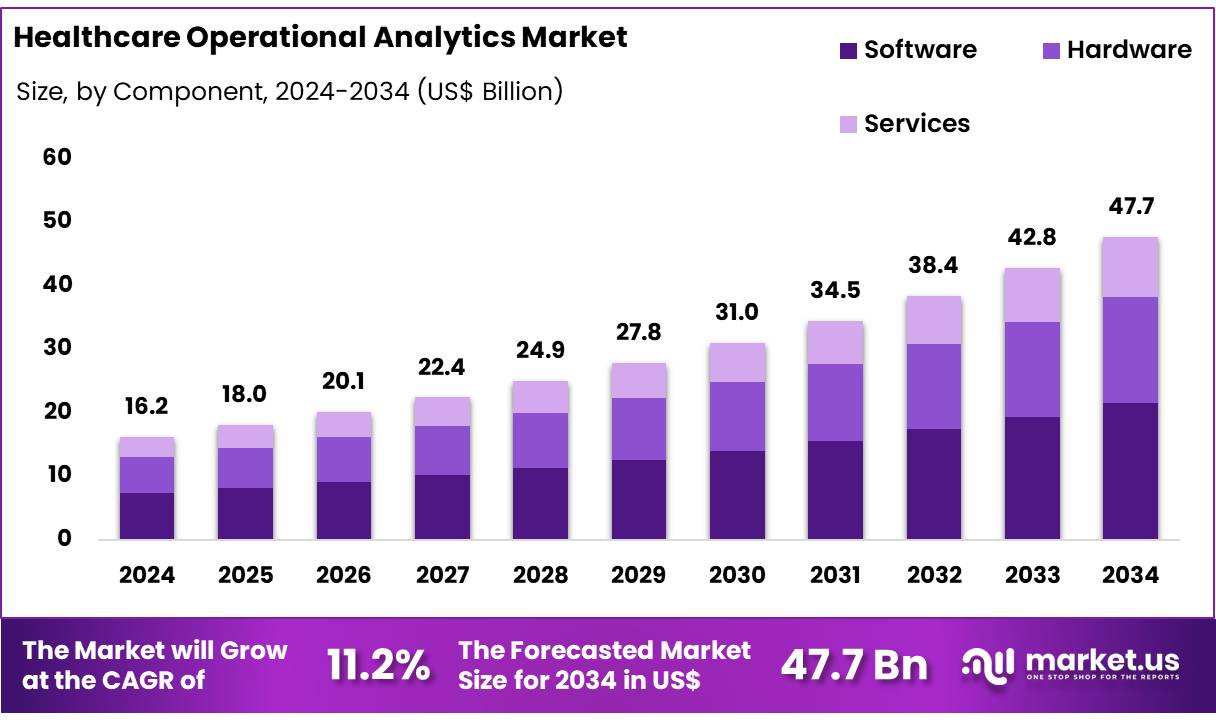
Global Healthcare Operational Analytics Market size is expected to be worth around US$ 47.7 Billion by 2034 from US$ 16.2 Billion in 2024, growing at a CAGR of 11.4% during the forecast period from 2025 to 2034. In 2024, North America led the market, achieving over 48.4% share with a revenue of US$ 7.3 Billion.
Healthcare operational analytics is becoming a critical component of modern healthcare systems as providers, payers, and public health organizations increasingly rely on data-driven decision-making to improve efficiency, reduce costs, and enhance patient outcomes. Governments and healthcare agencies continue to promote secure data exchange, interoperability, and advanced analytics to strengthen healthcare delivery.
The U.S. Centers for Medicare & Medicaid Services (CMS) has expanded initiatives that encourage the adoption of interoperable health information systems using modern standards such as HL7 FHIR, enabling healthcare organizations to access timely clinical data for operational and administrative decision-making.
The U.S. Centers for Disease Control and Prevention (CDC) is also advancing nationwide public health data modernization by supporting standardized data exchange and integrated analytics across healthcare systems. According to the CDC, interoperable data systems improve surveillance, accelerate outbreak detection, and enable healthcare organizations to respond more effectively to public health events through faster access to reliable information.
Operational analytics platforms are increasingly being used to optimize hospital resource utilization, workforce planning, patient flow, and financial performance. As healthcare organizations generate growing volumes of electronic health records and administrative data, advanced analytics helps identify operational bottlenecks and supports evidence-based management decisions. CMS also emphasizes that secure electronic health information exchange improves care coordination, operational efficiency, and patient-centered services across the healthcare ecosystem.
One notable indicator of digital transformation is the continued expansion of certified electronic health record adoption across U.S. hospitals, which exceeds 96%, providing a strong foundation for operational analytics and data-driven healthcare management. Additionally, the CDC continues investing in modern public health data technologies to improve real-time analytics and information sharing across healthcare networks.
Key Takeaways
- The global healthcare operational analytics market was valued at USD 16.2 billion in 2024 and is projected to reach USD 47.7 billion by 2034, expanding at a CAGR of 11.4% during the forecast period.
- In 2024, the software segment dominated the global healthcare operational analytics market, accounting for 46.5% of the total revenue share.
- In 2024, the financial analytics segment held the largest market share, contributing 42.4% of the global revenue.
- In 2024, the hospitals segment emerged as the leading end-user, capturing 38.5% of the total market revenue.
- North America led the global healthcare operational analytics market in 2024, representing more than 48.4% of the total revenue share.
Statistical Information
- More than 99% of U.S. non-federal acute care hospitals had adopted certified Electronic Health Records (EHRs) by 2024, providing a strong digital foundation for operational analytics, clinical workflow optimization, and hospital performance management.
- 91% of U.S. office-based physicians were using certified EHR systems in 2024, significantly expanding the volume of structured clinical data available for healthcare analytics and operational decision-making.
- 76% of U.S. hospitals were actively engaged in all four key domains of interoperable electronic health information exchange by 2025 sending, receiving, finding, and integrating patient information supporting advanced operational and financial analytics.
- The National Electronic Health Records Survey (NEHRS), conducted by the U.S. Centers for Disease Control and Prevention (CDC), collects nationwide data on EHR adoption, interoperability, and physician participation in health information exchange programs, demonstrating continued federal monitoring of healthcare digital transformation.
- The Office of the National Coordinator for Health Information Technology (ONC) maintains national datasets tracking hospital EHR adoption, patient engagement capabilities, and interoperable health information exchange, enabling healthcare organizations to benchmark operational performance.
- A 2024 national survey of 2,174 U.S. non-federal hospitals found that 31.5% had already implemented generative AI integrated with their EHR systems, while 24.7% planned implementation within one year, indicating rapid adoption of AI-driven operational analytics.
- Since the HITECH Act, certified EHR adoption among U.S. hospitals has increased more than tenfold over approximately 15 years, enabling widespread digitization of clinical and administrative workflows that support operational analytics.
- ONC reports that nearly every inpatient encounter in U.S. non-federal acute care hospitals is now documented electronically, creating extensive real-world datasets for resource planning, quality measurement, and operational intelligence.
Regional Analysis
North America accounted for the largest share of the healthcare operational analytics market in 2024, supported by its advanced digital healthcare ecosystem, extensive use of electronic health records (EHRs), and continued investments in healthcare interoperability. The United States remains the primary contributor due to widespread adoption of certified health IT, robust healthcare data infrastructure, and increasing demand for value-based care.
The Centers for Medicare & Medicaid Services (CMS) continues to promote interoperability through its Promoting Interoperability Program, encouraging hospitals and clinicians to use certified EHR technology to improve care quality, efficiency, and secure data exchange. The Medicare Access and CHIP Reauthorization Act (MACRA) has further strengthened the adoption of analytics by linking quality performance with reimbursement models.
CMS is also advancing a nationwide interoperability framework that supports standardized health information exchange using modern data standards, enabling providers and payers to leverage operational analytics for better resource management and clinical decision-making. Strong investments in AI-enabled healthcare solutions, combined with growing use of claims analytics and population health management, continue to reinforce North America’s leadership in the global healthcare operational analytics market.
Emerging Trends
- Healthcare interoperability is becoming a top priority. OECD estimates that achieving full interoperability could generate benefits equivalent to 2.7%–6.6% of annual health expenditure by reducing duplicate tests, improving care coordination, and enabling faster operational decisions across healthcare systems.
- Cloud-based healthcare analytics is expanding rapidly. According to the OECD, 25 countries have already established national cloud infrastructure strategies for health, while 27 countries have adopted national health interoperability strategies to support scalable analytics, AI deployment, and secure healthcare data sharing.
- Digital quality measurement is replacing manual reporting. The CDC’s NHSNLink uses HL7 FHIR standards to automatically extract clinical data from hospital EHRs, helping healthcare organizations reduce manual reporting while improving operational monitoring, infection surveillance, and quality performance analysis.
- Federal agencies are accelerating public health interoperability. Since 2025, the CDC and ASTP/ONC have jointly advanced nationwide interoperability initiatives using FHIR standards and TEFCA, enabling healthcare organizations to exchange standardized data for operational analytics and faster public health responses.
- Healthcare organizations are building connected data ecosystems. In 2026, CMS expanded its Health Technology Ecosystem with dozens of participating organizations and data networks, encouraging real-time, secure information exchange that strengthens operational analytics, patient coordination, and value-based healthcare delivery.
Use Cases
- Hospital capacity and operational planning are becoming more data-driven. As of May 2026, 139 NHS trusts were live on the NHS Federated Data Platform, using analytics to improve operational planning, resource allocation, and hospital performance across the healthcare system.
- Healthcare analytics is improving organizational performance reporting. The NHS reported 137 trusts actively measuring operational benefits through its Federated Data Platform, allowing healthcare providers to monitor efficiency, streamline back-office processes, and support evidence-based management decisions.
- Integrated regional healthcare management is expanding. By May 2026, 35 NHS Integrated Care Boards had adopted the Federated Data Platform, enabling shared operational analytics across hospitals and care providers to improve regional healthcare coordination and resource utilization.
- Public health agencies are using cloud analytics for faster decision-making. The CDC’s Data Modernization Initiative includes the One CDC Data Platform and Enterprise Data, Analytics and Visualization (EDAV), allowing analysts to integrate data more efficiently and accelerate operational insights across public health programs.
- Operational analytics is supporting secure multi-system data integration. The CDC promotes electronic case reporting, standardized surveillance systems, and interoperable data exchange so healthcare organizations can combine information from multiple sources, improving operational efficiency, outbreak response, and healthcare planning.
Frequently Asked Questions About Healthcare Operational Analytics
- Why is healthcare operational analytics important?
Healthcare operational analytics helps organizations identify operational bottlenecks, improve patient flow, manage staffing, reduce unnecessary spending, and monitor quality performance. It enables healthcare providers to make evidence-based decisions using real-time and historical data for continuous improvement. - What is driving the growth of the healthcare operational analytics market?
The market is growing due to increasing adoption of electronic health records, value-based healthcare models, healthcare interoperability initiatives, artificial intelligence, and the growing need to manage rising healthcare costs while improving patient outcomes and operational efficiency. - Which healthcare organizations benefit most from operational analytics?
Hospitals, integrated health systems, physician groups, health insurers, government healthcare agencies, and outpatient care providers benefit significantly from operational analytics by improving resource utilization, financial management, quality reporting, and patient care coordination. - What are the major data sources used in healthcare operational analytics?
Healthcare operational analytics combines information from electronic health records, insurance claims, laboratory systems, pharmacy records, financial applications, scheduling systems, patient surveys, and connected medical devices to generate actionable operational insights. - What challenges affect the healthcare operational analytics market?
Organizations often face challenges such as fragmented data, interoperability limitations, cybersecurity risks, privacy regulations, inconsistent data quality, and integration of multiple healthcare information systems. Addressing these issues is essential for maximizing analytics performance. - How does healthcare operational analytics support value-based care?
Operational analytics measures quality indicators, healthcare utilization, patient outcomes, and resource efficiency, helping providers meet value-based care objectives while improving care coordination and reducing avoidable healthcare costs through continuous performance monitoring. - What is the future outlook for the healthcare operational analytics market?
The future of the healthcare operational analytics market is expected to be shaped by greater adoption of cloud platforms, predictive analytics, AI-powered automation, interoperable health information exchange, and real-time operational intelligence that supports more efficient, patient-centered healthcare delivery.
Conclusion
The healthcare operational analytics market is expected to witness strong growth as healthcare organizations increasingly adopt data-driven strategies to improve operational efficiency, financial performance, and patient care. Rising implementation of certified electronic health records, interoperability initiatives, artificial intelligence, and cloud-based analytics platforms is accelerating digital transformation across the healthcare sector.
Government-led programs from the U.S. Centers for Medicare & Medicaid Services (CMS) and other public health agencies continue to promote standardized health information exchange, enabling more effective clinical and operational decision-making. As providers focus on value-based care, resource optimization, and real-time insights, healthcare operational analytics will remain a critical technology for improving healthcare delivery, reducing administrative burden, and supporting sustainable, patient-centered healthcare systems worldwide.




















