Report Overview
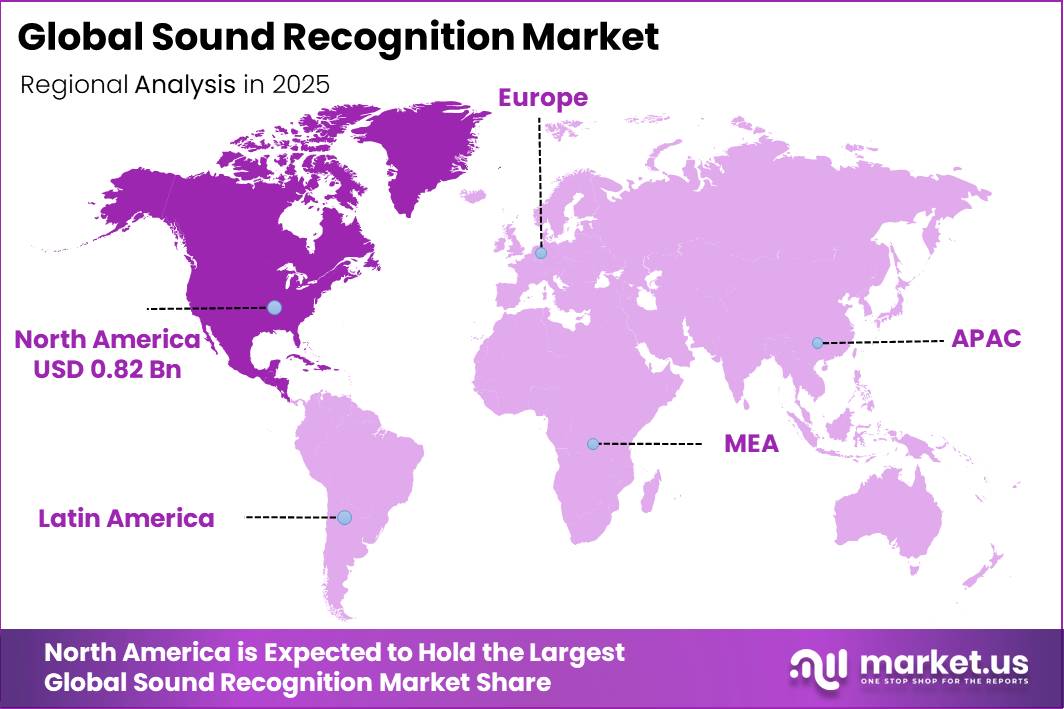
In 2025, the Global Sound Recognition Market was valued at USD 2.1 billion. The market is projected to grow at a CAGR of 17.2% during 2026–2035, reaching approximately USD 10.1 billion by 2035. North America dominated the global market in 2025, accounting for more than 38.9% of the total market share and generating approximately USD 0.82 billion in revenue.
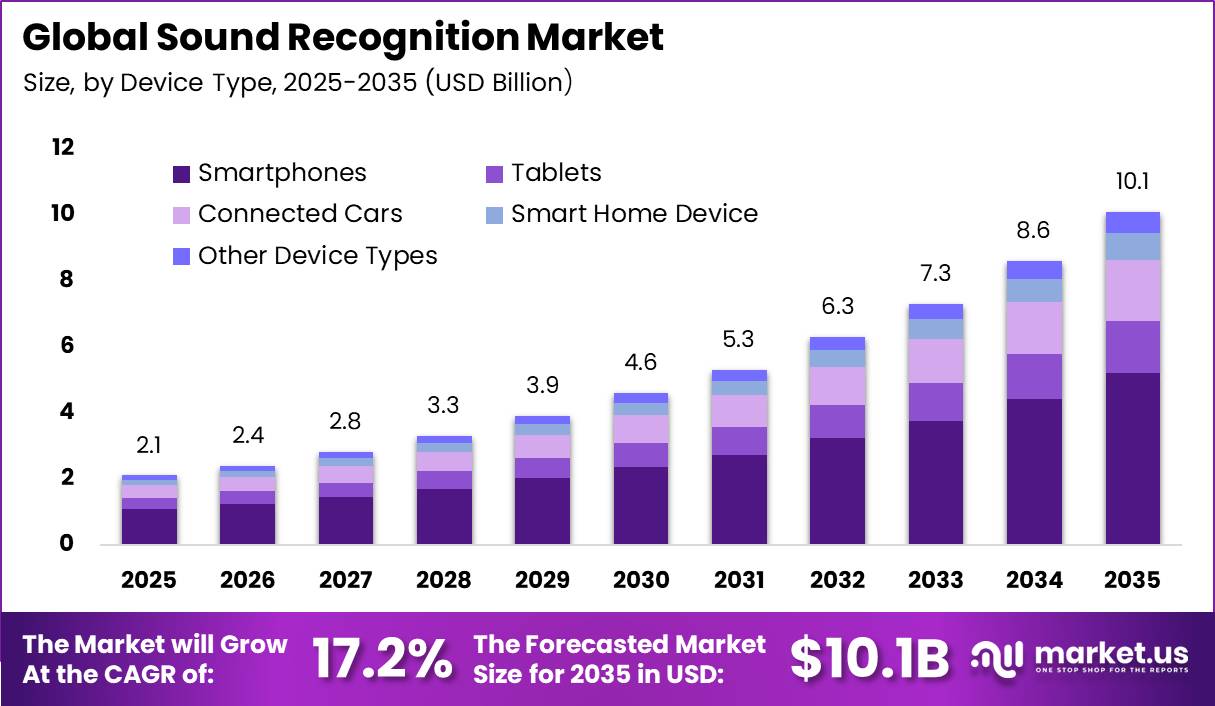
Market growth is supported by the increasing use of AI-based audio analysis across automotive, consumer electronics, industrial facilities, security systems, and healthcare. Sound recognition technology can identify speech, alarms, machine vibration, glass breaking, and battery venting sounds and convert them into useful alerts. Electric vehicles are creating a strong demand base for these solutions.
According to the International Energy Agency, global electric-car sales exceeded 17 million units in 2024, increasing by more than 25%, and are expected to cross 20 million units in 2025. NIST has also shown that AI systems can detect the sound of an overheating lithium-ion battery with 94% accuracy, supporting safety applications in vehicles, battery storage, and industrial environments.
UNCTAD reported that global corporate AI investment increased from USD 15 billion in 2013 to USD 189 billion in 2023, while the United States accounts for about 45% of global data centres. Healthcare also offers strong opportunities, as the World Health Organization estimates that more than 1.5 billion people experience hearing loss, including nearly 430 million people who require rehabilitation services.
Key Takeaway
- The Sound Recognition Market is valued at USD 2.1 billion in 2025, projected to reach USD 10.1 billion by 2035 at a CAGR of 17.2% (2026–2035).
- Smartphones lead the sound recognition market with a 51.5% share, driven by widespread device adoption and built-in audio capabilities.
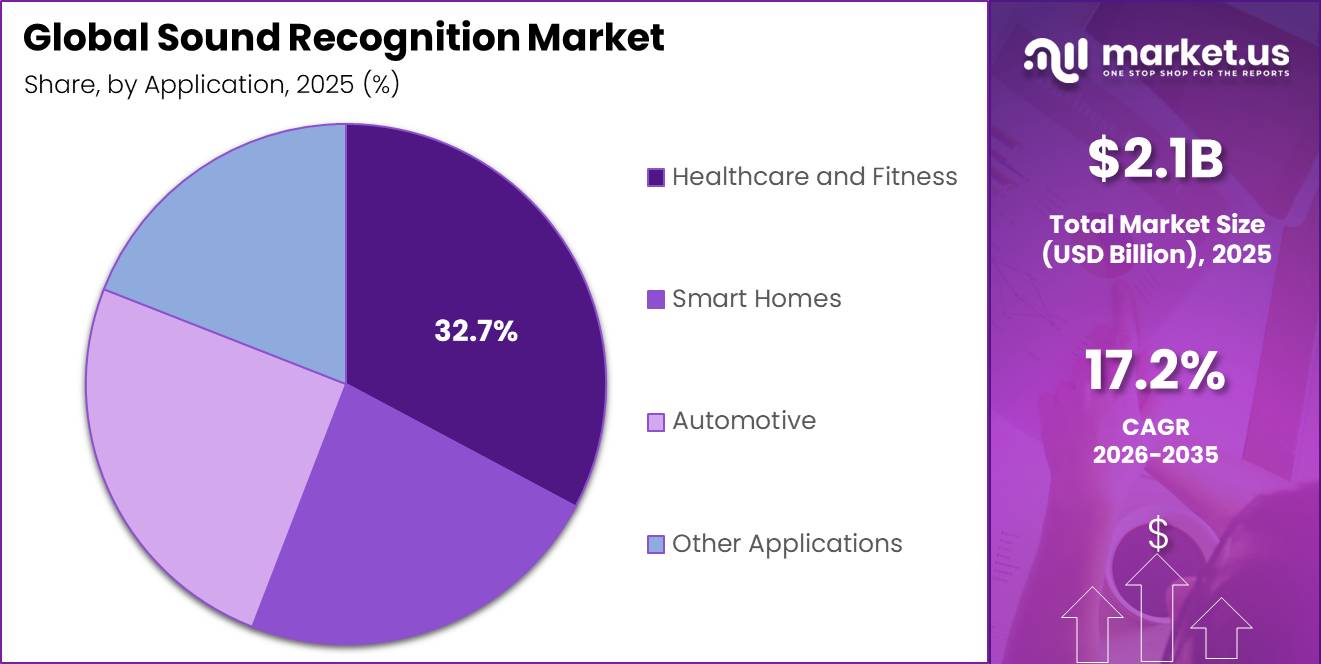
- Healthcare and fitness holds a 32.7% share, supported by growing demand for continuous audio-based health monitoring.
- North America led the market in 2025 with over 38.9% share and about USD 0.82 billion in revenue.
Market Statistics and Data Insights
- In Canada, 20.6% of businesses already using AI used speech or voice recognition in Q2 2026, compared with 20.0% in Q2 2025. Natural-language processing was used by 27.0%, while virtual agents or chatbots were used by 28.2% of AI-using businesses.
- Overall business AI adoption in Canada reached 19.2% in Q2 2026, up from 12.2% in Q2 2025 and 6.1% in Q2 2024, meaning adoption more than tripled within 2 years. Information and cultural businesses recorded 42.3% AI adoption, while finance and insurance reached 40.4%.
- Alphabet reported in its Q4 2025 earnings call that nearly 1 in 6 AI Mode queries were non-text queries using voice or images. AI Mode queries were also around 3 times longer than traditional searches, indicating that consumers are moving toward conversational and multimodal interactions.
- Google reported that Circle to Search was available on more than 580 million Android devices by early 2026.
- Ofcom’s 2025 Audio Survey found that 71% of voice-assistant users used voice assistants for both radio and other audio such as music or podcasts. Among voice-assistant users who listened to radio, 54% made voice requests through smart speakers, compared with 20% through smartphones.
- Around 6 billion people, equal to approximately 74% of the global population, were using the internet in 2025. This increased from a revised 5.8 billion users in 2024, adding more than 240 million users in a single year.
- More than 96% of the world’s population was covered by a mobile-broadband network in 2025, widening the addressable base for cloud-connected voice recognition, real-time transcription, sound alerts, and edge-AI applications.
- In the European Union, 76% of internet users used an internet-connected device or system in 2024. Around 67% used smart-home entertainment products, including smart TVs, home audio systems and smart speakers, while 32% used a smartwatch, fitness band or similar wearable.
- Apple’s current Sound & Name Recognition feature can recognize 15 different sounds using on-device intelligence. Users can also train devices to recognize their name or specific electronic sounds such as alarms, doorbells, and appliance beeps.
- NIST researchers trained an AI system using recordings from 38 lithium-ion batteries, expanding them into more than 1,000 audio samples. The system detected the sound of an overheating battery 94% of the time, even when other background sounds were present.
- More than 1.5 billion people, or nearly 20% of the global population, currently live with some degree of hearing loss, while approximately 430 million people have disabling hearing loss.
- WHO reports that hearing-aid production currently meets less than 10% of global demand, despite around 1.5 billion people living with hearing loss.
By Device Type
Smartphones dominate the sound recognition market with a 51.5% share, supported by their large global user base and built-in microphones, speakers, processors, and internet connectivity. According to the International Telecommunication Union, around 5.5 billion people were using the internet in 2024, while four in five people aged above 10 owned a mobile phone.
GSMA reported that smartphones accounted for nearly 80% of global mobile connections in 2024, representing about 5.8 billion connections. At the same time, global 5G connections exceeded 2 billion by the end of 2024. This wide device base makes smartphones a major platform for voice assistants, speech-to-text services, voice search, real-time translation, call transcription, music recognition, and emergency sound alerts.
By Application
Healthcare and fitness lead the sound recognition market with a 32.7% share, supported by the growing use of audio-based technologies for continuous and convenient health monitoring. According to the World Health Organization, around 1.8 billion adults, representing 31% of the global adult population, did not meet recommended physical activity levels in 2022.
This proportion could increase to 35% by 2030, highlighting the need for digital tools that encourage healthier lifestyles. Sound recognition supports applications such as voice-guided fitness coaching, exercise tracking, fall detection, breathing analysis, cough monitoring, and hands-free health recording.
The technology can also reduce the need for users to enter health information manually. Population ageing is creating another major opportunity for the segment. WHO estimates that around 1.4 billion people worldwide will be aged 60 years or above by 2030.
Key Market Segments
By Device Type
- Smartphones
- Tablets
- Connected Cars
- Smart Home Device
- Other Device Types
By Application
- Healthcare and Fitness
- Smart Homes
- Automotive
- Other Applications
Geopolitical Impact Analysis
Geopolitical disruptions are increasing supply-chain risks and production costs across the sound recognition market. Devices such as smartphones, wearables, smart speakers, and industrial monitoring systems depend on MEMS microphones, processors, memory chips, printed circuit boards, lithium-ion batteries, and rare-earth materials.
According to the IEA, the top 3 producing countries controlled 86% of refining capacity for key energy minerals in 2024, compared with 82% in 2020. China alone accounted for around 44% of global copper refining, 70–75% of lithium and cobalt processing, and more than 90% of rare-earth and battery-grade graphite refining.
This high concentration means export controls, factory disruptions, or trade restrictions can quickly affect global component supply. The U.S. Trade Representative also increased tariffs on selected Chinese semiconductors to 50% in 2025, while certain tungsten products faced 25% tariffs and specified silicon wafers and polysilicon faced 50% tariffs.
Shipping disruptions are adding further pressure. UNCTAD reported that Red Sea and Suez Canal disruptions added 148 percentage points to the China Containerized Freight Index’s cumulative 120% increase between October 2023 and June 2024. Bulk-vessel transits through the Suez Canal declined 22.3% year over year in the first quarter of 2024 and 97.8% in the second quarter.
Longer shipping routes can delay microphones, chips, batteries, and finished devices while increasing inventory and logistics costs. The World Bank projected global commodity prices to decline 12% in 2025 and another 5% in 2026, which may provide some cost relief. However, continued geopolitical uncertainty is encouraging suppliers to adopt regional manufacturing, dual sourcing, larger inventories, and long-term component agreements.
Regional Analysis
North America led the global sound recognition market in 2025, accounting for 38.9% of total revenue and around USD 0.82 billion in market value. The region benefits from a strong AI ecosystem, high use of connected devices, advanced healthcare systems, and early adoption of voice-enabled business technologies. Sound recognition is widely used in smartphones, smart speakers, vehicles, medical devices, contact centres, security systems, and industrial monitoring.
These applications depend on advanced microphones, edge processors, cloud infrastructure, and AI models that can recognize speech, alarms, equipment faults, coughs, and other sounds. In the United States, the National Science Foundation requested USD 729.1 million for artificial intelligence investments under its FY2025 budget, supporting research in machine learning, perception, reasoning, and trustworthy AI.
Canada is also supporting regional growth through wider business use of AI. Statistics Canada reported that 12.2% of Canadian businesses used AI to produce goods or provide services in the second quarter of 2025, compared with 6.1%oneyear earlier. This represents a doubling of adoption and supports demand for voice transcription, call analysis, fraud detection, accessibility tools, and workflow automation.
Asia Pacific is expected to be the fastest-growing region, supported by its large smartphone base, expanding 5G networks, strong electronics manufacturing sector, and rapid digitalisation. Growing use of multilingual voice interfaces, wearable devices, connected vehicles, and acoustic monitoring in factories is expected to drive faster unit demand.
Key Regions and Countries
- North America
- US
- Canada
- Europe
- Germany
- France
- The UK
- Spain
- Italy
- Rest of Europe
- Asia Pacific
- China
- Japan
- South Korea
- India
- Australia
- Rest of APAC
- Latin America
- Brazil
- Mexico
- Rest of Latin America
- Middle East & Africa
- GCC
- South Africa
- Rest of MEA
Market Dynamics
Drivers
| Driver | (~) % CAGR | Geographic Relevance | Impact Timeline |
|---|---|---|---|
| Smartphone Audio AI Integration | +3.2% | Global | Short term (2 years or less) |
| Enterprise Call Analytics Adoption | +2.4% | North America & Europe | Short term (2 years or less) |
| Edge AI Hardware Rollout | +2.1% | Global | Medium term (2 to 4 years) |
| Connected Healthcare Monitoring | +1.8% | North America, Europe & Asia Pacific | Medium term (2 to 4 years) |
| Industrial Acoustic Maintenance | +1.4% | Europe & Asia Pacific | Medium term (2 to 4 years) |
Smartphone Audio AI Integration
Smartphone integration is a major growth driver because it makes sound recognition a built-in feature rather than a separate software purchase. The International Telecommunication Union reported 5.5 billion internet users in 2024, while GSMA stated that smartphones represented 80% of global mobile connections, equal to around 5.8 billion connections.
Alphabet reported that Circle to Search was available on more than 580 million Android devices by 2026, while nearly 1 in 6 AI Mode queries used voice or image inputs. This large installed base allows device makers to offer speech recognition, transcription, translation, accessibility, and environmental-sound detection at scale, supporting recurring software, cloud-processing, and premium-device revenue.
Restraints
| Restraint | (~) % CAGR | Geographic Relevance | Impact Timeline |
|---|---|---|---|
| Biometric Privacy Restrictions | -2.3% | Europe & North America | Short term (2 years or less) |
| High Cloud Inference Costs | -1.7% | Global | Short term (2 years or less) |
| Fragmented Health Reimbursement | -1.4% | North America & Europe | Medium term (2 to 4 years) |
| Restricted Public Audio Collection | -1.2% | Europe | Short term (2 years or less) |
| Enterprise Data Residency | -1.0% | Global | Medium term (2 to 4 years) |
Biometric Privacy Restrictions
Privacy regulations can limit sound recognition deployments when voice data is used to identify people or infer sensitive traits. The EU AI Act entered into force on 1 August 2024, with prohibited-practice and AI-literacy rules applying from 2 February 2025 and broader application beginning on 2 August 2026. The European Commission identifies 9 prohibited AI practices, including emotion recognition in workplaces and education.
For sound recognition providers, these rules can restrict certain use cases and require stronger consent, privacy, and data-governance systems. High-risk requirements for selected sensitive applications apply from 2 December 2027, increasing compliance, documentation, audit, and legal-review costs before regulated products can scale.
Challenges
| Challenge | (~) % CAGR | Geographic Relevance | Mitigation Horizon |
|---|---|---|---|
| Multilingual Model Accuracy | -2.0% | Global | Long term (4 years or more) |
| Chip Supply Concentration | -1.6% | Global | Medium term (2 to 4 years) |
| Acoustic Dataset Scarcity | -1.5% | Global | Long term (4 years or more) |
| Edge Power Constraints | -1.3% | Global | Medium term (2 to 4 years) |
| Integration Skills Gap | -1.1% | North America, Europe & Asia Pacific | Medium term (2 to 4 years) |
Multilingual Model Accuracy
Multilingual accuracy remains a major operational challenge because sound recognition models must understand different accents, local vocabulary, background noise, microphone quality, and industry-specific terms. The International Telecommunication Union reported 5.5 billion internet users in 2024, while UNESCO identifies more than 7,000 living languages worldwide.
The World Health Organization reports that around 1.5 billion people live with hearing loss, increasing the need for reliable captions and speech interfaces. Supporting this level of diversity requires larger language datasets, continuous testing, human review, and regular model monitoring, which raises development costs and can slow international expansion.
Opportunities
| Opportunity | (~) % CAGR | Geographic Relevance | Execution Window |
|---|---|---|---|
| Ambient Clinical Documentation | +2.8% | North America, Europe & Asia Pacific | Medium term (2 to 4 years) |
| Predictive Industrial Audio | +2.1% | Asia Pacific & Europe | Medium term (2 to 4 years) |
| On-Device Safety Monitoring | +1.8% | Global | Long term (4 years or more) |
| Multilingual Voice Commerce | +1.6% | Asia Pacific, Latin America & Africa | Medium term (2 to 4 years) |
| Audio Data Licensing | +1.3% | Global | Long term (4 years or more) |
Ambient Clinical Documentation
Ambient clinical documentation remains a future growth opportunity, as wider adoption still requires secure health-record integration, validated clinical models, workflow changes, and physician trust. WHO projects the global population aged 60 years or older to increase from 1 billion in 2020 to 1.4 billion by 2030, while the CDC reported around 194 million U.S. adults had at least one chronic condition in 2023.
The European Commission’s AI Act gives certain regulated high-risk systems until 2 August 2028 to meet applicable requirements, allowing more time for compliant product development. As adoption expands, providers could move from per-device licensing toward per-clinician subscriptions, reduce manual documentation, and generate higher-margin recurring revenue after integration and validation costs are spread across larger healthcare deployments.
Key Players Analysis
The sound recognition market is mainly led by Tier-1 platform providers, including Google, Amazon Web Services, Microsoft, NVIDIA, and IBM. Together, these companies are estimated to control around 55–65% of the addressable software, cloud, and AI-compute value pool, although sound recognition revenue is not separately reported.
Alphabet generated USD 58.7 billion in Google Cloud revenue in 2025, rising 36%, while R&D spending reached USD 61.1 billion, equal to 15% of total revenue. Microsoft reported USD 281.7 billion in FY2025 revenue, with Azure exceeding USD 75 billion, while 2026 R&D spending reached USD 35.6 billion.
AWS represented 17% of Amazon’s 2025 sales mix and generated USD 7.2 billion in operating income in the first quarter of 2026. NVIDIA recorded USD 215.9 billion in FY2026 revenue and USD 18.5 billion in R&D spending, up 43% year over year. IBM generated USD 30.0 billion in software revenue, USD 23.6 billion in software annual recurring revenue, and spent USD 8.3 billion on R&D in 2025.
It also completed 10 deals during 2025. Among Tier-2 players, Philips reported EUR 5.08 billion in Connected Care sales and EUR 8.5 billion in Diagnosis & Treatment sales in 2025. Specialists such as LumenVox, Vivoka, and SpeechWrite are estimated to hold low-single-digit shares individually.
Top Key Players in the Market
- Google LLC
- Amazon Web Services, Inc.
- Microsoft Corporation
- IBM Corporation
- NVIDIA Corporation
- 3M
- Koninklijke Philips N.V.
- LumenVox
- Vivoka
- SpeechWrite
Recent Developments
- In 2026, Amazon and OpenAI expanded their strategic partnership, with OpenAI agreeing to increase its existing USD 38 billion AWS infrastructure commitment by another USD 100 billion over 8 years. OpenAI also committed to use around 2 gigawatts of AWS Trainium capacity, while Amazon announced a separate USD 50 billion investment in OpenAI.
- In 2025, IBM completed its acquisition of HashiCorp for an enterprise value of USD 6.4 billion, purchasing outstanding shares for USD 35 per share in cash. HashiCorp provides infrastructure automation and security technologies used across hybrid-cloud environments.
Report Scope
| Report Features | Description |
|---|---|
| Market Value (2025) | USD 2.1 Billion |
| Forecast Revenue (2035) | USD 10.1 Billion |
| CAGR (2026-2035) | 17.2% |
| Base Year for Estimation | 2025 |
| Historic Period | 2020-2024 |
| Forecast Period | 2026-2035 |
| Report Coverage | Revenue Forecast, Market Dynamics, Competitive Landscape, Recent Developments |
| Segments Covered | By Device Type (Smartphones, Tablets, Connected Cars, Smart Home Devices, Other Device Types), By Application (Healthcare and Fitness, Smart Homes, Automotive, Other Applications) |
| Regional Analysis | North America – US, Canada; Europe – Germany, France, The UK, Spain, Italy, Rest of Europe; Asia Pacific – China, Japan, South Korea, India, Australia, Singapore, Rest of APAC; Latin America – Brazil, Mexico, Rest of Latin America; Middle East & Africa – GCC, South Africa, Rest of MEA |
| Competitive Landscape | Google LLC, Amazon Web Services, Inc., Microsoft Corporation, IBM Corporation, NVIDIA Corporation, 3M, Koninklijke Philips N.V., LumenVox, Vivoka, SpeechWrite |
| Customization Scope | We will provide customization for segments and region/country levels. Additional customization can be done based on requirements. |
| Purchase Options | We have three licenses to opt for: Single User License, Multi-User License (Up to 5 Users), Corporate Use License (Unlimited Users and Printable PDF) |