



Overview
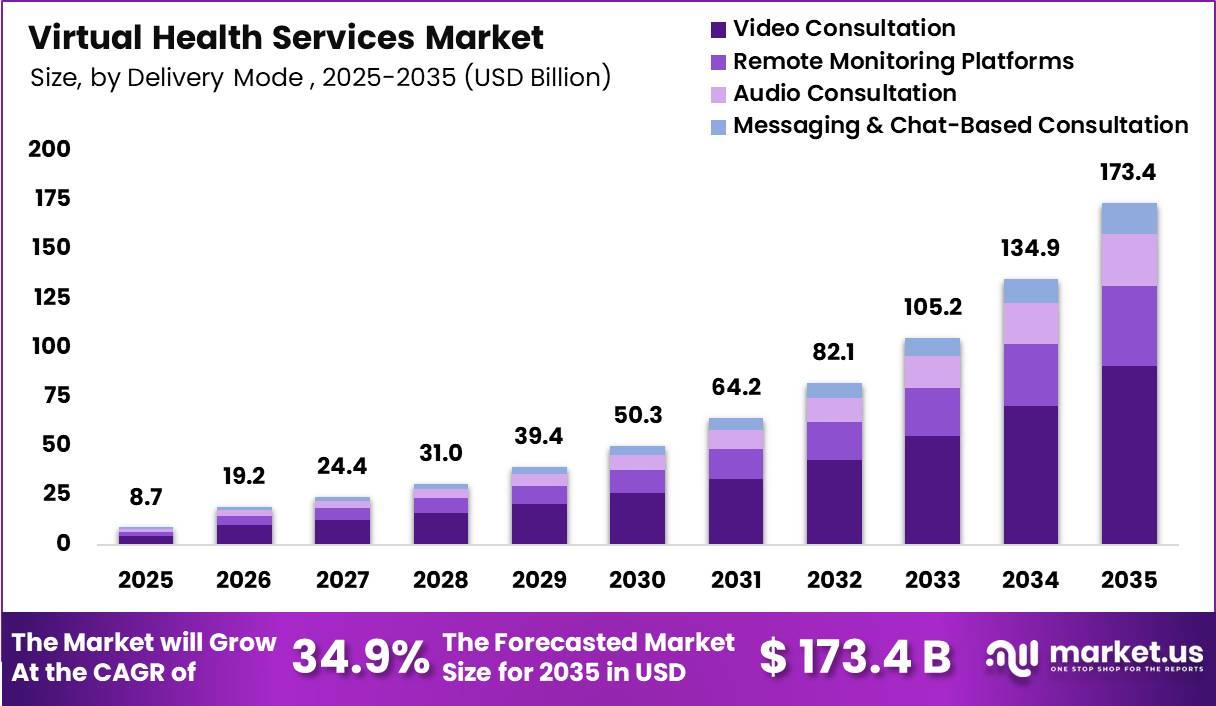
Virtual Health Service Market size is expected to be worth around US$ 173.4 Billion by 2035 from US$ 8.7 Billion in 2025, growing at a CAGR of 34.9% during the forecast period from 2026 to 2035. In 2025, North America led the market, achieving over 41.5% share with a revenue of US$ 3.61 Billion.
The global Virtual Health Service Market is experiencing rapid transformation as healthcare providers increasingly integrate telemedicine, remote patient monitoring, digital therapeutics, and virtual consultations into routine clinical practice. Rising demand for convenient healthcare access, growing adoption of connected medical devices, and continued investments in digital health infrastructure are accelerating the shift toward virtual care models.
Governments and healthcare organizations are also expanding reimbursement policies and interoperability standards, enabling broader adoption of digital healthcare services across hospitals, clinics, and home-care settings. According to the World Health Organization (WHO), digital health technologies have significant potential to improve healthcare accessibility, strengthen health systems, and support universal health coverage through secure and interoperable digital solutions.
Trusted healthcare organizations continue to report growing use of virtual care worldwide. The OECD noted that remote consultations across its member countries increased from an average of 0.5 teleconsultations per patient in 2019 to 1.3 in 2021, before stabilizing at 1.0 consultation per patient in 2023, demonstrating that virtual healthcare remains well above pre-pandemic levels.
Additionally, OECD data shows that the average availability of online digital health services reached 82% in 2024, reflecting continued investment in electronic health records, patient portals, and digital care platforms. These developments are expected to strengthen care coordination, improve patient engagement, and expand healthcare access in underserved and rural communities, supporting long-term growth of virtual health services worldwide.
Key Takeaways
- The Global Virtual Health Service Market is projected to grow from US$ 8.7 Billion in 2025 to approximately US$ 173.4 Billion by 2035.
- The market is anticipated to expand at a robust CAGR of 34.9% during the forecast period from 2026 to 2035.
- By service type, the Teleconsultation Services segment emerged as the leading category, accounting for 42.3% of the global market share in 2025.
- Based on delivery mode, the Video Consultation segment held the dominant position with a 52.3% market share in 2025.
- In terms of application, the Chronic Disease Management segment led the market, capturing 29.1% of the total market share in 2025.
- Regionally, North America maintained its leading position in 2025, securing a 41.5% market share and generating US$ 3.61 Billion in revenue.
Statistical Information
- 25% of Medicare Fee-for-Service beneficiaries used at least one telehealth service in 2024, showing that virtual healthcare has remained an established part of healthcare delivery beyond the pandemic period.
- More than 20% of U.S. adults reported having a telehealth visit in July 2022, reflecting strong consumer acceptance of remote healthcare consultations and digital care access.
- Telehealth usage increased 63-fold among Medicare Fee-for-Service beneficiaries in 2020, highlighting the rapid transition toward virtual healthcare platforms and remote care models.
- 95% of HRSA-funded health centers used telehealth to provide primary care services in 2024, demonstrating widespread provider adoption of virtual healthcare technologies across community healthcare systems.
- HRSA-funded health centers served 32.4 million patients in 2024 across nearly 1,400 health centers, creating a large patient base supported by digital healthcare access programs and telehealth-enabled services.
- Among U.S. adults diagnosed with diabetes, 39.4% used telemedicine services in 2022, indicating strong demand for virtual care solutions supporting chronic disease monitoring and follow-up management.
- In 2024, 98.73% of HRSA-funded health centers using telehealth reported using real-time telehealth technologies such as live video conferencing, confirming video consultation as a major delivery method for virtual healthcare services.
- Remote patient monitoring was used by 32.19% of HRSA-funded health centers implementing telehealth in 2024, showing increasing adoption of connected care tools for continuous patient monitoring and chronic condition management.
Regional Analysis
North America held the leading position in the Virtual Health Services Market in 2025, capturing more than 41.5% of the global market and generating US$ 3.61 billion in revenue. The region’s dominance is supported by a highly developed healthcare ecosystem, widespread broadband connectivity, advanced electronic health record (EHR) adoption, and strong investments in digital health technologies.
The United States continues to drive regional growth through the rapid integration of telemedicine, remote patient monitoring, artificial intelligence, and cloud-based healthcare platforms. According to the OECD, telemedicine has become a permanent component of healthcare delivery across member countries, with remote consultations remaining significantly above pre-pandemic levels as health systems continue integrating virtual care into routine clinical practice.
The World Health Organization (WHO) also highlights digital health as a strategic priority for improving healthcare access, interoperability, and patient-centered services worldwide. Canada further strengthens the regional market through government-supported digital health initiatives and continued investments in virtual care for rural and underserved populations.
In addition, increasing demand for chronic disease management, an aging population, favorable reimbursement policies, and ongoing improvements in cybersecurity and health data interoperability are expected to sustain North America’s leadership in the Virtual Health Services Market over the forecast period.
Emerging Trends
- AI Integration in Virtual Healthcare Platforms: Artificial intelligence is becoming a major trend in virtual health services by supporting automated patient interactions, clinical decision assistance, symptom assessment, and personalized care recommendations. WHO identifies artificial intelligence, interoperability, and digital innovation as important priorities for strengthening modern healthcare systems and improving healthcare delivery efficiency.
- Growth of Hybrid Healthcare Delivery Models: Healthcare systems are increasingly combining virtual consultations with physical visits to create flexible care pathways. This approach improves patient convenience while maintaining clinical quality. Federal telehealth data shows that Medicare fee-for-service users accessed telehealth services in 2024, demonstrating continued adoption of digital care models.
- Expansion of Interoperable Digital Health Platforms: Virtual healthcare providers are focusing on connecting telehealth applications with electronic health records, patient portals, and health information systems. WHO emphasizes standardized data exchange and interoperability as essential components for scaling digital health solutions globally.
- Increasing Adoption of Remote Patient Monitoring Technologies: Healthcare organizations are moving beyond video consultations by integrating wearable devices, connected sensors, and home monitoring tools. These technologies support continuous tracking of vital signs and help physicians manage chronic conditions remotely through real-time health data.
- Rise of Virtual Specialty Care Services: Virtual healthcare is expanding into specialty areas including dermatology, mental health, rehabilitation, chronic disease management, and post-surgical follow-up. Government healthcare resources highlight telehealth applications across multiple specialties, enabling patients to access expert care without frequent hospital visits.
Use Cases
- Chronic Disease Monitoring and Management: Virtual health services are increasingly used for diabetes, cardiovascular diseases, respiratory disorders, and hypertension management. Remote monitoring tools allow healthcare professionals to track patient conditions continuously, adjust treatments, and reduce unnecessary clinical visits through digital follow-up programs.
- Virtual Mental Healthcare and Behavioral Support: Telehealth platforms are becoming widely used for psychological counseling, psychiatric consultations, addiction support, and behavioral health services. Remote mental healthcare improves access for patients facing transportation challenges, provider shortages, or limited availability of local specialists.
- Post-Discharge and Post-Surgical Follow-Up Care: Hospitals are using virtual visits to monitor patients after procedures, review recovery progress, manage medications, and identify complications early. Telehealth enables healthcare teams to maintain continuity of care while reducing avoidable hospital readmissions.
- Remote Diagnostics and Clinical Assessment: Virtual care platforms are increasingly supporting diagnostic activities such as reviewing laboratory results, imaging reports, skin evaluations, and symptom assessments. These services allow healthcare professionals to provide faster medical guidance while improving accessibility for remote populations.
- Virtual Primary Care Access for Underserved Communities: Telehealth is being used to improve healthcare availability in rural and underserved areas by connecting patients with physicians through digital platforms. WHO highlights telemedicine as a tool for expanding equitable healthcare access and strengthening healthcare system resilience.
Frequently Asked Questions About Virtual Health Service
- How does Virtual Health Services work?
Virtual Health Services use internet-based platforms, smartphones, computers, and healthcare applications to connect patients with providers. Patients can schedule appointments, share health information, receive medical advice, monitor conditions, and access follow-up consultations without requiring frequent physical healthcare visits. - What are the major types of Virtual Health Services?
Major virtual healthcare services include teleconsultation, video visits, remote patient monitoring, digital behavioral health services, online specialist consultations, medication management, and virtual follow-up care. These solutions support multiple healthcare needs, from primary care access to chronic disease management. - What factors are driving the growth of the Virtual Health Services Market?
The Virtual Health Services Market is expanding due to increasing demand for convenient healthcare access, rising digital health adoption, improved internet connectivity, healthcare workforce challenges, and greater focus on remote monitoring. Government healthcare programs continue supporting digital transformation initiatives worldwide. - Why are video consultations important in Virtual Health Services?
Video consultations provide real-time communication between patients and healthcare professionals, allowing doctors to evaluate symptoms, discuss treatment options, and provide follow-up care remotely. They improve convenience and reduce travel barriers while maintaining direct interaction between providers and patients. - How are Virtual Health Services used for chronic disease management?
Virtual Health Services help manage chronic conditions such as diabetes, cardiovascular diseases, and respiratory disorders through remote monitoring, digital tracking tools, and regular virtual consultations. Healthcare providers can analyze patient data, adjust treatments, and improve long-term care outcomes. - How does Virtual Health Services improve healthcare accessibility?
Virtual Health Services reduce geographic and mobility barriers by connecting patients with healthcare professionals remotely. They are particularly useful for rural communities, elderly individuals, and patients requiring frequent follow-ups, helping improve healthcare availability and continuity of care. - What is the future outlook of the Virtual Health Services Market?
The future of the Virtual Health Services Market will focus on AI-enabled platforms, hybrid healthcare models, remote patient monitoring, wearable technologies, and interoperable digital systems. Continued investment in digital health infrastructure is expected to strengthen virtual care adoption globally.
Conclusion
The Virtual Health Service Market is entering a transformative phase as healthcare systems worldwide adopt digital solutions to improve accessibility, efficiency, and patient outcomes. The increasing use of teleconsultations, video-based care, remote monitoring, AI-powered platforms, and interoperable health technologies is reshaping traditional healthcare delivery models.
Government initiatives and healthcare organizations continue to support digital transformation by promoting secure data exchange, technology adoption, and patient-centered care. With growing demand for convenient healthcare access, chronic disease management, and virtual specialty services, virtual health solutions are expected to become an essential component of modern healthcare ecosystems globally.




















