


Overview
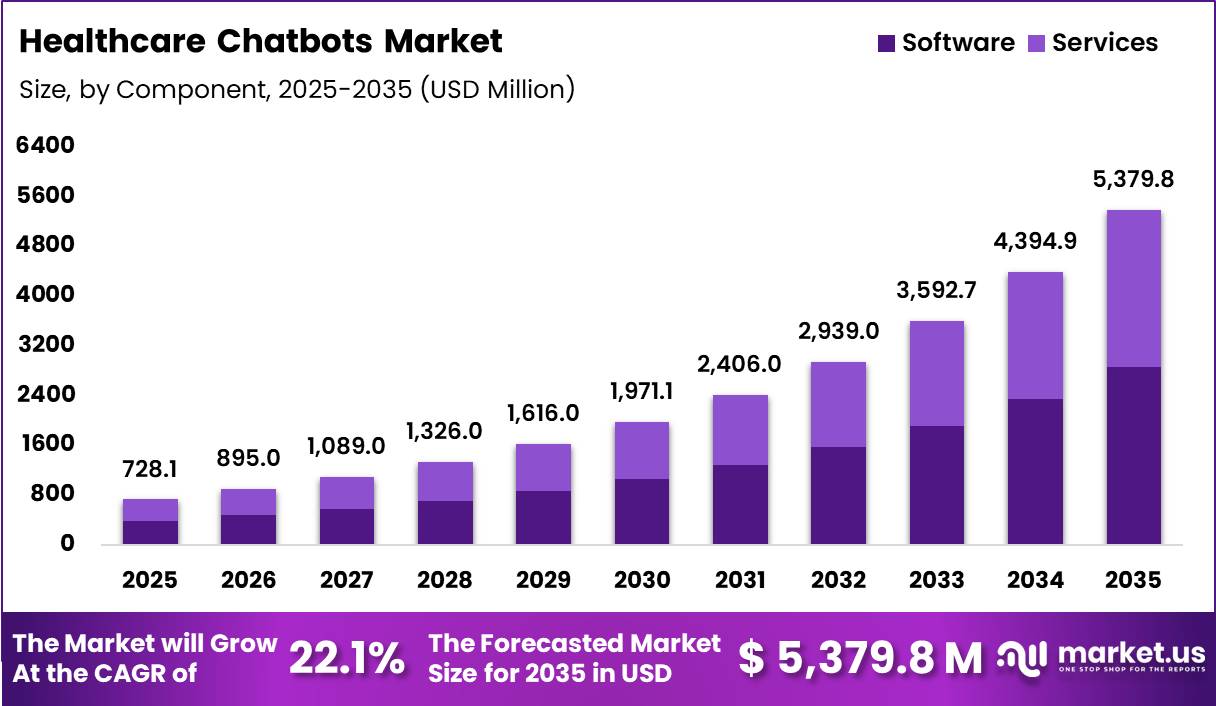
Global Healthcare Chatbots Market size is expected to be worth around US$ 5,379.8 Million by 2035 from US$ 728.1 Million in 2025, growing at a CAGR of 22.1% during the forecast period from 2026 to 2035. In 2025, North America led the market, achieving over 45.3% share with a revenue of US$ 329.8 Million.
The global Healthcare Chatbots market is gaining momentum as healthcare providers increasingly adopt artificial intelligence to improve patient communication, automate administrative tasks, and expand access to health information. Growing demand for 24/7 virtual assistance, appointment scheduling, medication reminders, symptom assessment, and post-treatment follow-ups is encouraging hospitals and healthcare organizations to integrate chatbot platforms into their digital health strategies.
Governments and public health organizations are also promoting responsible digital health adoption to improve healthcare accessibility and operational efficiency. According to the World Health Organization (WHO), digital health technologies play a critical role in strengthening healthcare systems through better data sharing, informed decision-making, and improved patient engagement.
Healthcare chatbots are evolving beyond basic customer support by leveraging natural language processing and generative AI to deliver more personalized interactions while assisting clinicians with routine administrative workloads.
The WHO Health Alert chatbot demonstrated the large-scale potential of conversational AI by reaching more than 13.5 million WhatsApp users with trusted health information, highlighting the growing acceptance of chatbot-based healthcare communication. Additionally, the WHO notes that digital technologies are becoming increasingly important for expanding equitable access to healthcare services worldwide.
Healthcare organizations are also emphasizing safe and responsible AI deployment by maintaining human oversight, protecting patient privacy, and ensuring compliance with healthcare regulations. As interoperability standards improve and digital transformation accelerates across hospitals and clinics, healthcare chatbots are expected to become an essential component of patient engagement, chronic disease management, and virtual care delivery, supporting more efficient healthcare systems while enhancing patient experiences.
Key Takeaways
- Market Size: The Global Healthcare Chatbots Market is projected to reach approximately US$ 5,379.8 Million by 2035, rising from US$ 728.1 Million in 2025.
- Market Growth: The Healthcare Chatbots Market is expected to expand at a CAGR of 22.1% during the forecast period from 2026 to 2035.
- Component Analysis: The Software segment leads the Healthcare Chatbots Market by component, accounting for 53.3% of the global market share in 2025.
- Deployment Model Analysis: The Cloud-Based segment held the dominant position in the Healthcare Chatbots Market, capturing 64.8% of total revenue in 2025.
- Application Analysis: The Symptom Checking segment emerged as the leading application area, representing 29.7% of the market share in 2025.
- End-Use Analysis: The Healthcare Providers segment dominated the end-use category, accounting for 34.8% of the market share in 2025.
- Regional Analysis: North America led the Healthcare Chatbots Market in 2025, securing 45.3% of the market share with revenue of US$ 329.8 Million.
Statistical Information
- The U.S. FDA has authorized more than 1,200 AI-enabled medical devices, reflecting the increasing adoption of artificial intelligence technologies across healthcare applications, including clinical decision support and patient-care solutions.
- WHO’s Global Digital Health Monitor analyzed digital health maturity across 58 countries in 2023, with the global average reaching Phase 3 digital maturity, indicating that many healthcare systems have established digital health strategies and implementation frameworks.
- Cigna Healthcare’s AI-based healthcare programs are projected to save approximately US$200 million in medical costs over three years by improving early identification of high-risk patients and supporting proactive care management.
- Cigna reported that AI-supported healthcare programs could improve clinical access by around 20% for patients managing complex conditions such as cancer, cardiovascular disease, and kidney disease.
- Cigna’s AI healthcare initiatives are designed to connect patients with more than 1,250 clinicians, showing increasing integration of AI platforms with healthcare provider networks.
- FDA-authorized AI healthcare technologies have expanded across multiple specialties, with radiology representing the largest adoption area. Available analyses of FDA-cleared AI/ML devices show radiology accounted for more than 1,100 authorized devices, followed by cardiovascular applications with more than 140 devices.
- The WHO digital health framework emphasizes AI governance, safety, and responsible implementation across healthcare systems, with digital health maturity assessments covering areas such as AI planning, data security, interoperability, and workforce training.
- Healthcare AI adoption is accelerating among government healthcare organizations, with the U.S. Department of Health and Human Services (HHS) targeting a 70% increase in AI deployment from 2024 to 2025 as part of its modernization strategy.
Regional Analysis
North America dominated the Healthcare Chatbots Market in 2025, driven by advanced digital healthcare infrastructure, strong AI adoption, and increasing use of virtual healthcare solutions across hospitals, insurers, and telehealth providers. The region benefits from high healthcare technology investment, improved patient engagement strategies, and growing demand for automated healthcare assistance. WHO highlights that digital health technologies and artificial intelligence can support improved healthcare delivery, decision-making, and system efficiency.
Europe is witnessing steady growth due to digital transformation initiatives, healthcare modernization programs, and rising adoption of AI-based patient support tools. Asia-Pacific is emerging rapidly with expanding telemedicine services, increasing smartphone penetration, and government-led digital health initiatives. Latin America and the Middle East & Africa are gradually adopting healthcare chatbot solutions as healthcare systems improve infrastructure and embrace digital care models.
Emerging Trends
- AI-Powered Patient Engagement Platforms: Healthcare chatbots are evolving into advanced digital assistants that help patients access healthcare information, receive guidance, and improve communication with providers. WHO Europe reported that 63% of EU Member States use chatbots for patient engagement, showing increasing adoption of conversational AI in healthcare systems.
- Responsible AI and Healthcare Governance: As chatbot adoption increases, healthcare organizations are focusing on AI safety, transparency, and ethical implementation. WHO Europe found that 81% of EU Member States are involving stakeholders in AI governance, highlighting the importance of trusted AI deployment in healthcare.
- Integration with Digital Health Ecosystems: Healthcare chatbots are increasingly being connected with patient portals, personal health records, and digital healthcare platforms. CMS launched a HealthTech ecosystem initiative where more than 700 organizations pledged support for digital healthcare modernization, including patient-facing AI applications.
- Cloud-Based and Remote Care Expansion: The growth of digital health services is increasing demand for scalable chatbot solutions that support remote communication, follow-ups, and health education. WHO and ITU reported that investing US$0.24 per patient annually in digital health interventions such as chatbots and telemedicine could help save more than 2 million lives over a decade.
- Personalized AI Health Assistants: Healthcare chatbots are shifting from basic question-answer tools toward personalized assistants that provide tailored guidance based on patient needs. Research analyzing more than 500,000 health-related AI conversations found that nearly 1 in 5 conversations involved personal symptom assessment or condition discussions.
Use Cases
- Symptom Checking and Care Navigation: Chatbots are increasingly used to help patients evaluate symptoms, understand possible health concerns, and identify appropriate care pathways. Large-scale AI interaction studies show growing use of conversational systems for symptom-related discussions, healthcare navigation, and self-management support.
- Appointment Scheduling and Administrative Support: Healthcare providers are deploying conversational AI assistants to automate routine tasks such as appointment preparation, patient inquiries, and healthcare navigation. CMS highlights patient-facing AI assistants as tools designed to provide personalized support while connecting users with healthcare services when required.
- Chronic Disease Management: Chatbots are being used for continuous patient engagement in conditions requiring regular monitoring, reminders, and education. AI-supported healthcare programs are helping organizations identify high-risk patients earlier and improve connections between patients and clinical teams.
- Health Information and Patient Education: Consumers are increasingly using AI chatbots to obtain healthcare information quickly. A Pew Research survey found that 22% of U.S. adults use AI chatbots for health information at least sometimes, with usage highest among younger adults.
- Virtual Healthcare Support and After-Hours Assistance: Chatbots are filling gaps in healthcare accessibility by providing support outside traditional clinical hours. AI health conversation analysis showed that personal health queries increased during evening and nighttime periods when conventional healthcare access is more limited.
Frequently Asked Questions About Healthcare Chatbots
- What are the major applications of healthcare chatbots?
Healthcare chatbots are mainly used for symptom checking, appointment management, medication reminders, patient education, health monitoring, and care navigation. They also support healthcare providers by automating repetitive communication tasks and improving patient service efficiency. - Can healthcare chatbots diagnose diseases?
Healthcare chatbots can provide general health information and support symptom assessment, but they are not designed to replace professional medical diagnosis. Healthcare organizations recommend using AI tools as supportive systems while maintaining clinical oversight for medical decisions. - Why are healthcare providers adopting chatbots?
Healthcare providers are adopting chatbots to improve patient communication, reduce administrative workload, provide 24/7 assistance, and support digital healthcare delivery. These tools help organizations manage increasing demand for faster and more accessible healthcare interactions. - What role does AI play in healthcare chatbots?
Artificial intelligence enables healthcare chatbots to understand complex questions, personalize responses, and improve interaction quality. AI technologies are increasingly used in healthcare for decision support, patient communication, clinical assistance, and health system management. - What factors are driving the growth of the Healthcare Chatbots Market?
The Healthcare Chatbots Market is expanding due to increasing digital health adoption, rising demand for virtual care solutions, growing AI integration, and the need for efficient patient engagement platforms across healthcare systems worldwide. - How will healthcare chatbots impact the future of healthcare?
Healthcare chatbots are expected to support more personalized, accessible, and efficient healthcare services by improving patient communication and digital care delivery. Their future growth will depend on safe AI integration, interoperability, and collaboration between technology providers and healthcare professionals. - What is the importance of cloud-based healthcare chatbots?
Cloud-based healthcare chatbots allow healthcare organizations to scale digital services, manage large volumes of patient interactions, and integrate chatbot solutions with healthcare platforms. They support flexible deployment, remote accessibility, and continuous improvement of digital health services.
Conclusion
The Healthcare Chatbots Market is entering a significant growth phase as artificial intelligence, cloud-based platforms, and digital health solutions transform patient engagement and healthcare delivery. Increasing adoption of virtual assistants, symptom assessment tools, and automated healthcare communication is helping providers improve accessibility and operational efficiency. Responsible AI development, data security, and regulatory compliance will remain critical for long-term adoption.
With healthcare organizations worldwide focusing on personalized care, remote support, and digital transformation, chatbots are expected to become an important component of future healthcare ecosystems, enhancing patient experiences while supporting healthcare professionals.




















