



Overview
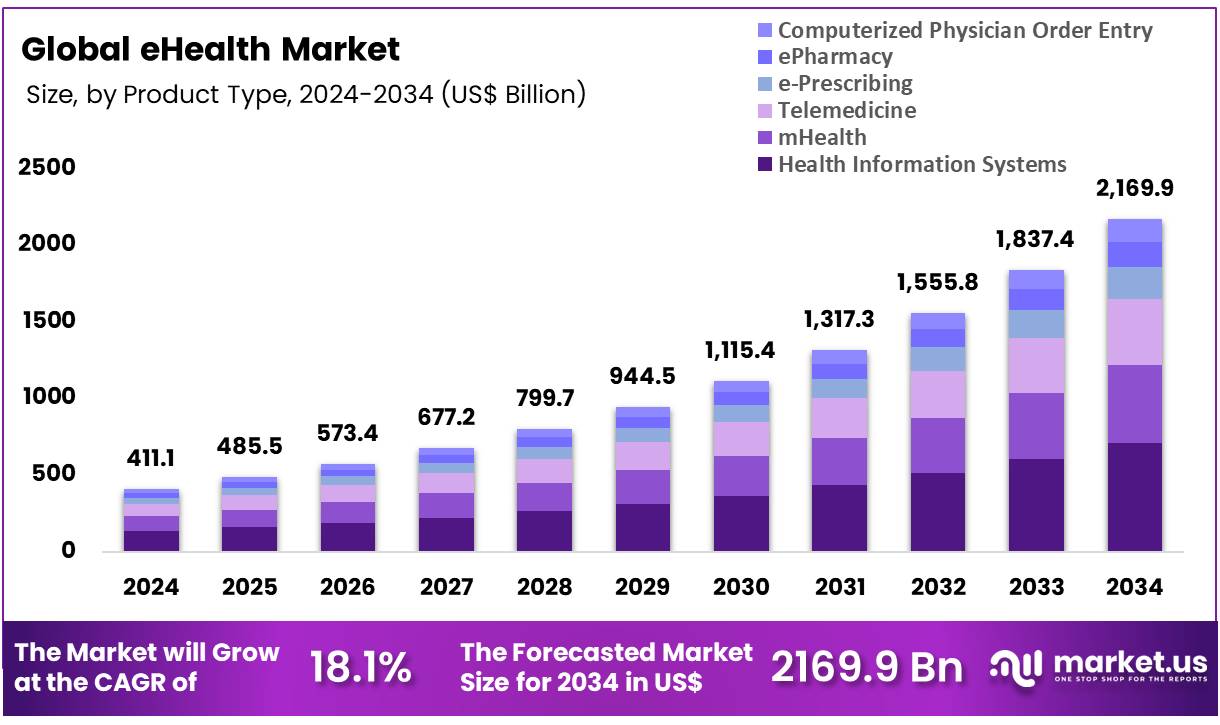
Global eHealth Market size is expected to be worth around US$ 2169.9 Billion by 2034 from US$ 411.1 Billion in 2024, growing at a CAGR of 18.1% during the forecast period 2025 to 2034. In 2024, North America led the market, achieving over 39.9% share with a revenue of US$ 164.0 Billion.
Digital health technologies such as electronic health records (EHRs), telemedicine, mobile health applications, remote patient monitoring, and healthcare analytics are becoming important tools for modern healthcare delivery. The World Health Organization (WHO) recognizes digital health as a key approach for improving healthcare access, strengthening health systems, and supporting better patient outcomes through technology-enabled solutions.
Governments worldwide are focusing on digital healthcare infrastructure, interoperability, and secure health information exchange. According to WHO, 129 countries have established national digital health strategies, highlighting global efforts to accelerate digital transformation in healthcare systems.
The increasing adoption of artificial intelligence, cloud-based healthcare platforms, connected devices, and data-driven healthcare models is creating new opportunities for healthcare organizations. These technologies support faster clinical decisions, personalized treatment approaches, and improved disease management. With rising demand for accessible healthcare services and continuous innovation in digital technologies, eHealth solutions are expected to become a central part of future healthcare ecosystems, enabling more connected, efficient, and patient-focused care worldwide.
Key Takeaways
- In 2024, the market for eHealth generated a revenue of US$ 411.1 Billion, with a CAGR of 18.1%, and is expected to reach US$ 2169.9 Billion by the year 2034.
- The product type segment is divided into health information systems, mhealth, telemedicine, e-prescribing, epharmacy, and computerized physician order entry, with health information systems taking the lead in 2023 with a market share of 32.8%.
- Considering end-user, the market is divided into providers, payers, and patients. Among these, providers held a significant share of 58.1%.
- North America led the market by securing a market share of 39.9% in 2023.
Statistical Information
- 91% of Medicare beneficiaries living in communities had internet access in 2024, creating a strong digital foundation for adoption of eHealth services such as telemedicine, patient portals, and online healthcare platforms.
- 51% of Medicare beneficiaries used the internet daily in 2024, showing increasing digital engagement among older populations, which supports greater acceptance of virtual healthcare solutions and digital health tools.
- 65% of Medicare beneficiaries used the internet to search for health information in 2024, highlighting a major shift toward digital channels for healthcare awareness, decision-making, and patient education.
- 33% of Medicare beneficiaries used the internet to fill prescriptions in 2024, indicating rising consumer adoption of online healthcare transactions and connected pharmacy services.
- Medicare telehealth utilization increased significantly during the COVID-19 period, with HHS analysis showing continued adoption of virtual care services among Medicare beneficiaries across different demographic groups and healthcare specialties.
- Medicare telehealth data tracked millions of virtual healthcare interactions between 2019 and 2021, demonstrating that telehealth became an established component of healthcare delivery rather than only a temporary solution.
- 129 countries have developed national digital health strategies according to WHO, showing global government commitment toward digital healthcare infrastructure, interoperability, and technology-enabled care systems.
- HHS continues maintaining dedicated telehealth policy frameworks and Medicare telehealth service lists, reflecting ongoing government support for virtual healthcare access and long-term digital healthcare integration
Regional Analysis
North America Leads the eHealth Market
North America maintained a leading position in the global eHealth market, supported by advanced healthcare infrastructure, widespread digital adoption, and strong government initiatives promoting virtual care. In 2024, the region accounted for 39.9% of the global market.
The U.S. government has actively supported telehealth expansion through policies led by agencies such as the Department of Health and Human Services (HHS), improving access to remote healthcare services. Continued adoption of telemedicine, electronic health records, and remote patient monitoring is strengthening the region’s digital healthcare ecosystem.
Asia Pacific Shows Strong Growth Potential
Asia Pacific is expected to witness the fastest growth during the forecast period due to expanding digital infrastructure, rising healthcare demand, and government-backed digital health programs. Countries including India and China are investing in technology-enabled healthcare systems to improve accessibility and disease management.
The World Health Organization highlights that digital health tools can support healthcare delivery, especially for managing noncommunicable diseases and improving access to care across diverse populations. Initiatives focused on digital health platforms, AI, and connected healthcare solutions are expected to accelerate regional eHealth adoption.
Emerging Trends
- Artificial Intelligence (AI) Integration in Healthcare: AI is becoming a major eHealth trend for clinical decision support, medical imaging, workflow automation, and predictive healthcare. The FDA maintains an AI-enabled medical device database to improve transparency, with AI-based technologies continuing to expand across diagnosis and treatment applications.
- Interoperable Digital Health Systems: Healthcare systems are increasingly focusing on connected platforms that allow secure sharing of patient information between providers, applications, and devices. WHO identifies interoperability and health data exchange as key priorities for scaling digital health solutions and improving coordinated care delivery.
- AI Governance and Responsible Digital Health Adoption: Governments and healthcare organizations are developing policies to ensure safe AI implementation. WHO reported that over 1,600 government officials from more than 100 countries received digital health and AI training, supporting responsible technology adoption.
- Expansion of Digital Health Infrastructure: Countries are strengthening national digital healthcare frameworks to support electronic records, telehealth, and connected care models. WHO reported that nations have established national digital health strategies, showing increasing government commitment toward technology-enabled healthcare systems.
- AI-Enabled Medical Devices and Software Solutions: Digital health innovation is moving beyond traditional telemedicine toward advanced software-based medical technologies. The FDA continues updating digital health guidance covering AI-enabled devices, remote data acquisition technologies, and cybersecurity considerations for healthcare software.
Use Cases
- Remote Patient Monitoring for Chronic Disease Management: eHealth platforms are increasingly used to monitor patient conditions outside hospitals through connected devices, sensors, and digital applications. These tools help healthcare providers track health changes earlier and support continuous care models. WHO recognizes remote monitoring as an important digital health application.
- AI-Assisted Clinical Decision Support: Healthcare professionals are using AI-based tools to analyze medical information, support diagnosis, and improve treatment decisions. FDA-authorized AI medical technologies are designed to assist clinicians while meeting safety and effectiveness requirements before market use.
- Digital Health Certification and Health Data Exchange: Cross-border digital health systems are emerging to improve secure healthcare information sharing. WHO reported that the Global Digital Health Certification Network has supported digital health infrastructure benefiting 1.8 billion people across 80 countries.
- Mobile Health Applications for Patient Engagement: Mobile health solutions are being used for wellness tracking, medication support, health education, and disease management. FDA recognizes mobile health applications, wearable devices, and digital platforms as important components of the broader digital health ecosystem.
- AI-Based Healthcare Workflow Automation: Healthcare organizations are applying AI tools to improve administrative efficiency, data analysis, and clinical workflows. WHO highlights that digital technologies can support better healthcare planning, evidence-based decisions, and improved healthcare system performance.
Frequently Asked Questions About eHealth
- How does eHealth improve healthcare delivery?
eHealth improves healthcare delivery by enabling faster access to medical information, supporting remote consultations, improving communication between healthcare providers and patients, and helping organizations deliver more efficient, coordinated, and patient-centered healthcare services. - What are the major components of the eHealth market?
The eHealth market includes telemedicine, electronic health records (EHRs), mobile health (mHealth), remote patient monitoring, healthcare information systems, digital therapeutics, and healthcare analytics solutions that connect patients, providers, and healthcare organizations. - Why is the eHealth market growing globally?
The eHealth market is growing due to increasing adoption of digital healthcare technologies, rising demand for convenient healthcare access, improved internet connectivity, healthcare data availability, and government initiatives focused on strengthening digital health infrastructure. - What role does telemedicine play in eHealth?
Telemedicine is a major eHealth application that allows healthcare professionals to provide consultations, diagnosis support, and follow-up care remotely. It improves healthcare accessibility, reduces geographic barriers, and supports continuous care delivery through digital communication technologies. - How is artificial intelligence transforming eHealth?
Artificial intelligence is transforming eHealth by supporting healthcare data analysis, clinical decision-making, predictive healthcare, and workflow automation. AI, along with big data and connected technologies, is becoming an important part of advanced digital healthcare systems. - What are the benefits of eHealth for patients?
eHealth helps patients access healthcare services more conveniently, communicate with healthcare providers digitally, monitor health conditions remotely, and receive personalized healthcare support. It also improves patient engagement by making health information easier to access and manage. - What challenges affect eHealth adoption?
Key challenges include healthcare data privacy concerns, cybersecurity risks, limited interoperability between systems, regulatory requirements, and unequal access to digital infrastructure. Addressing these issues is important for safe, reliable, and sustainable eHealth expansion. - What are the future trends in the eHealth market?
Future eHealth trends include artificial intelligence, wearable health devices, remote monitoring, interoperable healthcare platforms, cloud-based systems, and advanced health data analytics. These technologies are expected to improve healthcare efficiency and support more connected healthcare ecosystems.
Conclusion
The eHealth market is undergoing rapid transformation as digital technologies reshape healthcare delivery worldwide. The integration of electronic health records, telemedicine, mobile health applications, artificial intelligence, and remote monitoring solutions is improving accessibility, efficiency, and patient engagement. Government initiatives, digital health strategies, and investments in secure healthcare infrastructure are accelerating adoption across healthcare systems.
WHO emphasizes that digital health can strengthen health systems by improving access, quality, and sustainability of care. With continuous innovation in AI, interoperability, and connected healthcare platforms, eHealth is expected to become a critical foundation for future patient-centered, data-driven, and efficient healthcare ecosystems globally.




















